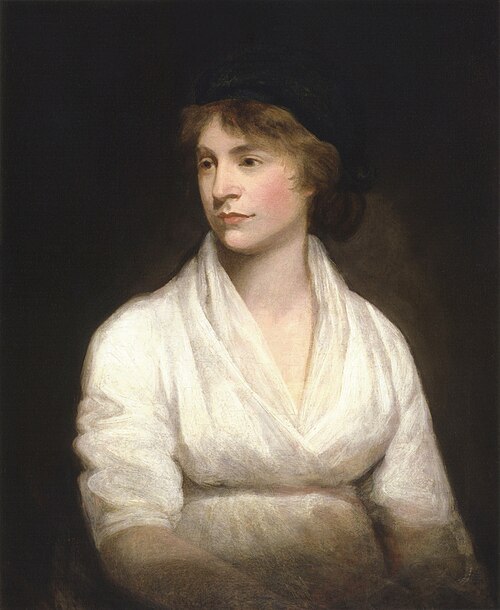
Start at the top for an easy introduction. Go further down for more detail and scholarship.
- Easy
- Intermediate
- Advanced
For young readers
Mary Wollstonecraft was born in London in 1759, more than 260 years ago. Her family often had money problems, and her father could be cruel. From a young age Mary looked after her mother and her younger sisters.
In Mary’s time, most girls were taught only to sew, dance, play music and look pretty so that they could marry. People said girls were not clever enough to learn hard subjects. Mary thought this was completely wrong.
She asked a simple question: if you never let someone go to school, how can you then say they are not smart? It is like tying up a bird’s wings and then saying birds cannot fly. Mary said girls and women can think and reason just like boys and men, if they are given the chance to learn.
Mary decided to earn her own living by writing, which very few women did then. She wrote books for children, novels, a travel book, a history of the French Revolution and, most famously, a book called A Vindication of the Rights of Woman. “Vindication” means standing up for something and showing it is right.
Mary died in 1797, when she was only 38, a few days after her second daughter was born. That daughter grew up to be Mary Shelley, who wrote the famous story Frankenstein.
For a long time people talked more about Mary’s unusual life than about her ideas. Later, people who worked for women’s right to vote and to go to university read her books again. Today she is remembered as one of the first great thinkers about equal rights for women.
At a glance
- Lived
- 27 April 1759 – 10 September 1797
- Born
- Spitalfields, London, England
- Main place of work
- London (with periods in Ireland, Paris and Le Havre, and a journey through Scandinavia)
- Role
- Writer, translator, reviewer, educator and political philosopher
- Best-known work
- A Vindication of the Rights of Woman (1792)
- Other major works
- Thoughts on the Education of Daughters (1787), A Vindication of the Rights of Men (1790), An Historical and Moral View of the French Revolution (1794), Letters Written in Sweden, Norway, and Denmark (1796), Maria: or, The Wrongs of Woman (unfinished, 1798)
- Family
- Married the philosopher William Godwin in 1797; mother of Fanny Imlay and of Mary Shelley, author of Frankenstein
- Era
- The late Enlightenment and the age of the French Revolution
Easy
Who was Mary Wollstonecraft?
Mary Wollstonecraft (1759–1797) was an English writer and philosopher best known for arguing that women deserve the same basic rights and the same kind of education as men. Her most famous book, A Vindication of the Rights of Woman, appeared in London in 1792. In it she claimed that women were not naturally weaker in mind than men; they only appeared so because society kept them uneducated and trained them to care about beauty and pleasing others.
She lived during one of the most dramatic periods in European history. The American colonies had just won independence, and in 1789 the French Revolution began to overturn the old order of kings and nobles. People everywhere were arguing about the “rights of man.” Wollstonecraft asked a pointed question: if these rights come from reason and from God, why should they belong only to men?
In a very short career of about ten years she wrote in many forms: a guide to educating girls, a children’s book, two novels, political pamphlets, a history of the French Revolution and a travel book. She also translated books from French and German and reviewed new books for a London magazine. Today she is regarded as one of the founding figures of feminist philosophy, although the word “feminist” did not exist in her lifetime.
Easy
A hard childhood and early independence
Mary was born on 27 April 1759 in Spitalfields, London, the second of seven children. Her family was comfortable at first, but her father, Edward John Wollstonecraft, wasted the money on failed schemes, and the family kept moving from place to place. He was also violent when drunk; as a teenager Mary is said to have slept outside her mother’s bedroom door to protect her. She took on a motherly role for her younger sisters, Everina and Eliza, that lasted her whole life.
Two friendships shaped her early years. In Beverley, in Yorkshire, she read books and attended science lectures with her friend Jane Arden. In London she met Fanny Blood, a young woman she admired deeply and later said had opened her mind. In 1784 Mary helped her sister Eliza, who was probably suffering from depression after giving birth, to leave an unhappy marriage—a bold step at a time when a wife who left her husband faced disgrace and poverty.
Mary had very few ways to earn money. The jobs open to a respectable but poor woman were lady’s companion, governess or schoolteacher, and she tried them all. With her sisters and Fanny Blood she set up a school at Newington Green, a village north of London where many religious Dissenters lived. When Fanny married and moved to Lisbon, Mary travelled there in 1785 to nurse her through a difficult pregnancy, but Fanny died. The school failed while Mary was away.
Easy
“The first of a new genus”: becoming a writer
After Fanny’s death, Mary worked for about a year as governess to the daughters of the Kingsborough family, wealthy Anglo-Irish landowners in Ireland. She did not get along with Lady Kingsborough, but the girls loved her; one of them, Margaret King, later said Mary had freed her mind from superstition. Her experiences there went into her children’s book, Original Stories from Real Life (1788).
In 1787 she made a daring decision: she would support herself by writing. Very few women could live from their pens at that time. She wrote to her sister that she was trying to become “the first of a new genus”—a new kind of creature. In London the publisher Joseph Johnson, a supporter of liberal and radical causes, helped her find a place to live and gave her steady work. She translated books, compiled a reading book for young women and wrote reviews, mostly of novels, for Johnson’s magazine, the Analytical Review.
At Johnson’s famous dinners she met some of the boldest thinkers of the day, including the pamphleteer Thomas Paine and the philosopher William Godwin, who would later become her husband. At their first meeting Godwin was annoyed: he had come to hear Paine, but Mary argued with him all evening. Johnson himself became a close friend whom she described as like a father and a brother.
Easy
Two Vindications: the rights of men and of woman
In November 1790 the politician Edmund Burke published Reflections on the Revolution in France, which defended monarchy, the nobility and tradition, and attacked the English supporters of the Revolution—among them Richard Price, a minister Mary knew from Newington Green. Mary was so angry that she wrote a reply in less than a month. A Vindication of the Rights of Men appeared on 29 November 1790, first without her name and then, in a second edition, with it. It was the first of many replies in what became known as the Revolution Controversy, and it made her famous.
Her next book went further. In 1791 the French statesman Talleyrand presented a plan for national education to the French Assembly, proposing that girls should be educated only at home for domestic life. Wollstonecraft answered with A Vindication of the Rights of Woman (1792), which she dedicated to Talleyrand, asking him to reconsider. She argued that women must be educated to use their reason so that they could be true companions to their husbands, wise mothers to their children and good citizens.
One of her most famous images describes what a bad education does to girls: taught from infancy that beauty is their sceptre, the mind shapes itself to the body and, roaming round its gilt cage, only seeks to adorn its prison. The book was, contrary to a common belief, generally well received when it first appeared. Only later, after details of her private life became public, did her reputation suffer.
Intermediate
Revolution, love and grief: France, Scandinavia and London
In December 1792 Wollstonecraft went to Paris to see the Revolution for herself, arriving about a month before King Louis XVI was executed. She mixed with the moderate Girondins and with other British visitors such as Helen Maria Williams. After France declared war on Britain in February 1793, life became dangerous for British subjects, and when the Jacobins took power and began the Reign of Terror, several of her friends were guillotined. To protect her, her lover, the American adventurer Gilbert Imlay, registered her at the United States embassy as his wife, although they were not married.
In May 1794, at Le Havre, she gave birth to her first daughter, Fanny, named after her dead friend. In the same year she published An Historical and Moral View of the French Revolution, which tried to explain the Revolution as a result of social, economic and political conditions rather than the madness of a whole nation. Imlay, however, drifted away. Back in London in 1795 she attempted suicide. She then travelled with her baby and a maid through Sweden, Norway and Denmark on business for Imlay; her letters from this journey became Letters Written in Sweden, Norway, and Denmark (1796), her most popular book in her own lifetime. On her return she made a second suicide attempt, jumping into the Thames, and was rescued.
Slowly she returned to writing and to Johnson’s circle, and a friendship with William Godwin grew into love. When she became pregnant they married on 29 March 1797, although both had criticised marriage as an institution. They lived in Somers Town, London, with Godwin keeping a separate study nearby so that each could stay independent. On 30 August 1797 she gave birth to a daughter, Mary. The placenta had not come away completely, infection followed, and Wollstonecraft died of septicaemia on 10 September 1797, aged 38. She was buried at St Pancras Old Church in London.
Intermediate
Her ideas: reason, virtue and independence
At the heart of Wollstonecraft’s thought is the idea that every human being is a rational and moral creature made by God, and that the purpose of life is to grow in virtue. Virtue, for her, has “only one eternal standard.” If that is so, there cannot be one kind of goodness for men and another for women. Women should not be trained merely to be gentle, charming and obedient; like men, they must develop understanding, self-control and independence of mind. This also meant that men should be held to the same moral standards as women, which exposed the sexual double standard of her age.
She did not think reason should crush feeling. The philosopher Sylvana Tomaselli, writing in the Stanford Encyclopedia of Philosophy, stresses that for Wollstonecraft reason, passion and appetite should work in harmony. What she attacked was a false, excessive “sensibility”—the fashionable cult of refined feelings that, she thought, left women “blown about by every momentary gust of feeling” and unable to think clearly.
Education was her main tool for change. She proposed national day schools where boys and girls would be taught together, “educated after the same model,” because men and women who will marry and raise citizens should share a common training. She also imagined that women might become doctors, study politics and run businesses. At the same time, her plan reflects the attitudes of her class: she suggested that after the age of nine poorer children, except the most gifted, should be taught separately from the rich.
Her ideal of marriage was friendship between equals rather than a union based on property or physical attraction alone. As she saw it, virtue can flourish only among equals, so a society that makes women dependent corrupts both sexes. Dependence makes women cunning and trivial, and makes men tyrants.
Intermediate
Her writings beyond the Vindications
Wollstonecraft’s early books were about education. Thoughts on the Education of Daughters (1787) is a conduct book—a guide to good behaviour—and Original Stories from Real Life (1788) is a book of moral tales for children. Both teach self-discipline, honesty and the use of reason, showing the influence of the philosopher John Locke, but they also give a strong place to religious faith and feeling.
Her two novels criticise marriage as it existed in her time. In Mary: A Fiction (1788) the heroine is forced into a loveless marriage for money. In the unfinished Maria: or, The Wrongs of Woman, published after her death in 1798, a husband locks his wife in an asylum. The friendship in that novel between the upper-class Maria and Jemima, a working-class woman who guards her, is often seen as one of the first attempts in feminist literature to suggest that women of different classes share common interests.
Letters Written in Sweden, Norway, and Denmark (1796) consists of 25 letters mixing descriptions of wild northern landscapes, observations about society and reflections on her own sorrow. It sold well, was praised by reviewers and influenced the Romantic poets William Wordsworth and Samuel Taylor Coleridge. Godwin later said that if ever a book could make a man fall in love with its author, this was that book.
Intermediate
A broken reputation and a long recovery
In January 1798 Godwin published Memoirs of the Author of A Vindication of the Rights of Woman. He meant it as a loving tribute, but he openly described her love affairs, her child born outside marriage and her suicide attempts. Many readers were shocked. The poet Robert Southey accused Godwin of stripping his dead wife naked, and satires mocked her and women like her. For almost a century her name was used as a warning rather than an inspiration, and novelists created ridiculous characters modelled on her.
Yet some readers kept her ideas alive. The poet Mary Robinson praised her in 1799. Scholars have pointed out allusions to her arguments in the novels of Jane Austen, who never named her. The American reformers Lucretia Mott and Elizabeth Cady Stanton, who met in London in 1840, found that they had both read her, and they went on to organise the Seneca Falls Convention of 1848. New editions of the Rights of Woman appeared in Britain and the United States in the mid-nineteenth century.
With the rise of the campaign for women’s votes, Wollstonecraft was reclaimed. The suffragist Millicent Garrett Fawcett wrote the introduction to a centenary edition of the Rights of Woman in 1892, presenting her as a foremother of the movement. In 1929 Virginia Woolf wrote that she was still “alive and active” among the living. From the 1970s, feminist scholarship produced many new biographies and studies, and more recently philosophers have read her as a serious moral and political thinker. A sculpture honouring her was unveiled at Newington Green in 2020.
Advanced
Liberal, republican or religious radical? Debates about her thought
Scholars disagree about which intellectual tradition Wollstonecraft belongs to. An older and still influential reading, associated with Virginia Sapiro among others, presents her as a champion of liberal values and individual rights in a line running from Locke. Others, such as Alan Coffee, Lena Halldenius and Sandrine Bergès, read her through the republican tradition, in which freedom means not being subject to anyone’s arbitrary will. On this view her central target is domination and dependence, not simply unequal legal rights, which explains why she treats marriage, property and education as political questions. Claudia L. Johnson earlier called the Rights of Woman “a republican manifesto,” linking it to the seventeenth-century Commonwealth tradition.
A third line of interpretation stresses religion. Barbara Taylor has argued that calling Wollstonecraft a feminist is anachronistic and that the image of her as a secular bourgeois liberal neglects her religious beliefs and her utopian hope for a divinely promised age of happiness. For Taylor her leading aim was that women should attain virtue, and liberation was the means to that end. More recent work, such as Emily Dumler-Winckler’s, examines how she used and sometimes subverted theological concepts to argue for women’s equality.
There is also debate over how far she really claimed equality. She insisted that virtue has one standard for both sexes and that men and women are equal before God, yet she also granted that men seem designed by Providence to reach a greater degree of virtue, and she addressed her appeal to men to “snap our chains.” It is unclear whether she thought women should have full voting rights; she suggested only that women should be represented in government. Some feminist critics, including Cora Kaplan and Mary Poovey, have argued that the Rights of Woman is deeply uneasy about female sexuality, while others respond that in her era any claim to female political independence was easily smeared as sexual licence.
Advanced
Arguing with Burke and Rousseau
Wollstonecraft’s reply to Burke was unusual because it attacked not only his politics but also his language. In his earlier treatise on the sublime and the beautiful, Burke had linked beauty with weakness and femininity, and the sublime with strength and masculinity. In the Rights of Men she turned these categories against him, arguing that his theatrical pity for Marie Antoinette turned citizens into swooning spectators and that his defence of tradition would also defend slavery, simply because it was old. Claudia Johnson considers this her first openly feminist critique. Recent scholars such as Mary Fairclough have, however, questioned the simple opposition, noting that the two writers’ treatments of feeling and instinct had much in common, and that Wollstonecraft later became more sympathetic to Burke’s worries about commercial society.
Her relationship with Jean-Jacques Rousseau is similarly double-edged. Large parts of the Rights of Woman attack Rousseau’s Émile (1762), which says that a woman should be educated to please men, and conduct-book writers such as James Fordyce and John Gregory. Yet she absorbed much from Rousseau: his praise of nature, his emphasis on sincere feeling and his hopes for moral education. Her Scandinavian letters echo themes of his Reveries of a Solitary Walker. Scholars such as Christopher Brooke and Laura Kirkley have explored how she rejected Rousseau’s picture of womanhood while drawing on other parts of his thought.
Her history of the French Revolution also belongs to this argument. She stopped the narrative in late 1789, before the Terror, perhaps to defend the Revolution’s achievement while condemning its later violence. She defended the women who marched on Versailles in October 1789 as hungry housewives, where Burke had called them furies, and she presented Marie Antoinette as a product of a court that valued women only for their bodies and their ability to bear heirs. The historian Tom Furniss has called this book her most neglected work, and even her best; a second edition did not appear until 1989.
Advanced
Sources for her life and the problem of the Memoirs
Our knowledge of Wollstonecraft’s life rests on her published works, her many surviving letters and Godwin’s Memoirs. The letters, collected in a modern edition by Janet Todd (2003), reveal her moods, friendships and struggles in vivid detail. But they were mostly private and emotional documents, and critics disagree about how to read her anguished letters to Imlay: some see them as signs of depression, others as the natural response of a foreign woman alone with a baby in a revolution that had killed her friends.
Godwin’s Memoirs is both a precious source and a problem. It was written by the person who knew her best in her final years, but it shaped how she was remembered for a century. Scholars note that Godwin portrayed her as a creature of feeling balanced by his own reason, and as more religiously sceptical than her own writings suggest. Modern biographers therefore try to test the Memoirs against her letters and works. For a long time, as the critic Cora Kaplan has observed, her life was read far more closely than her writing; the task of recent scholarship has been to reverse that balance.
The standard scholarly text is The Complete Works of Mary Wollstonecraft, edited by Janet Todd and Marilyn Butler in seven volumes (1989). Twenty-first-century scholarship has increasingly treated her as a philosopher in her own right, examining her engagement with Locke, Hume, Adam Smith, Kant and Plato, and her critique of commercial society, rather than only as a forerunner of later feminism.
Key ideas
- Education as the root of inequality
- Women appear less rational than men not by nature but because they are denied a rational education and trained to value beauty and pleasing others.
- One standard of virtue
- Because virtue has one eternal standard given by God, men and women must be held to the same moral duties—including chastity and modesty for men.
- Reason and feeling in harmony
- She criticised excessive ‘sensibility’, but did not want reason to suppress passion; well-educated feelings should drive and be guided by reason.
- Independence
- True virtue requires independence of mind and livelihood; dependence corrupts both the dependent and those who hold power over them.
- Marriage as friendship
- Marriage should be a rational companionship between equals, not a trade in property or a relationship based only on physical attraction.
- National co-education
- She proposed free day schools where boys and girls would be taught together ‘after the same model’.
- Rights from reason, not tradition
- Against Burke she argued that rights are valid because they are reasonable and just, not because they are ancient custom.
Records
- 1759 — Born on 27 April in Spitalfields, London.
- 1784 — Opens a school at Newington Green with her sisters and Fanny Blood; helps her sister Eliza leave her marriage.
- 1785 — Travels to Lisbon to nurse Fanny Blood, who dies; the school fails.
- 1786 — Becomes governess to the Kingsborough family in Ireland.
- 1787 — Publishes Thoughts on the Education of Daughters and moves to London to live by writing, with Joseph Johnson’s help.
- 1788 — Publishes Mary: A Fiction and Original Stories from Real Life; begins reviewing for the Analytical Review.
- 1790 — A Vindication of the Rights of Men, a reply to Burke, appears on 29 November.
- 1792 — Publishes A Vindication of the Rights of Woman; in December goes to revolutionary Paris.
- 1794 — Daughter Fanny Imlay born at Le Havre; An Historical and Moral View of the French Revolution published.
- 1796 — Letters Written in Sweden, Norway, and Denmark published after her journey of 1795.
- 1797 — Marries William Godwin (29 March); gives birth to Mary (30 August); dies on 10 September.
- 1798 — Godwin publishes his Memoirs of her and her unfinished novel Maria: or, The Wrongs of Woman.
Glossary
- Vindication
- A defence or justification—showing that something is right or true.
- Enlightenment
- An eighteenth-century movement that trusted reason and questioned tradition, religion-based authority and inherited privilege.
- Revolution Controversy
- The British pamphlet war of the 1790s over the French Revolution, started by Burke’s Reflections and answered by Wollstonecraft, Paine and others.
- Sensibility
- An eighteenth-century ideal of delicate, refined feeling; Wollstonecraft criticised its excesses, especially as a model for women.
- Conduct book
- A book of advice on proper behaviour, especially for young women.
- Dissenters
- English Protestants who did not belong to the Church of England; Newington Green was a centre of Dissenting life.
- Girondins and Jacobins
- Rival factions in the French Revolution; the moderate Girondins were overthrown by the radical Jacobins in 1793.
- Republicanism
- A political tradition that sees freedom as not being subject to arbitrary power and stresses civic virtue.
- Septicaemia
- Blood poisoning caused by infection; the cause of Wollstonecraft’s death after childbirth.
- Proto-feminist
- A thinker who argued for women’s equality before the word ‘feminism’ or an organised feminist movement existed.
Questions and answers
Did Mary Wollstonecraft go to school or university?
No. Women could not attend university in England then. She was largely self-taught, learning through reading, conversation, and her work as a translator and reviewer.
Is she related to the author of Frankenstein?
Yes. Her second daughter, born in 1797, was Mary Wollstonecraft Godwin, later Mary Shelley, who wrote Frankenstein (1818).
Did she say women should be able to vote?
Not clearly. In the Rights of Woman she suggested that women should be represented in government, but her main demands were about education, moral equality and independence. Scholars still debate how far her political claims went.
Was the Rights of Woman attacked when it came out?
Mostly not. It was generally well received in 1792. Hostility grew after 1798, when Godwin’s Memoirs revealed details of her private life.
Why did she go to France during the Revolution?
She wanted to see the Revolution she had defended in print, and to escape the pain of a rejected relationship in London. She witnessed the trial period of Louis XVI and the Terror.
Is it accurate to call her a feminist?
It is common but debated. The word only appeared in the 1890s. Historians such as Barbara Taylor warn that treating her as a modern feminist can hide her religious beliefs and her focus on virtue.
How do we know about her life?
From her books, her surviving letters, and William Godwin’s Memoirs (1798), which historians read critically because it shaped her reputation so strongly.
Sources and further reading
- Sylvana Tomaselli, Mary Wollstonecraft. Stanford Encyclopedia of Philosophy
- Mary Wollstonecraft. Wikipedia
- A Vindication of the Rights of Woman. Wikipedia
- 메리 울스턴크래프트. Wikipedia (Korean)
- Janet Todd, Mary Wollstonecraft: A Revolutionary Life. Weidenfeld & Nicolson, 2000
- Barbara Taylor, Mary Wollstonecraft and the Feminist Imagination. Cambridge University Press, 2003
- Claudia L. Johnson (ed.), The Cambridge Companion to Mary Wollstonecraft. Cambridge University Press, 2002
Related
- Jean-Jacques RousseauGeneva-born writer whose arguments about inequality, political authority and education influenced European thought.
- Storming of the BastilleThe seizure of a Paris fortress and prison on 14 July 1789 became an early emblem of the French Revolution.
- Jane AustenEnglish novelist whose sharp accounts of family, marriage and social standing remain central to the history of the novel.
- Seneca Falls ConventionTwo-day meeting in July 1848, usually called the first women’s rights convention in the United States, where 100 people signed the Declaration of Sentiments.
- Virginia WoolfEnglish novelist and essayist whose experiments with narrative time and consciousness helped shape literary modernism.
- Immanuel KantPrussian philosopher whose accounts of knowledge, moral duty and judgment reshaped modern philosophy.
Written with AI assistance from the published sources listed above, and revised as new research appears.