Start at the top for an easy introduction. Go further down for more detail and scholarship.
- Easy
- Intermediate
- Advanced
For young readers
Jane Austen was a writer who lived in the English countryside more than 200 years ago. She grew up in a busy house full of brothers, with one sister, Cassandra, who was her best friend all her life. Her father was a village clergyman who also taught boys at home, so there were always books and lively talk around her.
When she was a girl, Jane wrote funny stories to make her family laugh and copied them into notebooks. When she grew up, she wrote six long novels. They are about young women who must make choices about friends, family and whom to marry, at a time when women could not easily earn their own money or go to university.
Her books are not full of battles or dragons. Instead they are full of conversations: at dinners, at dances, on walks. Jane Austen was brilliant at showing what people are really like by the way they talk. Some of her characters are kind, some are silly, some are proud, and the heroines often have to learn that their first impressions were wrong.
In her lifetime her name was never printed on her books. The first one said only that it was written “By a Lady”. Only a few people knew who she was. She died when she was just 41 years old.
Today her novels are read in dozens of languages, turned into films and television series, and loved by readers of all ages. In 2017 her picture was put on the Bank of England’s £10 note.
At a glance
- Lived
- 16 December 1775, Steventon, Hampshire – 18 July 1817, Winchester
- Country
- Great Britain (from 1801 the United Kingdom of Great Britain and Ireland)
- Genre
- Novels of manners and courtship; comic and ironic realist fiction
- Novels published in her lifetime
- Sense and Sensibility (1811), Pride and Prejudice (1813), Mansfield Park (1814), Emma (Dec. 1815, dated 1816)
- Published after her death
- Northanger Abbey and Persuasion (Dec. 1817, dated 1818); unfinished works and juvenilia later
- Main places
- Steventon (to 1801), Bath (1801–1806), Southampton (1806–1809), Chawton (1809–1817)
- Known for
- Irony, sharp dialogue, free indirect style, close study of money, class and women’s choices
- Buried
- Winchester Cathedral
Easy
Who was Jane Austen?
Jane Austen was an English novelist whose six completed novels are among the most admired and most loved in the English language. She wrote about a small world, the families of the country gentry and clergy in southern England, but she studied it so closely and so wittily that readers across the world recognize themselves in her characters.
She lived from 1775 to 1817, a period that included the French Revolution and the long wars between Britain and France. Two of her brothers were officers in the Royal Navy during those wars. Her novels rarely mention big public events directly, but money, war, inheritance laws and the limits placed on women shape the lives of her characters.
Austen published anonymously. Her first novel appeared as “By a Lady”, and later ones as “By the Author of Sense and Sensibility” and so on. Only after her death did her brother Henry reveal her name to the public.
Easy
Growing up at Steventon
Jane Austen was born on 16 December 1775 at the rectory of Steventon, a village in Hampshire. She was the seventh of eight children of the Reverend George Austen and his wife Cassandra (born Leigh). Her father was the local clergyman and also took in boys as pupils, so the house was crowded and full of books.
Jane and her elder sister Cassandra were sent away to school for short periods, including a boarding school in Reading, but most of Jane’s education came from her father’s library and from family life. The Austens loved reading novels aloud and putting on plays in the barn.
From about the age of eleven or twelve, Jane wrote comic stories, playlets and parodies of the popular novels of the day. She later copied them into three notebooks, now known as her Juvenilia. These early pieces are wild, absurd and very funny, and they show that she was already mocking the clichés of sentimental fiction.
Easy
Six novels in brief
Sense and Sensibility (1811) follows two sisters, the careful Elinor and the passionate Marianne, after their family loses its home. Pride and Prejudice (1813) tells how the lively Elizabeth Bennet and the proud Mr Darcy misjudge each other and slowly learn better. Its first sentence, about a single man in possession of a good fortune being in want of a wife, is one of the most famous openings in English literature.
Mansfield Park (1814) is the story of Fanny Price, a poor, quiet girl raised by rich relatives, who holds on to her principles when others do not. Emma (1815) is about a clever, confident young woman who likes to arrange other people’s lives and makes a series of comic mistakes.
Northanger Abbey, published after Austen’s death, gently mocks the fashion for spooky “Gothic” novels through a heroine who imagines mysteries everywhere. Persuasion, also published after her death, follows Anne Elliot, who was persuaded years before to give up the man she loved, and gets a second chance.
Each novel ends in marriage, but the stories are really about learning: learning to judge people fairly, to see through flattery and to understand one’s own heart.
Intermediate
Writing, waiting and publishing
Austen wrote early versions of three of her novels in her twenties at Steventon. “Elinor and Marianne” (later Sense and Sensibility) was drafted before 1796; “First Impressions” (later Pride and Prejudice) was written in 1796–1797, and her father offered it to the London publisher Thomas Cadell, who declined it without reading it. “Susan” (later Northanger Abbey) was sold to the publisher Crosby in 1803 for £10, but Crosby never printed it; the Austens bought it back in 1816.
In 1801 her father retired and moved the family to Bath. The following years were unsettled. In December 1802 Jane accepted a marriage proposal from Harris Bigg-Wither, a wealthy family friend, but withdrew her acceptance the next morning. Her father died in January 1805, leaving his widow and daughters dependent on the brothers. They moved to Southampton and then, in July 1809, to a cottage at Chawton in Hampshire, provided by her brother Edward, who had been adopted by rich relatives and owned the Chawton estate.
At Chawton Austen found stability and wrote steadily. Sense and Sensibility was published by Thomas Egerton in October 1811 “on commission”, meaning that the author bore the risk; it made her a profit of about £140. She sold the copyright of Pride and Prejudice to Egerton for £110, and it appeared in January 1813. Mansfield Park followed in May 1814 and Emma, published by John Murray, in December 1815. At the suggestion of the Prince Regent’s librarian, Emma was dedicated to the Prince Regent, who admired her novels.
In early 1816 Austen began to fall ill. She finished Persuasion that summer, and in early 1817 began a new novel, later called Sanditon, but stopped after about twelve chapters. In May 1817 she moved to Winchester to be near her doctor, and died there on 18 July 1817. She was buried in Winchester Cathedral; the original inscription on her grave praised her character but did not mention her writing.
Intermediate
Money, class and women’s lives in Austen’s England
Austen’s world is the English gentry: landowners, clergy, naval officers and professionals, together with their families. Within this world, rank and income were carefully measured. Characters are often introduced with their annual income, such as Mr Darcy’s famous “ten thousand a year”, because readers of the time understood exactly what these sums meant for a household’s way of life.
The law of inheritance mattered greatly. Estates were often “entailed”, passing to the nearest male heir, so that daughters could be left with little. This is the problem facing the Bennet sisters in Pride and Prejudice and the Dashwood sisters in Sense and Sensibility. Genteel women could rarely earn a living except as governesses, and marriage was often the only route to economic security, a fact Austen treats with both comedy and seriousness.
Austen herself remained unmarried and depended financially on her family. Her writing earned her a modest but real income, roughly a few hundred pounds over her lifetime, which gave her a small measure of independence.
The wider world enters her novels in quieter ways. The navy, in which her brothers Francis and Charles served (both later became admirals), is central to Persuasion. In Mansfield Park the family fortune depends on an estate in Antigua, in the Caribbean, which in that period would have been worked by enslaved people, and Fanny Price asks her uncle about the slave trade, a question met by silence.
Intermediate
How she wrote: irony, dialogue and free indirect style
Austen is famous for irony: saying one thing in a way that lets the reader see another. Her narrators often seem to agree politely with a character’s view while quietly showing how foolish it is. This makes her novels funny, but also morally sharp, because the reader is constantly invited to judge.
She was also a master of dialogue. Characters reveal themselves through the way they talk: the endless chatter of Miss Bates in Emma, the pompous speeches of Mr Collins in Pride and Prejudice, the sharp exchanges between Elizabeth and Darcy. Many scenes read almost like plays, which helps explain why her novels adapt so well to stage and screen.
Most importantly for the history of the novel, Austen developed free indirect style (or free indirect discourse). The narrator’s voice slips into a character’s thoughts without saying “she thought”, so that we see the world through the character’s eyes while still hearing the narrator’s judgment. This technique allowed her to show a mind in the process of misjudging and then correcting itself, as Emma Woodhouse does. Later novelists from George Eliot to Virginia Woolf built on this method.
Austen described her own art modestly. In a letter she compared her work to a little piece of ivory, two inches wide, on which she worked with a very fine brush. Critics have long debated whether this image reflects real modesty, ironic self-defence, or a precise statement of her method of small scale and high finish.
Intermediate
From “By a Lady” to worldwide fame
Austen’s novels were well reviewed in her lifetime but she was not widely famous. In 1816 Walter Scott praised Emma in the Quarterly Review, admiring her art of copying nature as it really exists in the common walks of life. After her death, her brother Henry’s “Biographical Notice”, printed with Northanger Abbey and Persuasion, first named her to the public.
Her reputation grew slowly. In 1833 the publisher Richard Bentley reissued her novels, which have remained in print ever since. Some Victorian writers were unimpressed: Charlotte Brontë found her work too cool and restrained. The turning point for popular fame was A Memoir of Jane Austen by her nephew James Edward Austen-Leigh, published in 1869 (dated 1870), which presented her as a gentle, domestic “dear Aunt Jane”. Devoted admirers came to be called “Janeites”.
In the twentieth century Austen became a central author in university English studies and in popular culture. Film and television adaptations, especially from the 1990s onward, brought her stories to new audiences, and modern retellings have set them in places from Los Angeles high schools to Indian and Pakistani families. Her novels have been translated into dozens of languages, including Korean, Japanese and Chinese, where Pride and Prejudice is among the most widely read English novels.
Intermediate
Austen’s place in the history of the novel
When Austen began writing, the novel was still a young and somewhat disreputable form in England. Readers loved the long letter-novels of Samuel Richardson, the comic panoramas of Henry Fielding, the social comedies of Frances Burney and Maria Edgeworth, and the thrilling Gothic romances of Ann Radcliffe. Many moralists warned that novels were a waste of time, especially for young women. In a famous passage of Northanger Abbey, Austen’s narrator defends the novel as a work in which the greatest powers of the mind are displayed.
Austen learned from all these writers but narrowed her focus. She gave up the melodrama, coincidences and long digressions common in the fiction of her time and concentrated on a few families in a country village, which she once described to her niece Anna, an aspiring novelist, as the very thing to work on: three or four families in a country village. Within that small frame she achieved a new kind of realism: ordinary events, such as a picnic, a ball or a quarrel over a game of cards, carry great moral and emotional weight.
Her influence on later fiction is hard to overstate. Historians of the novel often treat her as a key figure in the shift from the eighteenth-century novel of incident to the nineteenth-century novel of consciousness, which leads to George Eliot, Henry James and Virginia Woolf. Woolf, in A Room of One’s Own (1929), praised Austen as a woman who wrote without bitterness or fear, in her own sentence and on her own terms, despite writing in a shared sitting room where she could be interrupted at any moment.
The cottage at Chawton where she wrote and revised her mature novels is now a museum, Jane Austen’s House, and the small table at which she is said to have written is one of its best-known objects. Steventon rectory, her birthplace, was demolished in the nineteenth century.
Advanced
Evidence: letters, manuscripts and the problem of biography
Much of what we know about Austen comes from her letters, but the record is badly damaged. Her sister Cassandra destroyed most of them after Jane’s death and cut passages from others; of perhaps three thousand letters, about 160 survive. There are, for example, no surviving letters from certain periods, including much of 1801–1804. The standard scholarly edition is Deirdre Le Faye’s edition of the Letters (Oxford University Press). Biographers must therefore reconstruct Austen’s inner life from fragments, family memoirs and the novels themselves, and they disagree about how much the novels can be read as autobiography.
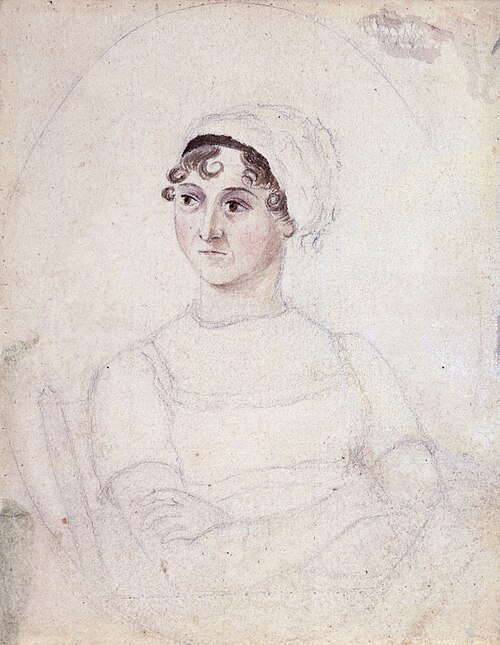
The family memoirs are themselves a problem. Henry Austen’s notice and James Edward Austen-Leigh’s Memoir were written partly to present a respectable, pious image, and they downplay her sharpness and professional ambition. Modern biographies, such as Claire Tomalin’s Jane Austen: A Life (1997), try to read past these family portraits. Even the only authenticated portraits, sketches by Cassandra, are few; the best known, in the National Portrait Gallery in London, was later softened for engravings.
Few manuscripts of the novels survive. Of the six published novels, the only surviving manuscript material is two cancelled chapters of Persuasion. What does survive in her hand is mainly the Juvenilia, Lady Susan, the unfinished novels The Watsons and Sanditon, and some other pieces. These are now brought together in the digital edition Jane Austen’s Fiction Manuscripts, edited by Kathryn Sutherland and hosted by the universities of Oxford and King’s College London. The working drafts, with their crossings-out and irregular punctuation, have challenged the old idea that Austen wrote with effortless polish and raised questions about how much her published texts were shaped by printers and editors.
Even her cause of death is uncertain. Since the 1960s the most common suggestion has been Addison’s disease, a failure of the adrenal glands; others have proposed Hodgkin’s lymphoma or other conditions. The evidence, mainly descriptions of her symptoms in her own late letters, is too limited to settle the question.
Advanced
Debates: conservative, feminist, or neither?
Critics have long argued about Austen’s politics. Marilyn Butler, in Jane Austen and the War of Ideas (1975), placed her in the conservative, anti-Jacobin reaction to the French Revolution, arguing that her novels defend inherited social order and self-discipline against radical individualism. Claudia L. Johnson, in Jane Austen: Women, Politics, and the Novel (1988), replied that Austen used the conventions of the conservative novel to expose the failures of paternal authority and the injustices women suffered, placing her closer to writers such as Mary Wollstonecraft than was once assumed.
Feminist criticism more broadly has asked whether Austen’s marriage plots accept or question the system that made marriage women’s main career. Some readers see her endings as a comic resolution that rewards moral growth; others see an ironic awareness that happy endings are rare and lucky exceptions. The novels themselves allow both readings, which is one reason they remain alive in debate.
Postcolonial criticism brought a new question. In Culture and Imperialism (1993), Edward Said argued that Mansfield Park takes for granted the colonial wealth from Antigua that supports the English country house, and that the novel’s silence about slavery is itself meaningful. Other critics have answered that Austen, who admired the anti-slavery writer Thomas Clarkson according to one of her letters, deliberately raises the issue through Fanny’s unanswered question. The exchange has made Mansfield Park one of the most discussed novels in debates about literature and empire.
Finally, scholars of style, such as D. A. Miller in Jane Austen, or The Secret of Style (2003), have studied how Austen’s impersonal, perfectly controlled narrative voice works, and what it means that a single woman of modest means created a voice of such authority. Such studies connect her techniques to the long history of the novel from Samuel Richardson and Frances Burney, whom she admired, to the modern psychological novel.
Key ideas
- Irony
- Saying one thing while letting the reader understand another; Austen’s narrators use it to expose vanity, snobbery and self-deception.
- Free indirect style
- A way of narrating in which the narrator’s voice blends with a character’s thoughts, showing a mind from inside while keeping ironic distance.
- First impressions and judgment
- Her heroines often misjudge others at first and must learn to see more truly, a central moral pattern in her novels.
- Marriage and economic security
- For women of the gentry, marriage often decided their whole economic future, a fact that gives her comedies real stakes.
- Entail and inheritance
- Legal arrangements that passed estates to male heirs, leaving daughters vulnerable, as in Pride and Prejudice.
- Novel of manners
- Fiction that explores a society’s customs, conversation and social codes, and how individuals live within them.
- Realism of everyday life
- Austen found moral drama in ordinary events — visits, dances, conversations — rather than in adventure or melodrama.
Records
- 1775 — Jane Austen born at Steventon rectory, Hampshire, on 16 December.
- c. 1787 — Begins writing the comic pieces later copied into the Juvenilia notebooks.
- 1796 — Begins “First Impressions”, the first version of Pride and Prejudice; finished in 1797 and rejected unseen by a publisher.
- 1801 — Family moves to Bath after her father’s retirement.
- 1803 — “Susan” (later Northanger Abbey) sold to Crosby for £10 but not published.
- 1805 — Death of her father, the Reverend George Austen.
- 1809 — Moves with her mother, sister and friend Martha Lloyd to Chawton Cottage.
- 1811 — Sense and Sensibility published “By a Lady”.
- 1813 — Pride and Prejudice published in January.
- 1814 — Mansfield Park published in May.
- 1815 — Emma published in December, dedicated to the Prince Regent.
- 1817 — Dies in Winchester on 18 July; Northanger Abbey and Persuasion appear in December with her brother’s biographical notice.
Glossary
- Gentry
- Landowning families below the nobility who lived on income from estates, investments or professions such as the church or the navy.
- Rectory
- The house of a parish clergyman (rector); Austen was born in Steventon rectory.
- Juvenilia
- Works written by an author as a child or teenager; Austen’s fill three notebooks.
- Entail
- A legal settlement restricting who may inherit an estate, often to male heirs only.
- Gothic novel
- A popular kind of fiction full of ruined castles, secrets and terror, parodied in Northanger Abbey.
- Prince Regent
- The future King George IV, who ruled in place of his ill father George III from 1811 to 1820.
- Publishing on commission
- An arrangement in which the author paid the costs and risks of printing, and the publisher took a fee.
- Janeite
- A devoted admirer of Jane Austen; the word became common in the late nineteenth century.
Questions and answers
Did Jane Austen ever get married?
No. She accepted one proposal in 1802 but changed her mind the next day. She lived with her mother and sister for the rest of her life.
Why didn’t her books have her name on them?
It was common for women, and for many writers, to publish anonymously. It protected privacy and reputation. Her brother Henry revealed her name after she died.
Which Jane Austen book should I read first?
Many readers start with Pride and Prejudice because it is funny, fast and clear. Northanger Abbey is also short and playful.
Was Jane Austen rich or famous in her lifetime?
Neither. She earned a few hundred pounds from her novels, and although the Prince Regent and some critics admired her, most readers did not know who she was.
What did she die of?
We do not know for sure. Addison’s disease is the most common suggestion, but other illnesses, such as Hodgkin’s lymphoma, have been proposed.
How reliable is the family’s picture of “dear Aunt Jane”?
Only partly. Most of her letters were destroyed, and the family memoirs aimed to present a modest, pious woman; the surviving letters and manuscripts show a sharper, more ambitious professional writer.
Does Mansfield Park really say something about slavery?
The novel mentions the family’s estate in Antigua and Fanny’s question about the slave trade. Critics disagree whether this reflects unexamined acceptance of empire or deliberate criticism.
Sources and further reading
- Jane Austen. Wikipedia
- Pride and Prejudice. Wikipedia
- Mansfield Park. Wikipedia
- Kathryn Sutherland (ed.), Jane Austen’s Fiction Manuscripts: A Digital Edition. University of Oxford and King’s College London
- Jane Austen, Pride and Prejudice (full text). Project Gutenberg
- Claire Tomalin, Jane Austen: A Life. Viking, 1997
- Deirdre Le Faye (ed.), Jane Austen’s Letters. Oxford University Press
- Marilyn Butler, Jane Austen and the War of Ideas. Clarendon Press, 1975
- D. A. Miller, Jane Austen, or The Secret of Style. Princeton University Press, 2003
Related
- Virginia WoolfEnglish novelist and essayist whose experiments with narrative time and consciousness helped shape literary modernism.
- The Tale of GenjiEarly eleventh-century Japanese narrative, generally attributed to the court writer Murasaki Shikibu.
- Dream of the Red ChamberA Qing-era novel centered on the Jia family, celebrated for its closely observed characters and account of an elite household’s decline.
- William ShakespeareEnglish playwright and poet whose plays span comedy, history and tragedy.
- Storming of the BastilleThe seizure of a Paris fortress and prison on 14 July 1789 became an early emblem of the French Revolution.
Written with AI assistance from the published sources listed above, and revised as new research appears.