Start at the top for an easy introduction. Go further down for more detail and scholarship.
- Easy
- Intermediate
- Advanced
For young readers
About a thousand years ago in Japan, there was a city called Heian-kyō, which is today’s Kyoto. The emperor lived there with hundreds of nobles who loved poetry, music, beautiful robes and moon-viewing parties. One of the ladies who served the empress wrote a story so long that it fills several thick books. Her nickname was Murasaki Shikibu.
The story is about a prince called Genji. He is so handsome and talented that people call him ‘the Shining Genji’. But his mother dies when he is very small, and he spends his whole life looking for love and for people who remind him of her.
Genji writes poems, plays music, falls in love, makes mistakes and is even sent away from the capital for a while. When he grows old, the story does not stop. It keeps going with his children and grandchildren, who have their own troubles.
In those days people sent little poems to each other the way we send messages today. The characters in the book trade almost 800 short poems! They choose the paper, the ink colour and even a flower to tie to the letter.
What makes the book special is that it shows what people are feeling inside — sadness, jealousy, loneliness, joy. Many people call it one of the first novels in the world, and it is still read, drawn and turned into comics and films in Japan today.
At a glance
- Date
- Early 11th century; parts were circulating by 1008, and the whole was known by c. 1021
- Place
- Heian-kyō (Kyoto), capital of Japan in the Heian period (794–1185)
- Author
- Murasaki Shikibu (c. 973/978 – after c. 1014), lady-in-waiting to Empress Shōshi; authorship of the last chapters is debated
- Language
- Classical Japanese written mainly in kana (hiragana)
- Form
- Monogatari (prose tale) in 54 chapters, with nearly 800 waka poems
- Structure
- Genji’s life (chapters 1–41), transition (42–44), the Uji chapters about the next generation (45–54)
- Significance
- The central classic of Japanese literature; often called one of the world’s earliest novels
Easy
What is The Tale of Genji?
The Tale of Genji (Genji monogatari) is a long prose narrative written in Japan in the early eleventh century, generally attributed to a woman known as Murasaki Shikibu. It follows the life and loves of Hikaru Genji (‘the Shining Genji’), son of an emperor, and then the lives of the next generation. Its 54 chapters, which fill well over a thousand pages in modern translations, are set among the aristocrats of the imperial court in Heian-kyō, today’s Kyoto.
It belongs to the genre called monogatari, literally ‘telling of things’, a type of tale written in Japanese rather than in Chinese, which was then the language of government and scholarship. Earlier monogatari were often short, fantastic or anecdotal, such as the Tale of the Bamboo Cutter. Genji transformed the genre by giving it a large cast of believable characters who grow older, remember and change over several decades.
The book is famous for its psychological depth, its attention to small gestures and moods, and its melancholy sense of the passing of time. It contains nearly 800 waka, the 31-syllable poems that people of the court used to communicate feelings. For these reasons it is often described as one of the world’s first novels, although what counts as a ‘novel’ is itself debated.
Easy
The story: the Shining Prince and the generation after him
The tale opens with an emperor’s love for a consort of modest rank, the Kiritsubo Lady, whose rivals torment her until she dies, leaving a small son. Fearing court factions, the emperor makes the boy a commoner with the surname Minamoto (Genji means ‘of the Minamoto clan’), so he cannot become a political pawn. The boy grows up dazzlingly gifted and falls in love with Fujitsubo, his father’s new consort, who closely resembles his dead mother. Their secret child is raised as the emperor’s son and later becomes Emperor Reizei.
Genji’s search for love takes him through many relationships: with his proud wife Aoi, who dies after childbirth, apparently attacked by the living spirit of the jealous Lady Rokujō; with the fragile Yūgao, who dies mysteriously in an abandoned house; and above all with Murasaki, Fujitsubo’s young niece, whom he takes into his home as a girl and later makes his principal partner. After a scandal Genji goes into exile on the lonely coast of Suma and Akashi, where he meets the Akashi Lady, whose daughter will one day become empress.
Genji returns to power and builds a vast mansion, the Rokujō-in, where he gathers the women in his life. But his late marriage to the young Third Princess wounds Murasaki deeply, and the princess has an affair with a young nobleman, Kashiwagi, which produces a son, Kaoru. Genji, raising a child who is not his own, recognises in this the echo of his own youthful sin. Murasaki falls ill and dies. A chapter with only a title, ‘Vanished into the Clouds’ (Kumogakure), marks Genji’s death without describing it.
The final ten chapters, set mostly in Uji south of the capital, follow Kaoru, serious and troubled by doubts about his birth, and his rival Niou, Genji’s passionate grandson. Their pursuit of three half-sisters ends in tragedy: the eldest, Ōigimi, wastes away rather than marry; the youngest, Ukifune, torn between the two men, tries to drown herself, is rescued, and becomes a Buddhist nun. The book ends abruptly, with Kaoru suspecting that another man is hiding her — a strikingly open ending.
Intermediate
Historical context: the Heian court and the Fujiwara regents
In 794 the Japanese court moved to a new capital, Heian-kyō, laid out on a grid modelled on the Chinese capital Chang’an. The Heian period (794–1185) that followed is known for a highly refined aristocratic culture. By Murasaki’s time real power lay less with emperors than with the northern branch of the Fujiwara family, who ruled as regents (sesshō and kanpaku) by marrying their daughters to emperors and serving as grandfathers to the next.
Fujiwara no Michinaga (966–1028) was the master of this system, and his daughter Shōshi, whom Murasaki served, bore two future emperors. Politics therefore ran through marriages, births and the prestige of the women’s quarters. Educated ladies-in-waiting were recruited to make an empress’s salon attractive, and literature became part of court competition — which helps explain why the tale is so attentive to marriage politics, rank and reputation.
Elsewhere in the world at the same time, the Song dynasty ruled China, Goryeo ruled Korea, the Chola empire was at its height in South India, and the Fatimids ruled Egypt. Japan had stopped sending official embassies to China in the late ninth century, and a distinctive ‘native’ court culture (kokufū bunka) flourished, though Chinese learning remained prestigious. Buddhism deeply shaped the imagination of the age, including the belief that the world was entering a degenerate era of the Dharma (mappō), commonly reckoned to begin in 1052.
Intermediate
Women, kana and the writing of Japanese
Official documents, history and scholarship in Heian Japan were written in literary Chinese (kanbun), and men of the court were expected to master it. During the ninth and tenth centuries, simplified phonetic scripts called kana developed from Chinese characters. The cursive form, hiragana, was sometimes called ‘women’s hand’ (onnade) because it was closely associated with women’s writing and with private poetry and letters, though men also used it.
Kana made it possible to write the spoken Japanese of the court fluently, with its honorifics, subtle verb endings and emotional nuance. In the late tenth and early eleventh centuries court women produced an extraordinary body of prose in kana: the Kagerō Diary, Sei Shōnagon’s Pillow Book, the diaries of Izumi Shikibu and Murasaki herself, and later the Sarashina Diary. The Tale of Genji is the summit of this tradition.
At the same time Genji is steeped in Chinese literature. The first chapter echoes Bai Juyi’s Tang poem ‘Song of Everlasting Sorrow’ about an emperor who loses his beloved consort, and allusions to Chinese history and to earlier Japanese poetry are woven throughout. Murasaki had to hide her knowledge of Chinese, which was thought unbecoming in a woman, yet she used it to give her tale depth and resonance.
Intermediate
Key themes and techniques
A central theme is impermanence (mujō), the Buddhist teaching that nothing lasts. Beauty, love, power and youth all pass, and the characters feel this most intensely at moments of greatest splendour. Closely linked is the idea of karmic connection (sukuse): relationships and misfortunes are understood as consequences of deeds in past lives, and Genji’s transgression with Fujitsubo returns to him in Kaoru’s birth. Many characters, especially women, seek escape through becoming nuns.
The tale also explores substitution and longing. Genji loves Fujitsubo because she resembles his mother, and Murasaki because she resembles Fujitsubo; in the Uji chapters Kaoru seeks in Ukifune a replacement for her dead sister. This chain of ‘stand-ins’ (yukari) gives the book a structure of echoes and questions whether any person can truly replace another.
Technically the narrative is remarkable. The narrator often speaks as a gossiping lady-in-waiting who comments, hesitates or claims not to know. Characters are rarely named directly but are identified by titles, places or poems, and much of the meaning is conveyed through poems exchanged at key moments, through the seasons and through the details of clothing, incense and handwriting. The famous ‘rainy night’ discussion in chapter 2, in which young men rank types of women, and a later passage in which Genji defends fiction as revealing truths that official histories omit, show the author reflecting on her own art.
Intermediate
Manuscripts, commentaries and editions
No manuscript in the author’s hand survives. In the Heian period the tale circulated in handwritten copies that readers borrowed and copied, and variations multiplied. The author of the Sarashina Diary describes her joy at obtaining a set of ‘over fifty chapters’ around 1021, reading them day and night — an early testimony that the whole work was already circulating.
In the early thirteenth century the poet and scholar Fujiwara no Teika (1162–1241) prepared a text known as the Aobyōshi-bon (‘blue-cover text’), and at about the same time Minamoto no Mitsuyuki and his son Chikayuki produced a different text, the Kawachi-bon. Most modern editions descend from Teika’s line, especially a fifteenth-century manuscript called the Ōshima-bon, supplemented by other copies. In 2019 an original Teika copy of chapter 5, ‘Wakamurasaki’, was rediscovered in Tokyo, a significant find for textual scholars.
Genji generated a vast commentary tradition, as later readers needed help with its archaic language, court customs and allusions. Important examples include the Kakaishō (14th century) and Kitamura Kigin’s Kogetsushō (1673), which made the tale accessible to a wider Edo-period readership. In the twentieth century the poet Yosano Akiko produced the first modern Japanese rendering, followed by versions by Tanizaki Jun’ichirō, Enchi Fumiko and Setouchi Jakuchō, among others.
Intermediate
Legacy in art, literature and the wider world
Within Japan, Genji became the classic par excellence. By the late twelfth century the poet Fujiwara no Shunzei declared that composing poetry without knowing Genji was regrettable, and it became required knowledge for poets. Nō plays, later tales, Edo-period parodies and popular illustrated books drew on it. The Genji Monogatari Emaki, illustrated handscrolls from the first half of the twelfth century now held by the Tokugawa Art Museum and the Gotoh Museum, are among the earliest surviving Japanese picture scrolls, and ‘Genji pictures’ became a major genre of painting, screens and lacquerware for centuries.
In the Edo period the scholar Motoori Norinaga (1730–1801) argued that the heart of the tale is mono no aware, a deep sensitivity to the pathos of things, rather than Buddhist or Confucian moral lessons. This interpretation was enormously influential in defining ‘Japanese’ aesthetics, though scholars today see it as one reading among many.
Internationally, Suematsu Kenchō published a partial English translation in 1882, but it was Arthur Waley’s version (1925–1933) that made the tale famous in the English-speaking world; Virginia Woolf reviewed its first volume with admiration. Edward Seidensticker produced the first complete English translation (1976), followed by Royall Tyler (2001) and Dennis Washburn (2015). There are translations into Korean, Chinese, French, German and dozens of other languages, as well as manga such as Yamato Waki’s Asakiyumemishi and many films. Japan has celebrated 1 November as ‘Classics Day’ (Koten no hi) since 2012, based on the 1008 diary entry, and a scene from the Genji scrolls appears on the 2000-yen banknote.
Advanced
Scholarly debates: authorship, order of composition and interpretation
Did one person write all 54 chapters? The attribution of the bulk of the tale to Murasaki Shikibu rests on her diary and on early tradition and is widely accepted. The Uji chapters (45–54), however, differ in tone and setting, and since the medieval period some readers have suspected another hand. The poet Yosano Akiko proposed that Murasaki’s daughter, Daini no Sanmi, wrote much of the later part. Stylistic and statistical studies of vocabulary and grammar have been used on both sides, and most scholars now accept Murasaki as the author of the whole while acknowledging that the question cannot be settled with certainty.
A related question concerns the order of composition. The chapters are numbered in narrative order, but that need not be the order in which they were written. In the mid-twentieth century the scholar Takeda Munetoshi proposed that a group of chapters (the ‘b series’, including Hahakigi and the Tamakazura sequence) was written later and inserted into an original ‘a series’, a theory that has been influential but debated. Whether the work was planned as a whole or grew episodically as readers asked for more is still discussed.
Interpretations have shifted with the times. Medieval Buddhist commentators sometimes treated the tale as a parable of attachment, and there were even legends that Murasaki suffered in hell for writing fiction; Confucian readers saw it as a warning against immorality; Norinaga read it through mono no aware. Modern scholarship includes feminist readings that focus on the constraints on women and on figures like Ukifune and Ōigimi who refuse or escape marriage, studies of spirit possession and illness, and historical readings of marriage and politics. Whether the book is ‘the first novel’ is debated too: some point to earlier works such as the Greek and Roman novels or the Sanskrit Kādambarī.
Advanced
Primary sources and textual evidence
The key external sources for dating are contemporary diaries. Murasaki Shikibu’s own diary (covering 1008–1010) refers to the tale and to the preparation of a fine copy at court, and a well-known passage records Emperor Ichijō remarking, after having the tale read aloud, that the author must have read the Chronicles of Japan (Nihon shoki), a compliment to her learning. The Sarashina Diary, written decades later but describing events around 1020–1021, shows that a set of more than fifty chapters existed by then. Together these place the composition of most of the tale within roughly the first two decades of the eleventh century.
The textual tradition is complicated. Scholars classify manuscripts into three main groups: the Aobyōshi-bon line associated with Teika, the Kawachi-bon line, and a heterogeneous group of other texts (beppon). Differences between them range from small wording changes to longer variant passages. Early fragments continue to surface; for example, a Kamakura-period manuscript of chapter 6 was identified in Kyoto in 2008. Because the oldest substantial manuscripts date from the Kamakura period (1185–1333), roughly two centuries after composition, the exact wording of Murasaki’s text is irrecoverable.
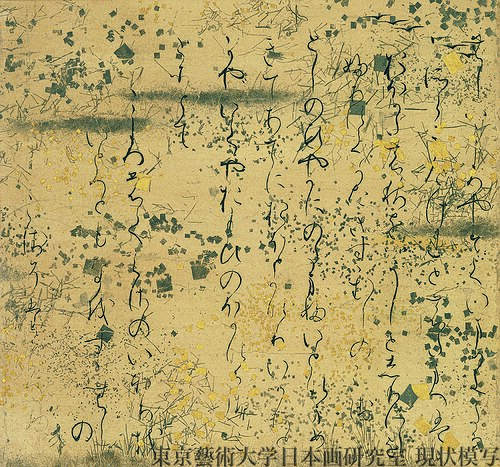
Visual evidence is also important. The twelfth-century Genji scrolls combine calligraphic text with paintings in the ‘blown-off roof’ (fukinuki yatai) style that shows interiors from above, and their text passages are among the oldest witnesses to the wording of some chapters. They also document how readers roughly a century after the author imagined the tale’s world.
Advanced
Methodological notes for readers and researchers
Reading Genji in any language involves interpretation from the start. The original rarely uses personal names or subjects of sentences, relying on honorific verb forms to show who is acting. Translators must decide who is speaking, what to call each character and how to render the poems. Waley’s elegant version freely rearranges and omits (he left out chapter 38); Seidensticker is concise; Tyler keeps court titles and closely annotates customs; Washburn aims for readability with psychological clarity. Comparing translations is itself a way into the text.
Modern scholarly editions, such as those in the major Japanese classical literature series, provide annotated texts based chiefly on the Ōshima-bon, with variants and commentary. Researchers should note which base text an edition uses and be cautious about treating any printed text as Murasaki’s exact words.
Finally, readers should approach the tale’s treatment of gender and power historically. Some of Genji’s relationships, including his taking of the young Murasaki, are disturbing to modern readers, and the narrator herself frequently signals the suffering they cause. Understanding Heian marriage customs, which usually involved husbands visiting wives who lived in their own family residences, helps explain the social world without excusing its harms.
Key ideas
- Mono no aware
- ‘The pathos of things’: a deep, gentle sensitivity to the beauty and sadness of passing things, which Motoori Norinaga saw as the heart of the tale.
- Impermanence (mujō)
- The Buddhist teaching that everything changes and ends; it colours the tale’s mood, especially in its later chapters.
- Karmic connection (sukuse)
- The belief that bonds and misfortunes result from deeds in earlier lives, used in the tale to explain fate and repetition.
- Substitution (yukari)
- The pattern of loving someone because they resemble another: Genji’s mother, Fujitsubo, Murasaki; later, Ōigimi and Ukifune.
- Monogatari
- The Japanese prose-tale genre. Genji turned it from short or fantastic stories into a long, realistic narrative of inner life.
- Poetic exchange
- Characters communicate through 31-syllable waka; poems carry feelings that cannot be spoken openly and link the prose to a poetic tradition.
- Miyabi
- Courtly refinement and elegance, the ideal of taste in dress, handwriting, music and behaviour valued by Heian aristocrats.
Records
- 794 CE — The imperial capital moves to Heian-kyō (Kyoto), beginning the Heian period.
- c. 973 CE — Murasaki Shikibu is born into a minor branch of the Fujiwara family (c. 973–978).
- 1001 — Death of her husband Fujiwara no Nobutaka; she may have begun the tale during her widowhood.
- c. 1005 — She enters the service of Empress Shōshi, daughter of Fujiwara no Michinaga (c. 1005–1006).
- 1008 — Her diary mentions the tale; this entry is the basis of Japan’s ‘Classics Day’ on 1 November.
- c. 1021 — The author of the Sarashina Diary obtains a set of more than fifty chapters (c. 1020–1021).
- c. 1120 — The Genji Monogatari Emaki illustrated scrolls are produced (first half of the 12th century).
- c. 1225 — Fujiwara no Teika prepares the Aobyōshi-bon text (early 13th century).
- 1673 — Kitamura Kigin’s annotated Kogetsushō makes the tale widely accessible in the Edo period.
- c. 1799 — Motoori Norinaga’s study Genji monogatari tama no ogushi presents the theory of mono no aware.
- 1925 — Arthur Waley’s English translation begins to appear (to 1933).
- 1976 — Edward Seidensticker publishes the first complete English translation.
Glossary
- Heian period
- The era of Japanese history from 794 to 1185, when the capital was Heian-kyō.
- Monogatari
- ‘Telling of things’: a Japanese prose tale, often with poems embedded.
- Waka
- A classical Japanese poem of 31 syllables (5-7-5-7-7), also called tanka.
- Kana / hiragana
- Japanese phonetic scripts derived from Chinese characters; hiragana was the flowing script used for most court women’s prose.
- Kanbun
- Literary Chinese as written in Japan, used for official and scholarly texts.
- Regent (sesshō / kanpaku)
- Offices through which the Fujiwara family governed on behalf of emperors, often their own grandsons.
- Uji chapters
- The last ten chapters (45–54), set largely in Uji and centred on Kaoru, Niou and Ukifune.
- Aobyōshi-bon
- The ‘blue-cover’ text of Fujiwara no Teika, the ancestor of most modern editions.
- Emaki
- An illustrated handscroll that combines painting and text, viewed by unrolling from right to left.
- Fukinuki yatai
- ‘Blown-off roof’: a painting convention that shows building interiors from above, used in the Genji scrolls.
Questions and answers
Is The Tale of Genji the first novel in the world?
It is often called that, because it is a long prose story focused on characters’ inner lives. But ancient Greek and Roman novels and the Sanskrit Kādambarī are earlier, so many scholars prefer to call it one of the earliest novels, or the first great psychological novel.
Who wrote The Tale of Genji?
It is attributed to Murasaki Shikibu, a lady-in-waiting at the Heian court in the early eleventh century. Her real name is unknown. Some scholars have questioned whether she wrote the last ten chapters, but most accept her as the author of the whole work.
How long is The Tale of Genji?
It has 54 chapters. Complete English translations run to about 1,100–1,300 pages, and the story covers some seventy-five years and hundreds of characters.
What happens at the end of The Tale of Genji?
Genji has died long before the end. The last chapters follow Kaoru and Niou and the young woman Ukifune, who becomes a nun. The book ends suddenly with Kaoru wondering whether another man is hiding her, and scholars still debate whether it is finished.
Why don’t the characters have real names?
Heian courtiers avoided using personal names, which were considered private. The characters are known by titles, ranks, residences or words from poems associated with them; ‘Murasaki’, ‘Yūgao’ and ‘Ukifune’ are nicknames given by readers from chapter titles or poems.
What does mono no aware mean?
It is often translated as ‘the pathos of things’: a sensitivity to the beauty of things that do not last. The scholar Motoori Norinaga (18th century) argued that it is the essence of Genji and of Japanese literature, an influential but debated view.
Which translation should I read?
Royall Tyler (2001) is closely annotated and faithful to court culture; Dennis Washburn (2015) is readable and complete; Edward Seidensticker (1976) is concise; Arthur Waley (1925–1933) is beautifully written but free and incomplete. Many readers start with an abridgement.
Sources and further reading
- The Tale of Genji. Wikipedia
- Murasaki Shikibu. Wikipedia
- The Diary of Lady Murasaki. Wikipedia
- Sarashina Nikki. Wikipedia
- Genji Monogatari Emaki. Wikipedia
- Heian period. Wikipedia
- Motoori Norinaga. Wikipedia
- Mono no aware. Wikipedia
- Murasaki Shikibu; trans. Royall Tyler, The Tale of Genji (translation). Viking, 2001
- Haruo Shirane, The Bridge of Dreams: A Poetics of ‘The Tale of Genji’. Stanford University Press, 1987
Related
- KojikiA Japanese compilation completed in 712 CE that brings together accounts of deities, origins and early rulers.
- Oku no HosomichiMatsuo Bashō’s prose-and-verse account of a journey through northern Japan, shaped through years of revision after the journey itself.
- Dream of the Red ChamberA Qing-era novel centered on the Jia family, celebrated for its closely observed characters and account of an elite household’s decline.
- Virginia WoolfEnglish novelist and essayist whose experiments with narrative time and consciousness helped shape literary modernism.
Written with AI assistance from the published sources listed above, and revised as new research appears.