Start at the top for an easy introduction. Go further down for more detail and scholarship.
- Easy
- Intermediate
- Advanced
For young readers
About a thousand years ago, a man named al-Hasan ibn al-Haytham was born in Basra, a port city in what is now southern Iraq. He loved mathematics and asked big questions: What is light? How do our eyes see? Is what old books say always true?
In his time many people believed that our eyes send out invisible rays, like a torch, that touch the things we look at. Ibn al-Haytham disagreed. He pointed out that looking at the bright Sun hurts our eyes—so something must be coming into them. He explained that light bounces off objects and travels in straight lines into the eye.
He liked to test his ideas. He made a dark room with a tiny hole in one wall. Light from outside came through the hole and made a picture of the outside world on the opposite wall—upside down! This is called a camera obscura, “dark room” in Latin, and it works like the first step of a camera.
A famous story says that the ruler of Egypt asked him to control the floods of the great river Nile. When Ibn al-Haytham saw the river, he realised his plan could not work. The story says he was afraid of the ruler’s anger and pretended to be ill in his mind until the ruler died. Historians are not sure how much of this story is true.
He wrote a big book called the Book of Optics in seven parts. Many years later it was translated into Latin, and scientists in Europe such as Roger Bacon and Johannes Kepler learned from it. His advice still sounds modern: do not simply trust what famous people have written—check it with reasoning and experiment, and be careful with your own opinions too.
At a glance
- Lived
- c. 965 – c. 1040 CE (death sometimes placed shortly after 1040)
- Born
- Basra, in today’s Iraq, then under the Buyid emirs
- Worked in
- Cairo, capital of the Fatimid Caliphate, for most of his productive life
- Language
- Arabic
- Fields
- Optics and visual perception, astronomy, geometry, number theory, natural philosophy
- Main work
- Kitāb al-Manāẓir (Book of Optics), seven books, written c. 1011–1021; Latin De aspectibus or Perspectiva
- Other works
- Al-Shukūk ʿalā Baṭlamyūs (Doubts Concerning Ptolemy, c. 1025–1028); On the Shape of the Eclipse; On the Configuration of the World; The Model of the Motions of Each of the Seven Planets (c. 1038); treatises on lunes, perfect numbers and analysis and synthesis
- Output
- Medieval lists credit him with around 90–200 titles; more than 50 survive at least in part
Easy
Who was Ibn al-Haytham?
Abū ʿAlī al-Ḥasan ibn al-Ḥasan ibn al-Haytham was a mathematician, astronomer and student of light who lived from about 965 to about 1040. He was born in Basra, in southern Iraq, and spent most of his working life in Cairo, the capital of the Fatimid caliphs. In medieval Latin Europe his first name, al-Hasan, became Alhacen, and a sixteenth-century editor spelled it Alhazen, the name by which he is still widely known.
He is best remembered for the Kitāb al-Manāẓir, the Book of Optics. In it he explained that we see because light from objects enters our eyes, not because our eyes send out rays. He studied how light is reflected by mirrors and bent (refracted) when it passes from air into water or glass, and how the eye and the mind work together to judge size, distance and colour.
He also wrote dozens of works on geometry, numbers and astronomy. Several of them criticise the great Greek astronomer Ptolemy, whom he admired but did not accept as beyond question. Because of his emphasis on testing claims, some modern writers have called him a pioneer of the scientific method; historians debate how far such labels are fair.
Easy
Basra, Cairo and a divided Islamic world
By the late tenth century the Abbasid caliphs in Baghdad had lost most of their real power. Iraq, including Basra, was controlled by the Buyids, a Persian dynasty. Egypt and much of North Africa and Syria were ruled by the Fatimids, a rival Ismaili Shiʿi caliphate that had founded Cairo in 969 as its capital.
Despite political division, scholars travelled, and books in Arabic moved across the whole region. Greek works on mathematics, optics and astronomy—Euclid, Ptolemy, Apollonius and others—had been translated into Arabic in the previous two centuries, and Arabic writers such as al-Kindi had already written on vision. Ibn al-Haytham could build on this rich library.
The Fatimid caliph al-Hakim (r. 996–1021) was a patron of learning but also known for unpredictable and harsh decisions. The best-known stories about Ibn al-Haytham’s life are set against this background.
Easy
His life: facts, stories and uncertainties
Our knowledge of his life comes mainly from biographical dictionaries written about two hundred years later, especially those of al-Qifti and Ibn Abi Usaybiʿa, and from a short intellectual autobiography he wrote in 1027. The later reports do not always agree, and some parts read like legend.
According to these accounts, he first held an official post in Basra. After studying the conflicting religious and philosophical views of his time, he decided to devote himself to learning, especially the philosophy of Aristotle and mathematics. He became famous for applied mathematics, and word reached al-Hakim that he had claimed the flooding of the Nile could be regulated.
The caliph invited him to Egypt. The story says that as he travelled up the Nile he realised his plan would not work; later versions add that he inspected the site near Aswan. He was given an administrative post instead, but fearing the caliph, he is said to have pretended to be mad and was confined to his house until al-Hakim died in 1021. During this time he is said to have written much of the Book of Optics.
Afterwards he lived in Cairo near the al-Azhar mosque, supporting himself by copying scientific manuscripts and teaching. A copy of Apollonius’ Conics in his handwriting, dated 1024, survives in Istanbul. One report places him in Syria for a time; other evidence shows him in Egypt around 1038. He died in Cairo around 1040.
Intermediate
How do we see? The Book of Optics
Ancient thinkers had two main theories of vision. Euclid and Ptolemy, the mathematicians, taught an extramission theory: the eye sends out a cone of visual rays. Aristotle and his followers taught an intromission theory: something from the object—a “form”—enters the eye. The physician Galen described the anatomy of the eye. Earlier Arabic writers had followed one or another of these traditions.
Ibn al-Haytham combined them in a new way. With the Aristotelians, he held that vision happens when something enters the eye—light and colour. With the mathematicians, he treated this as rays travelling in straight lines, which can be studied by geometry. With Galen, he used a detailed model of the eye. Against extramission he argued, among other things, that bright light can injure the eye, and that it is implausible that the eye could send rays to the distant stars the instant the eyelids open.
His theory faced a problem: every point of an object sends light in all directions, so every point of the eye receives light from every point of the object—which should produce a blur. His solution was that only the ray that strikes the surface of the eye perpendicularly is perceived clearly, so each point of the object corresponds to one point in the eye. This answer was not fully convincing, but no other theory of the time was so complete, and it shaped European optics until Kepler’s theory of the retinal image in the seventeenth century.
The Book of Optics has seven books. Books I–III deal with direct vision, the eye and perception, including errors of sight; Books IV–VI treat reflection and images in mirrors; Book VII deals with refraction. Throughout, he describes instruments and procedures that let readers check his claims.
Intermediate
Mirrors, refraction and the dark room
He gave a complete statement of the law of reflection: the incoming ray, the reflected ray and the line perpendicular to the mirror all lie in one plane, and the angles on either side are equal. He studied flat, spherical, cylindrical and conical mirrors and described spherical aberration—the way a curved mirror fails to bring all rays to a single point.
In Book VII he investigated refraction using an apparatus adapted from one described by Ptolemy. He noticed that the ratio between the angle of incidence and the angle of refraction does not stay constant. He explained refraction with a mechanical analogy—a ball thrown straight at a thin board breaks through, while one thrown at a slant glances off—and argued that light moves faster in less dense media and follows the path that is “easier and quicker,” an idea historians compare with Fermat’s later principle of least time.
His short treatise On the Shape of the Eclipse gives the first clear physical and mathematical analysis of the pinhole image, or camera obscura. Pinhole images had been noted earlier—in the Chinese Mozi and in the Aristotelian Problems—but Ibn al-Haytham varied the size and shape of the hole and the distance of the screen to show how the image forms, why it is inverted and why a large hole gives a blurred image. He used such a device to watch the crescent-shaped Sun during a partial eclipse.
Book V contains what is now called Alhazen’s problem: given a spherical mirror, a light source and an eye, find the point on the mirror where light is reflected to the eye. Ptolemy had studied special cases. Ibn al-Haytham solved the general problem using intersecting conic sections; it has no ruler-and-compass solution, and a purely algebraic solution was published only in 1965.
Intermediate
Seeing with the mind
One of his most original ideas is that seeing is not only a matter of light and the eye. To recognise an object, judge its distance or compare its size, the mind must interpret what the eye receives, often quickly and without our noticing, using what we learned from earlier experience. Modern psychologists call a similar idea unconscious inference.
He applied this to optical illusions. The Moon looks larger near the horizon than high in the sky, although its angle in the sky is the same. Ibn al-Haytham argued that we judge the horizon Moon to be farther away because we see the ground and objects stretching toward it, and so we perceive it as larger. This distance explanation had been suggested earlier by ancient writers, but his version was the one medieval Europe knew.
He also described colour constancy—objects look the same colour under different lights—and wrote about seeing with two eyes, including what later became known as the horopter. Some modern writers have credited him with anticipating many later discoveries in visual science; others warn that his account of binocular vision closely follows and corrects Ptolemy, so his achievement should be seen in that context.
Intermediate
Astronomy and mathematics
In On the Configuration of the World he gave a non-technical, physical picture of Ptolemy’s universe, with nested solid spheres carrying the planets around a stationary Earth. This book was later translated into Hebrew and Latin and read in Renaissance Europe. In the Doubts Concerning Ptolemy (c. 1025–1028), however, he sharply criticised contradictions in Ptolemy’s Almagest, Planetary Hypotheses and Optics—above all the equant, a device that made planets move uniformly around a point that is not the centre of their circle, which he thought could not correspond to any real physical motion.
In The Model of the Motions of Each of the Seven Planets (c. 1038), which survives only in part, he proposed a geometric model that kept an Earth-centred universe and circular motions but removed the equant. He also wrote on determining the meridian, finding the direction of Mecca, and the distance of the Milky Way, which he argued lay far beyond the Moon.
In mathematics he investigated Euclid’s parallel postulate, using a four-sided figure later associated with Johann Lambert; Omar Khayyam later criticised his use of motion in geometry. He wrote on the “lunes of Alhazen,” on constructing the regular heptagon, and on finding the volume of a paraboloid by summing fourth powers of whole numbers. In number theory he used the property now called Wilson’s theorem, solved systems of congruences, and may have been the first to state that every even perfect number has a particular form later proved by Euler.
Intermediate
Doubt and experiment
In the Doubts Concerning Ptolemy he wrote that the seeker after truth is not the one who simply trusts ancient authors, but the one who questions them and submits to argument and demonstration. He added that such a critic should also suspect himself, to avoid prejudice or leniency.
The Book of Optics repeatedly appeals to “testing”: procedures that check a claim against observation. He combined natural philosophy with geometry: a physical claim about light was expressed geometrically and then checked with instruments such as sighting tubes, screens and graduated devices.
He also held religious convictions. Medieval sources generally describe him as a Sunni Muslim, and he wrote that searching for truth and knowledge was the best way to come closer to God. He wrote a treatise on calculating the qibla, the direction of prayer. For him, rigorous inquiry and faith were not presented as opposites.
Intermediate
Influence in the Islamic world and Europe
In the Islamic world his optics was known mainly through a later revision, the Tanqīḥ al-Manāẓir of the Persian scholar Kamal al-Din al-Farisi (d. c. 1320), who used it to explain the rainbow. In al-Andalus, the mathematician-king al-Muʾtaman ibn Hud of Zaragoza used his work in the eleventh century.
In Latin Europe the Book of Optics was translated by an unknown translator, probably in the late twelfth or early thirteenth century, as De aspectibus or Perspectiva. It became the basis of the thirteenth-century “perspectivist” tradition of Roger Bacon, John Pecham and Witelo. In 1572 Friedrich Risner printed it in Basel together with Witelo’s optics as Opticae thesaurus, and it was read by Kepler, Descartes, Huygens and others.
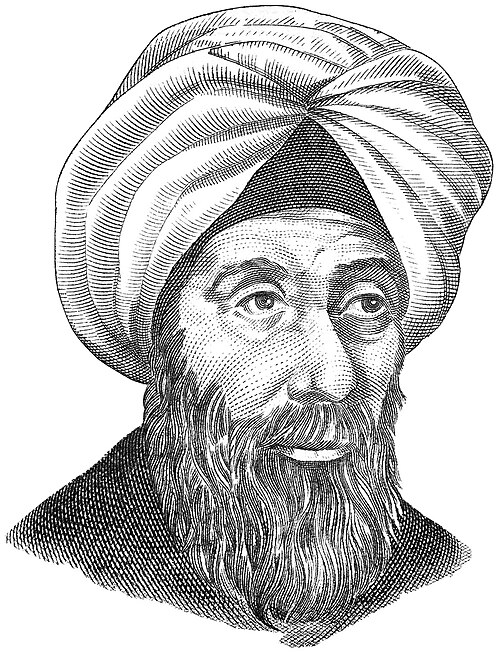
Today a lunar crater and an asteroid bear his name, his portrait appears on an Iraqi banknote, and the 2015 International Year of Light marked the thousandth anniversary of his optical work. He is often called “the father of optics.”
Advanced
One Ibn al-Haytham or two? Biography and attribution
The medieval bibliographies list works under two slightly different names: al-Ḥasan ibn al-Ḥasan ibn al-Haytham and Muḥammad ibn al-Ḥasan ibn al-Haytham. Roshdi Rashed argued that these may be two different people—a philosopher-physician, Muhammad, from Iraq, and the mathematician al-Hasan who worked in Egypt—and that the biographers merged them. Other scholars, including A. I. Sabra, argued for a single person. Most specialists today treat the mathematical and optical corpus as the work of one author, but the question affects which works and which biographical details belong to him.
The Nile story and the feigned madness come from sources written long after his death and have the shape of a moral tale about a scholar and a tyrant. They may preserve a real memory, but they cannot be confirmed. The dates of his birth and death are also derived from these later sources, and some scholars place his death after 1040.
Attribution matters for the Latin tradition too. Some treatises circulated in Latin under his name, while others, such as On the Shape of the Eclipse, remained in Arabic until the twentieth century and had no influence in medieval Europe. When assessing his influence, historians must ask which texts were actually available to which readers.
Advanced
“The first true scientist”? Debating his place in history
Ibn al-Haytham is often described in popular writing as the founder of the scientific method or the first true scientist. Historians of science are more cautious. Matthias Schramm argued that he was the first to vary experimental conditions systematically. G. J. Toomer, reviewing Schramm, warned that at the time the Optics had not been fully translated, that isolated passages could be read anachronistically, and that Ibn al-Haytham should be understood alongside earlier Greek and Islamic writers rather than in isolation.
Much modern knowledge rests on critical editions. A. I. Sabra edited and translated the Arabic text of Books I–III (English translation published by the Warburg Institute in 1989) and later Books IV–V. A. Mark Smith edited the medieval Latin version, De aspectibus, with English translations and commentary in a series of volumes beginning in 2001. Comparing the Arabic and Latin shows that the medieval translation differs from the original in places, so medieval Europeans read a somewhat different Alhacen.
Claims that he founded experimental psychology or psychophysics have been made by some modern authors, but critics point out that his reports on perception were qualitative, not quantitative. Similarly, his explanation of the Moon illusion was not new, although it became the standard medieval version. A balanced view sees him as an outstanding mathematician-physicist who transformed optics into a unified experimental and geometrical science, working within—and critically reshaping—a Greek and Arabic tradition.
Key ideas
- Intromission of light
- We see because light and colour travel from every point of an object in straight lines into the eye.
- Perpendicular rays
- Only the ray striking the eye perpendicularly is perceived clearly, giving a one-to-one match between object and eye.
- Law of reflection
- Incident ray, reflected ray and normal lie in one plane, with equal angles.
- Camera obscura analysis
- Light through a small opening forms an inverted image whose sharpness depends on the size of the hole.
- Perception as inference
- The mind interprets visual input using prior experience to judge size, distance and colour.
- Testing and experiment
- Claims about light are checked with instruments and controlled observation.
- Critique of authority
- Even Ptolemy must be questioned when his models contradict physical reality or each other.
Records
- c. 965 CE — Ibn al-Haytham is born in Basra under the Buyids.
- 969 CE — The Fatimids conquer Egypt and found Cairo.
- 996 CE — Al-Hakim becomes Fatimid caliph.
- c. 1011 — He begins the Book of Optics; tradition says he was then confined in Cairo.
- 1021 — Death of al-Hakim; the Book of Optics is completed by about this time.
- 1024 — He copies Apollonius’ Conics; the manuscript survives in Istanbul.
- c. 1025 — Doubts Concerning Ptolemy is written (c. 1025–1028).
- 1027 — He writes a short autobiography and list of his works.
- c. 1038 — The Model of the Motions of Each of the Seven Planets.
- c. 1040 — He dies in Cairo.
- c. 1200 — The Book of Optics is translated into Latin as De aspectibus.
- 1572 — Friedrich Risner prints the Latin Optics in Basel as Opticae thesaurus.
Glossary
- Optics (ʿilm al-manāẓir)
- The science of vision and light.
- Extramission theory
- The ancient idea that the eye sends out rays to see objects.
- Intromission theory
- The idea that something from the object enters the eye to cause sight.
- Refraction
- The bending of light as it passes from one transparent material into another.
- Camera obscura
- Latin for “dark room”: a darkened space where light through a small hole projects an inverted image.
- Fatimid Caliphate
- An Ismaili Shiʿi dynasty that ruled Egypt and neighbouring lands from Cairo (969–1171).
- Equant
- A point in Ptolemy’s planetary models around which a planet moves at uniform angular speed.
- Conic sections
- Curves—ellipse, parabola, hyperbola—formed by slicing a cone; used in his solution of Alhazen’s problem.
- Perspectivists
- Thirteenth-century European writers on optics, such as Bacon, Pecham and Witelo, who followed his work.
- Unconscious inference
- The idea that perception involves quick, unnoticed judgements by the mind.
Questions and answers
Why is he called Alhazen?
Medieval Latin writers turned his first name, al-Hasan, into Alhacen. The spelling Alhazen was popularised by Friedrich Risner’s printed edition of 1572.
Did he invent the camera?
No. Pinhole images were noticed long before him, in China and Greece. He gave the first clear scientific explanation of how the image forms, which is the basic principle of a camera.
Did he really pretend to be mad?
That story comes from biographers writing about two centuries later. It may contain some truth, but historians cannot confirm it.
Why does the Moon look bigger near the horizon?
He argued it is a trick of the mind: we think the Moon on the horizon is farther away, so our brain makes it look larger.
Was he the first scientist to use experiments?
He was not the first to experiment—Ptolemy also used instruments—but he used experiment and geometry together unusually systematically. Calling him the first scientist is a modern simplification that historians debate.
Which parts of his work were known in medieval Europe?
Mainly the Latin De aspectibus and some cosmological works. Treatises such as On the Shape of the Eclipse stayed in Arabic and were unknown in Europe until modern times.
Is there doubt about whether all works attributed to him are by one person?
Yes. Rashed suggested the bibliographies merge two men named Ibn al-Haytham; Sabra and others argued for one. The question affects the attribution of some philosophical and medical titles.
Sources and further reading
- Ibn al-Haytham. Wikipedia
- J. J. O'Connor and E. F. Robertson, Abu Ali al-Hasan ibn al-Haytham. MacTutor History of Mathematics Archive, University of St Andrews
- Book of Optics. Wikipedia
- Alhazen's problem. Wikipedia
- Camera obscura. Wikipedia
- 이븐 알하이삼. Wikipedia (Korean)
- A. I. Sabra, The Optics of Ibn al-Haytham, Books I–III: On Direct Vision (translation and commentary). The Warburg Institute, University of London, 1989
- A. Mark Smith, Alhacen's Theory of Visual Perception: A Critical Edition, with English Translation and Commentary, of the First Three Books of Alhacen's De aspectibus. American Philosophical Society (Transactions, vol. 91), 2001
Related
- EuclidGreek mathematician of Alexandria, active around 300 BCE, whose Elements built geometry and number theory from a few definitions and postulates and became the most influential mathematics textbook in history.
- Al-KhwarizmiNinth-century mathematician, astronomer and geographer of Abbasid Baghdad whose books gave the world the words “algebra” and “algorithm.”
- Omar KhayyamPersian mathematician, astronomer and philosopher of the Seljuk era who solved cubic equations geometrically and led the calendar reform of 1079; famous quatrains of uncertain authorship bear his name.
- AvicennaPhysician and philosopher whose writings shaped medicine and philosophy across the Islamic world and Europe.
- Galileo GalileiItalian mathematician and astronomer who revolutionized astronomy with the telescope, founded the mathematical science of motion and was condemned for defending Copernicus.
- Isaac NewtonEnglish mathematician and natural philosopher who formulated the laws of motion and universal gravitation, developed calculus and explained the composition of white light.
Written with AI assistance from the published sources listed above, and revised as new research appears.