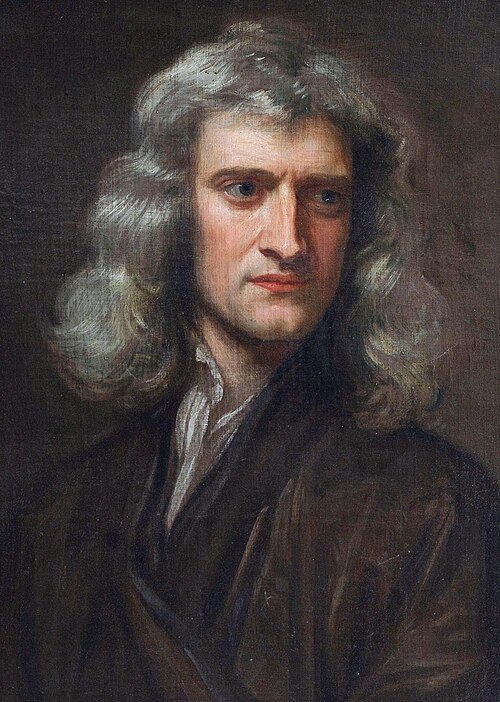
Start at the top for an easy introduction. Go further down for more detail and scholarship.
- Easy
- Intermediate
- Advanced
For young readers
Isaac Newton was born on Christmas Day 1642 in a farmhouse in the English village of Woolsthorpe. His father had died before he was born, and he was raised mostly by his grandmother. He was not much of a farmer, so his family sent him to study at Cambridge University.
When he was a young student, a deadly plague closed the university. Newton went home to the farm for almost two years. There, thinking and working on his own, he came up with some of the biggest ideas in the history of science.
He played with glass prisms and sunlight. He showed that white light is really made of all the colours of the rainbow mixed together. He also invented a new kind of maths, now called calculus, for working with things that keep changing, like the speed of a falling ball.
Newton later told a friend that seeing an apple fall made him wonder: why does it always fall straight down? He realized that the same pull—gravity—that makes the apple fall also keeps the Moon going around the Earth and the planets going around the Sun.
In 1687 he published a famous book in Latin, called the Principia. It explained three simple laws of how things move and the law of gravity. With them, people could calculate the paths of planets, comets and even the tides of the sea.
Newton also ran the Royal Mint, which made England’s coins, and led the Royal Society of scientists. He was a brilliant but difficult man who quarrelled with other scientists. When he died he was buried in Westminster Abbey in London.
At a glance
- Lived
- 25 December 1642 – 20 March 1727 (Julian calendar used in England); 4 January 1643 – 31 March 1727 in the modern calendar
- Born
- Woolsthorpe Manor, Lincolnshire, England
- Main places
- Trinity College, Cambridge (student from 1661, Fellow from 1667, Lucasian Professor 1669–1701); London from 1696
- Fields
- Mathematics, optics, mechanics, astronomy; also alchemy (“chymistry”), theology and chronology
- Key works
- Principia (1687; 2nd ed. 1713; 3rd ed. 1726); Opticks (1704); Arithmetica Universalis (1707); many papers published after his death
- Key ideas
- Three laws of motion, universal gravitation, calculus (“fluxions”), the composite nature of white light, the reflecting telescope
- Offices
- Member of Parliament for Cambridge University; Warden (1696) and Master (from the end of 1699) of the Royal Mint; President of the Royal Society from 1703; knighted 1705
- Buried
- Westminster Abbey, London—the first scientist to be buried there
Easy
Who was Isaac Newton?
Isaac Newton was an English mathematician, physicist and astronomer—in the language of his time, a “natural philosopher.” He is best known for his book Philosophiæ Naturalis Principia Mathematica (Mathematical Principles of Natural Philosophy), usually called the Principia, first published in 1687. In it he formulated the laws of motion and the law of universal gravitation, which together explained the motions of objects on Earth and of the planets, Moon and comets in the sky.
Newton also made fundamental discoveries in optics, showing that sunlight is a mixture of colours and building the first practical reflecting telescope. In mathematics he developed calculus, the mathematics of change, at about the same time as the German philosopher Gottfried Wilhelm Leibniz, which led to one of the bitterest disputes in the history of science.
The Stanford Encyclopedia of Philosophy divides his life into four parts: his youth before Cambridge; his years at Cambridge up to the Principia; about a decade of fame and growing restlessness; and three decades in London, where he ran the Royal Mint. Almost all of his great discoveries were made in the Cambridge years.
Easy
A farm boy in troubled times
Newton was born at Woolsthorpe Manor, near Grantham in Lincolnshire, on Christmas Day 1642 according to the calendar then used in England (4 January 1643 in the modern calendar), less than a year after Galileo died. His father, a farmer, had died two months earlier. When Isaac was three, his mother Hannah remarried and moved away, leaving him with his grandparents. She returned with three more children in 1653 after her second husband’s death.
He went to school in Grantham and was brought home in 1659 to manage the farm, which he did badly. His uncle and his schoolmaster persuaded his mother that he should go to university instead, and in 1661 he entered Trinity College, Cambridge, older than most of his classmates. He paid his way at first by doing servant’s duties, until he won a scholarship in 1664.
These were the most turbulent years in English history: civil war began in 1642, King Charles I was executed in 1649, Oliver Cromwell ruled as Lord Protector, and the monarchy was restored under Charles II in 1660, the year the Royal Society of London was founded. How much this turmoil affected Newton’s family is unclear, but it deeply changed English intellectual life.
Easy
The plague years: a “wonderful year”
At Cambridge the official teaching was still based on Aristotle, but by 1664 Newton was reading on his own the works of René Descartes and teaching himself the newest mathematics. From the summer of 1665 until the spring of 1667 the university was closed because of plague, and Newton spent almost all of this time at Woolsthorpe. This period is often called his annus mirabilis, or “wonderful year.”
In those months he made his first experimental discoveries about light and colour, worked out the mathematics of motion in a circle, and noticed a link between an inverse-square force and Kepler’s rule relating the periods of the planets to their distances from the Sun. By the end of 1666, according to the Stanford Encyclopedia, he had become in effect the leading mathematician in the world, having discovered the calculus, which he called the method of “fluxions.”
The famous apple belongs to this period. Late in life Newton told his friend William Stukeley that the thought of gravity had come to him “occasion’d by the fall of an apple” as he sat in a garden, wondering why it always falls straight toward the centre of the Earth. His niece’s husband, John Conduitt, gave a similar account. Some scholars doubt the story’s details, but it came from Newton himself; there is no evidence that the apple hit him on the head.
Easy
Light, colour and a new telescope
Before Newton, many people thought a glass prism somehow added colours to white light. Newton passed a narrow beam of sunlight through a prism in a darkened room and found that the band of colours—which he named the spectrum—was long and thin rather than round. He concluded that white light is a mixture of rays that bend by different amounts. With a lens and a second prism he could recombine the colours into white light, and a single colour passed through another prism did not change.
This led him to think that the lenses of ordinary telescopes would always blur images with coloured fringes. To avoid the problem he built a telescope that used a curved mirror instead of a lens to gather light. His first reflecting telescope was ready in late 1668; in 1671 the Royal Society asked for a demonstration, and he was elected a Fellow in 1672.
In 1672 his paper on light and colours was read to the Royal Society and printed in its Philosophical Transactions. It started years of argument with critics, including Robert Hooke and Christiaan Huygens, which so annoyed Newton that he withdrew from public debate. His full account, Opticks, appeared only in 1704, after Hooke had died, written in English, with later editions adding famous “Queries” about the nature of light and matter.
Intermediate
The Principia
In 1669 Newton became Lucasian Professor of Mathematics at Cambridge. For some years he showed little interest in the orbits of the planets, until a letter from Hooke in late 1679 asked what curve a body would follow under a force that weakens with the square of the distance. In August 1684 the astronomer Edmond Halley visited Cambridge and asked the same question. Newton answered at once: an ellipse. He could not find his calculation, but in November he sent Halley a nine-page treatise, De motu corporum in gyrum (On the Motion of Bodies in Orbit).
Encouraged by Halley, Newton spent the next two and a half years expanding these ten propositions into the Principia, a Latin work of about 500 pages with 192 derived propositions. The Royal Society had spent its book budget, so Halley paid for the printing himself. About 300 copies appeared in July 1687. Book 1 treats motion without resistance; Book 2 deals with motion through resisting fluids and argues against Descartes’s theory that the planets are carried round by whirlpools (vortices) of matter; Book 3, “On the System of the World,” applies the theory to the Solar System.
The book begins with definitions and three laws of motion: a body stays at rest or moves in a straight line unless a force acts on it; the change of motion is proportional to the force; and every action has an equal and opposite reaction. From these and the law that every body attracts every other with a force that decreases with the square of the distance, Newton derived Kepler’s laws of planetary motion and explained the paths of comets, the tides, the slight flattening of the Earth and the slow wobble of its axis. Here was one set of laws for heaven and Earth.
Newton revised the Principia carefully for a second edition in 1713, edited by Roger Cotes, and a third in 1726. The second edition added the General Scholium, in which he declared that he had not yet found the cause of gravity and that “hypotheses non fingo”—“I frame no hypotheses.”
Intermediate
From Cambridge to London: Parliament, the Mint and the Royal Society
The Principia made Newton famous. After the Glorious Revolution he sat in Parliament for Cambridge University in 1689–1690, and he became friends with the philosopher John Locke. In 1693 he suffered what he himself described as a breakdown, from which he recovered that autumn. Increasingly unhappy in Cambridge, he accepted the post of Warden of the Royal Mint in 1696 and moved to London; he became Master of the Mint at the end of 1699 and held that post for the rest of his life.
At the Mint Newton took his work seriously. During the Great Recoinage he estimated that a fifth of the coins handed in were counterfeit. He investigated and prosecuted coiners himself—28 in all, including the notorious William Chaloner, who was hanged—and improved the accuracy of the coins. His valuation of gold helped move Britain toward a gold standard. He also lost a large sum in the South Sea Bubble of 1720.
In 1703 he was elected President of the Royal Society and in 1705 Queen Anne knighted him. He used his position forcefully. He and Halley published the Astronomer Royal John Flamsteed’s observations against his wishes, making him a lifelong enemy. Newton died in London on 20 March 1727 (Julian calendar), at 84, and after lying in state he was buried in the nave of Westminster Abbey.
Intermediate
The calculus dispute with Leibniz
Newton had developed his method of fluxions in 1665–1666 and wrote fuller treatises by 1671, but he did not publish them; no one would print his long account. In the mid-1670s he exchanged letters about mathematics with Leibniz, among others, so his advances were not a secret. Leibniz began developing his own calculus in 1674 and published his first paper on it in 1684, using the differential notation that is still standard today. Newton presented a geometrical form of calculus in the Principia (1687), but his fluxional notation appeared in print only partially in 1693 and more fully in 1704, in treatises appended to the Opticks.
Tension turned into open conflict in 1710, when the Scottish mathematician John Keill accused Leibniz in the Philosophical Transactions of plagiarism. Leibniz, a Fellow of the Royal Society, appealed to the Society for justice. The committee report of 1712 sided with Newton—who largely controlled it—and in 1715 Newton published an anonymous review of it praising himself. Historians today agree that the two men invented calculus independently.
The quarrel had lasting effects. It widened a split between English mathematicians around the Royal Society and the continental group working with Leibniz’s calculus, most notably Johann Bernoulli—a division in the practice of mathematics that lasted long after Leibniz died in 1716. It also made continental thinkers, already uneasy about Newton’s gravity acting at a distance without any mechanism, more hostile to his physics for a time.
Intermediate
The private Newton: alchemy and theology
Newton wrote far more about alchemy and religion than about physics. In 1669 he bought chemical apparatus and alchemical books, and he carried out experiments in what historians call “chymistry”—the seventeenth-century blend of alchemy and chemistry—for decades. He wrote a major alchemical treatise, Praxis, in the early 1690s but never published it.
His religious studies were intense and, for his time, dangerous. He came to reject the doctrine of the Trinity, a central belief of the Church of England; scholars describe him as anti-Trinitarian and possibly close to the ancient Arian view. He kept these beliefs mostly hidden; according to the Stanford Encyclopedia, the question of the religious vows linked to his Cambridge professorship seems to have prompted his study of the Trinity in the first place. He also studied biblical prophecy, reconstructed Solomon’s Temple from the biblical text, and tried to date ancient history using astronomy; some of these works were published after his death, such as The Chronology of Ancient Kingdoms Amended (1728) and Observations upon the Prophecies of Daniel and the Apocalypse of St. John (1733).
These papers remained largely unknown for two centuries. After passing through Newton’s niece Catherine Barton and her husband John Conduitt, they went to the Earls of Portsmouth. Cambridge University kept the scientific papers after 1888, and the rest were sold at auction at Sotheby’s in 1936. The economist John Maynard Keynes bought a large part of the alchemical manuscripts and gave them to Cambridge in 1946. Serious study of these papers began only in the 1970s.
Advanced
Newton’s method: “I frame no hypotheses”
The Stanford Encyclopedia argues that the heart of Newton’s achievement is a new way of connecting theory to evidence. He distrusted the “method of hypotheses”—proposing a bold explanation and then checking some of its consequences. Instead he insisted that specific phenomena should decide each element of a theory, so that the only provisional step was generalizing from those phenomena. His fourth Rule of Reasoning, added to the third edition of the Principia, says that propositions gathered from phenomena by induction should be taken as exactly or very nearly true until other phenomena make them more exact or show exceptions.
This stance allowed Newton to leave questions open. He did not claim to know what causes gravity, or whether light is made of particles or waves, though he thought particles more likely. Critics such as Leibniz and Huygens complained that a force acting across empty space without contact was an “occult” quality. Newton replied that the evidence showed such a force exists and obeys a precise law, and that this was enough for science even without knowing its cause. In this way, historians argue, his work helped separate empirical science from speculative natural philosophy.
The optics and the mechanics produced two different Newtonian traditions: from the Opticks, a tradition of careful experiment; from the Principia, one of mathematical theory. Both shared Newton’s commitment to letting experience be not only the judge of theories but the basis for adopting them.
Advanced
Legacy, “Newtonianism” and the problem of sources
It took decades for Newton’s theory to win general acceptance. The Stanford Encyclopedia describes the 1740s as a turning point: French expeditions to Lapland and Peru confirmed that the Earth is flattened at the poles as Newton predicted, and mathematicians such as Clairaut, d’Alembert and Euler solved problems he had left open. Clairaut’s successful prediction of the return of Halley’s comet in 1759 convinced much of the educated public. Much of what we call “Newtonian mechanics,” including the familiar equation F = ma, which appears nowhere in the Principia, was actually formulated by Euler in the eighteenth century, and Laplace’s great Celestial Mechanics (1799–1805) completed the programme.
Newton became a symbol of the Enlightenment. Writers such as Voltaire popularized a “Newtonian” worldview in France, and philosophers from Locke and Berkeley onward asked what made the science of the Principia so successful. Hume and Adam Smith hoped for a comparable science of human affairs, and the question helped create the philosophy of science, beginning with Kant. Historians warn, however, that many eighteenth-century “Newtonians” had read little of the difficult Principia itself, and that ideas attributed to Newton by popularizers often differ sharply from what he wrote. In the twentieth century Einstein’s relativity showed that Newton’s theory holds only as an extremely good approximation.
Interpreting Newton the person is difficult. There is a sharp contrast between the public Newton of the published works and the private Newton of the alchemical and theological manuscripts, which became widely known only after 1936. We know surprisingly little about what drove him, and biographers, as one scholar notes, often tell us as much about themselves as about Newton. His famous line from a 1675 letter to Hooke—“If I have seen further it is by standing on the shoulders of giants”—is itself debated: some historians read it as modesty, others as a veiled insult to Hooke, who was reportedly short, and the phrase was a well-known proverb long before Newton.
Key ideas
- Laws of motion
- Three principles: inertia, force producing change of motion, and equal and opposite action and reaction.
- Universal gravitation
- Every body attracts every other with a force proportional to their masses and inversely proportional to the square of the distance between them.
- Unification of heaven and Earth
- The same law explains a falling apple, the Moon’s orbit, the planets, comets and the tides.
- Calculus (fluxions)
- Mathematics for quantities that change continuously, developed by Newton in the 1660s and independently by Leibniz.
- Composite white light
- White light is a mixture of colours that are refracted by different amounts, as prism experiments show.
- Inference from phenomena
- Newton’s method of deriving theory as directly as possible from observations, leaving open questions that evidence cannot decide.
- Action at a distance
- Gravity seemed to act across empty space without contact, which critics rejected and Newton accepted without claiming to know its cause.
Records
- 1642 — Newton is born at Woolsthorpe on 25 December (Julian calendar; 4 January 1643 in the modern calendar).
- 1661 — He enters Trinity College, Cambridge.
- 1665 — Plague closes Cambridge; at Woolsthorpe (1665–1667) he makes his early discoveries in calculus, optics and motion.
- 1668 — He completes his first reflecting telescope.
- 1669 — He becomes Lucasian Professor of Mathematics at Cambridge.
- 1672 — He is elected a Fellow of the Royal Society; his paper on light and colours is published.
- 1684 — Halley visits him; Newton sends Halley De motu corporum in gyrum.
- 1687 — The Principia is published in London in July, paid for by Halley.
- 1696 — He becomes Warden of the Royal Mint and moves to London.
- 1703 — He is elected President of the Royal Society.
- 1704 — Opticks is published, with his first printed work on calculus.
- 1727 — Newton dies in London on 20 March (Julian calendar) and is buried in Westminster Abbey.
Glossary
- Natural philosophy
- The older name for the study of nature, including what we now call physics and astronomy.
- Principia
- Newton’s Mathematical Principles of Natural Philosophy (1687), which set out the laws of motion and gravitation.
- Inverse-square law
- A rule in which a force becomes four times weaker when the distance doubles, as with gravity.
- Fluxions
- Newton’s name for rates of change in his version of calculus.
- Spectrum
- The band of colours produced when white light is spread out by a prism; Newton coined the term for this.
- Reflecting telescope
- A telescope that gathers light with a curved mirror instead of a lens, avoiding coloured fringes.
- Annus mirabilis
- “Wonderful year”: Newton’s period at Woolsthorpe in 1665–1667 when he made his first great discoveries.
- Lucasian Professor
- A professorship of mathematics at Cambridge, which Newton held from 1669 to 1701.
- Royal Mint
- The institution that made England’s coins, which Newton ran as Warden and then Master.
- General Scholium
- The concluding essay added to the Principia in 1713, where Newton wrote “hypotheses non fingo.”
Questions and answers
Did an apple really fall on Newton’s head?
No evidence says it hit his head. But Newton himself told friends that watching an apple fall in a garden made him think about gravity.
Did Newton discover gravity?
People always knew that things fall. Newton’s discovery was that the same force reaches out into space, keeps the Moon and planets in their orbits, and follows an exact mathematical law.
Who invented calculus, Newton or Leibniz?
Both, independently. Newton developed it first, in the 1660s, but Leibniz published first and created the notation most people use today.
Why is Newton’s birth year sometimes given as 1643?
England still used the old Julian calendar in 1642. In that calendar he was born on 25 December 1642; in the modern Gregorian calendar the date is 4 January 1643.
Is Newton’s theory of gravity wrong?
It is an extremely accurate approximation for everyday speeds and ordinary gravity. Einstein’s general relativity is more accurate for very strong gravity and very high speeds, and includes Newton’s theory as a limiting case.
Why did Newton study alchemy and prophecy?
For Newton these were serious investigations into nature and God, not side hobbies. Historians now see them as part of his intellectual world, although how they connected to his physics is debated.
Why did the Principia take so long to be accepted in Europe?
It was very difficult to read, only about 300 copies of the first edition were printed, and many continental thinkers objected to a force acting at a distance. Confirmations in the 1740s–1750s changed opinion.
Sources and further reading
- George Smith, Isaac Newton. Stanford Encyclopedia of Philosophy
- Newton’s Philosophiae Naturalis Principia Mathematica. Stanford Encyclopedia of Philosophy
- Isaac Newton. Wikipedia
- Philosophiæ Naturalis Principia Mathematica. Wikipedia
- Opticks. Wikipedia
- Leibniz–Newton calculus controversy. Wikipedia
- Richard S. Westfall, Never at Rest: A Biography of Isaac Newton. Cambridge University Press, 1980
Related
- Galileo GalileiItalian mathematician and astronomer who revolutionized astronomy with the telescope, founded the mathematical science of motion and was condemned for defending Copernicus.
- Nicolaus CopernicusRenaissance astronomer and church canon who argued that the Earth spins daily and orbits the Sun, launching the Copernican Revolution.
- René DescartesFrench philosopher and mathematician whose method of systematic doubt became central to early modern philosophy.
- VoltaireFrench writer and Enlightenment thinker known for satire, religious criticism and public campaigns against judicial injustice.
- Immanuel KantPrussian philosopher whose accounts of knowledge, moral duty and judgment reshaped modern philosophy.
Written with AI assistance from the published sources listed above, and revised as new research appears.