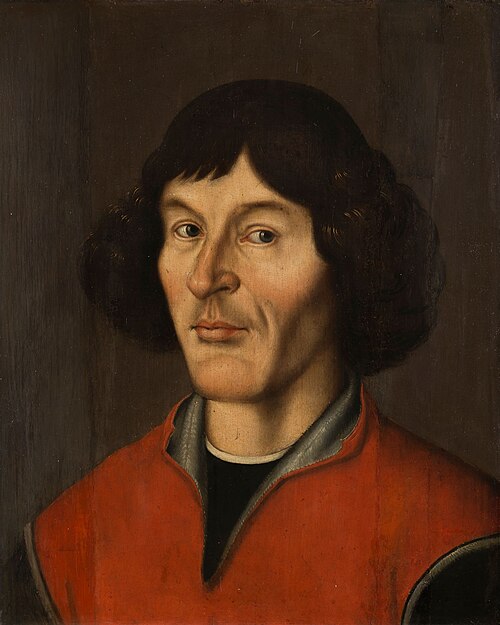
Start at the top for an easy introduction. Go further down for more detail and scholarship.
- Easy
- Intermediate
- Advanced
For young readers
Look at the sky during the day: the Sun seems to rise in the east, cross the sky and set in the west. For thousands of years, most people believed that the Sun, the Moon, the planets and the stars all went around the Earth, and that the Earth stood still in the middle.
About 500 years ago, a man named Nicolaus Copernicus had a surprising idea. What if the Earth is spinning like a top, and that is why the Sun seems to move across the sky? And what if the Earth, like the other planets, travels in a big circle around the Sun?
Copernicus was born in the town of Toruń, in what is now Poland. He studied at universities in Kraków and in Italy, where he learned mathematics, astronomy, law, medicine and ancient Greek. Then he worked for most of his life for the Church in a small town by the Baltic Sea called Frombork.
He was a busy man: he looked after land and money for the Church, treated sick people as a doctor, gave advice on coins, and even helped defend a castle during a war. At night, when he could, he watched the planets and did very long calculations.
He wrote his big book slowly, over many years. It was finally printed in 1543, the year he died. At first, many people liked his maths but did not believe the Earth really moved.
Later scientists such as Kepler, Galileo and Newton showed that Copernicus was right about the big picture. Today we say the “Copernican Revolution” when an idea turns the old way of seeing the world upside down.
At a glance
- Lived
- 19 February 1473 – 24 May 1543
- Born
- Toruń (Thorn), Royal Prussia, under the Crown of the Kingdom of Poland
- Main place of work
- Frombork (Frauenburg), seat of the cathedral chapter of Warmia, from 1510 until his death
- Education
- University of Kraków (1491–c.1495); Bologna (canon law, 1496–1501); Padua (medicine); doctorate in canon law from Ferrara (1503)
- Roles
- Canon of the Warmia chapter, administrator, physician, monetary adviser and astronomer
- Key works
- Commentariolus (manuscript, by 1514); essay on coinage (Monetae cudendae ratio, 1526); De revolutionibus orbium coelestium (Nuremberg, 1543)
- Languages
- Wrote in Latin; is thought to have spoken German and Polish, and knew Greek and Italian
- Legacy
- The heliocentric model that began the “Copernican Revolution”; the chemical element copernicium (Cn) is named after him
Easy
Who was Copernicus?
Nicolaus Copernicus was an astronomer, mathematician and churchman who lived at the time of the European Renaissance. He is famous for one bold idea: that the Sun, not the Earth, lies near the centre of the system of planets, and that the Earth is itself a planet that spins once a day and circles the Sun once a year.
This idea is called heliocentrism, from the Greek word helios, “sun.” The older view, which put the Earth at the centre, is called geocentrism. Copernicus set out his system in a great book in six parts, De revolutionibus orbium coelestium (On the Revolutions of the Heavenly Spheres), printed in Nuremberg in 1543.
Copernicus was not a full-time professor. For most of his adult life he was a canon—a member of the governing chapter of a cathedral—in Warmia, a small church-ruled territory on the Baltic coast. He did his astronomy in the time left over from managing estates, treating patients and dealing with politics and war.
Easy
Childhood and student years
Copernicus was born on 19 February 1473 in Toruń, a trading city on the Vistula River. His father, also named Nicolaus, was a merchant who had moved there from Kraków; his mother, Barbara Watzenrode, came from a leading Toruń merchant family. He was the youngest of four children. Only a few years earlier, in 1466, Toruń and the rest of West (Royal) Prussia had passed from the Teutonic Knights to the Crown of Poland, so the boy from a German-speaking family grew up as a subject of the Polish king.
His father died in 1483, and his maternal uncle Lucas Watzenrode took charge of the children. Watzenrode became bishop of Warmia in 1489 and guided his nephew toward a church career. In 1491 Copernicus entered the University of Kraków, which offered courses in mathematics, astronomy and astrology. He did not take a degree there—this was not unusual—but he began buying books on astronomy.
In 1496 he went to Italy to study canon law at Bologna. There he lived with the astronomy professor Domenico Maria Novara and made his first recorded observations, including the Moon passing in front of the star Aldebaran on 9 March 1497. He also learned Greek, which mattered because some key Greek astronomical works were not yet available in Latin. He later studied medicine at Padua and in 1503 received a doctorate in canon law from the University of Ferrara.
Easy
A busy life in Warmia
Thanks to his uncle, Copernicus had been elected a canon of the Warmia chapter at Frombork in 1495, which gave him a secure income for life. After returning from Italy he first lived with his uncle at the bishop’s palace in Lidzbark, involved in church politics and serving as his physician. In 1510 he moved to Frombork, where he lived for the rest of his life except for periods away on chapter business.
His duties were many. He managed the chapter’s lands, collected rents, settled disputes and kept accounts. From 1516 to 1521 he served as administrator at Olsztyn (Allenstein) Castle, and during the Polish–Teutonic War he directed the defence of Olsztyn against the Teutonic Knights. He also worked as a doctor for bishops, fellow canons and important people across Prussia.
Copernicus even wrote about money. Troubled by the debased coins circulating in Prussia, he wrote essays on coinage, including Monetae cudendae ratio (1526). In them he described the idea that bad, debased coins drive good coins out of circulation—a principle later called Gresham’s law—decades before Thomas Gresham.
Easy
How people pictured the sky before Copernicus
Educated Europeans in 1500 followed a picture of the universe built from the ideas of the Greek philosopher Aristotle and the astronomer Ptolemy, who worked in Alexandria in the second century CE. The Earth sat motionless at the centre. Around it turned the Moon, Mercury, Venus, the Sun, Mars, Jupiter and Saturn, and beyond them the sphere of the fixed stars. Heavenly bodies were thought to be made of a special fifth element that naturally moved in perfect circles.
The trouble was that the planets do not move so simply. Mars, Jupiter and Saturn sometimes seem to stop, move backward for a while and then go forward again. This is called retrograde motion. To explain it, Ptolemy had planets move on small circles (epicycles) whose centres travelled along larger circles (deferents). He also set the Earth slightly off-centre and added a point called the equant, around which the planets appeared to move at an even speed.
Ptolemy’s system worked well enough to predict where planets would be, and astronomers used it for over a thousand years. But many thinkers were uneasy. The equant seemed to break the rule that heavenly motion should be perfectly uniform and circular, and the system did not fit together as one unified whole.
Intermediate
The new idea: the Commentariolus
We do not know exactly when Copernicus became convinced that the Earth moves. It was probably between about 1508 and 1514. In 1514 a Kraków professor listed in his library catalogue a “manuscript of six leaves expounding the theory of an author who asserts that the earth moves while the sun stands still.” This was almost certainly the short, untitled treatise we now call the Commentariolus (“Little Commentary”), which Copernicus circulated in handwritten copies but never printed.
The Commentariolus set out a series of assumptions. The Earth is not the centre of the universe but only the centre of gravity and of the Moon’s orbit. All the planetary spheres surround the Sun, which is near the centre. The universe is vastly larger than people had thought, so the distance from the Earth to the Sun is tiny compared with the distance to the stars. The daily turning of the heavens is really the Earth rotating, the Sun’s yearly motion is really the Earth’s orbit, and the backward loops of the planets are an illusion caused by watching from a moving Earth.
In the Commentariolus Copernicus explained that he was troubled by Ptolemy’s equant and had looked for “a more reasonable arrangement of circles” in which everything would move uniformly. Most scholars believe that dislike of the equant was his starting point, although some argue that it led him to notice other problems that then pushed him toward the moving Earth.
Intermediate
On the Revolutions: writing, printing and a surprise preface
Copernicus spent decades turning his idea into a full mathematical astronomy. The work was slow: he needed new observations, Frombork was often foggy, his duties interrupted him, and he was far from printers and learned colleagues. The Stanford Encyclopedia of Philosophy suggests that fear of church authorities was probably the least of his reasons for delay; the technical difficulty of the task was the main one.
In 1539 a young mathematics professor from the Lutheran University of Wittenberg, Georg Joachim Rheticus, came to study with him. Rheticus published a summary of the theory, the Narratio prima (First Report), in Danzig (Gdańsk) in 1540—the first printed account of Copernicus’s system—and persuaded him to publish the full work. Rheticus took the manuscript to the printer Johannes Petreius in Nuremberg and oversaw most of the printing. According to tradition, Copernicus, paralysed by a stroke, received a copy of the finished book on the day of his death, 24 May 1543.
When Rheticus had to leave for Leipzig, the Lutheran minister Andreas Osiander took over. Osiander added an unsigned preface, “To the reader,” saying that the book’s hypotheses “need not be true nor even probable,” only useful for calculation. This contradicted Copernicus’s own view. Rheticus and Copernicus’s friend Bishop Tiedemann Giese protested, and decades later Johannes Kepler publicly showed that Osiander was the author. Copernicus’s own preface, a dedication to Pope Paul III, insisted that “astronomy is written for astronomers.”
The book has six parts. Book 1 presents the heliocentric order of the planets; Book 2 elaborates the ideas of the first; Book 3 treats the precession of the equinoxes and the Sun; Book 4 the Moon; and Books 5 and 6 the positions of the planets in longitude and latitude. Copernicus’s own manuscript survives in the Jagiellonian University Library in Kraków.
Intermediate
What was new—and what stayed old
The most powerful argument for Copernicus’s system was its unity. Once the Earth is placed among the planets, their order and distances follow from observation: the farther a planet is from the Sun, the longer it takes to go around. Copernicus listed Saturn at 30 years, Jupiter 12 years, Mars 2 years, the Earth one year, Venus 9 months and Mercury 80 days. In Ptolemy’s system nothing tied the planets together in this way. Copernicus also explained naturally why Mercury and Venus always stay close to the Sun, and why the outer planets appear to move backward.
Yet much remained traditional. Copernicus kept the ancient belief that heavenly motions must be perfectly circular and uniform, so he still needed small circles—epicycles or “epicyclets”—to match the observations; his system was not simpler than Ptolemy’s in the number of circles. The Sun was near, but not exactly at, the centre of his planetary orbits. He relied heavily on Ptolemy’s ancient observations, and he kept Aristotle’s physics, which left an awkward question: if the Earth is not the centre of the universe, why do heavy things fall toward it?
His system also faced a strong objection. If the Earth really circled the Sun, the nearby stars should seem to shift slightly during the year (stellar parallax). No such shift could be seen. Copernicus answered that the stars are immensely far away. Opponents such as Tycho Brahe replied that at such distances the stars would have to be absurdly large, and the objection remained a serious one long after Copernicus’s death.
Intermediate
Reception: from “useful maths” to revolution
At first, most readers treated the book as a superb calculating tool rather than a true picture of the world. Historians speak of a “Wittenberg interpretation”: astronomers there, led by Erasmus Reinhold, used Copernicus’s models to compute the Prutenic Tables but did not accept that the Earth moves. Tycho Brahe, the greatest observer before the telescope, called Copernicus a “second Ptolemy” but proposed his own compromise system in which the planets circle the Sun while the Sun circles a motionless Earth.
Religious objections appeared early. Martin Luther is reported to have mocked the idea at dinner in 1539, and his colleague Philipp Melanchthon also criticized it. In Rome, Pope Clement VII had heard an explanation of the theory from Johann Widmanstetter in 1533 and reacted favourably. A Dominican censor, Bartolomeo Spina, wanted to condemn it but died in 1546, and his friend Giovanni Maria Tolosani’s critique went unpublished. Around 1600 only about fifteen astronomers in Europe are thought to have supported Copernicus openly.
Everything changed in the early seventeenth century. Johannes Kepler, a convinced Copernican, replaced circles with ellipses and made heliocentric astronomy far more accurate. Galileo Galilei’s telescope revealed the phases of Venus and moons circling Jupiter. As the controversy grew, the Catholic Church’s Congregation of the Index in 1616 suspended De revolutionibus “until corrected,” calling the moving Earth a “false Pythagorean doctrine.” The general ban on heliocentric books was dropped in 1758, and the last prohibitions of the uncorrected De revolutionibus disappeared from the 1835 Index. Isaac Newton’s physics finally explained why the planets orbit the Sun.
Advanced
Predecessors: Aristarchus and the Maragha astronomers
Copernicus was not the first to imagine a moving Earth. Archimedes reports that Aristarchus of Samos, in the third century BCE, proposed that the Earth rotates and revolves around the Sun. In an early manuscript version of De revolutionibus, Copernicus mentioned the moving-Earth ideas of the Pythagorean Philolaus and of Aristarchus, and he owned a book that included Plutarch’s report of Aristarchus’s view. Scholars generally think he arrived at his system independently, since Aristarchus’s work survives only in brief reports.
A more technical question concerns his debt to astronomers of the Islamic world. Historians have shown that Copernicus used geometrical devices developed by the thirteenth- and fourteenth-century astronomers associated with the Maragha observatory and its successors: the “Tusi couple” of Nasir al-Din al-Tusi, the “Urdi lemma” of Mu’ayyad al-Din al-Urdi, and models of the Moon and Mercury identical to those of Ibn al-Shatir of Damascus. Noel Swerdlow and Otto Neugebauer argued that Copernicus used these devices, and F. Jamil Ragep has shown that a theory used by Regiomontanus had been developed by the Samarkand-trained astronomer Ali Qushji.
How these ideas reached Copernicus is still unclear. No Latin translation of the relevant Arabic texts is known. One possible route runs through Byzantine Greek: Gregory Chioniades translated works of al-Tusi into Greek, and Greek manuscripts containing the Tusi couple survive in Italy, where Copernicus studied. Some historians argue for direct transmission; others allow for independent rediscovery. The debate is important because it places Copernicus within a long, multi-civilizational effort to repair Ptolemy’s astronomy rather than presenting him as a lone genius.
Advanced
Sources, motives and the “book nobody read”
For such an important figure, the primary sources are thin. Copernicus’s surviving astronomical writings are the Commentariolus, the Letter against Werner (1524) and De revolutionibus; his other writings are mostly about coinage and church business. Rheticus wrote a biography of him, but it has been lost. As a result, questions such as why and when he adopted heliocentrism must be answered by inference. The Stanford Encyclopedia rejects the older idea that Neoplatonic or Hermetic philosophy drove him, stressing instead his careful technical analysis of planetary models.
The reception of the book has also been re-examined. Arthur Koestler famously called De revolutionibus “the book that nobody read.” The astronomer and historian Owen Gingerich spent some 35 years examining every surviving copy of the first two editions (1543 and 1566) he could find—276 copies of the first and 325 of the second—and studying readers’ notes in the margins. He showed that most leading astronomers of the sixteenth century owned and read it, though many annotated the technical models far more than the cosmology of Book 1.
Modern national history has added another layer. Nineteenth- and twentieth-century German and Polish writers each claimed Copernicus as their own. Historians such as Norman Davies and writers such as Czesław Miłosz have argued that this projects modern nationalism onto a Renaissance figure who identified above all with Prussia and Warmia, wrote in Latin, is thought to have spoken German and Polish, and served the Polish crown. Archaeology has also contributed: remains found beneath Frombork Cathedral in 2005 were identified as his in 2008, partly by DNA compared with hairs found in a book he had owned, and he was reburied there in 2010.
Key ideas
- Heliocentrism
- The view that the Sun lies at or near the centre of the planetary system and the Earth moves around it.
- Daily rotation of the Earth
- Copernicus explained the daily rising and setting of the Sun and stars by the Earth spinning on its axis, rather than the whole heavens turning.
- Apparent retrograde motion
- The backward loops of the planets are not real; they appear because we observe them from a moving Earth that overtakes or is overtaken by them.
- Unity of the system
- In the Copernican order, planets’ distances and periods are linked: the farther from the Sun, the slower. This coherence was his strongest argument.
- Uniform circular motion
- Copernicus rejected Ptolemy’s equant because he believed heavenly motions must be truly uniform and circular—an ancient ideal he kept.
- A vast universe
- To explain why no stellar parallax could be seen, Copernicus argued that the stars are immensely far away compared with the Earth–Sun distance.
- Copernican Revolution
- The long transformation of astronomy and physics, from Copernicus through Kepler, Galileo and Newton, that replaced the Earth-centred cosmos.
Records
- 1473 — Copernicus is born in Toruń on 19 February.
- 1491 — He enters the University of Kraków.
- 1496 — He begins studying canon law at Bologna and works with the astronomer Domenico Maria Novara.
- 1503 — He receives a doctorate in canon law at Ferrara and returns to Warmia.
- 1510 — He settles at Frombork, where he will live for the rest of his life.
- 1514 — A Kraków library list records a manuscript matching the Commentariolus, the first sketch of his heliocentric theory.
- 1520 — During the Polish–Teutonic War (1519–1521), he directs the defence of Olsztyn Castle.
- 1526 — He writes Monetae cudendae ratio on coinage reform.
- 1539 — Georg Joachim Rheticus arrives in Frombork to study with him.
- 1540 — Rheticus publishes the Narratio prima in Danzig, the first printed account of the theory.
- 1543 — De revolutionibus is printed in Nuremberg; Copernicus dies in Frombork on 24 May.
- 1616 — The Congregation of the Index suspends De revolutionibus “until corrected.”
Glossary
- Geocentrism
- The model that places a motionless Earth at the centre of the universe.
- Epicycle
- A small circle on which a planet moves, whose centre travels around a larger circle (the deferent).
- Equant
- A point in Ptolemy’s models around which a planet appears to move at a steady rate; Copernicus rejected it.
- Retrograde motion
- The apparent backward movement of a planet against the stars for a period of time.
- Stellar parallax
- The small apparent shift of nearer stars caused by the Earth’s motion; it was too small to detect in Copernicus’s time.
- Canon
- A member of the chapter, the body of clergy who helped govern a cathedral and its lands.
- Warmia
- A territory on the Baltic coast ruled by its prince-bishop and cathedral chapter, under the Polish crown in Copernicus’s time.
- Commentariolus
- Copernicus’s short manuscript outline of his heliocentric theory, circulated by 1514.
- Tusi couple
- A geometric device, invented by Nasir al-Din al-Tusi, that produces straight-line motion from two circular motions; Copernicus used it.
- Index of Prohibited Books
- The Catholic Church’s list of banned or restricted books, which suspended De revolutionibus in 1616.
Questions and answers
Was Copernicus the first person to say the Earth goes around the Sun?
No. The Greek astronomer Aristarchus of Samos suggested it about 1,800 years earlier. But Copernicus was the first to work out a full mathematical system of the planets based on a moving Earth.
Did Copernicus use a telescope?
No. The telescope was invented in the early 1600s, long after his death. He used simple instruments and his eyes, and relied a great deal on ancient observations.
Was Copernicus a priest?
He was a canon of the Warmia cathedral chapter, a church office with administrative duties. He took minor orders, which were enough for a canon, but it is unclear whether he was ever ordained a priest.
Why did he wait so long to publish?
Mainly because the mathematics and observations were hard and his many duties left little time. Worry about ridicule and religious objections may have played a part, but scholars think it was not the main reason.
Was his system more accurate than Ptolemy’s?
Not dramatically. Its predictions were of similar quality, and it still used many circles. Its advantages were coherence and a natural explanation of retrograde motion. Real gains in accuracy came with Kepler’s ellipses.
Was Copernicus Polish or German?
He was born in a German-speaking family in a city under the Polish crown and served a territory of the Polish kingdom. Many historians argue that modern national labels do not fit a Renaissance person who saw himself mainly as a Prussian.
Did the Church condemn Copernicus while he was alive?
No. There was no official Catholic position against his theory during his life; De revolutionibus was only suspended in 1616, during the controversy around Galileo.
Sources and further reading
- Sheila Rabin, Nicolaus Copernicus. Stanford Encyclopedia of Philosophy
- Nicolaus Copernicus. Wikipedia
- De revolutionibus orbium coelestium. Wikipedia
- Commentariolus. Wikipedia
- Copernican heliocentrism. Wikipedia
- Owen Gingerich, The Book Nobody Read: Chasing the Revolutions of Nicolaus Copernicus. Walker & Company, 2004
- N. M. Swerdlow and O. Neugebauer, Mathematical Astronomy in Copernicus’s De Revolutionibus. Springer, 1984
Related
- Galileo GalileiItalian mathematician and astronomer who revolutionized astronomy with the telescope, founded the mathematical science of motion and was condemned for defending Copernicus.
- Isaac NewtonEnglish mathematician and natural philosopher who formulated the laws of motion and universal gravitation, developed calculus and explained the composition of white light.
- AristotlePlato's student and Alexander's tutor. He founded the Lyceum and wrote on logic, ethics, politics and the natural world.
- Ibn al-Haytham (Alhazen)Basra-born mathematician and physicist who worked in Fatimid Cairo and whose Book of Optics explained vision as light entering the eye, backed by geometry and experiment.
- Gutenberg BibleLatin Bible printed in Mainz in the 1450s using movable metal type.
Written with AI assistance from the published sources listed above, and revised as new research appears.