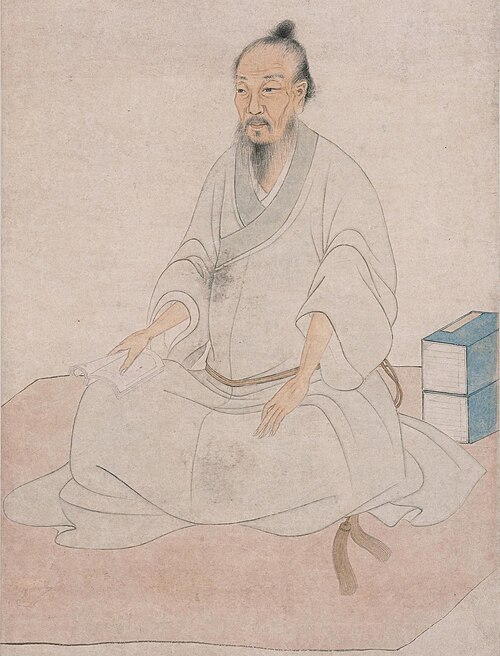
Start at the top for an easy introduction. Go further down for more detail and scholarship.
- Easy
- Intermediate
- Advanced
For young readers
Wang Yangming lived in China about 500 years ago. When he was young, he wanted to become a sage, a perfectly wise and good person. The famous teacher Zhu Xi had said that you become wise by carefully studying the principles in everything around you. So, the story goes, Wang and a friend sat in front of some bamboo plants and stared at them for days, trying to understand the principle of bamboo. The friend gave up after three days, and Wang got sick on the seventh day. They learned nothing about bamboo!
Later Wang became a government official. He bravely spoke up against a powerful and cruel court official. As punishment, he was beaten and sent far away to a poor mountain village in the southwest of China. There, lonely and far from home, he suddenly understood something: the goodness he was looking for was not hidden in bamboo or books. It was already inside his own heart and mind.
Wang taught that every person, whether rich or poor, educated or not, is born with “good knowing” (liangzhi), an inner sense that tells us what is right, like a compass inside. We only need to clear away selfish wishes that cover it up, like wiping dust off a mirror.
He also said that knowing and doing are one thing. If you say you know you should be kind to your parents but you are never kind to them, then you do not really know it yet. Real knowing always shows in what you do.
Wang was not only a thinker. He was also a governor and a general who ended a big rebellion very quickly. His ideas spread to Korea and Japan and are still discussed today.
At a glance
- Lived
- 1472–1529 (born 26 October 1472 in Yuyao, Zhejiang; died 9 January 1529 at Nan’an, Jiangxi)
- Names
- Personal name Wang Shouren 王守仁; courtesy name Bo’an 伯安; known as Yangming after the Yangming Grotto near Shaoxing; posthumous name Wencheng 文成
- Era
- Mid-Ming dynasty (reigns of the Hongzhi, Zhengde and Jiajing emperors)
- Roles
- Philosopher, teacher, scholar-official, provincial governor and military commander
- Key works
- Chuanxi lu 傳習錄 (Instructions for Practical Living, recorded conversations and letters); Inquiry on the Great Learning 大學問 (1527)
- Key ideas
- Mind is principle (心即理), unity of knowledge and action (知行合一), extending innate knowing (致良知)
- School
- School of Mind (心學), often called the Lu–Wang school; Yangming learning (陽明學)
- Influence
- Ming thought; Joseon Korea (the Ganghwa school of Jeong Je-du); Tokugawa and Meiji Japan (Yōmeigaku); modern Chinese philosophy
Easy
Who was Wang Yangming?
Wang Yangming was one of the most important thinkers in the history of Confucianism, the tradition of ethical and political teaching that goes back to Confucius. He lived during the Ming dynasty (1368–1644), when China was ruled by emperors in Beijing and governed by officials chosen through difficult examinations on the Confucian classics.
His real name was Wang Shouren. “Yangming” comes from the Yangming Grotto, a cave on Kuaiji Mountain near Shaoxing where he built a retreat for study; his students called him Master Yangming. He is also remembered as a rare combination: a philosopher who was also an able administrator and one of the most successful military commanders of his time.
Wang challenged the official interpretation of Confucianism created by Zhu Xi in the twelfth century. Zhu Xi’s teachings were the basis of the civil service examinations. Wang did not reject Confucianism, but he argued that the path to goodness begins in one’s own heart-mind, not in studying external things. His ideas started a movement, the School of Mind, that shaped East Asian thought for centuries.
Easy
Early life and the search to become a sage
Wang was born in 1472 in Yuyao, in Zhejiang province, into a family of officials and scholars. His father, Wang Hua, came first in the highest imperial examination in 1481, a great honour, and the family later lived in Beijing and in Shaoxing.
According to traditional biographies, the young Wang was lively and restless. He was interested in military strategy, archery, Daoist techniques for long life and Buddhism, as well as Confucian study. A famous story says that on his wedding day in 1488 he wandered into a Daoist temple, fell into conversation with a Daoist priest, and forgot to come home until the next morning.
Wang tried to follow Zhu Xi’s method of the “investigation of things” (gewu), which taught that by examining the principle (li) in each thing one by one, a person would eventually understand the principle of everything. In the bamboo episode, which Wang later described himself, he and a friend sat in front of bamboo in a courtyard trying to grasp its principle. His friend fell ill after three days, and Wang on the seventh. The failure convinced him that something was wrong with this approach, although it took many more years for him to find his own answer.
In 1499 Wang passed the highest examination and received the jinshi degree. He served in several ministries in Beijing. He suffered from illness and at times considered withdrawing from the world, but he also began to teach, arguing that learning should aim at becoming a sage, not just passing examinations.
Easy
Exile and awakening at Longchang
In 1506, during the reign of the Zhengde emperor, the powerful eunuch Liu Jin controlled the court and persecuted his critics. When officials who had protested were arrested, Wang submitted a memorial defending them. He was publicly beaten with forty strokes of a heavy stick and banished to Longchang, a remote post station in the mountains of Guizhou in the southwest, where he was to be a minor postal official.
Longchang was a hard place for a scholar from the prosperous east. Most of the local people belonged to non-Han peoples whose language Wang could not speak, the climate was harsh, and his servants fell sick. Wang built a simple shelter and, according to his biography, even prepared a stone coffin, facing the possibility of death while trying to keep his mind calm.
In 1508, one night at Longchang, he experienced a sudden awakening. He realized that his own nature was sufficient for becoming a sage and that he had been wrong to seek principle in external things. Principle, he now believed, is not out there in bamboo and books waiting to be discovered; it is present in the mind itself. This moment, known as the Longchang enlightenment (龍場悟道), is traditionally seen as the birth of his philosophy.
The next year, invited to teach at an academy in Guiyang, he began to lecture on the unity of knowledge and action. Local people and officials came to hear him, and he wrote about treating the local peoples with respect and understanding.
Intermediate
Official, governor and general
After Liu Jin fell from power in 1510, Wang returned to office, first as magistrate of Luling county in Jiangxi and then in a series of posts in Nanjing and Beijing. In 1516 he was appointed to govern the rugged border region of southern Jiangxi and neighbouring provinces, where bandit groups and rebel communities had resisted the government for years. Between 1517 and 1518 he suppressed them in a series of campaigns. He then introduced measures to rebuild local order, including a community compact (xiangyue) in which villagers promised to encourage good conduct and settle disputes, as well as local schools.
In 1519 Zhu Chenhao, the Prince of Ning, a member of the imperial family based in Nanchang, rose in rebellion, hoping to seize the throne. Wang, who happened to be nearby, rapidly gathered local forces, spread misleading information to delay the prince, captured his base at Nanchang, and defeated and captured him in a battle on Lake Poyang, all within about six weeks. It was one of the most celebrated military achievements of the Ming.
Success brought trouble. The Zhengde emperor had wanted to lead a campaign himself, and courtiers accused Wang of having been in league with the prince. Wang’s honours were delayed until the new Jiajing emperor made him Earl of Xinjian in 1521. After his father’s death in 1522, Wang spent several years in Shaoxing in mourning and teaching, surrounded by many students.
His military campaigns also had victims. Many of the people he fought in the south were poor settlers, displaced peasants and members of non-Han communities such as the She and Yao, and his campaigns involved large numbers of deaths. Wang believed that restoring order would protect ordinary people, and he emphasized education and reconciliation after fighting, but modern historians also examine his campaigns as part of the Ming state’s violent expansion into its southern frontiers.
Intermediate
The unity of knowledge and action
Wang’s most famous doctrine is the unity of knowledge and action (知行合一, zhixing heyi). Many people think of knowing and doing as two steps: first you learn what is right, then you act on it. Wang argued that this separation is a mistake. Genuine moral knowledge already includes the motivation and the action. As he put it, knowledge is the beginning of action and action is the completion of knowledge.
His example is filial piety. Someone who claims to know filial piety but does not care for their parents does not truly know it; they have only words. He also used the example of liking a beautiful colour or hating a bad smell: the moment you see the colour you already like it, the moment you smell the odour you already dislike it; there is no separate step of deciding to like or dislike. Real moral knowledge, he claimed, works the same way.
Wang meant this as a practical teaching. He criticized scholars who spent their lives reading and discussing morality and planned to act “later”, when they had studied enough. For Wang, moral learning happens in the middle of life, in dealing with family, office and difficult situations. “Training in the midst of affairs” (事上磨練) was one of his watchwords.
Intermediate
Mind is principle and innate knowing
Zhu Xi had taught that principle (li), the pattern that makes each thing what it ought to be, exists in all things and in the mind, and that a person must investigate things outside to understand principle fully. Wang, following the earlier Song thinker Lu Xiangshan (Lu Jiuyuan), declared that “the mind is principle” (心即理). There is no principle of filial piety in the parent’s body, he argued; it is in the mind of the child who loves the parent. Moral principles are not found outside and then brought in; they arise from the mind responding to situations.
Around 1520–1521 Wang summed up his teaching in the phrase “extending innate knowing” (致良知, zhi liangzhi). The term liangzhi, “good knowing” or “innate knowledge of the good”, comes from Mencius, who said that people know how to love their parents without being taught. For Wang, liangzhi is the mind’s natural ability to recognize right and wrong in each situation. Everyone has it in full, sage and ordinary person alike, but selfish desires obscure it. Learning means removing these obstructions and following liangzhi in every action.
Wang reinterpreted the classic Great Learning accordingly. Zhu Xi had rearranged its text and added a passage on investigating things; Wang insisted on the “old text” without Zhu’s changes and read gewu not as investigating external things but as “rectifying” one’s intentions and affairs, correcting what is not right in one’s own mind. His Inquiry on the Great Learning (1527) also presents the idea that the humane person forms “one body” with heaven, earth and all things, feeling their suffering as one’s own.
In his last years Wang summarized his teaching in the Four-Sentence Teaching (1527): the substance of the mind is without good or evil; when intentions move, there is good and evil; knowing good and evil is innate knowing; doing good and removing evil is rectifying things. His leading disciples interpreted these lines differently, and the debate shaped the later school.
Intermediate
Works and how they were recorded
Wang did not write a systematic treatise. His teaching survives mainly in the Chuanxi lu (傳習錄), “Record of Instructions for Practice”, a collection of conversations recorded by his students together with letters. The first part was compiled by his early disciple Xu Ai, who died in 1517, and was published by Xue Kan in 1518. More material was added in later editions, and the standard three-part version took shape in the decades after Wang’s death through the work of his disciple Qian Dehong and others. Wing-tsit Chan’s English translation (1963) is titled Instructions for Practical Living.
Other important texts include the Inquiry on the Great Learning, his edition of and preface to the old text of the Great Learning, and a controversial compilation, Zhu Xi’s Final Conclusions Arrived at Late in Life (1518), in which he argued that Zhu Xi had come to agree with him late in life. Critics, including the scholar Luo Qinshun, pointed out that some of the letters he cited were not late at all.
His complete works (Wang Wencheng gong quanshu), including memorials, official documents, poems and letters, were compiled after his death. The official documents are an important source for his administrative and military career.
Intermediate
Followers, critics and influence across East Asia
Wang died on 9 January 1529 on his way home from a campaign in Guangxi. His last words are recorded as: “This mind is bright and clear. What more is there to say?” Soon afterwards the court condemned his teaching as false and withdrew his title. His reputation was restored in 1567, when he received the posthumous name Wencheng, and in 1584 his tablet was placed in the Confucian Temple, the highest honour for a Confucian scholar.
His followers split into several branches, which the seventeenth-century historian Huang Zongxi classified by region in his Records of Ming Scholars (Mingru xue’an). Some, like Wang Ji, stressed the spontaneous working of innate knowing; others, like Qian Dehong and Nie Bao, stressed careful cultivation. The Taizhou school, founded by Wang Gen, a former salt worker, took the message that anyone can become a sage to commoners, and later radicals such as Li Zhi challenged conventional morality. After the fall of the Ming in 1644, critics such as Gu Yanwu blamed the Wang school’s emphasis on inner mind for empty talk and moral laxity, and Qing scholarship turned toward textual research.
In Joseon Korea, where Zhu Xi’s learning was the state orthodoxy, the great scholar Yi Hwang (Toegye) wrote a critique of the Chuanxi lu and condemned Wang’s ideas as heterodox, which limited their spread. Nevertheless, Jeong Je-du (1649–1736) developed the first systematic Korean Yangming philosophy and, after moving to Ganghwa Island in 1709, founded what became known as the Ganghwa school. In the early twentieth century Korean nationalist scholars such as Park Eun-sik and Jeong In-bo turned to Yangming learning as a philosophy of practice for national renewal.
In Japan, Yangming learning (Yōmeigaku) was taken up by Nakae Tōju and Kumazawa Banzan in the seventeenth century. It inspired Ōshio Heihachirō, who led an uprising in Osaka in 1837 on behalf of the starving poor, and it is often said to have influenced activists of the Meiji Restoration. In modern China, thinkers such as Mou Zongsan developed Wang’s ideas within New Confucianism, and Wang has recently been promoted in public life as a model of combining thought and action.
Advanced
Philosophical debates
Weakness of will. If knowing the good is already acting on it, how can people knowingly do wrong? Wang’s answer is that in such cases the knowledge is not genuine; it has been obscured by selfish desires. Philosophers, including contributors to the Stanford Encyclopedia of Philosophy, have debated whether this amounts to denying weakness of will (akrasia) altogether, as Socrates is often thought to have done, or whether Wang is redefining knowledge in a special practical sense. Philip J. Ivanhoe and others have compared Wang’s view with that of Mencius and with Western moral psychology.
Buddhism and Chan. Critics from Wang’s time onward accused him of teaching Chan (Zen) Buddhism in Confucian dress, because of his emphasis on sudden awakening, the mind, and the phrase “without good or evil” in the Four-Sentence Teaching. Defenders argue that Wang’s focus on family, society and moral action is thoroughly Confucian, and that his use of Buddhist-sounding language serves Confucian ends. Scholars continue to study how far he borrowed from Buddhist and Daoist practice, which he had studied deeply in his youth.
The Four-Sentence Teaching. In the famous discussion at the Tianquan Bridge in 1527, Wang Ji argued that if the substance of the mind is beyond good and evil, then intentions, knowledge and things must also be beyond good and evil (the “four nothings”), while Qian Dehong held that the first sentence describes the original state and the rest describe the practice needed by ordinary people (the “four haves”). Wang reportedly said that both views had their uses for different kinds of students. The debate became a central problem of late Ming thought.
Idealism? Modern interpreters have sometimes called Wang a subjective idealist, pointing to his remark that flowers on a mountain are not outside the mind. Many specialists argue that this is misleading: Wang was not denying the existence of the external world but claiming that value and meaning arise in the relationship between the mind and things. How to describe his metaphysics in modern terms remains open.
Advanced
Sources and the reliability of biographical accounts
The main source for Wang’s life is the chronological biography (nianpu) compiled after his death by his disciples, especially Qian Dehong. It is detailed and draws on documents and personal memories, but it was written to present Wang as a sage and a model, and it contains stories, such as the wedding-night conversation with a Daoist priest, the stone coffin at Longchang and some episodes of his youth, that may have been shaped or embellished. Historians compare it with Wang’s own letters, official memorials and records such as the Veritable Records of the Ming (Ming shilu) and the Ming History.
The dating of doctrines raises further questions. The nianpu presents a neat sequence: awakening at Longchang in 1508, the unity of knowledge and action in 1509, innate knowing in 1521, the Four-Sentence Teaching in 1527. Scholars such as Tu Weiming, in his study of Wang’s youth (1976), and Julia Ching (1976) have used letters and poems to test and nuance this picture, showing that Wang’s ideas developed gradually and in dialogue with friends and critics.
Finally, the Chuanxi lu is a record by students, not Wang’s own composition. Different disciples recorded and edited his words in light of their own understanding, and later editors selected and arranged the material. Careful study compares editions and records to separate Wang’s views from those of his followers.
Key ideas
- Mind is principle (xin ji li)
- Moral principles are not external objects to be discovered but arise in the heart-mind as it responds to situations.
- Unity of knowledge and action (zhixing heyi)
- Genuine moral knowledge already includes action; knowing without doing is not true knowing.
- Innate knowing (liangzhi)
- The inborn capacity, shared by everyone, to recognize right and wrong in each situation.
- Extending innate knowing (zhi liangzhi)
- Clearing away selfish desires so that liangzhi guides every action; Wang’s mature summary of his teaching.
- Rectifying things (gewu)
- Wang’s reading of the Great Learning: correcting one’s intentions and affairs rather than investigating external objects.
- Forming one body with all things
- The humane person feels connected to all beings and responds to their suffering as his own.
- Training in the midst of affairs
- Moral cultivation happens in daily life and work, not only in quiet study.
Records
- 1472 — Wang Shouren is born in Yuyao, Zhejiang (26 October).
- 1499 — Wang passes the metropolitan examination and becomes a jinshi.
- 1506 — Wang defends officials persecuted by the eunuch Liu Jin; he is beaten and banished to Longchang, Guizhou.
- 1508 — Wang experiences his awakening at Longchang.
- 1509 — Teaching in Guiyang, he begins to speak of the unity of knowledge and action.
- 1517 — As governor in southern Jiangxi he campaigns against bandits and rebels (to 1518).
- 1518 — The first part of the Chuanxi lu is published.
- 1519 — Wang suppresses the rebellion of Zhu Chenhao, Prince of Ning, within about six weeks.
- 1521 — Wang teaches “extending innate knowing” and is made Earl of Xinjian.
- 1527 — Wang composes the Inquiry on the Great Learning and gives the Four-Sentence Teaching before leaving for Guangxi.
- 1529 — Wang dies at Nan’an, Jiangxi (9 January).
- 1584 — Wang is enshrined in the Confucian Temple.
Glossary
- Neo-Confucianism
- The revival and reinterpretation of Confucianism from the Song dynasty onward, including both Zhu Xi’s school and Wang’s.
- Principle (li 理)
- The pattern or reason that makes things what they are and what they ought to be.
- Heart-mind (xin 心)
- The seat of both thinking and feeling in Chinese thought; often translated “mind” or “heart”.
- Liangzhi 良知
- “Good knowing” or innate knowledge of the good, a term from Mencius central to Wang’s teaching.
- Gewu 格物
- A phrase from the Great Learning, read by Zhu Xi as “investigating things” and by Wang as “rectifying things”.
- Jinshi 進士
- The highest degree in the imperial examinations, qualifying for senior office.
- Eunuch
- A castrated male servant of the imperial palace; some Ming eunuchs held great political power.
- Chuanxi lu 傳習錄
- The collected conversations and letters of Wang Yangming, the main source for his thought.
- School of Mind (xinxue 心學)
- The tradition of Lu Xiangshan and Wang Yangming, emphasizing the mind as the source of moral principle.
- Yōmeigaku
- The Japanese name for the study of Wang Yangming’s thought.
Questions and answers
Did Wang Yangming really stare at bamboo for seven days?
That is how he told the story himself, many years later. Whether or not every detail is exact, he used it to show why Zhu Xi’s method of investigating things did not work for him.
What does “knowing and doing are one” mean?
It means that if you really know something is good, you will do it. If you do not act, your knowing is not yet real.
Was Wang Yangming against studying books?
No. He read widely and lectured on the classics. He objected to study that became an end in itself, separated from becoming a better person.
Why is he called both a philosopher and a general?
Besides teaching, he served as an official and commander and famously crushed the Prince of Ning’s rebellion in 1519 within about six weeks.
How did his ideas reach Korea and Japan?
His books were carried by scholars and envoys. In Korea they were criticized by Yi Hwang but developed by Jeong Je-du; in Japan they were taken up by Nakae Tōju and later by reformers.
Is Wang’s philosophy a form of Zen Buddhism?
His critics said so, pointing to his talk of sudden awakening and a mind “without good or evil”. Most scholars see him as a Confucian who learned from Buddhism but put family, society and moral action at the centre.
Does the unity of knowledge and action deny weakness of will?
This is debated. Wang said people who knowingly do wrong do not truly know; philosophers disagree on whether this denies weakness of will or redefines what counts as knowing.
Sources and further reading
- Wang Yangming. Stanford Encyclopedia of Philosophy
- Wang Yangming (1472–1529). Internet Encyclopedia of Philosophy
- Wang Yangming. Wikipedia
- Yangmingism. Wikipedia
- 전습록. 위키백과 (Korean Wikipedia)
- 정제두 (Jeong Je-du). Encyclopedia of Korean Culture, Academy of Korean Studies
- 전습록논변 (Jeonseuprok nonbyeon). Encyclopedia of Korean Culture, Academy of Korean Studies
- Wing-tsit Chan (trans.), Instructions for Practical Living and Other Neo-Confucian Writings by Wang Yang-ming. Columbia University Press, 1963
- Philip J. Ivanhoe, Readings from the Lu-Wang School of Neo-Confucianism. Hackett, 2009
Related
- Zhu XiSong philosopher who gave enduring form to Neo-Confucian learning.
- MenciusA Confucian thinker who argued that people have the beginnings of moral goodness and that rulers must care for their subjects.
- ConfuciusTeacher from the state of Lu whose sayings, gathered in the Analects, shaped ethics and government across East Asia.
- Jeong Yak-yongJoseon scholar and reform thinker who wrote extensively about government, law and the practical responsibilities of officials.
- LaoziTraditionally named author of the Daodejing. Whether he was a single historical person is still debated.
Written with AI assistance from the published sources listed above, and revised as new research appears.