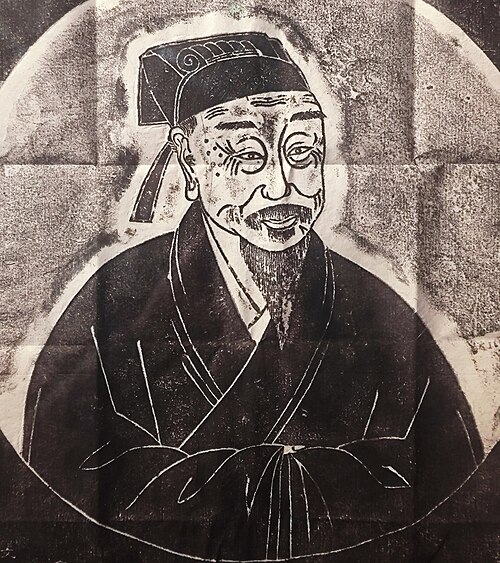
Start at the top for an easy introduction. Go further down for more detail and scholarship.
- Easy
- Intermediate
- Advanced
For young readers
Zhu Xi was born in 1130 in the mountains of Fujian, in southern China. A story says that when he was a small boy his father pointed at the sky and said, “That is heaven.” Little Zhu Xi asked, “And what is above heaven?” He kept asking big questions like that all his life.
He passed China's hardest government exam when he was only eighteen. But instead of chasing power, he spent most of his life reading, thinking and teaching. He liked to teach in quiet academies in the mountains, and hundreds of students came to learn from him.
Zhu Xi believed that everything in the world has a pattern, a “right way” of being, which he called li. A bamboo plant has the pattern of bamboo, a good son has the pattern of being a good son. Everything is also made of a kind of energy or stuff called qi. If you study things carefully, one after another, you slowly understand their patterns, and you become wiser and kinder.
He chose four short books of Confucian teaching and wrote clear notes on every line. These “Four Books” became the textbooks that every student in China had to learn for the government exams, from the 1300s until 1905. In Korea's Joseon dynasty, too, his ideas shaped schools, families and government.
Not everyone agreed with him. Some thinkers said it was better to look into your own heart than to study so many things. People still argue about his ideas today, which shows how important they are.
At a glance
- Life
- Born 1130 in Youxi, Fujian; died 1200 in Jianyang, Fujian
- Other names
- Courtesy names Yuanhui and Zhonghui; styled Hui'an; honoured as Zhuzi (Master Zhu); posthumous title Wen (Zhu Wengong)
- Era
- Southern Song dynasty (1127–1279)
- Roles
- Philosopher, teacher, commentator on the classics, local official
- Major works
- Collected Commentaries on the Four Books; Reflections on Things at Hand (with Lü Zuqian); Classified Conversations of Master Zhu (compiled after his death)
- School
- Neo-Confucianism: the Cheng–Zhu school of principle (lixue)
- Key ideas
- Principle (li) and vital stuff (qi); investigating things; reverence; the Four Books
- Influence
- Basis of the Chinese civil-service examinations from the 14th century to 1905; state orthodoxy in Joseon Korea; major influence in Japan and Vietnam
Easy
Who was Zhu Xi?
Zhu Xi (1130–1200) was the most influential Confucian thinker after Confucius and Mencius. Living in the Southern Song dynasty, he gathered the ideas of earlier Song philosophers into a single, comprehensive system that explained the universe, human nature, learning and government. This system is called Neo-Confucianism in English, and in Chinese often lixue, “learning of principle”, or daoxue, “learning of the Way”.
He was also a tireless teacher and editor. He wrote commentaries on the Confucian classics, compiled anthologies, revived academies, and discussed philosophy with hundreds of students, whose notes of his conversations fill 140 chapters. The Internet Encyclopedia of Philosophy notes that his thought dominated Chinese intellectual life for some eight centuries.
Most importantly, his selection of the Four Books and his commentaries on them became the official curriculum of the civil-service examinations from the Yuan dynasty until 1905. Generations of students across East Asia learned Confucianism through Zhu Xi's eyes.
Easy
His life: scholar, teacher and reluctant official
Zhu Xi was born in Youxi, Fujian, in 1130, soon after the Jurchen Jin dynasty had conquered northern China and the Song court had fled south. His father, a minor official, lost his post in 1140 for opposing peace with the Jin, and died when Zhu Xi was thirteen. The boy was then educated by his father's friends.
He passed the highest civil-service examination, the jinshi, in 1148, when he was eighteen. His first post was as a registrar in Tong'an county in Fujian. From 1153 he studied with Li Tong, a scholar in the tradition of the brothers Cheng Hao and Cheng Yi of the Northern Song. Under Li Tong's influence Zhu Xi turned away from his youthful interest in Buddhism and Daoism and devoted himself to Confucian learning.
For most of his life Zhu Xi held only minor or honorary posts, often temple sinecures that let him study. He served in real office for only about nine years, but did so energetically: as prefect of Nankang (1179–1181) he revived the White Deer Grotto Academy; he organised famine relief and promoted community granaries; as prefect of Zhangzhou (1190) and Tanzhou (1194) he reformed local customs and schools. In 1194 he was briefly a lecturer to the new Emperor Ningzong, but he was dismissed after about forty days for criticising the emperor's advisers.
His last years were dark. The powerful minister Han Tuozhou attacked Zhu Xi's circle, and from 1196 his teaching was banned as “false learning” (weixue); his followers were blacklisted. Zhu Xi died in 1200 while the ban was still in force. It was lifted soon after, and in 1209 he received the posthumous name Wen, “the Cultured”. In 1241 his tablet was placed in the Confucian temple.
Easy
Principle and vital stuff: li and qi
Zhu Xi explained the world with two ideas. Qi is the energy-stuff out of which everything is made: rocks, plants, animals, people, even thoughts and feelings. It is always moving, gathering and dispersing, heavier or lighter, clearer or murkier. Li, usually translated “principle” or “pattern”, is what makes each thing the kind of thing it is and what it ought to be: the pattern of a tree, of a boat, of a loving parent.
The two never exist apart. There is no qi without li and no li without qi. Yet Zhu Xi also said that li is in a sense prior, because it is the reason why things are as they are. Scholars still debate what exactly this priority means.
Zhu Xi borrowed a famous formula from Cheng Yi: “principle is one, its manifestations are many” (liyi fenshu). There is one great principle for the whole universe, which Zhu Xi identified with the Supreme Ultimate (taiji) described by the earlier thinker Zhou Dunyi; yet it appears differently in every thing and every relationship, just as the moon is one yet reflected in countless rivers, an image Zhu Xi himself used.
Intermediate
Human nature, the heart-mind and moral cultivation
Following Mencius, Zhu Xi held that human nature is good. Our nature is simply principle as it exists in us: the capacities for humaneness (ren), rightness, ritual propriety and wisdom. Why, then, do people do wrong? Because each person is also made of qi, and the qi we are born with may be clear or turbid. Zhu Xi distinguished the original nature, which is the same in everyone, from the physical nature, shaped by one's endowment of qi.
The heart-mind (xin) is where these meet. Adopting a phrase of Zhang Zai, Zhu Xi said that the heart-mind “unites nature and feelings” (xin tong xing qing). Feelings are not bad in themselves, but they must be guided by principle. Selfish desires that go beyond what is appropriate obscure our good nature. Zhu Xi's famous slogan, “preserve heavenly principle and eliminate human desires”, meant eliminating such selfish excess, not every natural wish, though later critics read it more harshly.
Cultivation therefore has two sides. One is reverence or mindfulness (jing): a calm, focused, attentive state of mind maintained both in quiet and in activity. The other is the investigation of things (gewu), which leads to the extension of knowledge (zhizhi). Zhu Xi summed up the method: preserve the mind with reverence, and extend knowledge by investigating principle. Neither is enough alone.
Intermediate
Investigating things and the art of reading
The phrase “investigating things and extending knowledge” comes from the Great Learning, a short classical text. Zhu Xi believed part of the text had been lost, so he rearranged it and wrote a supplementary passage explaining what investigation means: by examining the principle of each thing we meet, one after another, and accumulating understanding over time, a person reaches a point where everything suddenly connects and the whole of principle becomes clear.
“Things” includes natural objects, but above all human affairs: relationships, historical events, and the classics. For Zhu Xi the most important form of investigation was careful reading. He gave detailed advice on how to read: slowly, repeatedly, without forcing one's own ideas onto the text, until its meaning becomes part of oneself. His conversations on reading are among the most practical passages in his work.
He was also curious about nature. He observed fossil shells high in the mountains and concluded that the land had once been under water, and he discussed astronomy, calendars and geography. Modern scholars disagree about how far his investigation of things resembles scientific inquiry; its main goal was moral understanding.
Intermediate
The Four Books and his other writings
Earlier Confucian education centred on the Five Classics, large and difficult ancient works. Building on the Cheng brothers, Zhu Xi made four shorter texts the core curriculum: the Great Learning and the Doctrine of the Mean (two chapters from the Book of Rites), the Analects of Confucius, and the Mencius. He recommended reading them in the order Great Learning, Analects, Mencius and finally the Doctrine of the Mean. In 1190, as prefect of Zhangzhou, he printed the four together, and he kept revising his Collected Commentaries on them until his death.
With his friend Lü Zuqian he compiled Reflections on Things at Hand (Jinsi lu, 1175), an anthology of sayings by the Northern Song masters Zhou Dunyi, Zhang Zai, Cheng Hao and Cheng Yi, which became a basic introduction to Neo-Confucianism. He also wrote commentaries on the Book of Changes and the Book of Songs, compiled Elementary Learning (Xiaoxue) for the young, and directed an outline-and-details version of the great history Comprehensive Mirror for Aid in Government.
The Family Rituals (Jiali), a guide to capping, weddings, funerals and ancestral rites for ordinary families, has been attributed to him since the Song, though its authorship was questioned by some Qing scholars; many modern historians regard it as substantially his work. His letters, essays and poems fill a huge collected works, and his disciples' records of his conversations were compiled in 1270 as the Classified Conversations of Master Zhu (Zhuzi yulei).
Intermediate
Academies, debates and the Goose Lake meeting
Zhu Xi believed education should aim at personal moral growth, not merely at passing examinations. He founded or revived private academies (shuyuan), including the Hanquan Study near his home and the Wuyi Study in the Wuyi Mountains (1183). His revival of the White Deer Grotto Academy near Mount Lu in 1179, with its short statement of learning rules stressing the five human relationships and self-cultivation, made it a model for academies across East Asia.
In 1175 Lü Zuqian arranged a meeting at the Goose Lake Temple in Jiangxi between Zhu Xi and the brothers Lu Jiuyuan and Lu Jiuling. Lu Jiuyuan argued that the mind itself is principle and that one should first establish the moral mind; extensive study was secondary. Zhu Xi insisted on patient learning and investigation. The debate did not resolve their differences, and it came to symbolise the division between Zhu Xi's school of principle and the school of mind, later developed by Wang Yangming.
Zhu Xi also carried on long exchanges with the Hunan scholar Zhang Shi, and disputed with the utilitarian thinker Chen Liang over whether the great Han and Tang rulers had truly followed the Way. These debates show that his philosophy took shape through argument with gifted contemporaries.
Intermediate
Influence across East Asia
In China, the Yuan dynasty decreed in 1313 that the examinations would be based on the Four Books with Zhu Xi's commentaries, and the first such examinations were held in 1315. The Ming and Qing dynasties continued this system, so that until the examinations were abolished in 1905, Zhu Xi's interpretations were the official reading of Confucianism for hundreds of thousands of candidates.
In Korea, Zhu Xi's learning was introduced in the late thirteenth century; An Hyang is traditionally credited with bringing it from Yuan China. It became the ruling ideology of the Joseon dynasty (1392–1897), shaping government, education, family ritual and ancestor worship. Korean thinkers such as Yi Hwang (Toegye) and Yi I (Yulgok) developed Zhu Xi's ideas with great depth, especially in the Four–Seven Debate over the relation between moral feelings and li and qi. In Korean the school is called seongnihak, “learning of nature and principle”.
In Tokugawa Japan (1603–1868), scholars such as Hayashi Razan promoted Zhu Xi's teaching, which enjoyed official favour, and Yamazaki Ansai developed a strict Zhu Xi school. In Vietnam, Zhu Xi's commentaries were likewise central to education and examinations under later dynasties. Neo-Confucian ethics shaped family life, gender roles and ideas of loyalty across the region, for better and for worse.
Advanced
Sources for his life
Compared with most premodern thinkers, Zhu Xi is unusually well documented. Thousands of his own letters, memorials, prefaces and poems survive in his collected works, and the Classified Conversations record his words as noted down by dozens of disciples, often with dates and names, so that scholars can trace how his views changed. The earliest full biography is the Account of Conduct (xingzhuang) written by his disciple and son-in-law Huang Gan, and the official History of Song places him in a special chapter on the “learning of the Way” (Daoxue zhuan).
These sources also have limits. The Account of Conduct and many later chronological biographies (nianpu) were written by admirers who presented him as the model sage; the Qing scholar Wang Maohong produced a more critical nianpu that sorted out dates and questioned some traditions. The conversation records vary in reliability, since different disciples heard and wrote down his words differently. Modern biographers therefore weigh the dated letters most heavily.
Advanced
Critics and rival readings
The school of mind. Wang Yangming (1472–1529), the most important Ming critic, recounted how as a young man he tried to investigate the principle of bamboo by staring at bamboo for days until he fell ill, and concluded that principle is not to be sought outside the mind. He argued for the unity of knowledge and action and compiled Zhu Xi's late letters to claim that Zhu Xi himself had come round to a mind-centred view, a claim most scholars regard as selective.
Qing critics. Scholars of the Qing dynasty's evidential learning (kaozheng) movement criticised the Song Neo-Confucians for reading Buddhist and Daoist metaphysics into the classics. Dai Zhen (1724–1777) argued that Zhu Xi's sharp separation of principle from desire allowed the powerful to “kill people with principle”, condemning the natural desires of the weak in the name of morality. Wang Fuzhi and Dai Zhen affirmed the primacy of qi over li.
Modern critiques. In the early twentieth century, reformers of the May Fourth movement attacked Confucian orthodoxy, and Zhu Xi's ethics in particular, as a source of oppressive family and gender norms, such as the pressure on widows not to remarry. Defenders reply that later orthodoxy hardened Zhu Xi's teachings far beyond what he intended.
Buddhist influence. Zhu Xi vigorously criticised Buddhism for denying the reality of the world and human relationships. Yet many historians note that the metaphysical scale of Neo-Confucianism, and practices such as quiet sitting, developed in dialogue with Chan and Huayan Buddhism. How deep this influence goes is debated.
Advanced
Modern interpretations and open questions
What is li? Feng Youlan, in the 1930s, compared li to Platonic Forms, presenting Zhu Xi as a rationalist with a realm of eternal principles. Joseph Needham read Zhu Xi as an organic naturalist, with li as the organising pattern within things. A. C. Graham argued that li is better understood as contextual pattern than as abstract law, and others speak of li as “coherence”. These interpretations reflect different comparative frameworks as much as the texts themselves.
Orthodoxy or side branch? The New Confucian philosopher Mou Zongsan argued that Zhu Xi, by separating the mind from principle, departed from the main line of Confucian moral metaphysics running from Mencius to Lu Jiuyuan and Wang Yangming, calling his system a “side branch that became the orthodoxy”. Qian Mu, by contrast, produced a monumental study presenting Zhu Xi as the great synthesiser of Chinese learning. Wing-tsit Chan's translations and studies made Zhu Xi accessible in English.
Politics and society. Historians such as Yu Ying-shih have emphasised the political side of Zhu Xi's career: the daoxue fellowship as a reforming faction of scholar-officials seeking to guide emperors, and the ban on false learning as a political struggle. Others study his local activism in community granaries, academies and family rituals, which helped create the local elite culture of later imperial China.
Philosophers today also read Zhu Xi in the context of virtue ethics, moral psychology and environmental thought. The Stanford Encyclopedia of Philosophy describes the field of Zhu Xi studies as vital, wide-ranging and contentious.
Key ideas
- Principle (li)
- The pattern that makes each thing what it is and what it ought to be; one in essence, many in manifestation.
- Vital stuff (qi)
- The energy-matter that makes up all things and accounts for their differences.
- Supreme Ultimate (taiji)
- The totality of principle, the ultimate source of order in the universe.
- Investigating things (gewu)
- Studying the principle of things one by one, above all through reading, until understanding becomes comprehensive.
- Reverence (jing)
- A focused, attentive state of mind maintained in both stillness and activity.
- Human nature is good
- Our original nature is principle itself; turbid qi and selfish desires obscure it.
- The Four Books
- The Great Learning, Doctrine of the Mean, Analects and Mencius, made the core of Confucian education.
Records
- 1127 — The Jin conquer northern China; the Song court re-establishes itself in the south.
- 1130 — Zhu Xi is born in Youxi, Fujian.
- 1148 — He passes the jinshi examination at eighteen.
- 1153 — He first meets his teacher Li Tong and takes up his post as registrar of Tong'an.
- 1175 — He compiles Reflections on Things at Hand with Lü Zuqian and meets Lu Jiuyuan at Goose Lake Temple.
- 1179 — As prefect of Nankang, he revives the White Deer Grotto Academy.
- 1183 — He builds the Wuyi Study in the Wuyi Mountains.
- 1190 — As prefect of Zhangzhou, he prints the Four Books together.
- 1196 — The Qingyuan ban on “false learning” is imposed on his school.
- 1200 — Zhu Xi dies in Jianyang while the ban is in force.
- 1313 — The Yuan dynasty makes his commentaries on the Four Books the basis of the examinations (first held in 1315).
- 1905 — The Qing abolishes the civil-service examinations, ending Zhu Xi's official curriculum.
Glossary
- Neo-Confucianism
- The revival and reinterpretation of Confucianism from the Song dynasty onwards.
- Li (principle, pattern)
- The pattern or reason that makes things what they are.
- Qi
- Vital energy or matter, the stuff of which all things are made.
- Taiji
- The Supreme Ultimate, the source of all principle.
- Ren
- Humaneness or benevolence, the highest Confucian virtue.
- Jinshi
- The highest degree in the imperial civil-service examinations.
- Shuyuan
- A private or semi-private academy for study and teaching.
- Daoxue
- “Learning of the Way”, the name used by Zhu Xi's movement and its critics.
- Seongnihak
- The Korean name for Zhu Xi's learning of nature and principle.
- Kaozheng
- Qing-dynasty evidential scholarship based on philology and textual criticism.
Questions and answers
Is Zhu Xi as important as Confucius?
Not as the founder, but for later history he was hugely important: for about 600 years, most East Asian students learned Confucius's teachings through Zhu Xi's commentaries.
What does li mean?
It is usually translated “principle” or “pattern”: what makes a thing what it is and how it should be. Scholars debate the best translation.
Did Zhu Xi want people to suppress all their feelings?
No. He thought feelings are natural and should be guided by principle. His warning was against selfish desires that go beyond what is right, though later critics said his teachings were used to justify oppression.
Why was his teaching banned?
In 1196 his circle lost a political struggle with the minister Han Tuozhou, who labelled their teaching “false learning”. The ban was lifted after Zhu Xi's death.
How did Zhu Xi influence Korea?
His learning became the ruling ideology of the Joseon dynasty, shaping government, schools and family rituals, and Korean scholars like Yi Hwang and Yi I developed it further.
What was the Goose Lake debate about?
In 1175 Zhu Xi and Lu Jiuyuan disagreed over whether moral learning should begin with broad study and investigation or with establishing the moral mind within.
Did Zhu Xi write the Family Rituals?
It has long been attributed to him; some Qing scholars doubted this, but many modern historians consider it substantially his work.
Sources and further reading
- Zhu Xi. Stanford Encyclopedia of Philosophy
- Zhu Xi (Chu Hsi) (1130–1200). Internet Encyclopedia of Philosophy
- Zhu Xi. Wikipedia
- Neo-Confucianism. Wikipedia
- Four Books and Five Classics. Wikipedia
- White Deer Grotto Academy. Wikipedia
- 주희. 위키백과 (Korean Wikipedia)
- 성리학. 위키백과 (Korean Wikipedia)
- Wing-tsit Chan (trans.), Reflections on Things at Hand: The Neo-Confucian Anthology Compiled by Chu Hsi and Lü Tsu-ch'ien. Columbia University Press, 1967
- Patricia Buckley Ebrey (trans.), Chu Hsi's Family Rituals: A Twelfth-Century Chinese Manual for the Performance of Cappings, Weddings, Funerals, and Ancestral Rites. Princeton University Press, 1991
Related
- ConfuciusTeacher from the state of Lu whose sayings, gathered in the Analects, shaped ethics and government across East Asia.
- MenciusA Confucian thinker who argued that people have the beginnings of moral goodness and that rulers must care for their subjects.
- Wang YangmingMing philosopher and official who taught that moral knowledge must be realized in action.
- Jeong Yak-yongJoseon scholar and reform thinker who wrote extensively about government, law and the practical responsibilities of officials.
- Classic of Poetry (Shijing)China's oldest poetry anthology — folk songs, court odes and temple hymns later counted among the Confucian classics.
Written with AI assistance from the published sources listed above, and revised as new research appears.