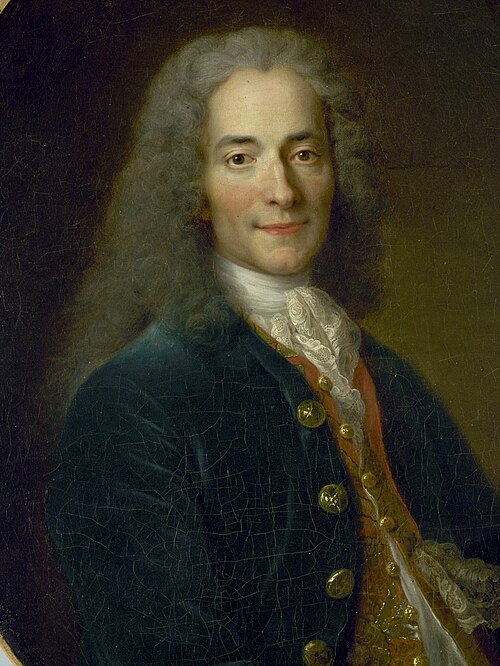
Start at the top for an easy introduction. Go further down for more detail and scholarship.
- Easy
- Intermediate
- Advanced
For young readers
Voltaire was born in Paris in 1694. His real name was François-Marie Arouet, but when he was young he invented a new name for himself, “Voltaire”, and that is the name the whole world remembers.
Voltaire was very clever and very funny, and he loved to make fun of powerful people who were cruel or foolish. This got him into trouble. He was locked up twice in the Bastille, a famous prison in Paris, and had to leave France for England, and later he lived near the Swiss border so he could escape quickly if the police came for him.
In England he discovered new ideas about science, especially Isaac Newton’s discoveries about gravity and light, and about freedom of religion. He came back and wrote books telling the French about them. With his friend Émilie du Châtelet, a brilliant scientist, he studied physics and mathematics.
His most famous story is Candide. It is about a young man who is taught that we live in “the best of all possible worlds”, and then suffers one disaster after another: wars, earthquakes, shipwrecks. The story is funny and sad at the same time, and it ends with the advice that “we must cultivate our garden”, which means doing useful work instead of dreaming.
When Voltaire was old, he heard that a Protestant man named Jean Calas had been tortured and put to death for a crime he almost certainly did not commit, because of prejudice against his religion. Voltaire wrote and wrote until the judgement was overturned. He became a hero for people who believed in fairness, tolerance and free thinking.
At a glance
- Lived
- 21 November 1694, Paris – 30 May 1778, Paris
- Birth name
- François-Marie Arouet; used the name “Voltaire” from 1718
- Main homes
- Paris; England (1726–1728); Cirey in Champagne (1734–1749); Potsdam, Prussia (1750–1753); Geneva (Les Délices, from 1755); Ferney, near Geneva (from 1759)
- Genres
- Tragedy, epic and satirical poetry, philosophical tales, history, essays, polemical pamphlets, letters
- Major works
- Philosophical Letters (1733–34); Elements of Newton’s Philosophy (1738); The Age of Louis XIV (1751); Candide (1759); Treatise on Tolerance (1763); Philosophical Dictionary (1764)
- Causes
- Religious toleration, freedom of expression, reform of criminal justice, Newtonian science, deism
- Output
- More than 20,000 surviving letters and some 2,000 books and pamphlets
- Burial
- First at Scellières Abbey; moved to the Panthéon, Paris, in 1791
Easy
Who was Voltaire?
Voltaire (1694–1778) was the most famous writer of the French Enlightenment, the eighteenth-century movement that asked people to use reason and evidence to question tradition, religion and authority. In his lifetime he was admired above all as a poet and playwright; today he is remembered mainly for his philosophical tales, especially Candide, and for his campaigns against intolerance.
Voltaire was not a system-builder like Descartes or Spinoza. He was a critic, a popularizer and a public activist who used wit and satire as weapons. He spread the science of Isaac Newton and the philosophy of John Locke in France, attacked the power of the Catholic Church, and defended victims of religious persecution and judicial cruelty. In doing so he helped create a new idea of what a philosopher could be: a public intellectual who speaks to a wide audience and tries to change society.
His slogan in his later years was “Écrasez l’infâme!”, “Crush the infamous thing!”, by which he meant religious fanaticism and the persecution it caused. He believed in a creator God (a view called deism) but rejected revealed religion, miracles and the authority of churches.
Easy
Early life: the young poet and the Bastille
François-Marie Arouet was born in Paris on 21 November 1694, the son of a notary and official. He was educated by the Jesuits at the Collège Louis-le-Grand, where he received an excellent classical education and made friends among the sons of the aristocracy. His father wanted him to become a lawyer, but he wanted to be a writer.
He soon became known in Parisian society for his sharp, witty verses. Satirical poems attributed to him about the Regent, the Duke of Orléans, led to his imprisonment in the Bastille from May 1717 to April 1718. In 1718, after his release, he began using the name “Voltaire”, and his tragedy Oedipe was a great success on the Paris stage that year. The origin of the name is uncertain: one popular explanation is that it is an anagram of “Arouet l. j.” (le jeune, “the younger”) written in Latin capitals; others connect it with a family place name.
In 1726 he quarrelled with a nobleman, the Chevalier de Rohan, who had him beaten by his servants. When Voltaire sought satisfaction, he was himself thrown into the Bastille again, and was released on condition that he leave for England. The episode taught him how little the law protected a commoner against the privileges of birth.
Easy
England and the Philosophical Letters
Voltaire lived in England from 1726 to 1728. He learned English, met writers such as Jonathan Swift and Alexander Pope and the politician Lord Bolingbroke, and attended Isaac Newton’s funeral in 1727. He was impressed by what he saw as English liberty: the power of Parliament, relative freedom of the press, the coexistence of many religious groups, and the honour paid to scientists and merchants.
The result was a book published in English in London in 1733 as Letters Concerning the English Nation and in French in 1734 as the Lettres philosophiques (Philosophical Letters). In short, lively chapters it praised Quakers and religious toleration, English government and commerce, Bacon, Locke and Newton, and Shakespeare. The implicit comparison with France was unmistakable.
The French authorities condemned the book, it was burned by order of the Parlement of Paris, and a warrant was issued for Voltaire’s arrest. He fled to the château of Cirey in Champagne, near the border of the independent Duchy of Lorraine.
Intermediate
Cirey and Émilie du Châtelet: science and philosophy
At Cirey Voltaire lived for about fifteen years (1734–1749) with Émilie du Châtelet, a mathematician and physicist, in the château belonging to her husband. The couple turned it into a centre of study with a library and scientific instruments. They studied Newton, the Bible and history, carried out experiments, and entered a prize competition of the Academy of Sciences on the nature of fire.
In 1738 Voltaire published the Elements of Newton’s Philosophy, which explained Newton’s optics and theory of gravitation to French readers, who were still largely attached to Descartes’ physics. Du Châtelet, more mathematically gifted than Voltaire, later made the French translation of Newton’s Principia with commentary, published after her death. Historians now see their work at Cirey as a genuine intellectual partnership rather than, as older accounts often suggested, a famous man and his mistress.
Throughout these years Voltaire was above all a man of the theatre. His epic poem La Henriade, celebrating King Henry IV as a tolerant ruler who ended the Wars of Religion, circulated from the 1720s, and tragedies such as Zaïre (1732) and Mahomet (1741) were among the greatest stage successes of the century. Mahomet, which portrays the Prophet of Islam as a fanatical impostor, was really aimed at fanaticism in general, including Christian fanaticism, but it has also been criticised as a hostile caricature of Islam; Voltaire’s later writings on Islam and its founder are more varied and sometimes admiring.
Voltaire also wrote plays, the comic epic La Pucelle about Joan of Arc, and the first of his philosophical tales, such as Zadig (1747). In the 1740s he regained favour at court for a time, was appointed royal historiographer and was elected to the Académie française in 1746. Du Châtelet died in 1749 after giving birth.
Intermediate
Prussia, Geneva and Ferney
In 1750 Voltaire accepted the invitation of King Frederick II of Prussia, with whom he had corresponded for years, and went to live at his court in Potsdam and Berlin. The friendship between the philosopher and the “philosopher-king” soured, especially after Voltaire mocked Maupertuis, president of the Berlin Academy. He left in 1753 and was detained for weeks in Frankfurt by Frederick’s agents.
Not welcome in Paris, Voltaire bought a property near Geneva, Les Délices, in 1755. He then clashed with Geneva’s strict Calvinist authorities, who disapproved of the theatre performances he staged. In 1758–59 he acquired the estate of Ferney, just across the border in France, which allowed him to escape to Switzerland if threatened by French authorities and vice versa.
At Ferney, where he lived for almost twenty years, the “patriarch of Ferney” received visitors from all over Europe, developed the village by building houses, a church and workshops for watchmaking and other trades, and ran a vast correspondence. From there he waged his campaigns for tolerance and justice.
Intermediate
Candide and the problem of evil
On 1 November 1755 an earthquake, tsunami and fire destroyed much of Lisbon and killed tens of thousands of people. The disaster shook Europe’s confidence in the “optimism” associated with Leibniz and Alexander Pope, the view that this is the best of all possible worlds and that “whatever is, is right”. In his Poem on the Lisbon Disaster (1756) Voltaire asked how anyone could tell the victims that their suffering was for the best. Rousseau replied in a letter defending Providence.
Voltaire’s answer was Candide, or Optimism, published anonymously in early 1759. Its innocent hero, taught by the philosopher Pangloss that all is for the best, is expelled from a castle, conscripted into war, survives the Lisbon earthquake, witnesses an auto-da-fé of the Inquisition, travels to South America and the utopian land of Eldorado, and meets slaves, swindlers and kings. The rapid, deadpan narration makes the horrors both absurd and shocking.
The book ends on a small farm near Constantinople, where the characters find a measure of contentment in work. Candide’s last words, “we must cultivate our garden” (il faut cultiver notre jardin), have been read in many ways: as a call for practical, modest effort in place of metaphysical speculation, as quietism, or as a program for improving the world through labour. Candide was quickly condemned and banned, yet it became one of the most widely read books of the century.
Intermediate
The Calas affair and the fight against intolerance
In October 1761, in Toulouse, Marc-Antoine Calas, the son of a Protestant cloth merchant named Jean Calas, was found dead in the family home. Rumour claimed that his father had killed him to stop him converting to Catholicism. Although the evidence strongly suggested suicide, the Parlement of Toulouse convicted Jean Calas, and on 10 March 1762 he was tortured and executed by being broken on the wheel. He protested his innocence to the end.
Voltaire investigated the case, became convinced that Calas was innocent and the victim of anti-Protestant prejudice, and launched a campaign of letters, pamphlets and appeals to influential people across Europe. In 1763 he published the Treatise on Tolerance, which used the case to argue that persecution for religious belief is irrational, cruel and harmful to society. In 1764 the royal council annulled the sentence, and in 1765 Calas was formally exonerated and the family compensated.
Voltaire took up other cases: that of the Sirven family, Protestants accused of killing their daughter; and that of the young Chevalier de La Barre, executed in 1766 for alleged blasphemy and sacrilege, whose body was burned together with a copy of Voltaire’s Philosophical Dictionary. These campaigns helped make public opinion a force in French politics and contributed to later reforms of criminal procedure and the abolition of judicial torture.
Intermediate
Ideas: deism, empiricism, liberty and history
Religion. Voltaire was a deist: he believed that the order of nature shows the existence of a supreme being, the “watchmaker” of the universe, and that morality is universal and natural. He rejected revelation, miracles, the divinity of Christ and the authority of churches. He also believed that belief in a God who rewards and punishes was socially useful; he is often quoted as saying “if God did not exist, it would be necessary to invent him.” He attacked above all fanaticism and clerical power, which he blamed for wars, massacres and persecutions.
Knowledge. Following Locke and Newton, he held that knowledge comes from experience and observation, and was sceptical of grand metaphysical systems. His Philosophical Dictionary (1764), a portable, alphabetical collection of short, often ironic articles, applied this sceptical spirit to theology, the Bible and philosophy.
Politics. Voltaire was not a democrat. He hoped for reform through enlightened rulers and admired strong monarchs who promoted reason and toleration, such as Frederick II and Catherine the Great of Russia, with whom he corresponded. He defended civil liberties, freedom of the press, equality before the law and the rights of property, and he supported the royal government’s attempts to curb the privileges of the parlements and the clergy.
History. In works such as The Age of Louis XIV (1751) and the Essay on the Manners and Spirit of Nations (1756), Voltaire tried to write a history of civilization rather than of kings and battles alone, including China, India and the Islamic world, and treating history as a secular, critical inquiry. He is often credited with coining the phrase “philosophy of history”.
Intermediate
Death, the Panthéon and legacy
In February 1778, aged 83, Voltaire returned to Paris for the first time in almost thirty years to see the production of his tragedy Irène. He was received with wild enthusiasm; at a performance his bust was crowned on stage. He died in Paris on 30 May 1778. Because he had not made a satisfactory confession, the church refused him Christian burial in Paris, and his nephew had him buried secretly at the abbey of Scellières in Champagne.
During the French Revolution Voltaire was honoured as a forerunner of liberty. On 11 July 1791 his remains were carried in a great procession to the Panthéon, the new national shrine for great men. His collected works were published in the lavish Kehl edition (1784–1789), organised by Beaumarchais.
Voltaire’s name became a symbol, loved or hated, of the Enlightenment itself: of anticlericalism, freedom of thought, satire and human rights. Later liberals, republicans and secularists claimed him; conservatives and Catholic writers blamed him for undermining faith and order. The famous saying “I disapprove of what you say, but I will defend to the death your right to say it” was not written by him; it was coined by the English writer Evelyn Beatrice Hall in 1906 to summarise his attitude.
Advanced
Limits and contradictions: Jews, race, slavery and class
Modern readers must confront the prejudices in Voltaire’s writings. Many of his works contain hostile and contemptuous remarks about Jews and ancient Judaism. Scholars disagree about how to interpret them: some, like Arthur Hertzberg in The French Enlightenment and the Jews (1968), argue that Voltaire gave a secular, modern form to old anti-Jewish prejudice; others stress that his attacks on the Hebrew Bible were part of his assault on Christianity’s foundations, while noting that this does not excuse his language. Voltaire also condemned the persecution of Jews by the Inquisition.
Voltaire supported polygenism, the idea that human races had separate origins, and wrote disparagingly of Africans and other peoples, views that fed later scientific racism. At the same time, Candide contains a famous scene in which an enslaved man in Surinam, mutilated by his master, tells Candide “it is at this price that you eat sugar in Europe”, one of the most powerful denunciations of slavery in eighteenth-century literature. Claims that Voltaire himself invested directly in the slave trade are not supported by clear evidence, though, like many wealthy men of his time, he invested in colonial and commercial ventures.
His social views were also limited. He was wealthy through investments and loans to aristocrats, and he was sceptical of spreading enlightenment to the common people, whom he sometimes called “la canaille” (the rabble). Historians debate whether this makes him a representative of an elite “moderate Enlightenment”, as Jonathan Israel argues, in contrast to the more democratic “radical Enlightenment” of Spinoza’s heirs.
Advanced
Sources and scholarship
Voltaire as philosopher. Because he wrote no systematic treatise, philosophers long treated Voltaire as a brilliant popularizer rather than a thinker. Recent scholarship, reflected for example in J. B. Shank’s Stanford Encyclopedia entry, argues that his significance lies in how he practised philosophy: by fusing literature, science and activism, he created the model of the philosophe as public critic.
Letters and editions. The richest source for his life is his enormous correspondence, which Theodore Besterman edited in a definitive edition; Besterman also founded what became the Voltaire Foundation at the University of Oxford, which has published a critical edition of the complete works. Because Voltaire often published anonymously, under pseudonyms or with false imprints, and denied his own works when convenient, questions of attribution and dating remain important.
Reception history. Much of Voltaire’s reputation was shaped after his death: by the Kehl edition, by the revolutionaries who took him to the Panthéon, and by nineteenth-century political battles in which he became a banner for anticlerical republicanism. Historians distinguish between this symbolic Voltaire and the eighteenth-century writer, whose positions were often cautious, tactical and contradictory. The collaboration with du Châtelet, the role of his publishers and correspondents, and the networks that spread his works are all active areas of research.
Key ideas
- Écrasez l’infâme
- Voltaire’s rallying cry against religious fanaticism, superstition and persecution.
- Tolerance
- People should not be persecuted for their beliefs; intolerance is irrational, cruel and socially harmful.
- Deism
- Belief in a creator God known through reason and nature, without revelation, miracles or church authority.
- Newtonian empiricism
- Knowledge comes from observation and experiment, not from speculative metaphysical systems.
- Critique of optimism
- Candide mocks the claim that this is the best of all possible worlds in the face of real suffering.
- Cultivate our garden
- Candide’s closing advice: practical, useful work rather than idle speculation.
- The philosophe as public critic
- Voltaire made the philosopher a public figure who uses wit and publicity to change society.
Records
- 1694 — François-Marie Arouet is born in Paris on 21 November.
- 1718 — Released from the Bastille, where he had been held since May 1717, he adopts the name Voltaire; his tragedy Oedipe triumphs in Paris.
- 1726 — After the quarrel with the Chevalier de Rohan he is briefly jailed, then goes to England.
- 1734 — The Philosophical Letters are condemned and burned; Voltaire moves to Cirey with Émilie du Châtelet.
- 1750 — He joins the court of Frederick II of Prussia (until 1753).
- 1755 — He settles at Les Délices near Geneva; the Lisbon earthquake strikes on 1 November.
- 1759 — Candide is published; Voltaire moves to Ferney.
- 1762 — Jean Calas is executed in Toulouse on 10 March; Voltaire begins his campaign.
- 1763 — Treatise on Tolerance is published.
- 1765 — Jean Calas is formally exonerated.
- 1778 — Voltaire returns to Paris in triumph and dies there on 30 May.
- 1791 — His remains are transferred to the Panthéon on 11 July.
Glossary
- Enlightenment
- The eighteenth-century European intellectual movement that emphasised reason, science, tolerance and criticism of traditional authority.
- Philosophe
- An eighteenth-century French man or woman of letters who applied critical reason to society, religion and politics.
- Deism
- Belief in a God who created the world but does not intervene through miracles or revelation.
- Bastille
- A royal fortress-prison in Paris, used for prisoners held on the king’s orders; stormed in 1789.
- Parlement
- A high court of justice in pre-revolutionary France, such as the Parlement of Paris or of Toulouse.
- Optimism (philosophical)
- The doctrine, associated with Leibniz, that this is the best of all possible worlds.
- Conte philosophique
- A philosophical tale: a short satirical story that conveys ideas, such as Candide or Zadig.
- Auto-da-fé
- A public ceremony of the Inquisition in which sentences were announced, sometimes followed by executions.
- Polygenism
- The discredited theory that human races have separate origins.
- Panthéon
- A former church in Paris turned into a mausoleum for France’s great figures in 1791.
Questions and answers
Why did he call himself Voltaire?
He adopted the name in 1718. Nobody knows for sure why; a popular theory is that it is an anagram of his family name, Arouet, with the letters “l. j.” for “le jeune” (the younger).
What is Candide about?
A naive young man taught that everything is for the best meets war, disaster and cruelty around the world, and finally learns to “cultivate our garden” by doing useful work.
Did Voltaire say “I disapprove of what you say, but I will defend to the death your right to say it”?
No. The line was written in 1906 by Evelyn Beatrice Hall to sum up his attitude. It does, however, reflect his defence of free expression.
Was Voltaire an atheist?
No. He was a deist who believed in a creator God but rejected revealed religion and church authority. He attacked atheism as well as fanaticism.
What was the Calas affair?
A Protestant father in Toulouse was wrongly executed in 1762 for supposedly killing his son. Voltaire’s campaign led to his posthumous exoneration in 1765 and made the case a symbol of religious intolerance.
Why is Voltaire criticised today?
His writings contain antisemitic and racist remarks and he held elitist views of the common people. Scholars debate how these fit with his defence of tolerance.
Was Voltaire an original philosopher?
He built no system, but scholars argue that he reshaped philosophy as public criticism and did much to spread Newtonian science and Lockean empiricism in Europe.
Sources and further reading
- J. B. Shank, Voltaire. Stanford Encyclopedia of Philosophy
- Voltaire. Wikipedia
- Candide. Wikipedia
- Letters on the English. Wikipedia
- Jean Calas. Wikipedia
- Treatise on Tolerance. Wikipedia
- François-Jean de la Barre. Wikipedia
- Poem on the Lisbon Disaster. Wikipedia
- Émilie du Châtelet. Wikipedia
- Arthur Hertzberg, The French Enlightenment and the Jews. Columbia University Press, 1968
Related
- Jean-Jacques RousseauGeneva-born writer whose arguments about inequality, political authority and education influenced European thought.
- Baruch SpinozaDutch philosopher who developed a rigorous account of nature, human freedom and the relation between reason and religion.
- René DescartesFrench philosopher and mathematician whose method of systematic doubt became central to early modern philosophy.
- Immanuel KantPrussian philosopher whose accounts of knowledge, moral duty and judgment reshaped modern philosophy.
- Storming of the BastilleThe seizure of a Paris fortress and prison on 14 July 1789 became an early emblem of the French Revolution.
- United States Declaration of IndependenceDocument adopted by the Continental Congress on 4 July 1776 declaring the thirteen colonies independent of Britain.
Written with AI assistance from the published sources listed above, and revised as new research appears.