Start at the top for an easy introduction. Go further down for more detail and scholarship.
- Easy
- Intermediate
- Advanced
For young readers
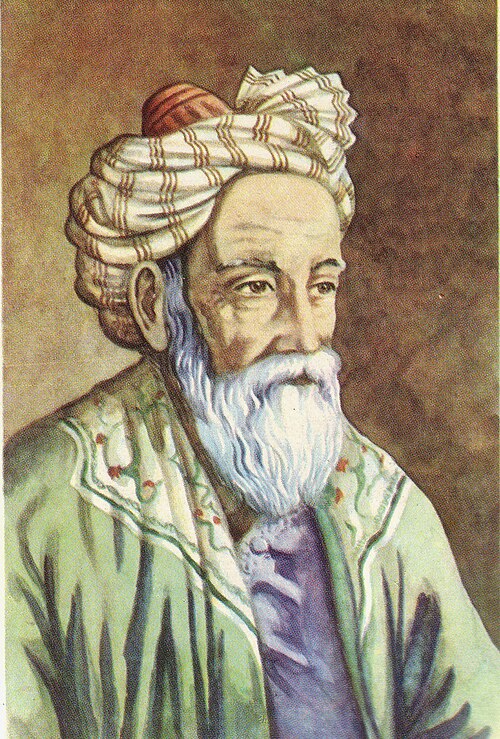
Almost a thousand years ago, in the city of Nishapur in north-eastern Iran, a boy named Omar was born. His family name, Khayyam, means “tent-maker,” so perhaps his ancestors made tents. Omar became one of the cleverest thinkers of his time.
He loved mathematics. He solved very hard puzzles called cubic equations—problems where a number is multiplied by itself three times. He could not solve them with ordinary sums, so he used curved shapes, like the path of a thrown ball, and found where two curves cross. That crossing point gave him the answer.
A powerful sultan asked Omar to help build an observatory, a place for watching the sky. With other scholars he measured how long a year really is, very, very precisely. They used this to make a new calendar that begins each year on the first day of spring. Iran’s calendar today still comes from that work.
Omar is also famous for short poems of four lines called rubāʿī. These poems talk about wine, roses, clay pots, time passing and enjoying today. In 1859 an Englishman named Edward FitzGerald turned some of them into English poems, and they became famous all over the world.
But here is a mystery: nobody knows for sure which of these poems Omar really wrote. Many were added to his name long after he died. So when you read “Omar Khayyam’s poems,” you are reading a mix of his voice, other poets’ voices, and FitzGerald’s imagination.
At a glance
- Lived
- 1048 – 1131 CE by the most common reckoning (birth date reconstructed as 18 May 1048 from his horoscope; some scholars place his death between 1124 and 1129)
- Born and died
- Nishapur, Khorasan (north-eastern Iran)
- Worked in
- Nishapur, Bukhara, Samarkand, Isfahan and Marv, under Karakhanid and Seljuk patrons
- Languages
- Arabic (scientific and most philosophical works) and Persian (one philosophical treatise; the quatrains attributed to him)
- Fields
- Algebra, geometry, astronomy and calendar reform, philosophy, music theory; poetry by attribution
- Main works
- Treatise on the Demonstration of Problems of Algebra (c. 1070s); Commentary on the Difficulties in the Postulates of Euclid (1077); On the Division of a Quadrant of a Circle; philosophical treatises such as On Existence; the Jalali calendar (introduced 1079)
- Tomb
- Mausoleum of Omar Khayyam, Nishapur (modern building of 1963 on the site of earlier tombs)
Easy
Who was Omar Khayyam?
Omar Khayyam (in Persian ʿUmar-i Khayyām) was born in 1048 in Nishapur, a great city of Khorasan in north-eastern Iran, and died there in old age, most probably in 1131. His full name, Ghiyāth al-Dīn Abū al-Fatḥ ʿUmar ibn Ibrāhīm, contains an honorary title (“Help of the Faith”) and his father’s name, Ibrahim. The word khayyām means “tent-maker” in Arabic, which may point to his family’s trade.
In his own lifetime he was admired as a mathematician, astronomer and philosopher. He wrote a groundbreaking book on cubic equations, a commentary on Euclid, and philosophical essays in the tradition of Avicenna, and he led the astronomers who produced a new solar calendar for the Seljuk sultan Malik-Shah.
Today, however, most people know him as a poet. Quatrains (rubāʿiyāt) about the shortness of life, wine and the mystery of existence were attributed to him in later centuries. The English poet Edward FitzGerald’s free version, The Rubáiyát of Omar Khayyám (1859), made “Omar” one of the best-known names of Persian literature. How many of these poems he really wrote is one of the great puzzles of literary history.
Easy
The world of the Seljuks
Khayyam lived under the Seljuks, a Turkic dynasty that took control of Iran and Iraq in the mid-eleventh century and ruled in the name of the Abbasid caliph in Baghdad. The Seljuk sultans governed through Persian administrators, and Persian became a major language of culture alongside Arabic, the language of religion and most science.
The most famous Seljuk statesman was the vizier Nizam al-Mulk, who founded colleges called Nizamiyyas to train scholars. The period was rich in learning but also dangerous. Religious and political conflicts were intense; the Ismaili movement later known in Europe as the Assassins opposed the Seljuks, and Nizam al-Mulk was murdered in 1092, probably by them. The First Crusade reached Syria and Palestine during Khayyam’s later years.
For a scholar like Khayyam, a rich patron was essential. Instruments, libraries and time for research depended on the favour of rulers and officials, and that favour could disappear suddenly when a patron died.
Easy
His life
Khayyam grew up in Nishapur, where he studied the Quran, Arabic, religious sciences, mathematics and astronomy. The historian al-Bayhaqi, who knew him personally, recorded his horoscope, from which modern scholars have calculated his birth date as 18 May 1048. He regarded Avicenna, who had died in 1037, as his intellectual master, although he could not have studied with him directly.
Around 1068 he went to Bukhara, and around 1070 to Samarkand, where the chief judge Abu Tahir became his patron and he wrote his famous treatise on algebra. In about 1074 he was invited by Nizam al-Mulk to the court of Sultan Malik-Shah and was asked to lead astronomical work at Isfahan. For nearly two decades he enjoyed rare stability.
After Malik-Shah and Nizam al-Mulk died in 1092, support ended. According to later reports, Khayyam made the pilgrimage to Mecca, perhaps partly to answer accusations that he held unorthodox views. He later served Sultan Sanjar at Marv and eventually returned to Nishapur, where he seems to have lived quietly. His pupil Nizami Aruzi describes visiting his grave there four years after his death, under trees that dropped blossoms on it.
Intermediate
Solving cubic equations with curves
Khayyam’s most important mathematical work is the Treatise on the Demonstration of Problems of Algebra, written in Arabic. Building on the algebra of al-Khwarizmi and his successors, he set out to classify and solve all equations of degree up to three—those involving numbers, “roots” (the unknown), “squares” and “cubes.”
Like earlier Islamic mathematicians, he allowed only positive coefficients and positive solutions, so equations that look alike to us were separate cases for him. He listed all possible forms and found that fourteen kinds of cubic equation cannot be reduced to simpler ones. He stated that these could not be solved with straightedge and compass alone, a claim that was only proved in the nineteenth century.
For each of the fourteen types he gave a geometric solution: the unknown is represented by a line segment determined by the intersection of two conic sections—for example a parabola and a circle, or a parabola and a hyperbola. He also discussed when such an equation has no positive solution or more than one.
Khayyam knew that he had not found an arithmetical formula for the cubic. He wrote that perhaps someone after him would discover it. Such formulas were indeed found in sixteenth-century Italy by Scipione del Ferro, Niccolò Tartaglia and Gerolamo Cardano. Because he systematically connected algebra and geometry, some historians see him as a forerunner of the analytic geometry of Descartes.
Intermediate
Euclid, parallel lines and the idea of number
In his Commentary on the Difficulties in the Postulates of Euclid, completed in 1077, Khayyam examined Euclid’s fifth or “parallel” postulate, which many mathematicians felt should be provable from the other axioms. He criticised earlier attempts—including Ibn al-Haytham’s—for secretly assuming what they wanted to prove or for introducing motion into geometry, which Aristotle had rejected.
Khayyam replaced the postulate with principles he took from Aristotle about converging lines, and studied a quadrilateral with two equal sides perpendicular to a base. He considered whether its two upper angles are right, acute or obtuse, and argued that only the right-angle case is consistent. The same figure appears in the eighteenth-century work of Girolamo Saccheri and is sometimes called the Khayyam–Saccheri quadrilateral. The acute and obtuse cases are now known to correspond to non-Euclidean geometries.
The same treatise discusses ratio and proportion. Khayyam showed that Euclid’s definition of equal ratios is equivalent to another definition based on a process like continued fractions, and he argued that ratios of magnitudes—including irrational ones—can be handled as numbers. Some historians see here a step toward the modern concept of real number.
Khayyam also wrote shorter scientific works. One applies Archimedes’ principle to find the proportions of gold and silver in an alloy by weighing it in air and in water. Another deals with music theory, classifying musical intervals and scales by numerical ratios. In his algebra he mentions a lost book on extracting roots of any degree, which suggests that he knew a general rule for expanding powers of a binomial—the pattern of coefficients known in Iran as “Khayyam’s triangle” and in Europe as Pascal’s triangle, which the earlier mathematician al-Karaji had already described.
Intermediate
The observatory at Isfahan and the Jalali calendar
Around 1074 Sultan Malik-Shah commissioned an observatory at Isfahan, where Khayyam headed a team of about eight scholars. Their aim was to revise the astronomical tables and reform the calendar. The observatory’s results were collected in an astronomical handbook known as the Zīj-i Malikshāhī.
The new calendar, named Jalālī after one of the sultan’s titles, was inaugurated in 1079. It was a true solar calendar: the year began at Nowruz, the spring equinox, and the months followed the Sun’s passage through the signs of the zodiac. Khayyam’s team reported the length of the year as 365.24219858156 days, extremely close to modern values.
Later sources describe an intercalation system based on a 33-year cycle containing eight leap years. Such a calendar drifts by only about a day in several thousand years—more accurate than the Gregorian calendar introduced in Europe in 1582. The Jalali calendar remained in use in Iran for centuries and became the basis of the modern Iranian solar calendar adopted in 1925.
Sources call Khayyam and his colleagues experts in ʿilm al-nujūm, “the science of the stars,” a term that covered both mathematical astronomy and astrology. His pupil Nizami Aruzi remarked that he did not observe Khayyam placing much faith in astrological predictions, and the historian of science George Saliba has warned that translating the term simply as “astrology” misrepresents the astronomers’ work. Even so, later reports say that at Sanjar’s court he was expected to forecast events such as the weather.
Intermediate
Khayyam the philosopher
Khayyam wrote a small number of philosophical treatises, mostly in Arabic and one in Persian. He worked within the Aristotelian-Neoplatonic tradition shaped by Avicenna. He translated and commented on one of Avicenna’s discourses on God’s unity, and according to al-Bayhaqi he was reading Avicenna’s metaphysics on the day he died.
In these works he defends the existence of God as the Necessary Existent and discusses existence, essence and universals, arguing that existence is a concept in the mind rather than something added to essences in reality. In a treatise on the necessity of contrariety in the world, he addresses the problem of evil: God creates beings that are good in themselves, while evil arises only accidentally from the contrary relations among them. He also discusses determinism, seeming to allow human agency within a framework of cosmic necessity.
In one treatise he surveys different ways of seeking knowledge—theologians, philosophers, Ismailis and Sufis—and appears to give special value to the Sufi path of purification. How this fits with the sceptical voice of the quatrains is still debated. His philosophical works were long neglected and have received serious study only in recent decades.
Intermediate
The quatrains and FitzGerald’s Rubáiyát
A rubāʿī (plural rubāʿiyāt) is a Persian poem of four lines, usually rhyming aaba, often ending with a sharp or surprising thought. The quatrains linked to Khayyam speak of the passing of time, the mystery of where we come from and go, the potter shaping clay (an image of creation), wine and friendship, and the wisdom of enjoying the present moment.
Edward FitzGerald (1809–1883) learned Persian from his friend Edward Cowell, who gave him a transcript of a manuscript in the Bodleian Library at Oxford, copied in Shiraz in 1460 and containing 158 quatrains, and later a copy of another manuscript in Calcutta. FitzGerald’s first edition of 1859 contained 75 stanzas. He called his work a “rendering” rather than a translation: some stanzas follow one Persian quatrain closely, while others combine or freely reinvent several.
At first the booklet did not sell, but from the 1860s it was admired by the Pre-Raphaelite poets and became hugely popular in the English-speaking world. FitzGerald revised it several times; Omar Khayyam Clubs were founded, and by 1929 more than 300 editions had appeared. Lines such as “The Moving Finger writes; and, having writ, / Moves on” became part of the English language. The poem’s success also shaped a Victorian image of the “East” as exotic and sensual.
Advanced
Did Khayyam write the Rubāʿiyāt? The authenticity problem
In his lifetime Khayyam was known as a scientist, not a poet. The earliest mention of his poetry comes from al-Isfahani in 1174, more than forty years after his death, and concerns Arabic verses. Individual Persian quatrains are quoted under his name by Fakhr al-Din al-Razi (c. 1160s), Najm al-Din Daya (c. 1230), Juvayni and, in 1340, the anthologist Jajarmi, who gives thirteen. Five quatrains later attributed to him already appear, unattributed, in the Sindbad-nāma of Zahiri Samarqandi from before 1160.
Later manuscripts, by contrast, attribute hundreds of quatrains to him, and modern collections have listed well over a thousand. The poems are uneven in language and contradictory in outlook, and many “wandering quatrains” are also attributed to other poets. In 1934 Hans Heinrich Schaeder went so far as to say that Khayyam’s name should be struck from the history of Persian literature. The Iranologist François de Blois has argued that little progress has been made since.
Scholars have tried various methods to identify a core of authentic poems. Arthur Christensen accepted 121 as reasonably authentic; Mohammad-Ali Foroughi accepted 178; Ali Dashti 36; and the writer Sadegh Hedayat only 14. After the Second World War, two manuscripts claimed to be very early—published with great excitement—were shown to be forgeries, a warning about how strong the desire for an “original Khayyam” is. Most scholars agree that he probably wrote some quatrains, but that it is rarely possible to prove that a particular poem is his.
Advanced
Sceptic, Sufi or philosopher? Reading the poems
FitzGerald presented Omar as an Epicurean sceptic whose wine was “the veritable Juice of the Grape.” Many scholars, including Arthur Christensen and later the Iranian writer Sadegh Hedayat, read the quatrains as expressing doubt about religious doctrine, the afterlife and divine justice. Medieval evidence partly supports a reputation for free thought: al-Qifti claimed in the thirteenth century that the poems were only outwardly Sufi, and several famous Sufi writers, such as Najm al-Din Daya and Attar, spoke of Khayyam with hostility.
A minority of interpreters—such as J. B. Nicolas in the nineteenth century and later Idries Shah—read the wine, the tavern and the beloved as Sufi symbols of mystical ecstasy. Critics such as Mehdi Aminrazavi respond that a Sufi reading is possible only by stretching the poems to fit classical doctrine. Others, such as Seyyed Hossein Nasr, warn that basing Khayyam’s philosophy on poems of uncertain authenticity is reductive, and point to his orthodox philosophical prose.
Recent scholarship tries to read the prose and the poems together. The Stanford Encyclopedia of Philosophy entry by Aminrazavi and co-authors suggests that the tension between the rational theism of the treatises and the bewildered protest of the quatrains may reflect a conflict between abstract reasoning and lived experience of suffering, rather than proving two different authors. Whatever one decides, it is essential to separate three layers: the historical Khayyam, the medieval Persian quatrain tradition, and FitzGerald’s Victorian poem.
Advanced
Legacy and modern scholarship
Khayyam’s mathematical work continued to be studied in the Islamic world. A thirteenth-century treatment of the parallel postulate in the tradition of al-Tusi, which credits Khayyam, was translated into Latin by John Wallis in Oxford and became known to Saccheri. In Europe his algebra became widely known only after Franz Woepcke published the Arabic text with a French translation in 1851.
In Iran he is a national figure. His white marble mausoleum in Nishapur, completed in 1963, stands over his headstone and is visited by many. Commissioned under Reza Shah and designed by Hooshang Seyhoun, it is a symbol of the city. The Iranian solar calendar still reflects the calendar reform associated with him.
Modern research on Khayyam is divided between historians of mathematics, who have edited and analysed his algebra and geometry, philosophers who have recently edited his treatises, and literary scholars who continue to wrestle with the quatrains. His case shows how a historical person can become a symbol: of Persian scientific brilliance, of free thought, of mystical wisdom or of Victorian melancholy, depending on who is reading.
Key ideas
- Geometric solution of cubics
- Each of fourteen irreducible cubic types is solved by intersecting two conic sections.
- Classification of equations
- All equations up to degree three are listed systematically by their positive terms.
- Parallel postulate critique
- Euclid’s fifth postulate is examined through a quadrilateral with right, acute or obtuse summit angles.
- Ratios as numbers
- Ratios of magnitudes, including irrational ones, are treated on the same footing as numbers.
- Solar calendar
- A year beginning at the spring equinox, with months following the Sun and a precise leap-year cycle.
- Necessary Existent and theodicy
- God exists necessarily; evil arises only accidentally from contrary relations among created things.
- Carpe diem in the quatrains
- The attributed poems urge living fully in the present in the face of death and uncertainty.
Records
- 1048 — Omar Khayyam is born in Nishapur (18 May, by reconstruction from his horoscope).
- c. 1068 — He goes to Bukhara.
- c. 1070 — In Samarkand, under the patronage of Abu Tahir, he writes his treatise on algebra.
- c. 1074 — Invited by Nizam al-Mulk, he joins Malik-Shah’s court and begins work at the Isfahan observatory.
- 1077 — He completes his commentary on the postulates of Euclid.
- 1079 — The Jalali calendar is inaugurated.
- 1092 — Deaths of Nizam al-Mulk and Malik-Shah; support for the observatory ends.
- c. 1118 — He works for Sultan Sanjar at Marv.
- 1131 — He dies in Nishapur (4 December in the most common reckoning; some place his death c. 1124–1129).
- 1174 — Al-Isfahani gives the earliest known reference to Khayyam as a poet.
- 1460 — The Bodleian manuscript of 158 quatrains is copied in Shiraz.
- 1851 — Franz Woepcke publishes Khayyam’s algebra with a French translation.
- 1859 — Edward FitzGerald publishes The Rubáiyát of Omar Khayyám.
Glossary
- Rubāʿī (pl. rubāʿiyāt)
- A Persian four-line poem, usually rhyming aaba.
- Seljuks
- A Turkic dynasty that ruled Iran, Iraq and Anatolia from the eleventh century.
- Cubic equation
- An equation in which the unknown appears multiplied by itself three times.
- Conic sections
- The circle, ellipse, parabola and hyperbola, curves produced by slicing a cone.
- Parallel postulate
- Euclid’s fifth postulate about lines that meet or never meet; its independence leads to non-Euclidean geometry.
- Jalali calendar
- The solar calendar introduced in 1079 under Malik-Shah, basis of the modern Iranian calendar.
- Nowruz
- The Persian New Year, at the spring equinox.
- Necessary Existent
- In Avicenna’s philosophy, the being whose existence is necessary in itself, identified with God.
- Wandering quatrain
- A quatrain attributed to more than one poet in different manuscripts.
- Sufism
- The mystical tradition of Islam, whose poetry often uses wine and love as symbols.
Questions and answers
What does “Khayyam” mean?
It means “tent-maker” in Arabic. His father or ancestors may have made tents, but we do not know for sure.
Is the Iranian calendar really his?
The modern Iranian solar calendar grew out of the Jalali calendar that his team of astronomers created in 1079, though it was simplified in the twentieth century.
Did he write all the poems in the Rubáiyát?
Almost certainly not. Hundreds of quatrains were added to his name over the centuries, and FitzGerald also changed and combined poems freely. Only a small number may be his.
Was Omar Khayyam against religion?
Scholars disagree. The quatrains attributed to him often question religious certainty, but his philosophical treatises defend God’s existence in Avicenna’s tradition. Some see him as a sceptic, a few as a Sufi, others as a philosopher torn between reason and experience.
Why could he not solve cubic equations with a simple formula?
An algebraic formula for the cubic was found only in sixteenth-century Italy. Khayyam solved them geometrically and said that perhaps someone after him would find an arithmetic solution.
How reliable are the stories about Khayyam, Nizam al-Mulk and Hasan-i Sabbah as schoolfriends?
This popular legend, repeated in FitzGerald’s preface, is doubted by historians: it rests on late sources and fits the three men’s dates poorly.
What are the earliest reliable witnesses to his poetry?
Al-Isfahani (1174) for Arabic verse, and quotations by Fakhr al-Din al-Razi, Najm al-Din Daya, Juvayni and Jajarmi for Persian quatrains.
Sources and further reading
- Omar Khayyam. Wikipedia
- Seyed N. Mousavian, Suzanne Sumner, Mehdi Aminrazavi and Glen Van Brummelen, Umar Khayyam. Stanford Encyclopedia of Philosophy
- J. J. O'Connor and E. F. Robertson, Omar Khayyam. MacTutor History of Mathematics Archive, University of St Andrews
- Rubaiyat of Omar Khayyam. Wikipedia
- 오마르 하이얌. Wikipedia (Korean)
- Mausoleum of Omar Khayyam. Wikipedia
- Edward FitzGerald (trans.), Rubáiyát of Omar Khayyám, the Astronomer-Poet of Persia. Bernard Quaritch, London, 1859
- Franz Woepcke (ed. and trans.), L'algèbre d'Omar Alkhayyâmî. Benjamin Duprat, Paris, 1851
- Mehdi Aminrazavi, The Wine of Wisdom: The Life, Poetry and Philosophy of Omar Khayyam. Oneworld, Oxford, 2005
Related
- Al-KhwarizmiNinth-century mathematician, astronomer and geographer of Abbasid Baghdad whose books gave the world the words “algebra” and “algorithm.”
- Ibn al-Haytham (Alhazen)Basra-born mathematician and physicist who worked in Fatimid Cairo and whose Book of Optics explained vision as light entering the eye, backed by geometry and experiment.
- AvicennaPhysician and philosopher whose writings shaped medicine and philosophy across the Islamic world and Europe.
- EuclidGreek mathematician of Alexandria, active around 300 BCE, whose Elements built geometry and number theory from a few definitions and postulates and became the most influential mathematics textbook in history.
- RumiPersian-language poet and Sufi teacher whose verse explores love and spiritual transformation.
- HafezPersian lyric poet especially known for ghazals of love, longing and spiritual ambiguity.
Written with AI assistance from the published sources listed above, and revised as new research appears.