Start at the top for an easy introduction. Go further down for more detail and scholarship.
- Easy
- Intermediate
- Advanced
For young readers
About 130 years ago, most people in Korea were farmers. They worked very hard, but some greedy officials took far too much of their rice and money as taxes and fines. In one county called Gobu, the magistrate even made farmers build a new reservoir and then charged them for using its water.
Many farmers followed a new religion called Donghak, which means "Eastern Learning". It taught that every person carries heaven inside them, so rich and poor, men and women all deserve respect. That idea gave people courage.
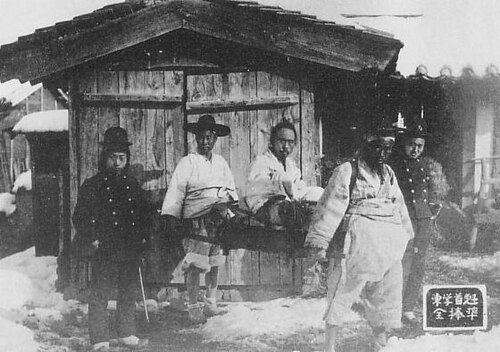
In 1894 the farmers of Gobu, led by a small but determined man named Jeon Bong-jun, rose up. People nicknamed him "General Mung Bean" because he was short. The farmers carried bamboo spears and farm tools. They won battles against the government's soldiers and even took the big city of Jeonju.
The frightened king's government asked China to send soldiers. Japan sent soldiers too, and the two foreign armies ended up fighting a war with each other on Korean soil. When the farmers rose again to drive out the Japanese, they were defeated by modern guns at a hill pass called Ugeumchi. Jeon Bong-jun was captured and executed.
The farmers lost, but people never forgot them. A sad folk song, "Bird, bird, blue bird", is said to remember them, and today Korea marks 11 May as a national day to honour the revolution.
At a glance
- When
- Early 1894 to early 1895 (the Gobu uprising began on 15 February 1894; main phases spring and autumn 1894)
- Where
- Joseon Korea, centred on Jeolla Province, spreading to Chungcheong, Gyeongsang, Gangwon, Hwanghae and elsewhere
- Leaders
- Jeon Bong-jun, Kim Gae-nam, Son Hwa-jung; in the second uprising also Son Byong-hi and northern Donghak leaders
- Opponents
- Joseon government troops; from the autumn of 1894, the Japanese army together with government forces and local militias
- Key events
- Victories at Hwangtohyeon and Hwangnyongchon; capture of Jeonju; Jeonju Truce and self-governing jipgangso offices; defeat at Ugeumchi
- Outcome
- Crushed by early 1895; leaders executed; tens of thousands or more killed (estimates vary widely)
- Consequences
- Triggered Qing and Japanese intervention and the First Sino-Japanese War; influenced the Gabo Reforms
- Commemoration
- Special Act on restoring participants' honour (2004); national memorial day on 11 May (2019); archives on UNESCO Memory of the World Register (2023)
Easy
What was the Donghak Peasant Revolution?
In 1894 tens of thousands of farmers in southwestern Korea took up arms. They were angry at corrupt officials, crushing taxes and a government that seemed unable to protect the country from foreign powers. Many of them belonged to Donghak, a religion founded in Korea a generation earlier, and its network of local congregations helped them organise.
The uprising had two main waves. In spring 1894 the peasant army defeated government troops and captured Jeonju, the capital of Jeolla Province. After a truce, peasants set up local offices to fix abuses. In autumn 1894, after Japanese troops seized the royal palace in Seoul, the peasants rose again, this time to expel the Japanese. They were defeated by the combined Japanese and government forces, and by early 1895 the movement had been crushed.
The revolution changed East Asian history. The Korean government's call for Chinese troops, and Japan's response, led directly to the First Sino-Japanese War of 1894–1895. Japan's victory ended China's long-standing influence over Korea and began a path that ended with Japan annexing Korea in 1910.
Easy
Donghak: a new faith for troubled times
Donghak, "Eastern Learning", was founded in 1860 by Choe Je-u, a scholar from Gyeongju. The name set it apart from "Western Learning" (Seohak), meaning Catholicism, which was spreading in Korea at the time. Donghak combined elements of Confucianism, Buddhism, Daoism and Korean folk belief with Choe's own religious experience of the Lord of Heaven.
A central teaching was that every person bears the Lord of Heaven within (sicheonju). Later leaders expressed this in the famous phrase in-nae-cheon, "humans are heaven". In a society divided into rigid classes of aristocrats (yangban), commoners and outcasts, the idea that all people were equally worthy was revolutionary.
The government saw Donghak as a dangerous heresy. Choe Je-u was executed in 1864 for "deluding the people". His successor, Choe Si-hyeong, spread the faith secretly, published its scriptures, and organised believers into local units called po and jeop, each led by a jeopju. This network would later carry messages and mobilise people across whole provinces.
Intermediate
Background and causes
By the late nineteenth century Joseon Korea faced crisis at home and abroad. Offices were bought and sold, and officials recouped their costs by squeezing farmers through the land tax, military cloth tax and grain-loan system. Local revolts had broken out repeatedly since the 1862 uprisings in the south.
Foreign pressure was growing. After the 1876 Treaty of Ganghwa opened Korean ports to Japan, Japanese merchants bought large amounts of rice and beans, driving up prices. The Imo Incident of 1882 and the failed Gapsin Coup of 1884 brought Chinese and Japanese troops into Seoul, and the 1885 Convention of Tianjin between Qing China and Japan required each to notify the other before sending troops to Korea.
Donghak believers first organised peacefully. In 1892 and 1893 they held mass petitions at Samnye and in front of the palace in Seoul, demanding that their founder be cleared of guilt and that persecution stop. At a large gathering at Boeun in 1893, banners called for driving out the Japanese and Westerners. Inside the movement, the more cautious northern branch around Choe Si-hyeong differed from the more militant southern leaders of Jeolla.
The spark came in Gobu County. Magistrate Jo Byeong-gap, appointed in 1892, extorted money on invented charges, collected funds for a monument to his own father, and forced farmers to build a new weir, the Manseokbo, then charged water fees for it. Petitions failed. Jeon Bong-jun, a village teacher and local Donghak leader whose father had reportedly died after protesting to the magistrate, emerged as the leader of resistance.
Intermediate
The first uprising: Gobu to Jeonju (spring 1894)
On 15 February 1894 (the 10th day of the first lunar month) about a thousand peasants attacked the Gobu county office. Jo Byeong-gap fled; the rebels destroyed the weir, seized weapons and distributed illegally collected grain. When a new magistrate promised redress they dispersed. But the government inspector Yi Yong-tae then arrested and punished villagers as "Donghak bandits", which convinced the leaders that only a wider rising would work.
In late April Jeon Bong-jun, with the Donghak leaders Son Hwa-jung of Mujang and Kim Gae-nam of Taein, issued a proclamation at Mujang and gathered forces at Baeksan. Their slogans included bogukanmin, "protect the nation and bring peace to the people", and jepokgumin, "remove tyranny and save the people". Discipline rules forbade killing needlessly and harming people's property.
Who joined the peasant army? Most were small farmers and tenants, but the ranks also included village scholars, petty clerks, and people from the lowest status groups, such as slaves, butchers and entertainers, who had the most to gain from an end to class discrimination. Donghak congregations supplied leaders and communications, while many who joined were not believers at all. Contemporary observers were struck by the army's discipline in its early months: leaders ordered their men to pay for food and to leave ordinary people's property untouched, and this helped the movement win local support.
On 11 May 1894 the peasant army routed provincial troops at Hwangtohyeon, near Gobu. It then swept through southern Jeolla and on 27 May defeated government forces sent from Seoul at Hwangnyongchon in Jangseong. On 31 May the peasants entered Jeonju, the provincial capital and ancestral seat of the royal family, without a major battle.
Intermediate
Foreign armies, the Jeonju Truce and the jipgangso
Alarmed, King Gojong's government asked Qing China for troops, which landed at Asan in early June 1894. Citing the Convention of Tianjin, Japan landed a much larger force at Incheon and moved toward Seoul. Fearing that foreign troops would use the rebellion as an excuse to stay, the peasants and the government negotiated. In June the peasants withdrew from Jeonju in what is known as the Jeonju Truce, in exchange for promises of reform.
Across much of Jeolla, the peasants then set up offices called jipgangso, which worked with local officials to punish corrupt clerks, cancel illegal taxes and settle grievances. The provincial governor Kim Hak-jin cooperated with Jeon Bong-jun, who directed affairs from Jeonju. Historians see this as a rare experiment in popular self-government in nineteenth-century Asia, though its extent and powers differed from place to place.
Which reforms the peasants actually demanded is a matter of scholarly care. Petitions and lists of demands from the period survive and call for punishing corrupt officials, abolishing unfair taxes and restraining Japanese rice merchants. A famous twelve-article reform programme, including freeing slaves and allowing widows to remarry, is known mainly from Oh Ji-yeong's history Donghaksa (1940), and some historians doubt that it existed in that form in 1894.
Intermediate
The second uprising and defeat at Ugeumchi (autumn–winter 1894)
Neither foreign army left. On 23 July 1894 Japanese troops occupied Gyeongbokgung Palace, installed a new government and pushed through the Gabo Reforms. Two days later Japan attacked Chinese ships, and the First Sino-Japanese War began. Japan won decisive battles at Pyongyang and on the Yalu River that autumn.
In October the southern peasants gathered again at Samnye, now with the goal of expelling the Japanese. After long hesitation Choe Si-hyeong ordered the northern branch to join, and Son Byong-hi led its forces to unite with Jeon Bong-jun at Nonsan. The combined army marched on Gongju, the key to the road to Seoul.
Between late November and early December 1894 the peasants attacked the Japanese and government troops holding the ridges around Gongju. At the Ugeumchi pass they charged uphill again and again into rifle and artillery fire. Armed mostly with old matchlocks, spears and farm tools, they suffered devastating losses; by most accounts only a few thousand of the attackers survived the battles around Gongju.
The survivors retreated south and were defeated again at Taein. Japanese units, government troops and yangban-led militias then hunted down rebels across the southern provinces, often executing prisoners and burning villages. Kim Gae-nam was captured and executed without trial. Jeon Bong-jun was betrayed and captured at Pinori in Sunchang in late December, interrogated in Seoul, and hanged with Son Hwa-jung and other leaders in April 1895. Small groups held out into early 1895, most famously on Mount Daedun.
Intermediate
Consequences
The human cost was enormous. No reliable count exists; estimates of the peasants and civilians killed during the uprising and the reprisals range from tens of thousands to several hundred thousand. Many families hid their connection to the movement for generations, and some destroyed genealogies to avoid persecution.
Internationally, the revolution was the occasion for the First Sino-Japanese War. By the Treaty of Shimonoseki (1895) China recognised Korea's "independence", which in practice meant the end of Chinese protection and the opening of Korea to Japanese influence. The Russo-Japanese War of 1904–1905 and the annexation of 1910 followed.
Domestically, several peasant demands, such as abolishing the legal class system and allowing widows to remarry, appeared in the Gabo Reforms of 1894–1896, though these reforms were carried out under Japanese pressure. Many surviving peasant fighters later joined the Righteous Armies that resisted Japan. The Donghak religion survived: Son Byong-hi reorganised it as Cheondogyo in 1905, and Cheondogyo leaders played a central role in the March First Movement of 1919.
Intermediate
Memory and names
What to call the events has changed with politics. Joseon officials called it a "rebellion of Donghak bandits" (Donghangnan). Twentieth-century historians used terms such as the Donghak Peasant Movement (Donghak nongmin undong), the standard textbook term in South Korea for decades, and the Gabo Peasant War (Gabo nongmin jeonjaeng), preferred in North Korea and by some South Korean scholars. Since 2004 South Korean law has used "Donghak Peasant Revolution" (Donghak nongmin hyeongmyeong).
Each name stresses something different: a religious movement, a class struggle of peasants against landlords and officials, or a national struggle against foreign aggression. Most historians today see all three dimensions intertwined.
Jeon Bong-jun became a folk hero. The song "Saeya saeya parangsaeya" ("Bird, bird, blue bird, do not land in the mung-bean field") is popularly linked to him, and he has been the subject of novels, dramas and statues. In 2004 South Korea passed the Special Act on the Restoration of Honour of Participants in the Donghak Peasant Revolution. In 2019 the government made 11 May, the anniversary of the victory at Hwangtohyeon, a national memorial day, and in 2023 a collection of 185 documents on the revolution was inscribed on UNESCO's Memory of the World Register.
In Japan, older histories called the events the "Tōgakutō rebellion", while many later Japanese scholars use "Kōgo Peasant War". Since the 1990s some Japanese historians, notably Inoue Katsuo, have documented the Japanese army's role in the killings, and Japanese and Korean citizens have held joint memorial events.
Advanced
Sources and evidence
Historians work with several kinds of sources, each with its own viewpoint. Government records, reports of officials and commanders, and court documents describe the rebels as bandits but give detailed information on movements and punishments. The record of Jeon Bong-jun's interrogations in 1895 preserves his own statements about his motives, including his denial of any plot with the Daewongun.
Materials produced by the peasants themselves include proclamations, circular letters and lists of demands. The Sabal tongmun, a circular with signatures arranged in a circle so no leader could be singled out, was discovered in 1968 and is dated to late 1893; it lists plans to attack Gobu and march on Jeonju, though scholars debate details of its dating and significance. Diaries by local yangban and officials, some written by participants in the suppression, add further perspectives.
Japanese archives, including legation and military reports, are essential for the autumn campaign and the reprisals. These were among the materials included in the 2023 Memory of the World inscription, which brings together records produced by the Korean government, the peasant army, civilians who fought the peasants, and the Japanese legation. Later accounts written by Donghak and Cheondogyo members, such as Oh Ji-yeong's Donghaksa, are valuable but must be read with attention to when and why they were written.
Advanced
Historical debates
One debate concerns the role of religion. Some historians argue that Donghak was the essential framework that turned local grievances into a regional movement, providing ideology, leadership and organisation. Others argue that the uprising was fundamentally a peasant war in which Donghak served mainly as a convenient network, pointing to the reluctance of the northern religious leadership to support armed revolt until the autumn.
A second debate concerns the rebels' political aims. The peasants' declarations professed loyalty to the king and targeted "corrupt officials" and the ruling Min clan rather than the monarchy itself. Evidence that some leaders were in contact with the Daewongun, the king's father and a rival of the Min faction, has led some historians to see the movement as partly entangled in court politics; others see these contacts as tactical. Whether the movement aimed at restoring a just Confucian order or at a new society is still argued.
A third debate concerns the authenticity of key texts, especially the twelve-article reform programme first published in 1940. Historians such as Yu Young-ik argued it was a later construction; others defend it as reflecting genuine demands recorded in other forms. The dispute matters because the programme's abolition of class distinctions has often been cited as proof of the movement's revolutionary character.
Finally, historians debate how to connect 1894 to later history: as the root of the anti-Japanese Righteous Armies and the March First Movement, as a forerunner of modern democratic movements, or, in North Korean historiography, as a stage in class struggle. Comparative work places it alongside other nineteenth-century millenarian and agrarian movements, such as the Taiping Rebellion in China, while stressing its distinctive combination of religious equality and national resistance.
Key ideas
- Donghak (Eastern Learning)
- A Korean religion founded in 1860 that taught that every person bears the Lord of Heaven within, challenging the rigid class hierarchy.
- Bogukanmin
- "Protect the nation and bring peace to the people": the rallying cry of the peasant army, joining reform at home with defence against foreign powers.
- Anti-corruption uprising
- The first uprising targeted extortionate officials and unfair taxes, beginning with Magistrate Jo Byeong-gap of Gobu.
- Jipgangso
- Local offices set up after the Jeonju Truce through which peasants, alongside officials, corrected abuses: an early experiment in popular self-government.
- Anti-Japanese resistance
- The second uprising aimed to drive out the Japanese army after it seized the royal palace in July 1894.
- Trigger of a regional war
- Qing and Japanese intervention against the rebellion led to the First Sino-Japanese War and a new balance of power in East Asia.
- Contested memory
- Names ranging from "bandit rebellion" to "revolution" show how different eras and states have interpreted the events.
Records
- 1860 — Choe Je-u founds Donghak in Gyeongju.
- 1864 — Choe Je-u is executed in Daegu; Choe Si-hyeong becomes leader.
- 1892 — Donghak believers petition at Samnye; Jo Byeong-gap becomes magistrate of Gobu.
- 1893 — Petition before the palace in Seoul and mass gathering at Boeun; the Sabal tongmun circular is drafted in Gobu.
- 1894 — 15 February: Gobu uprising. 11 May: victory at Hwangtohyeon. 31 May: peasants enter Jeonju. June: Jeonju Truce; Qing and Japanese troops land.
- 1894 — 23 July: Japanese troops seize Gyeongbokgung; the First Sino-Japanese War begins days later.
- 1894 — October: second uprising gathers at Samnye. Late November–December: defeat at Gongju and Ugeumchi; Jeon Bong-jun captured in late December.
- 1895 — April: Jeon Bong-jun and other leaders are executed; the Treaty of Shimonoseki ends the war.
- 1905 — Son Byong-hi renames Donghak as Cheondogyo.
- 2004 — South Korea passes a special act restoring the honour of participants.
- 2019 — 11 May, the anniversary of Hwangtohyeon, becomes a national memorial day.
- 2023 — Archives of the Donghak Peasant Revolution are inscribed on UNESCO's Memory of the World Register.
Glossary
- Joseon
- The Korean dynasty that ruled from 1392 to 1897, when it was renamed the Korean Empire.
- Yangban
- The hereditary aristocratic class of Joseon Korea, from which officials were drawn.
- Jeopju
- A local Donghak leader in charge of a congregation (jeop or po).
- Namjeop and Bukjeop
- The "southern" and "northern" branches of Donghak; the southern branch led the first uprising, and the northern branch joined in the autumn.
- Jipgangso
- Peasant-run offices set up in Jeolla after the Jeonju Truce to correct local abuses.
- Sabal tongmun
- A circular letter with signatures arranged in a circle around a bowl shape, so no single leader could be identified.
- Daewongun
- Yi Ha-eung, father of King Gojong and a powerful political figure, rival of Queen Min's faction.
- Gabo Reforms
- Sweeping reforms of 1894–1896, carried out under Japanese influence, that abolished the legal class system and the civil service examinations.
- Righteous Army (Uibyeong)
- Irregular volunteer forces that resisted Japanese aggression, especially from 1895 to the 1910s.
- Cheondogyo
- "Religion of the Heavenly Way", the name Donghak took in 1905.
Questions and answers
Why was Jeon Bong-jun called "General Mung Bean"?
Because he was small, like a mung bean (nokdu). The nickname was affectionate and became part of songs and stories about him.
Did the farmers want to overthrow the king?
Their declarations professed loyalty to the king and attacked corrupt officials and the ruling faction instead. Historians still debate how far their goals went beyond reform.
Why did Japan and China get involved?
The Korean government asked China for troops, and Japan sent its own soldiers under the 1885 Convention of Tianjin. Japan then used the situation to start a war with China for control of Korea.
Is it a peasant war, a religious movement or a revolution?
It was all of these in different ways. The Donghak network organised it, peasants' economic grievances drove it, and resistance to Japan shaped its second phase. The official South Korean term since 2004 is "revolution".
How many people died?
Nobody knows exactly. Estimates range from tens of thousands to several hundred thousand, including those killed in reprisals after the fighting.
Is the twelve-article reform programme genuine?
It is known mainly from a 1940 history by Oh Ji-yeong, and some historians consider it a later reconstruction. Other contemporary documents show that the peasants did demand an end to corrupt officials and unfair taxes.
How is the revolution remembered today?
Through a national memorial day on 11 May, museums and monuments in places such as Jeongeup and Gongju, a 2004 law restoring participants' honour, and the 2023 UNESCO Memory of the World inscription.
Sources and further reading
- Donghak Peasant Revolution. Wikipedia
- 동학 농민 혁명. Wikipedia (Korean)
- 전봉준 (Jeon Bong-jun). Wikipedia (Korean)
- Donghak. Wikipedia
- First Sino-Japanese War. Wikipedia
- Gabo Reform. Wikipedia
- 동학농민혁명 기념일 5월 11일, 국가기념일로 제정 (press release). Ministry of Culture, Sports and Tourism, Republic of Korea, 2019
- Archives of Korea's grassroots revolutions added to UNESCO Memory of the World register. The Korea Herald, 2023
- George L. Kallander, Salvation through Dissent: Tonghak Heterodoxy and Early Modern Korea. University of Hawaiʻi Press, 2013
Related
- March 1st MovementA Korean independence movement began with public declarations and demonstrations on 1 March 1919 and spread across the peninsula.
- Jeong Yak-yongJoseon scholar and reform thinker who wrote extensively about government, law and the practical responsibilities of officials.
- Meiji RestorationThe political transfer of authority to the Meiji emperor in 1868 began a far-reaching transformation of Japan’s government and society.
- First Opium WarWar between Britain and Qing China from 1839 to 1842, rooted in disputes over the opium trade and foreign commerce.
- Veritable Records of the Joseon DynastyOfficial day-by-day chronicles of 25 Joseon kings from 1392 to 1863, compiled in the capital from court historians’ drafts.
Written with AI assistance from the published sources listed above, and revised as new research appears.