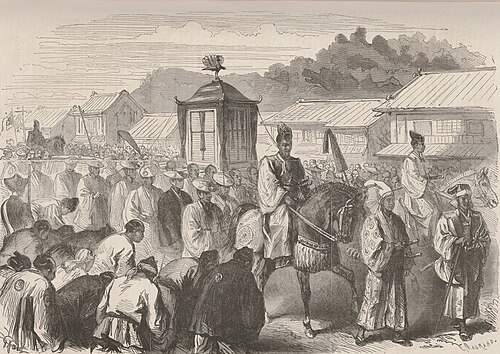
Start at the top for an easy introduction. Go further down for more detail and scholarship.
- Easy
- Intermediate
- Advanced
For young readers
For more than 250 years Japan was ruled by a family of military leaders called shoguns, from the Tokugawa family. There was also an emperor, but he lived quietly in the old capital, Kyoto, and had little real power. Japan kept most foreigners out and traded with only a few.
In 1853 American warships with black smoke pouring from their chimneys sailed into a bay near the shogun’s capital, Edo. Their commander, Matthew Perry, demanded that Japan open its ports. The shogun’s government agreed, and many Japanese people were angry and afraid. They worried that Japan could be taken over, as parts of China had been.
Young samurai from distant regions, especially Satsuma and Chōshū, decided that the shogun was too weak. They joined together and, in 1868, announced that the emperor, a boy of fifteen called Meiji, would rule again. After a short civil war, the shogun’s side lost. Edo was renamed Tokyo, which means “eastern capital”, and the emperor moved there.
Then Japan changed very fast. The samurai class was ended, and ordinary men were called up to serve in a new army. Children went to new schools. Railways, factories, newspapers and a post office were built, and people began to wear Western clothes and eat new foods. In 1889 Japan got its first constitution.
Not everyone was happy. Many samurai lost their old way of life and some fought back. Farmers paid heavy taxes. The Ainu people in the north and the people of the Ryukyu Islands in the south were brought under Japanese rule and pushed to give up their own ways. And the strong new Japan later went to war with its neighbours and took Korea and Taiwan as colonies. That is why the Meiji Restoration is remembered very differently in different countries.
At a glance
- Date
- Restoration decree of 3 January 1868 (Gregorian calendar); reforms continued through the 1870s–1890s
- Place
- Kyoto, where the decree was issued, and Edo, renamed Tokyo in 1868 and made the new capital
- Key actors
- Emperor Meiji (r. 1867–1912); leaders from Satsuma, Chōshū, Tosa and Hizen, such as Ōkubo Toshimichi, Saigō Takamori, Kido Takayoshi, Iwakura Tomomi and later Itō Hirobumi; the last shogun, Tokugawa Yoshinobu
- Civil war
- Boshin War, January 1868 – June 1869
- Founding documents
- Charter Oath (April 1868); Constitution of the Empire of Japan (proclaimed 1889, in force 1890)
- Slogans
- “Rich country, strong army” (fukoku kyōhei); “Civilization and enlightenment” (bunmei kaika)
- Results
- End of the shogunate and the samurai class; a centralized state with conscription, national schools, land tax reform and state-led industrialization
- Long-term impact
- Japan became the first non-Western industrial power, but also expanded by force, annexing Ryukyu and colonizing Taiwan and Korea
Easy
What was the Meiji Restoration?
The Meiji Restoration is the name for the political upheaval of 1867–1868 in which the Tokugawa shogunate, which had ruled Japan since 1603, gave way to a new government ruling in the name of the emperor. The word “restoration” reflects the claim that power was being returned to the emperor, whose ancestors had reigned for centuries but had long been political figureheads. The new era name, Meiji, means “enlightened rule”.
In a broader sense, historians use the term for the whole period of change that followed. Within about thirty years, Japan abolished its feudal domains and its hereditary samurai class, created a national army and navy, built a national school system, adopted a written constitution with an elected assembly, and began to industrialize. In Japanese the event is called Meiji Ishin, and the word ishin suggests “renewal” rather than simply a return to the past.
The Restoration is one of the most important turning points in modern world history. It showed that a non-Western country could adopt Western technology and institutions quickly on its own terms. It also laid the foundations of the Japanese empire that would later colonize its neighbours and fight in the Second World War. Because of this double legacy, it is remembered with pride in Japan and with much more mixed feelings in Korea, China and elsewhere.
Easy
Japan before 1868
Under the Tokugawa shoguns, Japan was divided into about 260 domains (han), each ruled by a lord (daimyō) who owed loyalty to the shogun in Edo. Society was officially divided into ranks, with the samurai, who were hereditary warrior-officials, at the top, and farmers, artisans and merchants below. The emperor lived in Kyoto and performed rituals but did not govern.
For two centuries the shogunate strictly controlled foreign contact. Christianity was banned, and Japanese could not travel abroad. Trade with Europe went only through the Dutch at the small island of Dejima in Nagasaki, alongside trade with China, Korea (through the Tsushima domain) and the Ryukyu Kingdom. Later historians called this policy sakoku, “closed country”, though Japan was never completely cut off.
The long peace brought great cities, commerce and culture. Edo became one of the largest cities in the world, and literacy was relatively high. But by the nineteenth century the shogunate had money problems, many samurai were poor, and scholars of “national learning” (kokugaku) and of the Mito school were stressing the sacred position of the emperor. News of Britain’s victory over China in the First Opium War (1839–1842) alarmed Japanese thinkers.
Intermediate
Causes: foreign pressure and domestic crisis
The immediate trigger was the arrival of US Commodore Matthew Perry in 1853. His return with a larger fleet the next year produced the Treaty of Kanagawa (1854), opening ports to American ships. In 1858 the shogunate’s chief minister, Ii Naosuke, signed commercial treaties with the United States and other powers without the emperor’s approval. These “unequal treaties” gave foreigners extraterritoriality, meaning foreigners were tried by their own consuls, and denied Japan control of its own tariffs.
The treaties split Japanese politics. Activists rallied around the slogan sonnō jōi, “revere the emperor, expel the barbarians”. Ii purged his critics and was assassinated in 1860. Radical samurai attacked foreigners; in response, British ships bombarded Kagoshima, the Satsuma capital, in 1863, and Western fleets bombarded Chōshū’s forts at Shimonoseki in 1863–1864. These defeats convinced leaders in both domains that expelling foreigners was impossible and that Japan must first become strong.
The shogunate tried to punish the rebellious Chōshū domain but failed in 1866. The same year Satsuma and Chōshū, former rivals, made a secret alliance, brokered in part by Sakamoto Ryōma of Tosa. In late 1867 the last shogun, Tokugawa Yoshinobu, offered to return his governing authority to the emperor, hoping to lead a new council of lords. His opponents moved first.
Intermediate
The course of events: coup, civil war and a new capital
On 3 January 1868 (by the Western calendar; in the Japanese calendar of the time it was still late 1867), Satsuma and allied troops took control of the gates of the imperial palace in Kyoto, and the court proclaimed the “restoration of imperial rule” (ōsei fukko). The shogunate was abolished and Yoshinobu was ordered to give up his lands. The emperor, Mutsuhito, known after death as Emperor Meiji, was fifteen years old; real power lay with court nobles such as Iwakura Tomomi and samurai leaders from the southwestern domains.
Fighting broke out at Toba–Fushimi near Kyoto later in January. The imperial side, flying an imperial banner, won, and Yoshinobu fled to Edo. In spring 1868 Edo Castle was surrendered without a battle after negotiations between Katsu Kaishū for the Tokugawa and Saigō Takamori for the imperial army, sparing the city. Resistance continued in the northeast, where an alliance of northern domains fought on; the siege of Aizu-Wakamatsu in autumn 1868 became a lasting symbol of loyalty and tragedy. The last holdouts, in Hakodate in Hokkaidō, surrendered in June 1869. The whole conflict is known as the Boshin War.
In April 1868 the young emperor proclaimed the Charter Oath, five brief principles promising that assemblies would be widely convened and matters decided by public discussion, that all classes would unite, that “evil customs of the past” would be abandoned, and that knowledge would be sought throughout the world. In September Edo was renamed Tokyo, “Eastern Capital”; in October the era name was changed to Meiji, with the new rule of one era name per reign; and the emperor moved to Tokyo, which became the permanent seat of government.
Intermediate
The reforms: building a modern state
Centralization came first. In 1869 the lords returned their domain registers to the emperor, and in August 1871 the government abolished the domains altogether and replaced them with prefectures run by appointed governors (haihan chiken). Former lords were compensated with government bonds. In the same years the status system was dismantled: commoners could take surnames, marry across ranks and choose occupations, and an edict of 1871 formally abolished the outcaste categories, although discrimination against their descendants (buraku people) continued.
From December 1871 to September 1873, the Iwakura Mission, led by Iwakura Tomomi with Ōkubo, Kido and Itō, toured the United States and Europe. It failed to revise the unequal treaties, but its members studied factories, parliaments, schools and armies and came home convinced that Japan needed thorough internal modernization. Meanwhile the “caretaker government” at home introduced a national school system (1872), the Western solar calendar (1873), universal male conscription (1873) and a land tax reform (1873) that replaced rice payments with a cash tax based on land value.
The state led industrialization. It built railways (the first line, between Tokyo and Yokohama, opened in 1872), telegraphs, a postal service, a modern currency and banks, and model factories such as the Tomioka silk mill (1872). Many were later sold to private businesses, some of which grew into large conglomerates (zaibatsu). Foreign experts were hired to teach, and students were sent abroad. Under the slogan “civilization and enlightenment”, Western clothing, food, architecture and ideas spread, especially in the cities.
Samurai lost their privileges step by step. Their stipends were converted into bonds in 1876, and in the same year the wearing of swords in public was banned. Discontent exploded in several revolts, the largest being the Satsuma Rebellion of 1877 led by Saigō Takamori, a hero of the Restoration who had left the government after a dispute in 1873 over whether to force Korea to open relations. The new conscript army crushed the rebellion, and Saigō died.
Intermediate
Constitution, nation and empire
From the 1870s the Freedom and People’s Rights Movement demanded an elected assembly. The government promised one in 1881, and Itō Hirobumi studied constitutions in Europe, especially those of Prussia and other German states, advised by scholars such as Rudolf von Gneist and Lorenz von Stein. The Constitution of the Empire of Japan was proclaimed on 11 February 1889 as a gift from the emperor. It created a two-chamber Imperial Diet, but sovereignty rested with the emperor, the army and navy answered directly to him, and in the first election of 1890 only about 1 percent of the population, men paying substantial taxes, could vote.
The Meiji state also built a new national ideology. State Shinto separated Shinto from Buddhism (1868), a policy that led to the destruction of many Buddhist temples and images in some regions. The Imperial Rescript on Education (1890) taught loyalty to the emperor and filial piety in every school. Emperor Meiji himself became a public symbol of the nation through tours, portraits and ceremonies.
National unity meant pressure on peoples at the margins. Ezo was renamed Hokkaidō in 1869 and opened to Japanese settlement; the Indigenous Ainu lost land, hunting and fishing rights and were pushed to assimilate. The Ryukyu Kingdom, which had been tied to both Japan and China, was abolished and annexed as Okinawa Prefecture in 1879. Abroad, Japan sent an expedition to Taiwan in 1874 and forced Korea to sign the unequal Treaty of Ganghwa in 1876, using the same gunboat methods once used against Japan.
Victory over Qing China (1894–1895), which brought Taiwan under Japanese rule, and over Russia (1904–1905) made Japan a great power. Britain agreed in 1894 to end extraterritoriality, and full tariff autonomy was recovered in 1911. Korea became a Japanese protectorate in 1905 and was annexed in 1910. By the time Emperor Meiji died in 1912, the country of the Restoration had become an empire ruling other peoples.
Intermediate
Who gained and who lost?
The Restoration is often called a “revolution from above”, carried out by a small group of former samurai officials, the Meiji oligarchs, from Satsuma and Chōshū in particular. These men and their successors dominated government for decades. Some former samurai, merchants and landlords prospered in the new economy, and many former lords became part of a new European-style peerage.
For many rural people, however, the new order was hard. The land tax, fixed in cash, was heavy, and in bad years farmers lost their land to landlords. Conscription, which some called a “blood tax”, provoked riots in 1873, and peasant uprisings against the land tax followed. Young women from farming families worked long hours in silk and cotton mills that financed Japan’s industrialization.
Former samurai, especially lower-ranking ones, lost stipends and status; some adapted as officials, teachers, soldiers or entrepreneurs, while others fell into poverty. Former outcastes gained legal equality but continued to face discrimination. For the Ainu, Ryukyuans, and later Taiwanese and Koreans, the Meiji state meant the loss of self-government and pressure to abandon their languages and customs.
Advanced
Memory and different national perspectives
In Japan the Restoration has long been a national founding story, retold in textbooks, novels, films and television dramas. Figures such as Sakamoto Ryōma and Saigō Takamori became popular heroes. But regional memories differ: in Kagoshima and Yamaguchi (the old Satsuma and Chōshū) it is a story of triumph, while in Aizu and other northeastern areas that fought for the Tokugawa it is remembered as defeat and humiliation. Official commemorations of “Meiji 150” in 2018 drew criticism in Japan for celebrating modernization without equal attention to the empire and war that followed.
In Korea the Meiji Restoration is usually taught as the starting point of the Japanese expansion that led to the Treaty of Ganghwa, the loss of sovereignty and colonial rule from 1910 to 1945. Leaders such as Itō Hirobumi, first Resident-General of Korea, assassinated by the independence activist An Jung-geun in 1909, are remembered very differently in the two countries. At the same time, Korean reformers of the 1880s, such as the leaders of the 1884 Gapsin coup, looked to Meiji Japan as a model, which makes the history more complex.
In China, late Qing reformers such as Kang Youwei and Liang Qichao studied Meiji Japan as a model for their own failed reform of 1898, and many Chinese students went to Japan in the following years. After 1895, and especially after the wars of the 1930s and 1940s, Chinese memory has emphasized aggression. Elsewhere in Asia and beyond, Meiji Japan was admired in the early twentieth century as proof that a non-Western nation could resist Western imperialism, especially after its victory over Russia.
Advanced
Historians’ debates
Restoration or revolution? The event was framed as a return to ancient imperial rule, yet it destroyed a whole social order. In the 1920s and 1930s Japanese Marxist historians divided into two schools. The Kōza-ha (“Lectures faction”) saw the Meiji state as an absolutist regime resting on semi-feudal landlordism, and argued that Japan still needed a bourgeois-democratic revolution. The Rōnō-ha (“Labour-Farmer faction”) argued that the Restoration had essentially been a bourgeois revolution, so the next step was socialist. This debate shaped Japanese historical scholarship for decades.
In the English-speaking world, E. H. Norman’s Japan’s Emergence as a Modern State (1940) stressed the authoritarian features that he believed prepared the way for militarism. From the late 1950s and 1960s, American “modernization theory” scholars presented Meiji Japan as a successful case of non-Western modernization, an interpretation criticized in the context of the Cold War and the Vietnam War for downplaying conflict and imperialism. W. G. Beasley’s The Meiji Restoration (1972) offered a detailed political narrative emphasizing nationalism and the role of lower samurai.
More recent scholarship has questioned sharp dividing lines. Historians emphasize continuities with late Tokugawa society, such as high literacy, commercial networks and administrative experience, and they study the Restoration from the perspectives of women, villagers, outcaste communities, Ainu and Ryukyuans. Others place it in global context, alongside the unification of Italy and Germany, the American Civil War and reforms in the Ottoman Empire and Siam, all in the same decades.
The role of Western pressure is also debated. Some scholars see Perry’s arrival as the decisive cause; others argue that the shogunate’s internal weaknesses, rivalry among domains and changing ideas about the emperor would have produced a crisis anyway, and that foreign pressure only accelerated it.
Advanced
Sources and methods
The Restoration is richly documented. Government decrees, the Charter Oath, drafts of the constitution, cabinet papers and the diaries and letters of leaders such as Kido Takayoshi and Ōkubo Toshimichi survive in Japanese archives. The National Diet Library in Tokyo has digitized many of these in its online exhibition Modern Japan in Archives. Domain records, village documents and petitions allow historians to study the view from below.
Foreign sources add another perspective: the reports of Western diplomats, such as the British interpreter-diplomat Ernest Satow, whose later memoir A Diplomat in Japan describes the 1860s, as well as Korean and Chinese records of diplomatic encounters with the new government. Newspapers, which multiplied after the 1870s, and woodblock prints (nishiki-e) of modern scenes show how the changes were presented to the public.
Historians must handle these sources with care. Much of the official narrative was written after the fact by the victors, who presented the Restoration as inevitable and heroic; the memoirs of participants often served later political aims. Comparing the records of winners and losers, central and local archives, and Japanese and foreign observers is essential to a balanced picture.
Key ideas
- Restoration of imperial rule (ōsei fukko)
- The claim that political authority was being returned to the emperor, which gave legitimacy to a new regime led by samurai and court officials.
- Revere the emperor, expel the barbarians (sonnō jōi)
- The slogan of anti-shogunate activists in the 1850s–1860s; it later shifted from expelling foreigners to learning from them.
- Rich country, strong army (fukoku kyōhei)
- The Meiji goal of building economic and military strength to secure independence and equality with the Western powers.
- Civilization and enlightenment (bunmei kaika)
- The movement to adopt Western ideas, technology and customs in the 1870s.
- Centralization
- Replacing some 260 semi-autonomous domains with prefectures under a single national government.
- Revolution from above
- The view that the transformation was directed by a small elite rather than by a popular uprising.
- Modernization and empire
- The same reforms that made Japan strong also enabled its colonial expansion into Ryukyu, Taiwan and Korea.
Records
- 1853 — Commodore Matthew Perry’s squadron arrives at Uraga near Edo.
- 1858 — The shogunate signs commercial treaties with the United States and other powers without imperial approval.
- 1866 — Satsuma and Chōshū form a secret alliance; the shogunate’s expedition against Chōshū fails.
- 1867 — Mutsuhito (Emperor Meiji) accedes; in November Tokugawa Yoshinobu returns governing authority to the court.
- 1868 — Restoration of imperial rule proclaimed (3 January); Boshin War begins; Charter Oath; Edo renamed Tokyo; Meiji era begins.
- 1869 — Last Tokugawa holdouts surrender at Hakodate; lords return their domain registers; Ezo renamed Hokkaidō.
- 1871 — Domains abolished and replaced by prefectures; the Iwakura Mission departs.
- 1873 — Conscription law and land tax reform; the Western calendar is adopted.
- 1876 — Samurai stipends converted and sword-wearing banned; Treaty of Ganghwa imposed on Korea.
- 1877 — Satsuma Rebellion led by Saigō Takamori is defeated.
- 1879 — The Ryukyu Kingdom is abolished and annexed as Okinawa Prefecture.
- 1889 — The Constitution of the Empire of Japan is proclaimed (11 February); the Imperial Diet opens in 1890.
Glossary
- Shogun
- The hereditary military ruler of Japan; from 1603 to 1867 the office was held by the Tokugawa family.
- Daimyō
- A feudal lord who ruled a domain under the shogun.
- Han (domain)
- A territory ruled by a daimyō, with its own samurai, taxes and administration.
- Samurai
- Hereditary warrior class that served as officials and soldiers in Tokugawa Japan; abolished as a privileged status in the 1870s.
- Unequal treaties
- Treaties that gave Western powers extraterritoriality and fixed tariffs in Japan (and China, Korea and others).
- Extraterritoriality
- The right of foreigners to be tried under their own country’s law and courts rather than local ones.
- Boshin War
- The civil war of 1868–1869 between the new imperial government and supporters of the Tokugawa.
- Meiji oligarchs
- The small group of leaders, mostly from Satsuma and Chōshū, who dominated the Meiji government.
- Zaibatsu
- Large family-controlled business conglomerates, such as Mitsui and Mitsubishi, that grew in Meiji Japan.
- Era name (nengō)
- The name of a period of years; from 1868 each emperor’s reign has had a single era name.
Questions and answers
Did Emperor Meiji rule by himself?
No. He was fifteen in 1868, and government was run by court nobles and former samurai leaders in his name. Later he took a more active symbolic and advisory role, but major decisions were made by the oligarchs.
Why is it called a “restoration”?
Because its leaders claimed to restore power to the emperor after centuries of rule by shoguns. Historians note that the result was not a return to the past but a completely new kind of state.
Was the Meiji Restoration peaceful?
Not entirely. The Boshin War of 1868–1869 killed thousands, and there were later samurai revolts, peasant riots and the Satsuma Rebellion of 1877.
What happened to the samurai?
They lost their stipends, their right to wear swords and their special status. Some became officials, officers, teachers or businessmen; many became poor.
Why do Koreans view the Meiji Restoration critically?
Because the modern Japanese state it created soon forced unequal treaties on Korea, made it a protectorate and colonized it from 1910 to 1945.
Was the Restoration a revolution?
Historians disagree. It destroyed the feudal order, like a revolution, but was led by members of the old elite and kept the monarchy; Japanese Marxist historians argued intensely over how to classify it.
Did Japan simply copy the West?
No. Meiji leaders chose selectively among Western models and combined them with Japanese traditions, especially a new emphasis on the emperor and Shinto.
Sources and further reading
- Meiji Restoration. Wikipedia
- 메이지 유신. 위키백과
- Boshin War. Wikipedia
- Charter Oath. Wikipedia
- Iwakura Mission. Wikipedia
- Meiji Constitution. Wikipedia
- Modern Japan in Archives: Political History from the Opening of the Country to Post-war. National Diet Library, Japan
- W. G. Beasley, The Meiji Restoration. Stanford University Press, 1972
- Marius B. Jansen, The Making of Modern Japan. Belknap Press of Harvard University Press, 2000
- Andrew Gordon, A Modern History of Japan: From Tokugawa Times to the Present. Oxford University Press, 2003
Related
- First Opium WarWar between Britain and Qing China from 1839 to 1842, rooted in disputes over the opium trade and foreign commerce.
- March 1st MovementA Korean independence movement began with public declarations and demonstrations on 1 March 1919 and spread across the peninsula.
- Natsume SōsekiJapanese novelist whose fiction explores social change, loneliness and the tension between personal wishes and obligation.
- The Great Wave off KanagawaHokusai’s woodblock print sets a towering wave above boats, with Mount Fuji small in the distance.
- Das KapitalKarl Marx’s study of capitalism, labor and value; its first volume appeared in 1867.
Written with AI assistance from the published sources listed above, and revised as new research appears.