Start at the top for an easy introduction. Go further down for more detail and scholarship.
- Easy
- Intermediate
- Advanced
For young readers
War and Peace is one of the longest and most famous stories ever written. A Russian writer named Leo Tolstoy wrote it about 160 years ago, at his family home in the countryside, a place called Yasnaya Polyana. The book is so long that a grown-up might need many weeks to read it.
The story takes place more than 200 years ago, when the French emperor Napoleon was fighting wars all over Europe. In 1812 his giant army marched all the way into Russia and even reached the city of Moscow. Then the city burned, winter came, and his army had to retreat through the snow.
But the book is not only about battles. It follows real-feeling people: Pierre, a clumsy, kind young man who suddenly becomes very rich and keeps asking what life is for; Prince Andrei, a proud, brave officer; and Natasha, a lively girl who loves singing and dancing. We watch them grow up, fall in love, make mistakes, lose people they love and find hope again.
Tolstoy put hundreds of characters in the book, including real people such as Napoleon and the Russian general Kutuzov. He liked to show that a dinner party, a hunt in the woods or a family quarrel can matter just as much as a famous battle.
Tolstoy also asked a big question: do kings and generals really control what happens, like players moving pieces in a game? He thought not. He believed that history is made by the choices of millions of ordinary people, like drops of water that together make a river.
At a glance
- Author
- Leo (Lev Nikolayevich) Tolstoy (1828–1910)
- Written
- c. 1863–1869, mainly at Yasnaya Polyana, Tolstoy’s estate near Tula
- First published
- Early parts serialized from 1865 in the journal The Russian Messenger (Russkii vestnik) under the title “1805”; complete book edition 1868–1869
- Setting
- Russia and Central Europe, 1805–1812, with an epilogue set in 1813–1820
- Language
- Russian, with many passages of dialogue in French
- Structure
- Four volumes (in the standard text) and a two-part epilogue; 361 chapters
- Form
- A long prose narrative mixing family story, war history and philosophical essays; Tolstoy himself refused to call it simply a novel
- Significance
- Often ranked among the greatest novels ever written; a model for the modern historical novel and for debates about how history works
Easy
What is War and Peace?
War and Peace is a work of prose fiction by the Russian writer Leo Tolstoy, written in the 1860s and set during the Napoleonic Wars. It follows a handful of aristocratic families, above all the Rostovs, the Bolkonskys and the Bezukhovs, from 1805 to 1812, with an epilogue that looks forward to 1820. Around them move hundreds of other characters, including roughly 160 real historical figures such as Napoleon, Tsar Alexander I and the Russian commander Mikhail Kutuzov.
The book is famous for its size. In most modern translations it runs to well over a thousand pages. But readers often say that it does not feel like a history lesson. Tolstoy shows the tiny details of daily life, like a girl’s first ball, a hunting trip, a child’s illness, a soldier’s fear before battle, with a clearness that makes them feel lived rather than invented.
The title joins two worlds that the book keeps moving between. “War” means the campaigns of 1805 and 1812, seen from generals’ headquarters and from the muddy positions of ordinary soldiers. “Peace” means the life of families at home: courtship, marriage, money worries, religion, birth and death. Tolstoy’s idea is that these two worlds are not separate; the same human forces shape both.
War and Peace is also unusual because the story is broken up by essays in which Tolstoy speaks directly to the reader about history, freedom and power. The second part of the epilogue is entirely an essay of this kind. Some readers skip these pages; others think they are the key to the whole book.
Easy
The story in brief
The book opens in July 1805 at a fashionable party in Saint Petersburg, where guests gossip in French about Napoleon. Here we meet Pierre Bezukhov, the awkward illegitimate son of a very rich count, and his friend Prince Andrei Bolkonsky, who is bored with society and his marriage and is leaving to fight. In Moscow we meet the warm, noisy Rostov family: their son Nikolai, who goes off as a hussar, and their daughter Natasha, who is thirteen at the start.
In the first war, Russia and Austria fight Napoleon. At the Battle of Austerlitz (December 1805) Andrei is badly wounded. Lying on the field, he looks up at the high, endless sky and feels that all his dreams of glory are small and empty. Meanwhile Pierre inherits his father’s fortune, is pushed into marrying the beautiful but cold Hélène Kuragina, fights a duel, and searches for meaning in Freemasonry. Andrei returns home just as his wife dies in childbirth.
In the years of peace after 1807, Andrei falls in love with Natasha and they become engaged, but his father insists they wait a year. While Andrei is abroad, Natasha is charmed by Hélène’s brother Anatole and nearly runs away with him. The engagement is broken, and Natasha falls into despair. Pierre, who secretly loves her, is one of the few who treat her kindly.
In 1812 Napoleon invades Russia. Andrei is fatally wounded at the Battle of Borodino, where Pierre wanders across the battlefield as a civilian observer. Moscow is abandoned and burns. The Rostovs give up their carts to carry wounded soldiers, and among the wounded is Andrei; Natasha nurses him and they are reconciled before he dies. Pierre stays in Moscow, is taken prisoner by the French and marches with them in the retreat. From a humble peasant soldier, Platon Karataev, he learns a simple acceptance of life. Freed by Russian partisans, he later marries Natasha, while Nikolai Rostov marries Andrei’s sister, Princess Marya. The first part of the epilogue shows these families in 1820, with hints of new political storms to come.
Easy
The main characters
Pierre Bezukhov is the book’s great seeker. Large, near-sighted and generous, he makes many foolish choices, from his marriage to Hélène to his plan to assassinate Napoleon. Yet he keeps asking honestly how one should live, and by the end he finds a kind of peace in ordinary love and duty.
Prince Andrei Bolkonsky is proud, clever and restless. He looks for meaning first in military glory, then in government reform, then in love. His experiences on the battlefield at Austerlitz and on his deathbed after Borodino are among the most famous spiritual moments in literature.
Natasha Rostova is often called one of the most alive characters in fiction. She begins as a spontaneous, joyful girl and grows through grief and error into a mother absorbed in family life. Her famous “Russian dance” at her uncle’s house, when this French-educated countess instinctively dances like a peasant woman, is Tolstoy’s image of a shared national spirit.
Around them stand many memorable figures: the stern old Prince Bolkonsky and his devout daughter Marya; the scheming Kuragin family; the daring officer Dolokhov; the loyal cousin Sonya; the young Petya Rostov, killed in his first battle; and Platon Karataev, the round, gentle peasant who represents for Pierre the wisdom of simple people. Kutuzov and Napoleon appear as characters too, drawn in deliberate contrast.
Intermediate
Historical background: 1812 and the 1860s
The war at the heart of the book is Napoleon’s invasion of Russia. On 24 June 1812 the Grande Armée, several hundred thousand strong and drawn from across Europe, crossed the Neman River. The Russian armies retreated; the bloody Battle of Borodino was fought on 7 September; the French entered a largely deserted Moscow on 14 September, and fires soon destroyed much of the city. In October Napoleon began a retreat that turned into catastrophe through hunger, cold and partisan attacks. Only a small fraction of his army left Russia.
In Russia, 1812 became a founding story of national pride, the “Patriotic War”. But Tolstoy was writing half a century later, in a very different country. After defeat in the Crimean War (1853–1856), in which Tolstoy himself served as an artillery officer at Sevastopol, Tsar Alexander II began the Great Reforms. The serfs were emancipated in 1861, and Russia argued fiercely about its future: should it follow Western Europe, or trust its own peasant and Orthodox traditions?
Tolstoy’s original plan was a novel about a Decembrist, one of the officers who rebelled against the tsar in 1825, returning from exile in Siberia after the amnesty of 1856. To understand his hero, Tolstoy went back to 1825, then to 1812, and finally to 1805. The result is a book about the past that constantly speaks to the questions of the 1860s: the relationship between nobles and peasants, the meaning of Russia, and the limits of government power.
Tolstoy researched carefully. He read Russian and French histories and memoirs of the period, letters and documents, and in 1867 he visited the battlefield of Borodino to study the ground. At the same time he freely invented and altered events, and he openly argued with the professional historians whose accounts he had read.
Intermediate
Tolstoy’s theory of history
The most distinctive idea in War and Peace is Tolstoy’s attack on the “great man” view of history, the belief that events are caused by the plans and orders of rulers and generals. Tolstoy argues that a battle or a war is the sum of countless individual actions, by soldiers, officers, peasants and townspeople, that no single mind can foresee or control. Commanders issue orders that arrive too late, describe a situation that has already changed, or are simply ignored.
This is why he portrays Napoleon as vain and deluded: Napoleon believes he directs events, when in fact he is carried along by them. Kutuzov, by contrast, is shown as wise precisely because he understands that he cannot control the battle. He dozes at councils of war, waits, and tries to let events take their course. Historians have pointed out that this portrait of Kutuzov is highly selective, and Tolstoy’s Napoleon is closer to a caricature than a biography.
In the second part of the epilogue Tolstoy turns this into a philosophical problem. Each of us feels free when we act, yet when we look at history from outside, every action seems caused by earlier conditions. Tolstoy compares historical understanding to calculus: just as mathematics understands motion by summing infinitely small units, history should try to understand the infinitely small actions of ordinary people, not the choices of a few leaders. He concludes that we must accept a necessity we do not perceive.
This theory is part of what makes the book so modern. It anticipates later historians’ interest in social history and everyday life, and it raises questions about freedom, causation and responsibility that philosophers still debate. It also has a moral side: if no leader controls history, then the glory of conquerors is an illusion, and the real value of life lies in love, family and conscience.
Intermediate
What kind of book is it? Form and technique
In 1868, before the final volumes appeared, Tolstoy published an article, “A Few Words Apropos of the Book War and Peace”, in which he declared that it was not a novel, still less a poem, and still less a historical chronicle. He argued that Russian literature had never fitted the European forms, and that his book was simply what he had wanted and been able to express.
The book mixes several kinds of writing: family chronicle, love story, battle narrative, historical essay and spiritual autobiography. The narrator moves freely into the minds of many characters, from Natasha to a hunting dog, and back out to comment on history. Tolstoy often uses what the critic Viktor Shklovsky called “estrangement” (ostranenie): describing a familiar thing, such as an opera or a council of war, through the eyes of someone who does not understand its conventions, so that it appears strange and even absurd.
Language is also part of the design. The aristocrats in the early chapters often speak French, the language of polite society in Russia at the time, while their country is at war with France. As the story moves toward 1812 and the characters rediscover their Russianness, French fades. In some editions this French was translated into Russian; in the standard text it is printed in the original with Russian translations in footnotes.
Some critics found the structure shapeless. The novelist Henry James famously grouped it with other nineteenth-century books he called “loose baggy monsters”. Many later critics have argued the opposite: that the book’s openness is deliberate, imitating the unpredictability of life and history instead of the neat plots of conventional novels.
Intermediate
How it was written and published
Tolstoy began serious work around 1863, shortly after his marriage to Sofia Andreyevna Behrs in September 1862. The work was done mostly at Yasnaya Polyana, the estate near Tula where he was born. Tolstoy rewrote constantly, and Sofia Andreyevna copied his difficult handwriting into fair copies again and again; family tradition says she copied the whole text many times, a detail often repeated but hard to measure exactly.
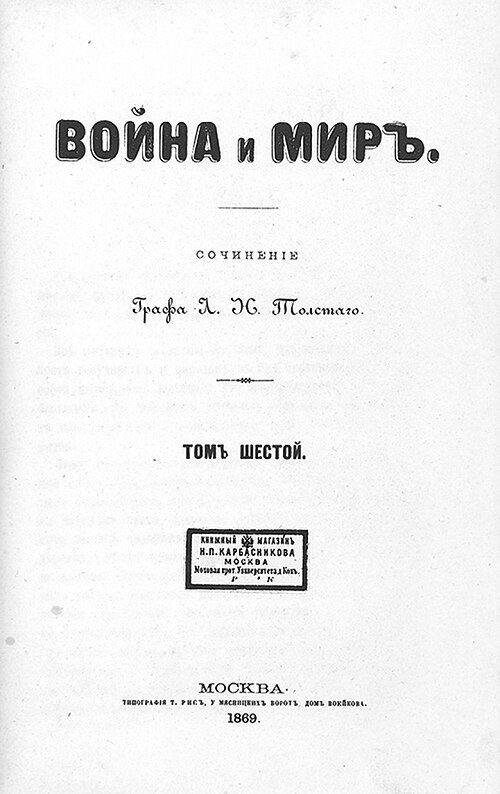
The first parts appeared in 1865–1866 in the Moscow journal The Russian Messenger (Russkii vestnik), edited by Mikhail Katkov, under the title “1805”. Tolstoy then stopped the serialization and revised heavily. The complete work, now called War and Peace, was published as a book in six volumes in 1868–1869.
Tolstoy kept changing the text. In an edition of 1873 he translated the French passages into Russian and moved many of the philosophical discussions into an appendix; later editions largely returned to the earlier form. Modern Russian editions follow the text established by scholars from the Complete Collected Works of Tolstoy, the huge “Jubilee Edition” published in the Soviet Union from 1928 onward, whose volumes also print many drafts.
These drafts show how much the book changed. Scholars have reconstructed earlier complete versions in which the plot and tone differ in significant ways, and one such reconstruction was published in Russia in 2000 as a separate book, provoking argument about whether an author’s rejected draft should be sold as an alternative “War and Peace”.
Intermediate
Reception, translation and legacy
Russian readers immediately recognized the book as a major event, though responses varied. Some veterans of 1812 and military writers objected to Tolstoy’s picture of the war and of Russian commanders; radicals of the 1860s disliked his idealization of the old nobility and his distrust of reform; conservatives admired its patriotism. Nearly all agreed on the power of its characters and scenes.
Translations spread the book around the world from the 1880s onward, and it became central to the international reputation of the Russian novel, together with the works of Dostoevsky and Turgenev. Translators have made very different choices, for example whether to keep the French passages in French, which shapes how readers in each language experience the book.
In the twentieth century, War and Peace took on new meanings. During the Second World War, known in Russia as the Great Patriotic War, the Soviet state promoted the novel as a patriotic epic of national resistance to invasion. Sergei Prokofiev turned it into an opera, and Sergei Bondarchuk directed a vast Soviet film version (1966–1967), which won the Academy Award for best foreign-language film. There have also been Hollywood and BBC adaptations, including television serials in 1972–1973 and 2016.
The book shaped the historical novel everywhere, showing how private lives and public events can be woven together. Writers across the world, including novelists of war and revolution in the twentieth century, have measured their own work against it. Its reflections on the fog of war also continue to be read by military historians and theorists.
Advanced
Scholarly debates: hedgehog or fox, form and meaning
Isaiah Berlin’s essay The Hedgehog and the Fox (1953) remains one of the most influential readings. Taking a line from the Greek poet Archilochus, “the fox knows many things, but the hedgehog knows one big thing”, Berlin argued that Tolstoy was by nature a fox, a genius at seeing the endless variety of life, who believed that one ought to be a hedgehog, possessing a single system that explains everything. The tension between the novel’s rich particularity and its philosophical claims of necessity is, for Berlin, the drama of Tolstoy’s mind.
Gary Saul Morson’s Hidden in Plain View (1987) took a different line, arguing that War and Peace is deliberately designed to resist closure and conventional plot, and that its apparent formlessness expresses Tolstoy’s view that life and history are made of countless small, unforeseeable moments. Critics influenced by Russian Formalism, notably Shklovsky and Boris Eikhenbaum, studied Tolstoy’s use of sources and his techniques of estrangement, while Marxist critics such as Georg Lukács treated the book as a model of realist representation of historical forces.
Other debates concern the book’s picture of society. Scholars have asked whether its portrayal of peasants, above all Platon Karataev, is an idealization from the point of view of a landowner; whether its treatment of women, especially Natasha’s transformation into a devoted mother in the epilogue, reflects Tolstoy’s own conservative views on marriage; and how its patriotism relates to later Russian and Soviet uses of the myth of 1812.
A persistent popular claim is that the title really means “War and the World” or “War and Society”, because pre-1918 Russian spelling distinguished миръ (peace) from міръ (world, community). Scholars have generally rejected this: the editions published in Tolstoy’s lifetime use the spelling that means “peace”, and the title’s contrast of war and peace fits the book’s structure.
Advanced
Sources, drafts and methods
Tolstoy’s historical sources included Russian military histories of 1812, such as the official accounts by Alexander Mikhailovsky-Danilevsky, French works like Adolphe Thiers’s history of the Consulate and Empire, and many memoirs, letters and documents. Comparing the novel with these sources shows where Tolstoy followed them, where he disputed them openly, and where he invented or changed details, for example in his portraits of Kutuzov and Napoleon or in the chronology of certain scenes.
The manuscripts survive in very large numbers and are preserved mainly in the State Tolstoy Museum in Moscow. They include outlines, drafts, proofs corrected by hand, and Sofia Andreyevna’s copies. Textual scholars have used them to trace how characters were created and renamed, how plot lines were abandoned, and how the balance between narrative and essay shifted. The Jubilee Edition devotes several volumes to this material.
For historians of memory, War and Peace is itself a historical source: it shows how educated Russians of the 1860s imagined the generation of 1812, and it helped fix that image for later generations. Studies of the novel therefore move between two periods at once. Researchers also compare it with French memoirs and histories, which tell the same events from the invaders’ side, a reminder that the story of 1812 is remembered very differently in Russia, France and the lands of Central Europe through which the armies passed.
Key ideas
- History from below
- Tolstoy’s view that history is the result of countless actions by ordinary people, not the plans of rulers and generals.
- Freedom and necessity
- We feel free when we act, yet from outside our actions seem determined; the second epilogue explores this paradox.
- The illusion of the great man
- Napoleon believes he controls events; Tolstoy presents this belief as vanity and self-deception.
- Wisdom of simplicity
- Characters such as Kutuzov and Platon Karataev show a humble acceptance of life that Tolstoy contrasts with intellectual pride.
- Search for meaning
- Pierre and Andrei pass through glory, religion, politics and love in search of what makes life worth living.
- Family and everyday life
- The book gives family life, courtship, birth and death as much weight as battles, suggesting they are the real substance of history.
- Estrangement
- A technique of describing familiar things through naive eyes so that their strangeness or falseness becomes visible.
Records
- 1805 — The story begins in July; in December Napoleon defeats Russia and Austria at Austerlitz.
- 1812 — Napoleon invades Russia; the Battle of Borodino (7 September) and the burning of Moscow follow; the French retreat.
- 1825 — The Decembrist revolt; Tolstoy’s first idea was a novel about a returning Decembrist.
- 1828 — Leo Tolstoy is born at Yasnaya Polyana.
- 1861 — Emancipation of the serfs in the Russian Empire.
- 1862 — Tolstoy marries Sofia Andreyevna Behrs.
- c. 1863 — Tolstoy begins sustained work on the book that becomes War and Peace.
- 1865 — The first part appears in The Russian Messenger under the title “1805”.
- 1867 — Tolstoy visits the battlefield of Borodino.
- 1869 — The final volume of the first complete book edition appears.
- 1873 — A revised edition translates the French and moves the essays into an appendix.
- 1966 — Sergei Bondarchuk’s Soviet film adaptation begins release (to 1967).
Glossary
- Napoleonic Wars
- The wars fought between Napoleon’s France and coalitions of European states, 1803–1815.
- Grande Armée
- Napoleon’s main army, which invaded Russia in 1812 with soldiers from many European countries.
- Serialization
- Publishing a long work in parts in a magazine or journal before it appears as a book.
- Decembrists
- Russian officers who rebelled against the tsar in December 1825, hoping for constitutional reform.
- Serf
- A peasant legally bound to a landowner’s estate; serfdom was abolished in Russia in 1861.
- Freemasonry
- A fraternal society with secret rituals and moral teachings, popular among Russian nobles in the early 1800s.
- Partisans
- Irregular fighters who attack an invading army from behind its lines; they harassed the French retreat in 1812.
- Epilogue
- A final section after the main story; War and Peace has one narrative epilogue and one philosophical epilogue.
- Estrangement (ostranenie)
- A term from Russian Formalist criticism for making the familiar seem strange by describing it freshly.
- Historical novel
- A work of fiction set in a real past period that mixes invented characters with real people and events.
Questions and answers
Is War and Peace a true story?
Partly. The wars, battles and many people, such as Napoleon and Kutuzov, are real, but the main families and their stories are invented, and Tolstoy sometimes changed historical details.
How long is it?
Very long: about 361 chapters, usually well over 1,000 pages in translation. It is best read slowly, a few chapters at a time.
Why do the characters speak French?
Russian aristocrats of the early 1800s often spoke French among themselves. Tolstoy uses this to show how distant they were from ordinary Russians, and it fades as the war with France grows.
Who is the main character?
There is no single hero. Pierre Bezukhov, Andrei Bolkonsky and Natasha Rostova are usually seen as the central three.
Why did Tolstoy say it was not a novel?
He felt it did not fit European categories of novel, epic poem or chronicle, and wanted freedom to mix story, history and philosophy.
Is Tolstoy’s theory of history taken seriously today?
Historians do not accept it as a complete theory, but his criticism of history centred on great men, and his stress on chance and the actions of many, anticipated later social history and still provokes debate.
Does the title really mean “War and the World”?
This is a popular myth. The spelling used in Tolstoy’s own editions means “peace”.
Sources and further reading
- War and Peace. Wikipedia
- 전쟁과 평화. 위키백과
- Leo Tolstoy. Wikipedia
- Yasnaya Polyana. Wikipedia
- French invasion of Russia. Wikipedia
- Isaiah Berlin, The Hedgehog and the Fox: An Essay on Tolstoy’s View of History. Weidenfeld & Nicolson, 1953
Related
- Fyodor DostoevskyRussian novelist whose works probe moral responsibility, poverty, belief and the pressures of modern city life.
- Storming of the BastilleThe seizure of a Paris fortress and prison on 14 July 1789 became an early emblem of the French Revolution.
- HomerThe poet tradition credits with the Iliad and the Odyssey, the founding epics of Greek literature. Whether one person composed both is debated.
- Georg Wilhelm Friedrich HegelGerman philosopher whose account of history, thought and social institutions profoundly influenced later philosophy.
- Jane AustenEnglish novelist whose sharp accounts of family, marriage and social standing remain central to the history of the novel.
Written with AI assistance from the published sources listed above, and revised as new research appears.