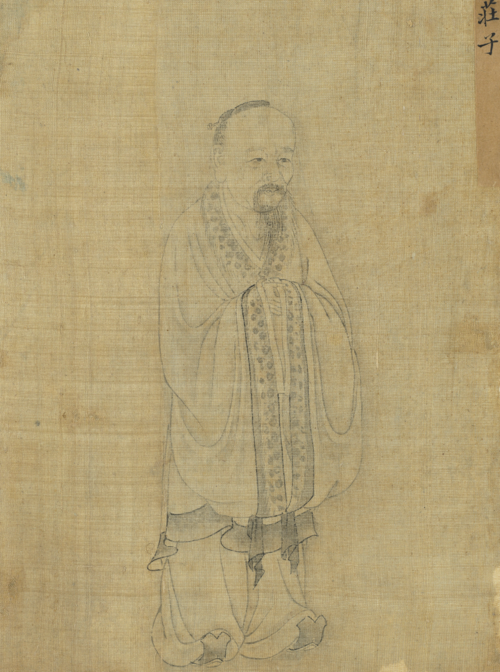
Start at the top for an easy introduction. Go further down for more detail and scholarship.
- Easy
- Intermediate
- Advanced
For young readers
More than 2,300 years ago in China lived a man named Zhuang Zhou. People call him Zhuangzi, “Master Zhuang”. He was not rich or powerful. He is said to have worked for a while as a minor official looking after a lacquer-tree garden, and he often had little money. But he had a wonderful imagination.
One night Zhuangzi dreamed he was a butterfly, fluttering happily from flower to flower. He did not know he was Zhuangzi. Then he woke up, and there he was, Zhuangzi again. But he wondered: “Was I Zhuangzi dreaming I was a butterfly, or am I a butterfly now dreaming that I am Zhuangzi?” It is a puzzle that makes you think about what is real.
Zhuangzi loved stories about animals and ordinary people. In one, a cook cuts up an ox so gracefully that his knife stays sharp for nineteen years, because he follows the natural gaps between the joints instead of hacking. Zhuangzi says life is like that: go with the natural way of things instead of forcing.
Once a king sent messengers to offer Zhuangzi an important job. Zhuangzi was fishing. He asked them: “I hear the king keeps a sacred turtle, dead for three thousand years, wrapped in silk in a box. Would that turtle rather be dead and honoured, or alive and dragging its tail in the mud?” “Alive in the mud,” they said. “Then go away,” said Zhuangzi. “I will drag my tail in the mud.”
Zhuangzi’s book is full of giant birds, talking trees, clever frogs and wise cripples. It teaches that different creatures see the world differently, that being “useless” can sometimes keep you safe, and that we should not be too sure we are right. Together with Laozi, he is remembered as one of the great teachers of Daoism.
At a glance
- Lived
- Traditionally c. 369–286 BCE; other estimates end his life around 298 BCE (dates uncertain; active in the late 4th century BCE)
- Home
- Meng, in the state of Song (location debated; candidates in modern Henan, Anhui and Shandong)
- Period
- Warring States period, China
- Tradition
- Classified as Daoist (daojia) by Han historians; paired with Laozi as “Lao–Zhuang”
- Book
- The Zhuangzi: 33 chapters in Guo Xiang’s edition (Inner 1–7, Outer 8–22, Miscellaneous 23–33), reduced from 52 in the Han
- Authorship
- Composite; the Inner Chapters are often, but not universally, attributed to Zhuang Zhou himself
- Famous stories
- The butterfly dream, Cook Ding, the giant bird Peng, the useless tree, the happy fish, the death of Hundun
- Later title
- In 742 CE the Tang court honoured him as Nanhua zhenren, and the book became the Nanhua zhenjing
Easy
Who was Zhuangzi?
Zhuangzi, “Master Zhuang”, is the name given to Zhuang Zhou, a Chinese thinker of the fourth century BCE, and to the book associated with him. Together with the Daodejing attributed to Laozi, the Zhuangzi is one of the two founding classics of Daoist philosophy. It is also one of the greatest works of Chinese literature, famous for its humour, imagination and daring style.
Where other thinkers of his age argued about how to govern the state and how to be a good person, Zhuangzi asked more unsettling questions. How do we know that our way of seeing is the right one? Is what is good for a human good for a fish or a bird? Is death something to fear? What would it mean to wander freely, without being trapped by ambition, fame or rigid opinions?
He answered not with a system but with stories, jokes, paradoxes and conversations, often between surprising characters: talking trees, a butcher, a wheelwright, people with disabilities who are wiser than kings, and even Confucius, who sometimes speaks Zhuangzi’s own ideas.
Easy
What we know about his life
Very little is known for certain about Zhuang Zhou’s life. The historian Sima Qian, writing around 100 BCE, gives only a few lines: Zhuang Zhou came from Meng, served as an official in charge of a “lacquer garden” (qiyuan), lived at the time of King Hui of Liang and King Xuan of Qi, and wrote more than 100,000 words, mostly in the form of parables. Meng was in the state of Song, a small state in the central plain; its exact location is disputed, and several places in modern Henan, Anhui and Shandong claim him.
The traditional dates of about 369–286 BCE are later estimates. What seems clear is that he was roughly a contemporary of Mencius, although neither mentions the other.
Other information comes from stories in the Zhuangzi itself, which must be read with care because the book freely mixes fact and fantasy. They show him as poor, once visiting a king in patched clothes and shoes tied with string; as refusing high office; and as a close friend and debating partner of the logician Hui Shi. When his wife died, a friend found him drumming on a basin and singing. Zhuangzi explained that at first he grieved, but then he reflected that her life had come from the formless and had now returned to it, like the passing of the seasons, and that weeping would show he did not understand fate.
Easy
Famous stories
The book opens with a vast fish called Kun in the northern ocean that turns into a bird called Peng, whose wings are like clouds hanging from the sky; it rises ninety thousand li and flies to the southern ocean. A cicada and a little dove laugh at it: why go so high, when we can flutter up to the treetops? The story contrasts small and large perspectives, and raises the question of whether freedom lies in greatness or in being content with one’s own nature.
In the story of Cook Ding, a butcher carves an ox for Lord Wenhui with such rhythm that it looks like a dance. After nineteen years his blade is as sharp as new, because he no longer sees the whole ox but follows its natural structure, sliding the knife through the spaces between the joints. The lord exclaims that from this he has learned how to nourish life.
Hui Shi complains to Zhuangzi that he has a huge tree so gnarled that no carpenter will look at it; it is useless. Zhuangzi replies that because it is useless, no one will cut it down; why not rest in its shade? Elsewhere, a sacred oak appears in a carpenter’s dream to explain that its uselessness is exactly what let it grow so old. This “usefulness of the useless” is one of the book’s best-known ideas.
Zhuangzi and Hui Shi are strolling on a bridge over the river Hao. “See how the fish come out and swim about at their ease; that is the happiness of fish,” says Zhuangzi. “You are not a fish; how do you know what fish enjoy?” asks Hui Shi. “You are not me; how do you know I don’t know?” replies Zhuangzi. The debate goes on, and readers still argue about who wins.
Intermediate
Historical context: withdrawal in an age of war
Zhuangzi lived in the Warring States period, when the great states of China fought constant wars and rulers recruited advisers to strengthen their armies and administrations. The “Hundred Schools” competed to offer them programmes: Confucians promoted ritual and benevolence, Mohists impartial care and utility, and others law, strategy or agriculture.
The Zhuangzi responds to this world with deep scepticism about service to rulers. Its stories are full of people crippled or executed for their talents, trees cut down because their wood is good, and officials destroyed by the favour of kings. Its advice is often to stay out of harm’s way, to be “useless” to those in power, or at least to serve without being consumed.
Intellectually, the Zhuangzi engages closely with its rivals. It criticizes the endless disputes of Confucians and Mohists over “this is right, that is wrong” (shi–fei), and it knows the logical paradoxes of the “School of Names”, especially those of Hui Shi. Its famous second chapter, “On Making Things Equal” (Qiwulun), can be read as a philosophical reply to the debates of its time.
Intermediate
Key ideas: perspective, spontaneity and free wandering
Perspective. Zhuangzi repeatedly shows that judgments depend on the point of view of the one who judges. Humans sleep in damp places and get ill, but eels do not; monkeys live in trees; people consider certain famous beauties lovely, but fish that see them dive deep and birds fly away. Which, he asks, knows the correct place to live or the true standard of beauty? The words “this” and “that”, “right” and “wrong”, shift as the speaker shifts.
Beyond fixed distinctions. From this, the Zhuangzi suggests that the wise person does not cling to one fixed perspective. It speaks of “the illumination of clarity” (ming) and of “walking two roads” (liangxing): seeing how things look from each side and letting distinctions be used lightly, as tools, rather than defended to the death. Whether this is relativism, scepticism, or a kind of mystical insight is debated.
Spontaneity and skill. Many stories celebrate craftspeople, such as Cook Ding, a wheelwright, a cicada catcher and a swimmer in a waterfall, whose long practice has become effortless. They act without forcing (wuwei), responding to things as they are. Their skill is a model of how to live: attentive, flexible, at ease.
Free wandering and the transformation of things. The first chapter is titled “Free and Easy Wandering” (Xiaoyao you). The ideal person is not bound by fame, merit or self; they “ride the changes” of the world. Life and death are presented as one continuous transformation, like the change from butterfly to Zhuangzi and back. The book includes moving passages on facing one’s own death, and on the “fasting of the heart” (xinzhai), emptying the mind of fixed opinions so that one can respond to things freshly.
Intermediate
The book and its layers
The Zhuangzi we read today is the edition of the scholar Guo Xiang (d. 312 CE), with his commentary. It has 33 chapters in three groups: the seven Inner Chapters (neipian), fifteen Outer Chapters (waipian) and eleven Miscellaneous Chapters (zapian). The Han imperial catalogue had listed a Zhuangzi in 52 chapters; Guo Xiang removed material he considered superficial or spurious.
The seven Inner Chapters are “Free and Easy Wandering”, “On Making Things Equal”, “The Secret of Caring for Life”, “In the World of Men”, “The Sign of Virtue Complete”, “The Great and Venerable Teacher” and “Fit for Emperors and Kings”. They have a distinctive style and are traditionally regarded as closest to Zhuang Zhou himself. The last chapter of the book, “All Under Heaven” (Tianxia), is an early survey of the schools of thought, including a portrait of Zhuang Zhou himself, and was clearly written by someone else.
The Outer and Miscellaneous Chapters are varied. Some continue the themes of the Inner Chapters; others sharply attack Confucian morality and civilization, praise a primitive age of simple living, or combine Daoist ideas with government. Several of the best-known stories, including the happy fish, the drumming on the basin and the turtle in the mud, come from these later chapters.
Intermediate
Influence and legacy
The Han historians Sima Tan and Sima Qian grouped Zhuangzi under the “Daoist school” (daojia), and from the third century CE he was read together with Laozi as “Lao–Zhuang”. In that period, thinkers of the “Learning of the Mysterious” (xuanxue), including Guo Xiang, used the Zhuangzi to discuss being and non-being, naturalness and the role of the sage in society.
When Buddhism entered China, early translators and monks sometimes used Zhuangzian vocabulary to explain Buddhist ideas, and Chan (Zen) Buddhism later shared much of Zhuangzi’s spirit: suspicion of words, love of paradox, and admiration for spontaneous action. In religious Daoism, Zhuangzi was revered as an immortal; in 742 the Tang emperor Xuanzong gave him the title “True Person of Southern Florescence” (Nanhua zhenren), and his book became a scripture, the Nanhua zhenjing.
In literature and art, the Zhuangzi’s influence is immense. Poets such as Tao Yuanming, Li Bai and Su Shi drew on its imagery of free wandering, the butterfly dream and the useless tree, and many Chinese idioms come from it, such as “a frog at the bottom of a well” for a narrow-minded person. In Korea and Japan it was widely read by scholars and poets, even where Neo-Confucian orthodoxy regarded it as heterodox.
Modern readers around the world have found in Zhuangzi a philosopher of perspective, freedom and play. English translations include those by James Legge (1891), Burton Watson (1968), A. C. Graham (1981) and Brook Ziporyn (2009 and 2020), and his stories are often cited in discussions of scepticism, environmental ethics and the philosophy of skill.
Advanced
Scholarly debates: authorship and layers
Who wrote what? It is widely agreed that the Zhuangzi is a composite anthology. The traditional view, going back at least to Guo Xiang’s arrangement, holds that the Inner Chapters are by Zhuang Zhou and the rest by followers or imitators. A. C. Graham, in Chuang-tzu: The Inner Chapters (1981) and related studies, proposed that the later chapters contain distinct groups: writings by a “School of Zhuangzi”, a “Primitivist” author close to the Laozi, “Yangist” chapters valuing the preservation of life, and “Syncretist” chapters that combine Daoist, Confucian and Legalist ideas, possibly from the early Han.
Liu Xiaogan, in Classifying the Zhuangzi Chapters (1994), argued on linguistic grounds that the Inner Chapters are earlier: compound terms such as daode (“the Way and its virtue”), xingming (“nature and destiny”) and jingshen (“spirit”) occur in the Outer and Miscellaneous Chapters but not in the Inner ones. Harold Roth and others refined these classifications.
Some scholars have gone further. Esther Klein, for example, has argued that the very distinction of “Inner Chapters” may be the result of later editing, and that early Han references to Zhuangzi, including Sima Qian’s, tend to cite passages now in the Outer and Miscellaneous Chapters. On this view, even the Inner Chapters cannot simply be assumed to be Zhuang Zhou’s own words.
Guo Xiang and Xiang Xiu. Already in the fifth century, the anecdote collection Shishuo xinyu claimed that Guo Xiang had taken over much of an earlier commentary by Xiang Xiu. How much of “Guo Xiang’s” commentary is his own remains uncertain.
Advanced
Interpretive debates: relativist, sceptic or mystic?
Philosophers disagree about what the Zhuangzi’s arguments amount to. Some read it as relativist: there is no perspective-independent standard of right and wrong, since what is “this” and “right” depends on the speaker’s position. Others read it as sceptical: we cannot know whether our judgments are correct, and the butterfly dream and the happy fish dramatize the limits of knowledge. Still others see it as mystical: the aim is a direct experience of the Dao beyond all distinctions.
Many recent scholars favour mixed or “therapeutic” readings. The volume Essays on Skepticism, Relativism, and Ethics in the Zhuangzi, edited by Paul Kjellberg and Philip J. Ivanhoe (1996), collected influential arguments on these questions. The Stanford Encyclopedia entry presents Zhuangzi as a perspectival relativist whose scepticism is “positive”: it frees us from dogmatism without paralysing action, and it values the practical know-how shown by skilled craftspeople.
Another debate concerns the Zhuangzi’s relation to the Daodejing. Traditionally Laozi is placed first and Zhuangzi seen as his follower. But the Inner Chapters rarely echo the Daodejing, and the Guodian manuscripts (c. 300 BCE) show the Laozi text still taking shape around Zhuangzi’s time. Many scholars therefore treat the two as largely independent sources that were only later combined into one “Daoist” tradition.
Translation is itself interpretation. The book’s puns, invented names and deliberately paradoxical language make every translation a choice among possible meanings. Chapter titles such as Qiwulun can be read as “On Making Things Equal” or as “Discussion on the Equality of Things”, which suggest different philosophical claims.
Advanced
Evidence and sources
Biographical evidence is extremely thin: Sima Qian’s short notice in the Records of the Grand Historian (Shiji, chapter 63, shared with Laozi, Shen Buhai and Han Fei), stories within the Zhuangzi, and the portrait in its last chapter. None of this is contemporary, and the stories are shaped by the book’s literary purposes.
The received text descends from Guo Xiang’s edition. The Tang scholar Lu Deming, in his Jingdian shiwen, recorded variant readings and noted other early editions, including ones with 52 and 27 chapters, which gives some idea of the text’s earlier diversity. Fragments of the Zhuangzi in Tang-period manuscripts from Dunhuang and in a Japanese temple copy preserve further variants.
Archaeology has added a little. Bamboo-slip fragments corresponding to passages of the Outer and Miscellaneous Chapters have been reported from early Han tombs, which suggests that at least some of that material was circulating by the second century BCE. No manuscript of the Inner Chapters from before the Han has been found. Careful comparison of language, rhymes and ideas therefore remains the main method for dating the layers.
Key ideas
- Free and easy wandering (逍遙遊)
- A state of freedom in which one is not bound by fame, ambition or fixed views, and moves easily with the changes of the world.
- Making things equal (齊物)
- Seeing that judgments of right and wrong, big and small, depend on perspective, so no single view should be absolutized.
- Wuwei (無為)
- Non-forcing action: acting spontaneously and in harmony with the nature of things, as a skilled craftsman does.
- Usefulness of the useless
- What seems worthless by conventional standards may be valuable, and may even be what keeps a thing alive.
- Transformation of things (物化)
- All things, including life and death, are part of a continuous process of change, as in the butterfly dream.
- Fasting of the heart (心齋)
- Emptying the mind of fixed ideas so that it can respond openly to whatever comes.
- Perspectival knowledge
- Knowledge is always from somewhere; Zhuangzi uses animals and dreams to show the limits of any one standpoint.
Records
- c. 369 BCE — Traditional date of the birth of Zhuang Zhou in Meng, in the state of Song.
- c. 334 BCE — Period of King Wei of Chu (r. 339–329 BCE), who according to tradition offered Zhuangzi a high post.
- c. 310 BCE — Approximate period of the death of his friend and rival Hui Shi.
- c. 286 BCE — Traditional date of Zhuangzi’s death.
- c. 100 BCE — Sima Qian writes a short biography of Zhuang Zhou in the Records of the Grand Historian.
- c. 100 CE — The Han imperial catalogue lists a Zhuangzi in 52 chapters.
- 312 CE — Death of Guo Xiang, whose 33-chapter edition and commentary become the standard text.
- 742 CE — Tang Emperor Xuanzong honours Zhuangzi as Nanhua zhenren; the book becomes the Nanhua zhenjing.
- 1891 — James Legge’s English translation appears in the Sacred Books of the East.
- 1968 — Burton Watson publishes The Complete Works of Chuang Tzu.
- 1981 — A. C. Graham publishes Chuang-tzu: The Inner Chapters, with a new theory of the book’s layers.
Glossary
- Dao (道)
- “The Way”: the path or pattern of things; in Daoism, the source and course of everything.
- Daoism (道家)
- A tradition of thought associated with Laozi and Zhuangzi that values naturalness, spontaneity and freedom from rigid convention.
- Inner Chapters
- The first seven chapters of the Zhuangzi, traditionally regarded as closest to Zhuang Zhou himself.
- Shi–fei (是非)
- “This–not this”, “right–wrong”: the judgments that philosophers of the time argued over.
- Wuwei (無為)
- “Non-action” or “non-forcing”: acting without contrived effort.
- Hui Shi (惠施)
- A logician of the School of Names, Zhuangzi’s friend and debating partner.
- Guo Xiang (郭象)
- A third–fourth-century scholar whose edition and commentary shaped the received Zhuangzi.
- Xuanxue (玄學)
- “Learning of the Mysterious”, a movement of the third–fourth centuries CE that reinterpreted the Laozi, Zhuangzi and Book of Changes.
- Parable (寓言)
- A story told to convey an idea indirectly; Sima Qian says most of Zhuangzi’s writing was of this kind.
Questions and answers
Was Zhuangzi a real person?
Most scholars think so, though we know very little about him. Sima Qian records a few facts, and the book contains stories about him, but these mix history with imagination.
Did Zhuangzi write the whole book?
No. The Zhuangzi is a collection built up over time. The seven Inner Chapters are often attributed to him, while the other chapters come from followers and other writers, possibly as late as the early Han dynasty.
What does the butterfly dream mean?
It raises the question of how we can be sure what is real, and also suggests that different forms of life are part of a single process of transformation. Readers interpret it in many ways.
What is the difference between Zhuangzi and Laozi?
Both are considered Daoist. The Daodejing is a short, poetic book with advice for rulers; the Zhuangzi is longer, full of stories and humour, and less interested in government than in personal freedom and perspective.
Why did Zhuangzi sing when his wife died?
In the story he says he grieved at first, but then understood that life and death are part of the natural cycle, like the seasons, and that endless weeping would mean not understanding this.
Is Zhuangzi a relativist?
Scholars debate this. Some see him as a relativist or sceptic about right and wrong, others as a mystic, and many think he uses sceptical arguments to free people from dogmatism rather than to deny all values.
How can we date the different chapters?
Mainly by comparing vocabulary, ideas and style, supplemented by early quotations and a few bamboo-slip fragments from Han tombs; no pre-Han manuscript of the Inner Chapters has been found.
Sources and further reading
- Zhuangzi. Stanford Encyclopedia of Philosophy
- Zhuangzi (Chuang-Tzu, 369–298 B.C.E.). Internet Encyclopedia of Philosophy
- Zhuang Zhou. Wikipedia
- Zhuangzi (book). Wikipedia
- Guo Xiang. Wikipedia
- Guodian Chu Slips. Wikipedia
- Zhuangzi (Chinese text with James Legge’s translation). Chinese Text Project
- A. C. Graham (trans.), Chuang-tzu: The Inner Chapters. George Allen & Unwin, 1981
- Burton Watson (trans.), The Complete Works of Chuang Tzu. Columbia University Press, 1968
Related
- LaoziTraditionally named author of the Daodejing. Whether he was a single historical person is still debated.
- ConfuciusTeacher from the state of Lu whose sayings, gathered in the Analects, shaped ethics and government across East Asia.
- MenciusA Confucian thinker who argued that people have the beginnings of moral goodness and that rulers must care for their subjects.
- MoziAn early Chinese thinker associated with Mohism, which advocated impartial concern and opposed aggressive war.
- Li BaiTang poet celebrated for vivid imagery and poems about friendship, travel, wine and the natural world.
- Siddhartha Gautama (the Buddha)Founder of Buddhism, who taught a path to liberation from suffering on the Ganges plain. His dates are disputed.
Written with AI assistance from the published sources listed above, and revised as new research appears.