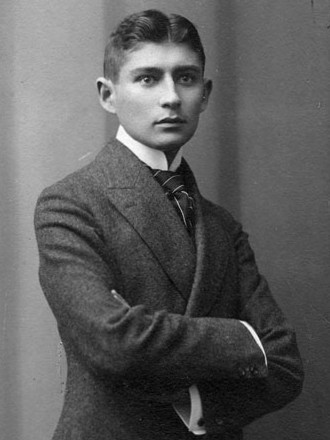
Start at the top for an easy introduction. Go further down for more detail and scholarship.
- Easy
- Intermediate
- Advanced
For young readers
Imagine waking up one morning and finding that you have turned into a giant bug. You can’t get out of bed, your family is scared of you, and you still have to worry about being late for work. That is how Franz Kafka’s most famous story, The Metamorphosis, begins.
Kafka lived about a hundred years ago in Prague, a beautiful old city that is now the capital of the Czech Republic. He spoke and wrote in German. By day he worked in an office that helped factory workers who got hurt on the job. At night he stayed up late writing stories.
His stories feel like strange dreams. In one, a man is arrested but nobody will tell him what he did wrong. In another, a man tries again and again to reach a castle on a hill, but he can never get there. The people in his stories keep trying hard, even when the rules seem to make no sense.
Kafka was shy and often unsure of himself. He was frightened of his strict father, and he wrote him a very long letter explaining his feelings. He became sick with a lung disease called tuberculosis and died when he was only 40.
Before he died, he asked his best friend, Max Brod, to burn his unpublished writing. Brod did not do it. Instead he published Kafka’s novels, and people all over the world began to read them. Today we even have a word, “Kafkaesque”, for a situation that feels confusing and trapped, like being lost in a maze of rules.
At a glance
- Lived
- 3 July 1883 (Prague) – 3 June 1924 (Kierling sanatorium, near Vienna)
- Homeland
- Prague, Kingdom of Bohemia, Austria-Hungary; after 1918, Czechoslovakia
- Language
- Wrote in German; also knew Czech, and studied Hebrew late in life
- Day job
- Doctor of law (1906); official at the Workers’ Accident Insurance Institute for the Kingdom of Bohemia, 1908–1922
- Published in his lifetime
- Short prose and stories, including Contemplation (1912), The Judgment (1913), The Metamorphosis (1915), In the Penal Colony (1919), A Country Doctor (1919/20) and A Hunger Artist (1924)
- Published after his death
- The novels The Trial (1925), The Castle (1926) and Amerika (The Man Who Disappeared, 1927), plus diaries and letters, edited by Max Brod
- Key themes
- Opaque authority and bureaucracy, guilt and judgment, fathers and sons, isolation, the body, the search for meaning
- Legacy
- One of the central writers of literary modernism; the adjective “Kafkaesque” entered many languages
Easy
Who was Franz Kafka?
Franz Kafka was a German-language writer who lived almost his whole life in Prague. During his lifetime he published only a few thin books of short stories and was known mainly to a small circle of readers. After his death, his three unfinished novels and many other writings were published, and within a few decades he was being read and discussed around the world.
Kafka’s stories often start with something impossible, told in calm, precise, almost businesslike sentences. A travelling salesman wakes up as a monstrous insect. A bank clerk is arrested on the morning of his thirtieth birthday by men who will not say what the charge is. A land surveyor arrives in a village and spends the rest of the novel trying, and failing, to reach the officials in the castle who supposedly summoned him. The strangeness is never explained, and the characters rarely question it; they simply try to cope.
Readers have found in these stories pictures of many things: the power of faceless bureaucracies, the feeling of being judged without knowing why, the loneliness of modern city life, the anxiety of a son before a powerful father, and the experience of being an outsider. Kafka himself refused to give simple explanations, which is one reason his work remains so open to interpretation.
Easy
Life: Prague, family and the office
Kafka was born on 3 July 1883 in Prague, then part of the Austro-Hungarian Empire. His father, Hermann Kafka, had grown up poor in a Czech-speaking Jewish village and built up a successful shop selling fancy goods in Prague. His mother, Julie Löwy, came from a more educated German-speaking Jewish family. Two younger brothers died as babies; Franz grew up with three younger sisters, Elli, Valli and Ottla.
He attended German-language schools, including the demanding Old Town German Gymnasium, and then studied law at the German university in Prague, receiving his doctorate in 1906. At university he met Max Brod, a writer who became his closest friend, his first champion and, later, his literary executor.
After a year at the insurance company Assicurazioni Generali, Kafka joined the semi-governmental Workers’ Accident Insurance Institute for the Kingdom of Bohemia in 1908. He was a capable and respected official who wrote reports on accident prevention and risk in factories and quarries, and he was promoted several times. The job gave him fixed afternoon hours, but he often complained that it left him too tired to write. Much of his fiction was written late at night.
Kafka never married. He was engaged twice to Felice Bauer, a woman from Berlin to whom he wrote hundreds of letters between 1912 and 1917, and briefly to Julie Wohryzek. From 1920 he had an intense, mostly written relationship with the Czech journalist and translator Milena Jesenská. In 1923 he met Dora Diamant, a young woman from an Orthodox Jewish family, and lived with her in Berlin for several months, the only time he lived away from Prague for long.
In August 1917 Kafka was diagnosed with tuberculosis. He took long periods of sick leave and retired on a pension in 1922. The disease spread to his throat, making it painful to eat and drink. He died on 3 June 1924 in a sanatorium at Kierling, near Vienna, aged 40, and was buried in the New Jewish Cemetery in Prague.
Easy
A German-speaking Jew in a Czech city
Kafka’s Prague was a city of several overlapping worlds. Most of its people spoke Czech, and Czech national feeling was growing stronger. A smaller, influential minority spoke German, and many German speakers in Prague were Jews like the Kafkas. This meant that Kafka belonged to a minority within a minority: a German speaker among Czechs, and a Jew among German speakers, at a time when antisemitism was common on all sides.
Kafka spoke Czech well and read Czech literature, but he wrote only in German. His German is often praised for its clarity and precision, perhaps partly because the German of Prague was somewhat cut off from everyday spoken German elsewhere. When the Austro-Hungarian Empire collapsed in 1918, Prague became the capital of the new Czechoslovakia, and Kafka, like many German speakers, found himself in a new state.
His relationship with Judaism changed over his life. His family was only loosely observant, and as a teenager he declared himself an atheist. From 1911, however, he was fascinated by a travelling Yiddish theatre troupe from Eastern Europe and grew interested in Jewish culture and Zionism. In his last years he studied Hebrew and dreamed of moving to Palestine. After his death, all three of his sisters were murdered in the Holocaust, as was Milena Jesenská in the Ravensbrück concentration camp; this history has shaped how many later readers see his work.
Intermediate
The main works
Kafka’s breakthrough as a writer came on the night of 22–23 September 1912, when he wrote the story The Judgment in a single sitting. In it, a young man’s conversation with his elderly father suddenly turns into an accusation, and the father sentences the son to death by drowning, a sentence the son immediately carries out. Kafka later wrote in his diary that this was the only way to write: with complete openness of body and soul. The story was dedicated to Felice Bauer.
A few weeks later, in November and December 1912, he wrote The Metamorphosis. Gregor Samsa, a travelling salesman who supports his parents and sister, wakes up transformed into “a monstrous vermin” (ungeheueres Ungeziefer). At first his family try to cope, and his sister Grete brings him food, but they gradually come to see him as a burden. His father wounds him by throwing apples; he dies alone, and the family feel relief and plan for the future. Published in 1915, it was the longest work Kafka regarded as finished. He told his publisher that the insect itself must not be drawn on the cover.
The Trial (Der Process), begun in 1914, follows Josef K., a bank official who is arrested one morning without being told the charge. He is free to go to work, but his life is gradually consumed by a mysterious court that meets in attics and tenement buildings. The novel contains the parable “Before the Law”, in which a man from the country waits all his life at an open door to the Law, guarded by a doorkeeper, only to be told at the end that this door was meant only for him. Kafka published the parable separately in his lifetime.
The Castle (Das Schloss), begun in 1922, concerns a land surveyor known only as K., who arrives in a snowy village ruled by the officials of a castle and struggles endlessly to have his position recognized. Amerika, or The Man Who Disappeared (Der Verschollene), begun in 1912, is a more comic novel about a young European emigrant in the United States, a country Kafka never visited. All three novels were left unfinished.
Other important works include In the Penal Colony (1919), about an officer devoted to a machine that executes prisoners by inscribing their sentence into their bodies; A Country Doctor (1919/20), a collection of short pieces; A Hunger Artist (1924), about a performer who fasts in a cage as public entertainment; and the Letter to His Father (written 1919), a long letter describing his fear of Hermann Kafka, which was never delivered.
Intermediate
How Kafka writes
Kafka’s most distinctive technique is to describe the impossible in the language of the everyday. The Metamorphosis does not ask how or why Gregor was transformed; it concerns itself with practical problems such as opening a door, missing a train and paying the family’s debts. This flat, exact style makes the absurd situations feel disturbingly real.
His narrators usually stay very close to a single character, who knows as little as the reader. Josef K. and the surveyor K. keep trying to reason their way through their situations, collecting information, making plans and arguing their case, but every explanation leads to another delay or another official. The logic of each sentence is clear; it is the whole that makes no sense.
Kafka also loved short forms: parables, fragments and aphorisms. In 1917–18, while recovering in the village of Zürau, he wrote a series of numbered aphorisms on truth, sin and hope. Many of his short texts, such as “Before the Law” or “An Imperial Message”, work like modern religious parables whose meaning cannot be pinned down.
Humour is an important part of his writing that is easy to miss. Max Brod recalled that Kafka laughed so hard while reading the first chapter of The Trial aloud to friends that he could hardly continue. Many readers now see his work as tragicomic, in the tradition of slapstick and Yiddish theatre as well as of religious and philosophical literature.
Intermediate
Themes: law, guilt, fathers and outsiders
Law and authority. Kafka trained as a lawyer and spent his working life in a large administrative institution. His fiction is full of courts, officials, files and hierarchies that are powerful but hidden. The characters never meet the highest authorities; they deal only with low-ranking officials, lawyers and messengers who themselves know little. Many readers have seen in this a prophetic image of modern bureaucracy and even of the totalitarian states that arose after his death, though Kafka wrote before them.
Guilt and judgment. In The Judgment, The Trial and In the Penal Colony, people are accused and punished, often without a clear crime. The accused frequently seem to accept their guilt. Critics debate whether this guilt is religious, psychological, social or existential; the texts support several readings at once.
Fathers and sons. The powerful, overbearing father appears in The Judgment and The Metamorphosis, and Kafka’s Letter to His Father describes a lifelong feeling of inadequacy before Hermann Kafka. Psychoanalytic readers have made much of this, though Kafka himself was sceptical about psychoanalysis as a key to his work.
Outsiders and the body. Kafka’s heroes are often strangers who do not belong: a surveyor in a village, an emigrant in America, an ape who learns to act human in A Report to an Academy, a creature hiding in its burrow. Bodies change, sicken, starve and are marked. These images have been read in terms of Jewish experience in Central Europe, of illness, of the alienation of the modern worker, and of the difficulty of communication itself.
Intermediate
Max Brod and the survival of the writings
Kafka left two notes asking Max Brod to burn his diaries, manuscripts, letters and drawings unread. Brod had already told Kafka he would never do this, and he did not. Between 1925 and 1927 he edited and published The Trial, The Castle and Amerika, followed by collections of stories, diaries and letters. Kafka had in fact destroyed much of his own work, some of it burned in Berlin with Dora Diamant’s help, so a good deal was lost.
Brod’s editions made Kafka famous, but they also shaped how he was read. Brod arranged unfinished chapters, gave the novels titles and a finished appearance, and interpreted Kafka as a religious seeker. Later scholars have criticized some of his editorial choices, and new critical editions based on the manuscripts, beginning in the 1980s, restored Kafka’s own spelling, punctuation and fragmentary state.
In 1939, as German troops occupied Prague, Brod escaped to Palestine carrying a suitcase of Kafka’s papers. Part of the material was later deposited in Oxford, where it is now held by the Bodleian Library. The manuscript of The Trial was sold at auction in 1988 and is now in the German Literature Archive in Marbach. Papers that Brod left to his secretary Esther Hoffe became the subject of a long legal dispute in Israel, which ended in 2016 when Israel’s Supreme Court ruled that they belonged to the National Library of Israel.
Intermediate
Influence and legacy
Kafka’s fame grew rapidly after the Second World War. Translations into English by Willa and Edwin Muir from the 1930s, and into French, introduced him to international readers, and after the war he became one of the most discussed writers in the world. Existentialist writers such as Albert Camus saw him as a guide to the absurd, while others read him as a prophet of totalitarianism.
Writers across the world have described his influence. Jorge Luis Borges wrote about him repeatedly, most famously in the essay “Kafka and His Precursors”, which argues that each writer creates his own precursors. Gabriel García Márquez said that reading The Metamorphosis showed him that fiction could break the rules of realism. Kafka’s influence can be traced in writers as varied as Samuel Beckett, Bruno Schulz, Philip Roth, Kōbō Abe and Haruki Murakami, whose novel Kafka on the Shore takes its title from him.
In communist Czechoslovakia, Kafka was long treated with suspicion. A conference held at Liblice in 1963, which argued that his themes of alienation applied to socialist societies too, is often seen as a forerunner of the reform movement of the Prague Spring. Today Prague celebrates him with museums, monuments and literary prizes.
The adjective “Kafkaesque” is now used in many languages for situations that are nightmarishly complex, illogical and bureaucratic. Some critics warn that this popular use flattens Kafka’s work, which is also funny, tender and deeply ambiguous.
Advanced
Interpretive debates
Few modern writers have attracted as many competing interpretations. Early readers, following Brod, saw Kafka as a religious or theological writer searching for divine grace; the castle and the court could be read as images of a hidden God. Existentialist readings in the 1940s and 1950s saw him as depicting the absurdity of human existence. Marxist and sociological readers emphasized alienated labour and bureaucratic domination, while psychoanalytic critics focused on the father complex and the body.
A major intervention came from Gilles Deleuze and Félix Guattari in Kafka: Toward a Minor Literature (1975; English 1986). They argued that Kafka wrote a “minor literature”: a minority using a major language (Prague German) in a way that deterritorializes it, makes everything political and gives it collective value. Their reading rejected the search for hidden symbolic meanings in favour of following how Kafka’s texts work as machines of desire and power.
Other scholars have emphasized Kafka’s Jewish context, reading his work in relation to Central European Jewish assimilation, Zionism, Yiddish culture and antisemitism, and asking how the Holocaust has influenced its reception. Still others, such as Walter Benjamin in an essay of 1934, warned against both theological and psychological reductions and stressed the gestures and the unresolvable quality of the parables.
A general caution now shared by many scholars is that the works resist any single key. Kafka’s texts seem to invite interpretation while dramatizing its failure, as in “Before the Law”, where the priest in The Trial offers several contradictory commentaries on the parable. For this reason some critics argue that the endless debate is itself part of what Kafka’s writing does.
Advanced
Sources: manuscripts, diaries and biography
Our knowledge of Kafka rests unusually heavily on private documents: his diaries (kept from about 1909 to 1923), notebooks, and several thousand letters to Felice Bauer, Milena Jesenská, Max Brod, his family and others. Felice Bauer’s and Milena’s letters to him have not survived, so we hear only one side of these correspondences. These documents are rich but were not written for publication, and they show Kafka presenting himself in different ways to different people.
For decades readers depended on Brod’s editions and his 1937 biography, which presented a saintly, religious Kafka. The critical edition published by S. Fischer from 1982 onward, and later facsimile editions of the manuscripts, have allowed scholars to see Kafka’s deletions, variant chapter orders and unfinished fragments. For example, the order of the chapters of The Trial is not fixed by Kafka and has been reconstructed differently by different editors.
The fullest modern biography is Reiner Stach’s three-volume work, which uses newly available documents, including material from Brod’s estate, to reconstruct Kafka’s daily life and social world. Stach and others have also drawn on Kafka’s professional writings for the insurance institute, which show him as a careful and effective civil servant rather than only a tormented artist.
Many details remain uncertain: the exact contents of lost manuscripts, what Kafka intended for his unfinished novels, and how far he really wished his papers destroyed. Scholars continue to debate whether his request to Brod was sincere, given that he chose as executor the one friend certain to refuse.
Key ideas
- The Kafkaesque
- A situation that is nightmarishly confusing, illogical and controlled by hidden authorities; the word comes from Kafka’s fiction.
- Opaque authority
- Courts, castles and offices that have great power but can never be reached or understood by those they govern.
- Guilt without crime
- Characters are accused and judged without being told what they did, and often come to accept their own guilt.
- Matter-of-fact strangeness
- Impossible events are narrated in calm, precise, everyday language, which makes them feel real.
- Parable
- Short stories such as “Before the Law” that seem to carry a deep lesson but resist a single meaning.
- Father and son
- The overpowering father is a recurring figure, reflecting Kafka’s troubled relationship with Hermann Kafka.
- Minor literature
- Deleuze and Guattari’s term for literature written by a minority in a major language, as Kafka wrote in Prague German.
Records
- 1883 — Born in Prague on 3 July to Hermann and Julie Kafka.
- 1906 — Receives his doctorate in law from the German university in Prague.
- 1908 — Joins the Workers’ Accident Insurance Institute; first prose pieces appear in the journal Hyperion.
- 1912 — Meets Felice Bauer; writes The Judgment in one night (22–23 September) and The Metamorphosis in November–December; Contemplation published.
- 1914 — Begins The Trial after breaking off his first engagement to Felice Bauer.
- 1915 — The Metamorphosis is published.
- 1917 — Diagnosed with tuberculosis in August; stays in Zürau and writes aphorisms.
- 1919 — In the Penal Colony published; writes the Letter to His Father, never delivered.
- 1922 — Begins The Castle; retires from the insurance institute on a pension.
- 1923 — Lives in Berlin with Dora Diamant.
- 1924 — Dies on 3 June at Kierling near Vienna; A Hunger Artist appears shortly after.
- 1925 — Max Brod publishes The Trial, followed by The Castle (1926) and Amerika (1927).
Glossary
- Austria-Hungary
- The multinational empire ruled by the Habsburgs that included Bohemia and Prague until 1918.
- Bohemia
- The historic western region of today’s Czech Republic, with Prague as its capital.
- Novella
- A work of fiction longer than a short story but shorter than a novel, like The Metamorphosis.
- Parable
- A short story used to teach or suggest a moral or spiritual truth.
- Aphorism
- A short, sharp statement expressing a thought or truth.
- Literary executor
- The person who decides what happens to a writer’s unpublished works after death; for Kafka, Max Brod.
- Modernism
- The early-twentieth-century movement in the arts that broke with traditional forms to express modern experience.
- Tuberculosis
- A serious infectious disease, usually of the lungs, that was a leading cause of death in Kafka’s time.
- Critical edition
- A scholarly edition that reconstructs a text from manuscripts and records variants and changes.
- Yiddish
- The traditional language of Ashkenazi Jews of Central and Eastern Europe, based on German with Hebrew and Slavic elements.
Questions and answers
Did Kafka really write a story about a man turning into a bug?
Yes. In The Metamorphosis (1915), Gregor Samsa wakes up as a “monstrous vermin”. Kafka never says exactly what kind of creature he is, and he asked that it not be drawn on the book’s cover.
Why did Kafka want his writings burned?
He was deeply self-critical and dissatisfied with most of his work. But he gave the task to Max Brod, who had said he would refuse, so some scholars wonder how serious the request was.
Was Kafka a German writer or a Czech writer?
He was a Prague Jew who wrote in German and lived in Austria-Hungary and then Czechoslovakia. He belongs to German-language literature, to Czech and Prague culture, and to Jewish literature at once.
What does “Kafkaesque” mean?
It describes a situation that is confusing, threatening and absurdly bureaucratic, where you cannot find out the rules or who is in charge.
Are Kafka’s novels finished?
No. The Trial, The Castle and Amerika were all left unfinished. The Trial has an ending chapter, but the order of its other chapters had to be decided by editors.
Is The Trial a prophecy of totalitarianism?
Many readers after 1945 read it that way, but Kafka wrote it in 1914–15, before the totalitarian states existed. Scholars debate whether it is better read as being about law, religion, psychology or modern institutions in general.
Where are Kafka’s manuscripts now?
Mainly in the Bodleian Library in Oxford, the German Literature Archive in Marbach (including The Trial) and the National Library of Israel in Jerusalem.
Sources and further reading
- Franz Kafka. Wikipedia
- 프란츠 카프카. 위키백과 (Korean Wikipedia)
- The Metamorphosis. Wikipedia
- The Trial. Wikipedia
- The Castle (novel). Wikipedia
- Letter to His Father. Wikipedia
- Max Brod. Wikipedia
- Kafkaesque. Wikipedia
- Reiner Stach (trans. Shelley Frisch), Kafka: The Decisive Years. Harcourt, 2005
- Gilles Deleuze and Félix Guattari (trans. Dana Polan), Kafka: Toward a Minor Literature. University of Minnesota Press, 1986
Related
- Fyodor DostoevskyRussian novelist whose works probe moral responsibility, poverty, belief and the pressures of modern city life.
- Friedrich NietzscheGerman philosopher and classical scholar who challenged inherited moral values and examined culture, power and the meaning of life.
- Lu XunChinese writer and critic whose fiction and essays examined social hierarchy, custom and the pressures of modern change.
- UlyssesJames Joyce’s novel follows a day in Dublin through changing styles and the inner lives of its characters.
- FiccionesJorge Luis Borges’s collection of stories explores imagined books, labyrinths, chance and the limits of knowledge.
- Tractatus Logico-PhilosophicusLudwig Wittgenstein’s compact philosophical book examines language, logic and what can be meaningfully said.
Written with AI assistance from the published sources listed above, and revised as new research appears.