Start at the top for an easy introduction. Go further down for more detail and scholarship.
- Easy
- Intermediate
- Advanced
For young readers
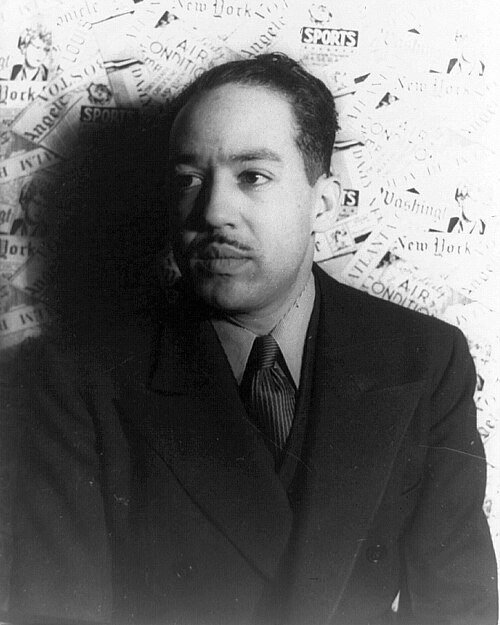
Langston Hughes was a poet who loved music. When he wrote, he listened to the blues and jazz he heard in clubs and on the streets, and he tried to make his poems sound like that music: sad and funny, slow and fast, all at once.
He was born in 1901 in the middle of the United States. His parents split up, and he spent much of his childhood living with his grandmother in Kansas. She told him stories about her family’s fight against slavery. He was often lonely, and books became his friends.
When he was still a teenager, riding a train across the huge Mississippi River, he wrote a poem called “The Negro Speaks of Rivers”. It imagines that Black people have known the great rivers of the world, from Africa to America, for thousands of years. It made him famous when it was published.
Hughes lived in Harlem, a neighbourhood in New York City where many Black artists, musicians and writers came together in the 1920s. This exciting time is called the Harlem Renaissance, which means “Harlem rebirth”.
In his time, Black Americans were often treated unfairly by law and by custom. They could be kept out of schools, restaurants and jobs. Hughes wrote about that unfairness, but he also wrote about ordinary joys: dancing, laughing, family and dreams. One of his most famous poems asks what happens to a dream that has to wait too long.
He wrote not only poems but also stories, plays, children’s books and newspaper columns, and he travelled all over the world. He is remembered as “the poet laureate of Harlem”.
At a glance
- Lived
- 1 February 1901 (Joplin, Missouri; he later gave 1902) – 22 May 1967 (New York City)
- Home
- Harlem, New York City, from the 1920s; his house at 20 East 127th Street is a city landmark
- Movement
- A leading voice of the Harlem Renaissance of the 1920s and a major figure in twentieth-century American literature
- Poetry
- The Weary Blues (1926), Fine Clothes to the Jew (1927), The Dream Keeper (1932), Shakespeare in Harlem (1942), Montage of a Dream Deferred (1951), Ask Your Mama (1961)
- Prose and drama
- Novel Not Without Laughter (1930), stories The Ways of White Folks (1934), play Mulatto (Broadway, 1935), the Simple stories, autobiographies The Big Sea (1940) and I Wonder as I Wander (1956)
- Style
- Jazz and blues poetry; the voices and speech of ordinary Black Americans
- Themes
- Black pride and history, racism and segregation, working-class life, music, dreams deferred, democracy
- Honours
- Harmon Gold Medal for Not Without Laughter; NAACP Spingarn Medal (1960)
Easy
Who was Langston Hughes?
Langston Hughes was one of the most important American writers of the twentieth century and the best-known poet of the Harlem Renaissance, the flowering of African American art, music and literature centred on Harlem in New York City in the 1920s. Over a career of more than forty years he published poetry, novels, short stories, plays, song lyrics, children’s books, histories, translations, autobiographies and a long-running newspaper column.
Hughes was among the first poets to bring the rhythms of the blues and jazz into written poetry. He wrote in the everyday language of working people, and he believed that the lives of ordinary Black Americans, the maid, the porter, the piano player, the young student, were worthy subjects for art. His poems were meant to be read aloud, and he gave readings across the United States and abroad.
His work combines pride in Black culture and history with sharp criticism of racism and inequality, but it is also full of humour, tenderness and hope. Lines from his poems have become part of American culture and of the civil rights movement.
Easy
A lonely childhood and a famous poem
James Mercer Langston Hughes was born on 1 February 1901 in Joplin, Missouri. In his autobiography he gave his birth year as 1902, but later research supports 1901. His parents separated soon after his birth. His father, James Hughes, frustrated by racism in the United States, moved to Cuba and then to Mexico. His mother, Carrie Langston, moved often in search of work.
Langston spent most of his childhood in Lawrence, Kansas, with his grandmother, Mary Patterson Langston. Her first husband, Lewis Sheridan Leary, had died after joining John Brown’s raid on Harpers Ferry in 1859, an attempt to start an uprising against slavery. Her stories of struggle and dignity shaped his sense of history. Hughes later remembered this time as lonely and said that books became his refuge.
As a teenager he lived with his mother in Lincoln, Illinois, and then in Cleveland, Ohio, where he attended Central High School. There he wrote for the school magazine and discovered poets such as Carl Sandburg and Walt Whitman, whose free verse and love of ordinary people influenced him deeply.
In 1920, travelling by train to visit his father in Mexico, he crossed the Mississippi River near St. Louis and, in a few minutes, wrote “The Negro Speaks of Rivers” on the back of an envelope. The poem links the speaker to the Euphrates, the Congo, the Nile and the Mississippi, joining ancient African history to the African American present. Published in The Crisis, the magazine of the National Association for the Advancement of Colored People (NAACP), in June 1921, it launched his career.
Easy
Harlem and the Harlem Renaissance
In 1921 Hughes enrolled at Columbia University in New York, partly to please his father, who wanted him to study engineering. He faced racism on campus and left after a year, but he fell in love with Harlem, the neighbourhood just north of the university.
In the early twentieth century hundreds of thousands of Black Americans left the rural South for northern cities in what is called the Great Migration. Harlem became the cultural capital of Black America, a place of churches, clubs, theatres, newspapers and political movements. Writers such as Claude McKay, Countee Cullen, Zora Neale Hurston, Jean Toomer and Jessie Fauset, thinkers such as W. E. B. Du Bois and Alain Locke, and musicians such as Duke Ellington and Bessie Smith created an explosion of creativity now called the Harlem Renaissance or the New Negro movement.
Before settling in Harlem, Hughes travelled. In 1923 he worked as a seaman on a ship to West Africa, and in 1924 he lived in Paris, washing dishes in a nightclub where he heard Black American jazz musicians. Later he worked in Washington, D.C. There, as a busboy in a hotel, he famously left some of his poems beside the plate of the poet Vachel Lindsay, who praised them publicly. In 1925 his poem “The Weary Blues” won first prize in a contest held by Opportunity, the magazine of the National Urban League.
Hughes became one of the young stars of the movement. He helped found the short-lived magazine Fire!! (1926) with Wallace Thurman, Zora Neale Hurston and other younger artists, who wanted to write more freely than older Black leaders thought respectable.
Intermediate
The Weary Blues and blues poetry
Hughes’s first book, The Weary Blues, was published by Alfred A. Knopf in 1926, with help from the white writer and photographer Carl Van Vechten. The title poem describes a pianist in a Lenox Avenue club playing the blues late at night and weaves the lyrics of a blues song into the poem itself. It was one of the first literary poems to take the form and feeling of the blues seriously.
The blues, a musical form born among Black Southerners, often uses a three-line stanza in which the second line repeats the first and the third answers them. Its tone mixes suffering with humour and resilience: “laughing to keep from crying”, as Hughes put it in a later book title. Hughes adapted these patterns to the page, capturing the sound of Black speech and song.
His second book, Fine Clothes to the Jew (1927), went further. Its title refers to a Harlem expression about pawning one’s good clothes at pawnshops, many of which were run by Jewish owners, when money ran out. The book portrayed prostitutes, workers, gamblers and domestic servants in their own voices. Much of the Black press attacked it as vulgar and damaging to the race’s image; the biographer Arnold Rampersad later called it Hughes’s most brilliant book of poems.
Other famous poems of this period include “I, Too”, in which a Black servant sent to eat in the kitchen declares that one day he will sit at the table and that he, too, is America, and “Mother to Son”, in which a mother tells her son that life for her has not been a crystal stair but that she keeps climbing.
Intermediate
“The Negro Artist and the Racial Mountain”
In June 1926 Hughes published an essay in The Nation that became a manifesto for younger Black writers. He criticized the desire of some middle-class Black Americans to imitate white culture and to be, in effect, “as little Negro and as much American as possible”. This urge, he argued, was the “racial mountain” that stood in the way of a true Black art.
Against it, Hughes celebrated the culture of ordinary Black people, especially jazz, the blues and spirituals, as the richest source for artists. He ended with a declaration that younger Black artists intended to express their “individual dark-skinned selves without fear or shame”. If white people were pleased, good; if not, it did not matter. The same was true, he added, of Black audiences.
The essay was partly a reply to George Schuyler, who had argued in the same magazine that African American art was essentially no different from white American art. The debate between these positions, about whether Black art should be distinct, political, respectable or free, ran through the Harlem Renaissance and continued in later movements such as the Black Arts Movement of the 1960s.
Intermediate
Depression, radicalism and travel
Hughes completed his degree at Lincoln University, a historically Black university in Pennsylvania, in 1929. For several years he was supported by a wealthy white patron, Charlotte Osgood Mason, who also funded Zora Neale Hurston. She wanted him to write about what she saw as a “primitive” Black spirit, and the relationship ended painfully in 1930. At about the same time Hughes and Hurston quarrelled over the rights to their jointly written comedy Mule Bone, ending their friendship.
His novel Not Without Laughter (1930), about a boy named Sandy growing up in a small Kansas town, drew on his own childhood and won the Harmon Gold Medal for literature. During the Great Depression, Hughes’s politics moved to the left. He toured the South giving readings at Black colleges, wrote in support of the Scottsboro Boys, nine Black youths falsely accused of rape in Alabama, and published radical poems.
In 1932–33 he travelled to the Soviet Union with a group of African Americans invited to make a film about race in America. The film was never made, but Hughes stayed on and travelled through Soviet Central Asia. He also visited Haiti, Cuba, Japan, China and, in 1937, Spain, where he reported on the Civil War for Black newspapers. He was fascinated by the connections between Black Americans and people of African descent in the Caribbean, Latin America and Africa, and he translated poets such as Nicolás Guillén, Federico García Lorca and Gabriela Mistral.
His collection of stories The Ways of White Folks (1934) looks at relations between Black and white Americans with irony and bitterness. His play Mulatto opened on Broadway in 1935 and ran for about a year, one of the longest runs of a play by a Black writer on Broadway before the 1950s. In 1936 he wrote the poem “Let America Be America Again”, which insists that the American dream has never yet been real for the poor, the Black, the Native American or the immigrant, and demands that it become so.
Intermediate
Simple, Montage of a Dream Deferred and later years
In 1942 Hughes began a weekly column for the Chicago Defender, one of the most important Black newspapers. In it he created Jesse B. Semple, known as “Simple”, a Harlem everyman who talks with the narrator in a bar about war, segregation, women, landladies and politics. Simple’s comic, shrewd commentary became hugely popular, and the columns were collected in several books, beginning with Simple Speaks His Mind (1950).
In the late 1940s Hughes wrote the lyrics for the Broadway opera Street Scene with the composer Kurt Weill and the playwright Elmer Rice. The income allowed him to buy a house at 20 East 127th Street in Harlem, where he lived for the rest of his life.
Montage of a Dream Deferred (1951) is a book-length sequence of short poems modelled on bebop, the fast, fragmented new jazz of the 1940s. It moves through a day and night in Harlem, catching voices and moments like a film montage. Its refrain returns again and again to the “dream deferred”, the promise of equality that keeps being postponed. The best-known poem in it, “Harlem”, begins “What happens to a dream deferred?” and suggests that it may dry up “like a raisin in the sun” or explode. Lorraine Hansberry took the title of her 1959 play A Raisin in the Sun from this line.
Hughes remained extremely productive: he wrote histories and children’s books such as The First Book of Jazz (1955), edited anthologies of Black and African poetry, wrote gospel plays, and in Ask Your Mama (1961) combined poetry with musical cues. He supported younger writers, including Gwendolyn Brooks and Alice Walker. He died in New York on 22 May 1967, after surgery. His ashes are interred beneath the floor of the Schomburg Center for Research in Black Culture in Harlem, under a cosmogram design titled “Rivers”.
Intermediate
Influence and legacy
Hughes helped establish that Black vernacular speech and music could be the foundation of serious literature. Later poets of the Black Arts Movement, performance and spoken-word poets, and hip-hop artists have been seen as heirs of his jazz and blues poetics. His poems are among the most widely taught in American schools.
His influence also crossed borders. Writers of the Négritude movement in the French-speaking world, such as Léopold Sédar Senghor and Aimé Césaire, read him as a model of Black cultural self-affirmation, and he was widely translated and read in Latin America, Africa and the Caribbean. Through his anthologies of African writing in the 1960s he also helped introduce a new generation of African authors to American readers.
Phrases from his poems, such as “a dream deferred” and “I, too, am America”, have been quoted in the civil rights movement and in public life ever since. The Langston Hughes House in Harlem was designated a New York City landmark in 1981, and its block of East 127th Street was renamed Langston Hughes Place.
Advanced
Debates: politics, respectability and private life
Politics and the McCarthy era. In the 1930s Hughes wrote openly radical poems, such as “Goodbye Christ” (1932), and supported many left-wing causes, though he said he never joined the Communist Party. In 1953 he was called before Senator Joseph McCarthy’s Senate subcommittee. He testified that his views had changed and distanced himself from some earlier writings. Critics and biographers have debated whether this was a necessary survival strategy, a genuine change of mind or a painful compromise; it also left him partly estranged from younger radicals, while conservatives continued to attack him.
Representation and respectability. From Fine Clothes to the Jew onward, some Black critics argued that Hughes’s portraits of the poor, of drinking and of sexuality fed white stereotypes. Hughes and his defenders replied that honesty about ordinary lives was itself a form of dignity. Later scholars have seen this conflict as central to the Harlem Renaissance, which depended partly on white patrons and publishers while trying to define an independent Black art.
Sexuality. Hughes never married and left little direct evidence about his romantic life. Some scholars and artists, notably in Isaac Julien’s film Looking for Langston (1989), have read him as a gay or bisexual writer and found coded meanings in some poems. Arnold Rampersad concluded that the evidence was inconclusive and that Hughes may have been largely asexual. The question remains open, and scholars disagree about how much weight to give it in reading the work.
Simplicity and craft. Because Hughes wrote in plain language, some critics once treated him as a folk or popular poet rather than a modernist. More recent scholarship stresses his formal experimentation, his use of montage and musical structure, and his place in international modernism alongside writers who were more obviously difficult.
Advanced
Sources and biography
Hughes wrote two autobiographies, The Big Sea (1940), covering his life to 1930, and I Wonder as I Wander (1956), covering the 1930s. They are lively and important sources, but they are also carefully shaped literary works. Hughes left out much about his private life and politics and sometimes simplified events, beginning with his own year of birth.
His papers, including manuscripts, thousands of letters and scrapbooks, are held mainly in the James Weldon Johnson Collection at Yale University’s Beinecke Library, which allows scholars to check and supplement the autobiographies. His extensive correspondence with Arna Bontemps and Carl Van Vechten has also been published.
The standard biography is Arnold Rampersad’s two-volume The Life of Langston Hughes (1986 and 1988), based on these archives. Scholars also use the newspapers and magazines in which he first published, such as The Crisis, Opportunity and the Chicago Defender, since his poems were often revised between their first appearance and later collections. The Collected Poems (1994) and a multivolume collected works edition have made it possible to see the full range and development of his writing.
Key ideas
- Blues poetry
- Poems that borrow the form, repetitions and feeling of the blues, mixing sorrow with humour and endurance.
- Jazz poetry
- Poetry that imitates the rhythms, improvisation and breaks of jazz, as in Montage of a Dream Deferred.
- The racial mountain
- Hughes’s image for the pressure on Black artists to imitate white culture instead of expressing their own.
- A dream deferred
- The promise of equality and opportunity for Black Americans that is repeatedly postponed.
- The voice of ordinary people
- Hughes wrote in the everyday speech of workers, maids, musicians and students, treating their lives as worthy of art.
- Diaspora connections
- His work links African Americans to Africa, the Caribbean and Latin America, as in “The Negro Speaks of Rivers”.
- Democratic vision
- Poems such as “I, Too” and “Let America Be America Again” claim America’s ideals for those excluded from them.
Records
- 1901 — Born in Joplin, Missouri, on 1 February.
- 1920 — Writes “The Negro Speaks of Rivers” on a train crossing the Mississippi.
- 1921 — The poem appears in The Crisis; he enters Columbia University.
- 1923 — Sails to West Africa as a crew member; lives in Paris the next year.
- 1926 — Publishes The Weary Blues and the essay “The Negro Artist and the Racial Mountain”.
- 1927 — Publishes Fine Clothes to the Jew, attacked by much of the Black press.
- 1929 — Graduates from Lincoln University in Pennsylvania.
- 1930 — Publishes the novel Not Without Laughter.
- 1932 — Travels to the Soviet Union and Central Asia.
- 1935 — His play Mulatto opens on Broadway.
- 1942 — Begins his Chicago Defender column, where the character Simple soon appears.
- 1951 — Publishes Montage of a Dream Deferred.
- 1953 — Testifies before Senator McCarthy’s subcommittee.
- 1967 — Dies in New York City on 22 May.
Glossary
- Harlem Renaissance
- The flowering of African American literature, art, music and thought centred on Harlem in the 1920s and early 1930s.
- Great Migration
- The movement of millions of Black Americans from the rural South to northern and western cities from about 1910 to 1970.
- Blues
- A musical form created by African Americans in the Deep South, often built on a repeated three-line stanza.
- Bebop
- A fast, complex style of jazz developed in the 1940s by musicians such as Charlie Parker and Dizzy Gillespie.
- Segregation
- The enforced separation of people by race in schools, transport, housing and public places.
- Vernacular
- The everyday spoken language of ordinary people, as opposed to formal or literary language.
- Patron
- A wealthy supporter who gives money to an artist, sometimes with expectations about the work.
- NAACP
- The National Association for the Advancement of Colored People, a civil rights organization founded in 1909; its magazine was The Crisis.
- Négritude
- A literary and political movement of French-speaking Black writers from the 1930s that affirmed African identity and culture.
Questions and answers
Why is Langston Hughes called the poet of Harlem?
He lived in Harlem for much of his life and wrote about its people, streets, music and dreams more than any other poet of his time.
What is “The Negro Speaks of Rivers” about?
The speaker says he has known the great rivers of history, the Euphrates, Congo, Nile and Mississippi, connecting Black Americans to thousands of years of human history. Hughes wrote it as a teenager.
What is a “dream deferred”?
A dream that is put off again and again. Hughes used the phrase for the promise of equality that America kept delaying for Black people.
How is Hughes’s poetry like music?
He borrowed the repeated lines of the blues and the rhythms and sudden breaks of jazz and bebop, and he sometimes performed his poems with jazz musicians.
Was Hughes a communist?
He supported many left-wing causes in the 1930s and wrote radical poems, but he said he never joined the Communist Party. In 1953 he testified before Senator McCarthy’s subcommittee and distanced himself from some earlier work.
Why was Fine Clothes to the Jew controversial?
Many Black critics felt its frank portraits of poor and working-class life gave a bad image of Black Americans. Hughes defended telling the truth about ordinary people, and later critics have praised the book highly.
How reliable are Hughes’s autobiographies?
They are valuable but selective. He left out much about his private life and politics, so scholars compare them with letters and archives, as Arnold Rampersad did in his biography.
Sources and further reading
- Langston Hughes. Wikipedia
- 랭스턴 휴스. 위키백과 (Korean Wikipedia)
- The Negro Speaks of Rivers. Wikipedia
- The Weary Blues. Wikipedia
- Fine Clothes to the Jew. Wikipedia
- Not Without Laughter. Wikipedia
- Montage of a Dream Deferred. Wikipedia
- Harlem Renaissance. Wikipedia
- Arnold Rampersad, The Life of Langston Hughes (2 vols.). Oxford University Press, 1986–1988
Related
- Haitian RevolutionA revolution beginning with an uprising of enslaved people in Saint-Domingue led to the abolition of slavery there and Haiti’s independence in 1804.
- United States Declaration of IndependenceDocument adopted by the Continental Congress on 4 July 1776 declaring the thirteen colonies independent of Britain.
- October RevolutionBolshevik forces overthrew Russia’s Provisional Government in Petrograd in October 1917, opening a new phase of revolution and civil conflict.
- GuernicaPablo Picasso’s large 1937 painting responds to the bombing of the Basque town of Gernika during the Spanish Civil War.
Written with AI assistance from the published sources listed above, and revised as new research appears.