Start at the top for an easy introduction. Go further down for more detail and scholarship.
- Easy
- Intermediate
- Advanced
For young readers
Have you ever tried to describe something really important, like why you love someone, and found that the words were not enough? A young man named Ludwig Wittgenstein thought very hard about questions like that. He wanted to know: what can words do, and what can they not do?
He wrote his ideas in a very short book with a very long Latin name: Tractatus Logico-Philosophicus. It is not written like a normal book with chapters. Instead, it is a list of numbered sentences, a bit like a set of building blocks. Sentence 1 is the biggest block, 1.1 rests on it, 1.11 rests on that, and so on.
The very first sentence says: “The world is everything that is the case.” In other words, the world is made of facts, like “the cat is on the mat”. Wittgenstein thought that a sentence works like a picture or a model of a fact. A toy car and a toy truck on a table can show how a real accident happened. In the same way, words arranged in a sentence can show how things are arranged in the world.
But some things cannot be pictured like that: what is good, what is beautiful, what the meaning of life is. Wittgenstein said we cannot put these into ordinary factual sentences at all. The last line of his book says: “What we cannot speak about, we must pass over in silence.” He did not mean that these things are unimportant. Many readers think he meant they are the most important of all.
Wittgenstein wrote much of the book in notebooks while he was a soldier in the First World War. Later he changed his mind about many of its ideas and wrote a very different book. But the Tractatus still puzzles and inspires philosophers today.
At a glance
- Author
- Ludwig Wittgenstein (1889–1951), Austrian-born philosopher, later professor at Cambridge
- Written
- About 1913–1918, from notes made in Cambridge and Norway and notebooks kept during military service in the First World War; the preface is dated Vienna, 1918
- First published
- 1921, in German, as “Logisch-philosophische Abhandlung” in Wilhelm Ostwald’s journal Annalen der Naturphilosophie (Leipzig)
- English edition
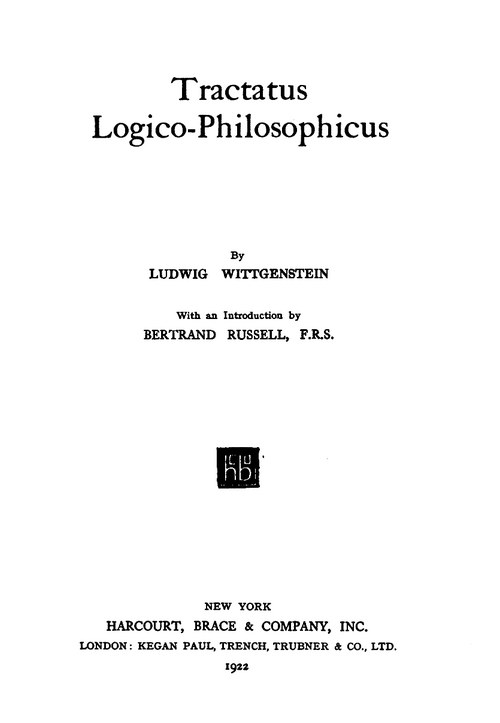
- 1922, London, Kegan Paul: German and English on facing pages, translated by C. K. Ogden with Frank Ramsey, introduction by Bertrand Russell
- Title
- Latin, suggested by G. E. Moore in allusion to Spinoza’s Tractatus Theologico-Politicus
- Form
- Seven main propositions with numbered sub-propositions (1, 1.1, 1.11 …); under 80 pages
- Main themes
- Picture theory of meaning, logical form, truth-functions, saying versus showing, the limits of language, ethics and the mystical
- Influence
- Vienna Circle and logical positivism, analytic philosophy of logic and language; later criticized by Wittgenstein himself
Easy
What is the Tractatus?
The Tractatus Logico-Philosophicus (usually shortened to Tractatus, and cited as TLP) is the only philosophical book Ludwig Wittgenstein published during his lifetime. It is very short, fewer than eighty pages in most editions, but it is one of the most discussed works of twentieth-century philosophy.
The book asks how language and thought are connected to the world. How is it possible for a sentence to be about something, and to be true or false? Wittgenstein’s answer leads him to a striking conclusion: there are limits to what can be said meaningfully, and many traditional questions of philosophy, as well as ethics, aesthetics and religion, lie beyond those limits.
In the preface Wittgenstein says that the whole meaning of the book could be summed up like this: what can be said at all can be said clearly, and what we cannot talk about we must pass over in silence. He also claims, boldly, that he has solved the problems of philosophy in their essentials, and then adds that this shows how little is achieved when those problems are solved.
The Latin title means “Logical-Philosophical Treatise”. It was suggested for the English edition by the Cambridge philosopher G. E. Moore, echoing the title of Spinoza’s Tractatus Theologico-Politicus. The original German title was simply Logisch-philosophische Abhandlung.
Easy
A book built from numbered sentences
The Tractatus is made of short, numbered remarks. There are seven main propositions, numbered 1 to 7. Each of them except the last is followed by comments with decimal numbers: 2.1 comments on 2, 2.12 comments on 2.1, and so on. A footnote explains that the numbers show the logical importance of each remark and the emphasis placed on it.
The seven main propositions give the skeleton of the book. In simple translations: 1. The world is everything that is the case. 2. What is the case, a fact, is the existence of states of affairs. 3. A logical picture of facts is a thought. 4. A thought is a proposition with a sense. 5. A proposition is a truth-function of elementary propositions. 6. (A formula giving the general form of a proposition.) 7. What we cannot speak about we must pass over in silence.
The style is compressed and oracular, more like a set of aphorisms than an argument. When Bertrand Russell urged Wittgenstein to give arguments for his claims, Wittgenstein is reported to have replied that arguments would spoil the book’s beauty. As a result, readers must reconstruct the reasoning, and this is one reason why interpretations differ so widely.
Roughly speaking, the book moves from the world (propositions 1–2), to how thoughts and sentences picture the world (3–4), to logic (5–6), and finally to the limits of language: the self, ethics, the mystical, and silence (the end of 6 and 7).
Intermediate
The world, facts and the picture theory
The Tractatus begins with an account of what the world is. The world is not a collection of things but of facts. Facts are made up of simpler “states of affairs” (Sachverhalte), which are combinations of simple objects. Objects are what is fixed and unchanging; their possible combinations make up “logical space”, and the actual combinations make up the world. Wittgenstein gives no examples of simple objects, which has become one of the book’s puzzles.
Against this background he develops what is called the picture theory of meaning. A proposition is a picture of a possible state of affairs. Its elements (names) stand for objects, and the way the names are arranged in the proposition represents a way the objects might be arranged in reality. If they are so arranged, the proposition is true; if not, it is false. Wittgenstein is said to have been inspired by a report of a Paris court case in which an accident was reconstructed with toy models.
For a picture to represent reality at all, it must share something with it: its logical form. But this shared form cannot itself be pictured. A proposition cannot step outside itself to describe how it represents; the logical form “shows itself” in the proposition. This distinction between what can be said and what can only be shown runs through the whole book.
The picture theory explains why a sentence can have meaning even when it is false, and why we can understand a sentence we have never heard before: we understand its parts and how they are combined. These were real problems for the logic of Frege and Russell, and the Tractatus offered a new solution.
Intermediate
Logic: truth-functions, tautologies and the “logical constants”
Wittgenstein held that all meaningful propositions are built out of elementary propositions by truth-functional combination: “not”, “and”, “or”, “if … then”. Whether a complex proposition is true depends only on the truth or falsity of its elementary parts. The Tractatus helped make popular the method of truth tables for showing this, a technique that the American logician Emil Post developed independently at about the same time.
He called the idea that the “logical constants” (words like “not” and “or”) do not stand for any objects his “fundamental thought”. Logic is not a science of special logical objects or the most general facts about the world; it reflects the structure that any language capable of picturing the world must have.
The propositions of logic are tautologies, true whatever the facts are, like “it is raining or it is not raining”. Contradictions are false whatever the facts are. Both, Wittgenstein says, “say nothing” about the world, but they show its logical structure. Mathematics, similarly, consists of equations that show rather than state facts. This view deeply influenced later ideas that logic and mathematics are true by virtue of form or meaning rather than by describing reality.
Proposition 6 gives a single formula for the general form of every proposition, based on one operation of joint negation (“neither … nor …”) applied repeatedly to elementary propositions. Whether this formula can really generate all of logic, including statements about “all” and “some”, has been much debated by logicians.
Intermediate
The limits of language: self, ethics and the mystical
If meaningful propositions are pictures of possible facts, then many sentences that look meaningful are not. Philosophical statements about the essence of the world, about logical form, or about value do not picture any possible state of affairs. Wittgenstein concludes that philosophy is not a body of doctrine but an activity: the clarification of thoughts. Most philosophical problems arise because we misunderstand the logic of our language.
In the 5.6s he writes that the limits of my language mean the limits of my world, and that the subject, the “I”, is not in the world but is a limit of the world, as the eye is not part of the visual field it sees. These remarks on solipsism are among the most discussed and puzzling passages in the book.
In the 6.4s and 6.5s the book turns to ethics, aesthetics, death and the meaning of life. The sense of the world must lie outside the world; there can be no propositions of ethics; ethics and aesthetics are one. “It is not how things are in the world that is mystical, but that it exists.” Even if all possible scientific questions were answered, he says, the problems of life would not have been touched at all.
Finally, Wittgenstein says that his own propositions are nonsensical: anyone who understands him will recognize them as such, having used them as steps to climb beyond them, and must throw away the ladder after climbing it. Only then will they see the world rightly. Then comes proposition 7, and silence. In a 1919 letter to a possible publisher, Ludwig von Ficker, he explained that the book’s point was ethical, and that it consisted of two parts, the one written and everything he had not written, and that the second was the important one.
Intermediate
How the book was published and translated
Finding a publisher was difficult. Several publishers turned the book down. Wittgenstein met Russell in The Hague in December 1919 to go through it line by line, and Russell agreed to write an introduction to help it get published. When Wittgenstein read the introduction, he thought it misunderstood his work, and he withdrew his support for publication with it, leaving the matter in Russell’s hands.
The German text finally appeared in 1921 in volume 14 of Annalen der Naturphilosophie, a journal edited by the chemist Wilhelm Ostwald, with Russell’s introduction in German. The printing contained many errors, and Wittgenstein was unhappy with it.
In 1922 the book was published in London by Kegan Paul in a series edited by C. K. Ogden, with the German and English on facing pages and Russell’s introduction. The translation was largely prepared by the young Cambridge mathematician Frank Ramsey and was checked by Wittgenstein, who sent back detailed corrections. A second English translation, by David Pears and Brian McGuinness, appeared in 1961 and is now often preferred; several new translations have been published since 2020.
An earlier manuscript version of the book was discovered in Vienna in 1965 by the philosopher Georg Henrik von Wright and published in 1971 as the Prototractatus. Wittgenstein’s wartime notebooks were published in 1961 as Notebooks 1914–1916. These documents allow scholars to follow how the book’s ideas and its numbering system developed.
Intermediate
What Wittgenstein did next, and the book’s influence
Believing he had finished with philosophy, Wittgenstein gave away his share of the family fortune and worked as an elementary schoolteacher in villages in Lower Austria from 1920 to 1926. He then worked as a gardener in a monastery and helped design a modernist house in Vienna for his sister Margarete.
Meanwhile the Tractatus found enthusiastic readers. In Vienna, a group of philosophers and scientists around Moritz Schlick, later known as the Vienna Circle, studied it line by line in the mid-1920s. They read it as support for their logical empiricism: meaningful statements are either tautologies of logic or claims that can be verified by experience, and metaphysics is meaningless. Wittgenstein met Schlick, Friedrich Waismann and Rudolf Carnap, but he disagreed with them about the importance of what cannot be said, and sometimes read them poetry by Rabindranath Tagore instead of discussing philosophy.
In 1929 Wittgenstein returned to Cambridge. He submitted the Tractatus as his doctoral thesis, examined by Russell and Moore. Over the following years he developed a new philosophy, centred on language as a set of activities or “language-games”, that became the Philosophical Investigations, published after his death in 1951. In its preface he wrote that he had been forced to recognize grave mistakes in his first book.
The Tractatus shaped analytic philosophy in many ways: through logical positivism, through its treatment of logic as tautology, through its picture of the relationship between language and reality, and through its idea of philosophy as clarification. It has also influenced artists, composers and writers fascinated by its final silence.
Advanced
How to read a book that calls itself nonsense
The central interpretive problem is the book’s ending. If its own propositions are nonsense, how can it teach anything? Traditional or “metaphysical” readings, associated with G. E. M. Anscombe’s An Introduction to Wittgenstein’s Tractatus (1959) and later with P. M. S. Hacker, hold that the book tries to convey real insights about logic, the world and value that cannot be stated but can be shown. On this view the Tractatus contains ineffable truths, and its nonsense is illuminating nonsense.
Since the late 1980s the “resolute” or “New Wittgenstein” reading, developed especially by Cora Diamond and James Conant, has argued that this is incoherent: nonsense is simply nonsense, and there are no ineffable truths. The book’s aim is therapeutic. By leading readers into the illusion that they understand its metaphysical sentences, and then revealing that they do not, it frees them from the temptation to philosophize in this way. The frame (preface and ending) tells the reader how to take the body of the book.
Critics of the resolute reading argue that it ignores Wittgenstein’s own statements, in letters and conversations, that he was trying to convey something important, and that it makes the detailed logical doctrines of the book pointless. Many scholars now take intermediate positions. The debate also affects how one sees the relation between the “early” and “later” Wittgenstein: resolute readers see more continuity, traditional readers a sharper break.
Other debates concern the nature of the simple objects (whether they are sense-data, spatial points, or something else, or whether Wittgenstein deliberately left this open), the relation of the Tractatus to Frege and Russell, the influence of Schopenhauer and of Tolstoy’s religious writings on its ethical remarks, and how far the book belongs to Viennese culture, including the critique of language by Karl Kraus and the architecture of Adolf Loos.
Advanced
Text, translation and evidence
Scholars of the Tractatus work with several layers of evidence: the 1913 “Notes on Logic” and the notes dictated to Moore in Norway in 1914; the surviving wartime notebooks (three of several are known); the Prototractatus manuscript; typescripts and the corrected printings; and Wittgenstein’s letters to Russell, Ogden, Ficker and the architect Paul Engelmann, his friend from the war years. Study of the Prototractatus has shown that the decimal numbering was built up gradually, and some scholars argue that the book should be read as a tree, following each number’s comments, rather than page by page.
Translation is itself an interpretive problem. Key terms such as Sachverhalt (translated “atomic fact” by Ogden, “state of affairs” by Pears and McGuinness), Bild (“picture”), Sinn (“sense”) and unsinnig (“nonsensical”) carry philosophical commitments in the choice of English words. The Ogden–Ramsey version is more literal and sometimes awkward; the Pears–McGuinness version is smoother but, some argue, less faithful. Wittgenstein’s own corrections to the Ogden translation are an important source for his intentions.
Biographical context has also shaped interpretation. Ray Monk’s biography Ludwig Wittgenstein: The Duty of Genius (1990) emphasized how the ethical and religious crisis of the war years is bound up with the book’s last pages. Some philosophers object that biography should not settle questions of logical content; others reply that Wittgenstein himself insisted that the point of the book was ethical.
A century after its publication, the Tractatus remains unusual in being both a technical work in the philosophy of logic and a meditation on what lies beyond words. Its reception history, from the Vienna Circle to the resolute readers, is a case study in how a short, difficult text can generate opposing traditions of reading.
Key ideas
- The world as facts
- The world is the totality of facts, not of things; facts are combinations of simple objects.
- Picture theory
- A meaningful proposition is a logical picture of a possible state of affairs, true if things are as it pictures them.
- Saying and showing
- Logical form cannot be stated in language; it shows itself in the structure of propositions.
- Truth-functions
- Complex propositions are built from elementary ones, and their truth depends only on the truth of their parts.
- Logic as tautology
- The propositions of logic say nothing about the world; they display the structure of any possible language.
- Philosophy as activity
- Philosophy is not a doctrine but the clarification of thoughts and the removal of confusions about language.
- The limits of language
- Ethics, aesthetics, the meaning of life and the mystical lie beyond what can be said, yet may be what matters most.
- The ladder
- The book’s own propositions are to be climbed and then thrown away once understood.
Records
- 1889 — Ludwig Wittgenstein is born in Vienna on 26 April.
- 1911 — Goes to Cambridge to study logic with Bertrand Russell.
- 1913 — Works alone in Norway; dictates the “Notes on Logic”.
- 1914 — Volunteers for the Austro-Hungarian army; begins wartime philosophical notebooks.
- 1918 — Completes the book while on leave; captured by Italian forces in November.
- 1919 — Released from a prisoner-of-war camp; meets Russell in The Hague to discuss the manuscript.
- 1921 — The German text is published in Annalen der Naturphilosophie.
- 1922 — Bilingual German–English edition published in London by Kegan Paul.
- 1929 — Wittgenstein returns to Cambridge and receives his doctorate for the Tractatus.
- 1951 — Wittgenstein dies in Cambridge on 29 April.
- 1953 — Philosophical Investigations is published posthumously, criticizing ideas of the Tractatus.
- 1961 — Pears–McGuinness translation and the wartime Notebooks 1914–1916 are published.
- 1971 — The Prototractatus, discovered in 1965, is published.
Glossary
- Proposition
- A sentence that says something true or false about the world.
- State of affairs (Sachverhalt)
- A combination of simple objects; the basic unit of which facts are composed.
- Logical form
- The structure that a picture shares with what it depicts, making representation possible.
- Truth-function
- A proposition whose truth value depends only on the truth values of its component propositions.
- Tautology
- A proposition true under every possible circumstance, such as “p or not p”.
- Truth table
- A table listing the truth value of a complex proposition for every combination of truth values of its parts.
- Logical positivism
- A philosophical movement of the Vienna Circle holding that only logical truths and empirically verifiable statements are meaningful.
- Solipsism
- The view that only one’s own mind or self is certain to exist; the Tractatus discusses it in a special sense.
- Resolute reading
- An interpretation holding that the Tractatus contains no ineffable truths and aims to cure readers of metaphysical confusion.
- Analytic philosophy
- A tradition of philosophy emphasizing logic, language and clarity of argument.
Questions and answers
Why is the book full of numbers?
Each remark is numbered to show how it relates to others: 2.1 comments on 2, 2.11 on 2.1, and so on. The numbers are meant to show logical importance.
What does “The limits of my language mean the limits of my world” mean?
Roughly, that what I can meaningfully think and say determines the shape of the world as it can be described; beyond that limit nothing can be said.
Did Wittgenstein think ethics was unimportant?
No. He placed ethics outside what can be said precisely because he thought it too important to be reduced to factual statements. He called the book’s point ethical.
Why does the book call its own sentences nonsense?
Because they try to say things, about logical form and the limits of language, that by its own theory can only be shown. They are a ladder to be thrown away.
Did Wittgenstein change his mind?
Yes. His later philosophy, especially Philosophical Investigations, rejected the picture theory and the idea of a single hidden logical form of language, though some themes continued.
Was it really written in the trenches?
Much of it was drafted in notebooks during his army service from 1914 to 1918, including at the front, though key ideas go back to Cambridge and Norway in 1912–14.
How did the Vienna Circle read it?
As a foundation for logical empiricism: meaningful statements are logical or empirically verifiable. Wittgenstein thought they overlooked the importance of what cannot be said.
Sources and further reading
- Anat Biletzki and Anat Matar, Ludwig Wittgenstein. Stanford Encyclopedia of Philosophy
- Ian Proops, Wittgenstein’s Logical Atomism. Stanford Encyclopedia of Philosophy
- Duncan J. Richter, Ludwig Wittgenstein (1889–1951). Internet Encyclopedia of Philosophy
- Tractatus Logico-Philosophicus. Wikipedia
- Ludwig Wittgenstein. Wikipedia
- Vienna Circle. Wikipedia
- Ludwig Wittgenstein, Tractatus Logico-Philosophicus (Ogden translation). Project Gutenberg
- Ray Monk, Ludwig Wittgenstein: The Duty of Genius. Jonathan Cape, 1990
- G. E. M. Anscombe, An Introduction to Wittgenstein’s Tractatus. Hutchinson, 1959
Related
- UlyssesJames Joyce’s novel follows a day in Dublin through changing styles and the inner lives of its characters.
- Franz KafkaPrague-born German-language writer whose stories portray uncertainty, opaque authority and people struggling to understand their circumstances.
- Baruch SpinozaDutch philosopher who developed a rigorous account of nature, human freedom and the relation between reason and religion.
- Immanuel KantPrussian philosopher whose accounts of knowledge, moral duty and judgment reshaped modern philosophy.
- Rabindranath TagoreBengali poet, writer and educator whose work reached readers across India and the wider world.
- AristotlePlato's student and Alexander's tutor. He founded the Lyceum and wrote on logic, ethics, politics and the natural world.
Written with AI assistance from the published sources listed above, and revised as new research appears.