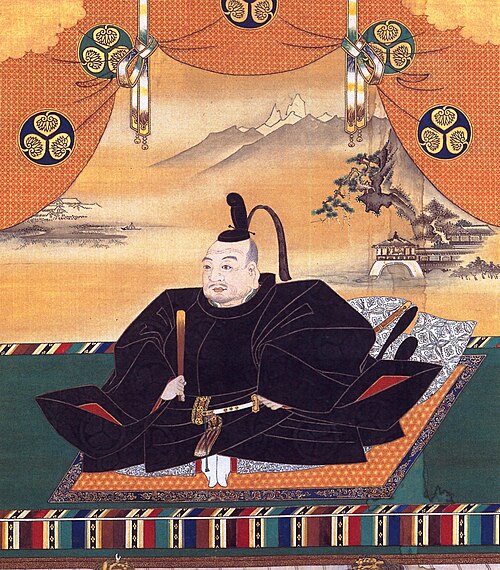
Start at the top for an easy introduction. Go further down for more detail and scholarship.
- Easy
- Intermediate
- Advanced
For young readers
About 450 years ago Japan was split into many small territories ruled by warlords who fought each other all the time. This long age of fighting is called the Warring States period.
Tokugawa Ieyasu was born into a small warlord family. When he was a little boy, he was sent away to live with a more powerful family as a hostage, a kind of guarantee that his own family would stay loyal. He grew up far from home and learned to be patient and careful.
When he grew up, he became an ally of Oda Nobunaga, a bold warlord who began to unite Japan. After Nobunaga died, another leader, Toyotomi Hideyoshi, took over, and Ieyasu served him too, while quietly growing stronger in eastern Japan, where he made the small town of Edo his home. Edo is today’s Tokyo.
After Hideyoshi died, Ieyasu won a huge battle at a place called Sekigahara in the year 1600. In 1603 the emperor gave him the title shogun, the top military ruler. His family ruled Japan for more than 250 years, and the country had a long time of peace.
Japanese people often compare the three unifiers with a story about a bird that will not sing. Nobunaga would say, “If it won’t sing, kill it.” Hideyoshi would say, “Make it want to sing.” Ieyasu would say, “Wait until it sings.” The story was made up long after they lived, but it shows how people remember Ieyasu: as a patient man who waited for his chance.
At a glance
- Lived
- 31 January 1543 – 1 June 1616
- Born
- Okazaki Castle, Mikawa Province (today Aichi Prefecture), as Matsudaira Takechiyo
- Died
- Sunpu (today Shizuoka), where he lived in retirement
- Title
- Sei-i taishōgun (shogun), 1603–1605; afterwards ōgosho (retired shogun) until his death
- Decisive battle
- Sekigahara, 21 October 1600 (15th day of the 9th month, Keichō 5)
- Capital
- Edo (today Tokyo), his base from 1590 and seat of the shogunate
- Legacy
- Tokugawa shogunate, 1603–1867; deified as Tōshō Daigongen and enshrined at Nikkō
Easy
Who was Tokugawa Ieyasu?
Tokugawa Ieyasu (1543–1616) was a daimyo, a regional military lord, who became the ruler of all Japan. He is counted as the third of the “three unifiers” who ended more than a century of civil war, after Oda Nobunaga and Toyotomi Hideyoshi. He founded the Tokugawa shogunate, also called the Edo shogunate, which governed Japan from 1603 until 1867.
Ieyasu’s career was long and full of reversals. He was a hostage as a child, an ally of Nobunaga as a young man, a rival and then a vassal of Hideyoshi in middle age, and only in his late fifties did he become the most powerful man in Japan. He was known for caution, patience, careful management of his followers and a readiness to be ruthless when he judged it necessary.
The system he created combined the shogun’s government in Edo with some 200–300 domains ruled by daimyo. It brought a long period of internal peace, during which cities, trade, education and popular culture flourished, while the government tightly controlled religion, foreign contact and the movements of the warrior class.
Easy
A childhood as a hostage
Ieyasu was born at Okazaki Castle in Mikawa Province as Matsudaira Takechiyo, the son of Matsudaira Hirotada, a minor lord squeezed between two powerful neighbours: the Oda to the west and the Imagawa to the east. When he was still a baby, his mother was sent back to her own family for political reasons, and he did not see her again for many years.
At about the age of five, Takechiyo was sent as a hostage to the Imagawa, but on the way he was seized and handed over to the Oda, who held him for about two years. After an exchange of prisoners he was taken to Sunpu, the Imagawa capital, where he spent the rest of his childhood and youth. His father died in 1549, and the Imagawa effectively took control of the Matsudaira lands.
Life as a hostage was not a prison. The boy received an education suitable for a warrior of good family, came of age in a ceremony that gave him an adult name, and married a woman of the Imagawa clan, later known as Lady Tsukiyama. But he learned early how fragile loyalty and power could be.
Easy
Independence and alliance with Oda Nobunaga
In 1560 the Imagawa leader Yoshimoto was killed by Oda Nobunaga at the Battle of Okehazama. The young Matsudaira lord, then called Motoyasu, seized the chance to return to Okazaki and break free of the Imagawa. In 1562 he made an alliance with Nobunaga that lasted twenty years. He soon took the name Ieyasu and, in 1566–1567, adopted the surname Tokugawa, claiming descent from the famous Minamoto warrior lineage.
The early years were hard. In 1563–1564 Ieyasu had to put down an uprising by followers of the Ikkō (True Pure Land) Buddhist sect in Mikawa, in which some of his own retainers joined the rebels. He then expanded east into Tōtōmi Province and moved his base to Hamamatsu in 1570. He fought beside Nobunaga at the Battle of Anegawa in 1570 and at Nagashino in 1575, where massed musket fire helped defeat the Takeda.
Ieyasu also suffered defeats. In early 1573 the great general Takeda Shingen crushed his army at Mikatagahara. In 1579, in one of the darkest episodes of his life, his wife Lady Tsukiyama was killed and his eldest son Nobuyasu was forced to commit suicide after accusations that they had plotted with the Takeda; the reasons are still debated. After the Takeda were destroyed in 1582, Nobunaga rewarded Ieyasu with Suruga Province.
Intermediate
Between Nobunaga and Hideyoshi: rival, vassal, lord of the Kantō
In June 1582 Nobunaga was attacked by his general Akechi Mitsuhide at the Honnō-ji temple in Kyoto and died. Ieyasu, who was visiting the Sakai area with a small escort, made a dangerous journey back to Mikawa through the mountains of Iga. In the confusion that followed, he fought the Hōjō and others for former Takeda lands and gained Kai and Shinano, becoming lord of five provinces.
Nobunaga’s general Toyotomi Hideyoshi quickly took the lead among his successors. In 1584 Ieyasu backed Nobunaga’s son Nobukatsu against Hideyoshi and fought him to a standstill at the Battles of Komaki and Nagakute. Instead of fighting on, both men chose a settlement. In 1586 Ieyasu formally submitted to Hideyoshi, who had given him his sister in marriage and sent his own mother as a hostage to reassure him.
In 1590, after Hideyoshi’s campaign destroyed the Hōjō of Odawara, Ieyasu was moved from his home provinces to the Kantō plain in the east, a larger but distant territory. He chose the small castle town of Edo as his headquarters and began to develop it. This transfer, often seen as an attempt to keep him far from the centre, gave him a large, compact power base.
When Hideyoshi invaded Korea in 1592 and 1597, Ieyasu was stationed at the headquarters at Nagoya in Hizen, northern Kyushu, but did not send his troops across the sea. As a result he avoided the heavy losses suffered by many western daimyo.
Intermediate
Sekigahara, 1600
Hideyoshi died in 1598, leaving a five-year-old son, Hideyori. He had appointed a Council of Five Elders, of whom Ieyasu was the most powerful, and five commissioners to govern until the boy grew up. Ieyasu soon began making marriage alliances and acting independently, alarming the administrator Ishida Mitsunari and others loyal to the Toyotomi house.
In 1600, while Ieyasu led an army against Uesugi Kagekatsu in the northeast, Mitsunari and his allies raised a “Western Army”. Ieyasu turned back with his “Eastern Army”, which included many daimyo who disliked Mitsunari. On 21 October 1600 the two armies met at Sekigahara, a valley in Mino Province. During the battle several western commanders, most famously Kobayakawa Hideaki, switched sides or stayed out of the fighting, and the Western Army collapsed within a day.
After the victory Ieyasu executed Mitsunari and other leaders, confiscated or reduced the lands of those who had opposed him, and redistributed territory to reward his allies and relatives. This reshaping of the map of Japan laid the foundation of Tokugawa power.
Intermediate
Founding the shogunate and ending the Toyotomi
In 1603 Emperor Go-Yōzei appointed Ieyasu sei-i taishōgun, the title held by the military rulers of the Kamakura and Muromachi eras. Unlike those regimes, he governed from Edo rather than Kyoto. He ordered daimyo to provide labour and materials to rebuild Edo Castle on a vast scale, a project that both strengthened the shogunate and drained the resources of potential rivals.
In 1605 Ieyasu handed the title of shogun to his son Hidetada, signalling that the office would be hereditary in the Tokugawa house. He moved to Sunpu, but as ōgosho, “retired lord”, he kept control of major policy, surrounded by advisers who included officials, Buddhist monks, the Confucian scholar Hayashi Razan, merchants and the English pilot William Adams.
The last obstacle was Toyotomi Hideyori, who remained in Osaka Castle with great wealth and prestige. In 1614 Ieyasu seized on the inscription on a temple bell cast for Hideyori, claiming it insulted him, and launched the Winter Campaign against Osaka. After a truce and the filling of the castle moats, the Summer Campaign of 1615 ended with the fall of Osaka Castle and the deaths of Hideyori and his mother Yodo-dono. The Toyotomi line was extinguished.
In 1615 the regime issued laws for the military houses (Buke shohatto), rules for the imperial court and nobility, and an order limiting each domain to one castle. Ieyasu died at Sunpu on 1 June 1616, probably of a stomach illness, perhaps cancer. The long-told story that he died from eating fried sea bream is doubtful, since he fell ill months before his death.
Intermediate
How the Tokugawa system worked
Historians call the system Ieyasu founded the bakuhan system, combining the bakufu (the shogun’s government) and the han (domains). The shogunate directly controlled large territories, major cities such as Kyoto, Osaka and Nagasaki, and important mines. The daimyo governed their own domains with considerable autonomy, but under rules set by Edo.
The daimyo were classified by their relationship to the Tokugawa: shinpan (relatives), fudai (hereditary vassals who had followed the Tokugawa before Sekigahara) and tozama (“outside” lords who had submitted later). Fudai daimyo were placed in strategic locations and staffed the shogunate’s offices, while powerful tozama such as the Shimazu of Satsuma and the Mōri of Chōshū were kept away from central government. Two centuries later, these same tozama domains would lead the movement that overthrew the shogunate.
The shogunate also governed the relationship between warriors and other groups. Warriors were expected to live in castle towns, peasants to farm and pay taxes in rice, and the regime watched religious institutions closely. Many features often associated with the Tokugawa, such as the system of alternate attendance in Edo and the strict limits on foreign contact, took their mature form under Ieyasu’s son and grandson, but they built on his foundations.
Intermediate
Foreign relations: Korea, Europe and Christianity
Ieyasu inherited a hostile relationship with Korea after Hideyoshi’s invasions. He moved to restore peace, partly for trade through the Sō family of Tsushima. In 1604–1605 the Korean monk and envoy Samyeong (Yujeong) travelled to Japan, met Ieyasu at Fushimi and arranged the return of captives. In 1607 a Korean embassy came to Edo and Sunpu, officially described as a mission to answer a letter and bring home captives, and in 1609 the Treaty of Kiyū (Giyu) with Tsushima reopened regulated trade at Busan. Later Korean embassies to Japan grew out of this settlement.
Ieyasu was curious about Europe. In 1600 the Dutch ship De Liefde arrived in Kyushu, and its English pilot, William Adams, became his adviser on ships, trade and foreign affairs. The Dutch opened a trading post at Hirado in 1609 and the English in 1613. The shogunate also licensed Japanese merchants to trade across Southeast Asia on “red-seal ships”.
At first Ieyasu tolerated Christian missionaries for the sake of trade, but his attitude hardened. After a bribery scandal involving a Christian official, the shogunate banned Christianity in its own lands in 1612 and nationwide from the end of 1613, expelled missionaries in 1614 and exiled prominent Japanese Christians such as Takayama Ukon. The persecution that followed, and the later restrictions of the 1630s, shaped Japan’s relations with the outside world for two centuries.
In 1609, with shogunal permission, the Shimazu of Satsuma invaded the Ryukyu Kingdom, which thereafter paid tribute both to China and to Satsuma.
Intermediate
Books, learning and deification
Ieyasu valued practical learning. Contemporaries recorded that he liked the Analects, the Doctrine of the Mean, Sima Qian’s Records of the Grand Historian, the Chinese political classic Essentials of Government of the Zhenguan Era and the Azuma kagami, a chronicle of the Kamakura shogunate. He sponsored printing projects, first with wooden movable type at Fushimi and later, at Sunpu, with copper movable type; Japanese movable-type printing in this period drew on Korean type and techniques brought back during the invasions.
He employed the Confucian scholar Hayashi Razan, a student of Fujiwara Seika, whose Neo-Confucian learning had been stimulated by contact with the Korean scholar Kang Hang, a captive in Japan after the invasions. The Hayashi family later directed official Confucian learning under the shogunate, although Buddhism and Shinto remained central to Ieyasu’s religious world.
Ieyasu wished to become a protective deity for his descendants. After his death he was buried at Kunōzan near Sunpu and, in 1617, enshrined at Nikkō under the divine title Tōshō Daigongen, “Great Avatar Illuminating the East”. His grandson Iemitsu rebuilt the Nikkō Tōshōgū in lavishly decorated form in the 1630s. Together with nearby shrines and temples, it has been a UNESCO World Heritage Site since 1999.
Advanced
Images of Ieyasu: god, schemer, model manager
Under the Tokugawa, Ieyasu was venerated as Tōshō Daigongen, and official histories presented him as a wise founder. After the Meiji Restoration of 1868, the new government, which had overthrown his descendants, promoted an emperor-centred history in which the shogunate appeared as an obstacle, and Ieyasu was often cast as a cunning, calculating “old badger” (tanuki oyaji) who had cheated the Toyotomi.
In the twentieth century his image changed again. A long popular novel by Yamaoka Sōhachi, published from 1950, portrayed him as a patient seeker of peace, and in postwar Japan he was widely read as a model of leadership and management. Television dramas continue to reinterpret him, sometimes as a hesitant, anxious young man who grows into a ruler.
Several famous sayings attributed to Ieyasu are later inventions. The hototogisu (cuckoo) verses comparing the three unifiers come from later writing. The well-known “testament” that begins “Life is like walking a long road carrying a heavy burden” is regarded by Japanese scholars as a forgery of the Meiji era, modelled on a text attributed to Tokugawa Mitsukuni; a related set of teachings, the Tōshōgū goikun, is also of doubtful authenticity. Such sayings tell us more about how later generations wanted to see Ieyasu than about the man himself.
In Korea, views of Ieyasu have tended to be relatively favourable compared with those of Hideyoshi, because he ended the Toyotomi regime and restored diplomatic relations. Joseon officials also understood his government as a continuation of the earlier Kamakura and Muromachi shogunates.
Advanced
Sources and debates
Much of what is told about Ieyasu comes from sources written by his followers or by the shogunate. The Mikawa monogatari, a memoir by the Tokugawa retainer Ōkubo Tadataka written in the 1620s, is vivid but partisan. The official Tokugawa jikki, compiled in the nineteenth century, drew on earlier records but was written to glorify the dynasty. Contemporary diaries such as the Ietada nikki of a Matsudaira vassal, letters and documents, and records from the Oda side such as the Shinchō kōki provide important checks.
Historians still debate key episodes. The 1579 deaths of Lady Tsukiyama and Nobuyasu have been explained as Nobunaga’s demand, as the result of a real plot with the Takeda, or as the outcome of conflict within the Tokugawa house between Okazaki and Hamamatsu factions. Recent research on Sekigahara has questioned dramatic details, such as the story that Ieyasu ordered his troops to fire on Kobayakawa Hideaki’s position to force him to defect, and has re-examined when the defections actually happened.
The foreign policy of the early shogunate is also debated. The older idea of a “closed country” (sakoku) has been challenged by historians such as Ronald Toby, who emphasised that the shogunate maintained managed relations with Korea, the Ryukyus, the Ainu, China and the Dutch, and used diplomacy to support its own legitimacy. Research on Japan–Korea relations has also shown that the Sō family of Tsushima altered official letters in the early seventeenth century to smooth the restoration of relations, a fact exposed in the 1630s.
Finally, historians weigh how much of the Tokugawa order was Ieyasu’s design and how much was developed by his successors. Most see him as the founder who secured military supremacy and set basic principles, while the institutions of the mature shogunate took shape over the following decades.
Key ideas
- Three unifiers
- Oda Nobunaga, Toyotomi Hideyoshi and Tokugawa Ieyasu, who in succession ended the Warring States period and unified Japan.
- Shogunate (bakufu)
- A government headed by the shogun, the emperor’s military deputy; the Tokugawa shogunate ruled from Edo from 1603 to 1867.
- Bakuhan system
- The balance between the shogun’s government and the semi-autonomous domains of the daimyo.
- Patience and calculation
- Ieyasu’s reputation rests on waiting for opportunities, managing alliances and avoiding unnecessary losses.
- Restoring relations with Korea
- After Hideyoshi’s invasions, Ieyasu’s government returned captives and reopened diplomacy and trade with Joseon.
- Controlled foreign contact
- Early openness to European trade gave way to the banning of Christianity and increasingly managed foreign relations.
- Deified founder
- Ieyasu was worshipped after death as Tōshō Daigongen, which gave the dynasty religious as well as political legitimacy.
Records
- 1543 — Born at Okazaki Castle in Mikawa Province.
- 1549 — Taken as a hostage to Sunpu, the Imagawa capital, after two years with the Oda.
- 1560 — Imagawa Yoshimoto is killed at Okehazama; Ieyasu returns to Okazaki.
- 1562 — Alliance with Oda Nobunaga.
- 1573 — Defeated by Takeda Shingen at Mikatagahara.
- 1582 — Nobunaga dies at Honnō-ji; Ieyasu escapes through Iga and expands to five provinces.
- 1590 — Transferred to the Kantō region; makes Edo his base.
- 1600 — Wins the Battle of Sekigahara.
- 1603 — Appointed shogun; the Tokugawa shogunate begins.
- 1607 — A Korean embassy visits Edo and Sunpu, restoring relations after the invasions.
- 1615 — Osaka Castle falls; the Toyotomi line ends; laws for military houses issued.
- 1616 — Dies at Sunpu; enshrined at Nikkō the following year as Tōshō Daigongen.
Glossary
- Daimyo
- A regional military lord who governed a domain and commanded his own warriors.
- Shogun
- Short for sei-i taishōgun, the title of Japan’s supreme military ruler, granted by the emperor.
- Sengoku period
- The Warring States period of Japanese civil war, roughly from the late fifteenth to the late sixteenth century.
- Ōgosho
- A retired shogun who continued to exercise power, as Ieyasu did at Sunpu from 1605.
- Fudai and tozama
- Hereditary Tokugawa vassals and “outside” lords who submitted after Sekigahara.
- Buke shohatto
- The laws for the military houses, first issued in 1615, regulating the conduct of daimyo.
- Edo
- The castle town that became the shogun’s capital and, after 1868, was renamed Tokyo.
- Tōshō Daigongen
- Ieyasu’s divine title after death, “Great Avatar Illuminating the East”.
- Red-seal ships
- Japanese trading ships licensed by the shogunate to sail to Southeast Asia in the early seventeenth century.
Questions and answers
Was Ieyasu the emperor of Japan?
No. The emperor remained in Kyoto as the formal source of authority. Ieyasu held the title shogun, which gave him military and political power in the emperor’s name.
Why did Ieyasu choose Edo?
Hideyoshi moved him to the Kantō region in 1590, and he chose Edo as his base. It had a good harbour and room to grow, and it became one of the largest cities in the world.
Did Ieyasu fight in the invasions of Korea?
No. He was stationed at the Japanese headquarters in northern Kyushu but did not send his troops to Korea. After Hideyoshi’s death he worked to restore relations with Joseon.
Is the hototogisu story true?
No. The verses comparing Nobunaga, Hideyoshi and Ieyasu to their treatment of a cuckoo that will not sing were written much later, but they reflect popular images of the three men.
Why did Ieyasu retire only two years after becoming shogun?
Passing the title to his son Hidetada showed that the office would stay in the Tokugawa family, while Ieyasu kept real power as retired shogun.
Did Ieyasu close Japan to the world?
Not entirely. He encouraged foreign trade and hired a European adviser, but banned Christianity. The strictest limits on foreign contact came in the 1630s under his grandson, and even then Japan kept managed relations with several neighbours.
How reliable are the stories about Ieyasu?
Many come from accounts written by his followers or by the shogunate, which tended to glorify him, or from later fiction. Historians compare these with diaries, letters and records from other sides.
Sources and further reading
- Tokugawa Ieyasu. Wikipedia
- 徳川家康. ウィキペディア
- 도쿠가와 이에야스. 위키백과
- Battle of Sekigahara. Wikipedia
- Tokugawa shogunate. Wikipedia
- Joseon missions to Japan. Wikipedia
- Nikkō Tōshō-gū. Wikipedia
- Shrines and Temples of Nikko. UNESCO World Heritage Centre
- Ronald P. Toby, State and Diplomacy in Early Modern Japan: Asia in the Development of the Tokugawa Bakufu. Princeton University Press, 1984
- Conrad Totman, Tokugawa Ieyasu: Shogun. Heian International, 1983
Related
- Yi Sun-sinJoseon naval commander who defeated Japanese fleets during the invasions of 1592–1598 and kept the war diary Nanjung ilgi.
- Meiji RestorationThe political transfer of authority to the Meiji emperor in 1868 began a far-reaching transformation of Japan’s government and society.
- Oku no HosomichiMatsuo Bashō’s prose-and-verse account of a journey through northern Japan, shaped through years of revision after the journey itself.
- The Great Wave off KanagawaHokusai’s woodblock print sets a towering wave above boats, with Mount Fuji small in the distance.
- Zhu XiSong philosopher who gave enduring form to Neo-Confucian learning.
- AnalectsA collection of sayings and short dialogues of Confucius and his disciples, compiled after his death and read across East Asia for two thousand years.
Written with AI assistance from the published sources listed above, and revised as new research appears.