Start at the top for an easy introduction. Go further down for more detail and scholarship.
- Easy
- Intermediate
- Advanced
For young readers
About a hundred years ago, much of Europe was ruled by emperors and kings. One of the biggest empires was Austria-Hungary. Its old emperor, Franz Joseph, had a nephew named Franz Ferdinand, who was next in line to become emperor.
In June 1914 Franz Ferdinand and his wife Sophie visited Sarajevo, a city in Bosnia. Austria-Hungary had taken over Bosnia a few years earlier, and many people there did not want to be ruled by it. A group of young men, most of them still students, had secretly come to Sarajevo with pistols and bombs to kill him.
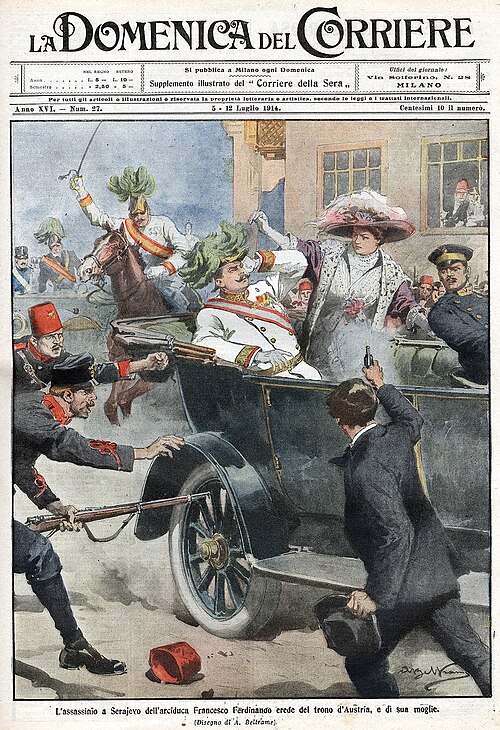
In the morning one of them threw a bomb at the archduke’s car. It bounced off and exploded under the next car, hurting other people. Later, the archduke’s driver took a wrong turn and stopped the car right next to another of the young men, Gavrilo Princip. Princip fired two shots, and both Franz Ferdinand and Sophie died.
Austria-Hungary blamed the neighbouring country of Serbia, where the young men had been given their weapons. Within about five weeks, because countries had promised to help their friends, most of the big powers of Europe were at war. It became the First World War, in which millions of people died.
People still argue about Princip. Some see him as a murderer who helped start a terrible war; others see him as a young freedom fighter against an empire. Historians agree that one shooting did not cause the whole war by itself: it was the spark, but Europe was already full of dry wood.
At a glance
- Date
- Sunday 28 June 1914, shortly before 11 a.m. (a bomb attack failed about 10:10 a.m.)
- Place
- Near the Latin Bridge, Sarajevo, capital of Bosnia and Herzegovina, then under Austro-Hungarian rule
- Victims
- Archduke Franz Ferdinand (b. 1863), heir presumptive to Austria-Hungary, and his wife Sophie, Duchess of Hohenberg (b. 1868)
- Assassin
- Gavrilo Princip (1894–1918), a Bosnian Serb student in the Young Bosnia movement
- Conspiracy
- Seven conspirators in Sarajevo, armed and helped across the border by officers of the Serbian secret society Unification or Death (the Black Hand)
- Outcome
- Austro-Hungarian ultimatum to Serbia (23 July), declaration of war (28 July) and the outbreak of the First World War in early August 1914
- Remembered as
- The “shot heard around the world”; judged very differently in Serbia, Austria, Bosnia and elsewhere
Easy
What happened in Sarajevo?
On Sunday 28 June 1914, Archduke Franz Ferdinand of Austria and his wife Sophie were shot dead in Sarajevo, the main city of Bosnia and Herzegovina. The killing, often called the Sarajevo assassination, set off the diplomatic crisis of July 1914 that led to the First World War.
Franz Ferdinand was the heir to the throne of Austria-Hungary, a large empire in central Europe made up of many peoples: Germans, Hungarians, Czechs, Poles, Croats, Serbs, Bosnian Muslims, Romanians and others. As Inspector General of the armed forces, he had come to Bosnia to watch army manoeuvres and then to make an official visit to Sarajevo.
The assassin, Gavrilo Princip, was a 19-year-old Bosnian Serb. He belonged to a loose network of young revolutionaries, later called Young Bosnia, who wanted to end Austro-Hungarian rule and unite the South Slavs (Serbs, Croats and others) in one state. He and his friends had received pistols and bombs from members of a secret nationalist society in the neighbouring Kingdom of Serbia.
Easy
The people involved
Franz Ferdinand (1863–1914) became heir to the throne only because others died: the emperor’s son, Crown Prince Rudolf, died by suicide in 1889, and Franz Ferdinand’s father died in 1896. He was known as short-tempered and conservative, but also as a man with ideas for reforming the empire, including giving more power to its Slavic peoples. He was cautious about war with Serbia and had more than once restrained the army’s chief of staff, Franz Conrad von Hötzendorf, who wanted it.
His wife, Sophie Chotek, was a Czech countess, not a princess of a ruling family. The imperial court allowed the marriage in 1900 only on condition that it be “morganatic”: their three children could never inherit the throne, and Sophie was often excluded from official ceremonies. In Bosnia, however, as the wife of the army’s inspector, she could appear at his side, which may be one reason the couple travelled together that day. The visit also fell close to their wedding anniversary.
The seven conspirators waiting in Sarajevo were young: Gavrilo Princip, Nedeljko Čabrinović and Trifko Grabež had travelled from Belgrade; Danilo Ilić, a slightly older teacher and journalist, organised the local group, which included Muhamed Mehmedbašić, a Bosnian Muslim, and two schoolboys, Vaso Čubrilović and Cvjetko Popović.
Easy
The day of the assassination, step by step
The couple arrived by train in the morning and set off in an open car in a motorcade of six cars along the Appel Quay, the road beside the Miljacka River. The conspirators had placed themselves along the route. Security was light, and the route had been published in the newspapers.
At about 10:10 a.m. Čabrinović threw a bomb at the archduke’s car. The driver sped up, and the bomb bounced off the folded roof and exploded under the following car, wounding its passengers and a number of bystanders, around sixteen to twenty people in total. Čabrinović swallowed poison, which only made him sick, and jumped into the river, which was very shallow in summer; he was captured. The other conspirators, in the crowds and the confusion, did nothing.
The archduke went on to the reception at the town hall, visibly angry. Afterwards he decided to visit the wounded in hospital. But the drivers had not been properly told of the change. At the Latin Bridge the first cars turned right into Franz Joseph Street, following the original plan, and the archduke’s driver, Leopold Lojka, followed. The governor of Bosnia, General Oskar Potiorek, who was in the car, shouted that it was the wrong way, and the car stopped to reverse.
By chance, Princip was standing a few steps away, near a delicatessen owned by Moritz Schiller. He stepped forward and fired two shots from a small Belgian FN pistol at close range. One bullet hit Franz Ferdinand in the neck; the other hit Sophie in the abdomen. Both died within a short time, shortly before 11 a.m. Princip tried to shoot himself and to take poison, but was seized by the crowd and arrested.
Intermediate
Background: Bosnia, Serbia and the South Slav question
Bosnia and Herzegovina had been part of the Ottoman Empire for about four centuries. In 1878, at the Congress of Berlin, Austria-Hungary was allowed to occupy and administer it, and in October 1908 it formally annexed the province. The annexation angered Serbia and Russia and caused a major European crisis. The population of Bosnia was mixed: Orthodox Serbs were the largest group, alongside Muslims (today called Bosniaks) and Catholic Croats.
Serbia, an independent kingdom since 1878, saw itself as the natural centre of a future South Slav state. In 1903 a group of army officers had murdered King Alexander Obrenović and Queen Draga and brought a new, more nationalist dynasty to power. In the Balkan Wars of 1912–13, Serbia nearly doubled its territory at the expense of the Ottoman Empire and Bulgaria. Austria-Hungary, with millions of South Slavs of its own, saw a larger, more confident Serbia as a threat to its survival.
Among young Bosnians, many of them students from poor rural families, radical ideas spread quickly: South Slav (Yugoslav) unity, Serbian nationalism, anarchism and the example of Russian revolutionaries. They admired Bogdan Žerajić, who in 1910 had tried to shoot the governor of Bosnia and then killed himself. For them, assassinating a high representative of the empire was an act of heroic resistance. At his trial Princip declared that he was a Yugoslav nationalist who wanted all South Slavs to be free of Austria.
The date also mattered. 28 June was Vidovdan, St Vitus’s Day, the anniversary of the Battle of Kosovo in 1389, a central event in Serbian national memory. To Serbian nationalists, an imperial visit on that day looked like a deliberate provocation.
Intermediate
The Black Hand and the question of Serbian responsibility
The weapons came from Serbia. In Belgrade, Princip, Čabrinović and Grabež were given four pistols, six bombs and cyanide capsules through Milan Ciganović and Major Vojislav Tankosić, members of a secret society of Serbian officers called Unification or Death, better known as the Black Hand. Its leader was Colonel Dragutin Dimitrijević, known as Apis, the head of Serbian military intelligence and one of the organisers of the 1903 regicide. Serbian border officers helped smuggle the young men and their weapons into Bosnia.
The Serbian government of Prime Minister Nikola Pašić did not order the assassination, and there is no evidence that it wanted a war in 1914; Serbia was exhausted after the Balkan Wars. But it was in conflict with Apis and the Black Hand, and Pašić seems to have learned in early June that armed young men had crossed into Bosnia. Whether and how clearly Serbia warned Vienna remains disputed; the Serbian envoy in Vienna appears to have given only a vague hint.
In 1917, during the war, the Serbian government in exile tried Apis and several associates in Salonika on largely fabricated charges of plotting against the regent. Before his execution Apis wrote a statement taking responsibility for organising the Sarajevo attack. Historians still debate how far this statement can be trusted and how widely the plan was known within the Black Hand itself.
Intermediate
From an assassination to a world war: the July Crisis
At first, much of Europe reacted with shock but little alarm; political murders were not rare. Behind the scenes, however, Austria-Hungary’s leaders, especially the army chief Conrad and the foreign minister Count Berchtold, decided to use the killing to crush Serbia as a political threat. On 5–6 July Germany gave its ally a promise of full support, known as the “blank cheque”, even if Russia intervened.
On 23 July Austria-Hungary sent Serbia an ultimatum with ten demands and a 48-hour deadline. It included demands that Austro-Hungarian officials take part in investigations on Serbian soil. Serbia’s reply on 25 July accepted most of the terms but rejected that point. Vienna broke off relations and on 28 July, exactly one month after the assassination, declared war on Serbia; Belgrade was shelled the next day.
Then the alliance system and military planning took over. Russia, which saw itself as the protector of Serbia and the Slavs, ordered general mobilisation on 30 July. Germany declared war on Russia on 1 August and on France on 3 August, and invaded neutral Belgium as part of its plan to defeat France quickly. Britain declared war on Germany on 4 August. Within five weeks of the shots in Sarajevo, the great powers of Europe were at war.
Serbia, the country Austria-Hungary set out to punish, suffered terribly. After repelling Austro-Hungarian invasions in 1914, it was overrun in late 1915 by German, Austro-Hungarian and Bulgarian forces; its army and many civilians retreated across the mountains of Albania in winter, and tens of thousands died. By the end of the war Serbia had lost a larger share of its population, through battle, epidemics and occupation, than almost any other belligerent. Bosnia itself became a front-line province under military rule.
The war that followed lasted until 1918 and killed around ten million soldiers and millions of civilians. It destroyed four empires: the Austro-Hungarian, German, Russian and Ottoman. Franz Ferdinand’s murder was the trigger, but most historians stress deeper causes: imperial rivalries, an arms race, rigid alliances, nationalist movements and decisions made by leaders in several capitals.
Intermediate
Aftermath in Bosnia: riots, trial and punishment
In the days after the killing, anti-Serb riots broke out in Sarajevo and other towns. Crowds attacked Serbian homes, shops and institutions, and several people were killed. The authorities arrested hundreds of Serbs, and a militia called the Schutzkorps, recruited largely from Bosnian Muslims, was used against Serb civilians during the war. These events are part of the story that is often forgotten outside the region.
The conspirators and many people who had helped them were tried in Sarajevo in October 1914. Under Austro-Hungarian law, those under twenty at the time of the crime could not be executed. Princip, Čabrinović and Grabež were therefore sentenced to twenty years; Vaso Čubrilović and Cvjetko Popović, even younger, received sixteen and thirteen years. Danilo Ilić and two men who had helped hide the weapons, Veljko Čubrilović and Miško Jovanović, were hanged in February 1915.
Princip was held in harsh conditions in the fortress prison of Theresienstadt (Terezín), in what is now the Czech Republic. He fell ill with tuberculosis, lost an arm to the disease, and died on 28 April 1918, a few months before the empire he had fought against collapsed. Čabrinović and Grabež also died in prison. Vaso Čubrilović survived and later became a historian and a government minister in socialist Yugoslavia.
Intermediate
Hero or terrorist? How the assassination is remembered
The memory of Sarajevo has changed with the politics of the region. In Austria between the wars, the victims were commemorated with a monument at the site. In the Kingdom of Yugoslavia and especially in socialist Yugoslavia after 1945, Princip and Young Bosnia were honoured as freedom fighters who helped bring about the South Slav state; the Latin Bridge was renamed Princip Bridge, and footprints marking where he stood were set in the pavement.
After Yugoslavia broke apart and the Bosnian war of 1992–95, views divided along national lines. Many Serbs continue to see Princip as a hero of liberation, and statues of him were unveiled in East Sarajevo in 2014 and in Belgrade in 2015. Many Bosniaks and Croats see him instead as a Serbian nationalist whose act has been used to justify later Serbian nationalism. In Sarajevo itself, the bridge is again called the Latin Bridge, and a small museum near the site presents the period of Austro-Hungarian rule.
In Austria, Germany, Britain and elsewhere, the assassination is usually told as the first step to a catastrophe, and Princip as a terrorist. The car in which the couple were shot, and Franz Ferdinand’s bloodstained uniform, are displayed at the Museum of Military History in Vienna. The centenary in 2014 revealed how differently the same event is still told in different countries.
Advanced
Historians’ debates: who was responsible for 1914?
The question of responsibility for the war has been debated since 1914. The Treaty of Versailles (1919) assigned responsibility to Germany and its allies, which Germans bitterly rejected. In the interwar years many historians argued that all the powers had “slid” into war. In 1961 the German historian Fritz Fischer, in Griff nach der Weltmacht (translated as Germany’s Aims in the First World War), used German archives to argue that Germany’s leaders had deliberately risked, and even sought, a great war to become a world power. The “Fischer controversy” transformed German historiography.
More recently, Christopher Clark’s The Sleepwalkers (2012) shifted attention back to the Balkans and to the many decision-makers in all capitals, portraying them as sleepwalkers who did not see the catastrophe they were creating. Clark gave substantial attention to Serbian nationalism and the Black Hand, which led some Serbian historians and others to criticise the book for placing too much blame on Serbia. Other works, such as Margaret MacMillan’s The War That Ended Peace (2013) and Sean McMeekin’s July 1914 (2013), weigh the roles of Russia, France, Britain and Germany differently.
A different line of research looks at the assassins themselves. Vladimir Dedijer’s The Road to Sarajevo (1966) placed Young Bosnia in the context of peasant poverty, Ottoman and Habsburg rule, and European revolutionary ideas. Historians still disagree over whether the conspirators were chiefly Serbian nationalists, Yugoslav idealists or tools of the Black Hand, and how far their act can be separated from the use later made of it.
Advanced
Sources and evidence
The assassination is relatively well documented. The Sarajevo trial of October 1914 produced a stenographic record of the defendants’ testimony, published in several editions and translations; it is a key source for the conspirators’ motives, though they sometimes shaped their statements to protect others. Eyewitness accounts include those of Count Franz von Harrach, who stood on the car’s running board, and of Governor Potiorek.
For the diplomatic crisis, historians rely on the vast official document collections that governments published after the war, often selectively, to defend themselves, as well as private diaries and later archive openings. Serbian archives for 1914 are less complete, partly because of wartime losses, which leaves gaps on exactly what the Serbian government knew.
Some details remain uncertain: the precise times of the shooting, the exact words spoken in the car, the identity of the specific pistol Princip used, and the reliability of Apis’s 1917 statement. Accounts in popular books often repeat dramatic details, such as Franz Ferdinand’s last words to Sophie, that come from a single witness. Careful readers should treat such details as testimony, not established fact.
Key ideas
- Trigger versus cause
- The assassination triggered the July Crisis, but the war resulted from deeper rivalries and the decisions of several governments.
- Nationalism in a multinational empire
- Austria-Hungary contained many peoples; South Slav nationalism threatened its unity, and its leaders feared that yielding to Serbia would encourage other groups.
- Alliance system
- Commitments between Germany and Austria-Hungary, and between Russia, France and Britain, turned a regional conflict into a general European war.
- Political violence and tyrannicide
- Young Bosnia saw the killing of imperial officials as legitimate resistance, an idea common among revolutionaries of the time.
- Contingency
- A wrong turn and a stalled car made the shooting possible; historians debate how much such chance events matter in history.
- Contested memory
- The same person is honoured as a liberator by some and condemned as a terrorist by others, reflecting later political conflicts.
Records
- 1878 — Congress of Berlin: Austria-Hungary occupies Bosnia and Herzegovina.
- 1903 — Serbian officers, including Apis, murder King Alexander Obrenović; a new dynasty takes power in Serbia.
- 1908 — Austria-Hungary formally annexes Bosnia and Herzegovina, causing an international crisis.
- 1911 — The secret society Unification or Death (the Black Hand) is founded in Serbia.
- 1912 — Balkan Wars (1912–13) greatly enlarge Serbia.
- 1914 — 28 June: Franz Ferdinand and Sophie are assassinated in Sarajevo.
- 1914 — 23–28 July: Austro-Hungarian ultimatum to Serbia and declaration of war; general war follows in early August.
- 1914 — October: trial of the conspirators in Sarajevo.
- 1917 — Apis is tried in Salonika and executed.
- 1918 — Princip dies in prison at Theresienstadt on 28 April; Austria-Hungary collapses in the autumn.
- 1961 — Fritz Fischer’s book sparks a major debate over German war aims.
- 2014 — The centenary reveals sharply different national memories of the event.
Glossary
- Archduke
- A title for members of the Habsburg imperial family of Austria.
- Heir presumptive
- The person next in line to a throne, whose place could change if someone closer were born.
- Morganatic marriage
- A marriage between a royal and a person of lower rank, in which the spouse and children cannot inherit royal titles or the throne.
- Annexation
- When a state formally makes another territory part of itself.
- Young Bosnia (Mlada Bosna)
- A loose network of young revolutionaries in Bosnia who opposed Austro-Hungarian rule.
- Black Hand
- Popular name for Unification or Death, a secret society of Serbian officers that aimed to unite Serbs in one state.
- Ultimatum
- A final set of demands with a deadline, backed by the threat of force.
- Mobilisation
- Calling up soldiers and preparing an army for war.
- Vidovdan
- St Vitus’s Day, 28 June, anniversary of the 1389 Battle of Kosovo and an important date in Serbian memory.
- July Crisis
- The month of diplomacy and decisions between the assassination and the outbreak of war in 1914.
Questions and answers
Why did the driver take a wrong turn?
After the bomb attack the plan was changed so the archduke could visit the wounded, but nobody told the drivers clearly. The first cars followed the old route, and the archduke’s car followed them.
How old was Gavrilo Princip?
He was 19. Because he was under 20, Austro-Hungarian law did not allow him to be executed, so he was sentenced to 20 years in prison, where he died in 1918.
Did Serbia order the assassination?
Not the Serbian government itself. Officers of a secret society in the Serbian army, the Black Hand, armed and helped the assassins. How much the government knew in advance is still debated.
Did one shot really start the First World War?
It started the chain of events, but the war came from decisions by many leaders and deeper tensions: rival empires, alliances, arms races and nationalism.
Why was Sophie with him when many ceremonies excluded her?
Because of their morganatic marriage, Sophie was often barred from court ceremonies in Vienna, but on a military inspection trip she could appear beside him in public. Historians note this as one reason for the joint visit.
How has the ‘war guilt’ debate changed?
From the Versailles verdict against Germany, to the view that all powers slid into war, to Fritz Fischer’s emphasis on German aims, to recent works like Clark’s that stress shared responsibility and the Balkan context.
Can you still see the car and the pistol today?
Yes. The open car in which the couple were shot, Franz Ferdinand’s uniform and pistols linked to the conspirators are displayed at the Museum of Military History in Vienna. The street corner in Sarajevo is marked with a plaque and a small museum.
Sources and further reading
- Assassination of Archduke Franz Ferdinand. Wikipedia
- 사라예보 사건. 위키백과 (Korean Wikipedia)
- July Crisis. Wikipedia
- Young Bosnia. Wikipedia
- Black Hand (Serbia). Wikipedia
- Christopher Clark, The Sleepwalkers: How Europe Went to War in 1914. Allen Lane, 2012
- Fritz Fischer, Griff nach der Weltmacht: Die Kriegszielpolitik des kaiserlichen Deutschland 1914/18. Droste, 1961
- Vladimir Dedijer, The Road to Sarajevo. Simon and Schuster, 1966
- Margaret MacMillan, The War That Ended Peace: The Road to 1914. Random House, 2013
Related
- October RevolutionBolshevik forces overthrew Russia’s Provisional Government in Petrograd in October 1917, opening a new phase of revolution and civil conflict.
- Assassination of Julius CaesarThe killing of Julius Caesar by a group of Roman senators on 15 March 44 BCE.
- United Nations Conference on International OrganizationDelegates met in San Francisco in 1945 to draft and sign the United Nations Charter after the devastation of the Second World War.
Written with AI assistance from the published sources listed above, and revised as new research appears.