Start at the top for an easy introduction. Go further down for more detail and scholarship.
- Easy
- Intermediate
- Advanced
For young readers
In 1889 France held a giant fair in Paris to show the world its newest inventions and to celebrate 100 years since the French Revolution. The organizers wanted something amazing at the entrance, and the company of an engineer named Gustave Eiffel offered to build the tallest tower in the world.
The tower is made of about 18,000 iron pieces, joined together with millions of little metal pins called rivets. Each piece was made in a factory, carried to the building site by horse and cart, and fitted together like a giant construction kit. It took just over two years to build.
When it was finished it was 300 metres tall, about as tall as a 100-storey building. For 41 years nothing built by people anywhere in the world was taller. It is shaped like a big letter A, wide at the bottom and thin at the top, so that the wind can blow through it without pushing it over.
Not everyone liked it. Famous artists and writers signed a letter calling it “useless and monstrous” and said it would spoil beautiful Paris. The tower was only supposed to stay for 20 years. It was saved partly because it was so useful for sending radio signals.
Today about six to seven million people go up the tower every year, by lift or by climbing hundreds of stairs. At night it glows golden and sparkles with thousands of lights, and people around the world recognize it at once as the sign of Paris.
At a glance
- Built
- Foundations begun 28 January 1887; structure completed 31 March 1889; opened to the public 15 May 1889
- Place
- Champ de Mars, beside the River Seine, Paris, France
- Designers
- Engineers Maurice Koechlin and Émile Nouguier and architect Stephen Sauvestre of the Compagnie des Établissements Eiffel, led by Gustave Eiffel
- Height
- 300 m at completion; about 330 m today with broadcast antennas
- Material
- Puddled (wrought) iron, about 7,300 tonnes; 18,038 parts joined by about 2.5 million rivets
- Original purpose
- Centrepiece and entrance of the Exposition Universelle of 1889, marking the centenary of the French Revolution
- Status
- French historical monument (1964); part of the UNESCO World Heritage site “Paris, Banks of the Seine” (1991)
- Record
- World’s tallest human-made structure from 1889 until the Chrysler Building in New York (1930)
Easy
What is the Eiffel Tower?
The Eiffel Tower is a lattice tower of iron standing on the Champ de Mars, a large park in western Paris beside the River Seine. It was built between 1887 and 1889 as the centrepiece of the Exposition Universelle, a world’s fair held to celebrate the hundredth anniversary of the French Revolution and to display French industry and science.
At 300 metres it was by far the tallest structure humans had ever made, almost twice the height of the tallest buildings of the time, such as the Washington Monument. It kept that record until 1930. Parisians soon nicknamed it “La dame de fer”, the Iron Lady.
The tower was meant to be temporary: its builder had permission to run it for 20 years, after which the City of Paris could take it down. Instead it survived, found new uses in science and radio, and became a symbol of Paris and of France. It is now owned by the City of Paris and is one of the most visited paid monuments in the world.
Easy
How to “read” the tower
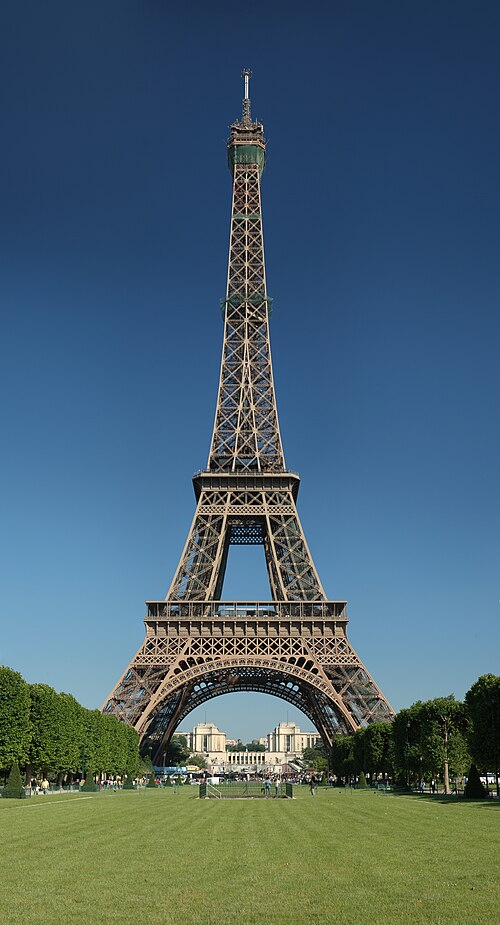
Look first at the four legs. They stand on a square base about 125 metres on each side and curve inward as they rise, meeting at the top. Between the legs, at the bottom, are four large decorative arches. These arches carry almost no weight; the architect Stephen Sauvestre added them to make the tower look grander and to form a gateway into the fair.
The tower has three public levels. The first platform is about 57 metres above the ground, the second about 115 metres, and the top platform about 276 metres. Above that are the lantern, the old apartment Gustave Eiffel used for guests and experiments, and today’s radio and television antennas.
The curve of the legs is not only for beauty. Eiffel explained that it followed calculations of the force of the wind: the tower is wide and strong where the wind pushes hardest near the base, and slim and open higher up. Because it is a lattice, the wind passes through the gaps. Even in strong winds the top moves only a few centimetres, although on hot days it can lean slightly away from the sun as the iron expands.
Around the tower, just below the first platform, are the names of 72 French scientists, engineers and mathematicians, such as Lavoisier, Ampère and Laplace, painted in gold letters. Eiffel chose them to present the tower as a monument to science. All 72 are men; commentators have long noted the absence of women such as the mathematician Sophie Germain.
Easy
Where did the idea come from?
The tower did not start as Gustave Eiffel’s own sketch. In 1884 two senior engineers of his company, Maurice Koechlin and Émile Nouguier, drew a design for a giant pylon: four lattice girders standing apart at the base and joining at the top. Eiffel was at first not very enthusiastic, but he let them develop it. The architect Stephen Sauvestre then added decorative arches, a glass hall on the first level and other details.
Eiffel liked the new version, bought the rights to the patent from his colleagues, and promoted the project energetically under his own name. In 1885 he presented it to the Society of Civil Engineers, saying it would symbolize “the century of Industry and Science” and the Revolution of 1789.
In May 1886 the French government announced a competition for the fair’s centrepiece, and its terms, which asked for a 300-metre metal tower on the Champ de Mars, practically guaranteed Eiffel’s victory. A contract signed in January 1887 gave him 1.5 million francs, less than a quarter of the expected cost, and the right to all income from the tower during the fair and for 20 years afterwards. He had to find the rest of the money himself.
Intermediate
How it was built
Work on the foundations began on 28 January 1887. The two legs farther from the river rested on concrete slabs laid on firm ground. The two legs nearer the Seine stood on softer soil, so workers sank iron caissons, huge boxes filled with compressed air to keep out water, down to about 22 metres, and poured concrete foundations inside them. On top of the concrete, blocks of limestone held the iron “shoes” on which each leg would stand.
The real secret of the construction was preparation. Eiffel’s drawing office produced some 1,700 general drawings and more than 3,600 detailed drawings of the 18,038 different parts. Rivet holes were specified to within a millimetre, and angles were calculated to a fraction of a degree. The pieces were made in the company’s workshops at Levallois-Perret, on the edge of Paris, often pre-assembled into sections, and brought to the site by horse-drawn carts. If a part did not fit, it was sent back to the factory rather than altered on site.
The legs rose first as inclined cantilevers, then rested on temporary wooden scaffolds. Small “creeper” cranes climbed up the legs along the future lift tracks, lifting pieces into place. The most delicate moment came in March 1888, when the four legs had to meet exactly at the first platform. Hydraulic jacks and boxes of sand under the legs let the engineers adjust their positions by fractions of a millimetre.
About 300 workers were employed on site. Thanks to guardrails, screens and movable platforms, only one worker is recorded as having died during construction, a remarkably low number for such a project in the nineteenth century. On 31 March 1889 Eiffel led officials and journalists up the stairs to the top and raised a French flag.
Intermediate
“Useless and monstrous”: the artists’ protest
Even before it rose, the tower provoked fierce opposition. Some doubted that a 300-metre tower could be built at all. Others objected on artistic grounds. On 14 February 1887 the newspaper Le Temps published a protest signed by prominent artists and writers, including the architect of the Paris Opera, Charles Garnier, the writer Guy de Maupassant and the composer Charles Gounod.
They protested “in the name of slighted French taste” against “this useless and monstrous Eiffel Tower”, which they compared to a gigantic black factory chimney that would humiliate Notre-Dame, the Louvre and the other monuments of Paris. The debate reflected a long French argument about whether engineers, not architects, should shape the city, and whether industrial materials like iron could be beautiful.
Eiffel answered that engineering and beauty were not opposites: the laws of natural forces, he said, obey the secret laws of harmony, and his tower would be grand in its own way, like the pyramids of Egypt. Some protesters later changed their minds. A well-known but unverifiable story claims that Maupassant often ate in the tower’s restaurant because it was the one place in Paris from which he could not see the tower.
Intermediate
The 1889 World’s Fair and its shadows
The Exposition Universelle opened on 6 May 1889 and closed on 31 October. It attracted more than 30 million visits. The tower opened to the public on 15 May; before the lifts started working, tens of thousands of people climbed its 1,710 steps to the top. By the end of the fair nearly 1.9 million people had gone up. There were restaurants on the first level, a printing press of the newspaper Le Figaro on the second, and a post office at the top. Famous visitors included Thomas Edison, who wrote an admiring message in Eiffel’s guestbook.
Because the fair celebrated the Revolution of 1789, most European monarchies officially stayed away, though companies from their countries still took part. The fair presented France as a modern republic of science and progress, with the vast iron-and-glass Galerie des Machines standing near the tower.
The fair also showed the darker side of that confidence. Colonial exhibits displayed people from French colonies in Africa and Asia in reconstructed “villages” for visitors to stare at, in conditions that later historians have described as human zoos. Recent research has also drawn attention to the financing of the tower: a bank that helped fund it, the Crédit Industriel et Commercial, was at the same time profiting from heavy loans to Haiti linked to the indemnity France had forced Haiti to pay after its revolution. These facts are now part of how the tower’s history is told.
Intermediate
Saved by science and radio
Eiffel knew his tower might be demolished when his concession ended, so he worked hard to make it scientifically useful. He installed meteorological instruments on it, and he used a cable stretched from the second level to the ground to drop objects and measure air resistance. In 1909 he built a wind tunnel at the foot of the tower and later moved his aerodynamics laboratory to Auteuil; his research helped early aircraft designers.
Radio proved decisive. In 1898 Eugène Ducretet sent early wireless signals between the tower and the Panthéon. Eiffel then encouraged the army to use the tower for military radio, and Captain (later General) Gustave Ferrié developed a powerful station there. In 1909 a permanent underground radio centre was built near the south leg, and the tower was allowed to remain. From 1910 it broadcast time signals from the Paris Observatory to ships at sea and to the world, helping to coordinate international time.
During the First World War the tower’s station intercepted enemy messages, which were used by French intelligence; according to many accounts they contributed to the Allied success at the Battle of the Marne in 1914 and to the case against the dancer Mata Hari in 1917. Later the tower carried radio and then television transmitters, and it still broadcasts radio and digital television today.
Intermediate
Later history: wars, lights and millions of visitors
From 1925 to 1934 the car maker Citroën lit up the tower with a giant electric advertisement. When German troops occupied Paris in June 1940, the French cut the lift cables so that the occupiers would have to climb the stairs. In August 1944, as Allied forces approached, Hitler is reported to have ordered the destruction of Paris’s landmarks, but the German commander Dietrich von Choltitz did not carry it out; how clearly the tower was targeted, and why Choltitz disobeyed, are debated by historians.
A fire in the television transmitter in 1956 damaged the top, and in 1957 a new antenna raised the height. In 1964 the tower was declared a historical monument. The lifts were modernized several times, a glass floor was added to the first level in 2014, and the tower is completely repainted roughly every seven years with about 60 tonnes of paint to protect the iron from rust.
Since the end of 1985 the tower has been lit from within by golden lights, and since the turn of the millennium it has, with some interruptions, sparkled with thousands of flashing bulbs for a few minutes every hour after dark. It has become the stage for national celebrations, New Year’s fireworks and the 2024 Paris Olympics. More than 300 million people have visited it since 1889.
Intermediate
A symbol in art and culture
Artists quickly adopted the tower. Georges Seurat painted it in 1889; Henri Rivière made a series of prints called Thirty-Six Views of the Eiffel Tower (1902), a tribute to Hokusai’s Thirty-Six Views of Mount Fuji; Robert Delaunay painted it again and again from 1909 as a symbol of modern energy; and the poet Guillaume Apollinaire wrote a poem in the shape of the tower in 1918. Filmmakers, photographers and advertisers made it the visual shorthand for Paris.
The French critic Roland Barthes, in a famous essay of 1964, argued that the tower is almost pure sign: it is useless as a building, yet it means everything people want it to mean, from science to love to Paris itself. It is both an object you look at and a place from which you look at the city.
The tower also inspired imitations around the world, from Blackpool Tower in England (1894) to Tokyo Tower (1958) and replicas in Las Vegas and in a Chinese housing development. Its image has become one of the most reproduced on earth, on souvenirs, logos and emoji.
Advanced
Debates: authorship, engineering and meaning
Who designed it? The tower bears Eiffel’s name, but the original concept came from Koechlin and Nouguier, and the architectural treatment from Sauvestre. Eiffel bought their patent rights and took public credit, while also supplying the company’s engineering experience, organization and financial risk. Historians today generally describe the tower as a collective achievement of an engineering firm, a view that reflects wider debates about how credit is given in large technical projects.
How was the shape calculated? Eiffel said that the curve of the legs followed from the wind loads. His team used graphical methods and conservative assumptions, treating the upper half as if it were solid. Later engineers have proposed mathematical models to explain why the profile works so well; one study published in 2004, based on Eiffel’s 1885 memoir to the Society of Civil Engineers, described the shape as the solution of a non-linear integral equation balancing wind pressure against the tension in the structure. Whether Eiffel consciously designed with such an equation, or arrived at the shape through practical experience, remains open.
Engineering versus architecture. The protest of 1887 was part of a nineteenth-century argument about whether iron structures by engineers, such as bridges, train sheds and exhibition halls, could be architecture. Eiffel’s firm had already built major bridges such as the Maria Pia Bridge in Porto (1877) and the Garabit Viaduct (1884), and it designed the internal framework of the Statue of Liberty (1886). Historians of architecture now often see the tower as a key work in the path toward modern structural expression.
Whose story? Recent scholarship and journalism have widened the frame beyond national pride, connecting the 1889 fair to colonial exhibitions and the tower’s finance to Haiti’s indemnity debt. Some see this as a necessary correction; others worry about reading later values into the past. Most historians agree that the tower’s meaning must include both its engineering triumph and the imperial world that produced it.
Advanced
Conservation and management today
The tower is a historical monument, owned by the City of Paris and managed by an operating company, the Société d’Exploitation de la Tour Eiffel (SETE). Keeping a wrought-iron structure over 135 years old in service is a constant engineering task: corrosion must be controlled by repainting, and every campaign requires removing old paint layers, some containing lead, which was used until 2001.
Repainting raises questions of colour as well as conservation. The tower was originally reddish-brown, later painted in various shades of yellow and ochre, and from 1968 a bronze colour known as “Eiffel Tower brown”; it is painted in three shades, darker at the bottom and lighter at the top, so that it looks uniform against the sky. Choices of colour are debated as matters of historical authenticity.
Other debates concern additions and control of the image. In 2024 the city’s plan to keep the Olympic rings on the tower permanently was criticized by Eiffel’s descendants and some residents as an alteration of a protected monument. The operating company also claims copyright over the tower’s night-time illuminations, although the tower itself has been in the public domain since 1993, which has made the commercial use of night photographs a legal grey area.
Finally, the pressure of millions of visitors, security needs such as the glass security walls built around the base from 2018, and the demands of maintenance have to be balanced against the idea of the tower as an open, public monument for everyone.
Key ideas
- Iron lattice structure
- A framework of many small iron pieces joined into triangles, strong yet light and open to the wind.
- Prefabrication
- Making precisely measured parts in a factory and assembling them on site, the method that let the tower rise in about two years.
- Engineering as art
- The debate, sharpened by the tower, over whether structures designed by engineers could be beautiful and count as architecture.
- World’s fair
- A large international exhibition of industry, science and culture; the 1889 Paris fair celebrated the French Revolution’s centenary.
- Temporary becomes permanent
- Built with a 20-year permit, the tower survived by proving useful, especially for radio.
- Symbol and sign
- The tower became an image that stands for Paris and modernity itself, as analysed by Roland Barthes.
- Hidden histories
- The fair’s colonial exhibits and the tower’s financing connect the monument to empire and to Haiti’s debt.
Records
- 1884 — Maurice Koechlin and Émile Nouguier sketch the idea of a giant lattice pylon.
- 1886 — The government competition for the fair’s centrepiece effectively selects Eiffel’s design.
- 1887 — Contract signed (8 January); foundations begun (28 January); artists’ protest published (14 February).
- 1888 — The four legs are joined at the first platform (March).
- 1889 — Structure completed (31 March); the Exposition Universelle opens (6 May); the tower opens to the public (15 May).
- 1898 — Eugène Ducretet sends early radio signals between the tower and the Panthéon.
- 1909 — A permanent radio station is built at the base and the tower is allowed to remain; Eiffel opens a wind tunnel on the Champ de Mars.
- 1910 — The tower begins broadcasting time signals as part of an international time service.
- 1930 — The Chrysler Building in New York surpasses the tower as the world’s tallest structure.
- 1940 — Lift cables are cut as German forces occupy Paris; lifts are not repaired until 1946.
- 1964 — The tower is officially declared a French historical monument.
- 1991 — The banks of the Seine in Paris, including the tower, are inscribed as a UNESCO World Heritage site.
Glossary
- Lattice
- A framework of crossed strips or bars leaving open spaces between them.
- Wrought (puddled) iron
- A tough, low-carbon iron produced by stirring molten iron in a furnace, widely used before steel became cheap.
- Rivet
- A metal pin heated and hammered to join two pieces of metal permanently.
- Caisson
- A watertight chamber, often filled with compressed air, used to build foundations below water level.
- Cantilever
- A beam or structure supported at only one end, projecting outward.
- Concession
- A right granted by a government to operate something, such as the tower, for a set period.
- Exposition Universelle
- French for “universal exhibition”: a world’s fair.
- Champ de Mars
- A large public park in Paris, once a military parade ground, where the tower stands.
- Wind tunnel
- A tube in which air is blown past models to study the forces of wind on them.
Questions and answers
How tall is the Eiffel Tower?
It was 300 metres tall when completed in 1889. With the antennas added since, it is about 330 metres today.
Did Gustave Eiffel design it himself?
Not alone. The first design came from his engineers Maurice Koechlin and Émile Nouguier, with architectural details by Stephen Sauvestre. Eiffel’s company built it and Eiffel championed and financed it.
Why was it built?
As the centrepiece of the 1889 World’s Fair in Paris, which celebrated the 100th anniversary of the French Revolution and showed off French engineering.
Was it really supposed to be taken down?
Eiffel’s permit ran for 20 years after the fair, after which the City of Paris could remove it. It was kept, largely because it had become valuable for radio.
How many steps are there?
Visitors in 1889 climbed 1,710 steps to the top. Today stairs are open to the public only as far as the second level; the top is reached by lift.
Does the tower move?
Slightly. In strong wind the top sways by a few centimetres, and on hot days the sun-warmed side expands so the top can shift by up to about 18 cm.
Why do historians connect the tower to Haiti?
A bank that helped finance the tower was at the same time profiting from loans to Haiti tied to the indemnity France had imposed after Haitian independence, a link highlighted by recent investigations.
What did the protesters of 1887 object to?
They thought a huge iron tower was ugly and would dominate and spoil the historic beauty of Paris; many also doubted engineers could create art.
Sources and further reading
- Eiffel Tower. Wikipedia
- Gustave Eiffel. Wikipedia
- Exposition Universelle (1889). Wikipedia
- Paris, Banks of the Seine. Wikipedia
- Paris, Banks of the Seine. UNESCO World Heritage Centre
- Roland Barthes, La Tour Eiffel (The Eiffel Tower), 1964
Related
- Storming of the BastilleThe seizure of a Paris fortress and prison on 14 July 1789 became an early emblem of the French Revolution.
- Haitian RevolutionA revolution beginning with an uprising of enslaved people in Saint-Domingue led to the abolition of slavery there and Haiti’s independence in 1804.
- Great Pyramid of GizaA royal tomb built for the Egyptian pharaoh Khufu. It is the largest of the Giza pyramids and the only surviving Wonder of the ancient world.
- The Great Wave off KanagawaHokusai’s woodblock print sets a towering wave above boats, with Mount Fuji small in the distance.
- The Starry NightVincent van Gogh’s 1889 painting presents a night sky in sweeping, rhythmic strokes above a village.
- Azul...Rubén Darío’s 1888 collection of prose and poetry helped establish Spanish American modernismo.
Written with AI assistance from the published sources listed above, and revised as new research appears.