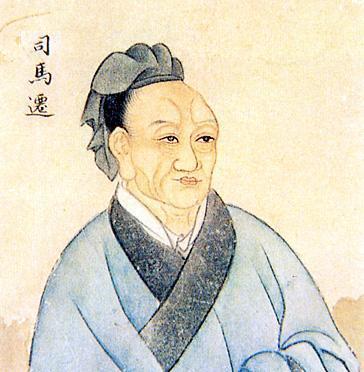
Start at the top for an easy introduction. Go further down for more detail and scholarship.
- Easy
- Intermediate
- Advanced
For young readers
More than 2,000 years ago, during the Han dynasty in China, a man named Sima Qian worked at the emperor's palace. His job was to watch the stars, keep the calendar and look after old records. His father had the same job, and before he died he asked his son to finish a great history book that he had started.
Sima Qian promised he would. As a young man he had travelled all over China, visiting old battlefields, the home town of Confucius and the places where famous stories had happened, and listening to what local people remembered.
Then something terrible happened. Sima Qian spoke up at court to defend a general who had lost a battle and surrendered. The emperor was furious. Sima Qian was sentenced to death, and the only way to escape was to accept a cruel and shameful punishment. He chose to live, even though it brought him great shame, because he wanted to keep his promise and finish the book.
The book he finished is called the Shiji, or Records of the Grand Historian. It has 130 chapters. Some chapters list the deeds of rulers year by year. Others are charts, like timelines. Some explain things like music, the calendar, rivers and money. And more than half tell the life stories of all kinds of people: emperors and queens, but also assassins, merchants, fortune-tellers and even jesters.
Sima Qian wrote so vividly that people still enjoy reading his stories today. For about two thousand years, historians in China, Korea, Japan and Vietnam copied the way his book was organized. That is why he is often called the "father of Chinese history".
At a glance
- Lived
- Born c. 145 BCE (some scholars say c. 135 BCE); died c. 86 BCE (date unknown)
- Birthplace
- Xiayang, near Longmen (near present-day Hancheng, Shaanxi, China)
- Dynasty
- Western Han, under Emperor Wu (r. 141–87 BCE)
- Offices
- Grand Astrologer / Grand Scribe (taishi ling, from c. 108 BCE); later Palace Secretary (zhongshu ling)
- Main work
- Shiji (史記, Records of the Grand Historian), originally called Taishigong shu ("The Grand Scribe's Book")
- Size
- 130 chapters, about 526,500 characters by the author's own count
- Scope
- From the legendary Yellow Emperor to the reign of Emperor Wu, about 2,500 years
- Legacy
- Created the annals-and-biographies (jizhuan) form used by China's official dynastic histories and copied across East Asia
Easy
Who was Sima Qian?
Sima Qian was an official of the Han dynasty (206 BCE–220 CE) who lived during the long reign of Emperor Wu, one of the most powerful rulers in Chinese history. He is remembered for one book, the Shiji, which he completed around 91 BCE. It was the first history to try to cover the entire known past of the Chinese world in one work.
His title, taishi ling, is often translated as "Grand Historian", but it could equally be rendered "Grand Astrologer" or "Grand Scribe". The office was responsible for astronomy, the calendar, omens and the keeping of documents. Writing a comprehensive history was not strictly part of the job; it was a personal project begun by his father, Sima Tan, who held the same post.
Sima Qian is famous not only for what he wrote but for the price he paid to write it. After defending a disgraced general in 99 BCE, he was condemned and chose to undergo castration rather than die, so that he could finish his work. His reflections on this choice, especially in his Letter to Ren An, have made him a symbol of integrity and endurance in East Asian culture.
Easy
Life: a promise from father to son
Sima Qian was born in Xiayang, near the Longmen ("Dragon Gate") gorge of the Yellow River. His birth year is uncertain: scholars have argued for about 145 BCE or about 135 BCE, based on differing early commentaries. His family claimed descent from ancient court historians. His father, Sima Tan, was appointed Grand Astrologer in Chang'an and wrote a short essay comparing the "Six Schools" of thought, which praised Daoism.
Sima Qian received a classical education and, according to his own postface, could read old-style scripts by the age of ten. At about twenty he set out on long journeys: south to the Yangzi and the Huai, to Mount Kuaiji where the flood-tamer Yu was said to be buried, and to Qufu, the home of Confucius, where he watched students practise the old rituals. Later he became a palace attendant (langzhong) and, around 111 BCE, was sent on an official mission to the newly conquered south-west.
In 110 BCE Emperor Wu performed the great feng and shan sacrifices at Mount Tai, the most solemn rites of kingship. Sima Tan fell ill and was not able to take part, which he felt as a disaster. On his deathbed he took his son's hand, wept, and asked him to complete the history he had begun, so that the deeds of worthy rulers, loyal ministers and righteous men would not be forgotten. Sima Qian promised to do so.
About two years later Sima Qian succeeded his father as Grand Astrologer, gaining access to the imperial library and archives. In 104 BCE he took part in the reform of the calendar that produced the Taichu ("Grand Beginning") calendar, and around this time he began writing in earnest.
Easy
The Li Ling affair and the Letter to Ren An
In 99 BCE the general Li Ling led a small force of infantry deep into the steppe against the Xiongnu, the nomadic confederation that was Han China's greatest rival. After fierce fighting against a much larger army he was surrounded and surrendered. At court, officials who had praised him now condemned him. Sima Qian, who barely knew Li Ling, spoke in his defence, pointing to his past loyalty and suggesting that he might have surrendered in order to repay the emperor later.
Emperor Wu took this as an attack on the commander of the main campaign, Li Guangli, the brother of the emperor's favourite consort. Sima Qian was charged and sentenced to death. Under Han law the sentence could be commuted by a large payment or by castration. He could not pay, and, as he later wrote, no friend spoke for him. He chose castration, a punishment considered so humiliating that a gentleman was expected to take his own life instead.
Sima Qian explained his choice in a letter to his friend Ren An, who was facing execution after the political upheaval of 91 BCE. In it he wrote that every man must die, but a death may be "weightier than Mount Tai or lighter than a goose feather". He had endured disgrace, he said, because his work was unfinished: he wished to "investigate the boundary between heaven and humanity, understand the changes of past and present, and complete the words of one school". The letter, preserved in Ban Gu's Book of Han, became one of the most famous prose texts in Chinese literature.
After his punishment Sima Qian served as zhongshu ling, a palace secretary post normally held by eunuchs, which kept him close to the emperor. The Letter to Ren An is the last clear record of his life. Nobody knows when or how he died; he may have died around the same time as Emperor Wu, in 87 or 86 BCE.
Intermediate
How the Shiji is organized
The Shiji has 130 chapters (juan) in five parts. The Basic Annals (benji, 12 chapters) trace the main ruling houses and rulers in chronological order, from the Yellow Emperor through the Xia, Shang and Zhou dynasties, the Qin, and the Han up to Emperor Wu. The Tables (biao, 10 chapters) are grids that line up the chronologies of different states and noble families, allowing readers to compare events at a glance.
The Treatises (shu, 8 chapters) deal with institutions and knowledge: rites, music, pitch-pipes, the calendar, astronomy, the feng and shan sacrifices, rivers and canals, and economics. The Hereditary Houses (shijia, 30 chapters) tell the histories of the feudal states of the Zhou period and of great families of the early Han.
The Arrayed Traditions or Biographies (liezhuan, 70 chapters) make up more than half the book. They include single and group biographies of statesmen, generals, philosophers and poets, as well as chapters on groups such as assassins, wandering knights, harsh officials, money-makers, diviners and jesters, and accounts of foreign peoples such as the Xiongnu, the peoples of the south-west, and Chaoxian (Joseon) in the Korean peninsula. The last chapter is Sima Qian's own postface, which tells his family history and the purpose of the book.
Many chapters end with a short comment beginning "The Grand Scribe says" (Taishigong yue), in which the author gives personal judgements, adds information from his travels, or expresses sympathy. This mixture of structured record and personal voice is one of the Shiji's most distinctive features.
Intermediate
History as storytelling
The Shiji is admired as literature as much as history. Sima Qian wrote dramatic scenes full of dialogue: the Banquet at Hongmen, where the future founder of the Han, Liu Bang, narrowly escapes assassination by his rival Xiang Yu; the assassin Jing Ke's attempt on the life of the king of Qin, the future First Emperor; and Xiang Yu's last stand, surrounded and singing a farewell song to his consort.
His choices were bold. He placed Xiang Yu, who never ruled a unified empire, and the Empress Dowager Lü, a woman who dominated the early Han court, among the Basic Annals, because in practice they held supreme power. He placed Confucius, who never ruled a state, among the Hereditary Houses, and Chen She, a peasant who led the first revolt against Qin, there too. These decisions show that he classified people by their historical importance, not only by formal rank.
He also showed interest in people outside the elite. Chapters on merchants and money-makers treat commerce seriously, and the chapter on wandering knights praises men who kept their word even when they broke the law. His biography of the Qin First Emperor describes the unification of China, the burning of books and the building of the emperor's tomb with rivers of mercury, details that continue to guide archaeologists at the site of the Terracotta Army.
At the same time, the Shiji is critical of power, including power in his own day. His accounts of Emperor Wu's costly wars, harsh officials and pursuit of immortality have often been read as quiet criticism of the emperor who punished him. Whether and how far he let personal resentment shape his history is still debated.
Intermediate
Sources and method
Sima Qian drew on a wide range of materials: the Confucian classics such as the Book of Documents and the Spring and Autumn Annals with its commentaries; the Discourses of the States and the Intrigues of the Warring States; genealogies; Qin and Han court documents in the imperial archives; the writings of philosophers; and oral traditions he collected in his travels. Where sources disagreed, he sometimes recorded more than one version, or said that he could not decide.
He was aware of the problem of legend. In the Basic Annals of the Five Emperors he notes that stories about the Yellow Emperor are often "not refined or proper", and that he chose what seemed most reliable after comparing texts with what elders told him in different regions. This is an early example of source criticism, although by modern standards he also accepted much that is legendary.
His reliability in some areas has been dramatically confirmed. In 1917 the scholar Wang Guowei showed that the list of Shang kings in the Shiji closely matches the names recorded on oracle bones excavated at Anyang, the Shang capital, which had been rediscovered only at the end of the 19th century. This showed that Sima Qian had access to genuine, very old records for the Shang dynasty. Excavated bamboo and silk manuscripts of the Warring States and Han periods have since both confirmed and complicated other parts of his account.
Intermediate
How the Shiji survived
According to his postface, Sima Qian made two copies of his book: one to be stored "in a famous mountain", that is, kept safe, and one in the capital. The work seems not to have circulated widely in his lifetime. It became better known through his grandson Yang Yun, the son of his daughter, during the reign of Emperor Xuan (74–48 BCE).
By the Eastern Han period, ten chapters were reported missing. Some were filled in by later writers; the scholar Chu Shaosun, active in the late first century BCE, added passages that are marked with his name. Which chapters are later reconstructions, and how much of the transmitted text reflects Sima Qian's own words, are still discussed.
In the medieval period three commentaries became standard and are printed with the text: by Pei Yin (5th century), Sima Zhen and Zhang Shoujie (both 8th century). The modern standard edition was published by the Zhonghua Book Company in Beijing in 1959. The Shiji has been translated fully or partly into many languages, including Édouard Chavannes's French translation (from 1895), Burton Watson's English selections, and the multi-volume English translation led by William H. Nienhauser Jr.; there are also complete translations into Korean and Japanese.
Intermediate
Legacy in China and East Asia
The Shiji created the model for Chinese official history. Ban Gu's Book of Han (Hanshu), completed in the late first century CE, adapted Sima Qian's form to cover a single dynasty. After that, each dynasty's official history followed the annals-and-biographies (jizhuan) form, producing the series later known as the Twenty-Four Histories, with the Shiji at its head.
Ban Gu also criticized Sima Qian: for placing Daoism before the Confucian classics, for praising wandering knights and merchants, and for straying from strict orthodoxy. These criticisms shaped how the Shiji was read for centuries, even as its literary quality was universally admired. From the Tang dynasty, writers of the "ancient prose" (guwen) movement, such as Han Yu, took Sima Qian's style as a model of powerful, clear writing.
The form spread across East Asia. In Korea, Kim Busik's Samguk sagi (1145), the oldest surviving Korean history, uses annals, tables, treatises and biographies in the same way, as does the later Goryeosa. Japanese and Vietnamese court historians also knew and imitated the Shiji. The Shiji's chapter on Chaoxian is itself one of the key sources for early Korean history, recording the kingdom of Wiman Joseon and its conquest by Han in 108 BCE.
Sima Qian's personal story has also had lasting power. His phrase about deaths "weightier than Mount Tai or lighter than a goose feather" is still quoted, for example in Mao Zedong's 1944 speech "Serve the People". In Korea, Japan and China he is a model of the scholar who endures humiliation to fulfil a mission, and his hometown near Hancheng maintains a shrine and tomb in his honour.
Advanced
Sima Qian as a historian: comparisons and methods
Sima Qian is often compared to Herodotus, the Greek "father of history", who lived about three centuries earlier. Both travelled widely, collected oral traditions and wove together geography, ethnography and narrative. But the Shiji is shaped by different ideas: it is concerned with the rise and fall of dynasties, the moral lessons of history in the Confucian tradition, and the cosmological cycles studied by an astrologer. It also has a more systematic structure, combining annals, tables and treatises with biography.
Historians today use the Shiji carefully. For early periods such as the Xia dynasty it preserves traditions that cannot be confirmed by archaeology; for the Shang, parts are confirmed by oracle bones; for the Warring States, excavated texts such as bamboo annals sometimes contradict its chronology. For the Qin and early Han, it is often the only detailed narrative source, and modern scholars compare it with excavated legal and administrative documents to test its claims.
Scholars also debate how Sima Qian understood his task. The postface cites Confucius's Spring and Autumn Annals as a model of history that passes moral judgement, but Sima Qian modestly denies that he is equal to it. His aim, to "understand the changes of past and present", suggests an interest in patterns of change and causation, including the role of fate and heaven, which he questions openly in the biography of Bo Yi and Shu Qi: if heaven favours the good, why do good people suffer? This question, raised by a man who had suffered himself, gives the Shiji its enduring philosophical depth.
Key ideas
- Annals-and-biographies form (jizhuan ti)
- Sima Qian's structure combining court annals with biographies, tables and treatises, which became the model for official histories across East Asia.
- Grand Scribe's comments
- Short personal judgements at the end of chapters, which gave history an individual voice.
- Filial duty
- Sima Qian presents his work as the fulfilment of a promise to his dying father.
- Enduring disgrace for a purpose
- He chose humiliation over death to finish his book, an example later generations admired.
- Heaven and humanity
- He sought to understand how cosmic order and human action interact, and questioned whether heaven rewards the good.
- Source criticism
- He compared texts, oral testimony and sites, and sometimes admitted doubt, though he also recorded legends.
- History of all kinds of people
- Besides rulers, the Shiji records merchants, assassins, knights, women rulers and foreign peoples.
Records
- c. 145 BCE — Sima Qian is born at Xiayang, near Longmen (an alternative date is c. 135 BCE).
- 141 BCE — Emperor Wu comes to the throne (reign counted from 141 BCE) and rules for over fifty years.
- c. 126 BCE — At about twenty, Sima Qian begins his long travels across the Han empire.
- 110 BCE — Sima Tan dies after missing the feng and shan sacrifices at Mount Tai, charging his son to complete the history.
- c. 108 BCE — Sima Qian becomes Grand Astrologer (taishi ling).
- 104 BCE — The Taichu calendar is adopted; Sima Qian takes part in the reform and begins writing.
- 99 BCE — Sima Qian defends the general Li Ling and is condemned; he chooses castration over death (in 99 or 98 BCE).
- c. 91 BCE — Letter to Ren An; the Shiji is essentially complete.
- c. 86 BCE — Probable death of Sima Qian, around the time of Emperor Wu's death (87 BCE); the date is unknown.
- c. 61 BCE — His grandson Yang Yun makes the work more widely known under Emperor Xuan.
- 1145 — Kim Busik compiles the Samguk sagi in Korea, following the Shiji's annals-and-biographies form.
- 1917 — Wang Guowei shows that the Shiji's list of Shang kings matches the oracle-bone inscriptions.
Glossary
- Han dynasty
- The Chinese dynasty that ruled 206 BCE–220 CE, with a break in 9–23 CE; Sima Qian lived under the Western Han.
- Taishi ling
- The office Sima Qian and his father held, responsible for astronomy, the calendar and records.
- Basic Annals (benji)
- Chapters that record rulers and dynasties year by year.
- Hereditary Houses (shijia)
- Chapters on feudal states and great families.
- Biographies (liezhuan)
- Chapters on the lives of individuals or groups; seventy in the Shiji.
- Xiongnu
- A powerful confederation of steppe peoples north of Han China.
- Oracle bones
- Shang-dynasty bones and shells inscribed with questions to ancestors; the earliest large body of Chinese writing.
- Twenty-Four Histories
- The traditional series of official dynastic histories of China, beginning with the Shiji.
- Eunuch
- A castrated man; in imperial China eunuchs served inside the palace.
- Guwen (ancient prose)
- A literary movement from the Tang dynasty that took early writers such as Sima Qian as stylistic models.
Questions and answers
Why is Sima Qian called the father of Chinese history?
Because his Shiji was the first history to cover all of China's known past in one book, and its structure was copied by official historians for two thousand years.
Why did Sima Qian accept such a terrible punishment?
He had promised his dying father to finish their history. He wrote that he endured disgrace so that his work would not be lost.
What kinds of people are in the Shiji?
Emperors, queens, generals and philosophers, but also assassins, merchants, wandering knights, fortune-tellers, jesters and foreign peoples such as the Xiongnu.
Does the Shiji mention Korea?
Yes. Chapter 115, on Chaoxian (Joseon), describes the state of Wiman Joseon and its conquest by the Han in 108 BCE, making it a key source for early Korean history.
How reliable is the Shiji?
It mixes legend and history. Its list of Shang kings was confirmed by oracle bones, but for very early periods and some Warring States dates, excavated texts show errors. Historians read it critically alongside archaeology.
Did Sima Qian really write the Letter to Ren An?
Most scholars have accepted it, but some recent research questions whether it was edited or partly composed later. The debate is open.
How is the Shiji different from Herodotus's Histories?
Both historians travelled and used oral sources, but the Shiji is organized into annals, tables, treatises and biographies, and reflects Chinese ideas of dynastic change and moral judgement.
Sources and further reading
- Sima Qian. Wikipedia
- Records of the Grand Historian. Wikipedia
- Sima Tan. Wikipedia
- Li Ling (Han dynasty). Wikipedia
- 사마천. Wikipedia (Korean)
- 사기 (역사서). Wikipedia (Korean)
- Burton Watson, Records of the Grand Historian of China (trans.). Columbia University Press, 1961 (rev. ed. 1993)
- Stephen W. Durrant, The Cloudy Mirror: Tension and Conflict in the Writings of Sima Qian. State University of New York Press, 1995
- Grant Hardy, Worlds of Bronze and Bamboo: Sima Qian's Conquest of History. Columbia University Press, 1999
- Stephen Durrant, Wai-yee Li, Michael Nylan, Hans van Ess, The Letter to Ren An and Sima Qian's Legacy. University of Washington Press, 2016
Related
- ConfuciusTeacher from the state of Lu whose sayings, gathered in the Analects, shaped ethics and government across East Asia.
- Qin's Wars of UnificationA series of Qin campaigns that conquered six rival states between 230 and 221 BCE.
- Terracotta ArmyThousands of life-size clay figures buried near the tomb of Qin Shi Huang, China's first emperor.
- Samguk sagiHistory of Korea's Three Kingdoms compiled under Kim Busik and presented to the Goryeo court in 1145.
- YinxuThe remains of a late Shang capital near modern Anyang, with royal tombs, workshops and inscribed oracle bones.
- The Art of WarAn early Chinese treatise on warfare traditionally attributed to Sunzi; its authorship and date are debated.
Written with AI assistance from the published sources listed above, and revised as new research appears.