Start at the top for an easy introduction. Go further down for more detail and scholarship.
- Easy
- Intermediate
- Advanced
For young readers
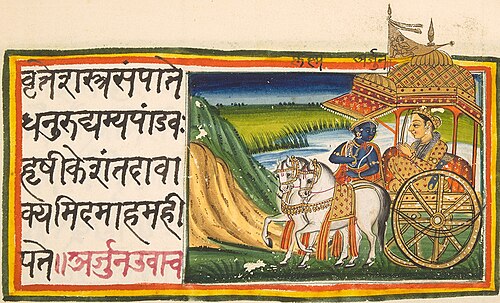
Imagine a great warrior named Arjuna standing in his chariot at the edge of a huge battlefield. Across the field he sees his cousins, his old teachers and his friends, all ready to fight against him. Suddenly he feels sick and sad. He drops his bow and says, "I cannot do this."
His chariot driver is Krishna, who in Hindu belief is God come to earth. Krishna begins to talk with Arjuna, and their conversation becomes a long poem called the Bhagavad Gita, which means "the Song of the Lord". It is part of a much bigger story, the Mahabharata.
Krishna tells Arjuna that every person has a true self, the soul, that can never be destroyed. He says we should do our duty as well as we can, but without worrying about winning or losing, or about rewards. He also teaches that loving God with your whole heart is a way to find peace.
For more than 2,000 years people in India and around the world have read, sung and memorised the Gita. Some read it as a holy book from God, others as a book of wisdom about how to live. Many people read it as being about the "battles" inside everyone, such as choosing to do the right thing when it is hard.
Famous people like Mahatma Gandhi, who led India's peaceful struggle for independence, carried the Gita with them and called it a guide for their lives.
At a glance
- What it is
- A Sanskrit religious and philosophical poem in dialogue form, part of the Bhishma Parva (sixth book) of the Mahabharata
- Length
- 18 chapters, 700 verses in the standard text (about 1,400 lines), mostly in the anuṣṭubh (śloka) metre
- Speakers
- Krishna and Arjuna, reported by Sanjaya to the blind king Dhritarashtra
- Setting
- The battlefield of Kurukshetra, on the eve of the great war of the Mahabharata
- Date
- Generally dated by scholars to the last centuries BCE (often the 2nd–1st century BCE); estimates range from about the 5th century BCE to the 1st–2nd century CE
- Author
- Traditionally attributed to the sage Vyasa; most scholars see it as the work of one or more anonymous composers
- Key themes
- Dharma (duty), karma yoga (selfless action), jñāna (knowledge), bhakti (devotion), the imperishable self
- First English translation
- Charles Wilkins, 1785
Easy
What is the Bhagavad Gita?
The Bhagavad Gita, often simply called the Gita, is a poem in Sanskrit, the classical language of ancient India. Its name means "the Song of the Lord" (bhagavat, "the Blessed One" or "the Lord", and gītā, "song"). It forms a small part of the Mahabharata, one of the two great epics of India and among the longest poems in the world.
The Gita is a conversation. On the morning of a terrible war, the warrior prince Arjuna loses heart, and his charioteer Krishna answers his questions about life, death, duty and God. In Hindu tradition Krishna is an avatar, a descent of the god Vishnu into the world, so his words are received by many Hindus as divine teaching.
Although it is only 700 verses long, the Gita has become one of the most important texts of Hinduism and one of the most translated books in the world. Hindus of many schools revere it, and philosophers, poets, political leaders and scientists far beyond India have read it closely. It is read both as scripture by believers and as a historical and philosophical text by scholars, and this page presents both perspectives.
Easy
The setting: a warrior's crisis
The Mahabharata tells of a quarrel between two branches of a royal family: the five Pandava brothers, among them Arjuna, and their cousins the hundred Kauravas, led by Duryodhana. After years of injustice, exile and failed peace talks, including a peace mission by Krishna himself, the two sides gather their armies on the plain of Kurukshetra, in the north of India.
The Gita begins with the blind king Dhritarashtra, father of the Kauravas, asking his counsellor Sanjaya what is happening on the "field of dharma". Sanjaya, granted the power to see the distant battlefield, reports everything, so the whole Gita is a story told within a story.
Arjuna asks Krishna to drive his chariot between the two armies. Seeing relatives, elders and teachers on both sides, he is overwhelmed by grief. He argues that killing his own family would be a sin and would destroy the social order, and he refuses to fight. The rest of the poem is Krishna's answer.
Easy
What Krishna teaches, in simple words
First, Krishna says that the true self (ātman) is eternal. Bodies are born and die, as people change old clothes for new ones, but the self is never born and never destroyed. So Arjuna's grief comes from confusing the self with the body.
Second, Krishna teaches that everyone must act; even doing nothing is a choice. The important thing is to do one's duty (dharma) without being attached to the results. One of the most quoted verses says, roughly: "You have a right to your actions, but never to their fruits." This way of acting is called karma yoga, the discipline of action.
Third, Krishna speaks of knowledge and of love. Seeing that the same divine reality lives in all beings brings wisdom and calm. And offering all one's actions to God with loving devotion (bhakti) frees a person from fear. Near the end, Krishna invites Arjuna to take refuge in him completely.
In the end Arjuna says his confusion is gone, picks up his bow, and prepares to do his duty. Readers have argued ever since about what this ending means.
Krishna also describes what a wise person is like. Such a person is not carried away by pleasure or crushed by pain, treats friends and enemies, praise and blame with the same calm, and does not act out of greed, fear or anger. This inner balance, which the Gita calls yoga, is presented as possible not only for monks in the forest but for people living ordinary lives with families and responsibilities.
Intermediate
Structure and highlights
The Gita has 18 chapters, each traditionally named as a kind of yoga, such as "the yoga of knowledge" or "the yoga of devotion". In the full Mahabharata they appear as chapters 25–42 (or 23–40 in some editions) of the Bhishma Parva. Each chapter ends with a colophon calling the text an Upanishad, linking it to the older philosophical texts of the Vedas.
Many commentators divide it into three groups of six chapters. The first six focus on action and self-discipline, the middle six on devotion and the nature of God, and the last six on knowledge, the difference between the body and the self, and the qualities of nature. This is a later interpretive scheme, not a division marked in the text itself.
Chapter 2 introduces the eternal self and the ideal of the sthitaprajña, the person of steady wisdom. Chapter 4 contains Krishna's promise to appear in the world whenever dharma declines. In chapter 11 Arjuna receives divine sight and beholds Krishna's universal form (viśvarūpa), blazing with countless faces and swallowing the warriors of both armies; here Krishna declares that he is Time, the destroyer of worlds. Chapter 18 draws the teachings together.
Most verses use the śloka, a metre of four quarters of eight syllables each, the same metre used for most of the epic. Its clarity and rhythm make the Gita suited to recitation, and many Hindus chant it daily or recite it at festivals and funerals.
Intermediate
Key ideas: dharma, action, knowledge and devotion
Dharma is a many-layered word meaning duty, right order and religion. Arjuna's svadharma, his own duty as a kṣatriya (warrior), is to fight a just war. The Gita states that it is better to do one's own duty imperfectly than another's duty well. How far svadharma refers to social class, and how far to a person's own nature, has become a major question of interpretation.
The Gita brings together several paths that were in tension in its time. The Vedic tradition emphasised ritual action; the renouncers, including Buddhist and Jain monks and Upanishadic ascetics, sought liberation by withdrawing from action. The Gita's answer is to transform action rather than abandon it: act without selfish desire, and action no longer binds.
It also absorbs ideas from Sāṅkhya philosophy, which distinguishes spirit (puruṣa) from matter (prakṛti) and describes three qualities or guṇas, sattva (clarity), rajas (passion) and tamas (inertia), that shape all things. And it uses the language of the Upanishads about brahman, the ultimate reality.
Above all these, many readers see devotion as the Gita's culmination. Krishna is not only a teacher but the supreme God, source of the universe, who loves his devotees. The relationship between the impersonal brahman and the personal God, and between knowledge, action and devotion, is exactly what later schools interpreted differently.
Intermediate
The Gita in Hindu tradition
Technically the Gita belongs to smṛti, "remembered" tradition, rather than śruti, the "heard" revelation of the Vedas. Yet it came to be treated almost as revelation. In the Vedanta tradition it forms one of the three foundational texts (prasthānatrayī), together with the Upanishads and the Brahma Sutras, on which every major school had to write a commentary.
For Vaishnava traditions, which worship Vishnu and his avatars, the Gita is central, and later texts such as the Puranas praise the merit of reading it. Its teaching of devotion influenced the bhakti movements that spread across India in the medieval period, expressed in regional languages as well as Sanskrit.
In everyday religious life, the Gita is recited in homes and temples, memorised by students, and studied in groups. Many Hindus celebrate Gita Jayanti, the day on which Krishna is believed to have spoken it. According to traditional chronology, the Kurukshetra war took place at the end of an earlier cosmic age, and the start of the present Kali age is traditionally dated to 3102 BCE; historians regard these dates as religious chronology rather than historical evidence.
The Gita's influence reaches far beyond its own verses. It inspired many later works that call themselves gītās, such as the Anu Gita within the Mahabharata itself and texts like the Ashtavakra Gita and Uddhava Gita, which present teachings in similar dialogue form. Scenes from the Gita, above all Krishna driving Arjuna's chariot, are among the most familiar images in Indian painting, sculpture, calendar art, theatre and film.
Intermediate
Classical commentaries: many readings of one text
The oldest surviving commentary is by Adi Shankara (traditionally c. 8th century CE), the great teacher of Advaita Vedanta. He read the Gita as teaching that the self is identical with brahman and that liberation comes ultimately through knowledge, with selfless action purifying the mind to prepare for it.
Ramanuja (11th–12th century), of the Sri Vaishnava tradition, disagreed. For his Viśiṣṭādvaita (qualified non-dualism), individual souls and the world are real parts of God, and loving devotion and surrender to Narayana, whom Krishna embodies, is the highest path. Madhva (13th century) went further toward dualism, insisting that God, souls and matter are eternally distinct.
Other important commentators include Abhinavagupta of the Kashmir Shaiva tradition, who commented on a slightly different recension, and Dnyaneshwar, whose Dnyaneshwari (c. 1290) in Marathi is one of the earliest works of Marathi literature and helped bring the Gita to people who did not know Sanskrit.
These commentaries show that the Gita did not fix a single doctrine. Each school found its own philosophy in the text, and debating the Gita became a way of debating the nature of reality, the self and God.
Intermediate
The Gita in the modern world
In 1785 Charles Wilkins, an employee of the East India Company, published the first English translation, with a preface by the Governor-General Warren Hastings. Translations into French, German and other languages soon followed, and in 1808 Friedrich Schlegel included passages in the first direct translation from Sanskrit into German. The American Transcendentalists Ralph Waldo Emerson and Henry David Thoreau were among its admirers.
In colonial India, the Gita became central to religious and national revival. Swami Vivekananda drew on it to present Hinduism as a universal spirituality. Bal Gangadhar Tilak wrote his influential commentary Gita Rahasya in prison in 1910–1911, stressing karma yoga as a call to action. Sri Aurobindo read it as a scripture of spiritual evolution. Some revolutionaries cited it to justify armed struggle against British rule.
Mahatma Gandhi called the Gita his "spiritual dictionary" and wrote a Gujarati commentary in prison in 1929. For him, its battlefield was an allegory of the struggle within the soul, and its teaching of selfless action supported non-violence. The Dalit leader B. R. Ambedkar, by contrast, criticised the Gita for defending the caste order and for justifying killing through the doctrine of the eternal soul.
The Gita's global reach continued in the twentieth century. J. Robert Oppenheimer, who read it in Sanskrit, later recalled Krishna's words from chapter 11 when describing the first atomic test in 1945. Philip Glass's opera Satyagraha (1979) sets texts from the Gita in Sanskrit, and A. C. Bhaktivedanta Swami Prabhupada's translation Bhagavad-gītā As It Is spread worldwide through the International Society for Krishna Consciousness.
Advanced
Dating, authorship and composition
Tradition attributes the Gita, like the whole Mahabharata, to the sage Vyasa. Historians generally regard Vyasa as a traditional or symbolic author, since the same figure is credited with compiling the Vedas and the Puranas, texts separated by many centuries.
Scholarly dates vary widely because the date of the Mahabharata itself is uncertain; the epic grew over many centuries, perhaps from around the 4th century BCE to the early centuries CE. The Gita is most often placed in the 2nd or 1st century BCE. A. L. Basham argued that its concern with the ethics of war and with renunciation fits a period after the rise of Buddhism and Jainism and the reign of Ashoka. Linguistic features that fall between Vedic and classical Sanskrit also point to the late first millennium BCE. Some scholars, such as K. N. Upadhyaya, argue for an earlier date in the 5th or 4th century BCE; others place a final redaction in the first centuries CE.
Many scholars see the text as composite. Basham suggested three or more authors or stages; others have identified an older core focused on Arjuna's duty, with later additions developing devotional theology and the vision of the universal form. Angelika Malinar, by contrast, has emphasised how closely the Gita's arguments connect to debates about war and kingship elsewhere in the epic, reading it as an integral part of the Mahabharata rather than a later insertion.
The text is remarkably stable at 700 verses in the vulgate, though some manuscripts and the Kashmir recension show variants, and one Mahabharata passage speaks of 745 verses. The standard critical text is that of the Critical Edition of the Mahabharata prepared at the Bhandarkar Oriental Research Institute in Pune.
Advanced
Interpretive debates: violence, caste, allegory and ethics
The most persistent debate concerns violence. Krishna urges Arjuna to fight in a war that will kill his kin, while many Indian traditions, including parts of the Mahabharata itself, praise ahiṃsā, non-injury. Some readers take the war literally and see the Gita as a justification of righteous war; Gandhi and many others read it allegorically as a teaching about inner struggle; still others, such as Ambedkar, see it as rationalising violence. Scholars also note that the Gita says little about the actual conduct of war, focusing instead on the inner attitude of the actor.
A second debate concerns caste. The Gita says that the four varṇas were created according to qualities and actions, and it urges each person to follow their own duty. Traditional readings linked this to birth; reformers such as Vivekananda and Aurobindo reinterpreted svadharma as duty according to one's nature or situation; critics argue that the text supported social hierarchy. The same verses thus support very different social visions.
Philosophers debate the Gita's ethical theory. Some describe karma yoga as a form of deontology, doing one's duty regardless of consequences; others stress that Krishna also points to consequences, such as social order. The Internet Encyclopedia of Philosophy article, for example, reads the Gita as criticising conventional moral theories and proposing its own procedural ethics centred on karma yoga and bhakti yoga.
Finally, historians of religion have asked how the Gita became so prominent. Some scholars argue that its status as the single essential scripture of Hinduism is partly a modern development, shaped by colonial-era translation, Orientalist scholarship and nationalist movements from the late nineteenth century, although it was already important in the commentarial and devotional traditions for many centuries. For believers, of course, its authority rests on its divine origin rather than on this history.
Key ideas
- Dharma
- Duty, right order and religion; in the Gita, especially the duty proper to one's own station and nature (svadharma).
- Karma yoga
- The discipline of acting without attachment to results, offering actions rather than seeking rewards.
- Jñāna yoga
- The path of knowledge: realising the eternal self and the one reality in all beings.
- Bhakti
- Loving devotion to God, presented as a path open to all people and, for many readers, the Gita's highest teaching.
- Ātman
- The true self, which the Gita describes as unborn, eternal and indestructible.
- The three guṇas
- Sattva, rajas and tamas, the qualities of nature that shape minds, actions and all things.
- Avatar
- The descent of God into the world; Krishna says he appears whenever dharma declines.
- Sthitaprajña
- The person of steady wisdom, calm in success and failure, pleasure and pain.
Records
- c. 400 BCE — The Mahabharata begins to take shape over several centuries (dates debated).
- c. 200 BCE — Most commonly proposed period for the composition of the Bhagavad Gita (2nd–1st century BCE).
- c. 800 CE — Adi Shankara writes the oldest surviving commentary, reading the Gita through Advaita Vedanta.
- c. 1100 — Ramanuja's commentary presents a devotional, qualified non-dualist reading.
- c. 1250 — Madhva writes a dualist commentary.
- c. 1290 — Dnyaneshwar composes the Dnyaneshwari, a Marathi commentary.
- 1785 — Charles Wilkins publishes the first English translation.
- 1808 — Friedrich Schlegel publishes German translations of passages from the Gita.
- 1910 — Bal Gangadhar Tilak begins writing Gita Rahasya in prison.
- 1929 — Mahatma Gandhi writes his Gujarati commentary on the Gita in Yerwada prison.
- 1945 — J. Robert Oppenheimer later recalls a verse of the Gita in connection with the first atomic test.
- 1979 — Philip Glass's opera Satyagraha sets Sanskrit texts from the Gita.
Glossary
- Sanskrit
- The classical language of ancient India, used for religious, philosophical and literary texts.
- Mahabharata
- A vast Sanskrit epic about the war between the Pandavas and the Kauravas, of which the Gita is a part.
- Kurukshetra
- The plain in northern India where the Mahabharata's great battle is set, called the "field of dharma" in the Gita's first verse.
- Avatar
- A descent of a deity, especially Vishnu, into the world in bodily form.
- Kṣatriya
- The warrior and ruling class in the traditional fourfold social order (varṇa).
- Varṇa
- The traditional ideal division of society into four classes: priests, warriors, merchants and labourers.
- Smṛti and śruti
- "Remembered" tradition and "heard" revelation, two categories of Hindu sacred texts.
- Vedanta
- A family of Hindu philosophical schools based on the Upanishads, the Brahma Sutras and the Gita.
- Moksha
- Liberation from the cycle of birth and death.
- Śloka
- The common epic verse form of two lines, each of sixteen syllables.
- Ahiṃsā
- Non-injury or non-violence, an important value in Indian religions.
Questions and answers
Is the Bhagavad Gita a separate book or part of the Mahabharata?
It is part of the Mahabharata, in the sixth book, but it has long been copied, printed and studied as a book on its own.
Does the Gita tell people to go to war?
In the story Krishna tells Arjuna to fight in a specific war that he describes as righteous. Many readers, including Gandhi, understand this as a lesson about facing inner struggles and doing one's duty, not as encouragement to violence.
Who wrote the Gita?
Tradition says the sage Vyasa composed it, recording Krishna's words. Historians think it was composed by one or more unknown poets, probably in the last centuries BCE.
Why are there so many different interpretations?
The Gita combines several philosophies and paths in a short, poetic text, so different schools, from Advaita to devotional traditions to modern activists, have emphasised different verses.
Is the Gita only for Hindus?
It is a sacred scripture for Hindus, and it has also been read by people of many faiths and none as a work of philosophy and literature.
What is the evidence for dating it to the 2nd–1st century BCE?
Its language falls between Vedic and classical Sanskrit, it responds to ideas associated with Buddhism, Jainism and the renunciant movements, and it is tied to the uncertain growth of the Mahabharata. None of these gives an exact date.
Did Oppenheimer really quote the Gita?
Yes. In a later television interview he recalled the line from chapter 11, often translated "Now I am become Death, the destroyer of worlds", when describing the first atomic explosion.
Sources and further reading
- Bhagavad Gita. Wikipedia
- Bhagavad Gītā. Internet Encyclopedia of Philosophy
- Mahabharata. Wikipedia
- Upanishads. Wikipedia
- Adi Shankara. Wikipedia
- 바가바드 기타. Wikipedia (Korean)
- Angelika Malinar, The Bhagavadgītā: Doctrines and Contexts. Cambridge University Press, 2007
Related
- MahabharataA vast Sanskrit epic centered on a conflict between related royal families, with the Bhagavad Gita among its parts.
- Early UpanishadsTexts that ask what the self (ātman) is and how it relates to ultimate reality (brahman) — a foundation of later Indian philosophy.
- RigvedaThe oldest collection of Vedic Sanskrit hymns, handed down orally for centuries before it was written down.
- RamayanaA Sanskrit epic about Rama, Sita and their exile, preserved in many versions across South and Southeast Asia.
- Adi ShankaraIndian philosopher associated with Advaita Vedanta, which teaches the ultimate unity of the self and brahman.
- Siddhartha Gautama (the Buddha)Founder of Buddhism, who taught a path to liberation from suffering on the Ganges plain. His dates are disputed.
Written with AI assistance from the published sources listed above, and revised as new research appears.