Start at the top for an easy introduction. Go further down for more detail and scholarship.
- Easy
- Intermediate
- Advanced
For young readers
Long ago, the Romans told a famous story about how their city began. A princess had twin baby boys, Romulus and Remus. Their father was said to be Mars, the god of war. A wicked king, who was afraid the boys would one day take his throne, ordered them to be thrown into the river Tiber.
But the basket with the babies floated to the shore. A mother wolf found them and fed them with her milk, like her own cubs. Then a kind shepherd and his wife took the boys home and raised them. When the twins grew up, they defeated the wicked king and decided to build a new city of their own.
The brothers could not agree where to build it. Each stood on a different hill and watched the sky for birds, which Romans believed carried messages from the gods. They argued about who had won, and the quarrel ended badly: Remus was killed. Romulus became the first king, and the city was named Roma after him.
Was that really how Rome began? Archaeologists, who dig carefully in the ground to learn about the past, have found something different. Around 3,000 years ago there were small villages of round huts on Rome’s hills. Over hundreds of years the villages joined together, drained a marshy valley, and built a market square. Slowly, they became one city.
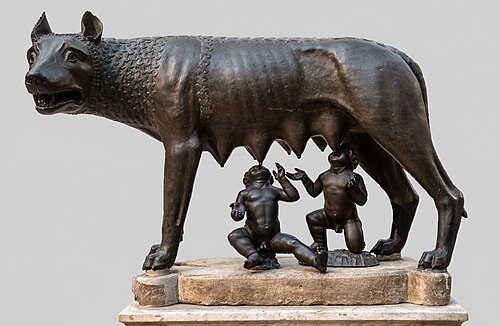
So the story of the twins is a legend, not a news report. But it mattered enormously to the Romans. It told them who they were: tough, brave, favoured by the gods, and sometimes violent. Even today people in Rome celebrate the city’s birthday every 21 April, and the picture of the wolf feeding the twins is a symbol of the city.
At a glance
- Traditional date
- 21 April 753 BCE (the date calculated by the Roman scholar Varro in the 1st century BCE; other ancient writers gave dates from 814 to 728 BCE)
- Place
- The Palatine Hill and neighbouring hills beside the Tiber River, in Latium, central Italy
- Legendary founder
- Romulus, twin of Remus, said to be a son of the god Mars and Rhea Silvia
- Peoples involved
- Latins, with Sabines nearby and Etruscans to the north; Greek colonies lay to the south
- What archaeology shows
- Villages from about the 10th–9th centuries BCE, growing gradually together; public spaces and walls appear in the 8th–7th centuries BCE
- Main written sources
- Livy, Dionysius of Halicarnassus and Plutarch, all writing more than 600 years after the traditional date
- Symbol
- The she-wolf nursing the twins (the Capitoline Wolf)
- Legacy
- Roman dating from “the founding of the city” (AUC) and the Natale di Roma, still celebrated on 21 April
Easy
What was the founding of Rome?
The “founding of Rome” refers to two different things. The first is the story that the Romans told about themselves: that the city was founded on a single day by a single man, Romulus, who ploughed a sacred boundary around the Palatine Hill and became Rome’s first king. The second is what historians and archaeologists can actually reconstruct: a long process in which several small communities on the hills beside the Tiber grew, merged and organised themselves into a city.
The traditional date, 21 April 753 BCE, was calculated centuries later by Roman antiquarians. It became the starting point of a Roman way of counting years, ab urbe condita (AUC), “from the founding of the city”. Modern historians do not treat 753 BCE as the date of a real event, but it is striking that archaeology places important changes on the Palatine in roughly the same period.
This page looks at both sides: the legend, which shaped Roman identity for more than a thousand years, and the evidence, which shows how a city really came into being in early Italy.
Easy
The legend: from Troy to the Palatine
The Roman story begins far away, at Troy. After the Greeks destroyed Troy, the Trojan hero Aeneas escaped with his father and son and, after long wanderings, reached Italy. His son founded the city of Alba Longa in the Alban Hills south-east of the future Rome, and a line of kings ruled there for generations.
One of these kings, Numitor, was driven from the throne by his younger brother Amulius. To make sure Numitor would have no heirs, Amulius forced Numitor’s daughter, Rhea Silvia, to become a Vestal Virgin, a priestess who had to remain unmarried. But Rhea Silvia gave birth to twins, Romulus and Remus, and said their father was the god Mars. Amulius ordered the babies to be drowned in the Tiber.
The servants left the twins at the edge of the flooded river. When the water went down, a she-wolf found them and nursed them in a cave at the foot of the Palatine Hill, later called the Lupercal. A woodpecker, a bird sacred to Mars, was said to have helped feed them. The shepherd Faustulus found the boys and raised them with his wife, Acca Larentia.
Grown up, the twins learned who they were, killed Amulius and gave the throne of Alba Longa back to their grandfather. Then they set out to found a new city where they had been saved. Romulus chose the Palatine, Remus the Aventine. To let the gods decide, each watched the sky for birds. Remus saw six vultures first; Romulus then saw twelve. Each side claimed victory. In the most famous version, Remus mockingly jumped over the new wall Romulus was building and was killed, by Romulus himself or by one of his followers. Romulus gave the city his name.
Easy
What Romulus was said to have done next
According to the legend, the new city had few people, so Romulus opened a place of refuge where anyone—runaways, exiles, the poor—could become a Roman. Because there were few women, he invited the neighbouring Sabines to a festival and the Roman men seized their daughters. This story, the “Rape (abduction) of the Sabine Women”, was told by Romans as a founding episode, but it is a story of kidnapping and forced marriage, and modern readers rightly see the women as victims of violence.
The legend continues that the Sabines went to war to get their daughters back. In the middle of the battle, the women themselves ran between the armies and begged their fathers and husbands to stop. Peace was made, and the Sabine king Titus Tatius ruled jointly with Romulus. Romans later used this story to explain why their city mixed several peoples.
Romulus was said to have organised the first Senate of one hundred elders, divided the people into groups, and created the first army. After a long reign he disappeared in a sudden storm; Romans said he had been taken up to the gods and worshipped him as the god Quirinus. Six more kings followed him, the last three of them linked with the Etruscans, until the monarchy was overthrown and the Republic began, traditionally in 509 BCE.
Intermediate
What archaeology shows: a city that grew
The site of Rome had clear advantages. It lay about 25 km from the sea, where an island made the Tiber easy to cross, and it had several steep hills—the Palatine, Capitoline, Esquiline, Quirinal and others—that were easy to defend. The crossing linked the Etruscan cities to the north with Latium and Campania to the south, and the route inland from the salt beds at the river mouth ran through the area.
Archaeologists place the earliest permanent settlements in the Latial Iron Age culture of the early first millennium BCE. Graves in the area later occupied by the Forum go back to around the 10th century BCE, and traces of huts on the Palatine date to the 9th and 8th centuries BCE. Post-holes cut into the rock show oval huts with wooden frames and thatched roofs—very close to the “Hut of Romulus” that later Romans carefully preserved on the Palatine as a relic.
During the 8th and 7th centuries BCE these communities began to act together. The marshy valley between the hills was drained and filled, and by around 600 BCE the Forum had been paved and was being used as a public space. Excavations led by the archaeologist Andrea Carandini on the lower slopes of the Palatine uncovered remains of a wall that he dated to about 730–720 BCE, which he interpreted as the sacred boundary (pomerium) of an early city. Many other scholars accept that the wall is early but reject the idea that it proves a single act of foundation.
Most historians therefore see Rome’s origin as synoecism: the gradual joining together of separate villages into one political community. By the 6th century BCE Rome was a substantial city with temples, public buildings and strong Etruscan cultural influence, fitting the tradition that its last kings were Etruscan.
Intermediate
Italy and the Mediterranean in the 8th century BCE
Rome did not begin in isolation. Central Italy in the 8th century BCE was a lively world of competing communities. To the north, the Etruscans were building powerful cities rich in metals. In Latium, dozens of Latin communities shared a language, festivals and sanctuaries. In the hills lived Sabines and other Italic peoples.
At the same time Greeks and Phoenicians were sailing west. The Greek settlement at Pithekoussai on the island of Ischia was founded in the first half of the 8th century BCE, followed by Cumae on the mainland; the Phoenicians founded Carthage in North Africa (by tradition in 814 BCE). Contact with these traders brought new goods, ideas and, eventually, the alphabet, which reached the Etruscans and Latins from Greek sources.
This context helps explain why the Roman legend links Rome to Troy. By the time the story took shape, Greek myths were known all over Italy, and connecting one’s city to the heroes of the Trojan War was a way of claiming a place in the wider Mediterranean world. The Romans eventually combined two founding stories—Aeneas from Troy and Romulus from Alba Longa—by inventing a line of Alban kings to fill the gap of several centuries between the fall of Troy and 753 BCE.
Intermediate
Why 753 BCE? How the Romans dated their origins
Ancient writers did not agree on when Rome was founded. The Greek historian Timaeus placed the foundation in 814 BCE, the same year he gave for Carthage. The Roman poet Ennius seems to have placed it much earlier. Quintus Fabius Pictor, the first Roman to write a history of Rome (in Greek, in the late 3rd century BCE), gave a date equivalent to 748/747 BCE; his contemporary Lucius Cincius Alimentus gave 729/728 BCE.
The date that became standard, 753 BCE, is linked with the great scholar Marcus Terentius Varro in the 1st century BCE. It was reached by adding up the traditional reigns of the seven kings and connecting them with the dates of the early Republic. According to Plutarch, Varro’s friend Lucius Tarutius even calculated a horoscope for Romulus to fix the day.
The day, 21 April, was the date of the Parilia, an old shepherds’ festival in honour of the deity Pales, in which people leapt over bonfires to purify themselves and their flocks. Linking Rome’s birthday to a festival of shepherds fitted the story of the twins raised among herdsmen. The Emperor Hadrian later dedicated a great temple to Venus and Roma, and 21 April continued to be celebrated as the city’s birthday.
Intermediate
What the story meant to the Romans
For the Romans the foundation story was not simply entertainment. It explained sacred places they could still visit: the Lupercal cave, the fig tree where the twins’ basket had come to rest, the Hut of Romulus on the Palatine. It was acted out in rituals such as the Lupercalia, a February festival in which young men ran around the Palatine.
The story also carried a moral and political message. Romulus stood for courage, piety toward the gods and the strength to build a state from nothing. His asylum explained why Rome was open to newcomers, and the Sabine story explained how enemies could become fellow citizens—themes Romans saw as the secret of their success.
But the story also had a dark side: Rome began with fratricide. Roman writers returned to this during the civil wars of the 1st century BCE. The poet Horace suggested that Romans were still paying for the blood of Remus. When Octavian took power, he considered the name “Romulus” as a title for himself before choosing “Augustus”; the founder was both a model and a warning.
Intermediate
The wolf and the twins through history
The image of the she-wolf nursing the twins became one of the most recognisable symbols in the world. In 296 BCE, according to Livy, the magistrates Gnaeus and Quintus Ogulnius set up a statue of the wolf and twins near the Ficus Ruminalis, the fig tree of the legend. The image appeared on Roman coins and later spread through the empire.
The most famous version, the bronze Capitoline Wolf in Rome, was long believed to be an Etruscan or early Roman work of the 5th century BCE. The figures of the twins were added in the Renaissance, probably in the late 15th century. Scientific studies in the 2000s suggested that the wolf itself may have been cast in the Middle Ages; its date is still debated.
In modern times, the founding story has been used for many purposes. The Fascist regime in Italy in the 1920s and 1930s celebrated the Natale di Roma (Birthday of Rome) on 21 April as a public holiday and presented itself as the heir of ancient Rome. After the war, the date continued to be marked in Rome with festivals and historical re-enactments. Copies of the Capitoline Wolf were given by Italy to cities around the world, and the wolf appears on the badge of the football club AS Roma.
Outside Italy the legend belongs to a broader world tradition of founding myths—stories of abandoned infants rescued by animals or shepherds appear in accounts of Sargon of Akkad, Cyrus of Persia and others. Comparing them helps us see how communities everywhere have used stories of origins to explain who they are.
Advanced
The sources and their problems
Our main accounts are late. Livy wrote the first book of his history of Rome (Ab urbe condita) around the 20s BCE; Dionysius of Halicarnassus, a Greek living in Rome, published his Roman Antiquities soon afterwards; Plutarch wrote his Life of Romulus around 100 CE. All of them depend on earlier historians—Fabius Pictor, Cincius Alimentus, Cato the Elder and others—whose works survive only in fragments, and none of whom wrote before about 200 BCE, more than five centuries after the traditional date.
The earliest Roman historians themselves had very limited documents. Rome’s early records were said to have been largely destroyed when the Gauls sacked the city around 390 BCE (387 BCE in some modern reckonings). What survived were priestly lists, family traditions of the aristocracy, place names, cult practices and oral stories. Some Greek writers had already told versions of Rome’s origins earlier, naming founders such as a Trojan woman called Rhome; the Romulus story may have been shaped in dialogue with such Greek accounts.
Livy himself was frank about the problem. In his preface he says that the traditions about the time before the city was founded are better suited to poetry than to reliable history, and that antiquity may be allowed to mix the human and the divine to make the beginnings of cities more venerable. Modern historians therefore read the legend as evidence for what later Romans believed and valued, not as a record of events.
Advanced
Debates: myth, memory and archaeology
How much history is hidden in the legend? At one end, a minority of scholars, most prominently Andrea Carandini, argue that the archaeological discoveries on the Palatine—especially the wall of about 730–720 BCE—confirm a real act of foundation in the 8th century, which later memory personalised as “Romulus”. At the other end, sceptical historians stress that the name Romulus looks like an invented eponym formed from Roma (“the Roman”), that the story is full of folk-tale motifs, and that archaeology shows gradual growth rather than a single moment.
Many historians take a middle position. Tim Cornell, for example, argues that the traditional narrative of the regal period preserves some genuine memory of institutions and broad developments—such as the importance of the Etruscan kings in the 6th century—even though the individual stories are not historical. Timothy Peter Wiseman, in his book Remus: A Roman Myth, analysed how the figure of Remus may have entered the story relatively late and been reshaped over time.
The meaning of the name Roma itself is uncertain. Proposals include a link with an old name of the Tiber (Rumon), with an Etruscan family name, or with a word for “teat” (ruma) connected with the fig tree Ficus Ruminalis. None is proven.
New finds regularly reopen the debate. In 2007 archaeologists announced the discovery of a decorated underground chamber beneath the Palatine that they suggested might be the Lupercal; other specialists argued it was more likely a later nymphaeum (a decorated fountain room). The case shows how strongly the legend still shapes the way discoveries in Rome are interpreted.
Advanced
Evidence and methods
Archaeology of early Rome is difficult because the ancient city lies beneath a modern one, and later Roman building levelled or covered earlier layers. Much of what is known comes from excavations in the Forum and on the Palatine since the late 19th century, from cemeteries such as those on the Esquiline, and from comparison with better-preserved Latin sites nearby. Dating relies on pottery sequences and, where possible, scientific methods; the absolute dates of Iron Age phases in Latium have been revised in recent decades, which affects how early settlements are dated.
Epigraphy adds a little. The Lapis Niger (“Black Stone”) in the Forum covers an inscription of the 6th century BCE, one of the oldest known Latin texts, which mentions a “rex” (king), supporting the tradition that Rome was once ruled by kings. Religious practices preserved into historical times, such as the Septimontium (a festival of the “seven hills”) and the Lupercalia, may also preserve traces of early community organisation.
The central methodological lesson is to keep two kinds of evidence separate before combining them. The legend tells us about Roman self-understanding from the 3rd century BCE onward; the material remains tell us about settlement, economy and society in the Iron Age. Where they appear to match, as with the Palatine huts and the date around 750 BCE, historians must ask whether this reflects genuine memory or later writers building their story around visible ancient remains.
Key ideas
- Foundation legend
- A story explaining a city’s origin through a heroic founder; Rome’s combined Aeneas from Troy with Romulus and Remus.
- Synoecism
- The joining of several villages into one political community; most historians think Rome formed this way.
- Ab urbe condita (AUC)
- “From the founding of the city”: a Roman way of counting years from 753 BCE, the date fixed by Varro.
- Pomerium
- The sacred boundary of the city, which Romulus was said to have ploughed; its line had religious and legal importance.
- Augury
- Reading the will of the gods from the flight of birds; the twins used it to decide where to found the city.
- Founding violence
- The fratricide of Remus and the abduction of the Sabine women show that Romans told their origins as both glorious and violent.
- Myth versus archaeology
- Written legend and material evidence answer different questions and must be interpreted separately before being compared.
Records
- c. 1000 BCE — Earliest Iron Age burials in the area of the later Roman Forum.
- c. 850 BCE — Hut villages develop on the Palatine and other hills beside the Tiber.
- 814 BCE — Date given by the Greek historian Timaeus for the foundation of both Rome and Carthage.
- 753 BCE — Traditional founding of Rome by Romulus on 21 April, according to Varro’s reckoning.
- c. 730 BCE — A wall is built at the foot of the Palatine, interpreted by some as the city’s earliest boundary.
- c. 600 BCE — The Forum valley is drained and paved as a public space; Rome is by now a unified city.
- 509 BCE — Traditional end of the monarchy and start of the Roman Republic.
- 296 BCE — According to Livy, the Ogulnii brothers set up a statue of the she-wolf and twins.
- c. 200 BCE — Quintus Fabius Pictor writes the first history of Rome, including the foundation story.
- c. 27 BCE — Livy writes Book 1 of his history, the most famous account of Romulus and Remus.
- 2007 — Archaeologists announce a chamber under the Palatine that they suggest may be the Lupercal; the identification is disputed.
Glossary
- Latium
- The region of central Italy around Rome, home of the Latin-speaking peoples.
- Palatine Hill
- One of Rome’s hills, traditionally the site of Romulus’ first city and later of imperial palaces.
- Vestal Virgin
- A priestess of the goddess Vesta, sworn to remain unmarried while in service.
- Lupercal
- The cave where, in legend, the she-wolf nursed the twins.
- Parilia
- An ancient shepherds’ festival on 21 April, which became Rome’s birthday.
- Sabines
- An Italic people living north-east of Rome, central to the legend of Rome’s early years.
- Etruscans
- A powerful people of central Italy north of Rome, whose culture strongly influenced early Rome.
- Eponym
- A person, real or imagined, after whom something is named; Romulus may be an invented eponym of Rome.
- Annalist
- A Roman historian who wrote year-by-year histories, such as Fabius Pictor.
- Capitoline Wolf
- A famous bronze statue of the she-wolf in Rome’s Capitoline Museums; its date is debated.
Questions and answers
Did Romulus and Remus really exist?
Almost certainly not as the story tells it. Most historians think they are legendary figures; the name Romulus may simply mean “the Roman”.
Was Rome really founded in 753 BCE?
The date was calculated centuries later. Rome grew gradually, but important changes on the Palatine did happen around the 8th century BCE.
Did a wolf really feed the twins?
No evidence supports it. Stories of abandoned babies raised by animals are found in many cultures; in Rome the wolf was also connected with Mars.
Why is Rome linked to Troy?
Connecting a city to the Trojan War heroes gave it prestige in a Mediterranean world that knew Greek myths; Virgil’s Aeneid made the link famous.
How do historians know anything about early Rome?
From archaeology (huts, graves, walls, the Forum), a few inscriptions such as the Lapis Niger, and later writers who drew on older traditions.
What was the abduction of the Sabine women?
In the legend, Roman men kidnapped Sabine women to marry them. Romans told it as a founding story, but it describes violence against women.
What is the scholarly debate about Carandini’s wall?
Carandini dated a Palatine wall to about 730–720 BCE and linked it to a real foundation; many scholars accept an early date but not that it proves a single founding act.
Sources and further reading
- Founding of Rome. Wikipedia
- Romulus and Remus. Wikipedia
- Livy, Livy, Ab urbe condita (Latin text and translation). Perseus Digital Library, Tufts University
- Livy. Wikipedia
- Quintus Fabius Pictor. Wikipedia
- Parilia. Wikipedia
- Capitoline Wolf. Wikipedia
- Latial culture. Wikipedia
- Lapis Niger. Wikipedia
- T. J. Cornell, The Beginnings of Rome: Italy and Rome from the Bronze Age to the Punic Wars (c. 1000–264 BC). Routledge, 1995
Related
- VirgilA Roman poet whose Aeneid became one of the most influential works of Latin literature.
- HomerThe poet tradition credits with the Iliad and the Odyssey, the founding epics of Greek literature. Whether one person composed both is debated.
- Assassination of Julius CaesarThe killing of Julius Caesar by a group of Roman senators on 15 March 44 BCE.
- Fall of the Western Roman EmpireThe removal of the western emperor Romulus Augustulus in 476 CE, often used as a marker for the end of the Western Roman Empire.
- PantheonA Roman temple rebuilt under Hadrian, celebrated for its vast concrete dome and central opening.
Written with AI assistance from the published sources listed above, and revised as new research appears.