Start at the top for an easy introduction. Go further down for more detail and scholarship.
- Easy
- Intermediate
- Advanced
For young readers
About 700 years ago, a huge kingdom called Mali stretched across West Africa, along the great Niger River and toward the Atlantic Ocean. Its king had the title mansa, which means something like “king of kings”. The most famous mansa was named Musa.
Mali was rich because it controlled land where people dug and washed gold out of the earth and rivers. Traders crossed the Sahara Desert with camels, bringing salt, cloth, books and horses, and they carried gold back north. Much of the gold in the coins of Europe and North Africa at that time came from West Africa.
Musa was a Muslim, and Muslims try to make a pilgrimage, called the hajj, to the holy city of Mecca once in their lives. In 1324 Musa set out with thousands of people and many camels carrying gold. The trip was thousands of kilometres long and took many months.
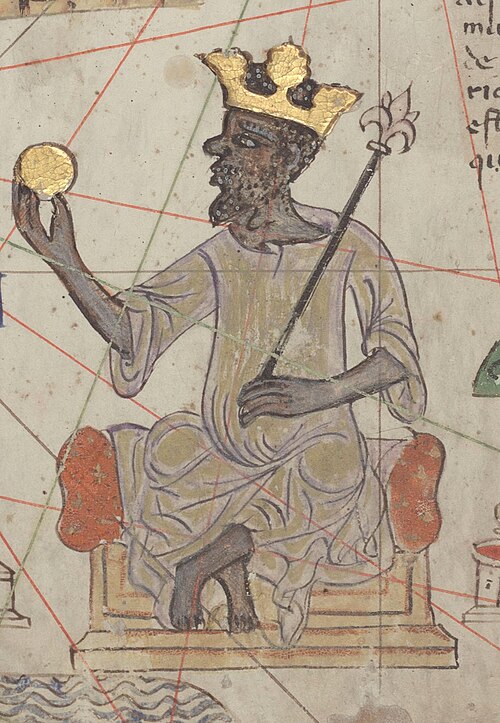
When he passed through Cairo in Egypt, he gave away and spent so much gold that people talked about it for years. Writers said the price of gold in Cairo went down because there was suddenly so much of it. A famous map made in Spain about fifty years later shows him sitting on a throne holding a large gold nugget.
Musa also cared about learning and faith. He brought scholars and a poet-architect back with him, and a great mud-brick mosque was built in the city of Timbuktu. Today people sometimes call him the richest person who ever lived, but historians say nobody can really measure his wealth.
At a glance
- Reign
- c. 1312–1337 (dates approximate; his death is placed in 1337 or, on one reading of Ibn Khaldun, c. 1332)
- Title
- Mansa (ruler, king) of Mali; remembered in tradition as Kankan (Kanku) Musa
- Realm
- Mali Empire, West Africa, centred on the upper and middle Niger; capital’s location uncertain
- Religion
- Sunni Islam (Maliki school), ruling over Muslim and non-Muslim subjects
- Hajj
- Pilgrimage to Mecca 1324–25, passing through Cairo in July 1324
- Building
- Associated with the Djinguereber Mosque in Timbuktu (traditionally 1327)
- Main sources
- Al-Umari, Ibn Khaldun, Ibn Battuta; the Timbuktu chronicles Tarikh al-Sudan and Tarikh al-Fattash; the Catalan Atlas
- Successor
- His son Maghan (Magha) I, later followed by Musa’s brother Sulayman
Easy
Who was Mansa Musa?
Mansa Musa was the ruler of the Mali Empire for about twenty-five years in the first half of the fourteenth century. Mansa is a Manding (Mandinka) title meaning ruler or king. Musa is the Arabic form of Moses, reflecting the Islamic faith of Mali’s ruling family. In West African tradition he is often called Kankan Musa or Kanku Musa, which has been interpreted as “Musa, son of Kanku”, possibly referring to his mother.
He is remembered above all for his pilgrimage to Mecca in 1324–25. Travelling through Egypt with a large retinue and great quantities of gold, he dazzled observers in Cairo and put Mali on the mental map of the Mediterranean world. Arab historians wrote about him in detail, and European mapmakers began to show a golden king of Mali in the heart of Africa.
Musa was also a builder and a patron of Islamic learning. During and after his reign, cities on the Niger bend such as Timbuktu and Gao became more closely tied to Mali and to the wider Muslim world, and Timbuktu began its long rise as a centre of scholarship.
At the same time, much about Musa is uncertain: the exact years of his reign, his precise family relationships, and many of the famous numbers about his wealth. Understanding him means both enjoying the stories and asking where they come from.
Easy
The Mali Empire: gold, salt and the Niger River
Mali grew out of small Manding kingdoms in the upper Niger region. According to oral tradition, preserved by griots (hereditary bards) in the Epic of Sundiata, the hero Sundiata Keita defeated the Sosso king Sumanguru around 1235, often associated with the Battle of Kirina, and founded the empire. Over the next century Mali expanded until it stretched from the Atlantic coast of Senegal and Gambia to the Niger bend and beyond, one of the largest states in the world at the time.
Mali’s wealth came from trade. The goldfields of Bambuk, Bure and other areas lay within or near its territory. Gold was exchanged northward across the Sahara for salt, which was mined at places such as Taghaza in the desert and was essential for life in the hot savanna, and for copper, cloth, horses, books and other goods. Caravans of camels linked West Africa with Morocco, Algeria, Tunisia and Egypt. West African gold supplied a large share of the gold used in the Mediterranean world, including in European coinage.
The Niger River was Mali’s highway. Boats carried grain, fish and trade goods between towns, and cities on the river’s great bend, where the savanna meets the desert, became meeting points for desert caravans and river traffic. Timbuktu, Djenné and Gao were among the most important.
Where Mali’s capital was is still debated. Earlier historians identified it with Niani in present-day Guinea, but archaeology has not confirmed this, and some scholars think the royal court may have moved or that Mali had no single permanent capital. The site shown on this map at Timbuktu marks a city closely linked to Musa, not his capital.
Easy
The famous pilgrimage of 1324–25
The hajj, the pilgrimage to Mecca, is one of the five pillars of Islam. Earlier rulers of Mali had already made the journey, but Musa’s pilgrimage was on an extraordinary scale. He crossed the Sahara with a great caravan and arrived in Egypt in the summer of 1324. According to the Arab accounts, he camped near the pyramids of Giza before entering Cairo in July.
In Cairo he met the Mamluk sultan al-Nasir Muhammad. The historian al-Umari, who gathered information from people who had met Musa, tells that Musa at first refused to kiss the ground before the sultan, but eventually agreed, saying that he prostrated himself to God alone. Musa gave rich gifts and spent lavishly, and his followers bought goods in the markets.
Later writers give large figures for his entourage and his gold: tens of thousands of people, hundreds of camels, and many loads of gold. These numbers were written down years after the event, sometimes copied from one another, and historians treat them as signs of how impressive the pilgrimage seemed rather than as exact statistics.
Al-Umari, writing some twelve to fifteen years later, reported that the amount of gold spent in Cairo lowered its value there: the gold mithqal, he said, had not recovered its former price in dirhams (silver coins) even in his day. He also reported that by the end of the journey Musa had run short of money and had to borrow from Cairo merchants. Musa returned to Mali in 1325, bringing with him scholars, books and the Andalusian poet Abu Ishaq al-Sahili.
Intermediate
Life and reign
Musa’s origins are known mainly from Ibn Khaldun’s genealogy of Mali’s kings, from al-Umari and from later oral tradition, and they disagree in details. He was not a son of the previous ruler. Some traditions make him a grandson of a brother of Sundiata; the historian François-Xavier Fauvelle has suggested instead that his claim ran through Sundiata’s daughter. Either way, Musa came to power from a collateral branch of the royal family.
According to al-Umari, Musa told the governor of Cairo that his predecessor had sent a fleet of ships into the Atlantic to discover whether the ocean had an end, then set out himself with an even larger fleet and never returned, leaving Musa in charge. This story is the only source for the so-called Atlantic voyage of “Abu Bakr II”. Modern historians debate whether it reflects a real expedition or a way of explaining an irregular succession, possibly even a coup.
Musa’s reign is conventionally dated from about 1312 to 1337. Ibn Khaldun gives a reign of twenty-five years; one reading of his chronology places Musa’s death around 1332, but other evidence, including an embassy from Mali to Morocco in the 1330s, has led Nehemia Levtzion and others to favour 1337. Musa was succeeded by his son Maghan, and after Maghan’s short reign by Musa’s brother Sulayman, whom Ibn Battuta met in 1352–53.
Under Musa, Mali reached one of its high points. Gao, the capital of the Songhay people on the Niger, came under Malian control; the Timbuktu chronicle Tarikh al-Sudan says Gao and Timbuktu submitted to Musa on his return from Mecca, though other sources credit his general Saghmanja with conquering Gao. Musa also maintained diplomatic ties with the Marinid sultanate of Morocco, exchanging embassies with Sultan Abu al-Hasan.
Intermediate
Islam, learning and architecture
Islam had reached West Africa through Saharan trade centuries earlier, first among merchants and rulers. In Mali the royal court was Muslim, but most people in the countryside continued to follow local religious traditions, and the mansa ruled over both. Royal ceremony combined Islamic elements, such as Friday prayer and the festivals, with older Manding practices involving griots and sacred kingship, a combination that Ibn Battuta later described with some disapproval.
Musa is remembered as a champion of Islam. He is said to have built mosques in the cities under his rule, brought back scholars and books of Maliki law, and sent students to study in Fez in Morocco. The poet and scholar Abu Ishaq al-Sahili, from Granada, returned with him and stayed in Mali until his death. Ibn Khaldun reports that al-Sahili built an elegant plastered, domed audience hall for the mansa and was rewarded with 12,000 mithqals of gold.
Tradition also credits al-Sahili with designing the Djinguereber (Great) Mosque of Timbuktu, dated to 1327. The mosque, built of earth, straw and wood, has been rebuilt many times, notably by the Timbuktu judge al-Aqib in the 1570s. Architectural historians such as Labelle Prussin have questioned the idea that a single Andalusian architect introduced the Sahelian earthen style, arguing that it developed over centuries from West African and Saharan traditions. The mosque is part of the Timbuktu World Heritage Site, inscribed in 1988.
Timbuktu’s greatest age as a city of scholars came later, in the fifteenth and sixteenth centuries, under Songhay rule, when the Sankore and Sidi Yahya mosques and many private libraries flourished. Musa’s era laid important foundations by drawing the city into the network of Islamic learning.
Intermediate
The golden king on the map
Musa’s pilgrimage made a lasting impression far from Mali. Egyptian and Syrian writers retold the story of the king who scattered gold in Cairo, and it continued to be repeated for centuries. For Mediterranean merchants the pilgrimage confirmed that the source of the gold they traded lay south of the Sahara.
The most famous image is in the Catalan Atlas, made on the island of Majorca around 1375 and attributed to the Jewish cartographer Abraham Cresques; it is now in the National Library of France in Paris. In the middle of the African part of the map sits a crowned black ruler on a throne, holding a sceptre and a large gold nugget or orb. The inscription calls him “Musse Melly”, lord of the black people, and says he is the richest and noblest ruler of his region because of the gold in his land.
The Atlas shows how knowledge of Mali had entered European geography, but also how partial it was: Mali appears as a source of gold rather than as a complex state with its own cities, scholars and politics. The idea of a fabulously wealthy African king influenced later European ambitions, including the Portuguese voyages down the Atlantic coast of Africa in the fifteenth century that sought direct access to West African gold.
Intermediate
Memory and legacy
Mali remained powerful for some decades after Musa. His brother Sulayman, who ruled until about 1360, kept the court splendid enough to impress Ibn Battuta. Later in the fourteenth and fifteenth centuries, however, succession disputes, pressure from Tuareg groups in the north and the rise of the Songhay state at Gao weakened Malian control of the Niger bend. The Songhay ruler Sunni Ali took Timbuktu in 1468, and Mali shrank to its south-western heartland, though a Malian state survived into the seventeenth century.
In Arabic historiography Musa became the model of a pious and generous African Muslim king. In the Timbuktu chronicles written in the seventeenth century, the Tarikh al-Sudan of al-Sa‘di and the Tarikh al-Fattash, he appears as a righteous ruler and builder of mosques, and his pilgrimage became a reference point in local history.
Interestingly, Musa plays a smaller role in Manding oral epics than Sundiata and other early figures. Some traditions even remember his journey critically, as a costly enterprise that took wealth out of the land. This difference between Arabic written sources, which were interested in his Islam and his gold, and West African oral traditions, which focus on the founding of the state and its lineages, is important for understanding how his reputation was formed.
In the modern era Musa has become a symbol of African wealth and achievement, featured in schoolbooks, museum exhibitions, popular history and online lists that call him the richest person in history. For many people of African descent, his story counters stereotypes that Africa had no great states or history before European colonialism. Historians welcome the attention while cautioning that wealth estimates in modern dollars are guesswork and that Mali’s importance lies as much in its institutions, trade networks and scholarship as in its gold.
Advanced
Sources and their problems
Almost everything written about Musa in his own time comes from outside Mali. The main account is by Ibn Fadl Allah al-Umari (1301–1349), a Damascus-born official of the Mamluk chancery who lived in Cairo. In his encyclopedia Masalik al-absar fi mamalik al-amsar (“Routes of the eyes through the kingdoms of the lands”), written in the late 1330s and 1340s, he recorded testimony from Cairene officials and merchants who had met Musa, including the emir Ibn Amir Hajib, who had been governor of the district where Musa stayed. His information is therefore second-hand but close in time.
Ibn Khaldun (1332–1406), in his universal history Kitab al-‘Ibar, provided a list of Mali’s kings and stories collected from informants, including Malian visitors and North African scholars. His chronology is the basis for most dates of Mali’s rulers, but it contains internal inconsistencies, which explains the debate over 1332 versus 1337. Ibn Battuta, who visited Mali in 1352–53 under Musa’s brother Sulayman, offers an eyewitness view of the court soon after Musa’s death, including anecdotes about Musa himself.
The two Timbuktu chronicles were written about three centuries after Musa’s reign and reflect the perspective of the city’s scholarly elite under Songhay and later Moroccan rule. The Tarikh al-Fattash, in particular, has a complicated textual history: parts of the version published in the early twentieth century were later shown to include nineteenth-century additions. Oral traditions preserved by griots are invaluable for Manding political culture but are difficult to date. The key Arabic texts are available in English translation in Levtzion and Hopkins’s Corpus of Early Arabic Sources for West African History.
Historians such as Hadrien Collet have analysed how the famous numbers about the pilgrimage were transmitted, showing that impressive figures often go back to a single chain of informants and grew in retelling. The claim that Musa was the richest person of all time, which spread widely online from the 2010s, converts medieval descriptions into modern currency in ways historians regard as methodologically unsound.
Advanced
Open questions
Chronology. Did Musa reign from 1312 to 1337, or did he die around 1332? The answer depends on how Ibn Khaldun’s reign lengths are combined and on the dating of Malian embassies to Morocco. Most historians follow Levtzion in preferring 1337, but the question remains open.
Succession and the Atlantic voyage. Was Musa’s predecessor an explorer who vanished at sea, or is the story a later justification of a disputed accession? Enthusiasts have claimed that Malian ships reached the Americas, but there is no archaeological or documentary evidence for this, and historians regard it as unsupported.
Economic impact. Did Musa’s spending really depress the price of gold in Cairo for years? Al-Umari’s statement is the key evidence, and it is plausible that a sudden influx of gold affected the local exchange rate between gold and silver. But the size and duration of the effect cannot be measured precisely, and some modern retellings exaggerate it into a regional economic crisis.
The nature of the empire. Recent archaeological and historical work questions older images of Mali as a centralised empire with a fixed capital. Some scholars describe it instead as a network of provinces and allied lords held together by the mansa’s court, trade and ritual prestige. How much control Musa actually exercised over distant regions such as Timbuktu or Gao is part of this larger debate.
Key ideas
- Mansa
- The Manding title of Mali’s ruler, combining political, military and sacred authority.
- Trans-Saharan trade
- Camel caravans linking West African gold with North African salt, goods and ideas, the basis of Mali’s wealth.
- Hajj as diplomacy
- Musa’s pilgrimage was both an act of faith and a display of power that announced Mali to the Islamic world.
- Patronage of learning
- Musa invited scholars, acquired books and sponsored mosques, strengthening Islamic scholarship in Mali’s cities.
- Outsider sources
- Most contemporary knowledge of Musa comes from Arab writers in Egypt and North Africa, with their own interests and limits.
- Myth of wealth
- Stories of Musa’s gold grew over centuries; modern claims about his fortune in dollars cannot be verified.
- Oral and written memory
- Arabic texts emphasise Musa’s piety and gold, while Manding oral tradition gives him a smaller place than Sundiata.
Records
- c. 1235 — Sundiata Keita defeats the Sosso and founds the Mali Empire, according to oral tradition.
- c. 1312 — Musa becomes mansa of Mali after his predecessor reportedly disappears on an Atlantic voyage.
- 1324 — Musa arrives in Cairo in July on his pilgrimage and meets the Mamluk sultan al-Nasir Muhammad.
- 1325 — Musa returns from Mecca with scholars and the poet Abu Ishaq al-Sahili; Gao and Timbuktu come under Malian control.
- c. 1327 — Traditional date for the building of the Djinguereber Mosque in Timbuktu.
- c. 1337 — Musa dies (some calculations give c. 1332); his son Maghan succeeds him. Al-Umari writes his account at about this time.
- 1352 — Ibn Battuta visits Mali (to 1353) during the reign of Musa’s brother Sulayman.
- c. 1375 — The Catalan Atlas depicts “Musse Melly” holding a gold nugget.
- c. 1655 — Al-Sa‘di completes the Tarikh al-Sudan, a Timbuktu chronicle that recalls Musa’s reign.
- 1988 — Timbuktu, including the Djinguereber Mosque, is inscribed on the UNESCO World Heritage List.
Glossary
- Mansa
- Title of the ruler of Mali, meaning king or ruler.
- Hajj
- The pilgrimage to Mecca, required once in a lifetime of Muslims who are able to make it.
- Griot
- A hereditary West African bard, musician and keeper of oral history.
- Mithqal
- A unit of weight (about 4.25 g) used for gold, and a gold coin of that weight.
- Dirham
- A silver coin used in the Islamic world.
- Mamluk Sultanate
- The state ruling Egypt and Syria from 1250 to 1517, whose capital was Cairo.
- Maliki school
- One of the four Sunni schools of Islamic law, dominant in North and West Africa.
- Sahel
- The belt of semi-arid land between the Sahara and the savanna to the south.
- Tarikh
- Arabic for history or chronicle, as in the Tarikh al-Sudan.
Questions and answers
Was Mansa Musa really the richest person ever?
Nobody knows. He ruled a land rich in gold and spent enormous amounts on his pilgrimage, but there is no way to compare medieval royal wealth accurately with modern fortunes.
Why did he go to Mecca?
The hajj is a religious duty for Muslims who are able to make it. For Musa it was also a way to show Mali’s power and piety and to build ties with the Muslim world.
Did his gold really lower prices in Cairo?
The Mamluk writer al-Umari said the value of gold in Cairo fell and had not recovered years later. Historians find this plausible for the local market, but the scale is uncertain.
Was Timbuktu his capital?
No. Timbuktu was an important trading and scholarly city under Mali’s control, but the capital’s location is debated and was probably further south-west.
Did ships from Mali reach America before Columbus?
Musa’s story of his predecessor’s Atlantic fleet is recorded by al-Umari, but there is no evidence that any such ships reached the Americas.
What are the main sources for his reign, and how reliable are they?
Al-Umari and Ibn Khaldun wrote within decades, using informants; Ibn Battuta visited Mali later; the Timbuktu chronicles date from the seventeenth century. All are valuable but partial, and their numbers are often rhetorical.
Why is 1337 more often given than 1332 for his death?
Ibn Khaldun’s reign lengths can be read to give c. 1332, but evidence of Malian diplomatic activity later in the 1330s has led many historians, following Levtzion, to prefer 1337.
Sources and further reading
- Mansa Musa. Wikipedia
- Mali Empire. Wikipedia
- Djinguereber Mosque. Wikipedia
- Timbuktu. Wikipedia
- Timbuktu. UNESCO World Heritage Centre
- Catalan Atlas. Wikipedia
- Tarikh al-Sudan. Wikipedia
- N. Levtzion and J. F. P. Hopkins (eds. and trans.), Corpus of Early Arabic Sources for West African History. Cambridge University Press, 1981
- Nehemia Levtzion, Ancient Ghana and Mali. Methuen, 1973
Related
- Ibn BattutaMoroccan traveler whose account describes journeys across Africa, Asia and parts of Europe.
- Great ZimbabweRemains of a major southern African city built and occupied by ancestors of the Shona people.
- Ibn KhaldunNorth African historian and thinker whose Muqaddimah examines how societies and states change.
- House of WisdomName associated with Abbasid scholarly collections and translation activity in Baghdad.
- One Thousand and One NightsA collection of tales that developed over centuries from several storytelling traditions.
Written with AI assistance from the published sources listed above, and revised as new research appears.