Start at the top for an easy introduction. Go further down for more detail and scholarship.
- Easy
- Intermediate
- Advanced
For young readers
About 750 years ago, in the middle of what is now Thailand, there was a city called Sukhothai. Its name means “the dawn of happiness”. The city had strong walls, deep moats full of water and gates in the middle of each side, like a castle in a storybook.
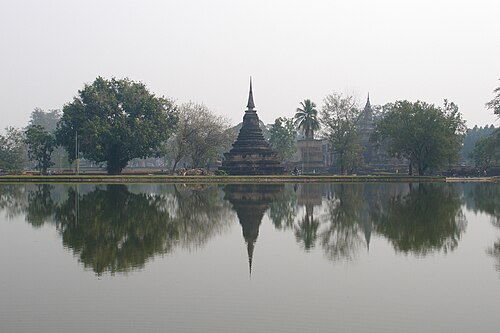
Inside the walls, the people built many Buddhist temples out of brick and covered them with plaster. The biggest temple, Wat Mahathat, stood right in the middle of the city. Its main tower has a top shaped like a lotus flower bud that has not opened yet. Around its base, rows of small monks made of plaster walk in a line with their hands together.
The artists of Sukhothai made Buddha statues that look calm and gentle, with soft round faces and a little smile. They also made something very unusual: a Buddha who is walking, with one foot lifted and one arm swinging gently, as if he were moving toward you.
Sukhothai is remembered for one of its kings, Ram Khamhaeng. A famous old stone with writing on it says that in his time “there are fish in the water and rice in the fields”, and that anyone with a problem could ring a bell at the palace gate so the king would come and listen. Some scholars argue about how old that stone really is, and that argument is part of the history too.
Later, the kingdom became part of another Thai kingdom, Ayutthaya, and the old city was left empty. Today its ruins stand among ponds and trees in a big park that anyone can visit by bicycle, and it is a UNESCO World Heritage Site.
At a glance
- Period
- Town founded earlier; capital of the Sukhothai kingdom from the events of 1238 (the traditional date) until its absorption by Ayutthaya, completed around 1438
- Place
- About 12 km west of the modern town of Sukhothai Thani, Sukhothai Province, lower northern Thailand
- City plan
- Walled rectangle about 2 km east–west by 1.6 km north–south, with a gate in each side and triple ramparts and moats
- Monuments
- Royal palace remains, 26 temples inside the walls and many more outside; the park counts 193 ruins over about 70 km²
- Key sites
- Wat Mahathat, Wat Si Chum, Wat Si Sawai, Wat Phra Phai Luang, Wat Sa Si, Wat Saphan Hin, Thuriang kilns
- Art
- The “Sukhothai style”: lotus-bud stupas, stucco decoration and idealized Buddha images, including the walking Buddha
- Protection
- Restoration by Thailand’s Fine Arts Department from 1961; historical park opened 1988
- World Heritage
- Part of “Historic Town of Sukhothai and Associated Historic Towns” with Si Satchanalai and Kamphaeng Phet, inscribed 1991
Easy
What is Sukhothai Historical Park?
Sukhothai Historical Park preserves the ruins of the old city of Sukhothai in the lower north of Thailand. In the thirteenth and fourteenth centuries Sukhothai was the capital of a kingdom of the same name, one of several Tai-speaking states that rose in mainland Southeast Asia at that time. The name, from Sanskrit and Pali words, is usually translated as “dawn of happiness”.
The park lies about 12 km west of the modern provincial town. Its core is the walled city, a rectangle about 2 km from east to west and 1.6 km from north to south, with a gate in the middle of each wall. Inside are the remains of the royal palace and about two dozen temples; many more monasteries stand outside the walls, on the plain and in the hills to the west. Altogether the park counts 193 ruins over about 70 square kilometres.
The park is managed by Thailand’s Fine Arts Department, which began restoring the site in 1961 and opened it as a historical park in 1988. In 1991 UNESCO inscribed it on the World Heritage List as part of the serial property “Historic Town of Sukhothai and Associated Historic Towns”, together with Si Satchanalai, about 50 km to the north, and Kamphaeng Phet to the south-west.
UNESCO describes the three towns as the setting of the first period of Siamese art and architecture, language and literature, religion and law. The Sukhothai ruins are especially admired for the Buddhist monuments and sculpture that art historians call the “Sukhothai style”.
Easy
How to “read” the city: walls, water and a relic at the centre
Sukhothai was laid out as an ordered image of the world. The city is roughly square, surrounded by three earthen ramparts with moats between them, and its most important temple, Wat Mahathat, stands near the centre beside the remains of the royal palace. A great relic stupa at the heart of a walled city, with a reservoir outside, is a plan that the historians Chris Baker and Pasuk Phongpaichit compare with Angkor-influenced towns of the region.
Water was the key to life in the city. Sukhothai did not sit on a flood plain beside a big river but in drier country, and its people had to store rain. An earthen dam in the hills to the south-west, known today as the Saritphong dam or Thamnop Phra Ruang, held back water that was carried by canals toward the city, where it filled ponds and reservoirs such as Traphang Thong and Traphang Ngoen. Many temples stand on islands in these ponds, so that the reflections of the towers are part of the scene.
The main roads ran from the four gates to the centre. Outside the walls, monasteries were placed in all directions, and on the forested hills to the west stood the monasteries of the “forest monks”, reached by paths of slate. The palace hill inside the city, known as Noen Prasat, is where the future King Mongkut found the famous stone inscription and a stone throne in 1833.
Walking or cycling through the park today, visitors move from the busy centre of royal and state ritual, through temples on islands, to quiet hill monasteries. This gives a good sense of how religious, political and economic life were bound together in the old city.
Easy
Monuments to know
Wat Mahathat (“monastery of the great relic”) was the main temple of the city and the kingdom. Its principal stupa, which enshrines relics of the Buddha, has the lotus-bud shape typical of Sukhothai. Around its base, 168 stucco figures of the Buddha’s disciples walk in procession with their hands joined in respect. Eight smaller stupas surround the main one, and two tall standing Buddhas called Phra Attharot rise beside it. The complex also contained assembly halls, an ordination hall and some 200 smaller stupas.
Wat Si Chum, north-west of the walls, is dominated by a massive square building (mandapa) whose walls, about 3 feet thick, enclose a huge seated Buddha about 11 metres wide and 15 metres high, known as Phra Achana. A narrow staircase inside the wall once led up to the roof; along it more than 50 engraved slate slabs showing stories of the Buddha’s previous lives (jataka) were found, the oldest surviving examples of Thai drawing.
Wat Si Sawai and Wat Phra Phai Luang are older than the kingdom. Both have towers (prang) in the Khmer style, built of laterite in the late twelfth or early thirteenth century, when the town lay within the cultural sphere of Angkor and Lavo (Lopburi). Wat Si Sawai was first a Hindu shrine and was later adapted for Buddhist worship. Wat Phra Phai Luang was once the ritual centre of the town, and its stucco decoration helps scholars trace the transition from Khmer to Thai art.
Among many others, Wat Sa Si stands on an island in a lake with a bell-shaped stupa in the Sri Lankan style; Wat Chang Lom and Wat Chang Rop have stupas ringed by sculpted elephants; and Wat Saphan Hin, on a hill to the west, has a 12.5-metre standing Buddha with a raised hand, looking out over the plain.
Intermediate
The Sukhothai style: lotus buds, stucco and the walking Buddha
Art historians use the term “Sukhothai style” for the architecture and sculpture produced in the kingdom from the late thirteenth to the fifteenth century. It drew on several sources: Khmer forms received through Lavo, Mon and northern Tai (Lan Na) traditions, and, increasingly, Sri Lankan models brought by Theravada monks. Out of these, Sukhothai created a distinct idiom that later Thai art regarded as classical.
The most recognizable architectural form is the lotus-bud stupa, a tall tower whose top swells into the shape of an unopened lotus. Temples were built mainly of brick and laterite, then coated with lime plaster (stucco) that was modelled into figures and ornament. Much of the fine stucco has disappeared, but the processions of disciples at Wat Mahathat and the reliefs of deities and animals at Wat Chedi Si Hong show its quality.
Sukhothai Buddha images, in bronze and stucco, are admired for their idealized, almost weightless bodies: oval faces with arched brows and a gentle smile, a flame-like finial on the head, smooth limbs and a robe that clings to the body. UNESCO links these features to the traditional “marks of a great being” (mahapurisalakkhana) by which Buddhist texts describe the Buddha’s superhuman body.
The best-known Sukhothai creation is the walking Buddha, shown in movement with one heel raised and one arm swinging. At Wat Chetuphon, south of the city, four great stucco images show the Buddha in the four postures of walking, sitting, standing and reclining. The walking pose, rare in earlier Buddhist art, became one of the emblems of Thai sculpture.
Intermediate
The kingdom of Sukhothai: rise, height and absorption
Sukhothai was a trading town on routes between Mon, Tai and Khmer-influenced centres long before it became a royal capital. An inscription at Wat Si Chum records that around 1238 two local lords, Pho Khun Bang Klang Hao and Pho Khun Pha Mueang, took the town from a ruler bearing a Khmer title; Bang Klang Hao became king as Si Inthrathit and founded the dynasty often called Phra Ruang. This event is traditionally taken as the founding of the kingdom.
Si Inthrathit’s son Ram Khamhaeng, who reigned in the late thirteenth century, is remembered as the kingdom’s greatest ruler. According to the inscription attributed to him, he extended Sukhothai’s influence over many towns, promoted Theravada Buddhism with monks from Nakhon Si Thammarat in the south, and devised a new form of Tai writing in 1283. He also opened relations with Yuan China. Modern historians read the list of places in his inscription as a network of alliances and tribute rather than a territory under direct rule.
After Ram Khamhaeng’s death, tributary towns broke away. His grandson Li Thai (Maha Thammaracha I), who reigned from about 1347, is known above all as a patron of Buddhism: he is credited with the cosmological treatise Trai Phum Phra Ruang (“Three Worlds”), invited a Sri Lankan-trained monk to head a forest monastery, and took monastic ordination himself in 1361. Under him and his successors the political centre shifted toward Phitsanulok.
The rising kingdom of Ayutthaya to the south made Sukhothai a subordinate state in the later fourteenth century; the chronicles record the submission of King Thammaracha II in 1378. After the death of the Sukhothai ruler Borommapan in 1438, Ayutthaya installed its own crown prince in the region, ending Sukhothai’s separate existence. How this process should be described, as conquest or as gradual incorporation through marriage and alliance, is debated.
Intermediate
Religion: Theravada monks, forest monasteries and Brahmin rites
Sukhothai’s rulers presented themselves as righteous Buddhist kings (dhammaraja). Theravada Buddhism, especially the Sri Lankan lineage known in Thai as Lankawong, was promoted through invited monks, the building of monasteries and royal ordinations. Inscriptions tell of a Lankan-trained monk re-ordaining thousands of monks, and of the prince Si Sattha, a grandson of Pha Mueang, who renounced his weapons, became a monk, travelled widely and restored sacred sites.
The monastic community was divided into two groups. “Village” or city monks (kamavasi) lived in monasteries in and near the town and concentrated on study of the scriptures. “Forest” monks (araññavasi) lived in quieter monasteries in the wooded hills west of the city, such as Wat Chang Rop and Wat Saphan Hin, and concentrated on meditation. The layout of the park still reflects this division.
Buddhism did not exclude older rituals. The Hindu shrine at Wat Si Sawai was later adapted for Buddhist use, and Li Thai built a shrine for Brahmin priests at Wat Pa Mamuang and had large bronze statues of Shiva and Vishnu cast, now in the National Museum in Bangkok. Brahmin court ceremonies continued alongside Buddhist devotion, as they still do in the Thai monarchy.
The Trai Phum Phra Ruang attributed to Li Thai described the Buddhist universe of heavens, hells and the human world, and the place of karma and merit within it. Written in Thai, it is often called the first Buddhist philosophical work in the Thai language and shaped Thai ideas of the cosmos for centuries.
Intermediate
Water, trade and the kilns of Sukhothai
UNESCO emphasizes that the Sukhothai towns were home to accomplished hydraulic engineers who dammed water, built reservoirs, ponds and canals, and controlled floods. Earthworks and moats slowed the monsoon runoff from the western hills, while dams and canals carried stored water into the city. Scholars disagree about how productive the surrounding farmland was, and therefore about how much of the kingdom’s wealth came from agriculture and how much from trade in forest products.
The inscription attributed to Ram Khamhaeng famously says that the ruler levied no tolls and that people traded freely in cattle, horses, elephants, silver and gold. Historians have used this passage, together with the locations of towns named in inscriptions, to reconstruct overland trade routes running east to the Mekong, north to Luang Prabang, west to the Mon ports of Martaban and Pegu, and south to the Gulf of Thailand.
Sukhothai was also a centre of ceramic production. At the Thuriang kilns beside the moat of Wat Phra Phai Luang, dozens of brick kilns have been recorded; radiocarbon dates place their activity from the mid-fourteenth century into the fifteenth and later. Their stoneware bowls and jars, often painted in black with a fish, a flower or a whirling circle, are known as Sukhothai ware. Much larger kiln fields at Si Satchanalai, with nearly two hundred recorded kilns, produced the celadons and other wares exported under the names “Sawankhalok” or sangkhalok.
These ceramics travelled widely: they have been found in shipwrecks in the Gulf of Thailand and at sites in Java, Sumatra, the Philippines, Sri Lanka and the Ryukyu Islands. The ceramic industry shows that the Sukhothai region was connected to Asian maritime trade, and the dating of the kilns is still being refined by excavation.
Intermediate
After the kingdom: abandonment, rediscovery and the park
Sukhothai continued to be inhabited under Ayutthaya but declined, especially during the wars with Burma. In 1583 people from the region were moved south, and after further wars in the 1760s the old town was largely deserted. In 1793 King Rama I founded a new Sukhothai 12 km to the east, the ancestor of the modern provincial town.
Early Bangkok kings took Buddha images from the ruined northern temples to the new capital. The most famous is the great bronze Buddha Phra Si Sakyamuni, originally the principal image of Wat Mahathat at Sukhothai and now in Wat Suthat in Bangkok. UNESCO notes that Rama I removed more than two thousand Buddha statues from Sukhothai for their protection.
In 1833 Prince Mongkut, then a monk and later King Rama IV, visited Sukhothai and found the stone inscription later called Sukhothai Inscription No. 1, together with the Manangkhasila stone throne, and took them to Bangkok. In 1907 Crown Prince Vajiravudh, later King Rama VI, made a study tour of the old towns of the north and published an account that encouraged historical and archaeological interest in Sukhothai.
Systematic restoration by the Fine Arts Department began in 1961, and the area was placed under legal protection in 1962. The historical park was officially opened in July 1988, and the World Heritage inscription followed on 12 December 1991. Today the Ramkhamhaeng National Museum, opened in 1964 inside the park, displays sculpture, ceramics and other finds from Sukhothai and its neighbours.
Advanced
The Ram Khamhaeng Inscription and the forgery debate
Sukhothai Inscription No. 1 is a four-sided siltstone pillar about 1.15 metres high, found by Mongkut in 1833 and dated by its text to 1292. It contains a first-person account of Ram Khamhaeng’s youth, a description of the prosperous kingdom and its just king, and a claim that Ram Khamhaeng devised “these Tai letters” in 1283. Its script writes all vowels on the line, unlike later Thai. Deciphered in stages by Thai scholars and by George Cœdès, whose authoritative edition appeared in 1924, it became the foundation of the modern image of Sukhothai. UNESCO added it to the Memory of the World Register in 2003.
In 1987 the historian Michael Vickery presented a paper comparing the inscription to the Piltdown hoax, drawing together doubts about its script, vocabulary and content. The art historian Piriya Krairiksh went further, arguing that Mongkut himself had produced it. The claims implied that much of Thai history would need rewriting, and they provoked years of intense debate, special publications and seminars; public reaction was sometimes hostile.
A 1990 study using scanning electron microscopy found that the weathering of the stele was consistent with that of other Sukhothai inscriptions of similar age. Most specialists now regard the inscription as at least partly authentic, but some proponents of the forgery theory remain unconvinced, and scholars continue to debate whether parts of the text, especially the passages on the script and the idealized society, were added or composed later, for example under Li Thai to glorify his grandfather.
The controversy produced a much richer body of scholarship. Recent readings treat the inscription less as a transparent description and more as a composed text: one scholar has compared its image of the king with Pali scriptural models of the righteous universal ruler; others read its list of towns as personal allegiances, and its account of free trade as evidence that commerce rather than rice was the kingdom’s main source of revenue.
Advanced
“The first Thai capital”? Sukhothai in national history
In the early twentieth century Sukhothai was placed at the beginning of a single line of Thai capitals: Sukhothai, then Ayutthaya, Thonburi and Bangkok. The idea was set out by Crown Prince Vajiravudh after his 1907 tour and developed by Prince Damrong Rajanubhab in the 1910s, and it became the standard account in school textbooks. Sukhothai was presented as a golden age of Thai freedom and paternal kingship, sometimes contrasted with a supposedly Khmer-influenced Ayutthaya.
The story of 1238 was long told as a Tai liberation from Khmer rule. More recent scholarship questions both the ethnic framing and the idea of Khmer administration: there is little evidence of Angkorian administrative control this far west, and both sides in the conflict appear to have been local lords with links to Angkor. Baker and Pasuk, for example, read the event as a victory of one Angkor-connected lord over another, not as a national uprising.
The political uses of Sukhothai have changed over time. The image of a father-like king close to his people was cited as a seed of Thai democracy after 1932, as a model of freedom from foreign ideology during the Cold War, and by radical writers as the beginning of liberation from Angkor. Archaeologists such as Srisakra Vallibhotama instead place Sukhothai as one polity among several early states in the region, and the Fine Arts Department’s more recent publications have moved away from calling it the first Thai kingdom.
Festivals show a similar process. The Loy Krathong festival is often said to have begun at Sukhothai with a court lady named Nang Nopphamat, but historians have shown that her story comes from a poem of the early Bangkok period; Baker and Pasuk call it a literary fiction. Like the inscription debate, such findings do not reduce Sukhothai’s importance but show how the site has been used to tell stories about the nation.
Advanced
Conservation and authenticity
UNESCO’s assessment stresses that Sukhothai’s integrity lies both in the many standing structures of each town and in the landscape engineering, the reservoirs, canals and roads, that linked the three towns. It also notes that integrity is challenged by the ongoing excavation programme, and that objects were removed in the past, including the Buddha images taken by Rama I and the inscription and throne taken by Mongkut.
Most of the monuments were Buddhist monasteries, and many were maintained and repaired over centuries with traditional materials. Since the 1960s the Fine Arts Department has controlled all conservation work, and the park’s boundaries coincide with the protected zones: no development other than for protection, conservation and interpretation is allowed, and there is no through traffic.
Restoring brick and stucco monuments raises difficult questions. Consolidating collapsed walls, rebuilding stupa spires and repairing Buddha images can make a site legible and safe, but can also impose modern interpretations; some statues in the park have been extensively reconstructed. Researchers studying stucco heads that left the site before restoration began in 1961 have used them to date the original sculpture, a reminder of how much was lost or altered.
New scientific work continues to change the picture. Radiocarbon and thermoluminescence dates from kiln sites, surveys of ancient iron-smelting furnaces in the hills north-west of the city, and geological studies of the stones used for boundary markers show that Sukhothai’s economy and technology were more complex, and its chronology longer, than the older textbook story suggested.
Key ideas
- Sukhothai style
- The distinctive art and architecture of the kingdom: lotus-bud stupas, stucco ornament and idealized Buddha images, regarded as a classical Thai style.
- Walking Buddha
- A Buddha shown in motion, with one heel raised; a signature creation of Sukhothai sculpture.
- Dhammaraja
- The ideal of the righteous Buddhist king who rules by the Dhamma, central to Sukhothai royal imagery.
- Hydraulic city
- Dams, canals, moats and reservoirs stored and managed water in a region without a great river.
- Mandala polity
- Power understood as networks of allegiance around a centre rather than fixed borders; modern readings of Sukhothai’s ‘empire’.
- Contested inscription
- Inscription No. 1 shaped Thai history but has been debated as partly or wholly later; the debate itself enriched scholarship.
- Heritage and nation
- Sukhothai was made the ‘first Thai capital’ in the 20th century; historians now examine how that story was built.
Records
- 1191 — An Angkorian inscription records Buddha images sent to 23 cities; one type appears to have been enshrined at Wat Phra Phai Luang.
- 1238 — Traditional date of the founding of the Sukhothai kingdom under Si Inthrathit (some historians date it a few years later).
- 1283 — Date given in Inscription No. 1 for Ram Khamhaeng’s creation of a new Tai script.
- 1292 — Date of Sukhothai Inscription No. 1, attributed to Ram Khamhaeng.
- 1347 — Li Thai (Maha Thammaracha I) becomes king of Sukhothai; patron of Buddhism and author of the Trai Phum Phra Ruang.
- 1361 — Li Thai is ordained as a monk, the first Siamese king known to do so.
- 1378 — King Thammaracha II submits to the expanding kingdom of Ayutthaya.
- 1438 — After the death of Borommapan, Ayutthaya installs its crown prince in the region; Sukhothai’s separate existence ends.
- 1793 — Rama I founds New Sukhothai 12 km east; the old city is abandoned.
- 1833 — Prince Mongkut finds Inscription No. 1 and a stone throne on the palace mound.
- 1961 — The Fine Arts Department begins restoring the ancient city.
- 1988 — Sukhothai Historical Park is officially opened.
- 1991 — Inscribed on the UNESCO World Heritage List with Si Satchanalai and Kamphaeng Phet.
- 2003 — The Ram Khamhaeng Inscription is added to UNESCO’s Memory of the World Register.
Glossary
- Wat
- A Buddhist monastery or temple compound in Thailand.
- Stupa (chedi)
- A monument, often containing relics, that represents the Buddha and his teaching.
- Prang
- A tall, corn-cob-shaped tower derived from Khmer temple architecture.
- Mandapa (mondop)
- A square building sheltering a sacred image, like the one enclosing the great Buddha at Wat Si Chum.
- Stucco
- Lime plaster modelled into figures and ornament over brick.
- Laterite
- A reddish, iron-rich stone that hardens when exposed to air, used in early Sukhothai towers.
- Theravada
- The ‘Way of the Elders’, the form of Buddhism dominant in Sri Lanka and mainland Southeast Asia.
- Jataka
- Stories of the Buddha’s previous lives, illustrated on slate slabs at Wat Si Chum.
- Celadon
- Stoneware with a grey-green glaze; Sukhothai-region celadons were exported widely.
- Phra Attharot
- A type of tall standing Buddha image, said to be eighteen cubits high, found at several Sukhothai temples.
Questions and answers
What does “Sukhothai” mean?
It is usually translated as “dawn of happiness”, from words of Sanskrit and Pali origin.
Was Sukhothai the first Thai kingdom?
It was long taught that way, but historians now see it as one of several early Tai states. Other Tai polities, such as those in the northern highlands, existed before or at the same time.
What is special about the walking Buddha?
Most earlier Buddha images sit, stand or lie. Sukhothai sculptors made the Buddha walk, with a lifted heel and swinging arm, which gives a feeling of gentle movement.
Why was the city abandoned?
After Sukhothai became part of Ayutthaya, the political centre moved away. Wars with Burma and the relocation of people emptied the city, and in 1793 a new town was founded to the east.
Is the Ram Khamhaeng Inscription a fake?
Some scholars argued in the late 1980s that it was made much later, even by King Mongkut. Scientific tests and further study have convinced most experts that it is at least partly genuine, but the debate is not fully settled.
Why is Sukhothai listed together with two other towns?
Si Satchanalai and Kamphaeng Phet shared Sukhothai’s language, script, laws, art and water systems and were linked by a highway, so UNESCO treats the three as one historic property.
Did Loy Krathong begin in Sukhothai?
Popular stories say so, but historians have shown that the legend of the court lady Nopphamat was written in the early Bangkok period, and there is no firm evidence that the festival began in Sukhothai.
Sources and further reading
- Historic Town of Sukhothai and Associated Historic Towns. UNESCO World Heritage Centre
- Sukhothai Historical Park. Wikipedia
- Sukhothai Kingdom. Wikipedia
- Ram Khamhaeng Inscription. Wikipedia
- Maha Thammaracha I (Li Thai). Wikipedia
- Si Satchanalai. Wikipedia
- Loy Krathong. Wikipedia
- Chris Baker, Pasuk Phongpaichit, A History of Ayutthaya: Siam in the Early Modern World. Cambridge University Press, 2017
Related
- Angkor WatMonumental temple complex built in the Khmer Empire under King Suryavarman II.
- BorobudurLarge Buddhist monument in Central Java, built around the eighth and ninth centuries.
- PrambananNinth-century Hindu temple complex dedicated to Shiva, Vishnu and Brahma, the largest of ancient Java, famous for its 47-metre central tower and Ramayana reliefs.
- HunminjeongeumThe Korean alphabet promulgated by King Sejong in 1446, and the title of the text explaining it.
- Siddhartha Gautama (the Buddha)Founder of Buddhism, who taught a path to liberation from suffering on the Ganges plain. His dates are disputed.
Written with AI assistance from the published sources listed above, and revised as new research appears.