Start at the top for an easy introduction. Go further down for more detail and scholarship.
- Easy
- Intermediate
- Advanced
For young readers
The Quran is the holy book of Muslims. Its name means “the recitation”, or “something read aloud”. Muslims believe that God sent its words to the Prophet Muhammad, little by little, over about 23 years, through the angel Gabriel.
The Quran is written in Arabic and is divided into 114 chapters called suras. The first one, al-Fatiha (“the Opening”), is short, and Muslims say it in every prayer, many times a day. After that, the chapters are arranged roughly from the longest to the shortest.
The Quran is meant to be heard as well as read. When it is recited well, it sounds almost like music, though it is not sung with instruments. Millions of children and adults around the world learn the whole book by heart. A person who has memorised all of it is called a hafiz, meaning “guardian” or “keeper”.
The Quran talks about God, who is one and merciful; about how the world was made; about prophets such as Abraham, Moses, Mary’s son Jesus, and Joseph; about how to treat parents, orphans and poor people; and about the Day of Judgment.
Because Muslims believe the Arabic words come from God, they treat copies of the Quran with great care. Translations into other languages, such as Korean or English, are very helpful, but Muslims usually see them as explanations of the meaning rather than the Quran itself.
At a glance
- Language
- Classical Arabic
- Revelation
- According to Islamic belief, revealed to Muhammad in Mecca and Medina from c. 610 to 632 CE
- Structure
- 114 suras (chapters) of very unequal length; about 6,236 verses (āyāt) in the most widely used counting; also divided into 30 equal parts (juzʾ) for recitation
- Standard text
- The consonantal text is traditionally traced to the codex made under the caliph Uthman (r. 644–656), c. 650
- Oldest manuscripts
- Leaves in Hijazi script radiocarbon-dated to the 7th century, e.g. the Birmingham leaves (parchment 568–645 CE) and the Sanaa palimpsest
- Readings
- Several canonical readings (qirāʾāt); today Hafs ʿan ʿAsim is most common, Warsh ʿan Nafiʿ prevails in North and West Africa
- Widely used printed edition
- The Cairo edition of 1924 (Hafs reading)
- Status
- For Muslims, the uncreated or eternal word of God (theologians debated this), the first source of Islamic belief and law
Easy
What is the Quran?
The Quran (also written Qur’an or Koran) is the scripture of Islam. Muslims believe it is the literal word of God, conveyed by the angel Gabriel to the Prophet Muhammad over roughly 23 years, from about 610 until his death in 632. Muhammad recited what he received, and his followers memorised it and wrote it down. Muslims regard it as the final revelation in a series that includes the Torah given to Moses, the Psalms given to David and the Gospel given to Jesus.
The word qurʾān comes from the Arabic root q-r-ʾ, “to read aloud” or “recite”, and the book calls itself by this name. It also calls itself al-kitāb, “the Book”, al-dhikr, “the Reminder”, and al-furqān, “the Criterion” that separates right from wrong.
The Quran is not arranged like a history book or a biography. It speaks directly, often in the voice of God addressing Muhammad or humanity, and moves between praise of God, warnings, stories of earlier prophets, laws and prayers. Readers therefore often rely on commentaries and on accounts of Muhammad’s life to understand the setting of particular passages.
This page explains the Quran as Muslims understand it and also describes what historians and textual scholars have learned about how it was written down and transmitted. These are different kinds of question, and both are presented here with respect.
Easy
A book to be heard: recitation and memorisation
Above all, the Quran is recited. Muslims recite passages in each of the five daily prayers, and the whole text is often recited over the month of Ramadan. Recitation follows a set of rules called tajwīd, which govern pronunciation, lengthening of vowels, pauses and nasal sounds. Great reciters are admired across the Muslim world, and recordings and broadcasts of recitation are part of daily life from Morocco to Indonesia.
Memorising the Quran is an old and living tradition. Children in Quran schools learn by repetition with a teacher, and many complete the whole text. Someone who has memorised it all is honoured with the title ḥāfiẓ. Muslim tradition emphasises that this oral chain, from teacher to student, has always accompanied the written text and helped to preserve it.
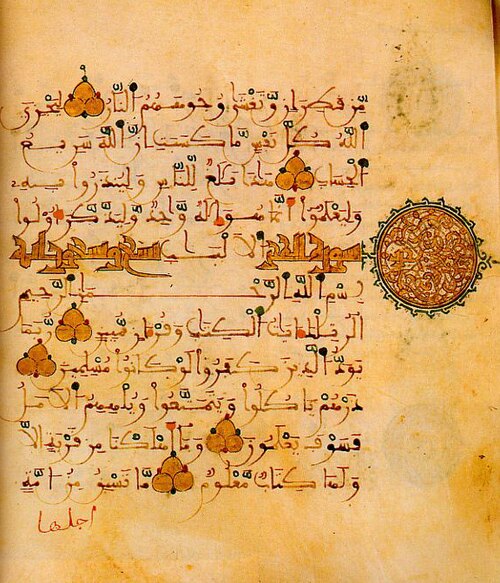
Written copies are treated with reverence. Many Muslims perform ritual washing before touching the Arabic text, keep it in a high, clean place, and never place other objects on top of it. The art of copying it gave rise to Islamic calligraphy and illumination, some of the finest achievements of Islamic art.
Easy
How the Quran is organised
The Quran has 114 suras (chapters). Each has a traditional name, often taken from a striking word in it, such as al-Baqara (“the Cow”), Maryam (“Mary”) or al-Nahl (“the Bee”). Every sura except the ninth begins with the formula called the basmala: “In the name of God, the Merciful, the Compassionate.” Twenty-nine suras open with mysterious separate letters, such as alif lām mīm, whose meaning has been debated since early times.
The suras are made up of verses called āyāt (singular āya), a word that also means “signs”, as in the signs of God in nature. The most widely used count gives 6,236 verses, not counting the basmala; other traditional counting systems differ slightly because they divide some verses differently, not because the text differs.
The order of the suras is not chronological. After the short opening prayer, al-Fatiha, the suras are arranged roughly from longest to shortest. The second sura, al-Baqara, is the longest, with 286 verses; many of the shortest suras, which come at the end, are among the earliest in date and are the ones children usually learn first. For recitation, the text is also divided into thirty parts (juzʾ) and sixty smaller units.
Traditionally each sura is labelled Meccan or Medinan, according to whether it is believed to have been revealed before or after Muhammad’s emigration to Medina in 622. About two-thirds are Meccan. Some suras are thought to combine passages from different times.
Intermediate
What the Quran teaches: main themes
The central theme is God: one, without partner, creator and sustainer of all things, merciful and just. The short sura al-Ikhlas (112) sums it up: “Say: He is God, One; God, the Eternal Refuge. He did not beget, nor was He begotten, and there is none comparable to Him.” The Quran invites reflection on the natural world, the alternation of night and day, rain and the growth of plants, as signs pointing to the Creator.
Many passages speak of the Last Day, resurrection, judgment and the reward of paradise or punishment of hell, often with vivid imagery. The ethical message links belief with action: prayer, almsgiving, honesty in trade, keeping promises, kindness to parents, and justice for orphans, widows, the poor and travellers.
The Quran retells and comments on stories of prophets known also from the Bible and other traditions: Adam, Noah, Abraham, Joseph, Moses, David, Solomon, Jonah, Zechariah, John, Mary and Jesus, as well as Arabian prophets such as Hud and Salih. Sura 12 tells the story of Joseph at length; sura 19 is named after Mary, who is mentioned by name more often in the Quran than in the New Testament. The Quran presents these prophets as bringing the same essential message, and it addresses Jews and Christians as “People of the Book”, sometimes in praise, sometimes in criticism, for instance of the doctrine of the Trinity.
The Medinan suras contain most of the legal material: rules on prayer, fasting, pilgrimage, marriage, divorce, inheritance, contracts, food, and the conduct of war. Although these verses are a relatively small share of the whole, they became foundations of Islamic law (sharīʿa) as developed by later jurists together with the hadith.
Intermediate
Language and literary style
The Quran is not poetry in the formal sense of Arabic metre, but much of it is written in rhymed, rhythmic prose (similar to what Arabs called sajʿ). Early Meccan suras are short, with brief, intense verses, oaths (“By the dawn! By the ten nights!”), and powerful images of the end of the world. Later Meccan suras tell longer stories, and Medinan suras have longer verses with legal and communal detail.
The text often shifts speaker and addressee: God may speak as “We”, “I” or “He” within a few verses; Muhammad is told “Say: …”; believers, unbelievers or all humanity are addressed in turn. Stories are frequently told allusively, as if the audience already knew them, focusing on their moral meaning rather than narrative detail.
Muslims hold that the Quran is inimitable (iʿjāz): its language surpasses anything a human could produce. The Quran itself challenges doubters to produce a sura like it. Classical scholars such as al-Baqillani and Abd al-Qahir al-Jurjani wrote treatises on this inimitability, which in turn laid foundations of Arabic rhetoric and literary theory. The Quran also standardised Classical Arabic, fixing a model of the language for grammar, law and literature across the Islamic world.
Intermediate
From revelation to book: the traditional account
According to Muslim tradition, during Muhammad’s lifetime the revelations were memorised by many companions and written by scribes, such as Zayd ibn Thabit, on whatever materials were available: parchment, palm-leaf stalks, flat stones and shoulder blades of camels. Tradition also holds that Gabriel reviewed the revealed text with Muhammad every Ramadan, and that the order of verses within suras was fixed by the Prophet’s instruction.
After Muhammad’s death, many memorisers were killed in the Battle of al-Yamama (c. 633). Fearing that parts of the Quran could be lost, Umar urged the caliph Abu Bakr to have the text collected. Zayd ibn Thabit gathered it from written pieces and from “the hearts of men” onto sheets (ṣuḥuf), which passed to Umar and then to his daughter Hafsa, one of Muhammad’s widows.
Under the third caliph, Uthman (r. 644–656), reports of disagreements over recitation among soldiers from different provinces led to a second project. A committee headed by Zayd produced a standard codex based on Hafsa’s sheets, in the dialect of Quraysh; copies were sent to the main cities, and other copies were ordered destroyed. Some companions had kept personal codices that differed in the order of suras and in some readings; the codex of Ibn Mas’ud reportedly lacked the first and last two suras, and that of Ubayy ibn Ka’b reportedly had two additional short prayers. The Uthmanic text became the basis for all later copies.
Sunni and Shia Muslims accept the same text of the Quran. Although some early Shia reports questioned whether the codex was complete, the mainstream position of Shia scholarship, like that of Sunni scholarship, is that the Quran in use is the complete revelation.
Intermediate
Script, readings and printed editions
Early Arabic script wrote only the consonantal outline (rasm) of words, often without dots to distinguish letters of the same shape and without vowel signs. This outline could be read in more than one way, and the living oral tradition determined the recitation. Over the following two centuries, dots and vowel marks were added: early systems used coloured dots, traditionally credited to Abu al-Aswad al-Du’ali (d. 688); the system of vowel signs still used today is credited to al-Khalil ibn Ahmad (d. 786).
Variant ways of reciting the text, all within or close to the Uthmanic outline, were transmitted by famous readers in the main cities. In the 10th century the Baghdad scholar Ibn Mujahid (d. 936) defined seven readings as canonical; later, Ibn al-Jazari (d. 1429) established ten. Each reading is known through two principal transmitters. The differences concern mostly vowels, dots and pronunciation, and occasionally words; Muslim scholars relate them to a hadith saying the Quran was revealed in “seven aḥruf” (modes), a phrase interpreted in many ways.
Printing came late. An Arabic Quran was printed in Venice in the 1530s, and European orientalists produced several editions, but Muslim societies long preferred handwritten copies. The Cairo edition published in 1924 under the patronage of King Fuad I, following the reading of Hafs from Asim, became the global standard for print, and the King Fahd Complex in Medina has distributed many millions of copies since the 1980s. Editions in the reading of Warsh are standard in much of North and West Africa.
Intermediate
Interpreting the Quran: tafsir
Commentary on the Quran, tafsīr, is one of the great scholarly traditions of Islam. It began with explanations attributed to Muhammad and his companions, especially his cousin Ibn Abbas. Al-Tabari (d. 923) compiled a monumental commentary gathering earlier opinions with their chains of transmission. Later classics include those of al-Zamakhshari, Fakhr al-Din al-Razi, al-Qurtubi and Ibn Kathir, and the concise Tafsir al-Jalalayn used widely in teaching.
Commentators use tools such as the “occasions of revelation” (asbāb al-nuzūl), reports about the situations in which verses were revealed, and the doctrine of abrogation (naskh), according to which some later rulings replaced earlier ones. They also draw on grammar, rhetoric, law and theology. Shia commentaries give weight to the teachings of the Imams; Sufi commentators seek inner, mystical meanings beneath the literal sense.
Modern interpreters have addressed new questions: Muhammad Abduh and Rashid Rida stressed reason and reform; Sayyid Qutb wrote a highly influential commentary about building a society based on the Quran; others have developed readings focused on social justice, gender or the environment. Interpretation has always been plural, and debates over how to read the text remain lively within Muslim communities.
Intermediate
Translation and the Quran in the world
Because the Arabic wording itself is regarded as revelation, Muslims have long held that a translation is not the Quran but an interpretation of its meaning; ritual prayer is performed in Arabic by Muslims of every language. Still, interlinear and full translations into Persian and other languages appeared early, and today there are translations into almost every major language, many by Muslim scholars.
The first Latin translation, Lex Mahumet pseudoprophete, was made in 1143 by Robert of Ketton for Peter the Venerable, abbot of Cluny, with polemical aims. George Sale’s English translation of 1734 was widely read in the Enlightenment. Modern English versions include those of Marmaduke Pickthall (1930), Abdullah Yusuf Ali (1934–1937) and M. A. S. Abdel Haleem (2004). Korean translations began in the late 20th century.
Beyond its religious role, the Quran has shaped the languages, literatures, law and visual arts of societies from West Africa to Southeast Asia. Arabic words and phrases from it are part of everyday speech for Muslims worldwide, such as in shā’ Allāh (“if God wills”) and bismillāh (“in the name of God”).
Advanced
The manuscript evidence
The earliest Quran manuscripts are written in a slanting script called Hijazi, on parchment, usually in vertical format, with few diacritical dots and no vowel signs. Many survive only as scattered leaves now held in different libraries. The Codex Parisino-petropolitanus, divided between Paris, St Petersburg, the Vatican and elsewhere, is one of the best-studied examples.
In 2015 the University of Birmingham announced that radiocarbon analysis at Oxford had dated the parchment of two leaves in its Mingana collection (Mingana 1572a), containing passages from suras 18–20, to between 568 and 645 CE with 95.4 per cent probability. The leaves turned out to belong with folios of the Paris codex. The result drew wide attention, but scholars caution that radiocarbon dates the death of the animal whose skin was used, not the writing, and that some features of the leaves, such as decorated sura dividers and verse markers, are debated.
The Sanaa manuscript, found in 1972 in a sealed space in the Great Mosque of Sanaa in Yemen among thousands of fragments, is a palimpsest: its upper text follows the Uthmanic standard, but an erased lower text, recovered with ultraviolet and digital imaging, differs from it in wording and in the order of suras. One leaf has been radiocarbon-dated to 578–669 CE. Behnam Sadeghi and Mohsen Goudarzi (2012) argued that the lower text belongs to a non-Uthmanic textual tradition of the companions’ era; Asma Hilali and Éléonore Cellard have studied it from other angles, including as a possible teaching or practice text. Its variants are mostly small, yet it is the clearest material witness to textual diversity before or alongside Uthmanic standardisation.
Large research projects now catalogue and compare early manuscripts. The Corpus Coranicum project of the Berlin-Brandenburg Academy of Sciences and Humanities (2007–2024) built databases of manuscripts (Manuscripta Coranica), variant readings, and Late Antique texts relevant to the Quran, and commissioned radiocarbon analyses of dozens of manuscripts.
Advanced
Historical-critical scholarship and its debates
Academic study of the Quran in Europe took modern form in the 19th century. Gustav Weil and above all Theodor Nöldeke, in Geschichte des Qorāns (1860; revised and expanded by Friedrich Schwally, Gotthelf Bergsträsser and Otto Pretzl in the early 20th century), proposed a chronology dividing the suras into early, middle and late Meccan and Medinan periods based on style and content. This scheme, which partly builds on the Muslim Meccan/Medinan classification, remains a common reference point, though scholars disagree over its details and over whether whole suras can be dated as units.
In the 1970s John Wansbrough, in Quranic Studies (1977), argued that the Quran was assembled over a long period in a sectarian milieu, perhaps as late as around 800, and that the traditional compilation stories were later creations. Patricia Crone and Michael Cook similarly questioned the traditional chronology. Such late-dating theories are now widely considered to be ruled out by the manuscript evidence, and Crone herself later accepted that most of the Quran goes back in some form to Muhammad. More speculative proposals, such as a pseudonymous scholar’s attempt to read many passages through Syriac, have been largely rejected by specialists.
Current debates are more focused. Some scholars accept an early fixation of the consonantal text under Uthman, as the tradition says; others suggest that standardisation may have been completed or enforced under the Umayyad caliph Abd al-Malik and his governor al-Hajjaj around the 690s–700s, when the script was also being reformed. Scholars such as Angelika Neuwirth read the Quran as a Late Antique text in dialogue with Jewish, Christian and Arabian traditions, attending to its oral and liturgical character and to the unfolding of its community. Others study its relationship to biblical and post-biblical literature, its rhetoric, and its place in the history of the Arabic language.
Many Muslim scholars engage critically with these methods, some rejecting assumptions they see as alien to the Quran’s nature as revelation, others adapting them. Believers and historians thus approach the text with different premises, but they share an interest in its early history, and the discovery and dating of manuscripts in recent decades has brought their questions into closer conversation.
Key ideas
- Word of God (kalām Allāh)
- Muslims believe the Quran is God’s speech, revealed in Arabic; medieval theologians debated whether it is created or eternal, and the eternal view became dominant in Sunni theology.
- Tawhid
- The absolute oneness of God, the Quran’s central teaching, from which its critique of idolatry follows.
- Prophets and scriptures
- The Quran presents a line of prophets sent to different peoples with one message, and itself as the confirmation and completion of earlier scriptures.
- Signs (āyāt)
- The same word means both the verses of the Quran and the signs of God in nature and history, inviting reflection on both.
- Guidance and law
- The Quran calls itself guidance (hudā); its legal verses, interpreted with the hadith, form the basis of Islamic law.
- Inimitability (iʿjāz)
- The belief that the Quran’s language and content cannot be matched by human effort, a doctrine that also nourished Arabic literary theory.
- Orality and text
- The Quran has always lived both as recitation passed from teacher to student and as written codex, with each supporting the other.
Records
- c. 610 CE — According to Islamic tradition, the first revelation comes to Muhammad in the cave of Hira.
- 622 CE — The Hijra to Medina; tradition divides the Quran into Meccan and Medinan suras at this point.
- 632 CE — Death of Muhammad; the revelation ends.
- c. 633 CE — After the Battle of al-Yamama, Abu Bakr has Zayd ibn Thabit collect the text on sheets (suhuf).
- c. 650 CE — The caliph Uthman issues a standard codex and sends copies to the main cities.
- c. 691 CE — Quranic passages appear in the mosaic inscriptions of the Dome of the Rock in Jerusalem (691–692).
- 923 CE — Death of al-Tabari, author of a monumental commentary (tafsir).
- 936 CE — Death of Ibn Mujahid, who defined the seven canonical readings.
- 1143 — Robert of Ketton completes the first Latin translation.
- 1924 — The Cairo edition (Hafs reading) is published and becomes the global standard for print.
- 1972 — The Sanaa manuscripts, including the palimpsest, are discovered in the Great Mosque of Sanaa.
- 2015 — Radiocarbon dating of the Birmingham leaves to 568–645 CE is announced.
Glossary
- Sura
- A chapter of the Quran; there are 114.
- Aya
- A verse of the Quran; the word also means “sign”.
- Basmala
- The formula “In the name of God, the Merciful, the Compassionate”, which opens every sura except the ninth.
- Juz’
- One of thirty roughly equal parts into which the Quran is divided for recitation, for example over the nights of Ramadan.
- Hafiz
- A person who has memorised the entire Quran.
- Tajwid
- The rules for correct and beautiful recitation of the Quran.
- Mushaf
- A written or printed copy of the Quran as a physical book.
- Rasm
- The consonantal outline of the written text, without dots or vowel marks.
- Qira’at
- The canonical readings, or ways of reciting the text, each transmitted from a famous early reader.
- Tafsir
- Commentary and interpretation of the Quran.
- Palimpsest
- A manuscript whose original writing was erased and written over, like the Sanaa manuscript.
Questions and answers
Is the Quran the same as the Bible?
No. It is a separate scripture, though it mentions many of the same figures, such as Abraham, Moses, Mary and Jesus. Muslims believe earlier scriptures came from God as well, and that the Quran confirms and completes them.
Why do people learn the Quran by heart?
Reciting it is part of prayer, and memorising it is seen as an act of devotion and a way of keeping the text alive. It has been passed on orally from teacher to student since the beginning.
Is a translation of the Quran still the Quran?
For most Muslims, no: the Quran is the Arabic text, and a translation is an interpretation of its meaning. Translations are still widely read to understand it.
Are there different versions of the Quran?
All Muslims use the same text, traced to the codex of Uthman. There are several canonical readings (qira’at) with small differences in pronunciation and occasionally wording; Muslim scholars regard all of them as authentic. Early manuscripts such as the Sanaa palimpsest show that some variants also existed before standardisation.
How old are the oldest Quran manuscripts?
Several leaves in Hijazi script have parchment radiocarbon-dated to the 7th century, within decades of Muhammad’s lifetime. Radiocarbon dates the parchment, so the writing may be somewhat later than the earliest possible date.
How do historians and believers differ in studying the Quran?
Believers begin from the conviction that it is God’s word; historical-critical scholars ask how the text took shape and was transmitted, using manuscripts, language and comparison with other texts. Their questions differ, but their findings increasingly overlap on the text’s early date.
Why is the order of the suras not chronological?
Tradition holds that the arrangement was fixed by the Prophet or his companions; it follows roughly decreasing length after the opening sura. Scholars, Muslim and non-Muslim, have proposed chronological orders separately, but none replaces the canonical sequence.
Sources and further reading
- Quran. Wikipedia
- History of the Quran. Wikipedia
- Qira'at. Wikipedia
- Tafsir. Wikipedia
- Birmingham Quran manuscript. Wikipedia
- Sanaa manuscript. Wikipedia
- Corpus Coranicum. Wikipedia
- M. A. S. Abdel Haleem, The Qur'an: A New Translation. Oxford University Press, 2004
- Seyyed Hossein Nasr (ed.) et al., The Study Quran: A New Translation and Commentary. HarperOne, 2015
- John Wansbrough, Quranic Studies: Sources and Methods of Scriptural Interpretation. Oxford University Press, 1977
Related
- MuhammadThe Prophet of Islam, whom Muslims believe to be the last messenger of God. Born in Mecca, he founded the Muslim community in Medina after the Hijra of 622.
- House of WisdomName associated with Abbasid scholarly collections and translation activity in Baghdad.
- One Thousand and One NightsA collection of tales that developed over centuries from several storytelling traditions.
- RumiPersian-language poet and Sufi teacher whose verse explores love and spiritual transformation.
- Gutenberg BibleLatin Bible printed in Mainz in the 1450s using movable metal type.
Written with AI assistance from the published sources listed above, and revised as new research appears.