Start at the top for an easy introduction. Go further down for more detail and scholarship.
- Easy
- Intermediate
- Advanced
For young readers
Imagine if the only way to get an important government job was to pass a very, very hard exam. You would have to memorise whole books, write beautiful essays and poems, and explain how to solve problems in the country. That was the idea of the imperial examination in China.
Before the exams, most officials got their jobs because they came from rich and famous families or because someone important recommended them. Around 1,400 years ago, the Sui emperors of China began choosing some officials by testing them instead. Later dynasties made the exams bigger and bigger.
Taking the exam was hard work. Students studied for many years. At the biggest tests, each candidate sat alone in a tiny room for days, with only paper, ink, a brush and food. Their names were covered with numbers, and clerks copied their answers so the examiners could not recognise anyone's handwriting and play favourites.
Only a few people passed the highest exam. Those who did became famous in their home towns and could become powerful officials. But many people studied all their lives and never passed, and women were not allowed to take the exams at all.
The idea spread. Korea used its own exams, called gwageo, for about 900 years, and Vietnam held them until 1919. Much later, European countries such as Britain began to hire government workers by exam too, and some of them had heard about China's system. When you take a test for school or a job, you are part of a very long story.
At a glance
- Began
- Sui dynasty; dates proposed range from 587 to 607, with 605 a common convention
- Ended
- China 1905 (abolished by Qing decree); Korea 1894 (Gabo Reform); Vietnam 1919
- Where
- China; adapted in Korea (from 958 under Goryeo; earlier Silla precursor in 788), Vietnam (from 1075) and briefly Japan (8th century)
- Tested
- Confucian classics, literary composition (poetry, rhapsodies), policy essays; at times law, mathematics and calligraphy
- Top degree
- Jinshi (進士, 'presented scholar'); Korean jinsa/mungwa, Vietnamese tiến sĩ
- Key reforms
- Tang: jinshi prestige, palace exam under Wu Zetian; Song: anonymised and recopied papers, large quotas; Yuan 1315: Zhu Xi's commentaries; Ming–Qing: eight-legged essay
- Legacy
- Model of recruitment by examination; cited in debates leading to Britain's Northcote–Trevelyan Report (1854)
Easy
What was the imperial examination?
The imperial examination (Chinese keju, 科舉, roughly 'selection by categories') was a system of competitive written examinations used by the Chinese state to select officials. In its mature form it had several levels: local tests, provincial examinations, a metropolitan examination in the capital and a final palace examination presided over, at least in name, by the emperor. Those who passed the final stage received the degree of jinshi and became eligible for high office.
The basic idea was that government should be run by educated men chosen for ability and learning, rather than by aristocrats who inherited office or by favourites of the court. This idea goes back to Confucian teaching, which held that the ruler should employ the worthy. The examinations turned this ideal into a bureaucratic routine that lasted, with interruptions, for about thirteen centuries.
It was never completely open. Women were excluded throughout; some groups, such as the families of certain entertainers, labourers or criminals, were barred in various periods; and preparing for the exams required years of expensive study. Even so, it was a remarkably durable attempt to link political power to education.
Easy
Before the exams: recommendation and aristocracy
Under the Han dynasty (206 BC–220 AD), officials were mostly chosen through recommendation. Local officials nominated men known for filial piety and integrity, and some candidates were tested at court. Emperor Wu established an Imperial Academy (Taixue) around 124 BC where students studied the Confucian classics, and graduates could enter service.
After the Han fell, the Wei state introduced the 'nine-rank system' in 220, in which officials rated local men on a scale of nine grades. Over time, the ratings came to reflect family status more than merit, and a small number of great clans monopolised the high ranks. A common saying of the period complained that no poor families reached the top grades and no powerful families were placed in the lowest.
By the time the Sui reunified China in 589, rulers had strong reasons to weaken this aristocratic grip. Choosing officials by examination promised a bureaucracy loyal to the throne rather than to their own clans.
Easy
Beginnings under the Sui and Tang
Emperor Wen of Sui (r. 581–604) abolished the nine-rank system and ordered provinces to send candidates to the capital to be examined in several categories. His son Emperor Yang (r. 604–618), who rebuilt Luoyang as the eastern capital in 605 and extended the Grand Canal, is traditionally credited with creating the jinshi examination. The Sui fell in 618 after its costly wars against Goguryeo, but the new Tang dynasty kept and expanded the examinations.
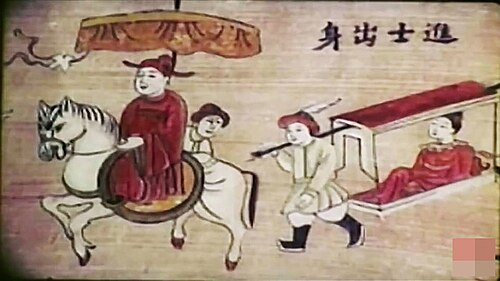
Under the Tang (618–907), several examination categories existed, including 'classicists' (mingjing), who were tested on the Confucian classics, and 'presented scholars' (jinshi), who were tested on literary composition and policy questions. There were also specialist examinations in law, mathematics and calligraphy. The jinshi became the most prestigious degree, and passing it was a celebrated event; the Tang poets often wrote about the joy of success and the bitterness of failure.
Numbers remained small. Over the whole Tang period only about 6,500 jinshi degrees were awarded, an average of roughly two dozen a year, and aristocratic families continued to dominate high office. Empress Wu Zetian, who ruled in her own name from 690 to 705, favoured the new degree-holders, held examinations at her palace and created a military examination. These steps raised the prestige of the system and helped bring new men into government.
Intermediate
The Song expansion and the late imperial system
The Song dynasty (960–1279) turned the examinations into the main route to office. Its founders, who had seen generals overthrow emperors, deliberately sought to govern through civilian scholars. The palace examination became a regular final stage, quotas were greatly increased and printing made the classics and study aids widely available.
The Song also introduced measures to make the process fair. Candidates' names were replaced with numbers and their answers were recopied by clerks so that examiners could not recognise handwriting. According to Columbia University's Asia for Educators, the number of candidates grew from fewer than 30,000 early in the dynasty to about 400,000 by its end, and in some regions only one candidate in several hundred succeeded. Most men who spent years preparing never became officials.
The Mongol Yuan dynasty suspended the examinations for decades and restored them in 1315, now based on the Neo-Confucian commentaries of Zhu Xi, with quotas that favoured Mongols and other non-Chinese groups. Under the Ming (1368–1644) and Qing (1644–1912) the system reached its greatest scale, with a three-tier degree ladder: licentiate (shengyuan), provincial graduate (juren) and jinshi. Answers had to follow a rigid format known as the eight-legged essay. Huge examination compounds with thousands of individual cells were built in provincial capitals.
In the nineteenth century the system came under increasing criticism for rewarding memorisation and formal style. After defeats by foreign powers and the Boxer crisis, the Qing government abolished the examinations by decree in 1905, and a new school system based on Western and Japanese models took their place.
Intermediate
Across East Asia: Korea, Vietnam and Japan
Korea: Unified Silla introduced a system in 788, known as dokseo sampumgwa, that graded students of the state academy by their reading of the classics, but birth-based bone-rank status still decided careers. A true examination system began under Goryeo in 958, when King Gwangjong adopted it on the advice of Ssang Gi (Shuang Ji), a scholar-official from the Later Zhou dynasty in China who served at the Goryeo court and was appointed the first examiner. Gwangjong used the exams, together with other reforms, to weaken powerful regional lords and build a bureaucracy loyal to the king.
Goryeo had examinations in literary composition, the classics, and technical subjects, as well as a Buddhist clerical examination. Yet the eumseo privilege allowed sons of high officials to enter office without examination. Under Joseon (1392–1910) the civil examination (mungwa) became the central path to high office, alongside military and technical examinations, and it was held regularly every three years with additional special sessions. Joseon records list more than 14,000 successful candidates in the highest civil examination before the system was abolished in the Gabo Reform of 1894.
Vietnam: the Lý dynasty held its first court examination in 1075. Later dynasties expanded the system, and from the fifteenth century the names of successful doctoral candidates were carved on stone stelae at the Temple of Literature in Hanoi. Vietnam held its last examination in 1919 under the Nguyễn dynasty, making it the last country to use the Confucian examination system.
Japan: the Taihō Code of 701 created a state academy and examinations modelled on the Tang, but in practice court ranks were largely inherited through privileges for the sons of high nobles, and the examinations lost importance during the Heian period. Japan's aristocratic court society adopted much of Chinese law and administration but not examination-based recruitment on a large scale.
Intermediate
Meanwhile in the world
The Sui experiment with examinations belongs to a wider moment around 600 when rulers across Eurasia were rebuilding states with written law and trained officials. In Japan, Prince Shōtoku's court introduced the Twelve Level Cap and Rank System in 603, which in principle ranked officials individually rather than by clan, and the Seventeen-Article Constitution, traditionally dated 604, which urged officials to serve the ruler with harmony and diligence. Japanese envoys travelled to the Sui court in 600 and 607 to learn from it. Four decades later, the Taika Reform of 645 attempted a fuller Chinese-style centralisation.
On the Korean peninsula, the Sui's great campaigns against Goguryeo in 612–614 ended in disaster and helped bring down the dynasty. The Tang, which inherited both the examinations and the conflict, ruled from Chang'an, where the Daming Palace, begun in 634, later became the main seat of government.
Further west, the Eastern Roman (Byzantine) emperor Justinian had already, in the 530s, codified Roman law in the Corpus Juris Civilis, and legal training in schools such as those of Constantinople and Beirut prepared men for administration. In Persia, Khosrow I (r. 531–579) had reformed taxation with the help of a professional class of scribes. In Arabia, the Prophet Muhammad began to preach in Mecca around 610, and within a century the caliphate would build its own bureaucracy of secretaries and registers.
These parallels do not mean the systems were connected. They show that several large states of the period were trying to solve the same problem, how to govern vast territories through trained and loyal officials rather than hereditary nobles, and that China's answer, the written examination, was the most systematic and long-lived.
Intermediate
The examination life
For candidates, the examinations shaped an entire life. Boys from families who could afford it began memorising the classics in early childhood, often hundreds of thousands of characters. Families, lineages and whole villages invested in promising students, hoping that one success would raise the status of everyone connected with him.
During the late imperial provincial examination, candidates were searched for hidden notes, locked into small individual cells in vast compounds and kept there for several days while they wrote their answers. Cheating was punished severely, yet crib sheets, bribery and impersonation were recurring problems. The results were posted publicly, and successful candidates were celebrated with banners and ceremonies.
Failure was far more common than success. Many degree-holders at the lower levels never obtained office but became teachers, local leaders or writers, forming the broad educated gentry of late imperial society. Some failed candidates turned against the system; the most famous example is Hong Xiuquan, who failed the provincial examination several times before leading the Taiping Rebellion in the nineteenth century.
Advanced
Evidence and scholarship
Historians reconstruct the examination system from official histories and administrative compendia, from lists of successful candidates, from local gazetteers and family genealogies, and from surviving examination papers, answer collections and guidebooks. Late imperial candidate rosters that record ancestors' degrees and offices have been especially important for studying social mobility.
The origin date is itself debated. Because the Sui histories describe a series of measures under both Emperor Wen and Emperor Yang, historians have proposed various starting points between 587 and 607. Reference works often use 605, but the choice depends on whether one looks for the first regular examination, the first jinshi category or the abolition of the nine-rank system.
Standard studies include Ping-ti Ho, The Ladder of Success in Imperial China (1962), which used candidate records to argue for substantial upward mobility in the Ming and Qing; Ichisada Miyazaki's China's Examination Hell, a vivid account of the late imperial process; and Benjamin A. Elman, A Cultural History of Civil Examinations in Late Imperial China (2000), which emphasises the examinations' role in creating a shared elite culture and in reproducing social hierarchy.
Advanced
Different perspectives
Ladder or filter? One long-running debate concerns social mobility. Ping-ti Ho argued that a significant share of Ming and Qing jinshi came from families without recent degree-holders, suggesting real openness. Others, including Robert Hymes in his study of Song-dynasty Fuzhou in Jiangxi, have pointed out that such families were often connected to elite lineages through marriage or kinship not recorded in the rosters, and that local elites kept their status through many strategies besides examinations. Elman has stressed that the long years of classical training needed to compete excluded most of the population, so the system selected within an educated minority. Most scholars now see it as offering limited but meaningful mobility while also legitimising the existing elite.
Engine of stability or cause of stagnation? Late Qing reformers and many twentieth-century Chinese intellectuals blamed the examinations, especially the eight-legged essay, for discouraging practical and scientific learning and leaving China unprepared for the modern world. Later historians have offered more mixed judgements, noting that the system created a common written culture across a vast empire, gave the state a loyal and literate elite and was reformed several times to include policy and practical questions.
National framings: in Korea, the gwageo is often presented both as a sign of Korea's participation in a shared Confucian civilisation and as a distinctly Korean institution adapted to local society, with some scholars emphasising how the yangban aristocracy restricted access. In Vietnam, the examinations and the doctoral stelae of the Temple of Literature are celebrated as part of national scholarly heritage. In Japan, historians discuss why examination-based recruitment did not take root, often pointing to the strength of the hereditary court aristocracy. These are differences of emphasis rather than contradictions.
East to West? European missionaries and travellers described China's examinations from the sixteenth century onward, and Enlightenment writers such as Voltaire admired the idea of government by scholars. Teng Ssu-yü's 1943 study argued that Chinese precedent significantly influenced the introduction of competitive examinations in the British East India Company and, through debates around the Northcote–Trevelyan Report of 1854, in the British home civil service. Other historians give more weight to European roots, such as university examinations and Prussian administrative reforms. The influence is widely acknowledged, but its size is still discussed.
Advanced
Legacy
The imperial examination was one of the longest-lived institutions in world history. It shaped the ideal of the scholar-official, the prestige of education in East Asian societies and the relationship between state and learning. The canon it tested, especially after 1315 the Four Books with Zhu Xi's commentaries, became the common intellectual inheritance of educated people from Beijing to Seoul and Hanoi.
Its influence on modern life is still debated but easy to see. Competitive national examinations for university entrance and civil service jobs in China, Korea, Vietnam and elsewhere are often compared with the old system, both admiringly and critically. The principle that public office should be filled by open competition on the basis of tested ability is now standard in many countries.
The system's history also raises questions that remain relevant: whether tests measure merit or privilege, what knowledge a state should reward, and how to balance fairness with the need for creative and practical ability.
Key ideas
- Meritocracy
- The idea that positions should go to those with proven ability. The examinations were an early, large-scale attempt to put this into practice, though access was never equal.
- Confucian classics
- The canonical texts, such as the Analects and later the Four Books, that formed the core of the examination curriculum and of elite education.
- Anonymity and fairness
- Song reforms such as numbering candidates and recopying papers aimed to stop examiners favouring people they knew.
- Scholar-official
- The educated man who served the state after passing the examinations, the central social ideal of late imperial China and Joseon Korea.
- Transmission and adaptation
- Korea, Vietnam and Japan adopted the system to different degrees, changing it to fit their own social structures.
- Social reproduction
- Because preparation was costly, examinations could also help established families keep their status, a central issue in modern research.
Records
- 220 CE — The Wei state introduces the nine-rank system of official recruitment.
- c. 587 CE — Sui Emperor Wen orders provinces to send candidates to the capital for examination (one of several proposed starting points).
- 605 CE — Conventional date for the start of the examinations under Emperor Yang of Sui, who also rebuilds Luoyang.
- 690 CE — Wu Zetian proclaims her own dynasty; she favours jinshi graduates and holds examinations at her palace.
- 788 CE — Unified Silla introduces the dokseo sampumgwa for grading students.
- 958 CE — King Gwangjong of Goryeo holds Korea's first civil service examination, with Ssang Gi as examiner.
- c. 973 CE — The Song establish the palace examination as a regular final stage.
- 1075 — Vietnam's Lý dynasty holds its first court examination.
- 1315 — The Yuan restore the examinations, based on Zhu Xi's commentaries.
- 1854 — Britain's Northcote–Trevelyan Report recommends recruitment to the civil service by examination.
- 1894 — Korea abolishes the gwageo in the Gabo Reform.
- 1905 — The Qing government abolishes the imperial examinations.
- 1919 — Vietnam holds its last Confucian examination.
Glossary
- Keju (科舉)
- The Chinese name for the imperial examination system.
- Jinshi (進士)
- 'Presented scholar', the highest examination degree, qualifying holders for senior office.
- Nine-rank system
- The system of rating candidates for office used from 220 until the Sui, which came to favour aristocratic families.
- Palace examination
- The final examination held at the imperial palace, ranked in the emperor's name.
- Eight-legged essay
- The strict essay format required in Ming and Qing examinations.
- Gwageo (과거)
- The Korean examination system, held from 958 to 1894.
- Eumseo (음서)
- The Korean privilege allowing sons of high officials to enter office without examination.
- Scholar-official
- An official recruited through learning, usually by passing the examinations.
Questions and answers
Could anyone take the exam?
Not everyone. Women could never take it, and some groups were banned in certain periods. In theory most men could compete, but only families with time and money could pay for years of study.
How hard was it?
Very hard. In the Song dynasty, in some regions only about one candidate in several hundred passed, and most people who prepared never became officials.
When did the exams start: 587 or 605?
Historians disagree because the Sui introduced several measures step by step. 605, under Emperor Yang, is a common convention, but 587 and 606–607 are also proposed.
Did Korea just copy China?
Korea adopted the model in 958 but adapted it: it kept privileges for high-ranking families, added Buddhist clerical exams and ran the system for over nine centuries in its own way.
Did the Chinese exams influence Western civil services?
Many historians think so. European writers knew and admired the system, and it was cited in British debates about recruiting officials by examination in the 19th century. How much it influenced the final reforms is still debated.
Did the exams make Chinese society mobile?
Partly. Studies such as Ping-ti Ho's show new families reaching high degrees, but others show that elite lineages often kept their advantage. The answer depends on the period, region and how 'new' families are defined.
Why were papers recopied by clerks?
So examiners could not recognise a candidate's handwriting and favour a friend or relative. It was part of Song efforts to make the tests fair.
Sources and further reading
- Imperial examination. Wikipedia
- The Confucian Scholar-Official and the Civil Service Examinations (Song Dynasty China module). Asia for Educators, Columbia University
- Sui dynasty. Wikipedia
- Gwageo. Wikipedia
- 광종 (光宗). Encyclopedia of Korean Culture, Academy of Korean Studies
- 지공거 (知貢擧). Encyclopedia of Korean Culture, Academy of Korean Studies
- Confucian court examination system in Vietnam. Wikipedia
- Northcote–Trevelyan Report. Wikipedia
- Ping-ti Ho, The Ladder of Success in Imperial China: Aspects of Social Mobility, 1368–1911. Columbia University Press, 1962
- Benjamin A. Elman, A Cultural History of Civil Examinations in Late Imperial China. University of California Press, 2000
- Ichisada Miyazaki (trans. Conrad Schirokauer), China's Examination Hell: The Civil Service Examinations of Imperial China. Weatherhill, 1976
Related
- Goguryeo–Sui WarsFour failed invasions of the Korean kingdom of Goguryeo by the Chinese Sui dynasty in 598 and 612–614; their cost helped bring down the Sui in 618.
- Taika ReformA programme of political reforms launched after the palace coup of 645, which aimed to turn Japan’s alliance of powerful clans into a centralised state on the model of Tang China.
- Daming PalaceThe main palace of the Tang emperors, begun in 634 on the Longshou Plateau outside the north-east corner of Chang’an and the seat of government until it was dismantled in 904.
- Corpus Juris CivilisThe body of Roman law compiled in 529–534 on the orders of Emperor Justinian I, later the foundation of the civil-law tradition in Europe and far beyond.
- Zhu XiSong philosopher who gave enduring form to Neo-Confucian learning.
Written with AI assistance from the published sources listed above, and revised as new research appears.