Start at the top for an easy introduction. Go further down for more detail and scholarship.
- Easy
- Intermediate
- Advanced
For young readers
About 1,700 years ago, in the highlands of what is now northern Ethiopia, there was a rich and powerful kingdom called Aksum. Its kings traded ivory, gold and incense with lands as far away as Rome, India and Arabia, and they made their own coins.
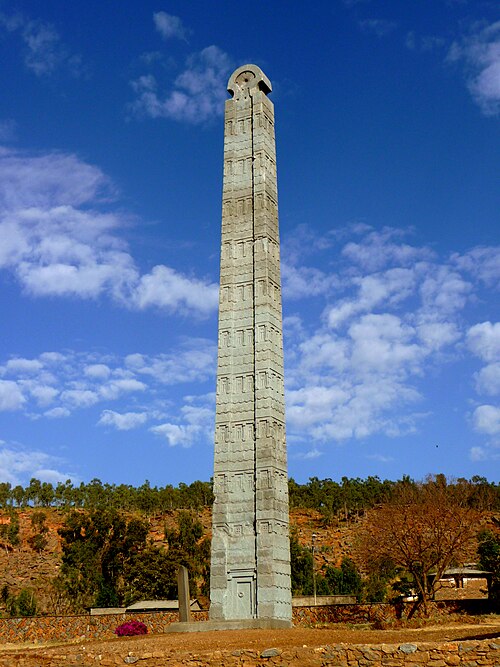
When important people died, the people of Aksum put up huge stone pillars called stelae over their tombs. The Obelisk of Axum is one of the biggest. It is carved from one single piece of stone, is about 24 metres tall, and weighs about as much as 30 elephants.
The pillar is carved to look like a skyscraper made of stone. At the bottom there is a pretend door that does not open, and above it are rows of pretend windows and the round ends of pretend wooden beams, floor after floor. It is like a model of a palace pointing up to the sky.
Nobody knows exactly how the stoneworkers moved such heavy stones. They probably cut them from a hill outside the town and dragged them on rollers or sledges, using many people, ropes and perhaps elephants, and then raised them with earth ramps and levers.
The obelisk has had an adventurous life. It fell down and broke long ago. In 1937 soldiers from Italy, which had invaded Ethiopia, cut it into pieces and took it to Rome as a trophy. After many years of asking, Ethiopia finally got it back in 2005, and in 2008 it was stood up again in Aksum, where it belongs.
At a glance
- What
- A monolithic funerary stele (tall carved stone marker), often called an obelisk; known to archaeologists as Stele 2
- When
- Probably carved and erected in the 4th century CE (some scholars allow the late 3rd century); exact date unknown
- Where
- Northern Stelae Field, Aksum, Tigray Region, northern Ethiopia
- Size
- About 24 m tall and about 160 tonnes, carved from a single block of hard volcanic stone (usually described as nepheline syenite or phonolite)
- Made by
- Stoneworkers of the Kingdom of Aksum, for an unknown member of the ruling elite
- Design
- Imitates a multi-storey building, with a false door at the base, false windows and projecting beam-ends on every side
- Modern history
- Taken to Rome by Fascist Italy in 1937; returned to Ethiopia in 2005; re-erected in Aksum in 2008
- Status
- Part of the archaeological site of Aksum, a UNESCO World Heritage Site since 1980
Easy
What is the Obelisk of Axum?
The Obelisk of Axum is a tall, carved stone pillar standing in the town of Aksum (also spelled Axum) in northern Ethiopia. It was made by the people of the Kingdom of Aksum, one of the great states of the ancient world, probably in the fourth century CE. It is about 24 metres high and weighs roughly 160 tonnes, and it was carved from a single block of stone.
Although it is often called an “obelisk”, archaeologists usually prefer the word stele (plural stelae), meaning an upright stone slab or pillar set up as a monument. An Egyptian obelisk is a four-sided shaft that narrows to a small pyramid at the top. The Aksumite pillars are flatter, are carved to look like buildings, and end in a rounded top. They were not copies of Egyptian obelisks but a local tradition of grave markers that grew larger and more elaborate over centuries.
Aksum has more than a hundred stelae of many sizes, from rough, unworked stones to a few gigantic, carefully decorated ones. The Obelisk of Axum, known in scholarly writing as Stele 2, is the second largest of the decorated giants. It stands in the Northern Stelae Field, a burial ground of the Aksumite elite on the edge of the modern town.
Today the obelisk is a national symbol of Ethiopia. Its story reaches from the ancient trade routes of the Red Sea to the Italian invasion of Ethiopia in the 1930s and to one of the most famous cases of cultural property being returned to its country of origin.
Easy
How to “read” the stele: a stone skyscraper
The most striking thing about the Obelisk of Axum is that it is carved to look like a tall building. Starting at the bottom, the viewer sees a false door, carved in relief with a lock or door knocker, as if it could open into the tomb or house of the dead. Above it, the pillar is divided into horizontal bands, one for each imaginary storey.
Each storey shows the features of real Aksumite architecture. Rows of false windows are carved into the stone. Between the storeys run horizontal beams, and small round or square knobs stand out from the surface. These knobs imitate the ends of wooden beams that stuck out from the walls of Aksumite buildings; archaeologists nickname them “monkey heads”. Real Aksumite palaces and churches were built with layers of stone and wood in exactly this way, and some later Ethiopian churches, such as the monastery church of Debre Damo, still show this style.
At the top, the stele ends in a rounded, semicircular head. Holes and marks show that metal plaques or frames were once attached there, and scholars think that some of the great stelae once carried metal discs or symbols. What these showed is uncertain; before Christianity, Aksumite coins and inscriptions often used the crescent and disc, symbols of the kingdom’s gods.
Reading the stele from bottom to top, one sees a house for the dead that rises many storeys toward the sky. Whatever its exact religious meaning, it was a powerful statement: the ruler buried here deserved a palace of stone that everyone in the city could see.
Easy
Giants of the stelae field
The Obelisk of Axum is one of three huge, fully decorated stelae in the Northern Stelae Field. The largest, known as Stele 1 or the Great Stele, was about 33 metres long and has been estimated to weigh more than 500 tonnes. It would have been one of the largest single stones ever raised by any ancient people. But it lies broken on the ground. Many archaeologists think it fell and shattered during or soon after the attempt to raise it.
The third giant, Stele 3, is about 21 metres tall and is often called “King Ezana’s Stele”. This name is a modern tradition, not an ancient inscription; there is no writing on the stele linking it to Ezana. It was the only one of the great decorated stelae still standing when European travellers and archaeologists described Aksum in the nineteenth and early twentieth centuries, and it has leaned over time.
Around the giants are many smaller stelae, some carved and some rough, together with underground tombs. The field was used as a cemetery for the elite over several centuries, and the size of each stele seems to reflect the rank of the person buried beneath or near it.
Intermediate
Quarrying, moving and raising the stones
The stelae were cut from a hard, fine-grained volcanic rock found in the hills to the west of Aksum. Archaeologists have identified ancient quarry areas several kilometres from the town, including a partly worked stele still lying where it was abandoned. Stoneworkers probably split the rock using wedges driven into lines of holes, then shaped and polished the block with iron tools and abrasives.
Moving a block of more than 100 tonnes over several kilometres was an enormous task. No written account survives, so all explanations are reconstructions. Most scholars suggest that the stones were dragged on wooden sledges or rollers along a prepared track, pulled by large teams of people with ropes; elephants, which the Aksumites are known to have captured and used, may also have helped. The detailed carving may have been finished only after the stone reached the cemetery.
Raising the stele was the most dangerous step. A likely method is that the base was slid into a prepared pit and the top raised gradually with levers, ropes and earth ramps, while the stone was supported by timber. Large base plates and wedging stones were placed around the foot. The collapse of the Great Stele shows that this technique had limits: the larger the stone, the greater the risk that it would crack under its own weight.
The achievement required a state able to organize hundreds of workers, feed them, and supply them with timber, iron and rope. The stelae are therefore not only works of art but evidence of the economic and political power of the Aksumite rulers.
Intermediate
The Kingdom of Aksum: a crossroads of the ancient world
The Kingdom of Aksum grew up in the highlands of what are now northern Ethiopia and Eritrea around the first century CE. The Periplus of the Erythraean Sea, a Greek guide for merchants written in the mid-first century CE, already mentions Aksum and its port of Adulis on the Red Sea, from which ivory and other goods were exported.
Over the next centuries Aksum became a major trading power between the Roman Mediterranean, Arabia, and India. It exported ivory, gold, incense, animal skins and other goods, and imported cloth, glass, metalwork, wine and oil. In the late third century, King Endubis began to issue coins in gold, silver and bronze, a sign of confidence shared by only a few states of the time. Aksumite coins have been found as far away as the eastern Mediterranean and southern India.
The Persian religious teacher Mani, in the third century, is recorded as listing Aksum among the four great kingdoms of the world, alongside Rome, Persia and China. Aksumite kings used inscriptions in Ge’ez (the classical Ethiopian language, written in its own script), Sabaic (a South Arabian language) and Greek, reflecting a society that looked both to Africa and across the Red Sea.
At its height in the sixth century, under King Kaleb, Aksum even controlled parts of Yemen for a time. The great stelae, however, belong to an earlier period, before Christianity became the religion of the royal court.
Intermediate
Religion and death: what were the stelae for?
The stelae marked the graves of the Aksumite elite. Beneath and around the Northern Stelae Field, archaeologists have found underground tombs cut into the rock or built of stone, some with several chambers. Next to the fallen Great Stele lies a large stone-built tomb known as the Mausoleum, and nearby is the so-called Tomb of the Brick Arches. Many of the tombs were robbed in antiquity, but finds of pottery, glass, metalwork and other objects show that the dead were buried with valuable goods.
The exact beliefs behind the stelae are not known, because the pre-Christian religion of Aksum is poorly documented. Inscriptions and coins mention gods such as Astar, Beher and Mahrem, the last associated with the king, and use the disc and crescent as symbols. Many scholars think the multi-storey form expressed the idea of the tomb as a house or palace for the dead, and that the height of the stele proclaimed the power and status of the ruler and his family.
The stelae also served the living. A dead ruler’s monument, visible across the city, reminded people of a dynasty’s greatness and helped the next ruler claim legitimacy. Raising an ever larger stele may have been a form of competition between rulers or families.
Some offering places, such as stone platforms with channels, have been found near the stelae, which suggests rituals continued at the graves after burial.
Intermediate
Christianity and the end of the stelae tradition
In the fourth century King Ezana adopted Christianity, influenced by Frumentius, a Christian from the Roman world who had been brought to the Aksumite court as a young captive and later became its first bishop. Ezana’s coins changed from the old disc-and-crescent symbol to the cross, one of the earliest uses of the cross on any state’s coinage. His inscriptions, including the trilingual Ezana Stone, record military campaigns and, in the later ones, praise the Christian God.
After this change, giant stelae stopped being raised. Most scholars therefore date the great decorated stelae, including the Obelisk of Axum, to the period just before or around Ezana’s conversion, in the fourth century or somewhat earlier. Some historians have suggested that the collapse of the Great Stele, a spectacular failure, may have contributed to the end of the tradition, but this is speculation.
Christianity became the enduring faith of the Ethiopian highlands. The Ethiopian Orthodox Tewahedo Church, one of the oldest Christian churches in the world, regards Aksum as its holiest city. The Church of Our Lady Mary of Zion in Aksum is believed by Ethiopian Orthodox Christians to house the Ark of the Covenant, which is guarded by a single monk; this tradition is central to Ethiopian religious identity.
In the seventh century, according to Islamic tradition, early followers of the Prophet Muhammad fled persecution in Mecca and were sheltered by the Christian king of Aksum. This event, often called the First Hijra, gave Aksum an honoured place in Islamic memory as well.
Intermediate
Falling, looting and return
Aksum declined from the seventh century, as trade routes across the Red Sea shifted and the political centre of the Ethiopian highlands moved south; the kingdom stopped issuing coins around the early eighth century. The town remained a sacred place and the site where Ethiopian emperors were sometimes crowned. At some unknown date the Obelisk of Axum fell and broke into several pieces, which lay on the ground for centuries.
In 1935–36 Fascist Italy invaded Ethiopia, one of the few African countries that had kept its independence. The war was marked by the Italian use of poison gas against soldiers and civilians, and the occupation that followed included mass reprisals, such as the killings in Addis Ababa in February 1937. In 1937, on Mussolini’s orders, the broken stele was taken from Aksum, shipped to Italy and re-erected in Rome, where it was unveiled on 28 October 1937, the fifteenth anniversary of the Fascist March on Rome. It stood at the Piazza di Porta Capena, in front of the building of the Ministry of Italian Africa.
In the 1947 peace treaty after the Second World War, Italy agreed to return objects taken from Ethiopia, but the obelisk remained in Rome for decades, amid arguments about cost, technical risk and ownership. For Ethiopians it became a symbol of the humiliation of occupation, and campaigns for its return continued through changes of government. In May 2002 the stele was damaged by lightning.
In 2003–04 the obelisk was dismantled again into three pieces, and in April 2005 it was flown back to Ethiopia in a series of flights on one of the world’s largest cargo aircraft. Because the ground near its original site contains fragile tombs, reinstallation required careful surveys; with UNESCO supervising the project, the stele was re-erected in the Northern Stelae Field and unveiled on 4 September 2008. Its return is often cited in international debates about restoring cultural objects taken in war or colonial occupation.
Advanced
Scholarly debates: dating, sequence and meaning
Dating. None of the great stelae bears an inscription, so their dates rely on the archaeology of the tombs associated with them, on the comparison of objects found there with dated material elsewhere, and on the general assumption that giant stelae were no longer raised after Christianity was adopted. Most specialists place Stele 2 in the fourth century CE, with some allowing a late third-century date; the relative order of the three giants is also debated. Estimates for the whole Aksumite stelae tradition range across several centuries, from simple markers early in the first millennium CE to the great decorated stelae at its end.
The fall of the Great Stele. Stele 1 lies broken across the area of the Mausoleum. Archaeologists such as David Phillipson have argued that it fell during or immediately after erection, perhaps because its foundations were inadequate, and that it may have been the last of the giant stelae. Others have considered later collapse or deliberate toppling. The question matters because it affects the sequence of the stelae and our understanding of the end of the tradition.
Names and attributions. Popular names that link stelae to specific rulers, such as “King Ezana’s Stele”, are not supported by inscriptions. Local traditions, recorded in later Ge’ez texts and oral history, connect Aksum with the Queen of Sheba and with King Menelik, the legendary founder of the Solomonic line, but these traditions are much later than the stelae and belong to Ethiopian religious and national history rather than to archaeology.
Meaning of the design. Scholars agree that the carved stelae imitate multi-storey buildings, but disagree about how literal this is. Some read them as images of real palaces, others as symbolic “houses” for the dead or as a way of expressing the connection between the tomb below and the sky above. The metal fittings at the top, now lost, might have resolved some questions if they had survived.
The word “obelisk”. The widespread name “Obelisk of Axum” reflects European habits of comparing African monuments to Egyptian ones. Many scholars prefer “stele” or “Stele 2”, both to be more precise and to stress that the Aksumite tradition developed on its own terms.
Advanced
Evidence and methods: how we know about the stelae
Early explorations. European travellers described the stelae from the sixteenth century onward. The first systematic study was made by the German Aksum Expedition (Deutsche Aksum-Expedition) of 1906, led by the orientalist Enno Littmann, which recorded monuments, inscriptions and architecture; its drawings and photographs remain valuable, especially for features later altered.
Modern excavations. In the 1970s the British Institute in Eastern Africa, under Neville Chittick, excavated in the stelae field and identified tombs associated with the great stelae. Work was interrupted by the political upheavals in Ethiopia, and resumed in the 1990s under David Phillipson, who excavated tombs such as the Mausoleum and the Tomb of the Brick Arches and studied the quarries. Ethiopian and international teams, including Italian and German archaeologists, have continued fieldwork since then.
Written evidence. Aksum’s own inscriptions, in Ge’ez, Sabaic and Greek, together with coins, provide the names and sequence of some kings, but none mentions the stelae directly. Outside sources, such as the Periplus of the Erythraean Sea, Greek and Roman writers, and the sixth-century account attributed to Cosmas Indicopleustes, describe Aksum’s trade and courts. Later Ethiopian texts, such as the Kebra Nagast, record traditions about the city’s sacred past.
Conservation science. The return and re-erection of Stele 2 required engineering studies of its fractures, of the ground and of the tombs below. The 2008 reassembly used modern reinforcement between the sections. Monitoring the leaning Stele 3 and protecting the fragile tombs remain challenges, and the case shows how conservation, archaeology and politics are intertwined at Aksum.
Key ideas
- Stele
- An upright stone monument; the Aksumite examples are grave markers carved from single blocks, some of enormous size.
- Monolith
- A monument made from a single piece of stone; the Obelisk of Axum was carved as one block about 24 m long.
- Architecture in stone
- The carved stelae imitate multi-storey buildings, with false doors, windows and beam-ends copied from real Aksumite construction.
- Elite commemoration
- The size and decoration of each stele reflected the rank of the dead and the power of their family or dynasty.
- Red Sea trade
- Aksum’s wealth came from trade between Africa, the Mediterranean, Arabia and India, which paid for its monuments.
- Christianization
- After King Ezana adopted Christianity in the fourth century, giant stelae were no longer raised.
- Restitution
- The obelisk’s return from Rome in 2005 made it a landmark case in debates about returning cultural property taken in war.
Records
- c. 50 CE — The Periplus of the Erythraean Sea mentions Aksum and its Red Sea port of Adulis.
- c. 270 CE — King Endubis begins Aksum’s own coinage in gold, silver and bronze.
- c. 300 CE — Probable period of carving and erection of the great decorated stelae, including Stele 2 (4th century CE, date uncertain).
- c. 340 CE — King Ezana adopts Christianity; the cross appears on his coins, and giant stelae are no longer raised.
- c. 520 CE — King Kaleb campaigns in Yemen; Aksum reaches its greatest extent.
- c. 615 CE — According to Islamic tradition, early Muslims from Mecca take refuge with the king of Aksum.
- 1906 — The German Aksum Expedition makes the first systematic survey of the stelae.
- 1937 — Occupying Italian forces take the fallen stele to Rome, where it is unveiled on 28 October.
- 1947 — Italy agrees in the peace treaty to return objects taken from Ethiopia.
- 1980 — The archaeological site of Aksum is inscribed on the UNESCO World Heritage List.
- 2005 — The obelisk is flown back to Ethiopia in three pieces in April.
- 2008 — The stele is re-erected in Aksum and unveiled on 4 September.
Glossary
- Stele (stelae)
- An upright stone slab or pillar set up as a monument, often to mark a grave.
- Obelisk
- Originally an Egyptian four-sided stone pillar ending in a small pyramid; loosely used for other tall stone monuments.
- Monolith
- A monument carved from a single block of stone.
- False door
- A carved door that does not open, symbolizing an entrance to the tomb or the world of the dead.
- “Monkey heads”
- Archaeologists’ nickname for the projecting ends of wooden beams in Aksumite walls, imitated in stone on the stelae.
- Ge’ez
- The classical language of Ethiopia and its script, still the liturgical language of the Ethiopian Orthodox Church.
- Adulis
- Aksum’s main port on the Red Sea coast, in present-day Eritrea.
- Periplus of the Erythraean Sea
- A first-century CE Greek handbook for merchants describing ports and trade from Egypt to India.
- Mausoleum
- A large tomb building; at Aksum, the name for a stone-built tomb beside the Great Stele.
- Restitution
- The return of cultural objects to the country or community from which they were taken.
Questions and answers
Is the Obelisk of Axum really an obelisk?
Not in the Egyptian sense. It is an Aksumite stele: a flat-sided pillar carved like a building with a rounded top. “Obelisk” is a popular name.
How did people lift such a heavy stone without machines?
No record survives, but they probably dragged it on sledges or rollers with ropes and many workers, then raised it with levers, timber supports and earth ramps.
Who is buried under it?
We do not know. It marks part of an elite cemetery, but no inscription names the person it commemorated.
Why was it in Rome?
During Italy’s occupation of Ethiopia, the fallen stele was taken to Rome in 1937 as a war trophy of the Fascist regime. It was returned in 2005.
Why are the stelae dated to before Christianity?
Because giant stelae stopped being raised after King Ezana adopted Christianity in the fourth century, and the tombs associated with them contain pre-Christian material.
Did the Great Stele ever stand?
Possibly not. Many archaeologists think the 33-metre Great Stele broke during or immediately after being raised, though this is debated.
What does the building design mean?
Scholars agree it imitates multi-storey Aksumite buildings; many read it as a house or palace for the dead that also displayed the family’s power, but the exact beliefs are unknown.
Sources and further reading
- Obelisk of Axum. Wikipedia
- Axum. Wikipedia
- Kingdom of Aksum. Wikipedia
- Ezana Stone. Wikipedia
- Aksum. UNESCO World Heritage Centre
- Stuart Munro-Hay, Aksum: An African Civilisation of Late Antiquity. Edinburgh University Press, 1991
- David W. Phillipson, Ancient Ethiopia: Aksum, Its Antecedents and Successors. British Museum Press, 1998
Related
- Pyramids of MeroëRoyal funerary pyramids of the Kushite kingdom at Meroë in present-day Sudan.
- Great Pyramid of GizaA royal tomb built for the Egyptian pharaoh Khufu. It is the largest of the Giza pyramids and the only surviving Wonder of the ancient world.
- Great ZimbabweRemains of a major southern African city built and occupied by ancestors of the Shona people.
- Hagia SophiaA monumental church built for the Byzantine emperor Justinian I in Constantinople between 532 and 537 CE.
- Fall of the Western Roman EmpireThe removal of the western emperor Romulus Augustulus in 476 CE, often used as a marker for the end of the Western Roman Empire.
Written with AI assistance from the published sources listed above, and revised as new research appears.