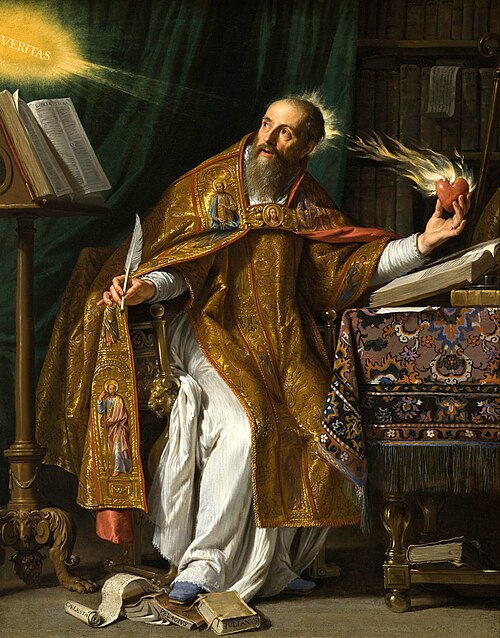
Start at the top for an easy introduction. Go further down for more detail and scholarship.
- Easy
- Intermediate
- Advanced
For young readers
Augustine was born in 354 in a small town in North Africa, in what is now Algeria, when the Roman Empire still ruled all around the Mediterranean Sea. His mother, Monnica, was a devoted Christian; his father, Patricius, was not, until late in life. Augustine was very clever, and his parents saved money so he could study to become a teacher of public speaking.
As a young man he wanted fame, fun and answers to big questions. Why is there evil in the world? What is true? He tried different groups and ideas, moved to Carthage, then to Rome, and then to Milan in Italy, where he became an important teacher.
In Milan, when he was 31, he had a great change of heart. He later wrote that, sitting in a garden in tears, he heard a child’s voice chanting “Pick it up and read, pick it up and read.” He opened a book of the letters of Saint Paul, read a few lines, and decided to give his whole life to God. The next spring he was baptized.
Back in Africa, he became a priest and then bishop of the port town of Hippo. He preached almost every week, settled arguments, helped the poor and wrote a huge number of books and letters. His most famous book, the Confessions, is like a long prayer in which he tells God the story of his life, including the naughty things he did as a boy, like stealing pears just for the fun of it.
Augustine lived when the Roman world was shaking. In 410 the city of Rome was captured and robbed by an army of Goths, and people asked: “Did this happen because we became Christians?” Augustine answered with a giant book, The City of God. He died in 430, while an army of Vandals was surrounding his city.
At a glance
- Lived
- 13 November 354 – 28 August 430 CE
- Born
- Thagaste, Roman province of Numidia (modern Souk Ahras, Algeria)
- Died
- Hippo Regius (near modern Annaba, Algeria), during the Vandal siege
- Roles
- Teacher of rhetoric; from 391 priest and from about 395/396 bishop of Hippo
- Language
- Latin
- Major works
- Confessions (c. 397–400), On the Trinity (c. 399–426), The City of God (c. 413–426), On Christian Doctrine, hundreds of letters and sermons
- Key ideas
- Evil as absence of good, the restless heart seeking God, grace and original sin, the inner experience of time and memory, the two cities
- Recognized as
- Saint and Doctor of the Church in Catholic tradition; also honoured in Anglican, Lutheran and Orthodox traditions
Easy
Who was Augustine?
Aurelius Augustinus, known in English as Augustine of Hippo or Saint Augustine, was a Christian thinker and bishop who lived in Roman North Africa from 354 to 430. He is one of the most influential writers in the history of Western thought. Theologians, philosophers, historians and poets have argued with him and borrowed from him for sixteen centuries.
He was born in Thagaste, a small town in the province of Numidia, in what is now eastern Algeria. North Africa was then a wealthy, Latin-speaking part of the Roman Empire, full of cities, farms and churches. Augustine thought of himself as an African and a Roman at the same time. His family belonged to the local middle class, and some scholars think they may have had Berber (Amazigh) roots, though this cannot be proven.
For about the first half of his life, Augustine was a teacher of rhetoric, the art of persuasive speaking, and a restless seeker of wisdom. For the second half he was a priest and bishop in the port city of Hippo Regius. He wrote more than a hundred books, together with hundreds of letters and sermons that survive, more than almost any other ancient author.
His most famous works are the Confessions, a spiritual autobiography addressed to God, and The City of God, a vast reflection on history and society written after the sack of Rome in 410. His ideas about God, evil, free will, grace, memory, time, love and the church shaped medieval Christianity, the Protestant Reformation and modern philosophy.
Easy
A restless young man
Augustine’s mother, Monnica, was a devout Christian, and he was enrolled as a catechumen, someone preparing for baptism, as a child, but baptism was put off. His father, Patricius, a town councillor of modest means, was a pagan who was baptized shortly before his death. With the help of a wealthy patron, the family sent Augustine to study in nearby Madauros and then in Carthage, the great city of Roman Africa.
In the Confessions Augustine remembers many small scenes from his youth: learning Greek unwillingly, weeping over the death of Dido in Virgil’s Aeneid, and stealing pears from a neighbour’s tree with friends, not because he was hungry but for the thrill of doing wrong. Later he used that last memory to ask a deep question: why do people sometimes choose evil for its own sake?
At about eighteen he began living with a woman whose name he never tells us; they had a son, Adeodatus (“given by God”), and stayed together for about fifteen years. At nineteen, reading Cicero’s dialogue Hortensius, now lost, he fell in love with philosophy, the search for wisdom.
He then joined the Manichaeans, a religious movement founded by the Persian prophet Mani that taught that the world is a battlefield between two equal powers, Light and Darkness. For about nine years this seemed to answer his question about where evil comes from. Gradually, however, he became disappointed, because its teachers could not satisfy his questions about astronomy and philosophy.
Easy
The garden in Milan
After teaching in Thagaste and Carthage, Augustine went to Rome in 383, and in 384 won the post of official professor of rhetoric in Milan, where the western emperor’s court was based. His mother followed him. She arranged an engagement to a young girl of good family, and Augustine sent away the mother of his son, a decision he later described with pain.
In Milan, two influences changed him. The sermons of Bishop Ambrose showed him that the Bible could be read in a deep, spiritual way. And “books of the Platonists”, works of Neoplatonist philosophers such as Plotinus translated into Latin by Marius Victorinus, taught him to think of God as a spiritual reality not in space, and of evil as the absence of good rather than a substance.
In the summer of 386, as he describes in Book 8 of the Confessions, he was in a garden, in anguish because he could not bring himself to give up his ambitions and his sexual life. He heard a child’s voice from a nearby house chanting “tolle lege, tolle lege”, “pick it up and read”. He opened Paul’s Letter to the Romans and read a passage urging readers to put on Christ and not to make provision for the flesh. “A light of certainty”, he wrote, flooded his heart.
He resigned his post, spent months in philosophical retreat at Cassiciacum with friends and family, and was baptized by Ambrose at Easter 387, together with his son and his friend Alypius. On the journey home, his mother died at Ostia, the port of Rome, shortly after a shared experience of spiritual ascent he describes movingly in Book 9.
Intermediate
Bishop of Hippo
Returning to Africa in 388, Augustine intended to live a quiet life of prayer and study with friends in Thagaste; his son Adeodatus died there young. In 391, visiting the port town of Hippo Regius, he was seized by the congregation and ordained a priest, as sometimes happened in the early church. Around 395/396 he became bishop of Hippo, a post he held for the rest of his life.
A bishop in late Roman Africa was a public figure. Augustine preached regularly, often several times a week, and hundreds of his sermons survive, taken down by stenographers. He judged civil disputes in the bishop’s court, defended the poor, intervened with officials, freed people from slave traders, and managed church property. He also lived in a community with his clergy, sharing property and a simple life; his guidelines for this community later became the basis of the Rule of Saint Augustine, used by many religious orders.
He was a tireless writer and correspondent, exchanging letters with bishops, officials, intellectuals and ordinary Christians across the Mediterranean, including Jerome in Bethlehem. He attended church councils in Carthage and became the leading intellectual voice of the African church.
His last years were darkened by the collapse of Roman power in Africa. In 429 the Vandals crossed from Spain, and in 430 they besieged Hippo. Augustine, ill with fever, died on 28 August 430, during the siege. According to his biographer Possidius, he had the penitential psalms written on the wall near his bed. His library, remarkably, survived.
Intermediate
The Confessions: a life told to God
The Confessions, written around 397–400, is in thirteen books. The first nine tell the story of Augustine’s life from infancy to his mother’s death in 387. Book 10 examines his present state and the nature of memory; Books 11–13 turn to the opening chapters of Genesis, reflecting on time, creation and the meaning of Scripture. The whole work is addressed to God, in the second person, as a long prayer.
The Latin word confessio means both confession of sin and confession of praise. The book begins with a famous line: “You have made us for yourself, and our heart is restless until it rests in you.” Augustine presents his life as a search for happiness in the wrong places and his return to God as the discovery of what he was really seeking.
The Confessions is often called the first autobiography in Western literature, though scholars debate the label, because it is not a simple record of events. It is a work of psychological insight: Augustine examines his motives, the power of habit, divided will, friendship and grief, and the way the self is hidden even from itself.
Book 11 contains a celebrated analysis of time. “What then is time? If no one asks me, I know; if I wish to explain it to one who asks, I do not know.” Augustine argues that past and future exist only in the mind, as memory and expectation, and that time is a kind of “stretching” (distentio) of the soul. Philosophers from Husserl to Ricoeur have engaged with this analysis.
Intermediate
The City of God: history after the fall of Rome
In August 410 the Visigoths under Alaric captured and sacked Rome, the first time in about 800 years that the city had fallen to a foreign enemy. Refugees reached Africa, and some pagans argued that Rome had fallen because it had abandoned its old gods for Christianity. Augustine responded with The City of God, written in instalments from about 413 to 426, in twenty-two books.
Books 1–10 attack the claim that the pagan gods had protected Rome or could give eternal happiness, and critique Roman religion and philosophy, while praising Plato and the Platonists as closest to Christian truth. Books 11–22 tell the story of two “cities”, two communities defined by what they love: the earthly city, built on love of self even to contempt of God, and the heavenly city, built on love of God even to contempt of self.
The two cities are mixed together in this world and will be separated only at the end of time. No earthly state, not even a Christian Roman Empire, is identical with the City of God. Augustine argued that earthly peace and order are real goods that Christians should value, but that states are also marked by pride and the desire to dominate (libido dominandi). He famously asked what kingdoms are without justice but great robber bands.
The City of God gave the Latin West a way of thinking about history as a meaningful story moving toward an end, without identifying God’s purposes with any one empire. It shaped medieval political theory, debates about church and state, and the idea of just war, which Augustine discussed in various writings.
Intermediate
Key ideas: God, evil, the self and love
God and the soul. Augustine wrote that he wanted to know only “God and the soul”. He found God by turning inward: looking into the mind, one discovers truths, such as those of mathematics, that are unchanging and higher than the mind, and these point to God as Truth itself. He called this “illumination”: God enlightens the mind as the sun lights up objects.
Certainty. Against the sceptics, Augustine argued that some things cannot be doubted: “if I am mistaken, I exist” (si fallor, sum). This argument, more than a thousand years before Descartes’ “I think, therefore I am”, has often been compared with it.
Evil. Against the Manichaeans, Augustine argued that everything God created is good, and evil is not a thing but a privation, a lack or corruption of good, like blindness in an eye. Moral evil comes from the will turning away from the higher good to lower goods.
Love and order. For Augustine, human beings are defined by what they love. Virtue is “rightly ordered love”: loving each thing as it deserves, and loving God above all. Sin is disordered love. His distinction between things to be “enjoyed” for their own sake and things to be “used” for the sake of something higher shaped Christian ethics and education, and his On Christian Doctrine became a key guide to interpreting Scripture and to the Christian use of classical learning.
The Trinity. In On the Trinity, written over some twenty years, Augustine explored the Christian doctrine of one God in three persons, famously looking for analogies in the human mind, such as memory, understanding and will.
Intermediate
Controversies: Manichaeans, Donatists and Pelagians
Augustine thought through many of his ideas in debate. Against the Manichaeans, his former companions, he wrote about the goodness of creation, the nature of evil and free will. His early work On Free Choice of the Will argued that God is not responsible for evil, which comes from misuse of freedom.
The Donatist controversy divided the African church. The Donatists, a large rival church, held that clergy who had handed over Scriptures during the persecution of the early fourth century had lost their holiness, and that sacraments given by unworthy clergy were invalid. Augustine argued that the sacraments belong to Christ, not to the minister, and that the church in this world is a mixed body of saints and sinners. After a conference at Carthage in 411, imperial laws suppressed Donatism, and Augustine came to support the use of state pressure to bring Donatists back, a position that has been sharply criticized as an early justification of religious coercion.
The Pelagian controversy, from about 411, concerned grace and human freedom. The British-born ascetic Pelagius and his followers taught that human beings can, and therefore must, obey God’s commands by their own efforts. Augustine argued that since Adam’s fall humanity is wounded by original sin, and that only God’s grace can heal the will and enable it to love the good. In his last works, against Julian of Eclanum, he developed strong views on predestination.
These positions were deeply influential in Western Christianity but also controversial. Eastern Christian traditions, which honour Augustine as a saint, generally did not adopt his doctrine of original sin in the same form, and debates over grace and free will that he began continued through the Middle Ages and the Reformation.
Intermediate
Influence through the centuries
In the Latin Middle Ages, Augustine was the most quoted authority after the Bible. Monks, scholars and popes read him; his works were copied in thousands of manuscripts. Thomas Aquinas, although he drew heavily on Aristotle, cited Augustine constantly. Religious orders, such as the Augustinian canons and friars, followed rules associated with his name.
Martin Luther was an Augustinian friar, and the Protestant Reformers appealed to Augustine’s teaching on grace against what they saw as the errors of their time. Catholic thinkers also claimed him; in the seventeenth century the Jansenist movement in France, named after Cornelius Jansen’s book Augustinus, was condemned by Rome in debates over how to read his theology of grace.
Modern philosophers have returned to Augustine again and again. Descartes’ cogito has been compared with his arguments; Ludwig Wittgenstein opened his Philosophical Investigations with a passage from the Confessions about how a child learns language; Hannah Arendt wrote her doctoral dissertation on Augustine’s concept of love; and his reflections on time, memory and the self continue to influence phenomenology and the philosophy of mind.
Augustine is also claimed as part of Africa’s intellectual heritage. In Algeria and elsewhere his African identity is increasingly emphasized, reminding readers that one of the foundational figures of “Western” thought was a North African writing in Latin.
Advanced
Sources and reliability: how we know Augustine
Augustine is unusually well documented for an ancient person. Besides the Confessions, we have the Life of Augustine by Possidius, bishop of Calama, who knew him for decades, together with Possidius’s Indiculum, a list of Augustine’s works. Augustine himself, near the end of his life, wrote the Retractationes (Reconsiderations), reviewing and correcting his books in roughly chronological order, which helps scholars date them.
New discoveries continue to add to this record. In the 1970s Johannes Divjak identified a group of previously unknown letters of Augustine in manuscripts in France (published in 1981), and in 1990 François Dolbeau discovered a collection of unknown sermons in a manuscript in Mainz. These texts show Augustine dealing with everyday problems such as slave trading, legal disputes and pastoral care.
The Confessions poses special problems. It was written ten or more years after the events it describes, by a bishop with pastoral and theological purposes. The French scholar Pierre Courcelle argued in 1950 that the garden scene is shaped by literary and symbolic conventions, and that Augustine’s conversion in 386 was in part a conversion to Neoplatonism, a claim that caused major debate. Most scholars now see the Confessions as neither simple history nor mere fiction, but as a carefully constructed theological interpretation of real experiences.
Peter Brown’s biography Augustine of Hippo (1967, revised 2000) placed Augustine in the social world of late Roman Africa and remains a standard work. In its revised edition, Brown reconsidered some of his earlier judgments in light of the Divjak letters and Dolbeau sermons, a good example of how new evidence changes historical interpretation.
Advanced
Scholarly debates: continuity, coercion and grace
Continuity or change? Scholars debate whether Augustine’s thought developed smoothly or went through major shifts. A common view is that in the 390s, especially in his answers To Simplician (c. 396), his understanding of grace changed decisively, placing much greater emphasis on God’s initiative. Some see this as the key turning point in his thought, more than the conversion of 386.
Philosophy and theology. Historians of philosophy ask how far Augustine was a Platonist. He clearly drew on Plotinus and Porphyry, but he also criticized them, especially for their pride and their rejection of the incarnation. How to describe the relationship, as synthesis, transformation or critique, remains debated.
Coercion. Augustine’s eventual support for imperial measures against the Donatists, based on his reading of the parable in which guests are “compelled to come in” (Luke 14:23), was later cited to justify persecution. Historians discuss whether he should be judged by the standards of his own time, when the state commonly enforced religious conformity, or held responsible for ideas that others used with terrible results.
Original sin, sexuality and predestination. Augustine’s views on the transmission of original sin, on sexual desire as a sign of the disordered will, and on predestination have been criticized since his own time, by Julian of Eclanum and by the monks of southern Gaul, and continue to be debated by theologians, historians and feminist scholars. Others argue that his thought is richer and more nuanced than such criticisms suggest. These debates show that Augustine remains a living participant in discussions of human nature.
Key ideas
- The restless heart
- Human beings are made for God, and their deepest longing can be satisfied only in God.
- Evil as privation
- Evil is not a substance but the absence or corruption of good; moral evil comes from the will turning from the higher good.
- Grace
- God’s free gift that heals and moves the human will, without which, Augustine argued, people cannot truly love the good.
- Original sin
- The idea that all humanity inherits a wounded nature and guilt from Adam’s fall, central to Western Christian theology.
- Time as distention of the soul
- Past and future exist in the mind as memory and expectation; time is a stretching of the soul.
- Two cities
- Humanity is divided by its loves: love of self builds the earthly city, love of God the heavenly city.
- Ordered love
- Virtue is loving each thing as it deserves; sin is disordered love.
- Inwardness
- Truth is found by turning inward to the mind and then upward to God, a path that shaped Western ideas of the self.
Records
- 354 CE — Born on 13 November in Thagaste, Numidia.
- c. 373 CE — Reads Cicero’s Hortensius and joins the Manichaeans.
- 384 CE — Becomes official professor of rhetoric in Milan; hears the sermons of Ambrose.
- 386 CE — Conversion in the garden at Milan; retreat at Cassiciacum.
- 387 CE — Baptized by Ambrose at Easter; his mother Monnica dies at Ostia.
- 391 CE — Ordained priest at Hippo Regius.
- c. 395 CE — Becomes bishop of Hippo (395 or 396).
- c. 397 CE — Begins writing the Confessions.
- 410 CE — Visigoths sack Rome; refugees and debates reach Africa.
- 411 CE — Conference of Carthage against the Donatists; the Pelagian controversy begins.
- c. 426 CE — Completes The City of God; soon after writes the Retractationes.
- 430 CE — Dies on 28 August during the Vandal siege of Hippo.
Glossary
- Rhetoric
- The art of persuasive speaking and writing, the core of higher education in the Roman world.
- Manichaeism
- A religion founded by the prophet Mani (3rd century) teaching a cosmic struggle between Light and Darkness.
- Neoplatonism
- A late ancient philosophy, developed by Plotinus, that described reality as flowing from a supreme One.
- Catechumen
- A person receiving instruction in preparation for Christian baptism.
- Donatism
- A North African Christian movement that held that sacraments given by unworthy clergy were invalid.
- Pelagianism
- The teaching associated with Pelagius that human beings can obey God without the special help of grace.
- Grace
- In Christian theology, God’s free and unearned help to humans.
- Original sin
- The doctrine that humanity inherits a fallen condition from Adam’s first sin.
- Predestination
- The doctrine that God has chosen from eternity those who will be saved.
- Doctor of the Church
- A title given by the Catholic Church to saints whose teaching is especially important.
Questions and answers
Was Augustine African?
Yes. He was born and spent most of his life in Roman North Africa, in present-day Algeria and Tunisia, and wrote in Latin. His family may have had Berber roots, but this is uncertain.
Why did he steal pears?
He tells us in the Confessions that he and his friends stole pears not because they were hungry but for the thrill of doing something forbidden, and he used this memory to explore why people choose wrong.
Did he really hear “pick it up and read”?
He says so in the Confessions, written about ten years later. Some scholars stress the literary and symbolic shaping of the scene; most think it describes a real experience interpreted theologically.
Why did he write The City of God?
After the Goths sacked Rome in 410, some blamed Christianity. Augustine answered by explaining that no earthly city is eternal and that history is shaped by two kinds of love.
What did he say about time?
That he knows what time is until someone asks him, and that past and future exist in the mind as memory and expectation.
Why is he controversial?
His teachings on original sin, predestination and the use of state pressure against the Donatists have been criticized from his own day to ours, even as his influence remains immense.
How did he influence philosophy?
Through his arguments about certainty, time, will, memory and inner experience, which influenced medieval thinkers, Descartes, Wittgenstein, Arendt and phenomenology.
Sources and further reading
- Saint Augustine. Stanford Encyclopedia of Philosophy
- Augustine (354–430 C.E.). Internet Encyclopedia of Philosophy
- Augustine of Hippo. Wikipedia
- Confessions (Augustine). Wikipedia
- The City of God. Wikipedia
- Donatism. Wikipedia
- Pelagianism. Wikipedia
- Sack of Rome (410). Wikipedia
- 아우구스티누스. 위키백과
- Peter Brown, Augustine of Hippo: A Biography. Faber and Faber / University of California Press, 1967 (rev. 2000)
Related
- PlatoStudent of Socrates and founder of the Academy. His dialogues remain a cornerstone of Western philosophy.
- Fall of the Western Roman EmpireThe removal of the western emperor Romulus Augustulus in 476 CE, often used as a marker for the end of the Western Roman Empire.
- Thomas AquinasDominican theologian and philosopher whose writings became central to medieval Christian thought.
- René DescartesFrench philosopher and mathematician whose method of systematic doubt became central to early modern philosophy.
- VirgilA Roman poet whose Aeneid became one of the most influential works of Latin literature.
Written with AI assistance from the published sources listed above, and revised as new research appears.