Start at the top for an easy introduction. Go further down for more detail and scholarship.
- Easy
- Intermediate
- Advanced
For young readers
A long time ago in India, a poet named Kālidāsa wrote a play. It is about a king called Duṣyanta and a girl called Śakuntalā, who grew up in a quiet forest with wise hermits, deer and flowering vines.
The king meets Śakuntalā while he is out hunting. They fall in love and marry in secret. Before he goes back to his palace, he gives her his ring with his name on it.
Then something goes wrong. A grumpy old sage feels ignored by Śakuntalā and puts a curse on her: the king will forget her completely. When she comes to the palace, he does not know who she is, and the ring has slipped off her finger into a river.
Later a fisherman cuts open a fish and finds the ring inside! The moment the king sees it, he remembers everything and is very sorry. In the end he finds Śakuntalā and their brave little son, who plays with lion cubs, and the family is together again.
People have loved this play for about 1,500 years. Actors still perform it, painters have painted it, and when it was translated into English and German more than 200 years ago, famous European writers were amazed by it.
At a glance
- Title
- Abhijñānaśākuntalam, “Śakuntalā recognized by a token”
- Author
- Kālidāsa, the most celebrated poet and dramatist of classical Sanskrit
- Date
- Uncertain; usually placed in the Gupta period, roughly 375–470 CE. Firm limit: Kālidāsa was famous by 634 CE
- Form
- A nāṭaka (heroic-romantic drama) in seven acts, mixing prose dialogue with verses in many metres
- Languages
- Generally Sanskrit for kings, sages and high-ranking men; Prakrits for the heroine, other women, the jester and humble characters
- Source
- The story of Śakuntalā in the first book of the Mahābhārata, transformed by a curse, a ring and a fish
- Main mood (rasa)
- Śṛṅgāra, the rasa of love, in union and in separation
- Fame abroad
- English translation by William Jones (Calcutta, 1789) and German version by Georg Forster (1791): the first Sanskrit play known in Europe
Easy
What is The Recognition of Śakuntalā?
The Recognition of Śakuntalā is a play in Sanskrit, the classical language of learning and court literature in South Asia. Its title, Abhijñānaśākuntalam, joins abhijñāna, a “token of recognition”, with the heroine’s name. The token is a signet ring, and losing it and finding it again drives the whole story.
Its author, Kālidāsa, is the most admired poet of classical Sanskrit, but almost nothing certain is known about his life. He is usually thought to have worked for the Gupta court and wrote for connoisseurs who knew the old stories well and came to enjoy how a poet retold them.
Within the Sanskrit tradition the play has long been ranked first among dramas. When William Jones asked a learned Brahmin in Bengal in the 1780s which play was most admired, the answer came at once, backed by a traditional saying: the play of Śakuntalā’s ring is the best, its fourth act is the best part of it, and four verses in that act are the finest of all.
The plot is simple to tell: love at first sight in a forest, a secret marriage, a curse that wipes out memory, a cruel rejection, a lucky find, remorse and a reunion in a heavenly hermitage. Around it Kālidāsa built a world in which plants, animals, gods and humans share the same feelings.
Easy
The story, act by act
Act One: King Duṣyanta is chasing a deer when hermits stop him, because the animal belongs to the hermitage of the sage Kaṇva, who is away on a pilgrimage. Slipping into the grove, the king sees Śakuntalā watering the trees with her friends Anasūyā and Priyaṃvadā, and steps out to rescue her from a bee. He learns that she is the daughter of the royal sage Viśvāmitra and the nymph Menakā, adopted by Kaṇva, so a king may marry her.
Act Two: Lovesick, the king gives up hunting, confides in his companion, the jester Mādhavya, and stays to protect the hermitage from demons, sending the jester home with the claim that his talk of love was only a joke. Act Three: Śakuntalā, feverish with longing, writes a love poem on a lotus leaf; the king, who has been listening, comes forward, and they marry by the gāndharva rite, a union based only on mutual consent.
Act Four: The king returns to his city, leaving her a ring engraved with his name. Lost in thought, she fails to greet the short-tempered sage Durvāsas, who curses her: the man she is dreaming of will not remember her. Her friends plead, and he relents so far that the curse will end when the king sees a token. Kaṇva, told by a heavenly voice that she is pregnant, sends her to her husband. Her farewell to the hermitage, its vines, her pet fawn and her foster father is the most famous scene in Sanskrit drama.
Act Five: At court the cursed king does not recognize her, and the ring has slipped off her finger at a sacred bathing place on the Ganges. Insulted, she calls him a deceiver; the hermits leave her, and a shining figure in the shape of a woman carries her off. Act Six: Police drag in a fisherman who found the royal ring in the belly of a carp. The king’s memory floods back. Wracked with remorse, he cancels the spring festival and paints her portrait, until Indra’s charioteer Mātali summons him to fight demons for the gods.
Act Seven: Flying home after victory, the king stops at the heavenly hermitage of the sage Mārīca (Kaśyapa) and Aditi, where a boy called Sarvadamana, “All-tamer”, is wrestling a lion cub. When the boy’s protective amulet falls to the ground, the king picks it up unharmed, although it is said to turn into a snake if anyone other than the boy or his parents touches it. Śakuntalā appears, the curse is explained, and the family is reunited. The boy is promised a great future as Bharata, a world ruler, and the play closes with a prayer for the welfare of the land.
Easy
How a Sanskrit play works: prologue, two languages and a jester
A Sanskrit play does not begin with the story. First comes a blessing verse, here addressed to the god Śiva in his eight visible forms, such as water, fire, sun, moon and earth. Then the stage director and an actress chat about the audience, sing a short song about early summer, and announce the new play by “the famous Kālidāsa”. At the end an actor speaks a closing prayer for king and people.
Dialogue is in prose, but at moments of strong feeling characters break into verse. Kālidāsa used more than thirty different metres in this play, so the verses work a little like arias in an opera, pausing the action so that the audience can savour a mood.
Sanskrit plays are bilingual. As a rule, kings, sages, priests and other high-ranking men speak Sanskrit, while women, including the heroine and her friends, as well as servants, police and the fisherman, speak Prakrits, literary languages related to Sanskrit. William Jones noticed this in 1789. The old handbook of theatre, the Nāṭyaśāstra, sets out such conventions in detail, assigning, for example, one Prakrit to heroines and their friends and another to the jester, while allowing exceptions: queens, courtesans, female performers and celestial nymphs may speak Sanskrit in certain situations.
The jester, the vidūṣaka, is a stock figure: a Brahmin who nevertheless speaks Prakrit, thinks mainly about food and comfort, and teases the king. Here the jester Mādhavya has a smaller part than in Kālidāsa’s other plays; the real comic scene belongs to the fisherman and two policemen at the start of Act Six.
Intermediate
From epic to stage: what Kālidāsa changed
Kālidāsa took his plot from the Mahābhārata, the great Sanskrit epic, where the story of Śakuntalā appears in the first book, the Ādiparvan (chapters 62–69 in the Pune critical edition). It explains the origin of Bharata, ancestor of the royal line whose descendants fight the epic’s great war. Kālidāsa’s audience would have known this older version well.
In the epic, Śakuntalā sets a condition before agreeing to marry: her son must be the king’s heir. The king agrees, leaves, and sends no one. Years later she arrives at court with a six-year-old boy. The king remembers her perfectly well but publicly denies her, calling her a liar. She answers with a long, fiery speech about the duties of husbands and the sacredness of a promise, and only a voice from heaven confirming her words makes him accept her, explaining that he had hesitated so that no one could doubt the boy’s legitimacy.
Kālidāsa changed three things. He added Durvāsas’s curse, so that the king forgets through no fault of his own; he added the ring as the token that will break the curse; and he sent Śakuntalā to court while still pregnant, so that the rejection happens before the son is born. The fish that swallows the ring is the poet’s way of making the recovery of memory feel both accidental and fated. As the translator Arthur Ryder observed, acts one and five and part of seven rest on the epic; most of the rest, including the farewell of Act Four and the fisherman scene, is Kālidāsa’s invention.
These changes have been judged in opposite ways. Many readers praise them for turning a story of a calculating king into a story about memory, loss and forgiveness. Others point out what was lost. The Sanskritist Sheldon Pollock notes that the epic’s bride-price bargain over the succession disappears and that Śakuntalā’s great speech of protest is suppressed; only the Kashmiri version of the play preserves a verse that faintly echoes it. The historian Romila Thapar contrasts the epic heroine, who insists on her son’s right to the throne, with the play’s more obedient ideal of a wife.
Intermediate
Rasa: tasting love in union and in separation
Classical Indian theatre had its own theory of what drama is for, set out in the Nāṭyaśāstra, a handbook attributed to the sage Bharata and compiled around the turn of the Common Era or somewhat later. Its central idea is rasa, literally “juice” or “taste”: the aesthetic experience that an educated spectator savours when the poetry, acting, music and gesture of a play together evoke a lasting emotion.
The Nāṭyaśāstra lists eight rasas: the erotic or loving (śṛṅgāra), the comic, the pathetic (karuṇa), the furious, the heroic, the terrible, the odious and the marvellous. Each grows out of a stable emotion; śṛṅgāra grows out of love (rati). The handbook adds that this rasa has two bases, union (sambhoga) and separation (vipralambha), and that love in separation is expressed through anxiety, longing, dreaming, illness and even madness.
The Recognition of Śakuntalā is usually read as a model of śṛṅgāra in both forms. The first three acts show love growing towards union; the curse opens a long stretch of separation, in which the king’s remorse in Act Six is as important as the joy of Act Three. Comedy (the jester, the policemen), heroism (the war of the gods) and wonder (the heavenly hermitage) appear as supporting moods, and the play ends in reunion, since Sanskrit dramatic theory did not allow a play of this kind to end in the hero’s defeat or death.
Act Four shows how the theory works in practice. When Kaṇva prepares to send Śakuntalā away, he says, in a verse that might be rendered: “Śakuntalā leaves today: my heart is wrung, my throat is choked with tears I hold back.” He then asks: if a forest hermit feels this, how much more must ordinary householders suffer when a daughter leaves? The translator W. J. Johnson points out that the verse is not there mainly to reveal Kaṇva’s character: it widens a personal sorrow into a feeling every parent in the audience can share, which is exactly what rasa theory asks of poetry.
Intermediate
Design, nature and fate
The play is carefully built. Pollock has shown that its acts mirror one another in rings around the central fourth act: Act One and Act Seven both begin with violence (a hunt, a war), a chariot ride, a visit to a sage’s hermitage, a bodily omen and a meeting with Śakuntalā; Acts Two and Six both show the king longing for her, with comic relief and a summons to protect others; Acts Three and Five both stage a meeting about the morality of their union, the first ending in union and the second in rejection.
Nature is not scenery but a participant. Śakuntalā calls the vines her sisters, will not drink before the trees have been watered, and has raised a fawn as her adopted son. When she leaves, the animals stop eating, the birds fall silent, leaves drop from the trees and the creepers seem to weep. Ryder saw in this sympathy between human and non-human life one of Kālidāsa’s deepest insights: that the world was not made for humans alone.
Fate (daiva, “what comes from the gods”) runs through the play. Omens announce both the first meeting and the reunion; characters repeatedly say that what is destined will happen. Pollock argues that this explains a feature that troubled European critics: the characters seem to make few real decisions because the play presents their love, separation and reunion as part of a divine plan, which ends in the birth of Bharata, the future world emperor.
Intermediate
Historical context: the probable Gupta setting
If, as most scholars think, Kālidāsa worked in the late fourth or fifth century, the play belongs to the age of the Gupta dynasty, which ruled much of northern India from about 320 to 550 CE. Chandragupta II (reigned about 380–415) extended Gupta power to Ujjain and western India by defeating the Śaka satraps; his son Kumāragupta I ruled until about 455. Tradition links Kālidāsa with Ujjain, but no contemporary record names him as a Gupta court poet, so the connection rests on inference.
The play reflects court values. Duṣyanta is an ideal king who protects hermits, respects Brahmin sages and dispenses justice. The closing prayer asks that kings work for the good of their subjects. Pollock has suggested that a play about the birth of Bharata, legendary founder of a universal empire, would have had special meaning for a dynasty that had reunited much of northern India and later faced invasions from Central Asia. This is an interpretation, not a documented fact.
The prologue speaks of a discerning audience, and Kālidāsa wrote for connoisseurs who already knew the epic story. A full performance of seven acts with music and dance would have taken a long time, and scholars think single acts were sometimes staged on their own.
Intermediate
Meanwhile in the world: the society behind the play
During a pilgrimage that lasted from 399 to 414, the Chinese Buddhist monk Faxian spent several years in northern India, then largely under Chandragupta II, searching for monastic texts. His description of the “Middle Kingdom” of the Ganges plain is idealized, but it gives an outsider’s view of the society for which Kālidāsa probably wrote. He reports light punishments, salaried royal guards and a population that, he says, did not kill animals or drink alcohol, with one exception: the people he calls Chandalas, who lived apart and were the only ones to work as fishermen, hunters and butchers.
This makes the fisherman of Act Six more than comic relief. When the policemen mock his trade, he replies that a man must not give up the work he was born to, however low it is thought, and that even a Brahmin who kills animals at a sacrifice may be gentle at heart. Nineteenth-century editors already connected the scene with the law books, which assigned fishing to low-ranking groups. Kālidāsa’s king hunts for sport, while a fisherman is despised for catching fish to feed his family; the play lets the audience laugh at the fisherman and also hear him answer back.
The same Sanskrit learned culture produced science as well as poetry. In 499, at Kusumapura, usually identified with or placed near Pāṭaliputra,, the astronomer Āryabhaṭa completed his Āryabhaṭīya, a treatise composed entirely in Sanskrit verse. Like Kālidāsa’s play, it was meant for a trained audience able to appreciate compressed, metrical language, which shows how the prestige of Sanskrit verse in this period reached far beyond the theatre.
In the Tamil-speaking south, poets and grammarians had their own theory of love, which offers a suggestive comparison rather than a proven link. The old Tamil grammar Tolkāppiyam, whose date is debated, treats kaḷavu, secret love before public marriage, and kaṟpu, wedded love, in separate chapters, and the first verse of its chapter on secret love likens such love to the way of the Gandharvas, one of the eight forms of marriage recognized in Sanskrit learning. The two ideas are not identical: in Sanskrit law the gāndharva union is itself a marriage, whereas Tamil kaḷavu describes clandestine love that is expected to lead to marriage. Later Tamil teachers repeated the comparison, which shows that Tamil scholars could explain their own love conventions by reference to the kind of consensual union that Duṣyanta and Śakuntalā make in Act Three.
Intermediate
Europe discovers Sacontalá: Jones, Forster and Goethe
William Jones, a judge of the Supreme Court in Calcutta and founder of the Asiatic Society, learned Sanskrit with the help of Indian teachers. He translated the play first word for word into Latin with his teacher Rāmalocana, then into English, and published it in Calcutta in 1789 as Sacontalá; or, The Fatal Ring. It was the first Sanskrit play made available in a European language. Jones’s preface called Kālidāsa “the Shakespeare of India” and explained the use of Sanskrit and Prakrit, but he also softened passages that he thought European readers would find too sensual.
London reprints followed, and in 1791 the naturalist and travel writer Georg Forster published a German version made from Jones’s English, dated Mainz, April 1791. Herder and Goethe were deeply impressed. In the same year Goethe sent his friend Friedrich Heinrich Jacobi a four-line epigram (two elegiac couplets), soon printed in a German monthly, which ends, in a free rendering: “If I would name heaven and earth in a single word, I say Śakuntalā, and all is said.” The lines were later printed at the head of many editions of the play.
Goethe returned to the play throughout his life. In 1830 he thanked the French scholar Antoine-Léonard de Chézy, who that year had published the first printed edition of the Sanskrit text in Paris, and wrote that he only now understood why the work had overwhelmed him. Many critics believe that the “Prelude on the Theatre” that opens Faust Part One (published 1808), a conversation between a theatre director, a poet and a comic actor before the drama begins, was suggested by Kālidāsa’s prologue. The resemblance is clear, but the link is an inference from that resemblance and Goethe’s known enthusiasm, not something he spelled out in Faust itself.
Its stage career in Europe was slower than its career in print. Jones suggested cutting the play to five acts, and Schiller is reported to have thought it unstageable. Much of its influence came through reading and through other arts: Franz Schubert began an opera on it in 1820–21, of which only fragments survive, and later composers, choreographers and sculptors returned to the subject. Theatrical experiments did follow; by the 1890s, Monier-Williams reported, his English translation had been acted by amateurs before a London audience. For European Romantics, however, the play was above all a book, and a symbol of the wise, natural India they imagined.
Intermediate
A national classic in modern India
In colonial and post-colonial India the play became a national classic, taught in schools and universities, printed in many editions and translated into the modern Indian languages. Educated Indians also staged it: in 1892 a young men’s society in Trivandrum performed Monier-Williams’s English translation over two evenings, explaining that their aim was to remind Hindus of the lessons of their ancient authors. Romila Thapar has traced how nineteenth-century middle-class nationalism made Śakuntalā a symbol of Indian womanhood and tradition. The play’s link with Bharata added to its appeal: in epic tradition he is ancestor of the Bhārata kings, and Pollock argues that he was probably understood as the eponym of Bhāratavarṣa, “the land of Bharata”, a legendary geographical name rather than a modern state. Article 1 of the Constitution of India (1950) begins with the words “India, that is Bharat”.
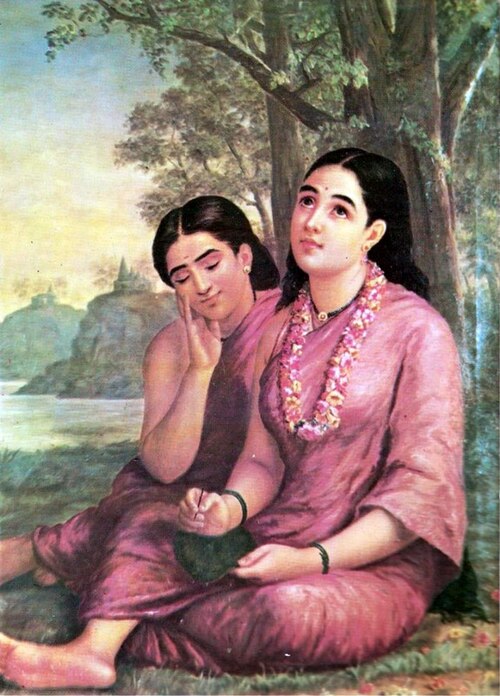
Painters and film-makers helped fix its images in popular memory. Raja Ravi Varma painted Śakuntalā writing her love letter to Duṣyanta in the 1870s, winning praise at a Madras exhibition, and returned to the subject many times; reproduced as inexpensive prints, his pictures helped popularize his image of her. Indian cinema has filmed the story repeatedly from the silent era onwards.
Rabindranath Tagore wrote influential essays on the play, reading it as the story of a love first driven by passion and then purified through suffering and penance. This moral reading was taken up by many Indian scholars in the twentieth century. Others have since challenged it, arguing that the play itself never treats Śakuntalā’s marriage as wrong.
The play is also performed. The Kālidāsa Samaroh at Ujjain, first held in 1958 and now organized every year by the Kalidasa Akademi, stages his plays in Sanskrit and in other Indian languages. Kavalam Narayana Panikkar, a leading figure of the “theatre of roots” movement whose productions drew on the movement vocabulary of Kerala’s classical and ritual arts, staged Kālidāsa’s play in 1982. Even so, Johnson observes that full productions are rare even in India, and that the play’s reputation rests more on its poetry than on its stage history.
Advanced
Evidence and method: manuscripts and recensions
No manuscript from Kālidāsa’s time survives. The play was copied by hand for centuries in different regional scripts, and the copies fall into distinct groups, usually called recensions: the Bengali (eastern), the Devanagari (northern and western), the Kashmiri and the South Indian (sometimes called Dravidian), the last preserved in Telugu, Grantha and Malayalam scripts. Some scholars also distinguish a Maithili version. The recensions differ in length, in readings and even in names: the Bengali has the king as Duṣmanta (Jones’s “Dushmanta”) and the nymph of Act Six as Miśrakeśī rather than Sānumatī, and its love scene in Act Three is much longer.
Which version is closest to Kālidāsa has been argued since the nineteenth century. Jones unknowingly translated a Bengali manuscript, and Chézy’s first edition (Paris, 1830) was based on a single manuscript of the Bengali recension, collected in Bengal and kept in the Royal Library in Paris. In 1842 Otto Böhtlingk edited the Devanagari text at Bonn, and in his edition of 1853 Monier Monier-Williams declared the Devanagari version “older and purer”, blaming Bengali scribes for padding the text. Richard Pischel replied with a critical edition of the Bengali recension (1877), arguing on the evidence of its Prakrit, which is consistent where the other versions mix dialects, that it was the more authentic, and that South Indian copyists had abridged the play.
The debate has not been settled. Many modern translators use the Devanagari or Bengali text; W. J. Johnson suggests that some extra Bengali material may have been added for performance. In the mid-2000s Somadeva Vasudeva published an English translation of the previously untranslated Kashmiri recension, which scholars value as an independent witness, and in 2018 Vasantkumar Bhatt circulated a reconstructed text based on comparison of five versions. Editors use the classic methods of textual criticism: comparing manuscripts, weighing the testimony of commentators such as the South Indian Kāṭayavema and Abhirāma, and checking quotations in later works on poetics.
The practical lesson for readers is that there is no single “original” Śakuntalā available to us. Every translation depends on a particular edition and its editorial choices, usually based mainly on one recension, so a passage that one reader quotes as typical of Kālidāsa may be absent from another reader’s text.
Advanced
Different perspectives
When was it written? The play itself gives no date. Jones repeated the Indian tradition that Kālidāsa was one of the “nine gems” at the court of a King Vikramāditya in the first century BCE, the king associated with the Vikrama era of 57 BCE. Most modern scholars reject this for lack of evidence and place Kālidāsa in the Gupta period on grounds of style, culture and the title Vikramāditya taken by Chandragupta II; Pollock, for example, accepts roughly 390–470 CE, while Ryder simply said “probably the fifth century”. The only hard limit is the Aihole inscription of 634 CE, whose poet boasts of rivalling the fame of Kālidāsa and Bhāravi.
Romantic “Orient” or Indian aesthetics? European admirers from Goethe onwards praised the play as an image of natural innocence, pure morality and gentle religion. Pollock argues that these categories, set by Goethe, have limited criticism ever since, and that Goethe’s enthusiasm deserves study as part of what Edward Said called Orientalism. As the Bengali poet and scholar Alokeranjan Dasgupta has emphasized, Goethe loved Indian poetry while disliking Indian religion and philosophy. European critics also complained that the play lacked conflict and character development, judging it by Aristotle’s standards. Scholars such as Johnson answer that Sanskrit drama aimed at rasa, not at plot and catharsis. Pollock, in turn, warns against using rasa merely to declare Indian literature different, and finds the play’s deeper meaning in its design and its myth of empire.
How should we read Śakuntalā as a woman? Romila Thapar contrasts the outspoken heroine of the epic, who demands her son’s rights and denounces the king, with Kālidāsa’s gentler, more submissive figure, and traces how colonial translators and nineteenth-century middle-class nationalists turned her into the model of the modest, devoted Hindu wife. Tagore’s reading of her “fall” and penance fits this pattern. Other readers stress that the play does not condemn her: her marriage is lawful, the fault lies with a curse, and in Act Five she rebukes the king sharply before her own escort tells her to obey her husband. Whether the play limits her voice or gives her dignity within the rules of its world remains an open, and lively, question.
Key ideas
- Abhijñāna (token of recognition)
- An object that proves identity: the ring, and in the last act the boy’s amulet. The title promises that recognition will come.
- Gāndharva marriage
- A union by mutual consent without family arrangement, one of the eight forms of marriage in Sanskrit law books; Duṣyanta and Śakuntalā marry this way.
- Curse and memory
- Durvāsas’s curse frees the king from blame and turns the story into a meditation on memory, loss and remorse.
- Śṛṅgāra rasa
- The aesthetic experience of love, which the Nāṭyaśāstra divides into union and separation; the play moves from one to the other and back.
- Sympathy of nature
- Plants and animals share human feelings, and the hermitage grieves when Śakuntalā leaves.
- Daiva (fate)
- Omens and divine voices show that meeting, separation and reunion follow a cosmic plan that leads to Bharata’s birth.
- Bilingual stage
- Sanskrit and Prakrit mark rank and gender, so the language a character speaks tells the audience who they are.
Records
- 57 BCE — The Vikrama era begins. Much later tradition, repeated by William Jones, put Kālidāsa at the court of a King Vikramāditya of this time; most modern scholars reject this.
- c. 400 CE — Kālidāsa is usually thought to have been active around this time under the Gupta kings; proposals range roughly from 375 to 470 CE.
- 634 CE — The Aihole inscription of the Chalukya king Pulakeśin II names Kālidāsa as a famous poet, the firmest late limit for his date.
- 1789 — William Jones publishes Sacontalá; or, The Fatal Ring in Calcutta, the first translation of a Sanskrit play into a European language.
- 1791 — Georg Forster’s German version, made from Jones’s English, appears; Goethe writes his four-line epigram on Śakuntalā.
- 1808 — Goethe publishes Faust Part One, whose “Prelude on the Theatre” many critics link with Kālidāsa’s prologue.
- 1830 — Antoine-Léonard de Chézy publishes the first printed Sanskrit text in Paris, from Bengali manuscripts.
- 1842 — Otto Böhtlingk edits the Devanagari recension at Bonn, opening a long debate over which version is closest to Kālidāsa.
- 1877 — Richard Pischel publishes his critical edition of the Bengali recension.
- 1958 — The first Kālidāsa Samaroh is held at Ujjain; it later becomes an annual festival of his plays.
Glossary
- Nāṭaka
- The most important type of Sanskrit play: based on a well-known story, with a celebrated, noble hero, usually a king.
- Nāṭyaśāstra
- The classical Sanskrit handbook of theatre, attributed to the sage Bharata, covering acting, music, dance, language and rasa.
- Rasa
- Literally “taste”: the aesthetic experience an audience savours when a work of art evokes a lasting emotion.
- Prakrit
- A group of Middle Indo-Aryan languages related to Sanskrit; on the Sanskrit stage they are usually spoken by women and most lower-ranking characters.
- Vidūṣaka
- The jester of Sanskrit drama, a Brahmin companion of the king who speaks Prakrit and provides comedy; in this play he is called Mādhavya.
- Sūtradhāra
- The stage director, who speaks the prologue and introduces the play to the audience.
- Recension
- A distinct version of a text that has developed in a particular region or manuscript tradition.
- Kaḷavu and kaṟpu
- In classical Tamil poetics, secret love before marriage and wedded love, the two phases of love poetry.
Questions and answers
Why did the king forget Śakuntalā?
Because of a curse. The sage Durvāsas felt insulted when Śakuntalā, daydreaming about the king, did not greet him, and cursed her so that the king would not remember her until he saw a token he had given her.
How did the ring get inside a fish?
It slipped off Śakuntalā’s finger while she was offering worship at a sacred bathing place on the Ganges on her way to the palace. A fish swallowed it, and a fisherman found it when he cut the fish open.
Why do some characters speak Sanskrit and others Prakrit?
Sanskrit drama used language to mark rank and gender: as a rule, kings, sages and other high-ranking men speak Sanskrit, while women, servants and humble people speak various Prakrits, following conventions described, with some exceptions, in the Nāṭyaśāstra.
Did Goethe really model Faust on this play?
Goethe admired the play deeply and wrote a famous four-line epigram about it in 1791. Many critics think the “Prelude on the Theatre” in Faust was suggested by Kālidāsa’s prologue, but this is a scholarly inference rather than a documented statement by Goethe in Faust.
Which text of the play is the real one?
We cannot be sure. The play survives in several regional recensions, chiefly Bengali, Devanagari, Kashmiri and South Indian, which differ in length and wording; scholars have argued for two centuries over which is closest to Kālidāsa.
Is Śakuntalā a passive heroine?
Readers disagree. Romila Thapar sees a shift from the assertive heroine of the epic to a submissive ideal wife, reinforced by later colonial and nationalist readings; others point out that in Act Five she angrily denounces the king and that the play never treats her marriage as wrong.
Sources and further reading
- Arthur W. Ryder (trans.), Kalidasa: Translations of Shakuntala and Other Works (introduction, translation, and the epic tale of Shakuntala). J. M. Dent / E. P. Dutton (Project Gutenberg edition), 1912
- William Jones (trans.), Sacontalá; or, The Fatal Ring: An Indian Drama by Cálidás, translated from the original Sanscrit and Prácrit (scan of the Calcutta edition). Calcutta (Internet Archive), 1789
- Georg Forster (German version from Jones’s English), Sakontala oder der entscheidende Ring: ein indisches Schauspiel (scan, Bayerische Staatsbibliothek copy). Johann Peter Fischer, Mainz and Leipzig (Internet Archive), 1791
- Monier Monier-Williams (ed.), Śakuntalá; or, Śakuntalá Recognized by the Ring: the Devanágarí Recension of the Text (preface and notes). Stephen Austin, Hertford (Internet Archive), 1853
- Richard Pischel (ed.), revised by Carl Cappeller, Kalidasa’s Śakuntala: An Ancient Hindu Drama, critically edited in the original Sanskrit and Prakrit of the Bengali recension (2nd ed.; 1st ed. 1877). Harvard University Press, Harvard Oriental Series 16 (Internet Archive), 1922
- Manomohan Ghosh (trans.), The Nāṭyaśāstra: A Treatise on Hindu Dramaturgy and Histrionics Ascribed to Bharata-Muni, vol. 1. Royal Asiatic Society of Bengal, Calcutta (Internet Archive), 1950
- Sheldon Pollock, What Happens in Śakuntalā: Conceptual and Formal Symmetries. In Namrata Chaturvedi (ed.), Memory, Metaphor and Mysticism in Kalidasa’s Abhijñānaśākuntalam, Anthem Press, 2020
- W. J. Johnson, Playing Around with Śakuntalā: Translating Sanskrit Drama for Performance. Asian Literature and Translation 1(2), Cardiff University Press, 2013
- Romila Thapar, Sakuntala: Texts, Readings, Histories (publisher’s description and contents: chs. 2–3 on the epic and the play, chs. 6–8 on Orientalist, colonial and nationalist readings). Columbia University Press, 2011
- Thapar’s Reading of Sakuntala’s Story: An Outline (secondary course handout summarizing Thapar’s book). Northern Arizona University
- Somadeva Vasudeva (trans.), The Recognition of Shakúntala (Kashmir recension), Clay Sanskrit Library. New York University Press and JJC Foundation
- Goethe-Jahrbuch 126 (2009), incl. Yoshito Takahashi, “›Weltliteratur‹ bei Wieland und Goethe”, and Shaswati Mazumdar’s review of Alokeranjan Dasgupta, Goethe und Tagore. Goethe-Gesellschaft / Wallstein Verlag, 2009
- Philippe-Édouard Foucaux, La Reconnaissance de Sakountala: Introduction. Wikisource (French), 1867
- Paul Brians, Kalidasa: The Recognition of Sakuntala (study guide). Washington State University
- Ram Ji Mishra and Zameerpal Kaur, Abhijnanshakuntalam in the Light of Karuna Rasa. The Creative Launcher 3(1): 323–330 (via Redalyc), 2018
- Abhijñānaśākuntalam. Wikipedia
- Sanskrit drama. Wikipedia
- Pritha Kundu, Kālidāsa’s ‘Śakuntalā’: ‘Lost’ and ‘Regained’ in Translation. Muse India 80, 2018
- Vasantkumar M. Bhatt, Abhigyana Shakuntala, Reconstructed Text. Internet Archive, 2018
- Sakuntala, D.701 (Schubert, Franz). IMSLP Petrucci Music Library
- James Legge (trans.), A Record of Buddhistic Kingdoms: Being an Account by the Chinese Monk Fâ-hien of His Travels in India and Ceylon (A.D. 399–414). Clarendon Press, 1886 (Project Gutenberg), 1886
- J. J. O’Connor and E. F. Robertson, Aryabhata the Elder. MacTutor History of Mathematics Archive, University of St Andrews
- Tolkāppiyam (Tamil text), Poruḷatikāram 3.3 Kaḷaviyal. Project Madurai
- Kalaviyal – I (course lesson D02114 on Nampi’s Akapporuḷ, a later Tamil grammar of love). Tamil Virtual Academy
- Gandharva marriage. Wikipedia
- Gupta Empire. World History Encyclopedia, 2015
- Aihole inscription. Wikipedia
- Aihole Inscription: In Praise of the Chalukyas of Badami. LiveHistory India
- Article 1: Name and Territory of the Union. Constitution of India (constitutionofindia.net)
- Shakuntala with Her Companion – Raja Ravi Varma. Ganesh Shivaswamy Foundation, on Google Arts & Culture
- Shakuntala Patra-lekhan. Wikipedia
- Kalidasa Samaroh. Kalidasa Sanskrit Akademi, Ujjain
- Kavalam Narayana Panicker smells of good earth. Deccan Chronicle, 2016
- Kavalam Narayana Panicker. Wikipedia
- Monier Monier-Williams (trans.), Sakoontala; or, The Lost Ring: An Indian Drama (translation first published 1855; preface to a later edition of the 1890s). Project Gutenberg
- Jérôme Petit, Antoine-Léonard Chézy (1773–1832). Bibliothèque nationale de France, France–South Asia heritage portal
Related
- KālidāsaA Sanskrit poet and playwright whose works are landmarks of classical Indian literature.
- MahabharataA vast Sanskrit epic centered on a conflict between related royal families, with the Bhagavad Gita among its parts.
- Johann Wolfgang von GoetheGerman writer whose poetry, drama and fiction, from the Sturm und Drang to Weimar Classicism, became central to German literature and European culture.
- Rabindranath TagoreBengali poet, writer and educator whose work reached readers across India and the wider world.
- Tirukkuṟaḷ (Kural)Tamil classic of 1,330 two-line verses on virtue, wealth and government, and love, attributed to the poet Tiruvalluvar and probably composed around the fifth century CE.
- AryabhataAn Indian mathematician-astronomer whose Āryabhaṭīya gave π ≈ 3.1416, a sine table and the idea that the Earth rotates daily.
Written with AI assistance from the published sources listed above, and revised as new research appears.