Start at the top for an easy introduction. Go further down for more detail and scholarship.
- Easy
- Intermediate
- Advanced
For young readers
Imagine a book where every lesson fits into just two short lines. You could learn one on the way to school and still remember it when you are grown up. The Tirukkuṟaḷ, often simply called the Kural, is that kind of book. It was written in Tamil, a language that people in south India and Sri Lanka have spoken and written for more than two thousand years.
The Kural has 1,330 little poems called couplets. They are grouped into 133 chapters of exactly ten couplets each, like 133 small boxes with ten treasures inside. The chapters talk about being kind, telling the truth, saying thank you, learning, choosing good friends, how a king should rule, why farmers matter, and even how it feels to fall in love.
One famous couplet says that the best way to “punish” someone who hurt you is to make them feel ashamed by being good to them. Another says that a person who forgets a kindness done to them has done something worse than almost any other wrong. These ideas are simple to say but hard to live by, and that is why people keep reading them.
Nobody knows for sure who wrote the Kural or exactly when. Tradition gives the author the name Tiruvalluvar, and many stories are told about him, but most of them were written down many centuries later. Experts still argue about whether he lived about 2,300 years ago or nearer 1,500 years ago, and about which religion, if any, he followed.
Today the Kural is everywhere in Tamil Nadu, a state in south India. Children learn couplets at school, and a giant stone statue of Tiruvalluvar, as tall as a 13-storey building, stands on a rock in the sea at Kanyakumari, the southern tip of India.
At a glance
- What
- A collection of short ethical and practical verses (couplets) in classical Tamil
- Author
- Attributed to Tiruvalluvar (Valluvar); the text itself names no author, and nothing reliable is known about his life
- When
- Disputed: modern proposals mostly range from about 300 BCE to the 6th century CE (Pope in 1886 even suggested 800–1000 CE); many scholars follow Kamil Zvelebil’s 450–500 CE
- Where
- The Tamil-speaking south of the Indian subcontinent; tradition links the poet to Mylapore (today part of Chennai) and to Madurai
- Structure
- 1,330 couplets in 133 chapters of ten; three books: aṟam (virtue, 38 chapters), poruḷ (wealth and polity, 70) and iṉpam or kāmam (love, 25)
- Metre
- Kuṟaḷ veṇpā: two lines, the first of four metrical feet and the second of three
- Commentaries
- Ten medieval commentators are named by tradition; five commentaries survive almost complete, of which Parimēlaḻakar’s (late 13th century) became the standard
- Print and translation
- First printed in Madras in 1812; Latin translation of books 1–2 by C. J. Beschi (1730); complete English versions by W. H. Drew and J. Lazarus (prose, 1840s–1885) and G. U. Pope (verse, 1886); now in dozens of languages
Easy
What is the Tirukkuṟaḷ?
The Tirukkuṟaḷ is a book of wisdom poetry written in classical Tamil. Its name joins the honorific tiru, “holy” or “excellent”, with kuṟaḷ, the name of the very short two-line verse form in which every one of its poems is composed. In English it is usually called the Kural, and its poems are called couplets or simply kurals.
The book does not tell a story. Instead it offers 1,330 separate sayings, each complete in itself, about how to live well. They range from the most personal questions, such as how to control anger or why one should not envy others, to public ones, such as how a ruler should choose ministers, gather taxes and defend a country. The last part turns to love between a man and a woman, described through the feelings of the lovers themselves.
The Kural belongs to a group of eighteen shorter works of Tamil literature, mostly didactic, that later tradition gathered under the name Patiṉeṇkīḻkkaṇakku (“the eighteen minor works”). It quickly became the most famous of them. A Tamil Buddhist epic of around the sixth century, the Maṇimēkalai, already quotes one of its couplets, with only a slight change of wording, and calls its author “the poet who does not lie”.
Because the Kural speaks about conduct without telling the reader which god to worship or which ritual to perform, people of many faiths have treated it as their own and translated it again and again.
Easy
How the book is built: three books, 133 chapters, 1,330 couplets
The Kural is unusually regular. It has 133 chapters (atikāram), and each chapter has exactly ten couplets on one theme, announced by its title. The chapters are grouped into three books (pāl). The first, Aṟattuppāl, the Book of Virtue, has 38 chapters (380 couplets). The second, Poruṭpāl, the Book of Wealth or Polity, is by far the longest, with 70 chapters (700 couplets). The third, Kāmattuppāl or Iṉpattuppāl, the Book of Love, has 25 chapters (250 couplets).
Within the books, modern editions also mark smaller groups. The Book of Virtue opens with four introductory chapters, beginning with “The Praise of God” and “The Excellence of Rain”, then moves through chapters on the virtues of the householder and on the virtues of the renouncer, and ends with a single chapter on fate. The Book of Love follows the two great phases of classical Tamil love poetry: secret, premarital love (kaḷavu) and wedded love (kaṟpu). Older commentators did not all agree on these smaller groupings, as later sections explain.
Every couplet uses the same metre, the kuṟaḷ veṇpā. The first line has four metrical feet (cīr) and the second has three, so each verse is seven “feet” long and ends on a short, final-sounding line. The form forces extreme compression: a whole argument, a comparison and a conclusion must fit into a space smaller than a modern text message. The very first couplet shows the style: “As the letter A comes first of all letters, so the Primal Lord comes first of the world.”
The three books match three of the four “aims of human life” of Sanskrit learning: dharma (virtue), artha (wealth and power) and kāma (pleasure). The fourth, mokṣa or liberation, has no book of its own; the commentator Parimēlaḻakar explained that liberation cannot be described in words. Whether the plan was borrowed from Sanskrit tradition or grew from Tamil ideas is still debated.
Easy
What does it teach? Virtue, compassion, learning, statecraft and love
The Book of Virtue builds a picture of a good person step by step. It praises the household life: a loving family, care for guests, sweet speech and gratitude. One couplet says that a person may find a way out after destroying any other good, but there is no way out for one who destroys gratitude (verse 110). Further chapters warn against envy, slander, greed and anger, and set a demanding standard for how to treat enemies: “To punish those who do you harm, shame them by doing them good” (verse 314).
Compassion for all living beings is one of the book’s strongest themes. A chapter on “Abstaining from Meat” follows directly after the chapter on compassion and asks how anyone who fattens his own flesh by eating the flesh of others can possess kindness (verse 251). Another chapter, on “Not Killing”, opens: “What is virtuous action? Not killing. Killing brings in its train every other wrong” (verse 321). Many scholars connect this strict non-violence and vegetarianism with Jain ethics, though it is also shared by other traditions in India.
The Book of Wealth is a practical guide for kings, ministers and citizens. It begins by listing what a ruler needs: an army, a people, resources, ministers, allies and fortifications (verse 381). It goes on to discuss education (“Learn thoroughly what should be learned; then live by it”, verse 391), the danger of flatterers, just and unjust rule, the use of spies, diplomacy, friendship, and vices such as drink and gambling. It gives special honour to farming: “However the world turns, it follows the plough; so, toilsome though it is, farming is foremost” (verse 1031).
The Book of Love is something quite different from a moral treatise. It is poetry spoken in the voices of a lover, a beloved and her companion, following the conventions of earlier Tamil love poetry. A young man meets a woman whose eyes, he says, hold two looks: “one causes the sickness, the other is its cure” (verse 1091). Later chapters describe longing during separation, gossip in the village, and the little quarrels of married lovers; the very last chapter celebrates the joy of making up after a lovers’ sulk.
Intermediate
When was it written? A date still in dispute
No inscription, manuscript or datable reference fixes when the Kural was composed, so every date is an inference. Proposals stretch over almost a thousand years. Tamil traditionalists, following the legend that the Kural was the last work presented to the third Tamil academy, have placed it as early as about 300 BCE. Others have argued for the first century BCE or the first century CE.
In the early twentieth century, Tamil revivalists led by the scholar Maraimalai Adigal settled on 31 BCE as Valluvar’s birth year. This was a symbolic choice rather than a result of new evidence, but it became the starting point of the “Thiruvalluvar year”, a Tamil era later used in official Tamil Nadu documents alongside the Gregorian calendar.
Most academic specialists argue for a later date, using the language of the text. The Kural contains grammatical forms and a share of Sanskrit loanwords not found in the oldest layer of Tamil poetry, uses the veṇpā metre that became popular after that layer, and seems aware of Sanskrit treatises usually dated to the first centuries CE. On such grounds the Tamil scholar S. Vaiyapuri Pillai placed it in the sixth century or later, while the Czech Tamilologist Kamil Zvelebil, after first suggesting 450–550 CE (1973), narrowed it to 450–500 CE (1974), a range widely cited today. Blackburn described a date of about 500 CE as the current scholarly consensus.
The latest possible dates are limited by the Maṇimēkalai, which quotes the Kural and is itself usually dated around the sixth century, though that date too is debated. G. U. Pope’s nineteenth-century proposal of 800–1000 CE, tied to his belief that the poet had absorbed Christian teaching, is no longer defended. Here Zvelebil’s 450–500 CE is used as a working estimate, not a settled fact.
Intermediate
Ten medieval commentators and the authority of Parimēlaḻakar
Short, dense verses invite explanation, and the Kural attracted more commentaries than any other Tamil literary work of the medieval period. A traditional “stray verse” names ten commentators: Tarumar, Maṇakkuṭavar, Tāmattar, Naccar, Paridhi (Paritiyār), Parimēlaḻakar, Tirumalaiyar, Mallar, Paripperumāḷ and Kāliṅkar. The commentaries of Maṇakkuṭavar, Paridhi, Kāliṅkar, Paripperumāḷ and Parimēlaḻakar survive almost complete; those of Tarumar, Tāmattar and Naccar survive only in fragments, and the rest are lost.
Dates for the commentators are uncertain, and scholars place them between the tenth and the fifteenth centuries. Maṇakkuṭavar is generally regarded as the earliest surviving commentator, writing around the late tenth century, and his remarks suggest that others had explained the text before him. Parimēlaḻakar wrote in the late thirteenth century; he is usually described as a Brahmin scholar from Kanchipuram, at home in both Sanskrit and Tamil learning.
The commentators did more than explain words. They also arranged the text. All of them accept the three books, the 133 chapters and nearly the same ten verses in each chapter, but they differ in how they divide the books into sub-sections, in the order of verses within chapters and, especially in the Book of Virtue, in the order and grouping of some chapters: Maṇakkuṭavar, for example, places several chapters among the householder’s virtues that later editions put among the renouncer’s, and vice versa. In other words, the order of couplets that readers see today is itself an interpretation.
Parimēlaḻakar’s version won. His commentary alone received sub-commentaries, the first printed edition of 1812 followed his arrangement, and almost every later edition and translation has done the same. His reading had a slant: he defined aṟam (virtue) as doing what texts such as the law book of Manu command and avoiding what they forbid. In the twentieth century, Tamil writers such as Pulavar Kuḻantai wrote new commentaries against him to free the Kural from Brahmanical and Sanskrit frameworks.
Intermediate
From palm leaf to print, and into many languages
For more than a thousand years the Kural circulated through memory and through palm-leaf manuscripts, which decay quickly in the hot, humid climate of south India; most surviving manuscripts are no more than two or three centuries old. Grammarians quoted its verses by the hundreds as model examples of good Tamil, so the text was kept alive in several streams at once.
European missionaries met the Kural early. The Italian Jesuit Costanzo Giuseppe Beschi translated the first two books into Latin in 1730, leaving out the Book of Love, a choice usually explained by his view that such poetry was unsuitable for a missionary to translate. Missionaries saw in this moral book common ground with Christian ethics. In 1812 the Tamil text was printed for the first time in Madras, an edition associated with the circle of Francis Whyte Ellis, the British Collector of Madras, whose own partial English translation appeared around the time of his death in 1819.
The first complete English translation by a single translator, in verse, was made by the missionary George Uglow Pope and published in London in 1886, with Beschi’s Latin and Ellis’s English reprinted in its notes; a complete English prose version had just been finished, begun by W. H. Drew in the 1840s and completed by John Lazarus in 1885. The German missionary scholar Karl Graul had already published German and Latin versions, and French, Russian and many other language versions have also appeared. Counts of languages vary: one widely repeated figure is 57, and in December 2025 the director of India’s Central Institute of Classical Tamil said the Kural had been translated into 34 languages, including 25 Indian languages, with dozens more planned.
Translations carried the Kural into world conversations about ethics. In his “Letter to a Hindu”, dated 14 December 1908, Leo Tolstoy quoted several couplets from what he called “the Hindu Kural”, including the advice to shame wrongdoers by doing them a great kindness, in support of his argument that evil should not be resisted by violence; Mohandas K. Gandhi wrote an introduction to the letter and published it in Gujarati translation.
Intermediate
Meanwhile in the world: ethical verse and the science of kings in South Asia
If the Kural was composed around the fifth century, it belongs to a period when, across South Asia, the ideal of the good life was being set down in short, memorable verse and in systematic treatises. The clearest connections are not political events but shared ideas and forms, and they can be traced in the texts themselves.
The first connection is with Sanskrit śāstra, the “sciences” of conduct. The Kural’s three books mirror the Sanskrit trio of dharma, artha and kāma, each with its own literature: law books such as the Manusmṛti, the Arthaśāstra on government, and the Kāmasūtra on love. Some parallels are close: the six things a king must possess in the opening couplet of the Book of Wealth, together with the king himself, correspond to the seven elements of the state listed at the start of Book VI of the Arthaśāstra. Yet scholars also point to differences: the Kural gives farmers a primacy the Arthaśāstra does not, and, as several Tamil scholars stress, it addresses virtue to everyone rather than dividing it by caste. In the north, meanwhile, the Gupta dynasty (c. 320–550) presided over a flowering of Sanskrit court literature, including the poetry and drama of Kalidasa, a world of refined ornament quite unlike the Kural’s plain aphorisms.
The second connection is with Buddhist and Jain verse teaching. The Pali Dhammapada, an anthology of 423 verses in 26 thematic chapters, was already an old text by the fifth century, when the great commentary on it, traditionally credited to the scholar Buddhaghosa working in Sri Lanka, was compiled. Like the Kural, it arranges brief ethical verses under thematic chapter headings, and modern scholars have written comparative studies of the two books. Within Tamil itself, the Jain Nālaṭiyār, four hundred moral quatrains also arranged under virtue, wealth and love, became so closely paired with the Kural that a Tamil proverb ranks them together.
A third connection shows the Kural crossing religious boundaries almost from the start. The Buddhist Maṇimēkalai quotes a Kural verse to support its own story, and much later a fourteenth-century Jain commentator called the Kural “our scripture”. The Kural thus took part in a shared South Asian culture of moral verse in which Hindus, Jains and Buddhists drew on, and competed over, the same stock of ideas about non-violence, self-control and good government.
Intermediate
The Kural in modern Tamil Nadu: monuments, portraits and politics
In the twentieth century the Kural became a symbol of Tamil identity. Leaders of the Dravidian movement, which opposed what it saw as Brahmin and Sanskritic domination, held it up as proof of an independent, ethical Tamil civilisation; the reformer Periyar E. V. Ramasamy, who had first dismissed it as too close to Brahmanical law books, later praised it as a foundation of Dravidian culture. Tamil Nadu marks Thiruvalluvar Day each January, and couplets are displayed in public places, including on buses.
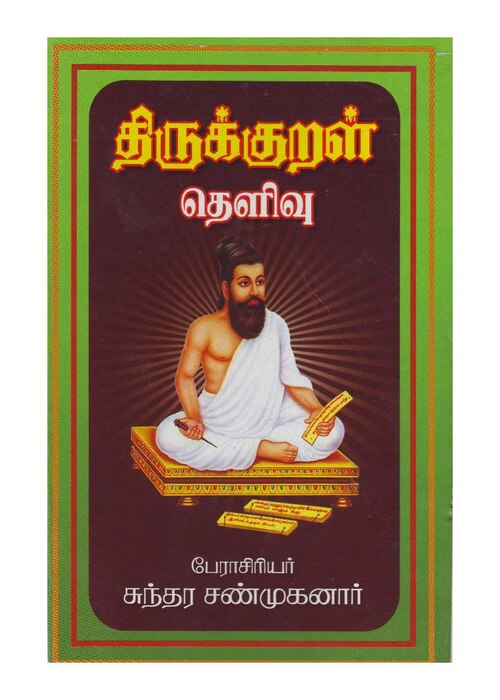
The poet’s image was shaped deliberately. A portrait by the painter K. R. Venugopal Sharma, showing Valluvar in white robes with a long beard and no religious or caste marks, gained official recognition in the 1960s; it was unveiled in 1964 by Zakir Husain, then Vice-President of India, and became the version reproduced in government offices and publications. The artist explained that he left out sectarian signs because the Kural teaches how people should live righteously, not a particular creed.
Monuments followed. In Chennai the Valluvar Kottam, built in the mid-1970s under Chief Minister M. Karunanidhi and designed by the architect V. Ganapati Sthapati, has a stone replica of a temple chariot and halls where all 1,330 couplets are carved in granite; it opened in 1976 and reopened after renovation in 2025. On 1 January 2000 Karunanidhi inaugurated Ganapati Sthapati’s 133-foot (about 41-metre) stone statue of Tiruvalluvar on a rock off Kanyakumari: its 38-foot pedestal stands for the 38 chapters on virtue and the 95-foot figure for the books on wealth and love.
Because the poet’s image carries so much meaning, changing it causes conflict. In November 2019 the Tamil Nadu unit of the Bharatiya Janata Party posted a picture of Valluvar in saffron robes with sacred ash and rudrākṣa beads. Opposition parties, led by the DMK, accused it of trying to claim a universal poet for Hindu nationalism, while BJP leaders replied that Dravidian parties had earlier stripped him of his Hindu symbols. Soon afterwards a Valluvar statue at Pillaiyarpatti near Thanjavur was defaced, deepening the row over who may define the poet’s image.
Advanced
Different perspectives
Dating schools. A traditional and Tamil-nationalist school places Valluvar in the last centuries BCE, linking him to the Caṅkam legend and, for some, to the symbolic 31 BCE. A philological school, represented by Vaiyapuri Pillai and Zvelebil, uses language, metre, loanwords and relations to other texts to argue for roughly the fifth or sixth century CE. Behind the numbers lies a deeper question: whether the Kural is seen as a product of the earliest Tamil past or of a later, more mixed culture. Neither extreme can be proven; a fifth- or early-sixth-century date has the widest academic support, but specialists still regard the matter as open.
Religious affiliation. Almost every religious community in south India has claimed the poet. Many scholars, including Zvelebil and the Jain scholar A. Chakravarti, see a Jain background in the stress on non-killing, vegetarianism and self-restraint and in epithets for God such as “he who walked on the flower” and “the one of eight qualities”. Others read the work as Hindu, pointing to the dharma–artha–kāma plan, a reference to “the lotus-eyed one” (usually Vishnu) and Parimēlaḻakar’s commentary; some argue specifically for Śaiva Siddhānta. The Dalit Buddhist reformer Iyothee Thass claimed it as Buddhist, Pope saw Christian influence, and many modern readers stress its non-sectarian character. As the scholar François Gros noted, even lotus imagery is shared by Vishnu, Brahmā, the Jain tīrthaṅkaras and the Buddha.
Sanskrit or Tamil? A related debate asks how much the Kural owes to Sanskrit literature. At one extreme, R. Nagaswamy has argued that it is essentially an abridgement of Sanskrit treatises; at the other, writers in the Dravidian tradition have read it as a deliberate rejection of Sanskritic and Brahmanical values. Between these poles, many scholars accept that the Kural knows Sanskrit ideas and sometimes echoes them closely, as in the list of a kingdom’s elements, while disagreeing about how far it reshapes them in Tamil poetic forms. Some, such as S. Maharajan, argue that its idea of aṟam is universal, unlike the caste-specific duties of the Dharmaśāstras; others read it within the Brahmanical framework, as Parimēlaḻakar did.
Translation choices. Translation choices can shape interpretation, and some translations reflect identifiable positions. Beschi left out the Book of Love; Pope framed the poet as an eclectic touched by Christianity; translators must decide whether to render aṟam as “virtue”, “righteousness” or the Sanskrit-laden “dharma”, and whether the Ādi Bhagavan of the first couplet is “God”, “the Primal Lord” or an untranslated name. Following Parimēlaḻakar’s order and sub-sections, as almost all translations do, also carries over one medieval reading. Comparing versions can therefore reveal different assumptions about the Kural’s religion and its relation to Sanskrit culture.
Advanced
Evidence and method: reading a text without an author or a date
The study of the Kural rests on unusual evidence. There is no autograph, no early manuscript and no external biography. Between the probable time of composition and the oldest surviving manuscripts lies a gap of perhaps a thousand years. Scholars therefore depend on three kinds of witness: quotations in other works (the Maṇimēkalai’s citation of verse 55, and the hundreds of verses cited in grammatical commentaries such as Iḷampūraṇar’s on the Tolkāppiyam), the medieval commentaries with their competing orders of verses, and the internal evidence of language and content.
Each kind has limits. Quotations prove that a verse existed by a certain time but not that the whole book did, or in what order. Commentaries show how the text was read, but they also reshaped it, and modern print has hidden their disagreements by following Parimēlaḻakar alone. Linguistic dating depends on the dates of other Tamil texts, which are themselves debated. Some recent scholarship, such as Jason W. Smith’s study, therefore sets aside the search for the historical author and his religion and asks instead how the text, in the form readers actually have, works on its audience. Tracing how the legends, portraits and monuments were produced in the nineteenth and twentieth centuries, as Blackburn did for the legend, has become a separate field of study.
Key ideas
- Aṟam (virtue)
- Right conduct, the subject of the first book; it covers household duties such as hospitality and gratitude and, for renouncers, self-control and non-violence. Whether it should be equated with Sanskrit dharma is debated.
- Poruḷ (wealth and polity)
- The practical world of rulers, ministers, allies, armies, money, friendship and work, treated in the longest book of seventy chapters.
- Iṉpam or kāmam (love)
- Love between man and woman, in courtship and marriage, presented in the voices of the lovers following classical Tamil love-poetry conventions.
- Non-killing and vegetarianism
- Chapters 26 (Abstaining from Meat) and 33 (Not Killing) make compassion for all living beings a central virtue, a stance often linked to Jain ethics.
- Gratitude
- Chapter 11 treats remembering a kindness as a fundamental duty; forgetting it is presented as almost the only wrong with no escape.
- Returning good for harm
- The ideal of answering injury with kindness so that the wrongdoer feels shame (verse 314), cited by modern advocates of non-violence.
- The primacy of farming
- The chapter on agriculture calls farming the foremost occupation, because all others depend on those who plough.
Records
- c. 31 BCE — 31 BCE: the birth year later assigned to Valluvar by Tamil revivalists; a modern convention, not historical evidence, now the base of the “Thiruvalluvar year”.
- c. 450 CE — Probable period of composition according to Kamil Zvelebil (450–500 CE); other modern proposals mostly range from about 300 BCE to the 6th century.
- c. 550 CE — The Tamil Buddhist epic Maṇimēkalai, usually dated to around the 6th century, quotes a Kural couplet and calls its author “the poet who does not lie”.
- c. 975 CE — Maṇakkuṭavar writes what is generally regarded as the earliest surviving commentary on the Kural (late 10th century).
- c. 1275 — Parimēlaḻakar writes his commentary (late 13th century), which later becomes the standard arrangement and reading of the text.
- 1730 — The Jesuit missionary C. J. Beschi translates the books on virtue and wealth into Latin.
- 1812 — The Kural is printed for the first time, in Madras, following Parimēlaḻakar’s arrangement.
- 1886 — G. U. Pope publishes in London the first complete English verse translation by a single translator, reprinting Beschi’s Latin and Ellis’s English versions in the notes.
- 1908 — Leo Tolstoy quotes “the Hindu Kural” in his “Letter to a Hindu” (14 December), later introduced and translated into Gujarati by Gandhi.
- 1964 — K. R. Venugopal Sharma’s white-robed portrait of Valluvar, without sectarian marks, is unveiled by Vice-President Zakir Husain and becomes the official image.
- 1976 — The Valluvar Kottam memorial, with all 1,330 couplets carved in granite, opens in Chennai.
- 2000 — On 1 January a 133-foot stone statue of Tiruvalluvar is inaugurated on a rock off Kanyakumari.
Glossary
- Kuṟaḷ veṇpā
- The two-line Tamil metre of the Kural: four metrical feet in the first line, three in the second.
- Atikāram
- A chapter of the Kural; there are 133, each with ten couplets on one theme.
- Pāl
- One of the three books of the Kural: Aṟattuppāl (virtue), Poruṭpāl (wealth) and Kāmattuppāl (love).
- Caṅkam
- The legendary academies of Tamil poets at Madurai; the name is also used for the oldest layer of Tamil poetry.
- Patiṉeṇkīḻkkaṇakku
- “The eighteen minor works”, a later grouping of mostly didactic Tamil texts that includes the Kural and the Nālaṭiyār.
- Urai
- A prose commentary explaining a Tamil text verse by verse; the Kural has ten traditional commentators.
- Puruṣārtha (trivarga)
- The Sanskrit “aims of human life”: dharma, artha and kāma (the trivarga), plus mokṣa, liberation.
- Akam and puṟam
- “Inner” and “outer”: the two great categories of classical Tamil poetry, love and public life, echoed in the Kural’s books on love and polity.
Questions and answers
Why is every chapter exactly ten couplets long?
No one knows whether the author planned it or later editors regularised it. All the surviving medieval commentaries already have 133 chapters of ten verses, so the arrangement is at least about a thousand years old.
Did Tiruvalluvar really exist?
Someone composed the Kural, and the medieval commentators all treated it as the work of one author, but his real name and life are unknown. The stories about his parents, wife and miracles were written down much later and are treated by historians as legend.
Was the Kural written by a Jain, a Hindu, or someone else?
The text never says. Strong arguments exist for a Jain background, and Hindu readings are also old and widespread, while others see the work as deliberately non-sectarian. Most scholars agree that the evidence cannot settle the question.
Is the Kural older than the Bible or the Analects?
Probably not. Some Tamil traditions date it to the last centuries BCE, but most specialists place it around the fifth or sixth century CE, later than most of the Hebrew Bible and the Analects of Confucius.
Why did early translators leave out the Book of Love?
Beschi translated only the first two books in 1730, a choice usually explained by his view that a missionary should not translate erotic poetry. Later translators, including Pope, published all three books.
How reliable is the text we read today?
The wording of most verses is stable, though commentators record variant readings. What changed more is the arrangement: the order of verses within chapters, the sub-sections and, in the Book of Virtue, the order of some chapters in modern editions come from Parimēlaḻakar, and other commentators arranged them differently.
Why is the Kanyakumari statue 133 feet tall?
Its height matches the 133 chapters of the Kural; the 38-foot pedestal stands for the 38 chapters of the Book of Virtue, and the 95-foot figure for the other two books.
Sources and further reading
- Jason William Smith, Tacit Tirukkuṟaḷ: Religion, Ethics, and Poetics in a Tamil Literary Tradition (Th.D. dissertation). Harvard Divinity School, Harvard University, 2020
- Stuart Blackburn, Corruption and Redemption: The Legend of Valluvar and Tamil Literary History. Modern Asian Studies 34(2): 449–482, 2000
- Norman Cutler, Interpreting Tirukkuṟaḷ: The Role of Commentary in the Creation of a Text. Journal of the American Oriental Society 112(4): 549–566, 1992
- Kamil Zvelebil, The Smile of Murugan: On Tamil Literature of South India. E. J. Brill, Leiden, 1973
- Kamil Zvelebil, Tamil Literature (A History of Indian Literature, vol. X, fasc. 1). Otto Harrassowitz, Wiesbaden, 1974
- Tirukkuṟaḷ of Tiruvaḷḷuvar (Tamil text). Project Madurai
- G. U. Pope, The ‘Sacred’ Kurral of Tiruvalluva-Nayanar, with Introduction, Grammar, Translation, Notes. W. H. Allen & Co., London (Internet Archive scan), 1886
- Kural. Wikipedia
- Valluvar. Wikipedia
- Dating the Tirukkural. Wikipedia
- Tirukkuṟaḷ translations into Latin. Wikipedia
- Tirukkural translations into English. Wikipedia
- Manakkudavar. Wikipedia
- Valluvar year. Wikipedia
- Nālaṭiyār. Wikipedia
- First page of the 1812 Madras edition of the Thirukkural (image and description). Wikimedia Commons
- Ramanathan S., Is Tamil New Year really ‘Tamil’? Politics of Thai vs Chitirai. The News Minute, 2017
- Leo Tolstoy, A Letter to a Hindu (with an introduction by M. K. Gandhi). Project Gutenberg, 1908
- ‘Thirukkural’ translation to be made available in 30 more languages by Jan 2026, says official. The Week (PTI), 2025
- Tamil Nadu observes birth anniversary of poet-saint Thiruvalluvar. All India Radio News (newsonair.gov.in), 2026
- How did Venugopal Sharma create the official portrait of Thiruvalluvar? (in Tamil). Vikatan, 2019
- Valluvar Kottam. Chennai District Administration, Government of Tamil Nadu
- Valluvar Kottam back to glory; CM Stalin unveils 2.0 on June 21. DT Next, 2025
- Thiruvalluvar Statue. Kanniyakumari District Administration, Government of Tamil Nadu
- Thiruvalluvar Statue. Wikipedia
- Thiruvalluvar in orange robes: DMK and CPI(M) slam BJP for ‘saffronising’ legendary poet. The News Minute, 2019
- Venerated Tamil poet dragged into ugly political row in Tamil Nadu. Deccan Chronicle, 2019
- Acharya Buddharakkhita (trans.), The Dhammapada: The Buddha’s Path of Wisdom (introduction by Bhikkhu Bodhi). Access to Insight
- Dhammapada. Wikipedia
- Gupta Empire. World History Encyclopedia, 2015
Related
- ArthashastraAn ancient Sanskrit treatise on statecraft, covering government, law, economy, espionage, diplomacy and war.
- KālidāsaA Sanskrit poet and playwright whose works are landmarks of classical Indian literature.
- Siddhartha Gautama (the Buddha)Founder of Buddhism, who taught a path to liberation from suffering on the Ganges plain. His dates are disputed.
- AnalectsA collection of sayings and short dialogues of Confucius and his disciples, compiled after his death and read across East Asia for two thousand years.
Written with AI assistance from the published sources listed above, and revised as new research appears.