Start at the top for an easy introduction. Go further down for more detail and scholarship.
- Easy
- Intermediate
- Advanced
For young readers
A long time ago, a kingdom called Silla ruled the south-east of Korea, and later most of the Korean peninsula. Its capital was the city we now call Gyeongju. Silla lasted for almost a thousand years, which is longer than most kingdoms in history.
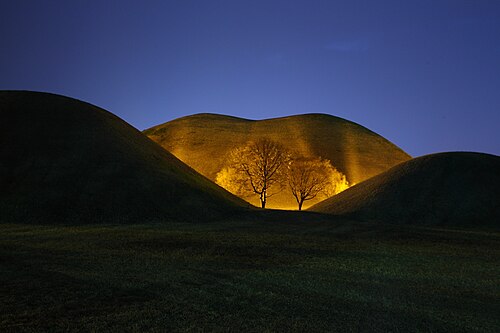
Today, if you walk around Gyeongju, you will see big grassy hills in the middle of the town. They are not ordinary hills. They are the tombs of Silla kings, queens and nobles. When archaeologists opened some of them, they found shining gold crowns, gold belts, glass cups from far-away lands and a painting of a flying white horse.
Near the tombs stands a stone tower shaped a bit like a bottle. It is called Cheomseongdae, and many people think the Silla people used it to watch the stars. There is also a pretty pond where a prince’s palace once stood, and a flat field full of huge stone blocks where the biggest temple in Korea used to be. It once had a wooden tower about as tall as a 25-storey building.
Just south of the city is a mountain called Namsan. Hidden in its forests are more than a hundred old temple sites and many Buddhas carved into the rocks, so people call it a museum without walls.
In the year 2000, UNESCO put these places on the World Heritage List, so that people all over the world would help look after them.
At a glance
- What
- A serial World Heritage property of five separate areas preserving the remains of Silla’s capital and its sacred mountain
- Where
- Gyeongju, North Gyeongsang Province, south-eastern South Korea
- Period
- Silla kingdom (traditionally 57 BCE – 935 CE); most surviving remains date from the 4th to 10th centuries CE
- The five areas
- Namsan (Mount Nam), Wolseong (royal palace), Daereungwon/Tumuli Park (royal tombs), Hwangnyongsa (great temple) and Sanseong (fortress)
- Size
- About 2,880 ha, with a buffer zone of about 350 ha (figures given for the inscribed property); 52 designated heritage items according to the Korea Heritage Service
- World Heritage
- Inscribed December 2000 (24th session, Cairns, Australia) under criteria (ii) and (iii); reference no. 976
- Famous sites
- Cheomseongdae, Wolseong, Donggung Palace and Wolji Pond, Cheonmachong and Hwangnam Daechong tombs, Hwangnyongsa site, Bunhwangsa pagoda, Namsan rock-carved Buddhas, Poseokjeong, Myeonghwalseong
- Not included
- Seokguram Grotto and Bulguksa Temple, also in Gyeongju, form a separate World Heritage property inscribed in 1995
Easy
What are the Gyeongju Historic Areas?
Gyeongju is a mid-sized city in south-eastern Korea. For almost a thousand years it was the capital of Silla, one of the three kingdoms of early Korea, which in the seventh century went on to rule most of the peninsula. Korean tradition dates Silla’s founding to 57 BCE and its end to 935 CE, when its last king handed his realm over to the new Goryeo dynasty. The city was then called Seorabeol or Geumseong; the name Gyeongju was given after Silla’s fall.
Unlike many ancient capitals, Silla’s capital was never buried under a later megacity. Royal tombs still rise between houses and roads, palace grounds lie open as parks, and temple foundations sit in rice fields. The Gyeongju Historic Areas are a selection of these remains, grouped into five separate zones and inscribed together on the UNESCO World Heritage List in 2000.
UNESCO’s description emphasises two things. First, Gyeongju contains an unusual concentration of Korean Buddhist art — sculptures, reliefs, pagodas and the ruins of temples and palaces — especially from the seventh to tenth centuries. Second, taken together, the areas bear witness to the whole culture of Silla: its city layout, its social structure and its way of life.
It helps to know what is not included. Seokguram Grotto and Bulguksa Temple on Mount Toham, east of the city, were listed separately in 1995. The Historic Areas are the capital and its surroundings: the palace, the tombs, the great city temples, the sacred southern mountain and the ring of fortresses.
Easy
How to read the map: five areas, five kinds of place
The five zones are not random. Each represents one side of life in a royal capital. The Korea Heritage Service summarises them like this: Namsan is a treasure house of Buddhist art; Wolseong is the palace ground of the thousand-year dynasty; Daereungwon (also called Tumuli Park) is where the great burial mounds of kings and nobles cluster; Hwangnyongsa represents the heart of Silla Buddhism; and Sanseong, the fortress area, shows the core of the capital’s defences.
Imagine the old city as a circle. In the middle, on a crescent-shaped rise beside the Namcheon stream, stood the royal palace of Wolseong. Just north and west of it lay the fields of giant tombs. To the north-east rose the city’s biggest temples. South of everything stood Namsan, a mountain filled with shrines and carved Buddhas. And on the hills to the east, fortress walls such as Myeonghwalseong guarded the approaches.
When you visit, you can read Silla’s history by moving between these zones. The tombs belong mostly to the period before Buddhism became the state religion; the temples show how Buddhism reshaped the city from the sixth century on; the palace pond and its finds show the refined court of the unified kingdom; and Namsan shows how the faith spread into the landscape itself.
The official list names 52 designated heritage items across the five areas, but some sources count differently, because a whole mountain such as Namsan contains hundreds of individual remains that are grouped under a smaller number of designations.
Easy
Hills full of gold: the royal tombs
The most striking sight in central Gyeongju is its tumuli — large grass-covered burial mounds, some more than ten metres high. The Daereungwon area contains several groups of them, including the tombs of Hwangnam-ri, Nodong-ri and Noseo-ri, the tomb traditionally assigned to King Michu, and the Five Royal Tombs (Oreung) associated with Silla’s legendary founders.
Many of the biggest mounds were built as stone-mound wooden-chamber tombs. Builders set up a wooden chamber for the coffin and grave goods, heaped a thick layer of river stones over it, and then covered everything with earth. When the wood rotted, the stones collapsed inward and sealed the chamber. That made the tombs very hard to rob, which is why so many treasures survived until modern times. These tombs were built on the Gyeongju plain on a large scale from roughly the fifth to the early sixth century.
Two excavations of the 1970s are especially famous. Cheonmachong, the ‘Heavenly Horse Tomb’ (Tomb No. 155), was excavated in 1973; it is about 47 m across and 12.7 m high and yielded more than 11,000 objects, including a gold crown and a painted birch-bark saddle flap showing a white flying horse, which gave the tomb its name. Nearby Hwangnam Daechong (Tomb No. 98), excavated from 1973 to 1975, is the largest known Silla tomb: two round mounds joined north to south, about 120 m long in total.
Hwangnam Daechong’s south mound held a man, and its north mound a woman. A silver belt fitting inscribed ‘buindae’ (夫人帶, ‘lady’s belt’) came from the north mound. The finds included gold crowns, belts, jewellery, weapons, pottery and glass vessels, some of which were brought over long distances. They show that Silla, although at the far eastern end of Eurasia, was linked to trade networks reaching China and beyond.
Intermediate
The Wolseong area: palace, sacred grove, observatory and pleasure pond
Wolseong (‘Moon Fortress’) was Silla’s main royal palace. It is a long, half-moon-shaped earthen enclosure about 890 m east–west and 260 m north–south, with a circuit of about 2,340 m. The Samguk sagi, the official history compiled in 1145, says that in the year 101 a fortress was built south-east of Geumseong and named Wolseong. Archaeology tells a somewhat later story: excavators report that its foundations were laid around the mid-fourth century and the walls completed in the early fifth. Almost nothing of the palace buildings stands above ground; the one standing stone structure, an icehouse (seokbinggo), dates from 1741, in the Joseon period.
Next to the palace lies Gyerim, a small wood of old trees. In Silla legend it is where the ancestor of the Kim royal clan was found as a baby in a golden box. Nearby is Cheomseongdae, a granite tower about 9 m tall (published figures range from 9.17 to 9.51 m): a square base, a curved, bottle-shaped body of 27 courses of stone, and a square, well-frame-shaped top. There is a small window about halfway up. The Samguk yusa, a thirteenth-century collection of histories and legends, says it was built in the reign of Queen Seondeok (632–647). It was designated a National Treasure in 1962.
North-east of Wolseong lies the pond known today as Wolji (formerly Anapji) with the site of Donggung, the ‘East Palace’, used for the crown prince and for royal banquets. The Samguk sagi records that King Munmu had a new pond dug inside the palace in 674, and later rulers held feasts there. The pond has three small islands and a winding shoreline; it is often said that no single viewpoint on the bank shows the whole pond at once.
Excavations at Wolji from 1975 onward recovered tens of thousands of objects (Wikipedia gives about 33,000) from the mud of the pond, including roof tiles, pottery, gilt-bronze Buddhist figures and everyday objects of court life. Three pavilions were reconstructed on the old foundations, and the lit-up pond is now one of Gyeongju’s most visited places at night.
Intermediate
The Hwangnyongsa area: the temple of the Yellow Dragon
Hwangnyongsa (‘Yellow Dragon Temple’) was the greatest temple of Silla and one of the largest in East Asia. According to tradition, in 553 King Jinheung ordered a new palace built east of Wolseong, but when a yellow dragon was reported at the site he turned it into a temple instead. The walls enclosing the precinct were finished in 569. In 574 a colossal Buddha statue more than 5 m tall was cast, and its golden hall was completed in 584.
The temple’s most famous building was a nine-storey wooden pagoda, begun in 643 and completed in 645 under Queen Seondeok. Tradition says it was proposed by the monk Jajang and built with the help of a master craftsman from the rival kingdom of Baekje named Abiji. Its total height was recorded as 225 cheok, which scholars convert to about 80 m. Each storey was said to stand for a neighbouring people Silla hoped to overcome, which shows how Buddhism and state protection were bound together. The main Buddha and the pagoda counted among the ‘Three Treasures of Silla’.
The pagoda was repaired several times after lightning strikes and earthquakes. In 1238, during the Mongol invasions, the whole temple burned and was never rebuilt. Excavations from 1976 to 1983 exposed its plan — one pagoda in front of three golden halls, all enclosed by roofed corridors — and uncovered about 40,000 artefacts, including a huge ceramic roof-end ornament. The precinct covered roughly 80,000 m² (estimates differ between sources).
Across the road stands Bunhwangsa, founded in 634 under Queen Seondeok. Its pagoda is built of dark stone cut to look like bricks, imitating Chinese brick pagodas. Three storeys survive of what records describe as a taller structure; stone lions guard its corners. It was designated a National Treasure in 1962.
Intermediate
The Namsan area: a mountain turned into a Buddha land
Namsan (‘South Mountain’) rises just south of the old city. It is not very high — its peaks reach about 466 to 495 m — and measures roughly 8 km north to south and 4 km east to west. Yet it is the largest and richest of the five zones. Surveys have recorded more than a hundred temple sites, around 80 stone Buddhas, about 60 stone pagodas and over 20 stone lanterns. Different surveys give different totals, since new remains are still being found in its valleys.
The carvings range from small, simple figures to monumental reliefs. At Chilburam (‘Seven Buddhas Hermitage’) a Buddha triad is carved in high relief on a rock face about 4.26 m high, with four more Buddhas on a stone block in front, one on each side; the group was designated a National Treasure in 2009. Other famous works include the standing stone Buddha triad at Bae-ri, the large rock-carved Buddha in the Samneung Valley, and the relief of a bodhisattva seated in a relaxed pose at Sinseonam.
Namsan was sacred before Buddhism arrived. Silla had a strong tradition of mountain and rock worship, and Korean scholars often see the Buddhist carvings as a meeting of that older belief with the new faith: a buddha may seem to emerge from the living rock rather than be placed in front of it. Some writers describe the mountain as a kind of Mount Sumeru, the world-mountain at the centre of the Buddhist universe, set down beside the capital.
The mountain also holds secular and royal sites. Najeong, a well at its foot, is where legend says the founder Hyeokgeose was born from an egg. Several royal tombs lie on its slopes. Poseokjeong is the remains of a curving stone water channel about 22 m long, used at a detached palace for banquets in which cups of wine floated along the stream while guests composed poems. The Samguk sagi records that in 927 King Gyeongae was holding a feast there when Gyeon Hwon, founder of Later Baekje, attacked the capital; the king died, and Silla never recovered.
Intermediate
The Sanseong area and Namsan fortress: defending the capital
Silla’s capital did not have one continuous city wall like Chinese capitals. Instead, it relied on mountain fortresses on the surrounding hills. The Sanseong (fortress) zone of the World Heritage property consists mainly of Myeonghwalseong, on a hill east of the city. Records place an attack on it in 405, and later repairs in the fifth and sixth centuries; King Jabi is said to have moved his residence there for a time in 475. It seems to have lost importance after 647, when it was associated with the rebellion of the noble Bidam.
On Namsan stands another stone fortress, Namsan Sinseong (‘New Fortress on Namsan’), which the Samguk sagi says was built in 591 under King Jinpyeong. It has left an exceptional kind of evidence: inscribed stone steles set up by the work gangs. Nine of them were found between the 1930s and 1994 and are kept in Gyeongju National Museum.
Each stele records the date — the 26th day of the second month of the year 591 — the officials and villagers in charge, their home districts and ranks, and the length of wall they built. Most remarkably, the builders swore that if their section collapsed within three years, they would accept punishment. These texts show how the Silla state mobilised labour from the provinces in the late sixth century, and they are among the most important written sources for Silla local administration.
Seen together, the fortresses show that Gyeongju was a capital defended by its landscape: a basin ringed by hills, with the royal palace protected by the Namcheon stream on one side and by fortified heights all around.
Intermediate
The society that built it: Silla from chiefdom to unified kingdom
Silla began as Saro, one of many small polities in the south-east of the peninsula. Over the fourth to sixth centuries it grew into a centralised kingdom. The huge gold-filled tombs belong to this phase, when the ruling aristocracy displayed its power through burial. Silla society was organised by the ‘bone-rank’ system, a hereditary hierarchy that decided which offices, houses, clothes and even carriages a family could have.
Buddhism reached Silla later than the other Korean kingdoms. It was officially recognised around 527–528, a turning point that tradition connects with the martyrdom of the courtier Ichadon. From then on, the building of great temples such as Hwangnyongsa and Bunhwangsa changed the face of the capital, and burial in massive mounds gradually gave way to smaller tombs and, later, cremation among some elites.
In the 660s Silla allied with Tang China to defeat Baekje (660) and Goguryeo (668), and then fought the Tang until 676 to secure control over most of the peninsula. The period that followed, often called Unified Silla, was the age of the Wolji palace pond, of Seokguram and Bulguksa, and of many Namsan carvings. The Samguk yusa claims that the capital at its height had 178,936 households; modern historians debate whether this figure is reliable and how it should be interpreted.
From the late eighth century, struggles between noble factions weakened the throne. Regional strongmen broke away, and in the ‘Later Three Kingdoms’ period Gyeon Hwon founded Later Baekje and Gungye founded Taebong, which the general Wang Geon took over in 918 as Goryeo. After Gyeon Hwon’s sack of the capital in 927, the last king, Gyeongsun, surrendered to Wang Geon of Goryeo in 935.
Intermediate
After Silla: neglect, rediscovery and World Heritage
After 935 Gyeongju became a provincial city. It kept a symbolic status — for a time under Goryeo it was an ‘Eastern Capital’ — but political power moved north. The Mongol invasions of the thirteenth century destroyed Hwangnyongsa in 1238. Under the Joseon dynasty, whose Neo-Confucian elite often disfavoured Buddhism, many temples on Namsan fell into ruin, and some carvings were damaged.
Modern archaeology in Gyeongju began under Japanese colonial rule (1910–1945). The discovery of Geumgwanchong (‘Gold Crown Tomb’) in 1921, during building work at a private house, produced the first Silla gold crown and sparked great interest in the tombs. Colonial-era excavations recovered spectacular objects but were often hurried and poorly recorded by modern standards, and they took place under a regime that used archaeology to support its own narrative of Korean history. Korean historians today study this period critically.
After liberation, and especially from the 1970s, South Korea made Gyeongju a centre of national heritage and tourism. The excavations of Cheonmachong and Hwangnam Daechong (1973–1975), Wolji (from 1975) and Hwangnyongsa (1976–1983) were landmarks of Korean archaeology. Much of the area was protected under national heritage law and within Gyeongju National Park. Excavation of Wolseong has continued since 1990 under the national research institute for Gyeongju.
In December 2000, at its 24th session in Cairns, Australia, the World Heritage Committee inscribed the Gyeongju Historic Areas under criteria (ii) and (iii). The Korea Heritage Service notes that the property was judged to exceed even Kyoto and Nara in Japan in the density and diversity of its remains — an assessment by the Korean heritage authority, best read as a national evaluation rather than a neutral ranking.
Advanced
Scholarly debates: who is buried here, and what was Cheomseongdae for?
Silla’s great tombs contain almost no written identification, so assigning them to particular rulers is difficult. Hwangnam Daechong is the classic case. Scholars disagree whether it dates to the fourth–fifth or the fifth–sixth century, and accordingly whether the man in the south mound was King Naemul, Silla’s first well-attested hereditary ruler, King Nulji, or another ruler. The answer depends on how one dates Silla pottery and metalwork relative to Chinese and Goguryeo parallels, and on how far one trusts the reign dates in the Samguk sagi. Cheonmachong is often tentatively linked to King Jijeung, and Geumgwanchong produced a scabbard inscribed ‘King Isaji’ (尒斯智王), a name not found in the historical record — a striking example of how the archaeological and textual pictures fail to line up.
The origin of the stone-mound wooden-chamber tomb is another long-running debate. Some scholars have proposed influence from the horse-riding peoples of the northern steppe, pointing to parallels in tomb form and to gold crowns with tree- and antler-like uprights. Others see a modification of Goguryeo or other peninsular burial forms, or a local development within the Gyeongju region. The Encyclopedia of Korean Culture presents these views side by side rather than settling the question.
Cheomseongdae’s function has been debated since at least the 1960s–70s. The traditional view, based on its name (‘tower for observing the stars’) and later records, is that it was an astronomical observatory, perhaps with an instrument or observer on its top platform. Critics note that the platform is small and awkward to reach, and alternative interpretations propose that it was a ritual altar, a monument or a Buddhist-inspired symbolic structure — for instance representing Mount Sumeru — or that it served as a gnomon to mark the seasons. Numerical symbolism is often cited: about 365 stones, 27 courses, 12 courses above and below the window. Because counts depend on which stones are included, such readings should be treated with caution.
A newer controversy concerns human sacrifice at Wolseong. In 2017 excavators announced two skeletons laid side by side beneath the western wall, and in 2021 a third, of a young woman, found close by. The excavators interpret these as foundation sacrifices made during the construction of the walls, the first archaeological support in Korea for legends of people buried to make walls stand firm. Other scholars have urged caution about the interpretation, and the finds are still being studied.
Advanced
Restoration, authenticity and a living city
Gyeongju raises a basic question of heritage practice: should vanished buildings be rebuilt? Most of Silla’s wooden architecture has disappeared, leaving foundation stones, earthworks and excavated fragments. Reconstruction attracts visitors and helps people imagine the past, but it risks producing buildings that owe more to modern guesswork than to evidence. The World Heritage system’s emphasis on authenticity — that a property should credibly convey its historical form and material — sits in tension with ambitions to re-create lost palaces and pagodas.
This debate became concrete with the Special Act on the Restoration and Maintenance of Key Historic Sites of the Silla Royal Capital, enacted in December 2019 (Act No. 16779) and in force from December 2020. It names Wolseong, Hwangnyongsa, Donggung and Wolji, and Cheomseongdae among the core sites and provides for their restoration and development. Supporters present the law as a way to restore the heart of a thousand-year capital; critics — including archaeologists and heritage specialists — have worried that full-scale reconstructions of, for example, the Hwangnyongsa pagoda could not be based on sufficient evidence. Digital reconstructions, or new buildings away from the original site — such as Hwangnyongwon, a modern tower inspired by the pagoda in the Bomun tourist complex — are possible compromises.
The Historic Areas are also a living city. People live, farm and drive among the tombs, and the modern city has grown around the protected zones. Balancing residents’ rights, tourism, new infrastructure and archaeological protection is a constant challenge. Earthquakes are an additional concern: Cheomseongdae has been monitored for tilt and structural movement since 2007, and the region experienced a strong earthquake in 2016.
For researchers, the ongoing excavations are both an opportunity and a methodological problem. Each season changes our picture of Silla, but every excavation also destroys part of the evidence it studies. Many archaeologists therefore argue for slower, more selective digging, better publication of older excavations, including those of the colonial era, and greater use of non-invasive survey methods such as ground-penetrating radar.
Key ideas
- A capital without a later megacity
- Because Gyeongju became a provincial town after 935, Silla’s tombs, palace grounds and temple sites still lie open within and around the modern city.
- Serial property
- The World Heritage listing groups five separate areas, each representing one side of the capital: palace, tombs, city temples, sacred mountain and defences.
- From tombs to temples
- The shift from gold-filled burial mounds to great Buddhist temples traces Silla’s transformation after it adopted Buddhism in the early sixth century.
- State-protection Buddhism
- Monuments such as the nine-storey pagoda of Hwangnyongsa were believed to protect the kingdom from its enemies.
- Sacred landscape
- On Namsan, older mountain and rock worship blended with Buddhism, turning the mountain into an open-air shrine.
- Texts versus archaeology
- Dates and names in the Samguk sagi and Samguk yusa often differ from what excavation shows, so both must be weighed critically.
- Authenticity and reconstruction
- Plans to rebuild vanished Silla buildings raise questions about evidence, authenticity and the purpose of heritage.
Records
- c. 57 BCE — Traditional date for the founding of Silla (Saro) by Hyeokgeose, according to the Samguk sagi.
- c. 101 CE — The Samguk sagi records the building of Wolseong; archaeology suggests the walls were built in the 4th–5th centuries.
- c. 528 CE — Silla officially recognises Buddhism (527 or 528), traditionally after the martyrdom of Ichadon.
- 553 CE — King Jinheung begins Hwangnyongsa on the site of a planned palace.
- 591 CE — Namsan Sinseong fortress is built; its builders set up inscribed oath steles.
- 645 CE — The nine-storey wooden pagoda of Hwangnyongsa, about 80 m tall, is completed.
- 674 CE — King Munmu has a new pond dug in the palace — today’s Wolji.
- 927 CE — Gyeon Hwon of Later Baekje sacks the capital; King Gyeongae dies at Poseokjeong.
- 935 CE — King Gyeongsun surrenders to Goryeo, ending Silla.
- 1238 — Mongol invaders burn Hwangnyongsa and its pagoda.
- 1973 — Excavation of Cheonmachong and Hwangnam Daechong begins (to 1975).
- 2000 — The Gyeongju Historic Areas are inscribed on the UNESCO World Heritage List.
Glossary
- Silla
- A Korean kingdom (traditionally 57 BCE – 935 CE) with its capital at Gyeongju; it unified most of the peninsula in the 7th century.
- Tumulus (plural tumuli)
- An earth mound raised over a grave.
- Stone-mound wooden-chamber tomb
- A Silla tomb type in which a wooden burial chamber was covered with a heap of stones and then earth.
- Serial property
- A World Heritage listing made up of several separate sites that together express one outstanding value.
- Pagoda
- A tower-like Buddhist monument, often holding relics, built of wood, brick or stone.
- Bone-rank system
- Silla’s hereditary class system that set limits on office, dress and housing.
- Rock-carved Buddha (maae-bul)
- An image of the Buddha carved in relief directly into a cliff or boulder.
- Samguk sagi
- ‘History of the Three Kingdoms’, the official Korean history compiled by Kim Busik in 1145.
- Samguk yusa
- ‘Memorabilia of the Three Kingdoms’, a 13th-century collection of history, legend and Buddhist tales compiled by the monk Iryeon.
- Criteria (ii) and (iii)
- World Heritage criteria for an important interchange of human values and for exceptional testimony to a cultural tradition or civilisation.
Questions and answers
Why are there big hills in the middle of Gyeongju?
They are the burial mounds of Silla kings, queens and nobles, built mostly between the 4th and 6th centuries.
Is Cheomseongdae really an observatory?
Traditionally yes, and it is often called the oldest surviving observatory in East Asia, but scholars have also proposed that it was an altar, a monument or a symbolic structure. The question is still debated.
Can I still see Hwangnyongsa’s pagoda?
No. It burned in 1238. Only its foundation stones remain, along with the rest of the temple’s ground plan.
Are Seokguram and Bulguksa part of the Gyeongju Historic Areas?
No. They are in Gyeongju but form a separate World Heritage property, inscribed in 1995.
How reliable is the traditional date of 57 BCE for Silla’s founding?
It comes from the Samguk sagi, written in the 12th century. Most historians treat the early dates as traditional; archaeology shows Silla emerging as a strong kingdom from about the 4th century.
Why is it so hard to know which king is buried in a Silla tomb?
The tombs rarely contain inscriptions naming the dead, and dating by pottery and metalwork gives ranges, not exact years, so identifications with kings remain hypotheses.
Will the old palace and pagoda be rebuilt?
A 2019 special act provides for restoring key sites, but full-scale reconstruction is controversial because of limited evidence and World Heritage concerns about authenticity.
Sources and further reading
- Gyeongju Historic Areas. UNESCO World Heritage Centre
- 경주역사유적지구 (Gyeongju Historic Areas). Korea Heritage Service, National Heritage Portal
- 윤성호 (Yun Seong-ho), 경주 월성 (Wolseong, Gyeongju). Encyclopedia of Korean Culture, Academy of Korean Studies, 2022
- 경주 황룡사지 (Hwangnyongsa Temple Site, Gyeongju). Encyclopedia of Korean Culture, Academy of Korean Studies
- 유경로 (Yu Gyeong-ro), 경주 첨성대 (Cheomseongdae, Gyeongju). Encyclopedia of Korean Culture, Academy of Korean Studies, 1995
- 황남대총 (Hwangnam Daechong). Encyclopedia of Korean Culture, Academy of Korean Studies
- 돌무지덧널무덤 (Stone-mound wooden-chamber tombs). Encyclopedia of Korean Culture, Academy of Korean Studies
- 경주 남산 일원 (Namsan Area, Gyeongju). Encyclopedia of Korean Culture, Academy of Korean Studies
- 진홍섭 (Chin Hong-sup), 경주 남산 신성비 (Namsan Sinseong Steles, Gyeongju). Encyclopedia of Korean Culture, Academy of Korean Studies, 1995
- 신라왕경 핵심유적 복원·정비에 관한 특별법 (Special Act on the Restoration and Maintenance of Key Historic Sites of the Silla Royal Capital), Act No. 16779. Wikisource (Korean), 2019
Related
- SeokguramEighth-century Buddhist grotto near Gyeongju, known for its granite Buddha and surrounding sculptures.
- Samguk sagiHistory of Korea's Three Kingdoms compiled under Kim Busik and presented to the Goryeo court in 1145.
- Tripitaka KoreanaGoryeo Buddhist canon carved on woodblocks in the thirteenth century.
- Hōryū-jiA Buddhist temple complex in Japan traditionally founded in 607 CE and home to some of the world's oldest surviving wooden buildings.
- Mogao CavesHundreds of Buddhist cave temples near Dunhuang on the Silk Road, made over a thousand years and famous for their murals, sculpture and hidden Library Cave.
Written with AI assistance from the published sources listed above, and revised as new research appears.