Start at the top for an easy introduction. Go further down for more detail and scholarship.
- Easy
- Intermediate
- Advanced
For young readers
Imagine a village where every building has a thatched or wooden roof. Then, one day, a huge hall with heavy clay roof tiles and a tall tower rises up in the middle of the fields. That is what happened in Asuka, Japan, about 1,430 years ago, when people built Asuka-dera, the first big Buddhist temple in the country.
The man who ordered it was Soga no Umako, the most powerful minister at the Japanese court. But Japan did not yet know how to build a temple like this. So the king of Baekje, a kingdom in Korea, sent experts: temple carpenters, a metalworker, four roof-tile makers and a painter. They taught Japanese workers new skills.
In the middle of the temple stood a pagoda, a tower that held tiny holy relics of the Buddha. Around it stood three golden halls, one on each side and one behind. A long covered walkway went around all of them like a fence.
In the main hall sits a big bronze Buddha made by a sculptor named Tori. People call it the Asuka Great Buddha. The temple burned in a fire long ago, and the statue was badly damaged and repaired many times, but it is still in the same place where it was first set up — so it may be the oldest Buddha statue in Japan still in its original spot.
Today Asuka-dera is a small temple surrounded by rice fields. Archaeologists have dug around it and found the outlines of the old buildings, the stone base of the pagoda and many old roof tiles, so we know how big and splendid it once was.
At a glance
- Built
- Begun 588; pagoda relics deposited 593; completed 596 (Nihon Shoki); Great Buddha installed 606 or 609
- Place
- Asuka village, Takaichi district, Nara Prefecture, Japan (the Asuka basin, seat of the Yamato court)
- Patron
- Soga no Umako, chief minister, as the Soga clan temple
- Builders
- Craftsmen sent from Baekje in 588 (temple carpenters, a metalwork master, four tile masters, a painter) with local and immigrant workers
- Layout
- One pagoda surrounded by three golden halls (east, west, north) inside a roofed corridor, with a lecture hall to the north
- Other names
- Hōkō-ji (法興寺), Gangō-ji (元興寺); moved to Heijō-kyō (Nara) as Gangō-ji in 718, the old site later called Angoin
- Main image
- Asuka Daibutsu, bronze seated Shaka, 275.2 cm, by Kuratsukuri no Tori; Important Cultural Property; heavily restored
- Status
- National Historic Site (1966); a component of the Asuka–Fujiwara group of ancient capital sites
Easy
What is Asuka-dera?
Asuka-dera is a Buddhist temple in the village of Asuka in Nara Prefecture. It was built between 588 and 596 by Soga no Umako, the most powerful minister of the Yamato court, and is considered Japan’s first Buddhist temple with a full set of monastery buildings. Its early names were Hōkō-ji (“temple where the Dharma flourishes”) and Gangō-ji; people also simply called it Asuka-dera, “the temple of Asuka”.
Before Asuka-dera, Buddhist images in Japan were kept in private houses or small shrines. Asuka-dera was something new: a planned complex of large wooden buildings on stone foundations with tiled roofs, laid out around a pagoda that held relics of the Buddha. It introduced to Japan not only a religion but also a whole package of technology — surveying, foundation-building, carpentry, roof tiles and bronze casting.
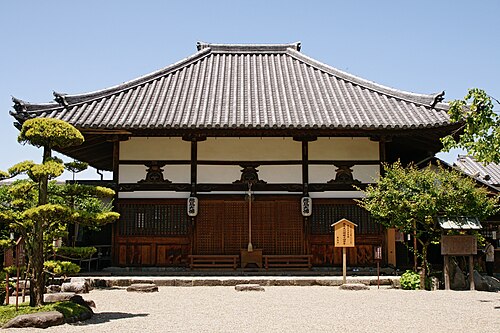
Most of the original temple disappeared long ago. What survives on the site is a small hall, rebuilt in the Edo period, standing where the central golden hall once stood, and inside it the bronze Asuka Great Buddha. Around it, archaeologists have traced the foundations of the original buildings under the fields.
Easy
How Buddhism reached Japan
Buddhism began in India in the fifth century BCE and spread through Central Asia to China and then to the kingdoms of the Korean peninsula. From Baekje, in south-western Korea, it reached Japan. According to the Nihon Shoki (Chronicles of Japan), King Seong of Baekje sent a gilt-bronze image of the Buddha, banners and sutras to the Yamato ruler Kinmei. The Chronicles date this to 552; other early sources give 538.
The Yamato court was divided. The Soga clan, which managed foreign relations and many immigrant craftsmen, wanted to accept the new faith; the Mononobe and Nakatomi clans, who were tied to the worship of the native gods (kami), warned that the gods would be angry. When an epidemic broke out, the opponents blamed Buddhism and threw an image into a canal. The quarrel ended in 587, when Soga no Umako and his allies defeated Mononobe no Moriya in battle.
Buddhism had also arrived privately earlier: a later chronicle says that an immigrant named Shiba Tatto (Shiba Tatsuto), grandfather of the sculptor Tori, was already worshipping a Buddhist image in Yamato in 522. After 587, Umako could build a temple on a scale never seen before, and Asuka-dera was the result.
Easy
Building the temple, 588–596
The Chronicles give an unusually detailed building record. In 588 Baekje sent Buddhist relics, monks and a team of specialists: two temple carpenters, one master of metal fittings for the pagoda top (rohan hakase), four tile masters (wa hakase) and one painter. The site chosen was the house of a man named Konoha, which was torn down. In 590 workers went into the mountains to cut timber; in 592 the Buddha hall and corridors were raised; in 593 relics of the Buddha were placed in the foundation of the pagoda’s central pillar; in 596 the temple was declared complete, and Umako’s son was put in charge.
The same year, two foreign monks came to live there: Hyeja (Eji) from Goguryeo and Hyechong (Eso) from Baekje, who together were called the “pillars of the Three Treasures”. Hyeja was also the Buddhist teacher of Prince Shōtoku, so Asuka-dera was a meeting place for the court, immigrant craftsmen and monks from two Korean kingdoms.
Roof tiles are the best evidence of Baekje’s role. The Korean Encyclopedia explains that the wa hakase (tile master) was a Baekje title for specialist tile makers, and that the tiles of Asuka-dera, with their lotus-petal designs, introduced tiled roofing to Japan and trained Japanese potters as tile makers. Two families of early tile designs have been found at the site, both in a style linked with Baekje.
Intermediate
How to “read” the temple plan
Excavations in 1956–57 revealed an unusual plan. A pagoda stood at the centre. Around it were three golden halls (kondō): one to the east, one to the west and one to the north, the northern one on the main axis. A roofed corridor enclosed this group, with the middle gate to the south and a lecture hall behind the corridor to the north. This “one pagoda, three golden halls” plan is not found in later Japanese temples and differs from the usual Baekje plan of one pagoda and one hall in a line.
The central position of the pagoda tells us what mattered most. A pagoda is a monument that houses relics of the Buddha’s body, so placing it at the centre, surrounded by image halls, made the relics the heart of the temple. Over the next century, Japanese temples gradually moved the image hall to the centre and the pagoda to the side — at Hōryū-ji the hall and pagoda stand side by side, and at later temples in Nara the pagodas were placed outside the main enclosure.
Korean scholars have compared the three-hall layout with temple sites of Goguryeo; the Korean Encyclopedia entry on Asuka-dera describes the plan as reflecting Goguryeo influence rather than a direct copy of Baekje practice. This matters because it shows that Asuka-dera was not simply the product of one Korean kingdom: Baekje builders, a Goguryeo monk, and perhaps plans known through Goguryeo all contributed.
Intermediate
The Asuka Great Buddha
In 605, according to the Chronicles, Empress Suiko ordered large images to be made in bronze and embroidery, and the king of Goguryeo sent 300 ryō of gold to help. The bronze Shaka (Śākyamuni) Buddha was installed in 606, or in 609 according to another temple record. Its maker was Kuratsukuri no Tori (Tori Busshi), from a family of saddle makers descended from the immigrant Shiba Tatto. His skill in casting and lacquer, learned in the saddle workshop, served him in making Buddhist images; later, in 623, he made the Shaka Triad of Hōryū-ji.
The seated Buddha is 275.2 cm high. It has suffered greatly: the golden hall burned in 1196, the statue later sat in the open for a time, and it was repaired many times. A survey in 1973 concluded that only part of the face — from the forehead to above the nose — and three fingers of the right hand were original. Later studies in 2015–2017 extended this somewhat, but still found that most of the body is later repair. Even so, because it has stayed on its original site for over 1,400 years, it is treasured as the oldest datable Buddha image in Japan in its original location.
Its style, where it survives — the long face, almond-shaped eyes and faint smile — resembles the Tori style of the Hōryū-ji triad, which art historians trace back to Buddhist sculpture of the Northern Wei in China, transmitted via the Korean peninsula.
Intermediate
Why build a temple? Faith, power and protection
For the Soga and the court, a temple was at once a religious foundation, a political statement and a technological showcase. Buddhism promised merit for the patron and his ancestors, healing from illness and protection for the state. The Chronicles repeatedly connect temple building with vows made in times of danger: Umako is said to have vowed to build a temple if he defeated the Mononobe, just as Prince Shōtoku vowed Shitennō-ji in the same campaign.
A tiled hall on stone foundations towering over the Asuka valley also displayed power in a new language. For three centuries Japanese elites had shown their status by building great burial mounds. Asuka-dera moved that display from the tomb to the temple: instead of a mound for one leader, a permanent complex where monks performed rituals for the living and the dead. Within a few decades dozens of clan temples appeared around Asuka and Ikaruga, and the building of giant keyhole-shaped tombs came to an end.
Finally, the temple was a school. Monks taught Chinese writing and Buddhist texts, craftsmen trained apprentices, and the court learned how to plan and finance large projects. The skills developed at Asuka-dera — laying out buildings on an axis, making tiles in quantity, casting large bronzes — were later used for palaces and capitals such as Fujiwara-kyō and Heijō-kyō. In that sense, the first Japanese state capitals were built partly on lessons learned in the first temple.
Intermediate
Meanwhile in the world
Asuka-dera was part of a wave of temple building across East Asia. In Baekje, King Wideok founded Wangheungsa at Buyeo in 577, in memory of a dead prince; a relic container dated to that year was found in its pagoda foundation in 2007. Baekje’s capital, Sabi, had been built by King Seong, the king whom the Chronicles credit with sending Buddhism to Japan. In Silla, Buddhism had been officially accepted in the 520s after the martyrdom of Ichadon, and the great temple of Hwangnyongsa was being built in the capital, Gyeongju.
In China, the Sui dynasty reunited the country in 589, the year after Asuka-dera was begun. Its founder, Emperor Wen, was a great patron of Buddhism and had relics distributed to pagodas across the empire in the early 600s — a Chinese parallel to the relic deposit in Asuka-dera’s pagoda. In India, the monastic university of Nalanda was flourishing and would soon attract Chinese pilgrims.
Further west, Justinian’s Hagia Sophia in Constantinople, finished in 537, was already the largest church in the Christian world, and in 597 Pope Gregory the Great sent missionaries to the Anglo-Saxons in England. In Arabia, Muhammad was born around 570, and in the Maya lowlands the city of Tikal was in its so-called hiatus after a defeat in 562. Across Eurasia, rulers were sponsoring great religious buildings that displayed both faith and new building technology — and Asuka-dera was Japan’s first contribution to that story.
Intermediate
Later history: from state temple to village temple
Asuka-dera stood at the centre of court life in the seventh century. According to the Nihon Shoki, it was at a kickball game at this temple that Prince Naka no Ōe first met Nakatomi no Kamatari, and in the coup of 645 Naka no Ōe used the temple as his stronghold against the Soga. After the fall of the Soga, the temple became an official state temple rather than a clan foundation.
When the capital moved to Heijō-kyō (Nara) in 710, the temple’s institution followed: in 718 Gangō-ji was established in the new capital, where it became one of the great temples of Nara. The original site remained as “Hon-Gangō-ji” (the original Gangō-ji) but declined. In 1196 a fire started by lightning destroyed the pagoda and the golden hall; by 1447 the Great Buddha was sitting in the open air, exposed and damaged.
The present small main hall was rebuilt in 1826, in the Edo period, with help from patrons in Osaka, and the temple, now called Angoin, belongs to the Shingon school. The site was designated a National Historic Site in 1966. It is now one of the component sites of the “Asuka–Fujiwara” group of ancient capitals, which Japan has nominated for World Heritage status.
Advanced
Archaeology: what the excavations showed
The excavations of 1956–57 were among the first large-scale excavations of an early temple in Japan. They established the three-hall layout, measured the corridors and gates, and uncovered the foundation stone of the pagoda. The eastern and western halls stood on two-tier stone platforms, ranked below the finer platforms of the pagoda and central hall — a hierarchy of foundations that shows careful continental-style planning.
The pagoda foundation held ritual deposits: beads of jade and glass, metal ornaments, horse trappings, pieces of armour and other objects. Many of these are of the same kinds found in kofun burial mounds. Archaeologists read this as evidence of continuity: the Soga honoured the relics of the Buddha with the same prestige goods that elites had placed in tombs. Asuka-dera thus stands at the meeting point of the Kofun period and the Buddhist Asuka period.
Recent work has refined the chronology of the roof tiles, the construction sequence and the history of the Great Buddha. The finding that most of the statue is later repair has not reduced its importance; rather, it has made the Great Buddha a case study in how damaged objects carry memory across centuries.
Advanced
Different perspectives
The date of Buddhism’s arrival is the first point of disagreement. The Nihon Shoki gives 552; the Jōgū Shōtoku Hōō Teisetsu and the temple history of Gangō-ji give 538. Many scholars now prefer 538, because the Nihon Shoki’s chronology for this reign has problems and because 552 may have been chosen for its significance in Buddhist calculations of the decline of the Dharma. Others point out that both dates are uncertain and that the real process was gradual, beginning with immigrants like Shiba Tatto before any official gift.
Korean and Japanese narratives emphasise different actors. Korean scholarship, such as the Korean Encyclopedia’s entry, stresses that Asuka-dera was built by Baekje craftsmen, housed Goguryeo and Baekje monks and received Goguryeo gold, making it a key monument for understanding how Korean Buddhist culture was transmitted to ancient Japan. Japanese scholarship accepts these contributions but tends to emphasise the Soga clan’s role as organiser and patron, the training of Japanese craftsmen, and the continuity with native Kofun traditions seen in the pagoda deposits. Both are supported by the evidence; they differ mainly in which part they put in the foreground.
The origin of the plan is also debated. The three-hall layout does not match the one-pagoda-one-hall plan of excavated Baekje temples such as Wangheungsa, and has been compared with Goguryeo sites. Some scholars therefore see a Goguryeo model, perhaps brought by Hyeja’s circle; others suggest that Baekje itself may have had such plans that have not yet been found, or that the plan was a local adaptation. Until more early temple sites are excavated in Korea and China, the question remains open.
Finally, the word “transmission” itself has been questioned. Rather than imagining culture flowing one way from a “source” to a “receiver”, many historians now describe a network: Chinese Buddhist models, Korean kingdoms competing for allies, immigrant families in Japan and a Japanese elite choosing what to adopt. Asuka-dera is best understood as the product of all of them.
Key ideas
- Clan temple (ujidera)
- Asuka-dera began as the Soga clan’s temple, showing how great families used Buddhism to display power and piety.
- Relics at the centre
- The pagoda holding the Buddha’s relics stood in the middle of the temple, reflecting early Buddhist priorities.
- Technology transfer
- Building the temple brought surveying, stone foundations, tiled roofs and large-scale bronze casting to Japan.
- Baekje craftsmen
- Specialists sent from Baekje in 588 led the construction and trained local workers.
- Goguryeo links
- A Goguryeo monk lived at the temple, Goguryeo gold helped pay for the Buddha, and the plan has been compared with Goguryeo sites.
- Continuity with the Kofun age
- Grave-good-like offerings in the pagoda foundation show old elite customs adapted to the new religion.
- Memory in a damaged statue
- The much-repaired Great Buddha remains valued because it has stayed on its original site for 1,400 years.
Records
- c. 522 CE — According to a later chronicle, the immigrant Shiba Tatto worships a Buddha image in Yamato.
- c. 538 CE — Official transmission of Buddhism from Baekje according to the Gangō-ji records (552 in the Nihon Shoki).
- 577 CE — King Wideok of Baekje founds Wangheungsa at Buyeo (relic container found in 2007).
- 587 CE — Soga no Umako and his allies defeat Mononobe no Moriya.
- 588 CE — Baekje sends relics, monks and craftsmen; construction of Asuka-dera begins.
- 593 CE — Buddha relics are placed in the foundation of the pagoda’s central pillar.
- 596 CE — The temple is completed; Hyeja of Goguryeo and Hyechong of Baekje reside there.
- 606 CE — The Asuka Great Buddha by Kuratsukuri no Tori is installed (609 in another record).
- 645 CE — Naka no Ōe uses the temple as his base in the coup against the Soga.
- 718 CE — Gangō-ji is established in the new capital, Heijō-kyō.
- 1196 — A fire started by lightning destroys the pagoda and golden hall at the original site.
- 1956 — Excavations (1956–57) reveal the one-pagoda, three-hall plan.
- 1966 — The site is designated a National Historic Site.
Glossary
- Pagoda (tō)
- A tower built to house relics of the Buddha, developed from the Indian stupa.
- Golden hall (kondō)
- The hall housing a temple’s main Buddhist images.
- Relics (shari)
- Remains believed to come from the Buddha’s cremated body, or objects representing them.
- Wa hakase
- “Tile master”, a Baekje title for specialist makers of roof tiles.
- Rohan hakase
- Master of the metal finial fittings at the top of a pagoda.
- Ujidera
- A temple founded by and for a particular clan.
- Kofun
- Large mound tombs of Japanese elites, mainly 3rd–7th centuries, and the period named after them.
- Shaka
- The Japanese name for Śākyamuni, the historical Buddha.
- Gangō-ji
- The temple name used for Asuka-dera and for its successor in Nara after 718.
Questions and answers
Is Asuka-dera the oldest temple in Japan?
It is usually called Japan’s first full-scale Buddhist temple. Its original buildings are gone, though; the oldest standing temple buildings are at Hōryū-ji.
Who built it?
Soga no Umako paid for it, and experts from Baekje in Korea led the construction, working with Japanese and immigrant workers.
Is the Great Buddha really 1,400 years old?
Parts of it are. After the fire of 1196 it was heavily repaired, and surveys suggest only parts of the face and hand are original. But it has always stayed in the same place.
Why are there three golden halls?
Nobody knows for sure. The plan has been compared with temples in Goguryeo; it differs from the usual Baekje plan and was not copied in later Japanese temples.
Did Buddhism come to Japan in 538 or 552?
Early sources disagree. The Nihon Shoki says 552, others say 538, and many historians now prefer 538 while noting that both are uncertain.
What was found under the pagoda?
Jewels, beads, metal ornaments, horse gear and armour pieces, similar to goods placed in kofun tombs, along with the relic deposit.
Can I visit it?
Yes. The temple, now called Angoin, still stands in Asuka village in Nara Prefecture, and the Great Buddha can be seen in its main hall.
Sources and further reading
- Asuka-dera. Wikipedia
- 飛鳥寺. Wikipedia (Japanese)
- 원영상 (Won Young-sang), 일본 비조사 (日本 飛鳥寺, Asuka-dera, Japan). Encyclopedia of Korean Culture, Academy of Korean Studies
- 양기석 (Yang Ki-seok), 와박사 (瓦博士, tile master). Encyclopedia of Korean Culture, Academy of Korean Studies
- About Asuka-Fujiwara: component properties. Ancient Capitals of Asuka and Fujiwara Council
- 쇼토쿠 태자의 스승 혜자 (Hyeja, teacher of Prince Shōtoku). National Institute of Korean History, 사료로 본 한국사
- Tori Busshi. Wikipedia
- Buddhism in Japan. Wikipedia
- 仏教公伝. Wikipedia (Japanese)
- 부여 왕흥사지 (Wangheungsa temple site, Buyeo). Wikipedia (Korean)
- W. G. Aston (trans.), Nihongi: Chronicles of Japan from the Earliest Times to A.D. 697. Kegan Paul, Trench, Trübner (Japan Society of London), 1896
Related
- King Seong of BaekjeThe 26th king of Baekje (r. 523–554), who moved the capital to Sabi, made Baekje a bridge between Liang China and Japan, and died in battle against Silla.
- Hōryū-jiA Buddhist temple complex in Japan traditionally founded in 607 CE and home to some of the world's oldest surviving wooden buildings.
- IchadonA young official of King Beopheung of Silla whose martyrdom, according to tradition, led the kingdom to accept Buddhism in 527.
- Taika ReformA programme of political reforms launched after the palace coup of 645, which aimed to turn Japan’s alliance of powerful clans into a centralised state on the model of Tang China.
- Hagia SophiaA monumental church built for the Byzantine emperor Justinian I in Constantinople between 532 and 537 CE.
Written with AI assistance from the published sources listed above, and revised as new research appears.