Start at the top for an easy introduction. Go further down for more detail and scholarship.
- Easy
- Intermediate
- Advanced
For young readers
More than a thousand years ago in England, people told stories in a language called Old English. It is the great-great-grandparent of the English spoken today, but it looks so different that most English speakers cannot read it without lessons.
Beowulf is the longest and most famous story-poem that survives in Old English. Nobody knows who made it up. It has 3,182 lines, which would take a few hours to read aloud.
The story happens in Denmark and Sweden, long before it was written down. A Danish king named Hrothgar builds a wonderful feasting hall called Heorot. But a monster called Grendel hates the happy noise and attacks the hall every night.
A strong young hero named Beowulf sails across the sea to help. He fights Grendel with his bare hands and tears off the monster’s arm. Then Grendel’s angry mother attacks, and Beowulf dives into a dark lake to fight her in an underwater cave.
Beowulf goes home and becomes a king. Fifty years later, when he is old, a dragon starts burning his land because someone stole a golden cup from its treasure. Beowulf fights the dragon with the help of one brave young man, Wiglaf. They kill the dragon, but Beowulf is badly hurt and dies.
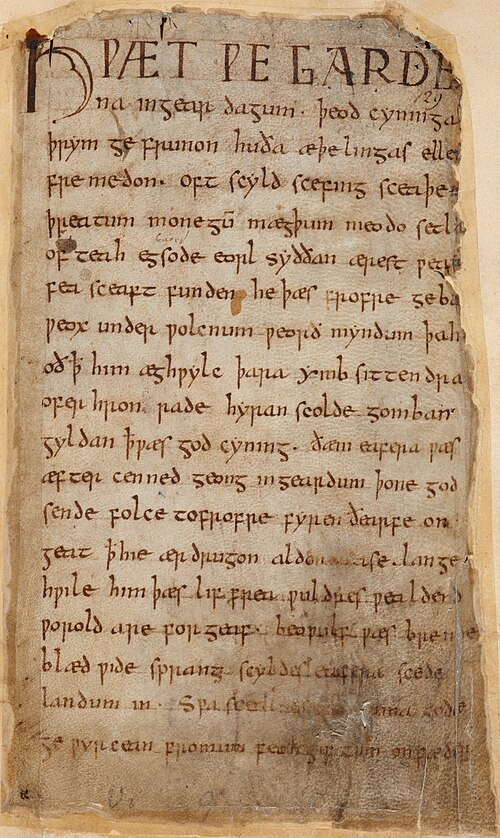
The poem only survived by luck. There is just one old handwritten copy, and in 1731 it was nearly destroyed in a fire in London. You can still see the burnt edges of its pages. Today it is kept safely in the British Library.
At a glance
- Type
- Heroic poem (often called an epic) in alliterative verse, 3,182 lines
- Language
- Old English, mostly Late West Saxon with forms from other dialects
- Composed
- Unknown and much debated: proposals range from the 8th century to the early 11th century
- Manuscript
- The Nowell Codex, copied about 975–1025 by two scribes; British Library, Cotton MS Vitellius A XV
- Setting
- Southern Scandinavia (Denmark and the land of the Geats, probably in today’s southern Sweden) in the 5th–6th centuries
- Author
- Anonymous; scholars call him or her “the Beowulf poet”
- Survival
- A single copy, scorched in the Cotton library fire at Ashburnham House in 1731
- First printed
- First full edition by Grímur Jónsson Thorkelin in 1815, based on transcripts made in 1786–87
Easy
What is Beowulf?
Beowulf is a poem of 3,182 lines written in Old English, the language of the Anglo-Saxons who lived in England between roughly the 5th century and the Norman Conquest of 1066. It is the longest heroic poem to survive from Anglo-Saxon England and one of the most studied and most often translated works of early medieval literature.
The poem has no title in the manuscript. Modern readers named it after its hero, Beowulf, a warrior of a people called the Geats. We do not know who composed it, when, or where. Scholars simply speak of “the Beowulf poet.” The only thing that can be dated with confidence is the single surviving handwritten copy, which was made around the year 1000.
Although the poem was written down in England by Christians, its story is set among pagan peoples of Scandinavia in the 5th and 6th centuries, in the time of the ancestors of the Anglo-Saxons. That gap between the world of the poem and the world of its audience is one of the things that makes Beowulf so interesting and so debated.
Easy
The story: three great fights
The poem opens with the funeral of Scyld Scefing, the legendary founder of the Danish royal line, whose body is sent out to sea in a ship loaded with treasure. His descendant King Hrothgar builds a magnificent mead hall called Heorot, where he and his warriors feast, give gifts and listen to songs.
The sounds of joy enrage Grendel, a monster who lives in the marshes and whom the poem describes as a descendant of the biblical Cain. For twelve years he raids Heorot at night and devours warriors. Beowulf, a young hero of the Geats, hears of this and sails to Denmark with a band of companions. He refuses to use a weapon against Grendel. When the monster enters the hall, Beowulf seizes his hand, and in the struggle he tears off Grendel’s arm at the shoulder. Grendel flees to his home and dies.
The next night Grendel’s mother comes for revenge and kills Æschere, Hrothgar’s most trusted counsellor. Beowulf follows her trail to a lake, dives in, and fights her in a cave beneath the water. The borrowed sword Hrunting cannot harm her, but he finds an ancient sword made by giants hanging on the wall and kills her with it. The blade melts in the monster’s blood, leaving only the hilt.
Beowulf returns home loaded with gifts and eventually becomes king of the Geats. After he has ruled for fifty years, a slave steals a golden cup from a dragon’s treasure hoard, and the dragon burns the countryside. The old king goes to fight it. His followers run away, except for the young Wiglaf, who helps him. Together they kill the dragon, but Beowulf is mortally wounded. The poem ends with his funeral: his body is burned on a great pyre and a mound is raised on a headland where sailors can see it, while his people mourn and fear the wars that will follow.
Easy
Heroes, halls and monsters
The world of Beowulf is built around the hall. A lord shares food, drink, gold rings and weapons with his warriors, and in return they promise to fight for him and even die for him. Gift-giving and loyalty hold society together. When warriors break that promise, as Beowulf’s followers do when they flee from the dragon, the poem treats it as a disgrace.
The monsters are the dark opposite of the hall. Grendel lives alone in the wild marshes and cannot bear the music of the feast. His mother lives under a lake. The dragon sleeps on a hoard of treasure that it can never use. Each of them threatens the circle of light, warmth and fellowship that the hall represents.
The main human characters include Hrothgar, the wise but aging Danish king; his queen Wealhtheow, who speaks carefully about the future of her sons; Unferth, a Danish warrior who at first mocks Beowulf and later lends him a sword; Hygelac, Beowulf’s king and uncle among the Geats; and Wiglaf, the loyal young relative who alone stands by Beowulf at the end.
Intermediate
Legend and history
Beowulf himself is not mentioned in any other surviving source, but many of the poem’s other figures appear in Scandinavian traditions, among them Healfdene, Hrothgar, Halga, Hrothulf, Eadgils and Ohthere, along with families such as the Scyldings and Scylfings. One event can be tied to outside history: the raid of Hygelac into Frisia, in which he is killed, corresponds to a raid recorded by the 6th-century historian Gregory of Tours and is usually dated to around 521.
Archaeology has added further links. At Gamla Uppsala in Sweden, the western of the great royal mounds, which Snorri Sturluson later connected with Eadgils, was excavated in 1874 and held a rich burial of a powerful man from around 575. At Lejre in Denmark, which Scandinavian tradition regarded as the seat of the Scyldings, excavations in 1986–88 and 2004–05 found large halls about 50 metres long, the first built in the mid-6th century, the period in which the poem is set.
In England, the ship burial found at Sutton Hoo in Suffolk in 1939 has often been compared with the poem. Its treasures, including a ceremonial helmet, a sword, a shield, a lyre and fine metalwork with connections to eastern Sweden, could illustrate the poem’s picture of hall life, gift-giving and treasure burial, and its opening description of a king sent to sea with a ship full of riches. Scholars are careful, however, not to treat the poem as a record of any particular burial.
Intermediate
How the poem sounds: alliterative verse
Old English poetry does not rhyme. Instead, each line is divided into two halves by a pause (a caesura), and the halves are linked by alliteration, the repetition of the same sound at the start of stressed syllables. Line 4 of the poem, “Oft Scyld Scefing sceaþena þreatum,” shows the pattern: the “sc” sound links both halves. The number of syllables in a line varies; what matters is the pattern of stressed positions.
Poets drew on a stock of formulas, ready-made phrases that fit a half-line and could be combined in new ways. Beowulf also uses many kennings, compressed poetic descriptions such as calling the sea the “swan’s riding” or a king a “ring-giver.” These devices were probably tools of oral performers, and they give the verse a dense, richly layered texture that is very hard to translate.
The poem famously begins with the word “Hwæt!” an exclamation that calls listeners to attention. Translators have rendered it as “Lo!”, “Listen!”, “So.” (Seamus Heaney) and even, in Maria Dahvana Headley’s 2020 version, “Bro!” The variety shows how every translation is also an interpretation.
The poem includes many stories within the story, called digressions: the tale of Sigemund the dragon-slayer, the fight at Finnsburg, the feud of Freawaru and Ingeld, the Swedish–Geatish wars and the “Lay of the Last Survivor,” spoken by the man who first buried the dragon’s treasure. Early scholars found these distracting, but many later critics argue that they deliberately mirror or contrast with the main action and give the poem a sense of deep history.
Intermediate
Big themes: glory, loyalty, feud and death
Beowulf is concerned with how a person should live when life is short and fame is the only thing that lasts. The hero seeks glory, but the poem constantly reminds us that halls burn, kings grow old and peoples fall. In his long speech often called “Hrothgar’s sermon,” the old king warns Beowulf against pride and urges him to be generous to his followers.
Feud and revenge run through the poem. Grendel’s mother kills to avenge her son; the digressions tell of marriages meant to end feuds that fail; and after Beowulf’s death his people expect their old enemies to attack. Some scholars read the poem as a critique of endless cycles of vengeance; others see it as a “dynastic drama” about the rise and fall of royal houses.
The poem is framed by funerals, beginning with Scyld Scefing and ending with Beowulf, and some critics have organised its structure around the four funerals it describes. Its ending is not triumphant but mournful. J. R. R. Tolkien argued that the poem is closer to an elegy than an epic, and that its real subject is mortality.
Intermediate
One manuscript, one fire
The poem survives only in a manuscript now called the Nowell Codex, after the 16th-century antiquary Laurence Nowell, whose name is written on its first page. It was later bound together with an unrelated 12th-century manuscript and entered the library of Sir Robert Cotton, where it was shelved as the 15th book on the top shelf (A) of the bookcase topped by a bust of the Roman emperor Vitellius. That is why its official name is British Library, Cotton MS Vitellius A XV.
The Nowell Codex also contains a fragment of the Life of Saint Christopher, the Wonders of the East, the Letter of Alexander to Aristotle and, after Beowulf, the Old English poem Judith. Two scribes copied it. The first wrote as far as line 1939 of Beowulf, breaking off in mid-sentence; the second finished the poem and also copied Judith. The first scribe regularised the spelling more, while the second preserved more older and dialectal forms. It is usually dated between about 975 and 1025, possibly to the decade after 1000.
In 1731 fire swept through Ashburnham House in London, where the Cotton collection was then stored. The manuscript survived, but its edges were scorched and continued to crumble for decades, taking letters with them. Two transcripts made in 1786–87 for the Icelandic scholar Grímur Jónsson Thorkelin, one by a hired copyist and one by Thorkelin himself, now serve as important witnesses to readings that have since been lost. Modern scholars such as Kevin Kiernan have used ultraviolet light and fibre-optic backlighting to recover hidden letters.
Intermediate
Rediscovery, translation and afterlife
For centuries the poem went almost unnoticed. It is first identified by name in letters of 1700 between the scholars George Hickes and Humfrey Wanley. Thorkelin published the first complete edition in 1815, with a Latin translation. Selected verses were put into modern English by Sharon Turner in 1805, and N. F. S. Grundtvig produced the first complete verse translation, into Danish, in 1820. John Mitchell Kemble published a literal English translation in 1837.
In 1922 the German philologist Frederick Klaeber published an edition that became the standard scholarly text for generations of students; its fourth edition appeared in 2008. By 2020 a database of Beowulf versions listed some 688 translations and adaptations, and the poem has been translated into at least 38 languages. Seamus Heaney’s 1999 verse translation became a bestseller, and J. R. R. Tolkien’s prose translation, made decades earlier, was published in 2014.
Beowulf has inspired novels, films, comics and games. Tolkien drew on it in The Hobbit, where the theft of a cup from a hoard rouses the dragon Smaug, and in The Lord of the Rings. John Gardner’s novel Grendel (1971) retells the story from the monster’s point of view, and Maria Dahvana Headley’s The Mere Wife (2018) moves it to a modern American suburb.
Advanced
The dating debate
When Beowulf was composed is one of the longest-running questions in English studies, and the answer shapes how the poem is read. The range of proposals is wide: from the 7th or early 8th century to the early 11th, when the manuscript was copied. Tolkien held that the poem preserves too genuine a memory of Anglo-Saxon paganism to be much later than the conversion of England, completed around 700. His view of an 8th-century date has been defended by scholars including Tom Shippey, Leonard Neidorf, Rafael J. Pascual and R. D. Fulk.
The strongest arguments for an early date are linguistic and metrical. R. D. Fulk’s A History of Old English Meter (1992) argued that the poem observes distinctions of vowel length in unstressed syllables, described by Kaluza’s law, that would have disappeared from speech by the 9th century. Critics reply that such features could reflect an archaic poetic tradition rather than the date of a particular poem; B. R. Hutcheson, for instance, doubts that Kaluza’s law can date the poem, while accepting that the overall weight of evidence favours the 8th century.
On the other side, Kevin Kiernan argued in Beowulf and the Beowulf Manuscript (1981) that the poem as we have it may have been created close to the time of the manuscript itself, perhaps in the reign of Cnut. Craig R. Davis has proposed the 890s, linking the poem’s genealogies to the court of Alfred the Great. The place of composition is equally contested: suggestions have included East Anglia (because of Sutton Hoo and the Wuffinga dynasty), Mercia, Northumbria and Wessex. The mixture of dialect forms in the text suggests a long and complicated transmission, which makes any single answer difficult.
Advanced
Oral poem or written text?
In The Singer of Tales (1960), Albert Lord, building on Francis Peabody Magoun and on fieldwork with South Slavic singers, argued that Beowulf was composed orally, using the same kind of formulas and traditional themes found in Homer. Lord believed the manuscript might record a performance, perhaps taken down in more than one sitting.
Later scholars have been less certain. They agree that recurring “themes” such as the arming of the hero or the hero on the beach exist across Germanic poetry, but many conclude that Old English verse mixes oral-formulaic habits with literate composition. Larry Benson spoke of “kernels of tradition” expanded by a literate poet; Ann Watts warned against applying a theory built on Homeric and South Slavic material directly to Anglo-Saxon poetry; John Miles Foley described a continuum from traditional oral composition to written text.
The poem itself describes oral performance. A poet in Hrothgar’s hall is said to “weave words” (wordum wrixlan) into a new song about Beowulf’s deed, and the harp is played at feasts. Whether those scenes reflect how Beowulf itself was made, or are an idealised picture written by a learned Christian author, remains open.
Advanced
Pagan and Christian, monsters and critics
Nineteenth- and early twentieth-century scholars often used Beowulf mainly as a quarry for evidence about Germanic history, myth and language. In his British Academy lecture of 25 November 1936, “Beowulf: The Monsters and the Critics,” Tolkien protested that the poem had been buried under this historical interest. He argued that the monsters are not childish distractions but the heart of the poem, and that it should be read as a carefully balanced work of art in two parts: the young hero’s rise and the old king’s death. The lecture is widely regarded as the beginning of modern literary criticism of the poem.
A central interpretive question is religious. The poem refers to God, creation, Cain, the Flood and the Last Judgement, all drawn from the Old Testament, but never mentions Christ, and its characters are presented as pagans. Some critics, such as Margaret Goldsmith, read it as a Christian allegory; others see a pagan poem given Christian colouring; still others, like Fred C. Robinson, argue that the poet looks back with admiration and sorrow on noble ancestors who lacked Christian revelation. Richard North has spoken of the poet interpreting “Danish myths in Christian form.”
More recent approaches look at the poem’s treatment of women and kinship, at its politics of feud and dynasty, at the body as a metaphor for loyalty (Stanley Greenfield), and at the monsters as figures of the outsider. Maria Dahvana Headley’s retelling from the viewpoint of Grendel’s mother is one example of how the poem continues to be reread from the margins.
Key ideas
- Heroic glory (lof, dōm)
- Fame earned by brave deeds is the one thing that outlives a warrior. The poem’s last word describes Beowulf as the man most eager for praise, which can be read as admiration, warning or both.
- Lord and retainer
- Society rests on an exchange: the lord gives treasure and protection, and warriors give loyalty to the death. Wiglaf embodies the ideal; the fleeing warriors betray it.
- Hall versus wilderness
- Heorot stands for order, community and song; the monsters come from marsh, mere and barrow. Much of the poem’s imagery plays on this contrast of light and dark.
- Feud and revenge
- Killings demand vengeance, and marriages meant to make peace often fail. The poem’s digressions repeatedly show feuds destroying families and kingdoms.
- Mortality and transience
- Halls burn, treasure rusts, kings age. Tolkien argued that the poem’s true theme is the defeat of even the greatest hero by time and death.
- Pagan past, Christian present
- A Christian poet tells of pagan ancestors. How he judges them, with sympathy, criticism or both, remains one of the poem’s central puzzles.
- Traditional craft
- Alliteration, formulas, kennings and digressions connect the poem to a wider tradition of Germanic oral poetry while displaying the skill of a single artist.
Records
- c. 521 CE — A raid by King Hygelac into Frisia, recorded by Gregory of Tours; the poem remembers it as the raid in which Hygelac dies.
- c. 550 CE — A great hall is built at Lejre in Denmark, the traditional seat of the Scyldings.
- c. 625 CE — Approximate date of the Sutton Hoo ship burial in East Anglia, often compared with the poem’s world.
- c. 700 CE — Earliest period commonly proposed for the poem’s composition; proposals range up to the early 11th century.
- c. 1000 — The Nowell Codex, the only manuscript, is copied by two scribes (c. 975–1025).
- c. 1563 — The manuscript is in the hands of the antiquary Laurence Nowell, whose name appears on its first page.
- 1700 — The poem is first mentioned by name in letters between George Hickes and Humfrey Wanley.
- 1731 — The Cotton library fire at Ashburnham House scorches the manuscript.
- 1786 — Grímur Jónsson Thorkelin has the first transcripts made (completed 1787).
- 1815 — Thorkelin publishes the first complete edition, with a Latin translation.
- 1936 — Tolkien delivers “Beowulf: The Monsters and the Critics” at the British Academy.
- 1999 — Seamus Heaney’s verse translation is published and becomes a bestseller.
Glossary
- Old English
- The earliest recorded form of English, spoken in England from about the 5th century to the 12th century. It is also called Anglo-Saxon.
- Alliterative verse
- Poetry in which lines are held together by repeated initial sounds on stressed syllables rather than by rhyme.
- Caesura
- The pause that splits each line of Old English verse into two half-lines.
- Kenning
- A compact poetic image that names something indirectly, such as “swan’s riding” for the sea.
- Scop
- An Anglo-Saxon court poet or singer who performed poetry, often with a harp or lyre.
- Mead hall
- A lord’s great hall, where warriors feasted, drank mead, received gifts and heard poetry.
- Thegn
- A warrior or retainer who served a lord in return for land, treasure and protection.
- Geats
- Beowulf’s people, who lived in southern Scandinavia; many scholars link them with the Gautar of today’s Götaland in Sweden.
- Codex
- A book made of folded, bound pages, as opposed to a scroll.
- Digression
- A story told inside the main story; Beowulf contains many that comment on its main action.
Questions and answers
Is Beowulf a real person?
No evidence outside the poem shows that Beowulf existed. But some people around him, such as Hygelac and Hrothgar, are probably based on real 6th-century Scandinavian rulers, and Hygelac’s raid into Frisia is recorded by Gregory of Tours.
Why was a poem about Danes and Swedes written in England?
The Anglo-Saxons traced their origins to northern Europe and shared its heroic legends. Kings in England also claimed descent from Scandinavian figures such as Scyld. The poem looks back to this shared ancestral past.
Can I read the original?
Only with study. Old English has different spelling, grammar and vocabulary, and letters such as þ and ð. Many editions print the Old English with a modern translation on the facing page.
Why is the story set among pagans if the poet was Christian?
Scholars disagree. The poet may have wanted to honour noble ancestors while showing that they lacked Christian faith, or may have been reshaping older pagan material. The poem mentions God and Old Testament stories but never Christ.
How do we know when the manuscript was made?
Mainly from the handwriting (palaeography). The two scribes’ scripts fit a date of about 975–1025, and some specialists narrow it to the decade after 1000.
What does the fire of 1731 mean for the text?
Letters along the scorched edges crumbled away in the following decades. Editors reconstruct missing words using the 1786–87 Thorkelin transcripts, ultraviolet imaging and knowledge of Old English metre.
Why does the date of composition matter so much?
An 8th-century poem would be close to England’s conversion and to living memory of pagan customs; an 11th-century poem would come from a kingdom ruled by Danish kings like Cnut. Each date suggests different audiences and meanings.
Sources and further reading
- Beowulf. Wikipedia
- Nowell Codex. Wikipedia
- Sutton Hoo. Wikipedia
- Beowulf: The Monsters and the Critics. Wikipedia
- Alliterative verse. Wikipedia
- 베오울프. Wikipedia (Korean)
- R. D. Fulk, Robert E. Bjork and John D. Niles (eds.), Klaeber’s Beowulf and The Fight at Finnsburg (4th edition). University of Toronto Press, 2008
- Kevin S. Kiernan, Beowulf and the Beowulf Manuscript. Rutgers University Press, 1981
- R. D. Fulk, A History of Old English Meter. University of Pennsylvania Press, 1992
- Seamus Heaney (trans.), Beowulf: A New Translation. Faber and Faber, 1999
- Leonard Neidorf (ed.), The Dating of Beowulf: A Reassessment. D. S. Brewer, 2014
Related
- HomerThe poet tradition credits with the Iliad and the Odyssey, the founding epics of Greek literature. Whether one person composed both is debated.
- VirgilA Roman poet whose Aeneid became one of the most influential works of Latin literature.
- Epic of GilgameshA king's friendship with Enkidu and his search for immortality, assembled from earlier Sumerian poems into a Babylonian epic.
- ShahnamehPersian epic by Ferdowsi recounting Iran's legendary kings and historical past.
- Book of KellsLavishly illuminated Latin Gospel book made by Columban monks around 800, the high point of Insular art.
Written with AI assistance from the published sources listed above, and revised as new research appears.