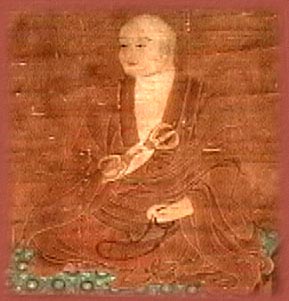
Start at the top for an easy introduction. Go further down for more detail and scholarship.
- Easy
- Intermediate
- Advanced
For young readers
About 1,200 years ago, on the Japanese island of Shikoku, a boy was born into a noble family. His childhood name is remembered as Mao, which means “true fish.” When he grew up and became a Buddhist monk he took the name Kūkai, which means “sky and sea.”
Kūkai was a very good student. His family sent him to the government school in the capital to learn Chinese books so that he could become an official. But Kūkai felt those books did not answer his biggest questions about life. So he left school and went into the mountains to pray, chant and meditate.
When he was about thirty years old, he sailed to China on a dangerous voyage with an official group sent by the Japanese emperor. In the great city of Chang’an he met an old teacher named Huiguo, who taught him secret Buddhist practices: special sounds to chant, special hand positions, and colourful pictures of the Buddha’s world called mandalas.
Kūkai came home and started a new Buddhist school called Shingon, which means “true word.” He taught that you do not have to wait for many lifetimes to become wise and awakened like the Buddha—you can do it in this life, with your body, your voice and your mind working together.
Kūkai was also a famous writer and one of the best handwriting artists in Japanese history. He built a monastery on a quiet mountain called Kōya, repaired a huge pond so farmers could water their rice, and opened a school for children from poor families as well as rich ones.
Many people in Japan still love him and call him Kōbō Daishi, “the Great Teacher.” Some believers say he is still sitting in deep meditation on Mount Kōya. Historians study old documents to find out what really happened in his life, and they also study how these beautiful stories grew over time.
At a glance
- Lived
- 774–835 CE (Buddhist tradition later fixed his birthday as the 15th day of the 6th lunar month; he died on the 21st day of the 3rd month of Jōwa 2, i.e. 835)
- Born
- Sanuki Province on Shikoku (traditionally Byōbugaura in Tado District, today’s Zentsūji area, Kagawa Prefecture); other birthplaces have been proposed
- Period
- Early Heian period in Japan; mid-Tang dynasty in China
- Role
- Buddhist monk, founder of the Shingon school of esoteric Buddhism, thinker, poet, calligrapher and lexicographer
- Main centres
- Mount Kōya (Kongōbu-ji) in the Kii Mountains, granted in 816; Tō-ji in Kyoto, entrusted to him in 823
- Key writings
- Sangō shiiki (797), Benkenmitsu nikyōron, Sokushin jōbutsu gi, Shōji jissō gi, Unji gi, Himitsu mandara jūjūshinron and Hizō hōyaku (c. 830)
- Language
- Classical Chinese (kanbun), with study of Sanskrit and the Siddhaṃ script
- Legacy
- Shingon remains a major Buddhist tradition in Japan; the Shikoku pilgrimage of 88 temples and devotion at Mount Kōya centre on him as Kōbō Daishi
Easy
Who was Kūkai?
Kūkai (774–835) was a Japanese Buddhist monk who founded the Shingon (“True Word”) school of esoteric Buddhism. He is known in Japan above all by the title Kōbō Daishi, “Great Teacher who Spread the Dharma,” which the imperial court granted him in 921, almost ninety years after his death. The name Kūkai, which he took as a monk, combines the characters for “sky” or “emptiness” (kū) and “sea” (kai).
He lived at the beginning of the Heian period, when the Japanese court had just moved its capital to Heian-kyō, today’s Kyoto. In 804 he travelled to China, where he received the full transmission of a recently developed form of esoteric Buddhism from the master Huiguo. After returning in 806 he spent the rest of his life teaching, performing rituals for the court, writing, and building institutions, above all the mountain monastery on Mount Kōya and the temple Tō-ji in Kyoto.
Kūkai was unusual in how many things he did well. Besides being a religious leader, he was a systematic philosopher, a poet in Chinese, one of the most admired calligraphers of Japan, a compiler of dictionaries and a writer on literary theory. He also supervised practical projects such as the repair of a large irrigation reservoir.
Easy
Childhood, school and the turn to Buddhism
Kūkai was born in 774 in Sanuki Province, in the north of the island of Shikoku. Tradition names Byōbugaura in Tado District, near today’s Zentsū-ji temple, as the place; some scholars have suggested other locations, including the capital region where his mother’s family was active. His father’s family, the Saeki, were local aristocrats connected with the ancient Ōtomo clan, and his childhood name is usually given as Mao (“true fish”), although even this is debated.
At about fifteen he studied the Chinese classics with his maternal uncle Ato no Ōtari, who tutored an imperial prince, and in 791 he entered the Daigakuryō, the government university in the capital, which trained young aristocrats for official careers through Confucian texts. Kūkai soon became dissatisfied. He later wrote that he met a Buddhist monk who taught him a mantra of the bodhisattva Kokūzō (Ākāśagarbha) that was said to strengthen memory and understanding, and he left the university to practise in the mountains and on the coasts of Shikoku.
In 797, at the age of twenty-four, he completed a work first called Rōko shiiki and later revised as Sangō shiiki, “Indications of the Goals of the Three Teachings.” It is written as a lively story in which a Confucian teacher, a Daoist hermit and a poor Buddhist mendicant each try to reform a spoiled young man. The Buddhist speaker wins the debate. The book shows the young Kūkai’s wide reading and literary skill and explains, in fictional form, why he chose Buddhism over an official career.
Easy
The voyage to China and the master Huiguo
For several years after 797 Kūkai’s movements are poorly documented. The Stanford Encyclopedia notes that the stories of his mountain training cannot be strictly verified. What is clear is that during this time he became interested in the Mahāvairocana Sūtra (Dainichi-kyō), an esoteric scripture that he could not fully understand without a teacher. Official records state that he was formally ordained in 804, shortly before leaving for China; older traditions give earlier dates.
In 804 he joined an official embassy to the Tang court led by Fujiwara no Kadonomaro. Four ships set out; the monk Saichō, who would found the Tendai school, sailed on another ship. Kūkai’s ship was blown far off course and landed on the coast of Fujian, where local officials were suspicious of the Japanese. According to the traditional account, a letter that Kūkai wrote in elegant Chinese on behalf of the ambassador helped persuade the authorities to let the party continue. The embassy reached the capital, Chang’an, at the end of 804.
In 805 Kūkai met Huiguo (746–805), a disciple of the great translator Amoghavajra and a leading master of esoteric Buddhism, at the Qinglong Monastery. According to Kūkai’s own report, Huiguo welcomed him warmly and within a few months gave him the initiations (abhiṣeka, kanjō) of both the Womb Realm and the Diamond Realm traditions, and finally the rank of master (ācārya). He received the initiation name Henjō Kongō, “Vajra of Universal Illumination.” Huiguo died at the end of that year; Kūkai was chosen to compose the inscription for his memorial stele. Shingon tradition counts Huiguo as the seventh and Kūkai as the eighth patriarch of the lineage.
Kūkai had been sent as a long-term student expected to stay many years, but in 806 he returned to Japan with a returning mission. He brought back scriptures and commentaries, mandalas and portraits of the patriarchs, ritual implements and Sanskrit materials, and he listed them in a catalogue presented to the court, the Shōrai mokuroku.
Easy
Back in Japan: Kyoto, Mount Kōya and Tō-ji
After landing in Kyushu in 806, Kūkai was not allowed into the capital until 809; he stayed at Kanzeon-ji near the regional government headquarters of Dazaifu. The reasons for the delay are not fully known. Many writers connect it with his early return, which broke the terms under which he had been sent, and with political changes at court. In 809 he moved to Takaosan-ji (later Jingo-ji) in the hills outside Kyoto and won the patronage of the new emperor, Saga, who shared his love of Chinese poetry and calligraphy.
In 812 Kūkai performed public initiation ceremonies at Takaosan-ji, and among those who received the first initiation was Saichō, then the most prominent monk in Japan. In 816 Emperor Saga granted Kūkai’s request for Mount Kōya, a high forested basin in the Kii Mountains south of the capital, as a place for meditation and training. Work on the site began in the following years, and it became the monastery later called Kongōbu-ji. In 823 the emperor entrusted him with Tō-ji, one of the official temples at the southern gate of Kyoto, which Kūkai turned into a centre of esoteric Buddhism in the capital.
Kūkai was also involved in public works and education. In 821 he directed the repair of Mannō-ike, a large irrigation reservoir in his home province of Sanuki. In 828 he opened the Shugei shuchi-in, a private school in Kyoto that, according to his founding statement, was to teach Buddhist, Confucian and other learning to students regardless of social rank and to provide meals for teachers and students. The school did not long survive his death.
From 831 Kūkai was ill. He withdrew to Mount Kōya, and in early 835 the court allowed Shingon to ordain three monks each year on the mountain. He died there on the 21st day of the 3rd month of 835. What happened next is described differently by historians and by the tradition, as explained below.
Intermediate
The world of early Heian Japan and Tang China
Kūkai lived in a period of transition. In 794 Emperor Kanmu moved the capital from Nara, and after a short stay at Nagaoka, to Heian-kyō. One motive often suggested is a wish to escape the political weight of the great Buddhist temples of Nara. The new government still relied on Buddhism to protect the state through rituals, but it favoured new movements that could serve the court. The two most important were Saichō’s Tendai school, centred on Mount Hiei, and Kūkai’s Shingon.
Japan’s elite culture was deeply shaped by China. Official documents, law, history and much poetry were written in classical Chinese, and embassies to the Tang court were the main channel for new learning. Kūkai’s mastery of Chinese prose, poetry and calligraphy was therefore not only an artistic accomplishment; it gave him access to the emperor and the aristocracy. His friendship with Emperor Saga, himself a skilled calligrapher, was built partly on these shared tastes.
In China, esoteric Buddhism (often called Zhenyan, “true word,” or Mijiao, “secret teaching”) had flourished in Chang’an in the eighth century thanks to Indian and Central Asian masters such as Śubhakarasiṃha, Vajrabodhi and Amoghavajra, who translated key texts and performed rituals for the Tang emperors. Kūkai arrived at the end of this peak. After Huiguo’s generation, esoteric Buddhism in China largely merged into other traditions, and the persecution of Buddhism in 845 damaged the great monasteries of Chang’an. As a result, Japan became the place where this particular synthesis was preserved and developed as a separate school.
Intermediate
Core teachings: the cosmic Buddha and buddhahood in this body
At the centre of Kūkai’s thought is Dainichi (Mahāvairocana), the “Great Sun” Buddha. In many Mahāyāna traditions the dharmakāya, the “Dharma body” or ultimate reality of the Buddha, is formless and silent; only the historical Buddha Śākyamuni and other manifested bodies teach. Kūkai argued instead that the dharmakāya itself preaches the Dharma (hosshin seppō). The universe, understood as the body of Dainichi, is constantly expressing truth, and every sound, form and event can be read as the Buddha’s teaching.
From this follows his most famous teaching, sokushin jōbutsu, “becoming a buddha in this very body.” Many Buddhist schools taught that the path to buddhahood takes three immeasurably long aeons across countless lives. Kūkai taught that because our body, speech and mind are already, at the deepest level, those of Dainichi, awakening can be realized in this present life. The idea appears in earlier Chinese commentaries, notably by Yixing, but the Stanford Encyclopedia notes that Kūkai was the first to give it a systematic explanation.
The means of realizing this is the practice of the “three mysteries” (sanmitsu). The Buddha’s body, speech and mind are mysterious, beyond ordinary understanding. In ritual, the practitioner forms mudrās (symbolic gestures) with the hands, recites mantras (sacred sounds, often in Sanskrit), and visualizes deities and mandalas in meditation. When the practitioner’s three activities are brought into harmony with the Buddha’s three mysteries, the difference between practitioner and Buddha is overcome.
Kūkai also taught that the universe is made of six great elements (rokudai): earth, water, fire, wind, space and consciousness. These interpenetrate without obstruction, so that mind and matter, Buddha and ordinary beings, are not ultimately separate. The two great mandalas of Shingon express this vision: the Womb Realm (Taizōkai) mandala, associated with the principle of reality and with compassion, and the Diamond Realm (Kongōkai) mandala, associated with wisdom. Tradition treats them as two aspects of a single truth.
Intermediate
Main writings
Kūkai wrote in classical Chinese. Besides the early Sangō shiiki (797), his most important doctrinal works include the Benkenmitsu nikyōron (“Treatise on the Difference between Exoteric and Esoteric Buddhism”), usually dated around 814–815, which sets out why esoteric teaching is superior. Three short treatises—Sokushin jōbutsu gi (“The Meaning of Becoming a Buddha in This Very Body”), Shōji jissō gi (“The Meanings of Sound, Word and Reality”) and Unji gi (“The Meanings of the Syllable Hūṃ”)—explain the philosophical basis of Shingon practice. Their exact dates are uncertain; they are generally placed in the late 810s or early 820s.
Around 830, when the court asked each Buddhist school to submit a statement of its teachings, Kūkai wrote the ten-fascicle Himitsu mandara jūjūshinron (“Treatise on the Ten Stages of the Mind”) and a shorter three-fascicle version, the Hizō hōyaku (“Precious Key to the Secret Treasury”). These are usually regarded as his masterpiece and as a summary of his whole system.
His other works show his range. The Bunkyō hifuron (“Secret Treasure-house of the Mirrors of Poetry”) collects Chinese theories of poetry and prose composition, and preserves material from Tang works that are otherwise lost. The Tenrei banshō meigi is a dictionary of Chinese characters in seal and clerical scripts, often described as the oldest surviving dictionary compiled in Japan. His poems, letters, petitions and inscriptions were gathered by his disciple Shinzei into the collection Henjō hakki seireishū, usually called the Seireishū.
Some of Kūkai’s own handwriting survives. The most famous example is the Fūshinjō, a set of letters he wrote to Saichō, probably around 812, now kept at Tō-ji. Tradition places Kūkai with Emperor Saga and Tachibana no Hayanari among the Sanpitsu, the “Three Brushes,” the finest calligraphers of early Heian Japan.
Intermediate
Influence in his time and after
In his own lifetime Kūkai’s most important relationship with another Buddhist leader was with Saichō. At first they cooperated: Saichō borrowed texts from Kūkai and received initiation from him. But in 813 Kūkai refused to lend Saichō a commentary on the Rishukyō, arguing that esoteric teaching must be received directly from a master rather than learned from books, and a disciple of Saichō, Taihan, chose to stay with Kūkai. By about 816 the two had parted ways. Their disagreement foreshadowed a lasting rivalry: Tendai itself later developed its own esoteric tradition (Taimitsu), distinct from Shingon’s (Tōmitsu).
After Kūkai’s death, Shingon became a pillar of court Buddhism. Esoteric rituals for the protection of the state, healing and good harvests were in constant demand among the Heian aristocracy, and esoteric art—mandalas, images of fierce wisdom kings, ritual implements—shaped Japanese religious art. Tensions arose between Tō-ji and Mount Kōya over leadership. In the twelfth century the reforms of the monk Kakuban led eventually to a division between Kogi (“old”) and Shingi (“new”) Shingon. Today Shingon is divided into many branches but remains one of Japan’s major Buddhist traditions.
Kūkai’s influence reached far beyond his school. Devotion to him as Kōbō Daishi spread among ordinary people from the late Heian and medieval periods, carried in part by itinerant holy men associated with Mount Kōya. The pilgrimage to 88 temples on Shikoku, about 1,200 kilometres long, is made in his name; pilgrims (henro) often carry the words dōgyō ninin, “two travelling together,” meaning that the Daishi walks beside them. Mount Kōya, with Kongōbu-ji and the Okunoin mausoleum, became part of the UNESCO World Heritage Site “Sacred Sites and Pilgrimage Routes in the Kii Mountain Range” in 2004.
Intermediate
Faith and history: eternal meditation and the Kōbō Daishi legends
For many Shingon believers, Kūkai did not simply die in 835. They hold that he entered an eternal meditative state (nyūjō) in his mausoleum at Okunoin on Mount Kōya, where he continues to watch over the world and awaits the coming of the future Buddha Maitreya. In keeping with this faith, monks at Okunoin bring him meals every day. A vast cemetery has grown along the approach to the mausoleum because many people, including famous warlords, wished to be buried near him. The devotional phrase Namu Daishi Henjō Kongō, “Homage to the Great Teacher, Vajra of Universal Illumination,” is recited in Shingon services.
Historians approach the question differently. The official court history Shoku Nihon kōki, compiled a few decades after his death, records his death, and according to the Japanese Wikipedia summary it describes the body as having been cremated; accounts of Kūkai remaining in meditation appear in later texts. Scholars therefore see the nyūjō belief as a tradition that developed after his death, especially in circles connected with Mount Kōya. This does not diminish its religious meaning for believers, but it is a different kind of claim from the documented events of his life.
Many other stories are told about Kōbō Daishi. He is said to have created springs by striking the ground with his staff—Japanese Wikipedia notes that such “Kōbō water” legends number well over a thousand across Japan—and to have founded or visited countless temples. He is also often credited with inventing the kana syllabary and composing the Iroha poem, which uses every kana sign once. Modern research rejects this attribution: the Iroha is first recorded in 1079, and its sound system reflects Japanese as pronounced later in the Heian period, not in Kūkai’s lifetime. Kana developed gradually from simplified Chinese characters over many generations.
The Shikoku pilgrimage, too, is associated with him in legend, but historians see the 88-temple circuit as a later development shaped by generations of monks and pilgrims, taking its familiar form in the early modern period. These legends are valuable evidence in their own right: they show how Kūkai became a saint and protector for people far from the court and the monasteries.
Advanced
The ten stages of mind and the exoteric–esoteric distinction
Kūkai’s Jūjūshinron and Hizō hōyaku arrange the religious and ethical possibilities of the human mind into ten stages. They begin with (1) the “goat-like” mind driven by appetite; pass through (2) the ethical mind of worldly virtue, associated with Confucian morality, and (3) the mind that seeks heavenly rebirth, associated with non-Buddhist religious practice; then (4) and (5) the minds of the śrāvaka and pratyekabuddha paths of mainstream Buddhism; and (6) to (9) the Mahāyāna schools known in Japan—Hossō (Yogācāra), Sanron (Madhyamaka), Tendai and Kegon. The tenth stage, the “secret, adorned mind,” is the esoteric realization of Shingon.
The scheme is a form of doctrinal classification (Chinese panjiao, Japanese kyōsō hanjaku), a genre in which East Asian Buddhists ranked teachings to make sense of the vast and contradictory body of scriptures. Kūkai’s version is distinctive in two ways. It includes non-Buddhist teachings as lower stages on a single path of the mind, and it places Tendai and Kegon, the most philosophically prestigious schools of his day, just below Shingon. Scholars discuss whether the lower stages are simply surpassed or are also, from the esoteric viewpoint, partial expressions of the one truth; Shingon interpreters have traditionally used both perspectives.
In the earlier Benkenmitsu nikyōron Kūkai had set out the basis for this ranking. According to the Stanford Encyclopedia’s summary, exoteric teachings (kengyō) were preached by the manifested Buddha according to the capacities of listeners, whereas esoteric teachings (mikkyō) are the self-expression of the dharmakāya; exoteric teachings hold that ultimate truth is beyond words, whereas esoteric teachings claim it can be expressed in mantra and ritual; and exoteric paths take aeons, whereas the esoteric path allows buddhahood in this body. The SEP notes that this explicit distinction is not found as such in his Indian predecessors and represents Kūkai’s own interpretive contribution. It also served institutional ends, helping Shingon claim a distinct identity against the established schools.
Advanced
Language, mantra and ritual: modern interpretations
Kūkai’s Shōji jissō gi is often read as a philosophy of language. Starting from a line of the Mahāvairocana Sūtra, it argues that all phenomena of the six sense fields are “letters” (monji) and that sound (shō), word or letter (ji) and reality (jissō) are ultimately inseparable. The universe is thus a text articulated by Dainichi, and differences between things function like the differences between signs. The Unji gi applies this to a single syllable, analysing the seed-syllable hūṃ into components that are read as expressing the whole of the teaching.
Modern scholars have interpreted this in several ways. Some emphasize its links to Indian theories of mantra and to Chinese Buddhist metaphysics; others compare it with twentieth-century semiotics and philosophy of language. The Stanford Encyclopedia stresses the relationship between emptiness and differentiation: because nothing has a fixed essence, things can appear as mutually distinguished signs. Such comparisons are illuminating but also risk lifting Kūkai out of his ritual and textual context.
Ryūichi Abé’s The Weaving of Mantra (1999) is an influential example of a historical approach. Abé reads Kūkai’s writings as a response to the religious and political situation of the early Heian court, arguing that Kūkai used the theory of mantra to redefine Buddhist discourse as a whole and to integrate esoteric ritual into the existing Nara Buddhist establishment, rather than simply founding a separate sect. Earlier English-language study relied heavily on Yoshito S. Hakeda’s Kūkai: Major Works (1972), which combined a biography with translations of central texts; it remains a standard introduction, though later research has revised parts of its picture.
Advanced
Sources for his life: autobiography, chronicle and hagiography
Our knowledge of Kūkai comes from several kinds of sources that must be weighed differently. The most direct are his own writings: the Sangō shiiki with its autobiographical preface, the Shōrai mokuroku describing his studies in China, his petitions and letters in the Seireishū, and surviving autograph documents such as the Fūshinjō. These are close to the events, but they were written for particular readers—the court, patrons, other monks—and present Kūkai as he wished to be seen. His account of Huiguo’s immediate recognition of him, for example, also served to legitimize his authority as the master’s heir.
The second group consists of official records, such as the government document dating his ordination to 804 and the notice of his death in the Shoku Nihon kōki. They supply fixed points but little detail. Early biographies by disciples, such as the Kūkai sōzu den attributed to Shinzei, add information but already have a commemorative purpose.
The third group is hagiography. Texts such as the Goyuigō, presented as Kūkai’s final instructions to his disciples but regarded by many scholars as a later compilation, and the illustrated biographies and legend collections of the medieval period, greatly expanded the story: miraculous signs at his birth and in China, contests of magical power, the founding of temples and springs, and his continued presence on Mount Kōya. Details that later became standard—for instance the exact date of his birthday—were fixed by the Shingon tradition long after his death.
Historians thus distinguish a relatively secure outline (birth in 774, the 797 treatise, the 804–806 journey, the grants of Kōya in 816 and Tō-ji in 823, the writings of about 830, death in 835) from uncertain matters such as his birthplace, the date of his first ordination and his activities between 797 and 804. At the same time, scholars of religion treat the legends not as mere errors but as sources for the history of devotion to Kōbō Daishi, which is itself one of the most important aspects of his historical impact.
Key ideas
- Hosshin seppō 法身説法 (the Dharma body preaches)
- The ultimate Buddha, Dainichi, is not silent: the whole universe is his constant expression of the truth.
- Sokushin jōbutsu 即身成仏 (buddhahood in this very body)
- Awakening can be realized in this present life and body, not only after countless rebirths.
- Sanmitsu 三密 (three mysteries)
- Body, speech and mind of the Buddha, joined in practice through mudrā, mantra and meditative visualization.
- Rokudai 六大 (six great elements)
- Earth, water, fire, wind, space and consciousness, which interpenetrate without obstruction and make up the body of Dainichi.
- Two mandalas (Ryōkai mandara 両界曼荼羅)
- The Womb Realm and Diamond Realm mandalas, picturing reality and wisdom as two aspects of one truth.
- Exoteric and esoteric (ken-mitsu 顕密)
- Kūkai’s distinction between teachings adapted to listeners and the direct, secret self-expression of the Dharma body.
- Ten stages of mind (jūjūshin 十住心)
- A path from appetite through ethics and the Buddhist schools to the esoteric realization of Shingon.
Records
- 774 CE — Kūkai is born in Sanuki Province on Shikoku into the Saeki family.
- 791 CE — He enters the government university (Daigakuryō) in the capital.
- 797 CE — He completes the Rōko shiiki, later revised as the Sangō shiiki.
- 804 CE — He is officially ordained and sails for Tang China with the embassy of Fujiwara no Kadonomaro.
- 805 CE — In Chang’an he receives the esoteric initiations from Huiguo, who dies at the end of the year.
- 806 CE — He returns to Japan and submits the Shōrai mokuroku; he stays in Kyushu until 809.
- 812 CE — He performs initiation ceremonies at Takaosan-ji; Saichō is among the recipients.
- 816 CE — Emperor Saga grants Mount Kōya for a training monastery.
- 823 CE — Kūkai is entrusted with Tō-ji in Kyoto.
- c. 830 CE — He writes the Himitsu mandara jūjūshinron and Hizō hōyaku.
- 835 CE — Kūkai dies on Mount Kōya; believers hold that he entered eternal meditation.
- 921 CE — The court grants him the posthumous title Kōbō Daishi.
Glossary
- Shingon 真言
- “True word,” the Japanese translation of mantra; the name of the esoteric Buddhist school Kūkai founded.
- Esoteric Buddhism (mikkyō 密教)
- Forms of Buddhism that teach through initiation, ritual, mantra and mandala, transmitted from master to disciple.
- Dainichi 大日 (Mahāvairocana)
- The “Great Sun” Buddha, the central, cosmic Buddha of Shingon.
- Mandala
- A painted or constructed diagram of buddhas and deities arranged to represent the enlightened universe.
- Mantra
- A sacred sound, word or phrase, often in Sanskrit, recited in ritual and meditation.
- Mudrā
- A symbolic gesture of the hands used in ritual and in images of buddhas.
- Abhiṣeka (kanjō 灌頂)
- An initiation ceremony, originally a royal consecration, that admits a disciple to esoteric practice or confers the rank of master.
- Kōbō Daishi 弘法大師
- “Great Teacher who Spread the Dharma,” the title granted to Kūkai in 921 and the name by which devotees know him.
- Nyūjō 入定
- “Entering meditation”; in Shingon faith, the belief that Kūkai remains in eternal meditation at Okunoin.
- Heian period
- The era of Japanese history from 794 to the late twelfth century, named after the capital Heian-kyō (Kyoto).
Questions and answers
What does the name Kūkai mean?
It is made of two characters meaning “sky” or “emptiness” and “sea.” It was his name as a monk; Kōbō Daishi is an honorary title given later.
Did Kūkai invent Japanese kana writing?
No. This is a popular legend. Kana developed gradually from Chinese characters, and the Iroha poem once credited to him is now dated to later in the Heian period.
Is Kūkai still alive on Mount Kōya?
Many Shingon believers hold that he remains in eternal meditation at Okunoin and offer him meals daily. Historians regard this as a religious tradition that developed after his death in 835.
Why did Kūkai and Saichō fall out?
They cooperated at first, but Kūkai insisted that esoteric teachings be received through direct training and refused to lend certain texts. A disciple’s move from Saichō to Kūkai added to the tension, and they parted around 816.
How does Shingon differ from other Buddhist schools of his time?
Kūkai taught that the cosmic Buddha himself preaches, that awakening is possible in this body, and that ritual use of body, speech and mind is the path to it. He ranked other schools as lower stages of the same path.
How reliable are the stories about his life?
His own writings and official records give a secure outline, but details of his youth, his first ordination and many miracles come from later hagiography and should be read as expressions of devotion rather than as documentary evidence.
What primary texts should a researcher start with?
The Sangō shiiki, Shōrai mokuroku, Benkenmitsu nikyōron, the three treatises on becoming a buddha, sound and word, and the syllable hūṃ, the Jūjūshinron and Hizō hōyaku, and the Seireishū collection of his letters and petitions.
Sources and further reading
- Kūkai. Stanford Encyclopedia of Philosophy
- Kūkai. Wikipedia
- 空海. Wikipedia (Japanese)
- Shingon Buddhism. Wikipedia
- Huiguo. Wikipedia
- Mount Kōya. Wikipedia
- Shikoku Pilgrimage. Wikipedia
- Iroha. Wikipedia
- Yoshito S. Hakeda (trans.), Kūkai: Major Works. Columbia University Press, 1972
- Ryūichi Abé, The Weaving of Mantra: Kūkai and the Construction of Esoteric Buddhist Discourse. Columbia University Press, 1999
Related
- Siddhartha Gautama (the Buddha)Founder of Buddhism, who taught a path to liberation from suffering on the Ganges plain. His dates are disputed.
- NāgārjunaA Buddhist philosopher associated with the Madhyamaka school and its analysis of emptiness.
- Hōryū-jiA Buddhist temple complex in Japan traditionally founded in 607 CE and home to some of the world's oldest surviving wooden buildings.
- The Tale of GenjiEarly eleventh-century Japanese narrative, generally attributed to the court writer Murasaki Shikibu.
- Mogao CavesHundreds of Buddhist cave temples near Dunhuang on the Silk Road, made over a thousand years and famous for their murals, sculpture and hidden Library Cave.
Written with AI assistance from the published sources listed above, and revised as new research appears.