Start at the top for an easy introduction. Go further down for more detail and scholarship.
- Easy
- Intermediate
- Advanced
For young readers
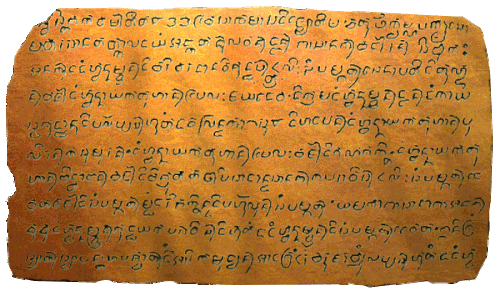
Imagine a sheet of copper about as big as a school notebook and as thin as a coin. On one side someone pressed ten lines of tiny letters into the metal. More than a thousand years later, a worker digging sand out of a river in the Philippines found it crumpled up in the mud.
The letters turned out to be a kind of receipt. It says that a family no longer owed a large amount of gold. It even warns anyone who might come back later and say the debt was still unpaid. Because it was written on metal, not on leaves or paper, the record has lasted for more than a thousand years.
The plate even tells us the exact day it was written: a Monday in April of the year 900. That makes it the oldest known piece of writing with a date that has been found in the Philippines.
Before it was found, many history books started the written history of the Philippines in 1521, when sailors from Europe arrived and wrote about the islands. This little plate showed that people around Manila Bay were already using writing, gold weights and written agreements more than 600 years earlier.
Today the plate is kept at the National Museum of the Philippines in Manila, and it has been declared a National Cultural Treasure, one of the country’s most precious objects.
At a glance
- What
- A debt-clearance document engraved on a single thin copper plate; probably the first plate of a set of two
- Date
- Śaka year 822, month of Vaiśākha, fourth day of the waning moon, a Monday = 21 April 900 CE (Julian calendar)
- Found
- Lumbang River near Lumban, Laguna, Luzon, during sand dredging; Postma dated the find to around 1987, other accounts give 1986 or 1989
- Size
- About 17.5 × 30.5 cm and roughly 1 mm thick, with ten lines of text on one side
- Script
- Early Kawi (often called Old Javanese script), an Indic script used in Java and beyond around 900
- Language
- Old Malay, with many Sanskrit terms and Old Javanese words; some scholars also see Old Tagalog elements
- First decipherment
- Antoon Postma, published 1991–92
- Where now
- National Museum of the Philippines, Manila; National Cultural Treasure (declared 2010)
Easy
What is the Laguna Copperplate Inscription?
The Laguna Copperplate Inscription, often shortened to LCI, is a sheet of copper with ten lines of writing pressed into one side. The text is an official note saying that a debt in gold has been cleared. It names the people involved, the officials who approved the clearance and the places with which those officials were associated, and it ends with a warning against anyone who might later claim the debt was still owed.
What makes the plate so important is its date. Its first line gives a precise day in the Indian Śaka calendar, which scholars have converted to Monday, 21 April 900 CE in the Julian calendar. No older dated document has been found in the Philippines. For that reason the plate is often called the first page of the written history of the Philippines.
The name “Laguna Copperplate Inscription” is modern. It was given by Antoon Postma, the scholar who first read the text, because the plate was recovered on the shores of Laguna de Bay, the large lake just south-east of Manila. The original document does not give itself that name; it calls itself a viśuddhapātra, a Sanskrit term meaning roughly “letter of clearance”.
Easy
A thin sheet of copper: the object and how it was found
The plate measures about 17.5 by 30.5 centimetres and is only about one millimetre thick. It is so thin that the letters engraved on the front show through as raised shapes on the back. Postma, who first studied it, described it as roughly 20 centimetres square; the more exact measurements come from a later direct examination by the epigraphers Elsa Clavé and Arlo Griffiths. When it was found it was crumpled and blackened. It has since been flattened, but the creases can still be seen.
The plate did not come from a planned excavation. It was scooped up by a mechanical conveyor during sand and gravel dredging in the Lumbang River, which flows into Laguna de Bay near the town of Lumban. Postma, after asking local people, concluded that it had been recovered around 1987; Clavé and Griffiths write “around 1986”, and some later accounts give 1989. In January 1990, after attempts to sell it on the antiques market had failed, it was offered to the National Museum in Manila, which acquired it and registered it under the accession number 1990-B-1.
The text stops in the middle of a sentence at the end of line ten. Scholars therefore think the plate was the first of at least two. Postma heard from local witnesses that a second inscribed plate may have been seen around the same time, but if it existed it has been lost.
Today the plate is displayed in the National Museum of Anthropology in Manila, in a gallery devoted to the ancient and traditional scripts of the Philippines. It is one of the archaeological objects declared National Cultural Treasures by the National Museum in 2010.
Easy
The letters and the language
The plate is written in a script that scholars call Early Kawi, or sometimes Old Javanese script. Kawi belongs to the large family of Indic scripts that descend from Brahmi, the ancient writing system of South Asia. In Kawi each basic letter stands for a consonant with a built-in vowel, and small marks above, below or beside the letter change the vowel. Around 900 the same style of Kawi was used across a wide area, especially in Java, and the letters of the Laguna plate look practically identical to those of Javanese documents of the time.
The language, however, is not Javanese. Postma identified it as Old Malay, an early form of the language that later became modern Malay and Indonesian. The earliest securely dated surviving Old Malay inscriptions come from the 680s, under the kingdom of Śrīvijaya in southern Sumatra, and the language was later also used in some inscriptions in Java. The Laguna plate is the only known Old Malay document from the Philippines, and the only known copperplate anywhere whose main language is Old Malay.
Mixed into the Old Malay are many borrowed words. Sanskrit supplies the opening date formula and legal terms such as the word for the clearance document and kāyastha, “scribe”. Old Javanese supplies titles such as pamgat, “official”. Postma also pointed out words that match Old Tagalog, the language spoken around Manila when the Spanish arrived, such as dayang for a woman of rank and lappas for a debt that has been settled. How much of the text is truly Tagalog is still argued about, as the section on different perspectives explains.
Intermediate
Antoon Postma and the decipherment
Antoon Postma (1929–2016) was a Dutch missionary and anthropologist who lived for about half a century among the Mangyan people of Mindoro and was known for his work on their Hanunó’o script. When he first saw the plate, his first thought was that it must come from Indonesia, since nothing similar had ever been found in the Philippines. He was also aware of earlier forged “ancient documents” that had once been celebrated as national treasures, so proving authenticity was his first task.
Working from his own tracing and then from photographs, Postma identified most of the letters with the help of nineteenth-century tables of Indonesian scripts. He corresponded with the Dutch palaeographer J. G. de Casparis, a leading expert on Indonesian inscriptions, who clarified doubtful characters and corrected Postma’s first reading of the year from Śaka 844 to Śaka 822. Experts in Indonesia and the Netherlands judged the plate genuine, because its script matched tenth-century forms and its language was grammatically correct in ways that a modern forger would find very hard to imitate.
Postma presented a preliminary paper at the congress of the Indo-Pacific Prehistory Association in Yogyakarta, Java, in August 1990. He then published his edition, translation and commentary in a series of overlapping articles in 1991 and 1992, of which the best known appeared in the journal Philippine Studies in 1992. He was careful to call his translation preliminary.
Postma’s edition has remained the starting point for all later work. In 2022 Clavé and Griffiths, specialists in Old Malay and Old Javanese inscriptions, published a new edition based on direct inspection of the plate in Manila in 2012. They praised Postma’s work as generally reliable while correcting a number of readings and word divisions, and their changes alter the meaning of several key passages.
Intermediate
What the document says
The text opens with the word svasti, “hail”, followed by the date: the elapsed Śaka year 822, the month Vaiśākha, the fourth day of the waning half of the moon, a Monday. It then states that on that day a clearance document was granted in connection with the family of a man with the honorific title dang hwan, named Namwaran (spelled Namwran on the plate).
The clearance was issued by an official (sang pamgat) who held the military title senāpati, “commander”, at a place called Tundun. The two main editions disagree about who this was. Postma read the passage as the commander of Tundun acting on behalf of a second person, the leader of Pailah, named Jayadewa. Clavé and Griffiths read it as one person: the commander at Tundun who also held the title nāyaka tuhān of Pailah, named or titled Jayadewa. The debt is stated as 1 kāti and 8 suwarna of gold. A scribe (kāyastha) took part, and three leaders bearing the title nāyaka tuhān are named as witnesses (Postma took them as witnesses of the clearance; Clavé and Griffiths think they more probably witnessed the original loan, while allowing either): the leader of Puliran, a leader of Pailah titled Ganasakti, and the leader of Binwangan titled Bisruta. Postma took the word Kasumuran after Puliran as the name of that leader, though he was unsure whether it might be a place; Tiongson and then Clavé and Griffiths read “Puliran Kasumuran” as a place name, which leaves the leader unnamed.
The second half explains how the debt was cleared and in whose favour. Postma understood the creditor to be the chief of Dewata, acting on behalf of the chief of Mdang. Clavé and Griffiths read a single creditor, “the deity official” (sang pamgat dewata), who bore the title “official of Mdang”. Because of loyal service, all the children and grandchildren of Namwaran are declared free of his debt. The final line begins a warning against anyone who might in future claim that the debt has not been settled, and it breaks off, presumably continuing on another plate.
Several details are read differently by the two main editions. Postma took dayang Angkatan as a noblewoman named Angkatan, who received the document together with her relative Bukah. Clavé and Griffiths read the same words as “a female servant who had been taken over” in debt bondage, with Bukah as her name. Postma translated the debt as “salary-related”; Clavé and Griffiths suggest a debt connected with an army, or possibly an engraver’s slip for “father’s debt”. These differences matter for how the society behind the text is understood.
Intermediate
A glimpse of society around Manila Bay in 900
Even as a single damaged page, the plate reveals a society with ranks and titles. People are introduced with honorifics such as dang hwan, sang pamgat and nāyaka tuhān, some of which are also known from Javanese and Malay inscriptions. Three of the four nāyaka tuhān carry Sanskrit names or titles (Jayadewa, Ganasakti, Bisruta), which shows that Indian-derived names had prestige locally. Postma noted that pamagat survived in Tagalog as a word for a title and that the shortened form gat appears in later Tagalog titles and surnames such as Gatmaitan. Clavé and Griffiths think it more likely that the term came into Old Malay from Javanese administrative language.
Gold is central to the text. The debt is measured in kāti and suwarna, units of weight that were also used in Java, written in abbreviated form on the plate. Scholars convert them differently. Postma took the suwarna as one-sixteenth of a kāti, with a kāti of about 617.6 grams, and so calculated the debt at about 926 grams of gold. Clavé and Griffiths use values attested in early Java, a kāti of 750–768 grams and a suwarna of about 38.6 grams, giving roughly 1.06 to 1.08 kilograms. Either way it was a large sum. These units were probably accounting units rather than particular coins, so the gold may originally have been lent in various forms; Clavé and Griffiths mention, as one possibility, the small bead-like gold pieces that collectors call piloncitos, which circulated between about the ninth and twelfth centuries and have been found around Manila Bay and elsewhere in the islands.
The document also shows that debt could bind a whole family. Postma compared it with sixteenth- and seventeenth-century Spanish reports and Tagalog dictionaries, which describe heavy interest and debtors and their descendants falling into servitude, and he used them to argue that such institutions had deep roots. The six-century gap between the plate and those sources limits how far the comparison can be pushed. Clavé and Griffiths read the plate itself as describing family members who had served in bondage and were released because of that service. On either reading, the plate gives the earliest written evidence of debt bondage in the Philippines.
Finally, the plate shows a legal culture that valued written proof. Witnesses, a scribe and a precisely dated record all follow a pattern of documents known from Java and Bali, and the term for the clearance document comes from a Sanskrit legal vocabulary that spread across South and Southeast Asia. Clavé and Griffiths point out that the Sanskrit law book of Yājñavalkya, from around the fifth century, already advised that debts contracted before witnesses be repaid before witnesses and that a receipt be drawn up.
Intermediate
Links with Java, Sumatra and the wider Malay-speaking world
Almost everything about the form of the plate points to Java. In Java and Bali hundreds of inscribed copper or bronze plates survive from roughly the ninth century onward, and most record grants of tax-exempt land. Java also produced debt-clearance and court-victory documents on metal plates in the same period. The way the Laguna plate states its date (month first, then day and fortnight) follows the Javanese pattern rather than the older Sumatran Old Malay one, though it leaves out the Javanese five- and six-day market weeks. The name Mdang (Medang) on the plate is the name of a royal centre closely associated with the kings of Mataram in Central Java.
The year 900 fell at the beginning of the reign of King Balitung of Mataram (about 898–910), whose reign produced many copperplate charters, nearly all in Old Javanese. Postma stressed that the date does not mean the plate came from Balitung’s court: it does not name a king and is not a royal charter. Still, it shows that people around Manila Bay were in contact with the documentary habits of the most powerful Javanese state of the time.
The language points also to Sumatra and to Śrīvijaya, where Old Malay first appears in writing in the 680s, for example in the Talang Tuwo inscription of 684. Some writers have therefore suggested Śrīvijayan influence in Luzon. Clavé and Griffiths argue for a different picture: by around 900 Malay had become a widely shared written language across maritime Southeast Asia, much as Latin or Persian served in other regions. Old Malay had even been used in Java itself before Old Javanese became the main written language there, as the Mañjuśrīgṛha inscription of 792 shows. On this view, writing in Malay with Javanese words in Luzon did not require Javanese or Sumatran rulers, only a shared, cosmopolitan culture of writing and law.
The plate thus places the Manila Bay region inside a network of trade and ideas linking Luzon with Java, Sumatra, the Malay peninsula and, further away, India and China. It does not, by itself, show who controlled that network. Javanese courts went on looking outward: more than four centuries later, the Old Javanese poem Nagarakretagama (1365) listed dozens of lands across the archipelago as acknowledging the Majapahit kingdom, including names that some scholars place in today’s Philippines, claims that historians treat with caution.
Intermediate
Meanwhile in the world
In Central Java, the Mataram (Medang) kingdom was at its height. During the ninth century its rulers had built great temples such as the Buddhist Borobudur and the Hindu Prambanan. King Balitung, who began his reign about two years before the Laguna plate was written, issued many copperplate charters in Old Javanese. In 929, less than thirty years after the plate, the centre of the kingdom moved to East Java under Mpu Sindok. These are not just events of the same date: the Laguna plate shares its script, its writing medium and part of its vocabulary with this Javanese world, and it names Mdang.
In Sumatra and Java, Old Malay had been written for more than two centuries, from the Śrīvijaya stone inscriptions of the 680s to Old Malay texts set up in Central Java such as the Mañjuśrīgṛha inscription of 792. The Laguna plate is the only piece of this early Old Malay record found in the Philippines, and it shows that the written language had reached Luzon.
At the same time, debt-clearance documents were being issued in Java and Bali using a related vocabulary of śuddha, “cleared”. A Javanese inscription of 912, for example, records how a debtor repaid a father’s debt in gold before five witnesses from nearby villages, with the document written by a local lord. Comparing such texts helps scholars interpret the Laguna plate’s witnesses and scribe.
Looking slightly later, Chinese records show sea trade with the islands growing. A Song record of 971 lists a place called Ma-yi among the southern sea countries, and in 982 traders from Ma-yi brought goods to the Chinese coast; in the early eleventh century the port of Butuan in Mindanao sent missions to the Song court. Whether Ma-yi lay in Mindoro or around Laguna de Bay is debated, so these records cannot describe Manila Bay in 900 directly, but they show the wider regional trade into which the plate’s world was growing.
Intermediate
Rewriting the start of Philippine history
For much of the twentieth century, the usual dividing line between prehistory and history in the Philippines was 1521, when Antonio Pigafetta kept his journal of Ferdinand Magellan’s expedition. Archaeology had shown human presence in the islands for tens of thousands of years, but without dated local documents, the written story seemed to begin with European observers. Some Western historians also described the islands as culturally isolated from the rest of Asia before the Spanish arrived.
The Laguna plate moved that line back by more than six hundred years. Postma wrote that the Philippines could now take its place on the tenth-century map of Southeast Asia beside Śrīvijaya, Mataram, Angkor and Champa, and he reported de Casparis’s view that it was one of the most important discoveries of recent times. The plate showed that literacy, standard weights of gold, formal legal procedures and titled officials already existed around Manila Bay long before 1521.
Postma also called for older evidence about the islands, such as Chinese records of trading places, to be re-examined in the light of the plate, and later studies have done so: Clavé and Griffiths, for example, read the plate together with Chinese records of Ma-yi and Butuan and with early finds bearing Indic script from Butuan in Mindanao. The plate itself has become a symbol of national heritage, displayed in the National Museum and declared a National Cultural Treasure.
Its meaning is still debated. Some readers stress continuity with later Tagalog society, others the plate’s Malay and Javanese character. Clavé and Griffiths note that the history of writing between the plate and the baybayin scripts recorded by the Spanish cannot yet be traced continuously; whether Kawi is the direct ancestor of baybayin remains an open question. The plate is a single document, and much about the people who made it remains unknown.
Advanced
Different perspectives
Place names. Only one identification is generally agreed: Tundun is Tondo, on the north bank of the Pasig River delta in today’s Manila. Postma first linked Pailah with Pila and Puliran with the south-eastern lake region of Laguna, but then decided that the plate treated them as separate places, and moved the whole set north to Bulacan: Pailah to the village of Paila in Norzagaray, Puliran to the town of Pulilan on the Angat River, and Binwangan to Binuangan in Obando at the mouth of the Bulacan River. Jaime Tiongson and the Pila Historical Society Foundation (2013) moved the context back to Laguna, identifying Pailah with Pila and Puliran with the old name of Laguna de Bay and its shores; Clavé and Griffiths accept these Laguna identifications. For Binwangan, proposals include Binuangan in Obando (Postma), Binawangan in Capalonga, Camarines Norte (Tiongson) and Binangonan in Rizal (the Indonesian scholar Kusen, 1991); Clavé and Griffiths leave the question open.
Medang and Dewata. Mdang (Medang) is the name of a royal and ancestral centre of the Mataram kings in Central Java, whose exact location is itself unknown. Kusen took it as a direct reference to that Javanese place, and some historians see the plate as evidence of Mataram’s influence in Luzon. Postma suggested that Javanese settlers may have carried the name to the Philippines. Clavé and Griffiths argue that a Javanese place need not be meant: the name may have been transplanted while keeping its link with ancestors, or sang pamgat Mdang may have become a title for a priest of an ancestor cult. Similarly, Postma, and after him the historian E. P. Patanñe, linked Dewata with places named Diwata near Butuan in Mindanao, while Clavé and Griffiths read dewata as “deity” and suggest that the creditor was an official of a religious institution devoted to a deified ancestor.
Language. Most specialists, including Postma and Clavé and Griffiths, classify the text as Old Malay. Postma allowed that some words could be Old Tagalog. Tiongson (2013) went further and argued that the language was Old Tagalog read through seventeenth-century dictionaries. Clavé and Griffiths reject this, pointing to fixed Old Malay formulas in the text, and conclude that Old Tagalog contributed little or nothing to its language. They stress that this says nothing against Tagalog culture: they think Tagalog was probably not yet being written, so a legal record was made in the shared written language of the region.
Tondo’s polity. Popular accounts often describe the plate as a decree of a “Kingdom of Tondo”. The text itself names a commander (senāpati) at Tundun who issued the clearance and three leaders of other places as witnesses (whether of the original loan or of its clearance is uncertain), but it names no king and describes no state. Historians of early Philippine societies generally prefer the neutral word “polity”, and some describe Tagalog political organisation as decentralised alliances of leaders rather than a territorial kingdom. Clavé and Griffiths cautiously suggest that Tundun may have been an outpost of a larger trading centre, perhaps Ma-yi of the Chinese sources, with some supervision over neighbouring settlements, and they warn that saying more would go beyond the evidence. The plate proves that Tondo existed as a named place with a ranking official in 900; it does not prove how large or centralised its rule was.
Advanced
Evidence and method: date, authenticity and provenance
The date is the most secure fact about the plate. Its formula gives era, year, month, fortnight, lunar day and weekday. Because these must all agree, a wrong conversion would usually produce the wrong weekday. Hector Santos (1996) worked out the Julian equivalent as Monday, 21 April 900, and Clavé and Griffiths reached the same result with two independent astronomical programs. The text also specifies that the Śaka year is an elapsed (atīta) year, one of the details a conversion must take into account.
Authenticity rests on internal evidence. The script matches the standard Early Kawi of about 850–925, and the language follows Old Malay spelling and grammar in details that a modern forger would have found very hard to reproduce. The engraver’s small mistakes also look genuine: in line three a syllable left out of a Sanskrit compound was added below the line with dots marking the correction. The specialists who have examined it, from Postma’s advisers to the editors of 2022, accept it as authentic.
Provenance is weaker. The plate was found by dredging, not by excavation, so there is no archaeological context such as a datable layer or associated objects. It passed through the antiques trade before reaching the museum, and accounts of the find year differ (1986, about 1987 or 1989). Because the plate is thin and portable, its findspot does not prove where it was written, but its place names, which include Tondo, point to the Manila Bay and Laguna region.
Finally, the text is incomplete. It probably continued on a second plate, containing the end of the warning and perhaps more names or a closing formula, which has not been recovered or identified. Interpretations of the political setting rest on a few titles and place names, so careful scholars separate what the text states (a dated clearance of a gold debt, witnesses, titles, places) from what it suggests (links with Javanese documentary practice) and from what remains speculation (the size of Tondo’s authority, or whether a foreign power was involved).
Key ideas
- Oldest dated Philippine document
- The plate’s Śaka date corresponds to 21 April 900 CE in the Julian calendar, more than six centuries before Pigafetta’s 1521 account.
- Debt clearance
- The text is a record that a gold debt has been settled, protecting the debtor’s descendants against future claims.
- Old Malay as a shared written language
- A Malay text with Sanskrit and Javanese terms shows Luzon taking part in a regional culture of writing that stretched from Sumatra and Java.
- Javanese documentary culture
- The copperplate medium, date formula, scribe, witnesses and the name Mdang link the plate with practices of contemporary Java.
- Ranks and titles
- Honorifics such as dang hwan, sang pamgat and nāyaka tuhān, and Sanskrit names, show a ranked society with prestige titles.
- Gold economy
- The debt is measured in kāti and suwarna, weight units shared with Java, showing gold used as a standard of value.
- Interpretation under uncertainty
- Several place names, the meaning of Mdang and Dewata, and the nature of Tondo’s authority remain debated.
Records
- 684 CE — The Talang Tuwo inscription near Palembang, Sumatra, one of the earliest dated Old Malay texts, is set up under Śrīvijaya.
- 792 CE — The Old Malay Mañjuśrīgṛha inscription is set up at the Sewu temple complex in Central Java.
- c. 898 CE — Balitung begins his reign over the Mataram (Medang) kingdom of Central Java (reigned about 898–910).
- 900 CE — On Monday, 21 April (Julian calendar; Śaka 822, Vaiśākha), the debt-clearance document is issued.
- 929 CE — The centre of the Mataram kingdom moves from Central to East Java under Mpu Sindok.
- 982 CE — Traders from Ma-yi bring goods to the Chinese coast; the place had first been named in a Song record of 971. These are among the earliest Chinese records of a Philippine trading place.
- 1521 — Antonio Pigafetta records Magellan’s expedition, long treated as the start of written Philippine history.
- c. 1987 — The plate is dredged from the Lumbang River near Lumban, Laguna (accounts range from 1986 to 1989).
- 1990 — The plate is offered to the National Museum in January; Postma presents a first paper at Yogyakarta in August.
- 1992 — Postma’s edition and commentary appear in Philippine Studies, after first articles in 1991.
- 2010 — The National Museum declares the plate a National Cultural Treasure.
- 2022 — Elsa Clavé and Arlo Griffiths publish a new edition and interpretation.
Glossary
- Copperplate
- A thin metal sheet engraved with an official text, a document form used in India, Java and Bali.
- Kawi script
- An Indic script used in Java and nearby regions from about the eighth century; also called Old Javanese script.
- Old Malay
- The early written form of Malay, known from inscriptions from the seventh century onward.
- Śaka era
- An Indian calendar era beginning in 78 CE, widely used to date inscriptions in Southeast Asia.
- Viśuddhapātra
- The plate’s own name for itself: a Sanskrit-derived term for a document of clearance.
- Kāti and suwarna
- Weight units for gold used in Java and beyond; the kāti was the larger unit, and scholars estimate their weights and ratio differently for this text.
- Senāpati
- A Sanskrit title meaning army commander, borne by the official at Tundun.
- Pamgat
- A title for an official, known from Old Javanese and later found in Tagalog as pamagat.
- Debt bondage
- A condition in which a debtor, and sometimes the family, must serve the creditor until the debt is cleared.
- National Cultural Treasure
- The highest designation for cultural property under Philippine heritage law, declared by national cultural agencies.
Questions and answers
Why is a debt receipt so important?
Because it is dated. It proves that writing, legal records and gold standards were in use around Manila Bay in 900 CE, centuries before the first European accounts.
Was it written in Tagalog?
Most specialists say no: the main language is Old Malay, with Sanskrit and Old Javanese words. Some scholars argue for Old Tagalog elements, and one study argued for Old Tagalog as the main language, but this is a minority view.
Who decoded it?
The Dutch anthropologist Antoon Postma, helped by the palaeographer J. G. de Casparis, published the first reading in 1991–92. A revised edition by Elsa Clavé and Arlo Griffiths appeared in 2022.
How much gold was the debt?
1 kāti and 8 suwarna. Depending on how the units are converted, that is roughly 0.9 to 1.1 kilograms of gold.
Does it prove that there was a Kingdom of Tondo?
It proves that Tondo (Tundun) existed and had a commander who could issue legal documents. It names no king, so how large or centralised Tondo’s rule was cannot be read from the plate alone.
Does Medang mean the plate came from Java?
Not necessarily. The script and some words are Javanese in style and Medang was a Javanese royal centre, but the other place names point to Luzon. Scholars debate whether Medang refers directly to Java or to a transplanted name or title.
Can I see it?
Yes. It is displayed at the National Museum of Anthropology in Manila, part of the National Museum of the Philippines.
Sources and further reading
- Antoon Postma, The Laguna Copper-Plate Inscription: Text and Commentary. Philippine Studies 40(2), Ateneo de Manila University, 1992
- Elsa Clavé and Arlo Griffiths, The Laguna Copperplate Inscription: Tenth-Century Luzon, Java, and the Malay World. Philippine Studies: Historical and Ethnographic Viewpoints 70(2), 2022
- Hector Santos, The Date of the Laguna Copperplate Inscription. Philippine Studies 44(4), Ateneo de Manila University, 1996
- The 9th to 10th Century Archaeological Evidence of Maritime Relations between the Philippines and the Islands of Southeast Asia. National Museum of the Philippines, 2022
- National Cultural Treasures (Archaeology collection). National Museum of the Philippines
- Laguna Copperplate Inscription. Wikipedia
- List of National Cultural Treasures in the Philippines. Wikipedia
- Mataram Kingdom (Medang). Wikipedia
- Kawi script. Wikipedia
- Tondo (historical polity). Wikipedia
- Talang Tuwo inscription. Wikipedia
- Manjusrigrha inscription. Wikipedia
- Ma-i. Wikipedia
- Piloncitos. Wikipedia
- Rajahnate of Butuan. Wikipedia
- Nagarakretagama. Wikipedia
Related
- PrambananNinth-century Hindu temple complex dedicated to Shiva, Vishnu and Brahma, the largest of ancient Java, famous for its 47-metre central tower and Ramayana reliefs.
- BorobudurLarge Buddhist monument in Central Java, built around the eighth and ninth centuries.
- Nagarakretagama (Desawarnana)Old Javanese kakawin poem completed in 1365 by the Buddhist poet Prapañca, praising King Hayam Wuruk and describing the Majapahit court, royal tours and realm.
Written with AI assistance from the published sources listed above, and revised as new research appears.