Start at the top for an easy introduction. Go further down for more detail and scholarship.
- Easy
- Intermediate
- Advanced
For young readers
Imagine a river that bends like a giant horseshoe, with a tall rock cliff along its side. Long ago, Buddhist monks and craftsmen in India chose a cliff like this, near a place now called Ajanta, and began to carve rooms right into the solid rock.
They did not build with bricks. Instead, they chipped away the stone with hammers and chisels, starting at the top and working downward, until halls, pillars, statues and little bedrooms for monks appeared inside the cliff. It was like sculpting a whole building out of a mountain.
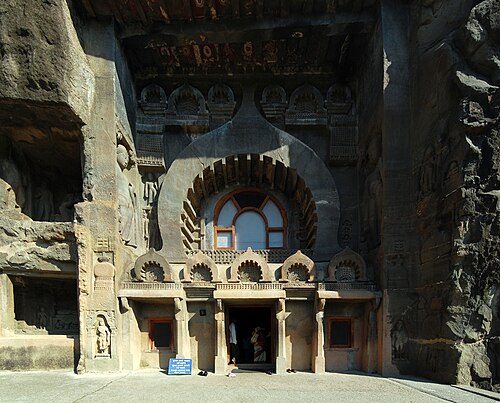
Some caves were prayer halls with a round, tall ceiling shaped like the inside of a boat turned upside down. At the end of each hall stood a stupa, a dome-shaped shrine. Other caves were monasteries, where monks lived, studied and meditated in small rooms around a big square hall.
Then painters covered the walls and ceilings with pictures. They painted princes and princesses, elephants and monkeys, dancers and musicians, and many stories about the Buddha's earlier lives, when he was born as an animal or a king and always tried to be kind and generous.
After some centuries people stopped using the caves, and the forest slowly hid them. In 1819 a British officer hunting a tiger saw one of the cave entrances across the river. Soon people from all over the world came to see them. Today the Ajanta Caves are a UNESCO World Heritage Site.
At a glance
- Place
- Horseshoe-shaped gorge of the Waghur river, Chhatrapati Sambhajinagar (Aurangabad) district, Maharashtra, India
- Number
- About 30 rock-cut caves (numbered 1–29 plus 15A, from east to west by position, not by age)
- First phase
- About 2nd–1st century BCE to the early centuries CE, in the Satavahana period (Caves 9, 10, 12, 13, 15A)
- Second phase
- 5th century CE under the Vakataka dynasty; Walter Spink dates most work to c. 460–480, while others extend it into the 6th century
- Types
- Chaitya halls for worship (Caves 9, 10, 19, 26; 29 unfinished) and viharas (monasteries)
- Art
- Wall paintings (especially Caves 1, 2, 16, 17), relief sculpture and Buddha images; many scenes from the Jātaka tales
- Religion
- Buddhist; early caves without Buddha images, later caves with Buddha images in shrines, reflecting Mahāyāna-influenced practice
- Status
- UNESCO World Heritage Site (1983); protected by the Archaeological Survey of India
Easy
What are the Ajanta Caves?
The Ajanta Caves are a group of about thirty Buddhist monuments cut into a basalt cliff in the hills of northern Maharashtra, western India. They line the outer curve of a deep, horseshoe-shaped bend in the Waghur river, in a quiet valley that was once far from towns but near important trade routes across the Deccan plateau.
The caves were made in two main periods. The first began around the 2nd or 1st century BCE; the second, much larger, took place in the 5th century CE under the Vakataka dynasty. Each cave is either a worship hall (chaitya) or a monastery (vihara), and together they formed a community where monks lived, prayed and received pilgrims and patrons.
Ajanta is world-famous for its paintings. The murals in Caves 1, 2, 16 and 17 form the largest surviving group of ancient Indian wall paintings. With their graceful figures, rich colours and crowded storytelling, they are often called one of the high points of Indian art. The caves also contain fine sculpture, from monumental Buddhas to ornamental pillars and doorways.
Easy
How to "read" a cave
A chaitya hall is a long, tall room with a rounded end, like an apse in a church. Rows of pillars divide a central nave from narrow side aisles. The ceiling is a high barrel vault, and in early caves it was carved with imitation wooden ribs, copying earlier buildings made of timber. At the rounded end stands a stupa, a dome-shaped monument representing the Buddha's final passing into nirvana. Worshippers walked around it clockwise along the aisles. Outside, a huge horseshoe-shaped window above the entrance lets light fall onto the stupa.
A vihara is a monastery. It usually has a square central hall surrounded by small cells, each a bedroom for one or two monks with a stone bench for a bed. A porch with pillars stands in front. In the later viharas, a shrine was cut into the back wall facing the entrance, holding a large seated Buddha, so that the monastery also became a place of worship.
Paintings covered almost every surface: walls, pillars and ceilings. The walls usually show long stories, told in episodes that flow into one another without frames, so the viewer must follow the figures across the wall. The ceilings are covered with patterns of flowers, animals, birds and geometric designs, like a painted canopy.
The caves are numbered from 1 at the eastern end to 29 at the western end, with 15A added later. The numbers follow their position in the cliff, not their age, so the oldest caves, 9, 10, 12 and 13, are in the middle of the row.
Easy
Stories on the walls
Many paintings illustrate the Jātakas, stories of the Buddha's previous lives. In them the future Buddha, called the Bodhisattva, is born as a prince, a merchant, an elephant, a deer or a monkey, and each time shows a virtue such as generosity, patience or compassion. In the Vishvantara Jātaka in Cave 17, for example, a prince gives away everything he owns, even his family, in an extreme act of generosity. Other scenes show the life of the historical Buddha: his birth, his leaving the palace, his enlightenment and his teaching.
The two most famous single figures are the bodhisattvas painted on either side of the shrine door in Cave 1. One, usually identified as Padmapani ("lotus in hand"), stands with his head gently tilted, holding a blue lotus, his eyes lowered in calm compassion. The other is Vajrapani. These over-life-size figures are among the best-known images in Indian art.
The paintings also show everyday life in great detail: palaces and city streets, kings and courtiers, women in elaborate jewellery, musicians, dancers, soldiers, ships, horses and elephants, foreigners in unusual clothes, and forest animals. A well-known scene in Cave 16, often called "the dying princess", shows a grieving woman, usually identified as Sundari, the wife of the Buddha's half-brother Nanda, when she learns that he has become a monk. For historians these images are a window into the courtly culture of 5th-century India.
Intermediate
The first phase: early Buddhist caves
The earliest caves belong to a widespread tradition of rock-cut Buddhist architecture in the western Deccan, which also includes sites such as Bhaja, Karla and Pitalkhora. They were made in the period when the Satavahana dynasty dominated the region, from roughly the 2nd century BCE onward. Caves 9 and 10 are chaitya halls; Caves 12, 13 and 15A are small monasteries.
These early caves are aniconic: the Buddha is not shown in human form. Worship focused on the stupa, and the Buddha was represented, where necessary, by symbols. Inscriptions record gifts from individual donors, showing that the caves were supported by lay followers, including merchants and families, as well as monks.
Cave 10, probably the oldest chaitya at Ajanta, preserves fragments of the oldest paintings, with scenes such as a royal procession approaching a sacred tree. Their style, with full-bodied figures and lively crowds, relates to the sculpture of early stupas such as Sanchi. After this first phase, activity at Ajanta seems to have stopped or slowed for several centuries.
Intermediate
The second phase: the Vakataka golden age
In the 5th century CE the Vakataka dynasty ruled much of central India and the Deccan. Under Emperor Harishena (reigned c. 460–477), members of his court sponsored a burst of new excavation at Ajanta. Harishena himself was a Hindu ruler; the Vakatakas worshipped Shiva. But his ministers and vassals included devout Buddhists, and royal families in this period often supported several religions.
Inscriptions name some of the patrons. Varahadeva, Harishena's minister, dedicated Cave 16 with a long inscription describing the Vakataka kings. Upendragupta, a local ruler under Harishena, sponsored Caves 17 to 20. A monk named Buddhabhadra, together with a minister of the king of the neighbouring Ashmaka region, dedicated the great chaitya Cave 26, whose inscription speaks of a memorial on the mountain that will endure as long as the moon and sun.
The caves of this phase are larger and richer than those of the first. Buddha images now appear everywhere: seated in shrines at the back of the viharas, standing in front of the stupas in the new chaityas 19 and 26, and carved in reliefs across façades. Cave 26 contains a colossal reclining Buddha representing his parinirvana (final passing away), and a dramatic relief of the demon Mara's attack and his daughters' temptation.
According to the historian Walter Spink, work proceeded very quickly: begun around 460–462, disrupted by threats from the Ashmakas around 468, and ending abruptly after Harishena's death in 477, when many caves were left unfinished and hastily completed shrines were added. Others argue for a longer chronology, discussed below.
Intermediate
How the caves were cut and painted
The caves were carved from the top down. Workers first cut a narrow tunnel at ceiling level, then enlarged it downward and outward, removing the rock in stages and leaving pillars, statues and walls standing where planned. Unfinished caves at Ajanta show every stage of this process, from rough blocks to finished sculpture, making the site a textbook of rock-cut technique.
The paintings are not true fresco, painted into wet lime plaster as in Italy, but are done on a dry surface, a method sometimes called tempera or secco. The rough rock was covered with a layer of clay or mud mixed with organic materials such as plant fibre, then a thin coat of lime, and the painters worked on this ground with pigments bound in glue. Colours came mainly from local earths, such as red and yellow ochre, together with white, black from soot and green minerals; blue is often said to include imported lapis lazuli.
The painters were highly skilled. They used shading to model faces and bodies, bold outlines to give movement, and conventions of posture and gesture to express emotion. Scholars see in their work the refined aesthetics described in Sanskrit texts on painting and poetry of the Gupta-Vakataka period, including the ideal of rasa, the emotional flavour a work of art should awaken in its audience.
Intermediate
Abandonment, rediscovery and copying
After the 5th or 6th century the caves gradually fell out of use. Some later travellers may have known of them; the 7th-century Chinese pilgrim Xuanzang describes a monastery in the region of Maharashtra that many scholars identify with Ajanta, though he may not have visited it himself. Local people living nearby always knew the caves existed, but vegetation and debris covered many entrances, and the site was unknown to the outside world.
On 28 April 1819, John Smith, a British cavalry officer hunting a tiger, was guided by a local shepherd boy to Cave 10. He scratched his name and the date on a painted pillar, where it can still be seen, a reminder that rediscovery also brought damage. News spread quickly, and Ajanta soon became famous among colonial officers, scholars and artists.
Because the paintings were fragile, several projects tried to copy them. Major Robert Gill worked at the site from 1844 to 1863 and made many large copies, but most were destroyed in a fire at the Crystal Palace in London in 1866. From 1872 John Griffiths and his students from the Bombay School of Art made about 300 copies over thirteen years; more than a hundred were destroyed by another fire in London in 1885. Griffiths's team also coated some paintings with varnish to make them easier to see, which later darkened and damaged them. Between 1909 and 1911 Christiana Herringham, with students of the Calcutta School of Art including the future painter Nandalal Bose, made another set of copies, published in 1915.
In the 1920s the region belonged to the princely state of Hyderabad. Its ruler, the Nizam Mir Osman Ali Khan, supported conservation work, including the employment of the Italian restorers Lorenzo Cecconi and Count Orsini, and built a road to the site. The archaeologist Ghulam Yazdani published a multi-volume photographic record of the paintings. Since Indian independence, the caves have been protected by the Archaeological Survey of India, and in 1983 they were inscribed on the UNESCO World Heritage List.
Intermediate
Influence and legacy
Ajanta was part of a network of Buddhist sites linked by monks, merchants and artists across South Asia and beyond. Its painting style is often compared with the 5th-century murals at Sigiriya in Sri Lanka, with Buddhist cave paintings along the Silk Road in Central Asia and China, and with the 7th-century wall paintings of the Golden Hall of Hōryū-ji in Japan, which were damaged by fire in 1949. Whether these resemblances reflect direct influence or a shared pan-Asian Buddhist style is debated.
Nearby, at Ellora, rock-cut architecture continued in the following centuries with Buddhist, Hindu and Jain caves side by side, and many elements first worked out at Ajanta were developed further there.
In modern times Ajanta has had a powerful influence on Indian artists. The copies made by Herringham's team, and the involvement of students such as Nandalal Bose, helped inspire the Bengal School's search for an Indian modern art rooted in older traditions. For many Indians Ajanta is a symbol of the country's classical heritage, and its paintings are reproduced in textbooks, on stamps and in popular culture. Ajanta is also often cited as a starting point of the Indian rock-cut tradition when studying later East Asian cave temples such as Seokguram in Korea.
Intermediate
Conservation challenges
Ajanta's paintings are extremely fragile. They suffer from moisture seeping through the rock, from insects and microbes, from the old varnishes and restorations applied in the 19th and 20th centuries, and from the dust, humidity and body heat brought by large numbers of visitors. Light also damages pigments, so the caves are kept dimly lit and flash photography is forbidden.
The Archaeological Survey of India has carried out cleaning and consolidation, sometimes with international partners, and has limited the number of visitors allowed into the most delicate caves at one time. Some scholars, including Spink, have criticized recent cleaning campaigns as too aggressive, while conservators stress the need to remove harmful old coatings. As at many painted sites, there is a tension between access and preservation.
In 2012 the state tourism corporation announced plans for full-size replicas of Caves 1, 2, 16 and 17 at a visitor centre near the entrance, to reduce crowding in the originals. Digital documentation, including high-resolution photography, is now an important tool for recording the paintings before further deterioration.
Advanced
The chronology debate
The dating of Ajanta's second phase is one of the most discussed questions in South Asian art history. Walter M. Spink, who studied the site for more than half a century, proposed a "short chronology": nearly all the later caves were created in less than twenty years, roughly 460–480 CE, under Harishena and his court. He reconstructed a year-by-year sequence based on changes in architectural details, such as the shapes of doorways and pillars, on unfinished work, and on signs of hurried changes of plan, and connected these to political events, especially the Ashmaka threat and Harishena's death.
Other scholars, including Karl Khandalavala and Hans Bakker, have argued for a longer period of activity extending into the late 5th or 6th century, and the Archaeological Survey of India has described work as continuing into the mid-6th century. Critics of the short chronology note that it depends heavily on stylistic reasoning and on assumptions about the speed of work, and that inscriptional evidence is limited. Supporters answer that the density of interlinked evidence at the site makes a compressed timeline plausible.
The debate matters because Ajanta is used as a reference point for dating other art across South and Southeast Asia. If the paintings were made in two decades by a single generation, they represent one extraordinary moment of patronage; if over a century, they record a longer evolution of style and practice. Spink's detailed volumes, Ajanta: History and Development (Brill, from 2005), remain essential even for those who disagree with his conclusions.
Advanced
Interpretation: patronage, religion and identifying the scenes
Identifying what the paintings show is itself a scholarly task. Many murals are damaged, and their narratives were drawn from Buddhist texts in Sanskrit and Pali, some of which differ from each other. Researchers such as Dieter Schlingloff have spent decades matching scenes with literary sources, correcting older identifications. Even famous images like the "dying princess" or the figure called Padmapani are identified by convention, and alternative readings exist.
Another question concerns the religious character of the later caves. The appearance of Buddha images, bodhisattvas such as Avalokiteshvara, and shrines in monasteries is often linked to Mahāyāna Buddhism. But many scholars caution that the monks of Ajanta may have followed traditional monastic codes while taking part in new devotional practices, and that the labels "Hinayana" and "Mahayana" oversimplify a more complex situation.
Finally, the caves show how religious art was financed. Inscriptions reveal royal ministers, local kings, monks and lay donors seeking religious merit for themselves and their families. The fact that a Hindu emperor's court sponsored some of the finest Buddhist art in India is a reminder that religious identities in the 5th century were often less exclusive than modern categories suggest, and that art, politics and piety were closely intertwined.
Key ideas
- Rock-cut architecture
- Buildings created by carving away solid rock rather than constructing with blocks; Ajanta is a major example.
- Chaitya and vihara
- The two cave types: a worship hall with a stupa, and a monastery with monks' cells.
- From symbol to image
- Early caves honour the Buddha through the stupa; later caves are full of Buddha images, reflecting changes in Buddhist practice.
- Narrative painting
- Long, continuous wall stories, especially the Jātakas, teach Buddhist virtues through vivid everyday scenes.
- Royal and lay patronage
- Ministers, local kings, monks and ordinary donors paid for caves to earn religious merit.
- Short versus long chronology
- Scholars debate whether the later caves were made in about twenty years or over a century.
- Preservation versus access
- The paintings are fragile, so protecting them means limiting how people can visit and see them.
Records
- c. 150 BCE — The first caves (including Caves 9 and 10) begin to be excavated, in the 2nd or 1st century BCE.
- c. 100 CE — The first phase comes to an end; activity at Ajanta pauses for several centuries.
- c. 460 CE — Harishena becomes Vakataka emperor; a new phase of excavation begins at Ajanta soon after.
- c. 468 CE — According to Spink, threats from the Ashmaka kingdom interrupt much of the work.
- c. 477 CE — Death of Harishena; according to Spink, work soon stops and many caves remain unfinished.
- c. 640 CE — Xuanzang describes a monastery in Maharashtra often identified with Ajanta.
- 1819 — John Smith, a British officer, reaches Cave 10 while hunting a tiger.
- 1844 — Robert Gill begins copying the paintings (to 1863).
- 1866 — Most of Gill's copies are destroyed in the Crystal Palace fire in London.
- 1872 — John Griffiths and his students begin a thirteen-year copying project.
- 1909 — Christiana Herringham's team, including Nandalal Bose, begins copying (to 1911).
- 1983 — The Ajanta Caves are inscribed on the UNESCO World Heritage List.
Glossary
- Chaitya (chaitya-griha)
- A Buddhist worship hall with a stupa at the end, often apsidal with a vaulted ceiling.
- Vihara
- A Buddhist monastery, usually with a central hall and surrounding cells.
- Stupa
- A dome-shaped monument that originally held relics and represents the Buddha's nirvana.
- Jātaka
- A story of one of the Buddha's previous lives.
- Bodhisattva
- A being on the path to Buddhahood; in the Jātakas, the Buddha in earlier lives; in Mahāyāna, a compassionate helper of others.
- Aniconic
- Representing a sacred figure through symbols rather than a human image.
- Tempera / secco
- Painting on a dry wall surface with pigments mixed with a binder, as at Ajanta.
- Vakataka dynasty
- A dynasty that ruled much of central India and the Deccan in the 3rd–5th centuries CE.
- Parinirvana
- The Buddha's final passing away, shown at Ajanta as a reclining figure.
- Rock-cut
- Carved directly out of natural rock rather than built.
Questions and answers
Were the Ajanta Caves natural caves?
No. They were carved by people out of solid rock, working from the top of each cave downward with hammers and chisels.
How old are the paintings?
The oldest fragments date from around the 2nd or 1st century BCE; most of the famous paintings were made in the 5th century CE.
Who lived in the caves?
Buddhist monks lived in the monasteries, sleeping in small stone cells and gathering in the halls to pray and study, supported by donors.
Why were the caves forgotten?
After the 5th or 6th century the monastery declined and the forest covered many entrances. Local people knew of them, but the wider world learned about them after 1819.
Why was a Hindu emperor's court paying for Buddhist caves?
Religious patronage was often shared in ancient India. Harishena was Hindu, but his Buddhist ministers and vassals sponsored caves, and rulers often supported several traditions.
When exactly were the later caves made?
Walter Spink argues for about 460–480 CE; other scholars and the Archaeological Survey of India see work continuing into the 6th century. The question is still debated.
Are the paintings true frescoes?
Not in the Italian sense. They were painted on a dry surface of mud plaster and lime, a technique often called tempera or secco.
Sources and further reading
- Ajanta Caves. Wikipedia
- Ajanta Paintings. Wikipedia
- Harishena. Wikipedia
- Vakataka dynasty. Wikipedia
- Christiana Herringham. Wikipedia
- Ajanta Caves. UNESCO World Heritage Centre
- 아잔타 석굴. Wikipedia (Korean)
- Walter M. Spink, Ajanta: History and Development (multi-volume). Brill, 2005–2017
Related
- Siddhartha Gautama (the Buddha)Founder of Buddhism, who taught a path to liberation from suffering on the Ganges plain. His dates are disputed.
- AshokaA Mauryan emperor whose inscriptions describe his commitment to dhamma after a devastating conquest of Kalinga.
- SeokguramEighth-century Buddhist grotto near Gyeongju, known for its granite Buddha and surrounding sculptures.
- BorobudurLarge Buddhist monument in Central Java, built around the eighth and ninth centuries.
- Hōryū-jiA Buddhist temple complex in Japan traditionally founded in 607 CE and home to some of the world's oldest surviving wooden buildings.
- KālidāsaA Sanskrit poet and playwright whose works are landmarks of classical Indian literature.
Written with AI assistance from the published sources listed above, and revised as new research appears.