Start at the top for an easy introduction. Go further down for more detail and scholarship.
- Easy
- Intermediate
- Advanced
For young readers
Long ago, on the big Greek island of Crete, people built a huge building with more than a thousand rooms. It had many floors, wide staircases, bathrooms, storerooms full of giant clay jars and walls painted with dolphins, flowers and young people jumping over bulls. We call this place Knossos, and the people who lived there the Minoans.
The building was so big and so full of corridors that it is easy to get lost in it. Thousands of years later, the ancient Greeks told a story about it. They said that King Minos of Crete kept a monster there, the Minotaur, half man and half bull, inside a maze called the Labyrinth. A hero named Theseus found his way out with the help of a ball of thread given to him by the princess Ariadne.
The real Minoans did not leave us that story. They wrote in a script that nobody can read yet, called Linear A. So archaeologists study their buildings, pottery, pictures and tools like detectives, to work out how they lived.
The Minoans were great sailors and traders. Their ships carried oil, wine and beautiful pottery across the sea to Egypt and other lands, and brought back copper, tin and gold. Egyptian paintings even show people from Crete bringing gifts.
About 125 years ago, a British archaeologist named Arthur Evans dug up Knossos. He rebuilt some of the rooms with concrete and painted copies of the pictures, so visitors can imagine what it looked like. But some of his rebuilding was guesswork, and archaeologists still argue about it.
At a glance
- Period
- Settlement from c. 7000 BCE; palace built c. 1900 BCE, rebuilt after c. 1700 BCE, in use until the 14th century BCE or later
- Place
- Kephala hill, about 5 km south-east of the centre of Heraklion, Crete, Greece
- Culture
- Minoan civilisation (Bronze Age Crete); later a Mycenaean Greek administrative centre
- Size
- Palace complex of roughly 20,000 m² around a large rectangular central court, part of a much larger town
- Writing
- Cretan hieroglyphs and Linear A (undeciphered); Linear B tablets in Mycenaean Greek
- Excavation
- Minos Kalokairinos, 1878–79; Arthur Evans, from 1900; extensive partial reconstruction in the early 20th century
- Status
- UNESCO World Heritage Site as part of the “Minoan Palatial Centres” (inscribed 2025)
- Finds
- Frescoes, sealings, pottery and figurines, mostly in the Heraklion Archaeological Museum
Easy
What is Knossos?
Knossos is an archaeological site on the island of Crete, just outside the modern city of Heraklion. It is best known for a vast building complex of the Bronze Age, usually called the Palace of Minos, which was the largest of several similar complexes on Crete. The people who built it are called Minoans, a modern name invented by the archaeologist Arthur Evans after the legendary King Minos.
The palace was not a single building put up at one time. It grew over centuries around a large open courtyard, with wings of rooms rising two or three storeys on every side. It contained storerooms, workshops, shrines, halls for ceremonies, living quarters and a sophisticated system of drains and light wells. Around it lay a town of houses, roads and cemeteries.
Knossos is also one of the oldest settlements in Europe. People first lived on the hill around 7000 BCE, in the Neolithic period, and the layers of their houses built up into a mound several metres deep before the first palace was built.
Knossos matters for two reasons. It is the key site for understanding the Minoans, the first complex, urban civilisation in the Aegean. And through Greek myth it has shaped the European imagination for nearly three thousand years, as the home of Minos, Daedalus, the Minotaur and the Labyrinth.
Easy
How to “read” the palace
The heart of the palace is the Central Court, a paved rectangle roughly fifty metres long, oriented approximately north–south. Every Minoan palace has such a court, and it was probably used for gatherings and ceremonies. All the main wings open onto it.
On the west side lay the rooms for storage and ritual. A long corridor gives access to narrow storerooms (magazines) where enormous clay jars, called pithoi, held olive oil, wine and grain; stone-lined pits in the floors may have held valuables. Next to the court is the so-called Throne Room, with a stone seat against the wall flanked by painted griffins, stone benches and a sunken area that Evans called a lustral basin. Nearby were small shrines where Evans found figurines of women holding snakes.
On the east side, built into the slope, is the so-called Domestic Quarter. A Grand Staircase descended several floors around a light well, an open shaft that brought daylight and fresh air into the lower rooms. Here Evans identified the “King’s Megaron” and “Queen’s Megaron”, with a room containing what he interpreted as a bath and a toilet flushed by the drainage system. These names are Evans’s interpretations, not ancient labels.
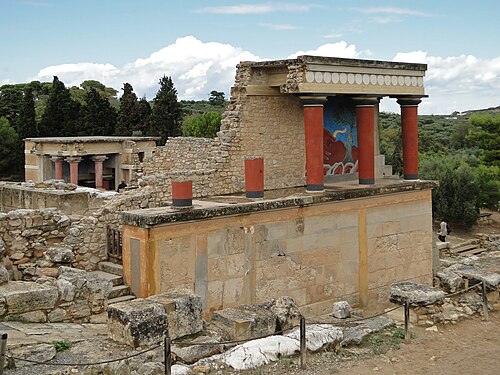
Other features to look for are the west façade of large cut blocks, the ceremonial entrances with long painted corridors, stone “horns of consecration” (a sacred symbol shaped like a pair of bull’s horns), and double axes (labrys) carved as signs on stone blocks. Much of what visitors see today, including the red columns that narrow towards the bottom, is a reconstruction, but it is based on the original column bases and on painted images of Minoan buildings.
Easy
Life, art and the sea
Minoan painters decorated walls with frescoes, painting on wet lime plaster. Famous scenes from Knossos include the Bull-Leaping Fresco, in which young people grasp a charging bull’s horns and somersault over its back; the Procession Fresco, with rows of people carrying gifts; the Cup-Bearer; the Dolphin Fresco; and the so-called Prince of the Lilies. Colour conventions distinguish figures: men are usually painted red-brown and women white.
Minoan craftspeople were also masters of small-scale art. They carved seals in hard stones with tiny scenes, made fine thin-walled pottery painted with sea creatures and plants, and produced objects of faience, ivory and gold. A stone vessel in the shape of a bull’s head, from the Little Palace at Knossos, has eyes of rock crystal and horns once covered with gold.
The Minoans lived by farming, herding and trade. Crete produced olive oil, wine, wool and textiles, but lacked metals, so its ships sailed across the Aegean and to Cyprus, the Levant and Egypt. Egyptian texts refer to a land called Keftiu, generally identified as Crete, and paintings in Egyptian tombs of the fifteenth century BCE show Keftiu people bringing vessels as gifts.
Bulls appear everywhere in Minoan art and religion: in bull-leaping, in the horns of consecration, in bull-shaped vessels. This may help explain why later Greeks associated Crete with a bull-headed monster.
Intermediate
Building, destruction and rebuilding
Archaeologists divide the Minoan Bronze Age into Early, Middle and Late Minoan periods, a system created by Evans and his assistant Duncan Mackenzie on the basis of pottery styles. The first palace at Knossos was built around 1900 BCE, in the Middle Minoan period, at the same time as the palaces at Phaistos and Malia. This “Old Palace” period saw the use of Cretan hieroglyphic writing and the fine, colourful pottery called Kamares ware.
Around 1700 BCE the palaces were badly damaged, probably by earthquakes. They were rebuilt on a grander scale, beginning the “New Palace” or Neopalatial period, the height of Minoan civilisation. Most of what is visible at Knossos today belongs to this phase. Linear A was now the main administrative script.
During this period, probably in the sixteenth century BCE, the volcano on the island of Thera (Santorini), about 110 km north of Crete, erupted with enormous force. It buried the Minoan town of Akrotiri on Thera and caused tsunamis and ashfall on Crete. The exact date is disputed, and the eruption did not bring Minoan civilisation to an immediate end: Knossos continued and even flourished.
Around 1450 BCE many sites across Crete were destroyed by fire. Knossos suffered less and survived as the island’s main centre, but its administration now used Linear B, a script adapted to write Greek. This shows that Mycenaean Greeks from the mainland had taken control, or at least that a Greek-speaking elite now ran the palace. The final destruction of the palace is conventionally dated to the fourteenth century BCE, around 1375–1350 BCE, though some scholars argue for a later date. People continued to live at Knossos, and in the first millennium BCE it became one of the leading Greek city-states of Crete.
Intermediate
Who ruled? Society and religion
Because Linear A cannot be read, we know little directly about Minoan politics. Evans imagined a priest-king ruling from Knossos over a peaceful island empire, a “Pax Minoica”, and even suggested a thalassocracy, or rule of the sea, echoing the Greek historian Thucydides, who wrote that Minos was the first to build a navy. Modern archaeologists are more cautious. It is unclear whether Crete was unified under Knossos, whether the palaces were independent centres, or how power was shared.
Unusually for Bronze Age art, Minoan images rarely show a king, battles or rulers smiting enemies. Instead they show processions, ceremonies, nature and many women in prominent roles, often as priestesses or goddess figures. This has led some to suggest that women held special religious authority, although the older idea of a matriarchal society is not supported by clear evidence.
Minoan religion took place in the palaces, in household shrines, in caves and in peak sanctuaries on mountaintops, where worshippers left clay figurines. Important symbols include the double axe, the horns of consecration, sacred trees and pillars. The “snake goddess” figurines found at Knossos in 1903 are among the most famous Minoan objects, though their exact meaning is debated.
The picture of peaceful Minoans has been challenged by evidence of weapons, fortifications at some sites and possible human sacrifice. At Knossos, excavations around 1980 found children’s bones with cut marks in a building of the Late Minoan period, which some interpret as ritual practice and others explain differently. The debate shows how much Evans’s early vision still shapes the questions archaeologists ask.
Intermediate
Writing at Knossos: hieroglyphs, Linear A and Linear B
Knossos has produced examples of three Bronze Age scripts. Cretan hieroglyphs, used mainly on seals, appear in the Old Palace period. Linear A, a syllabic script written on clay tablets, sealings, stone offering tables and metal objects, was used across Crete in the Neopalatial period. Neither has been deciphered, and the Minoan language behind them remains unknown.
Evans also found thousands of clay tablets and fragments in a third script, which he named Linear B. These tablets were made of unfired clay and survived only because the fire that destroyed the palace baked them hard. In 1952 the architect Michael Ventris, building on the analytical work of Alice Kober and working with the philologist John Chadwick, showed that Linear B recorded an early form of Greek, now called Mycenaean Greek.
The decipherment transformed the history of Knossos. The tablets are administrative records: lists of personnel, sheep and wool, textiles, chariots and armour, land and offerings to gods. Some divine names are familiar from later Greek religion, such as Zeus and Athena. One tablet from Knossos records an offering of honey to the “Mistress of the Labyrinth” (da-pu2-ri-to-jo po-ti-ni-ja), showing that the word “labyrinth” was already associated with Knossos in the Bronze Age.
Linear B proves that, in its final palatial phase, Knossos was run in Greek. It also raises a difficult chronological question, discussed below: when exactly were the Linear B tablets written and the palace destroyed?
Intermediate
From palace to myth: Minos and the Labyrinth
Greek myths told of Minos, a powerful king of Crete and son of Zeus and Europa. His wife Pasiphaë gave birth to the Minotaur, a monster with a bull’s head, which Minos kept in the Labyrinth, a maze built by the craftsman Daedalus. Athens was forced to send young men and women to be devoured by the monster, until the Athenian hero Theseus killed it with the help of Minos’s daughter Ariadne.
Homer already knew of Knossos. In the Odyssey, Crete is described as a land of many cities, among them Knossos, where Minos ruled. In the Iliad, Idomeneus, grandson of Minos, leads the Cretan contingent to Troy. These poems were composed centuries after the palace fell, but they preserve a memory of Crete’s Bronze Age importance.
It is tempting to connect the myth directly with the ruins: the complex, many-roomed palace as the Labyrinth, bull-leaping as the origin of the Minotaur story, and the double axe (labrys) as the source of the word “labyrinth”. These connections are attractive but uncertain; the labrys etymology in particular is debated by linguists. What is clear is that the Greeks associated Knossos with a powerful ancient kingdom, and that this association guided the first excavators to the site.
The myth has had a long afterlife, from Ovid and medieval maps to Picasso’s minotaurs and modern novels and films, making Knossos one of the most imaginatively charged places in Europe.
Intermediate
Excavation and Evans’s reconstruction
In 1878–79 a local merchant and antiquarian from Heraklion, Minos Kalokairinos, dug trial trenches at the site and found storerooms full of pithoi. Crete was then under Ottoman rule, and further excavation was stopped. Heinrich Schliemann, excavator of Troy and Mycenae, also tried to buy the site but failed.
After Crete became autonomous, the British archaeologist Arthur Evans, who had bought part of the land, began large-scale excavations in March 1900 with Duncan Mackenzie and a large team of Cretan workers. Within a few seasons they uncovered most of the palace. Evans published his results in The Palace of Minos at Knossos, four volumes issued between 1921 and 1935.
Evans went further than any excavator of his time in rebuilding what he found. To protect the ruins and to help visitors understand them, he had walls, columns, staircases and upper floors reconstructed, mostly in reinforced concrete in the 1920s and 1930s, and had copies of frescoes painted and placed on the walls. The Swiss artists Émile Gilliéron and his son restored many frescoes from small fragments.
Today the reconstructions are part of the history of the site and are themselves protected. They help visitors picture a multi-storey building, but they also fix Evans’s interpretations in concrete. Some restored frescoes, such as the Prince of the Lilies, combine fragments that may not belong together, and several room names reflect Evans’s assumptions about royalty and religion.
Advanced
Debates: chronology, the Linear B tablets and the idea of a “palace”
The date of the Linear B archive. Evans dated the destruction of the palace, and hence the Linear B tablets, to around 1400 BCE. In the 1960s the philologist Leonard Palmer challenged Evans’s and Mackenzie’s records of the excavation, arguing that the tablets belonged to a much later destruction, closer to that of Pylos on the mainland (around 1200 BCE). The resulting “Palmer–Boardman debate” led to intensive re-study of the excavation notebooks. Most scholars now accept a fourteenth-century date for the main archive, but the tablets from the Room of the Chariot Tablets may be earlier, and the question of later occupation and administration at Knossos remains discussed.
The Thera eruption. Radiocarbon measurements, including on an olive branch buried at Thera, tend to point to the later seventeenth or sixteenth century BCE, whereas traditional archaeological synchronisms with Egyptian chronology suggest the mid-sixteenth century or later. Recent revisions of the radiocarbon calibration curve have narrowed the gap but not closed it. The debate affects the absolute dates of the whole Neopalatial period, and therefore of Knossos’s most famous phase.
What was the “palace”? Evans assumed a royal residence. Many scholars now question whether a king lived there, whether the complex was primarily religious, administrative or communal, and whether the model of Near Eastern palaces fits Crete at all. Some prefer neutral terms such as “court-centred building”. The central courts suggest large communal ceremonies, and the storerooms suggest the collection and redistribution of goods, but the relationship between these functions is debated.
Minoans and Mycenaeans. How Greek-speakers came to control Knossos, whether by conquest, gradual infiltration or alliance with local elites, is still unclear. Studies of burials, pottery and more recently ancient DNA have been used to address the question, which touches on the broader problem of how archaeological cultures relate to languages and peoples.
Advanced
Evidence, methods and conservation today
Much of our knowledge of Knossos depends on excavations conducted early in the twentieth century, before modern recording methods. Evans and Mackenzie kept notebooks and daybooks, but stratigraphic information was often incomplete, and many deposits were removed entirely. Later excavators, working for the British School at Athens and the Greek Archaeological Service, have re-examined parts of the site, dug beneath floors and in the surrounding town, and re-studied the stored finds.
Scientific methods now contribute much. Radiocarbon dating refines chronology; petrographic and chemical analysis of pottery and clay traces trade; analysis of animal bones and plant remains reveals diet and economy; isotope studies track mobility; and surveys of the wider Knossos valley show how the town grew. Wall paintings are studied with microscopy and pigment analysis, which help distinguish ancient paint from modern restoration.
Conservation poses special problems. The early concrete reconstructions have deteriorated, and the reinforcing iron inside them has corroded. Conservators must protect both the fragile ancient remains and the historic reconstructions, while coping with very large numbers of visitors. Shelters, walkways and restoration programmes have been introduced by the Greek authorities.
In 2025 Knossos was inscribed on the UNESCO World Heritage List together with five other Cretan sites (Phaistos, Malia, Zakros, Zominthos and Kydonia) as the “Minoan Palatial Centres”. The listing recognises the palaces as a group, reflecting the modern view that Knossos should be understood as part of a network of Minoan centres rather than in isolation.
Key ideas
- Minoan civilisation
- The Bronze Age culture of Crete, named by Evans after King Minos, known for palaces, frescoes, seafaring and trade.
- Court-centred palace
- Minoan palaces were organised around a large central court, surrounded by wings for storage, ritual, work and living.
- Destruction and renewal
- Knossos was damaged and rebuilt several times, after earthquakes, fires and the Thera eruption.
- Undeciphered writing
- Cretan hieroglyphs and Linear A still cannot be read, so Minoan history depends mostly on archaeology.
- Mycenaean takeover
- Linear B tablets show that Greek-speakers ran Knossos in its final palatial phase.
- Myth and memory
- Greek stories of Minos, the Minotaur and the Labyrinth preserve a distant memory of Bronze Age Crete.
- Reconstruction as interpretation
- Evans’s concrete rebuilding shapes how visitors see the site, and is now part of its history.
Records
- c. 7000 BCE — First Neolithic settlement on the Kephala hill at Knossos.
- c. 1900 BCE — The first palace is built, along with palaces at Phaistos and Malia.
- c. 1700 BCE — Earthquake damage; the palace is rebuilt on a grander scale (Neopalatial period).
- c. 1600 BCE — The volcano of Thera (Santorini) erupts; the exact date is disputed.
- c. 1450 BCE — Widespread destructions on Crete; Knossos survives under Greek-speaking (Mycenaean) administration using Linear B.
- c. 1375 BCE — Conventional date for the final destruction of the palace (c. 1375–1350 BCE; some argue later).
- 1878 — Minos Kalokairinos makes the first excavations at the site.
- 1900 — Arthur Evans begins large-scale excavation of the palace.
- 1921 — Evans publishes the first volume of The Palace of Minos at Knossos (completed 1935).
- 1952 — Michael Ventris deciphers Linear B, showing that it records Greek.
- 2025 — Knossos is inscribed on the UNESCO World Heritage List as part of the Minoan Palatial Centres.
Glossary
- Bronze Age
- The period when bronze (copper mixed with tin) was the main metal for tools and weapons; in the Aegean, roughly 3100–1100 BCE.
- Minoan
- Referring to the Bronze Age civilisation of Crete; a modern term coined by Arthur Evans.
- Mycenaean
- Referring to the Bronze Age Greek civilisation of the mainland, named after Mycenae.
- Fresco
- A wall painting made on wet lime plaster, so that the colours bind with the wall.
- Pithos (plural pithoi)
- A very large clay storage jar for oil, wine or grain.
- Light well
- An open shaft inside a building that lets light and air into lower rooms.
- Labrys
- A double-headed axe, an important Minoan religious symbol.
- Horns of consecration
- A sacred Minoan symbol shaped like a pair of bull’s horns, placed on buildings and altars.
- Linear A / Linear B
- Two related Aegean syllabic scripts; Linear A (Minoan) is undeciphered, Linear B writes Mycenaean Greek.
- Neopalatial
- The “New Palace” period of Minoan Crete, c. 1700–1450 BCE, the height of the civilisation.
Questions and answers
Was there really a Labyrinth with a Minotaur?
The Minotaur is a myth. But the palace was huge and maze-like, bulls were important in Minoan religion, and a Bronze Age tablet from Knossos mentions a “Mistress of the Labyrinth”, so the story may preserve distant memories.
Can we read what the Minoans wrote?
Not yet. Linear A and Cretan hieroglyphs are undeciphered. Linear B, used at Knossos at the end, can be read because it writes Greek.
Why do the columns get thinner at the bottom?
Minoan columns were made of tree trunks, probably set upside down. The reconstructions copy the shape shown by original column bases and in Minoan paintings.
Did the Thera eruption destroy the Minoans?
Not directly. It caused serious damage, but Knossos continued for a long time afterwards. The later decline had several causes that are still debated.
How much of what visitors see is original?
The foundations, lower walls, floors and many stones are original, but upper floors, columns, painted walls and many roofs are twentieth-century reconstructions by Evans’s team.
Was Knossos ruled by a king?
Evans thought so, but Minoan art rarely shows rulers, and scholars debate whether Knossos had a king, a priestly elite or a more collective form of power.
Why is the date of the Linear B tablets controversial?
Because early excavation records were imperfect, scholars have argued over which destruction layer the tablets come from; most now favour the fourteenth century BCE for the main archive.
Sources and further reading
- Knossos. Wikipedia
- Minoan civilization. Wikipedia
- Linear B. Wikipedia
- Arthur Evans. Wikipedia
- Minoan eruption. Wikipedia
- Minoan Palatial Centres. UNESCO World Heritage Centre
- 크노소스. 위키백과
- Arthur Evans, The Palace of Minos at Knossos (4 vols.). Macmillan, 1921–1935
Related
- HomerThe poet tradition credits with the Iliad and the Odyssey, the founding epics of Greek literature. Whether one person composed both is debated.
- PlatoStudent of Socrates and founder of the Academy. His dialogues remain a cornerstone of Western philosophy.
- Mask of TutankhamunA gold funerary mask found in the tomb of the Egyptian pharaoh Tutankhamun.
- Battle of KadeshA battle between Egyptian forces under Ramesses II and Hittite forces under Muwatalli II near Kadesh in Syria.
- Great Pyramid of GizaA royal tomb built for the Egyptian pharaoh Khufu. It is the largest of the Giza pyramids and the only surviving Wonder of the ancient world.
Written with AI assistance from the published sources listed above, and revised as new research appears.