Start at the top for an easy introduction. Go further down for more detail and scholarship.
- Easy
- Intermediate
- Advanced
For young readers
Long, long ago, about 5,000 years before today, people living along the River Nile in Egypt ground colourful minerals on flat stones to make eye paint. These flat stones are called palettes, like an artist’s palette for mixing colours.
The Narmer Palette looks like one of those stones, but it is much bigger: about as tall as a young child’s arm is long, and too heavy and precious for everyday use. It was probably a special gift for a temple of the falcon god Horus.
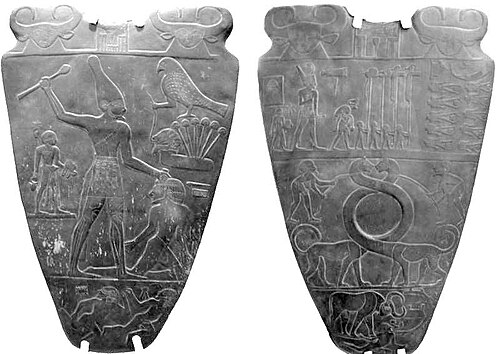
On one side a king named Narmer, wearing a tall white crown, raises a heavy club over an enemy he holds by the hair. On the other side he wears a different red crown and walks in a parade towards rows of defeated enemies. In ancient Egypt, the white crown stood for the south and the red crown for the north, so the palette seems to say: this king rules both lands.
The king is drawn much bigger than everyone else. That is not because he was a giant. Egyptian artists made the most important person the biggest, just as you might draw yourself big and your house small in a picture.
At the top of each side, the king’s name is written in a little box using two pictures: a catfish and a chisel. These are some of the earliest hieroglyphs, the picture-writing of ancient Egypt. Can you imagine writing your name with pictures of things that sound like it?
The palette was dug up in 1897–98 at an ancient town now called Hierakonpolis, and today it is in the Egyptian Museum in Cairo. Scientists and historians still argue about whether it shows a real war that united Egypt, or whether it is more like a poster showing how powerful a king was supposed to be.
At a glance
- Date
- About 3100 BC (late Naqada III / start of the First Dynasty); estimates range c. 3200–3000 BC
- Found
- Hierakonpolis (ancient Nekhen), Upper Egypt, in or near the ‘Main Deposit’ of the temple of Horus, 1897–98, by James Quibell and Frederick Green
- Material
- A single slab of fine-grained dark grey-green siltstone (greywacke), probably from the Wadi Hammamat; often wrongly called slate or schist
- Size
- About 63 cm tall and 42 cm wide, carved in low relief on both sides
- Now in
- Egyptian Museum, Cairo (JE 32169; formerly CG 14716)
- Type
- Ceremonial or votive cosmetic palette, one of the latest and most elaborate of the Predynastic decorated palettes
- Why it matters
- Earliest known image of a king wearing both the White and Red Crowns; early hieroglyphic writing; many conventions of Egyptian art already in place
Easy
What is the Narmer Palette?
The Narmer Palette is a flat, shield-shaped slab of dark grey-green stone, about 63 centimetres tall, carved with pictures on both sides. It was made in Egypt at the very end of the fourth millennium BC, around 3100 BC, at the moment when the separate communities along the Nile were becoming a single kingdom ruled by one king.
Its pictures show a king whose name is written with the signs for a catfish and a chisel, read as Narmer. On one side he wears the tall White Crown later associated with Upper (southern) Egypt; on the other, the Red Crown of Lower (northern) Egypt. It is the earliest known image of a king wearing both crowns, and for that reason the palette has often been seen as a record of the unification of Egypt.
The palette is also important for the history of writing and art. It has some of the earliest hieroglyphic signs that can be read, and its style, with the king drawn large, figures arranged in horizontal bands and bodies shown in a combination of views, set patterns that Egyptian artists would follow for almost three thousand years.
Easy
From make-up stones to royal monuments
For more than a thousand years before Narmer, Egyptians used small stone palettes to grind minerals such as green malachite and dark galena into powder for eye paint. Mixed with fat or resin, this paint decorated the face and may also have protected the eyes from sun and insects. Palettes were common grave goods, and many were cut in the shapes of fish, turtles, birds and other animals.
Towards the end of the Predynastic period, in the phase archaeologists call Naqada III, a few palettes became very large and were decorated with detailed scenes of hunting, battle and animals. Examples include the Hunters Palette, the Battlefield Palette, the Bull Palette and the so-called Libyan Palette. These objects show no sign of everyday use and seem to have been ceremonial, connected with the rise of powerful rulers.
The Narmer Palette is the most famous and one of the latest of these ceremonial palettes. It still has a circular hollow for grinding, framed by the necks of two fantastic animals, but it is too large and too finely carved to have been used for personal make-up. Scholars think it was a votive gift to a temple; one idea is that it was used to prepare cosmetics for dressing the statue of a god. Soon after Narmer’s time, decorated palettes went out of use.
Easy
Reading the first side: the king strikes his enemy
At the top of each side, two faces of a cow with curving horns, probably the goddess Bat (later merged with Hathor), look out at the viewer. Between them is a rectangular frame called a serekh, which represents the front of a palace; inside it are the catfish and chisel signs spelling the king’s name.
The largest scene on the side usually called the recto shows Narmer in the White Crown. He grips a kneeling captive by the hair and raises a pear-shaped mace to strike him. Behind the king a smaller man carries his sandals. Next to the captive’s head are two signs that may give his name or his homeland; some read them as “Wash.”
Above the captive, a falcon, the symbol of the god Horus and of the king, perches on a clump of papyrus plants and holds a rope tied to the nose of a human head that emerges from the plants. This is a kind of picture-sentence: the falcon-king has captured the people of the papyrus land, a region usually identified with the marshy Nile Delta. Below the king, two more enemies sprawl or flee.
The pose of the king striking a kneeling enemy became one of the most lasting images in Egyptian art. Pharaohs were shown in exactly this pose on temple walls for thousands of years, until Roman times.
Intermediate
Reading the second side: procession, beasts and bull
The other side, the verso, is divided into three bands, or registers. In the top band Narmer, now wearing the Red Crown and holding a mace and a flail, walks behind four standard-bearers carrying emblems (an animal skin, a dog and two falcons). His sandal-bearer follows him, and in front walks a long-haired official whose title or name may be read as “Tjet.” At the right lie ten decapitated bodies, their heads placed between their legs; above them are signs showing a boat, a falcon with a harpoon and a door, which may name a place or event.
The middle band is the grinding area. Two men hold ropes tied to two serpopards, imaginary creatures with a leopard’s body and a long snake-like neck, whose necks curve and cross to frame the circular hollow. Some scholars have suggested that the intertwined necks symbolise the joining of two lands; similar creatures appear on Mesopotamian objects of roughly the same date, which suggests contact between Egypt and Mesopotamia.
In the bottom band a bull, a symbol of the king’s strength, breaks down the walls of a fortified town with its horns and tramples a fallen man. In later Egyptian kingship the king was often called “strong bull,” and the royal costume included a bull’s tail, which Narmer wears hanging from his belt on the palette.
Intermediate
The rules of Egyptian art, already in place
The palette shows that many rules of Egyptian art already existed around 3100 BC. The king is much larger than anyone else, a convention called hierarchical scale: size shows importance, not physical height. The scenes are arranged in registers standing on ground lines, which organise the story like lines of text.
Narmer’s body is shown in the “composite” or “aspective” manner typical of Egyptian art: his head, legs and feet are in profile, his shoulders face forward and his eye is drawn as if seen from the front. The aim was not to copy what the eye sees from one point, but to show each part of the body in its most recognisable form.
The proportions of the king also appear to follow the system later used by Egyptian artists, in which the height of a standing figure was measured in fixed units. By contrast, the smaller figures, such as the captives, the corpses and the men holding the serpopards, are carved more freely, in a greater variety of poses. This contrast between the formal, ordered king and the chaotic enemies became a basic theme of Egyptian royal art.
Intermediate
Early writing on the palette
The palette is one of the earliest objects on which Egyptian hieroglyphs can be read. The king’s name uses the rebus principle: the picture of a catfish stands for the sound nꜥr and the picture of a chisel for mr, together giving Narmer. The meaning of the name is uncertain; suggestions include “fierce,” “painful” or “stinging catfish.”
Other small groups of signs label people and places: the name or title of the sandal-bearer, the official in front of the king, the captive, and the places named above the corpses and near the fleeing enemies. Some of these can be read using the values of later hieroglyphs, but because writing was still new, scholars are cautious about every reading.
The palette also shows how early Egyptian writing and pictures worked together. The falcon holding the rope on the papyrus plants is halfway between an image and a sentence. Writing at this stage was mostly used for names, titles and labels, not yet for continuous texts, which appear only centuries later.
Intermediate
Who was Narmer, and how was Egypt united?
Narmer was a king who ruled around 3100 BC. Many Egyptologists regard him as the first king of the First Dynasty and identify him with Menes, whom later Egyptian king lists and the Greek-writing priest Manetho named as the first king of united Egypt. Others argue that Menes was Narmer’s successor, Hor-Aha. Seal impressions from the royal cemetery at Abydos, which list the kings of the First Dynasty in order, begin with Narmer.
The unification of Egypt was a long process, not a single battle. Archaeology shows that Upper Egyptian centres such as Hierakonpolis, Naqada and Abydos grew powerful during the fourth millennium BC, that Upper Egyptian material culture spread northward into the Delta, and that kings before Narmer, including Iry-Hor and Ka, already had some presence in Lower Egypt. Narmer’s name, however, is found at many more sites in Lower Egypt and in southern Canaan than those of his predecessors.
Narmer was buried at Umm el-Qa’ab near Abydos, in a tomb of two joined chambers. Other objects bearing his name include the Narmer Macehead, also found at Hierakonpolis, as well as seal impressions, labels and pottery inscriptions.
Intermediate
Discovery at Hierakonpolis
The palette was found in the excavation season of 1897–98 by the British archaeologists James E. Quibell and Frederick W. Green at Hierakonpolis, the Greek name (“city of the hawk”) of ancient Nekhen, about 100 kilometres south of modern Luxor. Nekhen had been one of the most important centres of Upper Egypt in the Predynastic period and remained a cult centre of Horus long afterwards.
Quibell and Green found a large group of ritual objects in the temple area, which they called the Main Deposit. It included the Narmer Macehead and the Scorpion Macehead, which shows an earlier king. Unfortunately the excavators did not record the exact positions of the finds clearly, and Green’s notes place the palette in a different layer one or two metres away from the deposit. The objects were probably old royal gifts to the temple that were later buried together.
The palette survived in almost perfect condition and was taken to the Egyptian Museum in Cairo, where it is one of the most famous exhibits. Modern excavations at Hierakonpolis, begun in the 1960s and continued by Michael Hoffman, Barbara Adams and Renée Friedman, have revealed much about the Predynastic town, its cemeteries and its early temple.
Advanced
Historical record or royal ideology?
Since its discovery the palette has been at the centre of a debate about how to read early images. The traditional view, still popular, is that it records a real event: the conquest of Lower Egypt by an Upper Egyptian king, or at least a decisive victory in the north that completed the unification. Earlier alternative readings saw it as a record of a victory over Libyans or over a Delta kingdom centred on Buto.
Other scholars argue that the palette’s main purpose was not to record history but to express an ideology of kingship. Nicholas Millet proposed that the scenes on the palette and related objects commemorate the event by which the year of dedication was named, rather than a unique act of unification. Whitney Davis, in Masking the Blow, analysed the smiting image as a visual metaphor that freezes the moment before a mortal blow. John Baines argued that the chief purpose of the piece is to assert that the king dominates the ordered world in the name of the gods and has defeated the forces of disorder.
In 1993 the German Egyptologist Günter Dreyer found at Abydos a year label of Narmer that appears to show the same event as the palette. Because First Dynasty years were named after notable events, many scholars, including Dreyer and Toby Wilkinson, take the label as evidence that the palette refers to an actual historical event, perhaps a campaign in the north-western Delta. Others, including Baines and David Wengrow, remain more cautious. Many now accept that the palette can refer to a real event and at the same time present it in timeless, symbolic terms.
Advanced
Materials, workshops and foreign connections
The stone of the palette is a hard, fine-grained siltstone (often called greywacke) that came from the Wadi Hammamat in the Eastern Desert, a quarry used since Predynastic times and later for royal statues. Earlier descriptions called the material slate or schist, but those rocks split and flake in ways that siltstone does not. Obtaining and carving such stone required organised labour and skilled craftsmen, probably attached to the royal court.
Several motifs on late Predynastic objects, including the serpopards with intertwined necks, the hero between animals on the Gebel el-Arak knife handle, and certain boat designs, resemble images from Uruk-period Mesopotamia or Elam. Scholars debate whether these reflect direct contacts, trade through the Levant, or the circulation of prestige objects such as cylinder seals. The palette shows that Egypt’s early royal art borrowed and transformed foreign motifs as it developed its own distinctive language.
The palette should also be read within the ritual setting of the temple at Nekhen. As an offering, it placed the king’s victory before the god Horus and linked the ruler with the god who was believed to embody kingship. The combination of cosmetic palette, temple gift and political message shows how religion, display and power were intertwined at the birth of the Egyptian state.
Advanced
Legacy and modern significance
For ancient Egyptians, history in a sense began with the first king of a united land. Later king lists began with Menes, and the ideal of the king as the one who unites the “Two Lands” and defeats chaos remained central to Egyptian kingship. The double crown, which combines the White and Red Crowns, and titles such as “King of Upper and Lower Egypt” expressed this idea until the end of pharaonic civilisation.
For modern scholars, the palette is a key document for the formation of one of the world’s earliest territorial states, alongside archaeological evidence from cemeteries, settlements and early writing at Abydos. It is often compared with contemporary works of narrative relief from Mesopotamia, such as the Warka Vase from Uruk.
The palette is also a reminder of how our view of the past depends on the chances of excavation and interpretation. A single object, found in a poorly recorded deposit, came to stand for an entire historical process. Today it is studied not only as evidence of a war, but as evidence of how early rulers used images, writing and religious gifts to create the idea of a unified kingdom.
Key ideas
- Unification of the Two Lands
- The joining of Upper and Lower Egypt under one king, which Egyptians regarded as the beginning of their history; the palette is the earliest image of a king wearing both crowns.
- Smiting the enemy
- The image of the king striking a kneeling foe with a mace, which became the standard symbol of royal victory for three thousand years.
- Hierarchical scale
- The most important figure is shown largest, so size expresses rank rather than physical height.
- Order versus chaos
- The calm, ordered king contrasts with scattered, defeated enemies, expressing the king’s role as guardian of cosmic and political order.
- Rebus writing
- Pictures stand for sounds, as the catfish (nꜥr) and chisel (mr) spell the king’s name.
- Votive object
- An offering dedicated to a god in a temple; the palette was probably such a gift to Horus at Nekhen.
- History and symbol
- The palette may refer to a real event while presenting it in timeless ritual form, a tension at the heart of its interpretation.
Records
- c. 3900 BCE — Naqada I period begins; small stone cosmetic palettes are common in graves.
- c. 3500 BCE — Hierakonpolis flourishes as a major Predynastic centre in Upper Egypt.
- c. 3200 BCE — Naqada III: large decorated ceremonial palettes appear; early kings (Dynasty 0) rule in Upper Egypt.
- c. 3100 BCE — Reign of Narmer; the palette is carved and dedicated in the temple at Nekhen.
- c. 3000 BCE — Early First Dynasty: decorated palettes go out of use.
- 1897 — Quibell and Green find the palette at Hierakonpolis during the 1897–98 season.
- 1964 — Werner Kaiser identifies tombs B17 and B18 at Abydos as Narmer’s.
- 1993 — Günter Dreyer finds a year label of Narmer at Abydos that appears to show the same event as the palette.
Glossary
- Palette
- A flat stone for grinding minerals into cosmetic powder; ceremonial examples were decorated with relief scenes.
- Serekh
- A rectangular frame representing a palace façade, in which early kings’ Horus names were written.
- White Crown / Red Crown
- The royal crowns later associated with Upper (southern) and Lower (northern) Egypt.
- Serpopard
- A modern name for an imaginary creature with a leopard’s body and a long serpent-like neck.
- Register
- A horizontal band of images standing on a ground line.
- Naqada III
- The last phase of the Predynastic period (c. 3200–3000 BC), including the kings of ‘Dynasty 0.’
- Hierakonpolis (Nekhen)
- An important Predynastic town and cult centre of Horus in Upper Egypt, where the palette was found.
- Year label
- A small tag naming a year of a king’s reign after a notable event, attached to goods.
- Greywacke / siltstone
- A hard, fine-grained dark stone from the Wadi Hammamat used for palettes and statues.
Questions and answers
Was the palette used for make-up?
It has a grinding hollow like everyday cosmetic palettes, but it is too big and elaborate for personal use. It was probably a temple gift, perhaps used in rituals for a god’s statue.
Why is the king so much bigger than the other people?
Egyptian artists showed importance by size. The king was the most important person, so he is drawn largest.
Does the palette prove that Narmer united Egypt?
Not by itself. It shows him with both crowns and defeating northern enemies, and a year label found in 1993 supports a real event, but unification was a longer process that began before him.
Was Narmer the same person as Menes?
Many Egyptologists think so, because early seal impressions put Narmer first in the list of First Dynasty kings, but some argue that Menes was his successor Hor-Aha.
What do the long-necked animals mean?
No one knows for sure. They frame the grinding area and may symbolise the joining of two lands or the taming of chaotic forces; similar creatures appear in Mesopotamian art.
Why is the find context uncertain?
The 1897–98 excavators did not record exactly where each object lay, and their reports disagree, so archaeologists cannot say precisely how the palette was deposited.
Can the hieroglyphs on it be read?
The king’s name can be read with reasonable confidence, and some other labels can be tentatively read using later sign values, but the writing system was very young and many readings are uncertain.
Sources and further reading
- Narmer Palette. Wikipedia
- Narmer. Wikipedia
- Hierakonpolis. Wikipedia
- Cosmetic palette. Wikipedia
- Joshua J. Mark, Narmer Palette. World History Encyclopedia, 2016
- Toby A. H. Wilkinson, Early Dynastic Egypt. Routledge, 1999
- Whitney Davis, Masking the Blow: The Scene of Representation in Late Prehistoric Egyptian Art. University of California Press, 1992
- Barry J. Kemp, Ancient Egypt: Anatomy of a Civilization (2nd ed.). Routledge, 2006
- David Wengrow, The Archaeology of Early Egypt: Social Transformations in North-East Africa, 10,000 to 2650 BC. Cambridge University Press, 2006
Related
- Pyramid TextsSpells carved inside the royal pyramids at Saqqara from about 2350 BC, the oldest large body of Egyptian religious writing, meant to raise the dead king to the sky among the gods.
- Great Pyramid of GizaA royal tomb built for the Egyptian pharaoh Khufu. It is the largest of the Giza pyramids and the only surviving Wonder of the ancient world.
- Mask of TutankhamunA gold funerary mask found in the tomb of the Egyptian pharaoh Tutankhamun.
- CuneiformOne of the world’s earliest writing systems, made by pressing a reed into wet clay; invented in southern Mesopotamia and used for more than 3,000 years to write many languages.
- Code of HammurabiA collection of legal judgments issued under Hammurabi, king of Babylon, in the eighteenth century BCE.
Written with AI assistance from the published sources listed above, and revised as new research appears.