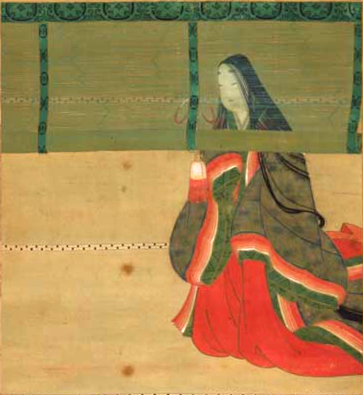
Start at the top for an easy introduction. Go further down for more detail and scholarship.
- Easy
- Intermediate
- Advanced
For young readers
About a thousand years ago, in the Japanese capital Heian-kyō (today’s Kyoto), a clever woman worked as a helper and companion to a young empress named Teishi. At court people called her Sei Shōnagon. She had sharp eyes, a quick tongue and a head full of poems.
Sei Shōnagon kept a very unusual notebook. Some pages were lists, like ‘Things that make your heart beat faster’ or ‘Hateful things’. Some pages described the seasons. Other pages told funny or proud stories about life with the empress.
The book begins with the seasons. For spring, she says, the best time is dawn, when the sky over the mountains turns slowly pale and then pink. For summer it is night, for autumn the evening, and for winter the frosty early morning. It is like a tiny guide to noticing beautiful moments.
She was not shy about her opinions. She wrote about people who talk too much, guests who stay too long and a mosquito buzzing by your ear at night. Reading her feels a little like reading the messages of a funny, bossy friend.
Behind the jokes there is a sad story. The empress’s family lost power, and the empress died young. Sei Shōnagon chose to remember the happy, shining days. Her book became one of the most loved classics in Japan, and children there still learn its first lines at school.
At a glance
- Date
- Written mainly in the 990s; largely finished around 1001–1002, with some later additions possible
- Place
- Heian-kyō (Kyoto), capital of Japan in the Heian period (794–1185)
- Author
- Sei Shōnagon (c. 966 – c. 1025?), lady-in-waiting to Empress Teishi from about 993
- Language
- Classical Japanese written mainly in hiragana
- Form
- A miscellany of about 300 short sections: lists, reflective sketches and diary-like reminiscences
- Genre
- Regarded as the first great zuihitsu (‘following the brush’), a Japanese genre of free-form essays
- Main text versions
- Four lines of manuscripts: Sankanbon and Nōinbon (mixed order), Sakaibon and Maedabon (sorted by type)
Easy
What is The Pillow Book?
The Pillow Book (Makura no sōshi) is a collection of short pieces of prose written in Japan around the year 1000 by Sei Shōnagon, a lady-in-waiting to Empress Teishi, the young consort of Emperor Ichijō. It contains lists of things, little essays on nature and people, and memories of events at court. There is no story running from beginning to end. Each piece stands on its own, like entries in a notebook.
The book is famous for its voice. Sei Shōnagon writes with confidence, humour and strong opinions. She tells us what she thinks is charming and what she thinks is dreadful, and she often describes her own clever answers with obvious pride. Many readers feel that she speaks to them almost directly across a thousand years.
In Japan it is counted, with Kamo no Chōmei’s Hōjōki and Yoshida Kenkō’s Tsurezuregusa, as one of the ‘three great zuihitsu’, and it is often placed beside The Tale of Genji as one of the two peaks of Heian literature. It is also one of the richest sources we have for daily life, manners and tastes at the Japanese court in the late tenth century.
Easy
What is inside: lists, sketches and memories
Scholars usually sort the sections into three kinds, a scheme proposed by the Japanese scholar Ikeda Kikan. The first kind is the list sections (ruijū shōdan). Some are simply headings such as ‘Mountains’, ‘Rivers’ or ‘Insects’, followed by names Sei Shōnagon likes. Others group feelings: ‘Things that make the heart beat faster’, ‘Hateful things’, ‘Adorable things’, ‘Dispiriting things’. Under ‘Adorable things’, for example, she describes a baby sparrow that comes hopping when you make little squeaking noises at it.
The second kind is the reflective sections (zuisō shōdan), short sketches of nature, the seasons and ordinary life. The most famous is the very first section, which names the best moment of each season. In my own rough translation it begins: ‘In spring, the dawn. As the sky along the mountain rim slowly whitens and brightens a little, thin purple-tinged clouds trail across it.’
The third kind is the reminiscences or diary-like sections (kaisō or nikkiteki shōdan). Here Sei Shōnagon recalls particular days in Empress Teishi’s household: visits by the emperor and the empress’s family, poetry contests, witty exchanges with courtiers, snowy mornings and festivals. Not every section fits neatly into one box, and even the classification of the opening passage has been disputed.
The sections are short. Many are only a few lines long, and the language is simple enough that modern Japanese readers can follow much of it with a little help. The English Wikipedia article counts 164 lists in the book, and the most widely used text, the Sankanbon, is usually divided by modern editors into about 300 sections.
Intermediate
Historical context: Empress Teishi’s salon and the rise of Michinaga
In the Heian period, real political power lay less with the emperor than with the Fujiwara family, whose leaders married their daughters to emperors and ruled as regents for their grandsons. Teishi, born in 977, was the daughter of the regent Fujiwara no Michitaka. She entered the court of the young Emperor Ichijō in 990 and in the same year was made empress (chūgū). Her household became a brilliant salon, and the lively, confident world of the Pillow Book is the world of her ladies at its height.
That world soon cracked. Michitaka died in 995; his brother Michikane died only days after succeeding him; and power passed to their younger brother Fujiwara no Michinaga. Teishi’s brother Korechika, Michitaka’s intended heir, lost out, and in 996 he and his brother Takaie were disgraced and sent away after an incident in which their party attacked the retired Emperor Kazan. Michinaga became the dominant figure at court.
Michinaga then placed his own young daughter Shōshi in the emperor’s household. Around 1000 he had her named empress too, creating for the first time a situation with two empresses: Shōshi took the title chūgū and Teishi the title kōgō. Teishi died in childbirth at the end of that year by the Japanese calendar (January 1001 by the Western calendar), still in her early twenties. Shōshi’s household later employed Murasaki Shikibu, the author of The Tale of Genji.
The Pillow Book was written against this background of decline, yet it hardly mentions it. As the Japanese Wikipedia article notes, a faint sentimentality appears in places, but the book mostly shows the empress as gracious, witty and admired. Already in the early thirteenth century the critical work Mumyōzōshi praised Sei Shōnagon for recording only the empress’s days of glory and saying nothing of her family’s fall. Why she did so is one of the central questions of interpretation.
Intermediate
Women, kana and learning at court
Heian men of the court were expected to write official documents and serious scholarship in literary Chinese. Japanese written in hiragana, the flowing phonetic script derived from Chinese characters, was associated with women and with private writing such as letters, poems, diaries and tales. The Pillow Book is written mainly in hiragana, and this is one reason it sounds close to speech and remains readable today.
Women were not, however, cut off from Chinese learning. Sei Shōnagon shows off her knowledge of Chinese poetry and history in several famous episodes. In one, on a snowy day, the empress asks, ‘How is the snow on Xianglu Peak?’ Sei Shōnagon answers by having the blinds raised, recognising an allusion to a poem by the Tang poet Bai Juyi about lifting a blind to look at the snow. Such moments show a court culture in which quick recognition of a quotation was a social art.
Not everyone admired this display. Murasaki Shikibu, who served the rival Empress Shōshi, wrote in her diary that Sei Shōnagon was terribly pleased with herself, that she scattered Chinese characters about in a show of cleverness, and that on close inspection her learning fell short. This harsh judgement is the only contemporary description of Sei Shōnagon by another writer, and it has coloured her reputation ever since.
Intermediate
Key themes and techniques: okashi, seasons and the art of the list
The key aesthetic word of the Pillow Book is okashi, which can mean charming, delightful, amusing or interesting. It expresses a bright, alert pleasure in things noticed with a sharp eye and a quick mind. Japanese criticism often contrasts it with the emotional, melancholy mono no aware associated with The Tale of Genji: where Genji lingers on the sadness of passing things, the Pillow Book delights in their sparkle. The contrast is a simplification, since the Pillow Book also contains moments of aware, but it captures a real difference of tone.
The famous opening shows her technique. Traditional court poetry linked each season with standard images, such as spring with blossoms. Sei Shōnagon instead links each season with a time of day: spring with dawn, summer with night, autumn with evening, winter with early morning. Scholars such as Fujimoto Munetoshi have argued that by skipping the expected images she challenged readers whose taste had been shaped by the Kokinshū tradition.
The lists are her most original invention. By grouping things under a heading, she makes the reader compare them, and the comparisons are often surprising or funny. ‘Hateful things’ moves from a visitor who talks endlessly when you are busy to a mosquito whining near your face when you are trying to sleep. The lists also include place-names from poetry (utamakura), so they work partly as a guide to the poetic geography of Japan.
Her style is concise, with quick leaps from one association to the next. The scholar Mitani Eiichi called it a bright literature ‘close to haikai’ in style, and Hagitani Boku described how her associations flow freely within each section regardless of whether it is a list, a reflection or a memory.
Intermediate
How the book was made and what its title means
What we know about the writing of the book comes mostly from its own afterword. There Sei Shōnagon says that Teishi’s brother Korechika presented the emperor and the empress with a supply of fine paper, then still expensive. The emperor’s side had used theirs to copy the Chinese Records of the Grand Historian (Shiji). When the empress asked what they should write on theirs, Sei Shōnagon replied (in the Sankanbon wording), ‘It should surely be a pillow,’ and the empress gave her the paper.
What ‘pillow’ means has been argued about for centuries. The scholar Tanaka Jūtarō listed eight theories. The main ones are that it was a notebook to keep by one’s pillow; that ‘pillow’ refers to headwords, as in utamakura (poetic place-names), because the book lists so many names; that it was a private book, not to be shown to others; and that it was a pun, because Shiji could be read ‘shiki’, which also suggests bedding (shikitae no makura, ‘pillow of spread cloth’). In 2014 the historian Gomi Fumihiko suggested another pun, linking shiki to shiki, ‘the four seasons’, which would explain why the book opens with the seasons. At the time, makura no sōshi also seems to have been an ordinary phrase rather than a unique title.
The afterword also says the book escaped her control. When Minamoto no Tsunefusa, then a captain of the guards, visited her home, a mat set out for him happened to carry her manuscript, and he took it away and circulated it. The Japanese Wikipedia article dates this to around 996, but it also notes that Sei Shōnagon apparently kept adding to the work afterwards, with some passages thought to be written as late as the end of the Kankō era (around 1011). The scholar Hagitani Boku even argued that the story of the gift of paper is a literary fiction created by the author.
Intermediate
Manuscripts and editions: four lines of text
No manuscript in Sei Shōnagon’s hand survives, and the copies that do survive differ so much that one scholar, Ishida Jōji, remarked that the Sankanbon and Nōinbon texts are so different one could almost think they had different authors. Modern scholars group the manuscripts into four lines. Two keep the sections in a mixed, apparently random order (zassan keitai): the Sankanbon and the Nōinbon. Two rearrange them by type, with lists, reflections and memories grouped together (ruisan keitai): the Sakaibon and the Maedabon. The sorted versions are thought to be the work of later editors.
The Sankanbon (‘three-volume text’) carries a colophon dated 1228 by an old man who is thought to be the poet-scholar Fujiwara no Teika; he says he copied two borrowed books but had no authoritative text to settle doubts. The line originally had more volumes, and one group of copies lacks the first 75 sections; another group supplies them. No complete copy earlier than the Muromachi period is known. The name Sankanbon was given by Ikeda Kikan in 1928.
The Nōinbon takes its name from a colophon saying it was a copy owned by the monk-poet Nōin, who was related to Sei Shōnagon by marriage. Its important copies include a Muromachi-period manuscript now at Gakushūin University and a fragment with a colophon of 1350. Early printed editions of the seventeenth century used this line, and so did the influential commentary Makura no sōshi shunshoshō by Kitamura Kigin (1674 or later). For some three centuries this was the text most people read.
The Sakaibon is named after a colophon saying it was copied in 1570 from a book owned by a man of Sakai; it lacks the reminiscences and the afterword. The Maedabon exists in only one copy, kept by the Maeda family of Kaga (now the Maeda Ikutokukai foundation). Copied in the mid-Kamakura period, it is the oldest surviving manuscript of the work and is designated an Important Cultural Property. It survives in four volumes, with a fifth apparently lost, and contains some passages found in no other line.
Intermediate
Legacy in Japan and the world
The Pillow Book is regarded as the founding work of zuihitsu, literally ‘following the brush’: loosely connected personal essays and fragments. Later landmarks of the genre, Hōjōki (early thirteenth century) and Tsurezuregusa (fourteenth century), are grouped with it as the ‘three great zuihitsu’. In the Edo period the form became popular with merchant readers and with scholars such as Motoori Norinaga, who wrote in it. According to the Japanese Wikipedia article, the Pillow Book also influenced renga, haikai and the popular prose books called kana-zōshi, and it even inspired an Edo parody, the Inu makura (‘Dog pillow’).
Pictures were made from it too. The Makura no sōshi emaki, a handscroll of the early fourteenth century, survives as one scroll with seven text passages and seven pictures. It is painted in the monochrome hakubyō style, black ink with only touches of red, and its text follows the Sankanbon line. It is designated an Important Cultural Property and is privately owned.
Translation brought the book to the world. Six passages appeared in English in 1889 in a translation by T. A. Purcell and W. G. Aston; Arthur Waley published a selection in 1928; Ivan Morris produced the first complete English translation in 1967; and Meredith McKinney published a new complete version in 2006. There are complete Chinese translations by Zhou Zuoren (1961) and Lin Wenyue (1989), a French selection by André Beaujard and a complete Spanish translation made directly from Japanese (2002).
Modern writers and artists keep returning to it. Peter Greenaway’s 1996 film The Pillow Book tells a modern erotic story that borrows the title and some ideas. In Japan there are novels, manga and playful modern retellings, and the opening lines are memorised by schoolchildren. Its lists have been compared, anachronistically, to the imaginary catalogues of Jorge Luis Borges.
Advanced
Scholarly debates: purpose, silence and the author’s voice
The central interpretive question is how to read the book’s near-silence about the fall of Teishi’s family. One line of interpretation, going back to Mumyōzōshi, treats it as loyalty and tact: the author chose to preserve the empress’s radiance. Fujimoto Munetoshi has argued more strongly that the work is an act of reverence written to console the spirit of the dead empress, so that the absence of the family’s decline is only natural. Another reading, cited in the Japanese Wikipedia article, takes even the apparently boastful episodes as a claim that Teishi and her circle, though politically defeated, continued to live in a world of beauty and taste under the emperor’s favour. The Japanese scholar Kishigami Shinji, by contrast, sensed a dark shadow beneath episodes dated after Michitaka’s death in 995.
Critics have also attacked the book. Some Japanese scholars of the twentieth century found it shallow or narrow: Tamagami Takuya dismissed it as mere chatter, Matsuo Satoshi faulted it for accepting court society without sympathy for human suffering outside it, and Akiyama Ken saw in it an attempt by a woman of middling rank to identify with the upper aristocracy. Ishida Jōji called it a record of the ‘civilisation’ of Teishi’s household rather than a work written as an individual. Suzuki Hideo answered that the author’s individuality was expressed precisely through her bond with the community around the empress, which gave her a vantage point for sharp criticism.
A further debate concerns the book’s original form. Because the mixed-order texts differ greatly from each other, and because quotations from the Pillow Book in medieval Genji commentaries (such as Shimeishō and Kakaishō) include passages not found in surviving copies, many scholars think the work grew in stages and that its original shape cannot be fully recovered. In English-language scholarship, Valerie Henitiuk has studied how the book has been reshaped in translation, a reminder that its apparent formlessness invites each editor and translator to impose an order of their own.
Biographical questions remain open as well. Her service is usually dated from about 993 until Teishi’s death, yet one section speaks of having served ‘some ten years’. Traditions that she served other ladies after 1001, or met Murasaki Shikibu, lack firm evidence. Medieval tales that she ended her days in poverty were rejected by the historian Tsunoda Bun’ei, who noted that many of her former patrons and relatives were still alive and able to support her.
Advanced
Evidence and methods: choosing a text
Editors of classical texts normally prefer the oldest manuscript as their base text. The Pillow Book is an exception: the Maedabon is the oldest surviving copy, but it belongs to the sorted (ruisan) type, which is believed to reflect a later editor’s rearrangement, so it is rarely used as a reading text. The same objection applies to the Sakaibon. The real contest has been between the two mixed-order lines.
Until the early twentieth century the Nōinbon, transmitted through seventeenth-century printed editions and Kitamura Kigin’s commentary, was the standard text. In 1925 the first annotated edition based on a Sankanbon manuscript appeared, and in 1928 Ikeda Kikan published a study of the variant texts arguing for the superiority of the copy with the 1228 colophon. In 1935 Kusunoki Michitaka, comparing the text with the Sakaibon, judged the first group of Sankanbon copies purer than the second. After long debate the Sankanbon came to be regarded as closest to the original, and it is now the text used in school textbooks and most editions, while a few important editions, such as that of Matsuo Satoshi and Nagai Kazuko, still use the Nōinbon.
This consensus has limits. Even the Sankanbon has been copied many times since the author’s day, with errors and deliberate changes, and in the currently used text sections 1–75 come from the second group of copies, whose wording is said to have been checked against the Sakaibon. Some scholars warn that, section by section, the Nōinbon is sometimes better, so the Sankanbon cannot always be assumed superior. Readers comparing translations should remember that section numbers and even content vary by base text. The English Wikipedia, for example, counts 297 Sankanbon sections plus 29 supplementary ones, while other editions divide the text differently.
Other kinds of evidence help place the work. Contemporary sources such as Murasaki Shikibu’s diary show that Sei Shōnagon was known as a writer by about 1010. The historical tale Eiga monogatari describes how courtiers continued to visit Teishi’s household after Michitaka’s death, supporting the picture of a salon that remained lively in adversity. The fourteenth-century emaki shows which passages later readers chose to illustrate and preserves an early witness to the Sankanbon wording.
Key ideas
- Okashi
- The book’s key aesthetic word: charming, delightful, amusing. A bright, witty pleasure in noticing things, often contrasted with the melancholy mono no aware of The Tale of Genji.
- The list (monozukushi)
- Sei Shōnagon’s signature form: a heading such as ‘Hateful things’ followed by surprising examples that invite the reader to compare and agree or disagree.
- Seasons and times of day
- The opening pairs each season with a time of day (spring–dawn, summer–night, autumn–evening, winter–early morning), a fresh twist on the conventions of court poetry.
- Memory as tribute
- The reminiscences show Empress Teishi’s household at its most brilliant and pass over its political ruin, a choice read as loyalty, consolation or deliberate idealisation.
- Wit and learning
- Quick recognition of Chinese and Japanese poetic allusions was a social art at court, and Sei Shōnagon records her own successes with evident pride.
- Zuihitsu
- ‘Following the brush’: loosely connected personal writing. The Pillow Book is regarded as the genre’s founding work.
- Unstable text
- Because four manuscript lines differ in order and content, the ‘original’ Pillow Book cannot be fully recovered, and editors must choose a base text.
Records
- c. 966 CE — Estimated birth of Sei Shōnagon, daughter of the poet Kiyohara no Motosuke.
- 990 CE — Fujiwara no Teishi enters the court of Emperor Ichijō and is made empress (chūgū).
- c. 993 CE — Sei Shōnagon begins serving Empress Teishi, around the winter of this year.
- 995 CE — Teishi’s father, the regent Michitaka, dies; power passes to his brother Fujiwara no Michinaga.
- 996 CE — Teishi’s brothers Korechika and Takaie are disgraced and sent from the capital. The afterword’s story of Minamoto no Tsunefusa carrying off the manuscript is dated to about this time.
- 1000 — Michinaga’s daughter Shōshi is named empress (chūgū) and Teishi becomes kōgō: two empresses at once.
- 1001 — Teishi dies in childbirth (January 1001 in the Western calendar). The work is thought to be largely complete around this time, though additions may have continued.
- 1228 — Date of the colophon, attributed to Fujiwara no Teika, from which the Sankanbon line descends.
- 1570 — Date of the colophon naming the Sakai owner of the sorted text later called the Sakaibon.
- c. 1674 — Kitamura Kigin’s commentary Makura no sōshi shunshoshō, based on the Nōinbon, makes that text the standard for centuries.
- 1928 — Ikeda Kikan argues for the superiority of the Sankanbon; Arthur Waley publishes a selected English translation.
- 1967 — Ivan Morris publishes the first complete English translation (followed by Meredith McKinney’s in 2006).
Glossary
- Heian period
- The era of Japanese history from 794 to 1185, when the capital was Heian-kyō (Kyoto).
- Nyōbō
- A lady-in-waiting: an educated woman serving in the household of an empress or noble, usually known by a nickname based on a relative’s office.
- Chūgū and kōgō
- Two titles for an emperor’s principal consort. In 1000 they were split between Shōshi (chūgū) and Teishi (kōgō).
- Hiragana
- A cursive Japanese phonetic script derived from Chinese characters, used for most Heian women’s prose.
- Okashi
- Charming, delightful or amusing; the characteristic aesthetic of the Pillow Book.
- Mono no aware
- ‘The pathos of things’: a sensitivity to the beauty and sadness of things that pass, associated with The Tale of Genji.
- Utamakura
- ‘Poem pillows’: places and images with fixed poetic associations, which appear in many of the book’s lists.
- Zuihitsu
- A Japanese genre of loosely connected personal essays; literally ‘following the brush’.
- Zassan and ruisan
- The two forms of the text: mixed order (Sankanbon, Nōinbon) and sorted by type (Sakaibon, Maedabon).
- Colophon (okugaki)
- A note at the end of a manuscript recording who copied it, when and from what, crucial for tracing textual lines.
- Emaki
- An illustrated handscroll combining text and pictures, read by unrolling from right to left.
Questions and answers
Why is it called The Pillow Book?
The afterword says the empress gave Sei Shōnagon paper after she suggested writing ‘a pillow’. Nobody is sure what she meant: a bedside notebook, a book of poetic headwords, a private book, or a pun on the Chinese history Shiji (read ‘shiki’). The question is still debated.
Is it a diary?
Only partly. Some sections recall real days at court like a diary, but others are lists or short essays, and the book does not follow a calendar. It is usually called a zuihitsu, a free-form collection of writing.
Was Sei Shōnagon rivals with Murasaki Shikibu?
They served rival empresses, Teishi and Shōshi, and Murasaki criticised Sei Shōnagon sharply in her diary. There is no reliable evidence that they ever met, and Sei Shōnagon had probably left court before Murasaki arrived.
Why does the book say so little about the empress’s misfortunes?
Scholars disagree. Some see loyal tact, some an attempt to console the empress’s spirit, and some a deliberate idealisation of a defeated household. The medieval critic of Mumyōzōshi already praised this silence as a sign of the author’s fine character.
Which text do modern editions use?
Most use the Sankanbon, judged in the twentieth century to be closest to the original, although the oldest surviving manuscript is the Maedabon. Some respected editions still follow the Nōinbon, which was standard before about 1930.
Did Sei Shōnagon mean the book to be read by others?
The afterword claims it was private and was carried off by a visitor. Whether that is literally true or a conventional show of modesty is uncertain; the book clearly assumes readers who know the empress’s circle, and parts of it circulated during her lifetime.
Which English translation should I read?
Meredith McKinney’s complete translation (2006) is praised for accuracy; Ivan Morris’s (1967) is elegant and well annotated; Arthur Waley’s (1928) is a charming but partial selection.
Sources and further reading
- The Pillow Book. Wikipedia
- 枕草子 (Makura no sōshi). Wikipedia (Japanese)
- Sei Shōnagon. Wikipedia
- 清少納言 (Sei Shōnagon). Wikipedia (Japanese)
- Fujiwara no Teishi. Wikipedia
- Fujiwara no Michinaga. Wikipedia
- Zuihitsu. Wikipedia
- 枕草子絵詞 (Makura no sōshi emaki). Wikipedia (Japanese)
- Sei Shōnagon, trans. Meredith McKinney, The Pillow Book (translation). Penguin Books, 2006
Related
- The Tale of GenjiEarly eleventh-century Japanese narrative, generally attributed to the court writer Murasaki Shikibu.
- Oku no HosomichiMatsuo Bashō’s prose-and-verse account of a journey through northern Japan, shaped through years of revision after the journey itself.
- KojikiA Japanese compilation completed in 712 CE that brings together accounts of deities, origins and early rulers.
- Natsume SōsekiJapanese novelist whose fiction explores social change, loneliness and the tension between personal wishes and obligation.
Written with AI assistance from the published sources listed above, and revised as new research appears.