Start at the top for an easy introduction. Go further down for more detail and scholarship.
- Easy
- Intermediate
- Advanced
For young readers
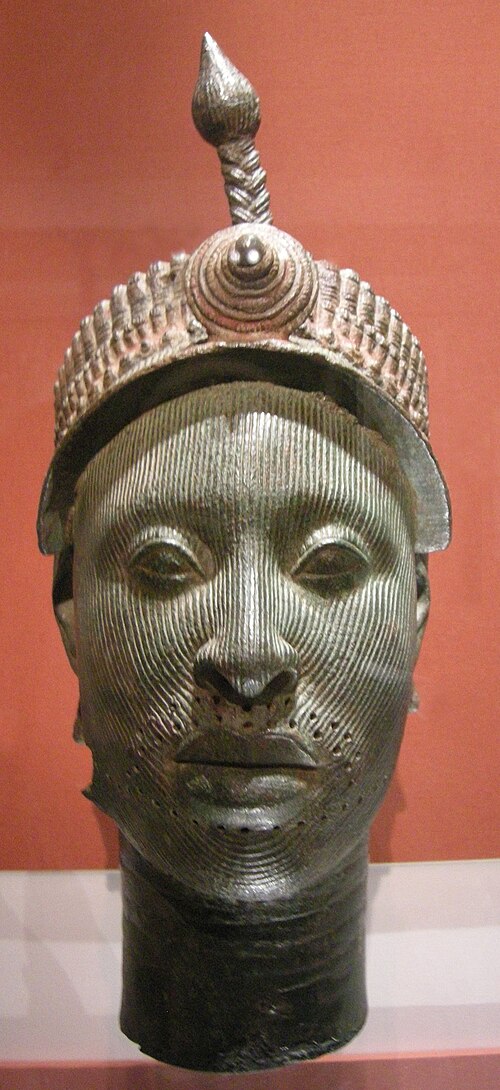
About 700 years ago, in a busy city called Ife in what is now Nigeria, artists made heads out of metal and baked clay. The heads look so real that you almost expect them to blink. They show calm faces with fine lines running down the skin, full lips and carefully shaped ears.
To make a metal head, the artist first shaped the face in wax over a clay core. Then the wax was covered in more clay and heated so the wax melted away, leaving a hollow mould. Hot liquid metal was poured in. When it cooled, the artist broke the mould and found a metal head inside. This is called the “lost-wax” method.
Many people think the heads show kings, called the Ooni, or other important people at the royal court. Some have small holes around the forehead and chin. Perhaps crowns, beads or hair were once attached there.
In 1938 some workers were digging the foundations of a house in Ife when they found a group of these metal heads buried in the ground. People around the world were amazed. Some Europeans at the time wrongly believed Africans could not have made such beautiful art. They were wrong: the heads were made by Yoruba artists.
Today most of the heads are kept in Nigerian museums, and a few are in museums in other countries, such as the British Museum in London. For the Yoruba people, Ife is a holy city where, in their traditions, the world and the first people were created.
At a glance
- Made in
- Ilé-Ifẹ̀ (Ife), a Yoruba city in present-day Osun State, south-western Nigeria
- Date
- Mainly c. 1200–1400 CE, the ‘classical’ period of Ife; some works are dated as late as the 15th century, and some scholars centre the metal heads around 1300
- Materials
- Copper alloys (often heavily leaded zinc-brass), nearly pure copper, terracotta (fired clay) and some stone
- Technique
- Lost-wax casting for metal works; hand modelling and firing for terracottas
- Major finds
- Heads and figures collected by Leo Frobenius in 1910; eighteen copper-alloy works found by chance at the Wunmonije Compound in 1938
- Style
- Idealised naturalism: calm, symmetrical faces, often with fine vertical striations, nail holes at hairline and jaw, and elaborate beaded crowns
- Where they are
- Mostly in Nigeria’s national museums (including the museum at Ife); a few, such as the Bronze Head from Ife, are in collections abroad, including the British Museum
- Associated ruler
- Oral tradition links many brass works to Ooni Obalufon II (Obalufon Alayemore), later revered as the patron deity of brass casting and weaving
Easy
What are the Ife heads?
The Ife heads are sculptures of human heads made in the city of Ilé-Ifẹ̀, usually just called Ife, in south-western Nigeria. Some are cast in metal, mostly copper alloys; many more are made of terracotta, which is clay shaped by hand and then fired. They were made above all between about 1200 and 1400 CE, during a period that historians call Ife’s classical age.
What makes them famous is their naturalism. The faces look like real people: the cheeks, lips, eyelids and ears are carefully modelled, and the proportions are balanced and calm. At the same time they are not snapshots. Many share an idealised, serene expression, as if the artists wanted to show a perfect version of a person, not every wrinkle and flaw.
The heads belong to a much larger body of Ife art that includes full figures, animals, vessels and ritual objects. Together they make Ife one of the great centres of world sculpture, and they have become symbols of Nigeria and of African creativity more generally.
Easy
How to look at an Ife head
Start with the surface of the face. On many Ife heads, fine parallel lines run from the forehead down over the cheeks and chin. The lips are usually left smooth. Scholars do not agree on what these lines mean. They might show scarification or face marks, a veil of beads, or simply an artistic way of catching light on the skin. Some heads have no lines at all.
Next, look at the edges. Many metal heads have small holes along the hairline, around the mouth or on the jaw. These suggest that something was attached: perhaps real hair, a beard, a veil of beads or a crown. Some heads also have larger holes in the neck, which suggests they were fixed to something else, perhaps a wooden body or a stand.
Then look at the head as a whole. Some wear elaborate crowns made of rows of beads, with tassels and a crest on top. The famous Bronze Head from Ife in the British Museum wears such a crown, topped by a rosette and a plume, and still shows traces of red and black paint. The size also matters: that head is about 35 centimetres high, roughly three-quarters of life size.
Finally, notice the large size of heads in full-figure sculptures from Ife. In Yoruba thought, the head (orí) holds a person’s inner essence and destiny. Making the head large and beautiful was a way of honouring that inner power.
Easy
How were they made?
The metal heads were made by lost-wax casting, one of the oldest and most demanding ways of making metal sculpture. First the artist built a core of clay roughly in the shape of the head. Over it went a layer of wax, into which all the details of the face were carved and modelled. The wax model was then covered with more clay, leaving small channels. When the mould was heated, the wax melted and ran out, leaving a thin empty space in the shape of the sculpture.
Molten metal was poured into this space. When it had cooled, the outer mould was broken away and the metal head was cleaned and polished. Because the mould is destroyed each time, every lost-wax casting is unique. Casting thin, even walls of metal on a life-size head requires great skill, and the Ife casters were among the best in the world at the time.
Although these works are often called “bronzes,” most are actually made of copper mixed with zinc and lead, which is closer to brass. Museums now often use the more accurate term “copper alloy.” A few Ife works, including a famous life-size mask, are of almost pure copper, which is especially hard to cast.
The terracotta heads were made differently: clay was modelled by hand, often with great delicacy, then dried and fired. Terracotta sculpture had a long history in the region before the metal heads, and the metal works may have been modelled on terracotta prototypes.
Intermediate
The city that made them
Ilé-Ifẹ̀ is regarded by the Yoruba as the place where the world and humankind were created. In one widely told tradition, the supreme deity Olódùmarè sent Ọbàtálá to create the land; Oduduwa took over the task and became the ancestor of the kings of Ife and of other Yoruba dynasties. The Ooni, the ruler of Ife, still holds a special spiritual position among Yoruba rulers.
Historians and archaeologists describe a long growth. Settlement began in the first millennium BCE; by the late first millennium CE, groups of large households were forming alliances; and around the tenth to eleventh centuries a leader remembered as Oduduwa is associated with building a large wall. The period from roughly 1000 to 1420 CE is often called Ife’s classical age. The city grew to perhaps 70,000–105,000 people in the mid-fourteenth century and had a second wall and paved roads.
A distinctive feature of classical Ife was its pavements. Floors and courtyards were paved with broken pottery sherds set on edge, often in herringbone patterns, sometimes with decorative ceramic discs. Art historians use these pavements to divide Ife’s history into eras, and the “Late Pavement Era” of about 1200–1400 corresponds to the peak of sculptural production.
Ife was wealthy because of trade and craft. It produced glass beads using its own recipes, at workshops such as the Olokun Grove, and these beads have been found at sites across West Africa from the eleventh to the fourteenth century. Ife traded rainforest goods like beads and ivory for copper, salt and textiles coming from the north. The copper and brass used in the heads were once thought to have come from Europe or North Africa; some analyses now point to Nigerian ores, although the question is not fully settled.
Intermediate
Kings, ancestors and Obalufon
Most scholars think the metal heads represent Oonis or members of the royal court. They were not casual portraits: the materials were rare and precious, and the effort needed to cast them was enormous. They belonged to the world of kingship, ritual and ancestor honour.
Oral tradition links the great age of Ife brass casting to Ooni Obalufon II, also called Obalufon Alayemore. He is remembered as a ruler who restored order after a period of conflict, extended Ife’s influence toward the Niger River, and presided over an era of peace and prosperity when glass bead production and copper imports surged. He is credited with commissioning brass images of royal ancestors and is said to have been the first Ife ruler to wear a crown.
After his death he was deified. Today he is revered as an òrìṣà (deity) associated with brass casting, weaving, regalia and good government. The life-size copper mask known as the Obalufon mask, kept for a long time in a palace room linked to coronations, is associated with him and shares stylistic features with the British Museum head.
Traditions also say that Ife’s casting knowledge spread to other kingdoms. Benin in particular remembered that its court art was learned from Ife masters, and a prince from Ife, Oranmiyan, is linked with the founding of Benin’s current royal dynasty around the thirteenth century. Historians treat such traditions carefully, but they show how Ife was seen as a source of legitimacy and skill.
Intermediate
Discovery: Frobenius and the Wunmonije find
Europeans first learned of Ife sculpture through the German ethnologist Leo Frobenius. His expedition reached Ife on 29 November 1910 and stayed about three weeks, excavating and collecting terracotta heads and a copper-alloy head from the Olokun Grove. He removed many objects without a licence and was taken to court in Nigeria for trafficking. Several of the terracottas he took are in Berlin; the British Museum acquired casts of six in 1927.
In 1938 workmen digging foundations at the Wunmonije Compound in Ife found by chance a group of copper-alloy sculptures: seventeen heads and the upper half of a figure, eighteen works in all. Most went to what became the national museum at Ife. A few left Nigeria. The Bronze Head from Ife now in the British Museum was taken out by Henry Maclear Bate, editor of the Daily Times of Nigeria; it reached London via Paris and entered the museum in 1939 through the National Art Collections Fund. Two others went to the United States.
The 1938 discovery helped push the colonial government to control the export of antiquities from Nigeria, and legislation was enacted that year. Later excavations at sites in Ife, such as Ita Yemoo, added more finds and helped archaeologists place the sculptures in their historical context.
The heads quickly became symbols. The Ife head was the emblem of the 1973 All-Africa Games in Lagos, it appears in logos of Nigerian institutions such as Obafemi Awolowo University in Ile-Ife, and a major touring exhibition, Kingdom of Ife: Sculptures from West Africa, marked the fiftieth anniversary of Nigerian independence in 2010. In 2011 the British Museum head was included in the radio series A History of the World in 100 Objects.
Intermediate
A challenge to prejudice
The Ife heads arrived in Europe at a time when colonial ideas held that Africans had no history of great art. The sculptures did not fit this belief, and some Europeans tried to explain them away. Frobenius himself admired their beauty but claimed that they could not have been made by the ancestors of the people he met. He suggested they were relics of an ancient colony from the Mediterranean and even linked them to the legend of Atlantis. He announced this “discovery” in January 1911, and it was widely reported in the press.
His description of the Olokun head shows both admiration and contempt: he praised its “marvellous beauty” while dismissing the living people of Ife as unworthy guardians. This combination, deep admiration for African objects joined to disrespect for African people, was common in colonial collecting.
Later research made it plain that the sculptures are an indigenous Yoruba achievement, part of a long West African tradition of figurative art. Scholars see links to earlier traditions such as the terracottas of the Nok culture of central Nigeria (first millennium BCE) and the remarkable copper-alloy castings of Igbo-Ukwu in south-eastern Nigeria (around the ninth to twelfth centuries CE). The Ife heads are now treated as one of the highest points of this African history of art, not as a mystery that needs an outside explanation.
Intermediate
Legacy and ownership
Ife’s artistic influence continued after the classical age. The court art of Benin, including the famous Benin Bronzes, is linked by tradition to Ife teachers, and Yoruba art from Oyo, Owo and many other centres continued to give special importance to the head, the crown and the royal image. In Yoruba religion, Obalufon remains the patron of brass casters and weavers.
The ownership of the Ife heads is less fraught than that of the Benin Bronzes, because most of them were found in Nigeria and stayed there. But the few taken abroad in the colonial period, such as those removed by Frobenius and the British Museum head exported in 1938–1939, belong to wider debates about how African objects entered Western collections and whether they should be returned. Museums and Nigerian institutions have cooperated in exhibitions and research, as in the 2010 Kingdom of Ife exhibition, while discussions about ownership continue.
Advanced
Dating, workshops and the ‘single artist’ question
Dating Ife sculpture is difficult because many pieces were found by chance, outside controlled excavations, and metal cannot be directly radiocarbon dated. Chronologies rely on associated charcoal, the pavement sequence, thermoluminescence dating of terracottas and clay casting cores, and stylistic comparison. Most scholars place the bulk of the naturalistic metal and terracotta works between the twelfth and fifteenth centuries. Henry Drewal, John Pemberton and Rowland Abiodun proposed a sequence of eras that places the Late Pavement Era at about 1200–1400, followed by a Post-Pavement Era.
Within that span, emphases differ. The British Museum head is usually dated to around the fourteenth to fifteenth century. Suzanne Preston Blier, in Art and Risk in Ancient Yoruba (2015), links much of the corpus to a period around 1300 and to the political circumstances of Obalufon’s reign, reading the art in the light of the political crises and risks of that time. Others prefer a broader range. The dates given in this entry (c. 1200–1400) should therefore be read as a general bracket rather than a precise date.
The stylistic unity of the Wunmonije heads, including their shared proportions and details, has led some specialists to suggest that they were made by a single artist or a single workshop within a limited period. If so, the corpus might represent a concentrated royal commission rather than a long, slow tradition. This remains a hypothesis; it is difficult to test without better contextual dating.
Advanced
Portrait or ideal? Debates about meaning and use
Were the heads portraits of specific individuals? Their variety in facial structure, marks and headgear suggests to some scholars that they depict particular people or offices. Others emphasise their idealisation: most show youthful, serene faces rather than individuals at a given age. A widely held middle view is that they represent rulers and office-holders in an idealised form, fusing likeness with the ideals of calm, dignity and balance valued in Yoruba aesthetics.
Their use is also debated. The holes around the hairline and jaw and the openings in the necks have long suggested that they were attached to other materials. One influential hypothesis, associated with the archaeologist Frank Willett, is that they were mounted on wooden bodies and dressed as effigies for royal funerary or commemorative rites. Other interpretations connect them with shrines of royal ancestors or with rituals of installation and renewal of kingship. Surviving Yoruba practices provide suggestive parallels, but no written record from the period confirms any single use.
The history of the Olokun head shows the problems of authenticity that surround such famous objects. Collected by Frobenius in 1910 and later returned to the palace at Ife, it was for decades suspected of being a sand-cast replacement made between 1910 and 1934. Metallurgical study around 2010 indicated that it was made by lost-wax casting, and it is now generally regarded as the original. The episode shows how colonial-era handling, scientific analysis and expert opinion all shape what counts as ‘the’ Ife canon.
Advanced
Materials, trade and the wider world
The metal of the Ife heads raises questions about trade. Ife lies in the forest zone without major known copper sources in its immediate area, and earlier scholars proposed that the metal came from Central Europe, Mauritania, the Byzantine world or southern Morocco. More recent analyses suggest that local Nigerian ores contributed, but lead isotope and trace-element studies are still being refined, and it is likely that metal from several sources reached Ife through trans-Saharan and regional networks.
Ife’s glass industry provides clearer evidence of long-distance links. Glass of a high-lime, high-alumina composition, produced with local recipes at Ife, has been identified at sites across West Africa, from Mali and Mauritania to Burkina Faso and Chad, in contexts of the twelfth to fourteenth centuries. The historian Akinwumi Ogundiran has called this network the “Bead Road.” He and others have argued that Ibn Battuta’s mention in 1352 of a great southern kingdom called “Yufi” most likely refers to Ife.
The end of Ife’s classical period around 1400–1420 is linked by archaeologists and historians to several factors: drought beginning around 1380, disruption in the western Sudan as Mali weakened, internal conflict, and epidemic disease. After this, political and economic weight shifted towards Benin and later Oyo, while Ife retained its religious prestige. The heads thus mark a specific historical moment of wealth, royal ambition and artistic experiment.
Key ideas
- Idealised naturalism
- Ife artists combined lifelike detail with calm, balanced, idealised faces rather than exact likenesses.
- Lost-wax casting
- A technique in which a wax model is replaced by metal inside a clay mould, producing unique, thin-walled castings.
- The head (orí)
- In Yoruba thought the head holds a person’s essence and destiny, which helps explain its prominence in Ife art.
- Sacred kingship
- The sculptures belong to the world of the Ooni, royal ancestors and rituals that link rulers to the divine.
- An indigenous tradition
- Colonial claims of outside origin have been rejected; Ife art grew out of West African traditions such as Nok and Igbo-Ukwu.
- Trade and wealth
- Glass beads and forest goods traded for copper and other imports funded Ife’s artistic flowering.
- Contested collecting
- The removal of some works during the colonial era is part of wider debates about African heritage in foreign museums.
Records
- c. 1000 — Beginning of Ife’s classical period, with a walled urban centre and potsherd pavements.
- c. 1200 — Start of the Late Pavement Era, the peak of naturalistic terracotta and copper-alloy sculpture.
- c. 1300 — Period often linked to Ooni Obalufon II and the flowering of brass casting.
- 1352 — Ibn Battuta hears in Mali of a great southern kingdom, “Yufi,” probably Ife.
- c. 1420 — Ife’s classical period ends amid drought, conflict and epidemic.
- 1910 — Leo Frobenius’s expedition reaches Ife on 29 November and removes sculptures, including from the Olokun Grove.
- 1911 — Frobenius announces that Ife art is evidence of Atlantis.
- 1938 — Eighteen copper-alloy sculptures are found at the Wunmonije Compound; Nigeria’s colonial government restricts antiquities exports.
- 1939 — The Bronze Head from Ife enters the British Museum.
- 1973 — The Ife head serves as the emblem of the All-Africa Games in Lagos.
- 2010 — The exhibition Kingdom of Ife: Sculptures from West Africa marks fifty years of Nigerian independence.
Glossary
- Ooni
- The title of the king of Ife, who holds a special spiritual role among Yoruba rulers.
- Terracotta
- Clay that has been shaped and then fired to make it hard.
- Copper alloy
- A metal mixture based on copper, such as bronze (with tin) or brass (with zinc).
- Lost-wax casting
- A method of casting metal using a wax model that melts out of a clay mould.
- Striations
- Fine parallel lines incised on the faces of many Ife heads.
- Òrìṣà
- A deity or spiritual power in Yoruba religion.
- Orí
- The Yoruba word for head, also meaning a person’s inner self and destiny.
- Potsherd pavement
- A floor made of broken pottery pieces set on edge, typical of classical Ife.
- Wunmonije Compound
- The site in Ife where eighteen copper-alloy sculptures were found in 1938.
Questions and answers
Are the Ife heads made of bronze?
Not exactly. They are often called bronzes, but most are copper mixed with zinc and lead, more like brass. Some are almost pure copper, and many Ife heads are terracotta.
Who do the heads show?
Most likely Ife rulers (Oonis) and members of the royal court, shown in an idealised way. We don’t know the names of most of the people shown.
Why do some heads have holes?
The small holes along the hairline and jaw may have held hair, beards, beaded veils or crowns. Holes in the neck suggest the heads were fixed to bodies or stands.
What do the lines on the faces mean?
Nobody knows for sure. They might show facial marks, beaded veils or an artistic technique. Scholars still debate it.
Why did Frobenius think Atlantis was involved?
Colonial prejudice made him assume that Africans could not have produced such art. His theory has been completely rejected; the heads are Yoruba works.
Were the heads made by one artist?
Possibly. The Wunmonije heads are so similar that some specialists think one artist or workshop made them, but this has not been proven.
Should the heads abroad be returned to Nigeria?
Some were removed without a licence or exported during colonial rule, so they are part of wider restitution debates. Most Ife heads are already in Nigerian museums.
Sources and further reading
- Bronze Head from Ife. Wikipedia
- Ifẹ. Wikipedia
- Ife Empire. Wikipedia
- Obalufon Alayemore. Wikipedia
- Yoruba art. Wikipedia
- Fourth German Inner Africa Research Expedition. Wikipedia
- Art forgery. Wikipedia
- Nok culture. Wikipedia
- Igbo-Ukwu. Wikipedia
- Suzanne Preston Blier, Art and Risk in Ancient Yoruba: Ife History, Politics, and Identity c.1300. Cambridge University Press, 2015
Related
- Benin BronzesThousands of brass plaques, royal heads and other court artworks made for the Oba of Benin, looted by British forces in 1897 and now at the centre of restitution debates.
- Olmec Colossal HeadsMonumental basalt heads made by Olmec communities on Mexico's Gulf Coast, probably depicting rulers.
- Mask of TutankhamunA gold funerary mask found in the tomb of the Egyptian pharaoh Tutankhamun.
- Bust of NefertitiPainted limestone-and-stucco portrait of Queen Nefertiti, wife of the pharaoh Akhenaten, made in the workshop of the sculptor Thutmose at Amarna and found by a German expedition in 1912.
- Ibn BattutaMoroccan traveler whose account describes journeys across Africa, Asia and parts of Europe.
- Mansa MusaRuler of the Mali Empire remembered for its wealth, his pilgrimage to Mecca and support for Islamic learning.
Written with AI assistance from the published sources listed above, and revised as new research appears.