Start at the top for an easy introduction. Go further down for more detail and scholarship.
- Easy
- Intermediate
- Advanced
For young readers
About 3,350 years ago, Egypt had a king named Akhenaten and a queen named Nefertiti. Her name means “the beautiful one has come.” The king built a brand-new capital city in the desert beside the Nile, and artists moved there to make statues and pictures of the royal family.
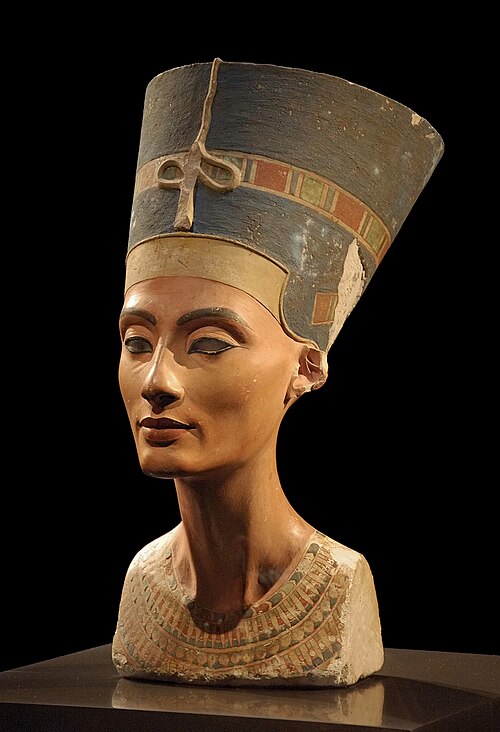
One of those artists had a workshop full of stone heads and plaster faces. Among them was a portrait of the queen from the shoulders up. The sculptor carved it from limestone, covered it with a thin layer of plaster so the skin looked smooth, and painted it in bright colours: a tall blue crown, a gold band, a necklace of flowers, and warm skin.
When the city was left empty, the workshop slowly fell into ruin and the bust lay hidden in the rubble for more than 3,000 years. In December 1912, German diggers found it. Their leader wrote in his diary that words were useless: you simply had to see it.
The bust has one strange thing: its right eye has a shiny inlay, but the left eye is empty. Nobody knows for sure why. Maybe it was never finished, maybe it was a teaching model, or maybe the eye fell out and was lost.
Today the bust stands in a museum in Berlin, Germany, and hundreds of thousands of people visit it every year. But many people in Egypt say it was taken unfairly and should come home. That is why the bust is not only a beautiful face, but also a big question about who should keep treasures from the past.
At a glance
- Made
- About 1345–1340 BC (reign of Akhenaten, 18th Dynasty, New Kingdom)
- Place made
- Workshop complex P 47.2 at Akhetaten (Tell el-Amarna), Middle Egypt; attributed to the sculptor Thutmose
- Subject
- Nefertiti, Great Royal Wife of Akhenaten; identified by her flat-topped blue crown (no inscription on the bust)
- Materials
- Limestone core, painted stucco (gypsum plaster) layers, rock-crystal and beeswax eye inlay
- Size
- About 47–49 cm high; roughly 20 kg
- Discovered
- 6 December 1912 by the Deutsche Orient-Gesellschaft expedition led by Ludwig Borchardt
- Now
- Neues Museum, Berlin (Ägyptisches Museum und Papyrussammlung, inv. ÄM 23100)
- Controversy
- Egypt has asked for its return since 1924; the Berlin museums cite the signed 1913 division of finds
Easy
What is the Bust of Nefertiti?
The Bust of Nefertiti is a life-size portrait of the head, neck and shoulders of Nefertiti, the chief wife of the Egyptian king Akhenaten, who ruled in the 14th century BC. It is about half a metre tall. A core of limestone was covered with layers of fine plaster (stucco) and then painted so carefully that the colours still look fresh today.
The bust was found in 1912 at Tell el-Amarna, the modern name for the ruins of Akhenaten’s capital city, Akhetaten (“Horizon of the Aten”). It was lying in the ruins of a sculptor’s workshop, together with many plaster faces and unfinished heads. An inscribed ivory object found in the same house names a “sculptor” called Thutmose, so the workshop – and the bust – are usually attributed to him.
Since 1913 the bust has been in Germany. Today it stands alone in the North Dome Room of the Neues Museum on Berlin’s Museum Island, where it is the star of the Egyptian collection. It is often compared with the gold mask of Tutankhamun as the best-known image to survive from ancient Egypt.
The bust is also at the centre of one of the longest-running debates about museums and the past. Egypt has asked for it back for about a hundred years; Germany’s museum authorities say it was legally assigned to the German excavators. Both the art and the argument are part of its story.
Easy
How to look at the bust
Start with the crown. Nefertiti wears a tall, flat-topped blue crown that only she is shown wearing in Egyptian art; scholars call it the “Nefertiti cap crown.” A golden band with coloured inlays runs around it like a ribbon. At the front there was once a rearing cobra (the uraeus), a royal symbol, but it has broken off. Because the bust has no written name, this crown is how we know who it shows.
Next, look at the face. From the front it is almost perfectly symmetrical: the eyebrows, the lines of the eyes and the curve of the lips mirror each other. The eyebrows are painted as tiny cross-hatched hairs. The lips are red, the skin a warm, light brown. Around the neck lies a broad collar of painted flower petals and leaves, in green, red, blue and yellow.
Then look from the side. The long, slender neck leans forward and seems to carry the weight of the heavy crown. One textbook compares the effect to a heavy flower on a slim stalk. The shoulders are cut off straight and their sides were left unpainted, which is one clue in the debate about what the bust was for.
Finally, notice the eyes. In the right eye the iris and pupil are made of black-dyed beeswax under a thin piece of polished rock crystal, which catches the light like a real eye. The left socket is empty and smooth. This missing eye has puzzled people ever since 1912.
Easy
Who was Nefertiti?
Nefertiti lived in the 14th century BC. Her name means “the beautiful one has come.” She was the Great Royal Wife – the chief queen – of Amenhotep IV, who changed his name to Akhenaten. We do not know for certain who her parents were. One common idea links her family to an official named Ay, who much later became king himself, but the evidence is thin.
She and Akhenaten had six daughters. One of them, Ankhesenpaaten, later married the boy-king Tutankhamun and changed her name to Ankhesenamun. Pictures from Amarna often show the royal couple together with their children under the rays of the sun, which end in little hands holding the sign of life.
Nefertiti appears in art far more often, and in more powerful poses, than most Egyptian queens. She is shown the same size as the king, worshipping the sun god directly, and even striking enemies – a scene normally reserved for pharaohs. For a long time scholars thought she vanished around Akhenaten’s twelfth year, but an inscription found in 2012 shows she was still Great Royal Wife in his sixteenth year.
What happened to her after that is uncertain. Many Egyptologists now think she ruled for a short time after Akhenaten’s death as a female pharaoh under the name Neferneferuaten, before Tutankhamun came to the throne, but this is still debated. Her mummy has never been securely identified.
Intermediate
Akhenaten’s revolution and the city of Amarna
The bust belongs to one of the most unusual moments in Egyptian history. Early in his reign (about 1351–1334 BC), Amenhotep IV turned the state religion toward the Aten, the disc of the sun, as the one god worthy of worship. Whether this was true monotheism or “monolatry” – worshipping one god without denying others exist – is still discussed. He took the name Akhenaten and closed or neglected the cults of other gods, especially Amun of Thebes.
In his fourth or fifth year the king chose an empty stretch of desert on the east bank of the Nile in Middle Egypt and founded a new capital there, Akhetaten. Palaces, open-air sun temples, government offices and whole neighbourhoods of houses were built quickly. Artists, officials and workers moved there from Thebes and Memphis.
The revolution did not last. After Akhenaten died in his seventeenth year, the court returned to the traditional gods within a few years. Tutankhaten changed his name to Tutankhamun, the capital was abandoned, and later kings tried to erase the memory of Akhenaten’s reign. For archaeologists this was lucky: because Amarna was occupied for only a short time and then left, its houses and workshops were not buried under centuries of later building.
Thutmose’s workshop was part of this city. When the court moved away, the sculptors left behind models, plaster studies and unfinished works – including the bust – on shelves and floors. Over time the roof leaked and collapsed, and the bust ended up in the rubble of a storeroom, where it lay until 1912.
Intermediate
Amarna art and where the bust fits
Traditional Egyptian art changed slowly over thousands of years. Under Akhenaten it changed suddenly. The so-called Amarna style shows the royal family in intimate, everyday scenes – kissing, playing with their children, eating – and depicts bodies in a new way: long faces and necks, narrow shoulders, full hips and bellies, slender arms and legs. Early portraits of Akhenaten in particular look strikingly exaggerated.
The Nefertiti bust is famous partly because it does not look extreme. The long neck and forward tilt show Amarna influence, but the face is balanced and calm. Some scholars see it as a return to a more classical, idealised style in the later part of the reign; others stress that Amarna art itself developed and softened over time. Either way, the bust shows how far a master sculptor could combine the new sensitivity to individual features with traditional ideals of perfection.
The objects from the same workshop make the point clearer. Among some two dozen plaster faces were portraits of royal family members and of unknown people, some with wrinkles and bags under the eyes – rare in Egyptian art, where women were usually shown as forever young. A small statue of an older Nefertiti with a rounded belly was also found there. Seen next to these pieces, the famous bust looks like a deliberate choice of an ideal image.
Busts themselves were unusual in Egypt. Because Egyptians valued images that were complete, a figure cut off at the chest could seem incomplete. Busts do appear, however, mainly in household ancestor cults, and they become more common from the Amarna period onward. A matching bust of Akhenaten found in the same room had been smashed in ancient times.
Intermediate
How it was made: stone, plaster, paint and crystal
The sculptor first carved the basic form in limestone. Over this core he applied stucco – a plaster made from gypsum – in layers of different thickness, and did the final, delicate modelling in this softer material. CT scans in 1992 and especially in 2006 made this visible from the inside for the first time.
The 2006 scan, carried out at Berlin’s Imaging Science Institute and published in the journal Radiology in 2009, showed that the carved limestone face underneath differs slightly from the painted surface. The inner face has creases at the corners of the mouth and on the cheeks and a small bump on the nose; the outer plaster smooths these away. Researchers suggested that this reflects the ideals of beauty of the time – the sculptor corrected nature toward perfection.
The paint uses the familiar palette of Egyptian pigments. Analyses commissioned by Borchardt and published in 1923, and later non-invasive tests by the museum’s Rathgen research laboratory in 2009, identified copper-based blue and green frits (including the artificial pigment “Egyptian blue”), red ochre and other iron-based reds, yellow orpiment (an arsenic mineral), carbon black and white chalk.
The finishing work is remarkably uneven in a revealing way. The face received the greatest care, while the collar is painted more quickly and the sides of the shoulders were left bare. This mixture of perfection and incompleteness is at the heart of the long debate over whether the bust was a finished artwork or a model.
Intermediate
Discovery in 1912 and the division of finds
German interest in Amarna grew around 1900, when objects from the site appeared on the art market. After a trial season in 1907, the Egyptologist and architectural historian Ludwig Borchardt began long-term excavations for the Deutsche Orient-Gesellschaft (German Oriental Society). The sole sponsor was the Berlin businessman and art patron James Simon. As was normal then, the Egyptian Antiquities Service – run by French scholars – granted the licence.
On 6 December 1912 the team was excavating house P 47.2. Borchardt had gone to greet a visiting party led by Prince Johann Georg of Saxony when his colleague Hermann Ranke sent word that “something good is coming out.” The bust was lifted out that afternoon; the prince’s own photographs show it in the arms of the Egyptian foreman Mohammed es-Senussi. That evening Borchardt wrote his famous diary line: “Description is useless, must be seen.”
At the end of each season, finds were divided between the excavators and Egypt in a partage. On 20 January 1913 the inspector Gustave Lefebvre divided the Amarna finds into two supposedly equal halves. A painted altar showing Akhenaten, Nefertiti and their daughters headed the Egyptian list; the bust headed the German one. The official record, signed by Lefebvre and Borchardt, survives in Berlin.
How the bust was presented that day is the core of the dispute. According to the museum, Lefebvre saw photographs and inspected the objects. Critics point to evidence that Borchardt showed an unflattering photograph, described the piece as painted gypsum rather than limestone, and that it was already packed in a box in a dim room. A 1924 note in the society’s archives records that Borchardt “wanted to save the bust for us.”
Intermediate
A century in Germany: secrecy, war and a return to Museum Island
The bust reached Berlin in 1913 and became the property of James Simon, who showed it in his villa, where Emperor Wilhelm II saw it. When the other Amarna finds went on display at the Neues Museum in late 1913, the bust was kept back at Borchardt’s request. Simon donated his Amarna finds, including the bust, to the museum on 11 July 1920. Borchardt published it in 1923, and in 1924 it went on public view in a newly roofed “Amarna Courtyard” of the Neues Museum. It caused a sensation.
In 1939 the museums were closed and their treasures packed away. The bust was kept first in a bank vault, then in the Zoo flak tower, and in March 1945 in a salt mine at Merkers in Thuringia, where US troops found it. It was taken to the American Central Collecting Point in Wiesbaden and shown to the public there from 1946.
Postwar politics shaped its home. East Germany wanted it returned to Museum Island in East Berlin, where it had stood before the war, but in 1956 it went instead to West Berlin, first to the Dahlem museum centre and from 1967 to the Egyptian Museum opposite Charlottenburg Palace. By the 1970s the bust had become a symbol of national identity for both German states.
After reunification it moved in 2005 to the Altes Museum on Museum Island, and in October 2009 it returned to the rebuilt Neues Museum, where it stands in the North Dome Room. Conservators have classified it as non-transportable: the CT scans revealed air pockets between the stone core and the plaster, and the painted surface and crystal inlay are fragile.
Intermediate
From portrait to icon
Within a few years of 1924 the bust had become one of the most copied images from the ancient world. Its long neck, arched brows and calm, slightly smiling mouth came to stand for an ideal of feminine beauty, and it appeared on postcards, posters and a 1989 German postage stamp. A famous Hollywood example is the hairstyle designed for the actress in Bride of Frankenstein (1935), said to have been inspired by it.
The bust also became entangled with national politics. In 1930 German newspapers spoke of it almost as a new queen for a country that had lost its monarchy. The Nazi leadership treated it as a treasure: in 1933 Hermann Göring considered returning it to King Fuad I of Egypt as a diplomatic gesture, but Hitler refused and spoke of building a museum around it. Some historians have noted that it was valued partly as a German rival to the Tutankhamun treasures found by a British-led team in 1922.
In Egypt, too, Nefertiti became a national symbol, standing for the brilliance of ancient Egyptian civilisation. This double role – German museum icon and Egyptian national treasure – explains why disputes about the bust can become emotional and political very quickly.
Modern art and technology continue the story. In 2003 two Hungarian artists placed the bust briefly on a bronze body for a Venice Biennale project, which angered Egyptian officials. In 2016 the museum’s 3D scan became public after a freedom-of-information request, and the museum now offers a scan as a free download.
Advanced
The repatriation debate: law, ethics and competing arguments
Egyptian requests began almost as soon as the bust went on display in 1924. In 1925 Egypt threatened to stop German excavations; in 1929 it offered an exchange of other objects, which Germany declined. After 1945 Egypt asked the United States, then in control of the bust, to hand it over; the US referred the matter to the German authorities. Requests were renewed in the 1950s and repeatedly from the 2000s, especially by the Egyptologist Zahi Hawass, then head of Egypt’s antiquities service, who in 2005 asked UNESCO to intervene.
The Egyptian case rests on two main arguments. First, that the 1913 division was obtained by deception: the protocol describes a “painted plaster bust of a princess,” whereas Borchardt’s diary clearly names the queen, and the inspector may not have seen the object properly. When the Berlin museum shared its documents in 2009, Hawass said they confirmed that Borchardt had acted unethically. Second, a broader principle that archaeological finds belong in the country where they were found.
The German position, set out by the museum and the Prussian Cultural Heritage Foundation, is that the partage followed the legal procedure of the time, that the division record was signed by the responsible Egyptian official, and that Egyptian authorities could have examined everything. Museum scholars stress that the bust was deliberately placed at the head of the German list as the equivalent of the most important object on the Egyptian side. In addition, conservators argue that the bust is too fragile to travel, which rules out even a temporary loan.
The debate now sits within a wider international discussion about objects removed during the colonial era, when Egypt was under strong European influence and its antiquities service was led by foreigners. Some commentators separate the legal question (was the export lawful at the time?) from the ethical one (was the system itself fair?). Positions range from full return to shared ownership or long-term loans. As of the sources consulted here, the bust remains in Berlin and the Egyptian request stands.
Advanced
Scholarly questions: model or artwork, the empty eye, and forgery claims
Borchardt argued in 1923 that the bust was a sculptor’s model – a master version to be copied for other portraits. His evidence was the straight cut of the shoulders, their unpainted sides and the empty left eye, which he thought was unnecessary to complete because it would mirror the right. This view dominated for decades. The Berlin museum itself now presents the question as open: the two dozen plaster studies from the same double room (rooms 18/19) are unpainted except for guide lines and are clearly models, whereas the royal busts are almost fully finished, and standardised colour schemes for crowns and collars would hardly need a painted template. The bust may instead have served the veneration of the royal couple.
The empty eye has several explanations. Borchardt concluded that there had never been an inlay, because the socket is smooth and showed no trace of adhesive. Dietrich Wildung, a later director of the museum, suggested the bust was used to teach pupils how to model the eye. Zahi Hawass has argued that an inlay existed and was later destroyed. Earlier speculation that Nefertiti lost an eye to disease is contradicted by other portraits that show both eyes. The museum notes that if an inlay ever existed, it was not present at discovery.
The Swiss art historian Henri Stierlin and the Berlin writer Erdogan Ercivan, in separate books, claimed that the bust was a modern forgery made around 1912. Their arguments included the missing eye, the delay in publication, and the claim that the limestone core had never been dated. Specialists rejected the claims: the pigments match those of 18th-dynasty painting (tested in the 1920s and again in 1982), the CT scans reveal an ancient working process with an inner carved face, and the bust closely matches other identified images of Nefertiti from the workshop.
Wider historical questions surround the bust as well. Its date depends on Amarna chronology and on stylistic arguments; sources place it between about 1351 and 1334 BC, with around 1345–1340 BC as the usual estimate. The attribution to Thutmose rests on the ivory blinker naming him found in the complex, which is strong but indirect. And the identity of Nefertiti’s later role – queen, co-regent or pharaoh Neferneferuaten – remains one of the liveliest debates in Egyptology, which colours how the bust is interpreted as an image of female power.
Key ideas
- Idealised portrait
- The bust shows a recognisable individual but perfected: CT scans show that the sculptor smoothed away creases carved in the stone core with a final layer of plaster.
- Amarna style
- The new art of Akhenaten’s reign, with intimate royal scenes and elongated bodies; the bust shows its influence in a restrained, balanced form.
- Workshop context
- The bust was found among plaster studies and unfinished works in the house of a sculptor, which gives rare insight into how royal images were produced.
- Model or finished work
- Whether the bust was a master template for copying or an object of royal veneration is still unresolved.
- Partage
- The early 20th-century system of dividing excavated finds between foreign excavators and Egypt; the legality and fairness of the 1913 division is central to the dispute.
- Repatriation
- The return of cultural objects to their country or community of origin; Egypt has sought the bust’s return since 1924.
- Icon of beauty
- After 1924 the bust became a worldwide symbol of feminine beauty and a national symbol for both Germany and Egypt.
Records
- c. 1351 BCE — Amenhotep IV (later Akhenaten) becomes king, with Nefertiti as his Great Royal Wife.
- c. 1346 BCE — Founding of the new capital Akhetaten (Tell el-Amarna) in honour of the Aten.
- c. 1345 BCE — Approximate date usually given for the making of the bust in the workshop of Thutmose (estimates range to c. 1340 BC).
- c. 1336 BCE — Year 16 inscription at Deir Abu Hinnis still names Nefertiti as Great Royal Wife.
- c. 1334 BCE — Death of Akhenaten; within a few years Amarna is abandoned and the workshop falls into ruin.
- 1912 — 6 December: the bust is found in house P 47.2 by the Deutsche Orient-Gesellschaft expedition under Ludwig Borchardt.
- 1913 — 20 January: division of finds; the bust is allotted to the German side and shipped to Berlin.
- 1920 — James Simon donates the Amarna finds, including the bust, to the Berlin museums.
- 1924 — The bust goes on public display in the Neues Museum; Egypt’s requests for its return begin.
- 1945 — US forces find the bust in the Merkers salt mine; it is later exhibited in Wiesbaden.
- 2006 — A detailed CT scan reveals the carved inner face beneath the stucco.
- 2009 — The bust returns to the rebuilt Neues Museum; Egypt renews its request after seeing the 1913 documents.
Glossary
- Bust
- A sculpture showing the head, neck and upper chest or shoulders of a person.
- Stucco
- A fine plaster, here made from gypsum, spread over a stone core so that details can be modelled and painted.
- Great Royal Wife
- The title of the principal queen of an Egyptian king.
- Aten
- The disc of the sun, worshipped by Akhenaten as the supreme or only god.
- Akhetaten
- “Horizon of the Aten,” Akhenaten’s capital, whose ruins are known as Tell el-Amarna.
- Uraeus
- A rearing cobra worn on the brow of Egyptian kings and queens as a symbol of royal power.
- Egyptian blue
- An artificial blue pigment made by heating sand, copper and other ingredients, used throughout ancient Egypt.
- Partage
- French for “division”: the official sharing of excavated finds between excavators and the host country.
- CT scan
- Computed tomography: X-ray imaging that shows cross-sections of an object without damaging it.
- Repatriation
- Returning an object to its country of origin.
Questions and answers
Why is one eye missing?
Nobody knows for sure. The excavator thought the left eye was never inlaid because the bust was a model; others think it was a teaching piece or that the inlay was lost. It was not there when the bust was found.
How do we know it is Nefertiti if her name is not written on it?
Because of the flat-topped blue crown, which only Nefertiti wears in labelled images, and because it was found with other portraits of the royal family.
Is the bust made of gold or stone?
It is limestone covered with plaster and paint. Only the painted band on the crown looks golden.
Could the bust be a fake?
Specialists say no. The pigments match ancient ones, CT scans show an ancient way of working with a carved face under the plaster, and it matches other works from the same workshop.
Was the bust taken illegally?
This is disputed. Germany points to the signed 1913 division of finds; Egypt argues the Egyptian inspector was misled about the object’s importance and material. The legal and ethical questions are still debated.
Why doesn’t Berlin at least lend it to Egypt?
The museum classifies it as too fragile to transport because of air pockets between stone and plaster. Critics suspect that a loan might also create pressure for a permanent return.
Did Nefertiti rule Egypt herself?
Possibly. Many Egyptologists now identify her with the female pharaoh Neferneferuaten who ruled briefly after Akhenaten, but others disagree, and the evidence is fragmentary.
Sources and further reading
- Nefertiti Bust. Wikipedia
- Nefertiti. Wikipedia
- Thutmose (sculptor). Wikipedia
- Amarna. Wikipedia
- Amarna art. Wikipedia
- The Bust of Nefertiti. Staatliche Museen zu Berlin, Ägyptisches Museum und Papyrussammlung
- Discovery and Partage. Staatliche Museen zu Berlin, Ägyptisches Museum und Papyrussammlung
- The Bust. Staatliche Museen zu Berlin, Ägyptisches Museum und Papyrussammlung
- The Queen. Staatliche Museen zu Berlin, Ägyptisches Museum und Papyrussammlung
- The Presentation. Staatliche Museen zu Berlin, Ägyptisches Museum und Papyrussammlung
Related
- Mask of TutankhamunA gold funerary mask found in the tomb of the Egyptian pharaoh Tutankhamun.
- Narmer PaletteA shield-shaped ceremonial palette of dark siltstone, about 63 cm tall, showing King Narmer in the crowns of both Upper and Lower Egypt defeating his enemies.
- Rosetta StoneGranodiorite stele fragment inscribed in 196 BC with a priestly decree honouring Ptolemy V in hieroglyphic, Demotic and Greek; the parallel texts became the key to deciphering ancient Egyptian writing.
- Great Pyramid of GizaA royal tomb built for the Egyptian pharaoh Khufu. It is the largest of the Giza pyramids and the only surviving Wonder of the ancient world.
- Benin BronzesThousands of brass plaques, royal heads and other court artworks made for the Oba of Benin, looted by British forces in 1897 and now at the centre of restitution debates.
Written with AI assistance from the published sources listed above, and revised as new research appears.