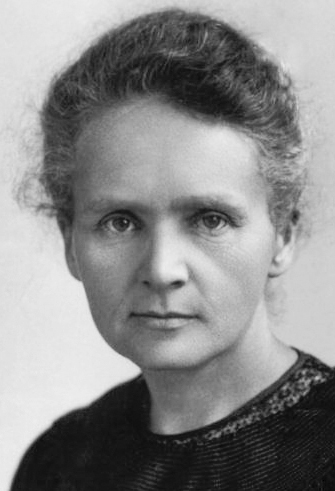
Start at the top for an easy introduction. Go further down for more detail and scholarship.
- Easy
- Intermediate
- Advanced
For young readers
Marie Curie was born in Warsaw, Poland, in 1867. Her name then was Maria Skłodowska, and her family called her Mania. Her parents were teachers, and she loved learning, especially science and mathematics.
At that time Poland was ruled by the Russian Empire, and women were not allowed to study at university in Warsaw. So Maria studied at a secret “flying university” that moved from house to house, and worked as a teacher to save money.
When she was 24 she went to Paris to study at the famous Sorbonne. She was very poor and sometimes wore all her clothes at once to keep warm in her little room. But she finished top of her class and married another scientist, Pierre Curie.
Marie wanted to know why a metal called uranium gave off invisible rays. She measured the rays very carefully and found that they came from inside the tiny atoms themselves. She called this “radioactivity.” Working in a leaky old shed, Marie and Pierre found two new elements. They named one polonium, after Poland, and the other radium, which glows in the dark.
Marie won two Nobel Prizes, the most famous science prize in the world—one in physics and one in chemistry. No one else has ever won in two different sciences. During the First World War she drove X-ray cars to hospitals near the front lines so doctors could see bullets and broken bones inside wounded soldiers.
Nobody knew then that radioactive materials can make people very ill. Marie became sick and died in 1934. Her notebooks are still radioactive today! She is remembered in Poland and France, and all over the world, as a hero of science who opened doors for women scientists.
At a glance
- Lived
- 7 November 1867 – 4 July 1934
- Born
- Warsaw, Kingdom of Poland (Congress Poland), Russian Empire
- Worked
- Paris: the School of Industrial Physics and Chemistry (ESPCI), the University of Paris (Sorbonne) and the Radium Institute
- Fields
- Physics and chemistry; pioneer of radioactivity research and its medical uses
- Discoveries
- Radioactivity as an atomic property; the elements polonium (July 1898) and radium (December 1898); isolation of radium
- Nobel Prizes
- Physics 1903 (with Pierre Curie and Henri Becquerel); Chemistry 1911 (alone)
- Firsts
- First woman Nobel laureate; first woman professor at the University of Paris (1906); first woman buried in the Panthéon on her own merits (1995)
- Family
- Married Pierre Curie (1895); daughters Irène Joliot-Curie (Nobel Prize in Chemistry 1935) and Ève Curie, her biographer
Easy
Who was Marie Curie?
Marie Curie (1867–1934), born Maria Salomea Skłodowska, was a Polish and naturalised French physicist and chemist. She is famous for her research on radioactivity—a word she helped coin—and for discovering, with her husband Pierre Curie, two new chemical elements, polonium and radium.
She was the first woman to win a Nobel Prize, the first person to win it twice and the only person to win Nobel Prizes in two different sciences: physics in 1903 and chemistry in 1911. In 1906 she became the first woman professor at the University of Paris. Later she founded research institutes in Paris and Warsaw that studied both the science of radioactivity and its use in treating cancer.
Curie spent her working life in France but never lost her Polish identity. She used both surnames, taught her daughters Polish and named the first element she discovered after her homeland, which at the time did not exist as an independent state. Both Poland and France claim her with pride.
Easy
A girlhood in occupied Warsaw
Maria Skłodowska was born on 7 November 1867 in Warsaw, then the capital of the Kingdom of Poland under Russian rule. She was the youngest of five children of two teachers. Both sides of the family had lost property through taking part in Polish uprisings against Russian rule. Her father taught mathematics and physics; when the Russian authorities stopped laboratory teaching in Polish schools, he brought equipment home and showed his children how to use it. He was later demoted for his pro-Polish views.
Her childhood was marked by loss. Her eldest sister Zofia died of typhus, and her mother died of tuberculosis in 1878, when Maria was ten. She finished secondary school in 1883 with a gold medal. Women could not enrol at regular universities in Russian Poland, so Maria and her sister Bronisława joined the “Flying University,” a secret Polish institution of higher learning that admitted women and moved from place to place to avoid the authorities.
The sisters made a pact: Maria would work and help pay for Bronisława’s medical studies in Paris, and later Bronisława would help her. Maria worked for several years as a tutor and governess. From 1890 to 1891 she also began practical training in a chemistry laboratory at the Museum of Industry and Agriculture in Warsaw, run by her cousin Józef Boguski.
Easy
Student in Paris and marriage to Pierre
In late 1891 Maria—now Marie in French—moved to Paris and enrolled at the University of Paris, the Sorbonne. She lived in a cheap attic room in the Latin Quarter, sometimes forgetting to eat, and studied physics, chemistry and mathematics by day while tutoring in the evenings. She earned a degree in physics in 1893 and a second degree, with the help of a scholarship, in 1894.
In 1894 a Polish physicist introduced her to Pierre Curie, an instructor at the School of Industrial Physics and Chemistry (ESPCI), because she needed laboratory space for a study of the magnetic properties of steel. Their shared passion for science turned into love. Marie hoped at first to return to Poland, but she was refused a post at Kraków University, which was then closed to women in such roles. Pierre persuaded her to come back to Paris.
They married on 26 July 1895 in Sceaux, without a religious service. Instead of a wedding gown Marie wore a dark blue outfit, which she later used for years in the laboratory. Their first daughter, Irène, was born in 1897. To support the family Marie took on teaching, and in 1900 she became the first woman on the faculty of the École normale supérieure for young women at Sèvres, which trained women teachers.
Easy
Mysterious rays and two new elements
In 1895 Wilhelm Röntgen discovered X-rays, and in 1896 Henri Becquerel found that uranium salts gave off penetrating rays without any outside source of energy. Marie chose these “uranium rays” as the subject of her doctoral research. Using a very sensitive electrometer invented by Pierre and his brother Jacques, she measured how the rays made the air conduct electricity. She found that the strength of the rays depended only on the amount of uranium present, not on its chemical form. She concluded that the radiation must come from the atoms themselves—a bold idea when most scientists thought atoms could not be divided or changed.
Testing many substances, she found in 1898 that thorium also gave off such rays. She also noticed something strange: two uranium ores, pitchblende and chalcolite, were more active than pure uranium. She suggested they must contain an unknown element far more active than uranium. Pierre was so intrigued that he set aside his own research on crystals to join her.
Working in a leaky, poorly ventilated shed next to ESPCI—a former dissecting room—the Curies ground and dissolved pitchblende and separated it chemically, following the radioactivity. In July 1898 they announced a new element in the fraction that behaved like bismuth and named it polonium, after Poland. In December 1898 they announced a second, in the fraction that behaved like barium, and named it radium, from the Latin word for ray. Along the way they introduced the word “radioactivity.”
Intermediate
Isolating radium and the first Nobel Prize
Many chemists would not accept new elements until they could be seen in pure form and weighed. Polonium was very hard to collect because it decays quickly, but radium could be separated from barium by repeated crystallisation. Using about a tonne of pitchblende residues donated by the Austrian government, Marie worked for more than three years to obtain one-tenth of a gram of radium chloride in 1902, enough to determine radium’s atomic weight. Between 1898 and 1902 the Curies published 32 scientific papers, including one reporting that radium destroyed diseased, tumour-forming cells faster than healthy ones.
In June 1903 Marie received her doctorate from the University of Paris. That December the Royal Swedish Academy of Sciences awarded the Nobel Prize in Physics jointly to Henri Becquerel, Pierre Curie and Marie Curie for their research on radiation. The committee had at first intended to honour only Becquerel and Pierre; the Swedish mathematician Gösta Mittag-Leffler alerted Pierre, who insisted that Marie be included. She became the first woman to receive a Nobel Prize.
Radium soon became the basis of a new industry for medicine and luxury products. The Curies chose not to patent their methods and gained little from this business. A company that made Pierre’s instruments helped scale up production, with the chemist André Debierne adapting their techniques. Their second daughter, Ève, was born in December 1904.
Intermediate
Tragedy, scandal and a second Nobel Prize
On 19 April 1906 Pierre Curie was killed instantly when he slipped under a horse-drawn wagon while crossing a street in the rain. Marie was devastated. In May the University of Paris offered her his chair of physics, and she became the first woman professor in the university’s history. She took on the task of building the laboratory Pierre had never had, and in 1909 the university and the Pasteur Institute agreed to create a Radium Institute for her.
In 1910 she isolated radium as a pure metal and helped establish an international standard for radioactivity, later called the curie. Yet in January 1911 the French Academy of Sciences rejected her candidacy by one or two votes. Right-wing newspapers attacked her as a foreigner and an atheist, and some falsely claimed she was Jewish, reflecting the xenophobia and antisemitism of France after the Dreyfus Affair.
Later that year the press revealed her relationship with the physicist Paul Langevin, a married man separated from his wife. A furious campaign followed, and a crowd gathered outside her home. In the middle of this storm the Nobel committee awarded her the 1911 Nobel Prize in Chemistry for the discovery of radium and polonium and the isolation of radium. When a committee member suggested she stay away from the ceremony, she replied that the prize had been given for her discoveries and that there was no connection between her scientific work and her private life. She attended—then collapsed with depression and a kidney illness and withdrew from public life for much of 1912.
Intermediate
The “Little Curies”: X-rays for the wounded in the First World War
When the First World War broke out in 1914, the new Radium Institute in Paris had just been completed, but most of its researchers were called up to the army. Curie realised that surgeons near the front needed X-ray images to find bullets and shrapnel and to set broken bones, which could save limbs from amputation. She quickly learned radiology, anatomy and even car mechanics.
She equipped vehicles with X-ray machines and generators—soon nicknamed petites Curies, “Little Curies”—and became director of the Red Cross radiology service. With help from a military doctor and her seventeen-year-old daughter Irène, she set up 20 mobile units and about 200 fixed radiological posts in the first year of the war, and trained women as X-ray operators. It is estimated that more than a million wounded soldiers were examined with these units.
She also supplied radon gas from her own radium to sterilise infected tissue, and invested her Nobel Prize money in French war bonds. She later described her wartime work in the book Radiology in War (1919). Despite all this, she received no formal honour from the French state for her war service.
Intermediate
The Radium Institute, America and Warsaw
After the war Curie led the Radium Institute, which became one of the world’s four leading centres of radioactivity research, alongside Ernest Rutherford’s Cavendish Laboratory in Cambridge, the Vienna Radium Institute and the Kaiser Wilhelm Institute for Chemistry in Berlin. Its researchers later included her daughter Irène and son-in-law Frédéric Joliot-Curie, who won the Nobel Prize in Chemistry in 1935 for artificial radioactivity. She also trained and supported many women scientists.
In 1921 the American journalist Marie Mattingly Meloney organised a fundraising tour of the United States, and President Warren G. Harding presented Curie with one gram of radium bought with American donations. A second American tour in 1929 provided radium for a new Radium Institute in Warsaw, which opened in 1932 with her sister Bronisława as director. From 1922 until her death she served on the League of Nations’ International Committee on Intellectual Cooperation, alongside Albert Einstein and Henri Bergson.
Years of exposure to radiation—from carrying radioactive samples in her pocket and from unshielded X-ray equipment in the war—damaged her health. She died on 4 July 1934 at a sanatorium in Passy, in the French Alps, of aplastic anaemia. Her last book, Radioactivity, appeared in 1935. In 1995 her remains and Pierre’s were moved to the Panthéon in Paris; she was the first woman honoured there for her own achievements.
Advanced
Her scientific contribution in context: from atomic property to unstable nucleus
Curie’s central conceptual contribution was the hypothesis that radioactivity is an atomic property, independent of chemical combination or physical state. Combined with her quantitative electrometric method, this turned radioactivity into a tool for chemical analysis: by following the activity, one could track and concentrate invisibly small amounts of unknown substances. This method—radiochemistry—remains basic to nuclear science and medicine.
Her results also posed deep puzzles. Radium released energy continuously without any apparent source, which seemed at first to contradict the conservation of energy. Some physicists suggested that atoms might be capturing energy from an unknown outside radiation. The solution came from Ernest Rutherford and Frederick Soddy, who showed from 1902 that radioactive atoms spontaneously transform into other elements, and later from Rutherford’s nuclear model of the atom (1911), which located radioactivity in the nucleus. The Curies’ intense sources of radiation were essential to this work.
Historians note that Curie herself was cautious about theoretical speculation and emphasised careful measurement and chemistry. This caution has sometimes been read as conservatism, especially in contrast with Rutherford’s bold theorising, but others see it as the rigour that made her discoveries secure. Her monumental Traité de radioactivité (1910) summarised the field for a generation of researchers.
Advanced
Credit, gender and the “Curie myth”
Questions of credit shadowed Curie’s career. In the 1890s many scientists assumed that a husband must lead a joint project. The biographer Robert Reid stressed that the research idea was her own and that she made sure to record this twice in her biography of Pierre. The near-omission of her name from the 1903 Nobel nomination shows how easily her role could have been erased, while the 1911 Academy vote and the Langevin scandal show how gender, nationality and religion were used against her.
At the same time, the popular image of Curie has been shaped by a powerful legend. Ève Curie’s best-selling biography Madame Curie (1937–1938) and the Hollywood film Madame Curie (1943) portrayed a saintly, self-sacrificing genius in a dark shed. Later biographers, such as Françoise Giroud, Susan Quinn and Barbara Goldsmith, used newly available papers—including her diaries after Pierre’s death and the Langevin affair—to present a more complex person. The historian Eva Hemmungs Wirtén has examined how Curie’s decision not to patent radium and her celebrity were themselves constructed and used in debates about science and intellectual property.
Her identity has also been contested. French newspapers called her a foreign intruder when she sought French honours but a French heroine when she won foreign prizes, as Ève later remarked. Polish memory emphasises Maria Skłodowska, the patriot who named polonium; French memory, Madame Curie of the Panthéon. Recent scholarship, including work on the network of women she trained at the Radium Institute, tends to see her as a transnational figure whose achievements depended on both countries and on many collaborators.
Advanced
Radiation, health and the sources for her life
The dangers of ionising radiation were not understood when the Curies began their work. Marie carried test tubes of radioactive material in her pockets and admired their faint glow in the dark. She attributed some health problems to other causes and was reluctant to accept that radium, which also promised cancer treatment, was harming its discoverers and workers. When her body was exhumed in 1995, the French radiation protection office concluded that she had not been exposed to lethal levels of radium during her life, and suggested that her wartime X-ray work was a more likely cause of her illness—a conclusion that remains debated.
The material record of her life is literally radioactive. Her laboratory notebooks from the 1890s are kept in lead-lined boxes at the Bibliothèque nationale de France, and readers must sign a waiver and wear protective clothing; radium-226 has a half-life of about 1,600 years. Beyond these notebooks, historians rely on her scientific papers, her biography Pierre Curie (1923), autobiographical notes, correspondence, the records of the Nobel committees (opened after fifty years), newspaper coverage and the memories of her daughters and students.
Using these sources critically means separating Curie’s own words from later retellings. Some famous quotations attributed to her are difficult to trace to reliable originals. Careful modern works, such as the online exhibit of the American Institute of Physics, therefore combine documentary evidence with the scientific context to explain what she did and why it mattered.
Key ideas
- Radioactivity as an atomic property
- Curie concluded that the rays come from within atoms themselves, not from chemical reactions—an early blow to the idea that atoms are indivisible.
- Measurement as discovery
- Precise electrometer measurements revealed that some ores were more active than uranium, pointing to unknown elements.
- Radiochemistry
- Following radioactivity through chemical separations to find and concentrate new substances—a method still used today.
- Polonium and radium
- Two new elements announced in 1898; polonium named for Poland, radium from the Latin for ray.
- Medical uses of radiation
- From radium therapy for tumours to mobile X-ray units in wartime, her work linked physics directly to medicine.
- Open science
- The Curies chose not to patent radium extraction, a decision later celebrated and debated.
- Women in science
- Her career broke barriers—first woman Nobel laureate, first woman professor at the Sorbonne—and she trained many women researchers.
Records
- 1867 — Born Maria Skłodowska in Warsaw on 7 November.
- 1891 — Moves to Paris and enrols at the University of Paris.
- 1895 — Marries Pierre Curie on 26 July.
- 1898 — Announces the radioactivity of thorium; with Pierre, discovers polonium (July) and radium (December).
- 1902 — Obtains one-tenth of a gram of radium chloride.
- 1903 — Receives her doctorate; shares the Nobel Prize in Physics with Pierre Curie and Henri Becquerel.
- 1906 — Pierre dies in a street accident; Marie becomes the first woman professor at the University of Paris.
- 1910 — Isolates radium metal; publishes her Traité de radioactivité.
- 1911 — Rejected by the French Academy of Sciences; awarded the Nobel Prize in Chemistry.
- 1914 — Radium Institute completed; she organises mobile X-ray units for the war.
- 1932 — The Radium Institute in Warsaw opens, directed by her sister Bronisława.
- 1934 — Dies of aplastic anaemia on 4 July at Passy, Haute-Savoie.
Glossary
- Radioactivity
- The spontaneous giving off of radiation by certain atoms as they change; a word the Curies introduced.
- Element
- A basic chemical substance made of only one kind of atom, such as oxygen, gold or radium.
- Electrometer
- An instrument that measures very small electric charges; Curie used it to measure radioactivity.
- Pitchblende
- A dark uranium ore (uraninite) from which the Curies extracted polonium and radium.
- Isotope
- A form of an element with a different number of neutrons in its nucleus; many are radioactive.
- Half-life
- The time it takes for half of a radioactive substance to decay—about 138 days for polonium-210 and about 1,600 years for radium-226.
- X-rays
- Penetrating electromagnetic radiation used to see inside the body, discovered by Röntgen in 1895.
- Curie (unit)
- A unit of radioactivity named in honour of the Curies.
- Flying University
- A secret Polish institution of higher education in Russian-ruled Warsaw that admitted women.
- Aplastic anaemia
- A disease in which the bone marrow stops making enough blood cells, often linked to radiation damage.
Questions and answers
Why did she name an element polonium?
To honour her homeland, Poland, which was then divided among Russia, Prussia and Austria and did not exist as an independent country. She hoped the name would draw attention to it.
Did Marie Curie discover radioactivity?
Henri Becquerel first detected the rays from uranium in 1896. Curie showed that the effect was an atomic property, found it in thorium, discovered new radioactive elements and gave the phenomenon its name.
Is it true her notebooks are still radioactive?
Yes. They are kept in lead-lined boxes, and people who consult them wear protective clothing, because radium lasts for thousands of years.
Why didn’t she patent radium?
She and Pierre wanted other scientists to be able to work freely. Historians still discuss how this choice shaped her reputation and the radium industry.
Was she French or Polish?
Both. She was born and educated in Poland, became a French citizen through marriage and did all her major research in France, while keeping a strong Polish identity.
Why was she rejected by the French Academy of Sciences?
In 1911 she lost by one or two votes amid attacks on her as a woman, a foreigner and an atheist; no woman was elected a full member until her former student Marguerite Perey in 1962.
What killed her?
Aplastic anaemia, probably caused by long exposure to radiation. Experts disagree on whether radium or wartime X-ray work was the main cause.
Sources and further reading
- Marie Curie. Wikipedia
- 마리 퀴리. Wikipedia (Korean)
- Marie Curie and the Science of Radioactivity. American Institute of Physics
- Research Breakthroughs (1897–1904). American Institute of Physics
- The Discovery of Polonium and Radium. American Institute of Physics
- Radioactivity: The Unstable Nucleus and its Uses. American Institute of Physics
- Susan Quinn, Marie Curie: A Life. Simon & Schuster, 1995
- Eva Hemmungs Wirtén, Making Marie Curie: Intellectual Property and Celebrity Culture in an Age of Information. University of Chicago Press, 2015
- Naomi Pasachoff, Marie Curie and the Science of Radioactivity. Oxford University Press, 1996
Related
- Nicolaus CopernicusRenaissance astronomer and church canon who argued that the Earth spins daily and orbits the Sun, launching the Copernican Revolution.
- Isaac NewtonEnglish mathematician and natural philosopher who formulated the laws of motion and universal gravitation, developed calculus and explained the composition of white light.
- Galileo GalileiItalian mathematician and astronomer who revolutionized astronomy with the telescope, founded the mathematical science of motion and was condemned for defending Copernicus.
- Mary WollstonecraftEnglish writer and philosopher whose A Vindication of the Rights of Woman (1792) argued that women seem inferior only because they are denied education, a founding text of feminist thought.
- Assassination of Archduke Franz FerdinandThe killing of Archduke Franz Ferdinand and his wife Sophie in Sarajevo on 28 June 1914 triggered a diplomatic crisis that led to the First World War.
Written with AI assistance from the published sources listed above, and revised as new research appears.