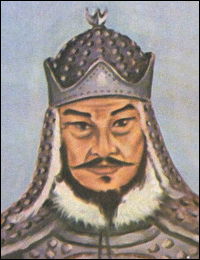
Start at the top for an easy introduction. Go further down for more detail and scholarship.
- Easy
- Intermediate
- Advanced
For young readers
About 1,400 years ago, the northern part of Korea and a large piece of what is now northeast China belonged to a kingdom called Goguryeo. Its capital was Pyongyang. Next door was a huge and powerful empire in China called the Tang, and in the south of Korea were two smaller kingdoms, Baekje and Silla.
Yeon Gaesomun came from one of Goguryeo's most important noble families. In the year 642, some nobles and the king planned to get rid of him. He found out first. He struck before they could, killed many of the officials who opposed him and the king himself, and put the king's nephew on the throne. From then on, the king was king only in name. Yeon Gaesomun made the real decisions.
A few years later, the Tang emperor Taizong marched into Goguryeo with a giant army. Goguryeo's people defended their stone fortresses on the hills. At one fortress, called Ansi, the defenders held out for about two months until winter came and the emperor had to go home. The Tang attacked again and again, but while Yeon Gaesomun lived, they could not take the capital.
After he died, his sons quarrelled about who should be in charge. One son even went over to the Tang side. The enemies of Goguryeo used this moment, and in 668 the kingdom fell.
Was Yeon Gaesomun a good leader? Old history books written in China, and many written later in Korea, called him cruel because he killed a king. About a hundred years ago, some Korean writers began to praise him as a brave defender of his country. Today historians try to see both sides.
At a glance
- Lived
- Birth year unknown (often given as c. 594 or c. 603); died 665 according to his son's epitaph (other records give 664 or 666)
- Kingdom
- Goguryeo (traditionally 37 BC–668 AD), capital Pyongyang
- Power
- Seized power in a coup in 642; took the title Dae Mangniji (大莫離支, Grand Prime Minister) and ruled through King Bojang (r. 642–668)
- Wars
- Defended Goguryeo against Tang invasions in 645, 647–648 and 661–662
- Name forms
- Yeon Gaesomun (淵蓋蘇文); Tang sources write Quan Gaisuwen (泉蓋蘇文) to avoid the Tang founder's personal name; the Nihon shoki calls him Iri Kasumi (伊梨柯須彌)
- Family
- Father Yeon Taejo; sons Namsaeng, Namgeon, Namsan; younger brother Yeon Jeongto
- Main sources
- Samguk sagi (1145), Old and New Book of Tang, Nihon shoki (720), epitaphs of his sons found near Luoyang
Easy
Who was Yeon Gaesomun?
Yeon Gaesomun was a Goguryeo aristocrat and military commander who, from 642 until his death in the mid-660s, was the most powerful man in the kingdom. Goguryeo was then one of the great states of northeast Asia, stretching from the Liao River in Manchuria to the Han River region of the Korean peninsula, with its capital at Pyongyang.
He came to power by force. Warned that the king and a group of high officials were plotting to remove him, he struck first, killed more than a hundred of his opponents, assassinated King Yeongnyu and set the king's nephew, King Bojang, on the throne. He then created or took the title Dae Mangniji, usually translated as 'Grand Prime Minister', and combined civil and military command in his own hands.
His years in power coincided with the most dangerous period in Goguryeo's history. The newly founded Tang empire, which had reunited China, was determined to bring Goguryeo to heel, and the southern Korean kingdom of Silla was seeking Tang help against its rivals. Under Yeon Gaesomun, Goguryeo repelled several large Tang invasions. Within three years of his death, however, a quarrel among his sons opened the way for a Tang–Silla alliance to conquer the kingdom in 668.
Easy
His family and his many names
According to the Korean Encyclopedia of Korean Culture, his family name Yeon (淵, 'deep water' or 'pool') was linked with a story that the family's founder had been born from a spring or from water. His grandfather Jayu and father Taejo had both held the high office of mangniji, and Yeon Gaesomun inherited his father's position as head of one of the kingdom's regional divisions (bu). In other words, he was not an outsider; he belonged to the inner circle of Goguryeo's aristocracy.
The same man appears under different names in different countries' records. Chinese histories of the Tang write his surname as Quan (泉, 'spring'), because the Tang founder's personal name was Li Yuan (淵), and it was forbidden to write an emperor's personal name. For the same reason his eldest son is called Quan Namsaeng (천남생) on the tombstone found near Luoyang. The Japanese chronicle Nihon shoki writes his name with phonetic characters as Iri Kasumi, which may reflect how the name sounded in the Goguryeo language.
His birth year is not recorded. Modern writers often give a date around 594 or 603, but these are estimates. Even his death is dated differently: the epitaph of his son Namsaeng points to 665, the Samguk sagi places it in 666, and the Nihon shoki mentions it under 664. Many historians prefer 665 because the epitaph was written close to the events by a member of the family.
Easy
The coup of 642
In the 630s Goguryeo built a long line of fortifications along its western frontier, often called the Cheolli Jangseong ('Thousand-li Wall'), to guard against the Tang. Yeon Gaesomun was put in charge of this project, which gave him command over troops and labour on the frontier. Some historians think the court's decision to send him there was partly a way of keeping a powerful rival away from the capital.
In 642, according to the traditional account, the king and senior officials planned to kill him. He learned of the plot, invited the officials to a military review, and had them killed there. He then entered the palace, killed King Yeongnyu and enthroned Bojang. Chinese sources speak of more than a hundred dead; other records give a higher figure of around 180. The details differ, but all sources agree that the coup was bloody and that it ended the old balance of power among the great families.
The coup took place in the same year as another turning point. Baekje, Goguryeo's southern neighbour, had just captured dozens of Silla fortresses, including the important stronghold of Daeya. Silla urgently needed allies, and its envoy Kim Chunchu, the future King Muyeol, travelled to Pyongyang that winter to ask for help. Yeon Gaesomun's government demanded that Silla first return lands in the Han River basin that Goguryeo had lost decades earlier. The talks failed, Kim Chunchu barely made it home, and Silla turned instead to the Tang.
Intermediate
The great Tang invasion of 645
Tang Taizong (r. 626–649) presented his invasion as a punitive war: Yeon Gaesomun, he said, had murdered his lord and oppressed the people, and was attacking Silla, a loyal Tang ally. Behind these justifications lay strategic concerns. The Sui dynasty had been destroyed partly by its disastrous wars against Goguryeo in 598 and 612–614, and a strong, independent Goguryeo on the Tang's northeastern flank was seen as a lasting threat.
In 645 Tang armies crossed the Liao River and took several major Goguryeo fortresses, including Gaemo, Liaodong and Baegam. A large Goguryeo relief army was defeated in open battle near Ansi fortress. But Ansi itself refused to surrender. For roughly two months the Tang besieged it, even building a great earthen ramp against its walls, and still the fortress held. With autumn turning cold and supplies running short, Taizong ordered a retreat. The commander of Ansi is not named in the official histories; the name Yang Manchun often given to him appears only in much later Joseon-period writings.
The campaign cost the Tang heavily and did not reach Pyongyang. Taizong then switched to a strategy of smaller, repeated raids in 647 and 648 meant to exhaust Goguryeo's frontier. He was preparing another great campaign when he died in 649.
Intermediate
Holding on: the 650s and 660s
Taizong's son Gaozong changed the approach. Instead of striking Goguryeo only from the west, the Tang allied with Silla and attacked Baekje first. In 660 a Tang fleet and a Silla army destroyed Baekje, and Goguryeo lost its southern ally. Now it could be attacked from both the northwest and the south.
In 661 Tang forces besieged Pyongyang itself. In early 662 Goguryeo won one of its most famous victories when an army under Yeon Gaesomun destroyed a Tang force under the general Pang Xiaotai near the Sasu River, killing Pang and, according to the records, his sons. Soon afterwards the Tang lifted the siege of Pyongyang.
In 663 a Japanese fleet sent to restore Baekje was defeated by Tang and Silla forces at the Battle of Baekgang. Goguryeo was increasingly isolated, but as long as Yeon Gaesomun lived, its central leadership held together.
Intermediate
How he governed: power, religion and diplomacy
Yeon Gaesomun ruled through King Bojang rather than taking the throne himself. This allowed him to keep royal legitimacy while controlling appointments and armies. The position of Dae Mangniji later passed to his eldest son Namsaeng, which suggests he was building a hereditary regime for his family, much as powerful regents did in other monarchies.
One of his notable policies was the promotion of Daoism. In 643, on his advice, the Goguryeo court asked the Tang for Daoist teachers and texts; the Tang sent a group of Daoist priests led by one Shuda together with the Daodejing. Historians interpret this in different ways. Some see it as an attempt to calm relations with the Tang, whose ruling Li family claimed descent from Laozi. Others see it as a way to weaken the Buddhist establishment that was closely tied to rival aristocrats. Later Korean Buddhist tradition remembered the policy with hostility.
In foreign policy he was firm toward the Tang and toward Silla, but he maintained contact with Japan (Wa), which was itself going through a political upheaval after the Isshi Incident of 645 and the Taika Reform. The Nihon shoki records Goguryeo embassies to Japan in these years and preserves a Japanese account of his coup.
Intermediate
Meanwhile in the world
Yeon Gaesomun's two decades in power were a time of dramatic change across Eurasia. In Chang'an, Tang Taizong ruled one of the largest empires on earth; in 645, the very year he invaded Goguryeo, the monk Xuanzang returned to the Tang capital after studying for years at Nalanda in India, bringing hundreds of Buddhist texts. The Tang also built the vast Daming Palace north of Chang'an, begun in 634 and later used as the main seat of government.
In Japan, the same year 645 saw the violent overthrow of the Soga clan and the start of the Taika Reform, which tried to build a centralised state on Chinese lines. Like Goguryeo's coup of 642, it was a palace revolution carried out by men who feared both rival clans and the power of the Tang.
Far to the west, the Arab armies of the early Islamic caliphate, united after the death of the Prophet Muhammad in 632, defeated the Sasanian Persians at Nahavand in 642, the same year as Yeon Gaesomun's coup. By 651 the Sasanian empire had collapsed, and during these years the text of the Quran was compiled into a standard written form under the caliph Uthman. The Byzantine emperors in Constantinople, worshipping in Hagia Sophia, were losing Syria and Egypt to the new power.
Seen together, these events show a world in which large new empires, the Tang in the east and the caliphate in the west, were rapidly redrawing borders. Goguryeo's long resistance and eventual fall were part of this larger story of consolidation, in which smaller or older states either adapted, allied with a rising power, or were absorbed.
Intermediate
After his death: division and the fall of Goguryeo
When Yeon Gaesomun died, his eldest son Namsaeng succeeded him as Dae Mangniji at about the age of thirty-two. While Namsaeng was inspecting the provinces, his younger brothers Namgeon and Namsan took control of the capital. Namsaeng fled to the old capital of Gungnae-seong and eventually appealed to the Tang for help, surrendering to them in 666. Around the same time Yeon Gaesomun's younger brother Yeon Jeongto went over to Silla with a group of fortresses.
The split gave the Tang and Silla the opening they had lacked for decades. In 667–668 Tang armies under Li Ji advanced from the northwest, guided in part by Namsaeng, while Silla attacked from the south. Pyongyang fell in 668. King Bojang and many aristocrats were taken to the Tang, and the Tang set up a Protectorate General to Pacify the East to govern the former territories.
Namsaeng spent the rest of his life as a high-ranking official in the Tang and died in 679. His tomb epitaph, discovered near Luoyang in the early twentieth century, together with the epitaphs of his brother Namsan and of later descendants, is one of the few sources written from inside the Yeon family, and it is the basis for dating Yeon Gaesomun's death to 665.
Advanced
Sources: seeing Yeon Gaesomun through his enemies' eyes
No Goguryeo chronicle survives. Almost everything we know about Yeon Gaesomun comes from three kinds of material. The first is Chinese official history: the Old Book of Tang (945), the New Book of Tang (1060) and the Zizhi tongjian (1084). These were written by the historians of the state he fought, and they describe him as arrogant, cruel and a regicide, partly to justify Taizong's war.
The second is the Samguk sagi, compiled in Goryeo in 1145 under Kim Busik. For the Goguryeo–Tang wars it draws heavily on the Chinese histories, sometimes nearly word for word, and it judges him from a Confucian standpoint in which killing a king was among the worst crimes. The Samguk yusa (late 13th century) adds Buddhist traditions, including hostile stories about his promotion of Daoism.
The third is material from outside the Chinese–Korean official tradition: the Nihon shoki, which gives an independent Japanese account of the 642 coup and a strikingly different picture of him as an imposing figure, and the epitaphs of his sons and descendants found in China. These epitaphs were written under the Tang for men who served the Tang, so they too have their own bias, but they preserve family details and titles not found elsewhere.
Because of this, historians treat the vivid personal details in the histories, such as his carrying five swords or forcing nobles to kneel as mounting blocks, with caution. The broad outline of his career is secure; his motives and character have to be inferred from sources that were mostly hostile.
Advanced
Different perspectives
The Tang and later imperial Chinese view: in the official histories he is a usurper who murdered his king, and the Tang wars are framed as a rightful punishment. In later Chinese popular fiction and theatre about the Tang general Xue Rengui, a character based on him appears as a fierce enemy commander. In the early 2000s the Northeast Project of the Chinese Academy of Social Sciences described Goguryeo as a regional regime within Chinese history; from that standpoint, the Sui and Tang campaigns are presented as wars inside a Chinese political order rather than as foreign invasions. This framing was strongly contested in Korea, and in 2004 the two governments reached an informal understanding to keep the dispute from escalating.
The traditional Korean Confucian view: from the Samguk sagi through Joseon-era historians, the dominant judgement was negative. Loyalty to the ruler was a supreme value, and Yeon Gaesomun had killed a king, ruled as a dictator and, in this view, left behind a divided family that destroyed the state. Even so, some Joseon writers admired Goguryeo's resistance at Ansi, which shows that judgement of the man and of the war could be separated.
The Korean nationalist view of the early twentieth century: under the pressure of Japanese colonisation, historians such as Park Eun-sik, who wrote a biography of him in 1911, and Shin Chaeho reinterpreted him as a great hero who defended Korean independence against a mighty empire. Park praised him as a man who stood for 'independence and self-determination'. North Korean historiography also celebrates him as a patriot, in keeping with its emphasis on Goguryeo as the model of an independent Korean state.
Recent academic views: many modern historians in Korea and elsewhere avoid both extremes. They read the 642 coup as the outcome of a struggle among great aristocratic families in a kingdom where power had long been shared among them, and they see his foreign policy as a rational response to Tang pressure and Silla's diplomacy, while also noting that his concentration of power in one family made the state fragile once he died. Evidence cited on this side includes the pattern of noble titles in Goguryeo, the epitaphs of the Yeon family, and comparisons with the fall of Baekje. The debate is less about the facts than about how to weigh loyalty, legitimacy and national survival.
Advanced
Legacy and memory
Yeon Gaesomun's story became a symbol that different generations used for their own purposes. For Confucian historians he was a warning about disloyal ministers; for nationalists under colonial rule he was proof that Koreans had once stood up to the largest empire in Asia; for modern novelists and television dramas in South Korea he is a larger-than-life war leader.
For historians of East Asia he matters as a key actor in the seventh-century crisis that ended the Three Kingdoms period and reshaped the region. The fall of Goguryeo led to the Silla–Tang War, to Silla's control of most of the southern peninsula, and, in the north, to the rise of Balhae in 698 under leaders who claimed Goguryeo's legacy. It also sent Goguryeo refugees to Japan and into Tang service, spreading people and skills across the region.
The key open questions remain: how far he acted from personal ambition and how far from a coherent strategy, whether his policies prolonged Goguryeo's life or made its collapse more sudden, and how to write the history of a state whose own voice is almost entirely lost.
Key ideas
- Military regency
- Yeon Gaesomun ruled through a king he had installed, holding real power as Dae Mangniji. Similar arrangements appear in many monarchies where a powerful minister or general controls the throne.
- Fortress defence
- Goguryeo relied on a network of hill fortresses along its western frontier. Holding out in fortresses like Ansi forced invading armies into long sieges far from home, which is how Goguryeo defeated larger forces.
- Alliance diplomacy
- The failed talks with Silla's Kim Chunchu in 642 helped push Silla into alliance with the Tang, which in the end decided the fate of both Baekje and Goguryeo.
- Succession crisis
- Concentrating power in one family worked while its head was alive but split the state when his sons fought each other after his death.
- Hostile sources
- Because Goguryeo's own records are lost, historians must reconstruct him from the writings of his enemies and later Confucian critics, reading them against the grain.
- History and identity
- How Yeon Gaesomun and Goguryeo are remembered is tied to modern questions of national identity in Korea and China, which is why the same events are told differently.
Records
- 598 CE — First Sui invasion of Goguryeo fails.
- 612 CE — Sui Emperor Yang's massive invasion is defeated; further failed campaigns follow in 613–614.
- c. 631 CE — Goguryeo begins building a long frontier defence line; Yeon Gaesomun later supervises the work.
- 642 CE — Yeon Gaesomun's coup: King Yeongnyu is killed and King Bojang enthroned. Silla's Kim Chunchu visits Pyongyang but fails to win an alliance.
- 643 CE — Goguryeo requests Daoist teachers from the Tang; a Daoist mission arrives with the Daodejing.
- 645 CE — Tang Taizong invades; several fortresses fall, but the siege of Ansi fails and the Tang retreat.
- 647 CE — Tang begins smaller raids on Goguryeo (647–648).
- 660 CE — Tang and Silla destroy Baekje.
- 662 CE — Goguryeo destroys the Tang army of Pang Xiaotai at the Sasu River; the Tang lift the siege of Pyongyang.
- 665 CE — Death of Yeon Gaesomun, according to his son Namsaeng's epitaph (other records: 664 or 666).
- 666 CE — Namsaeng, ousted by his brothers, surrenders to the Tang; Yeon Jeongto defects to Silla.
- 668 CE — Pyongyang falls to Tang and Silla forces; Goguryeo comes to an end.
Glossary
- Goguryeo
- A kingdom in northern Korea and Manchuria, one of the Three Kingdoms of Korea, which lasted until 668.
- Dae Mangniji (大莫離支)
- The supreme office Yeon Gaesomun held after 642, combining the roles of chief minister and commander-in-chief.
- Tang
- The Chinese dynasty (618–907) that fought Goguryeo and, allied with Silla, conquered it in 668.
- Coup
- A sudden, usually violent seizure of power by a small group inside the government.
- Ansi fortress
- A Goguryeo hill fortress in the Liaodong region whose defenders withstood the Tang siege of 645.
- Epitaph
- An inscription placed in or on a tomb describing the life of the dead person; those of Yeon Gaesomun's sons were found near Luoyang.
- Naming taboo
- The Chinese custom of not writing an emperor's personal name, which is why Tang sources changed Yeon (淵) to Quan (泉).
- Samguk sagi
- The oldest surviving Korean history of the Three Kingdoms, compiled in 1145 by Kim Busik and others.
Questions and answers
Did Yeon Gaesomun become king?
No. He killed King Yeongnyu but placed another member of the royal family, King Bojang, on the throne and ruled through him.
Did Goguryeo win against the Tang?
While Yeon Gaesomun lived, Goguryeo defeated or stopped several Tang invasions, including the huge campaign of 645. But after his death his sons fought each other, and the Tang and Silla together conquered Goguryeo in 668.
Why do Chinese sources call him Quan Gaisuwen?
The Tang founder's personal name was Yuan (淵), the same character as Yeon's surname. Tang writers were forbidden to write it, so they replaced it with Quan (泉), which also means 'spring'.
When exactly did he die?
Sources disagree: 664 (Nihon shoki), 665 (his son Namsaeng's epitaph) and 666 (Samguk sagi). Many historians prefer 665 because the epitaph is close to the family.
Was he a hero or a tyrant?
It depends on the standard used. Confucian historians condemned him for killing a king; early twentieth-century nationalists praised him for resisting the Tang. Many modern historians describe both his ruthlessness and his success as a war leader.
How reliable is the story of the Ansi commander Yang Manchun?
The siege is well documented, but the commander is unnamed in the official histories. The name Yang Manchun appears only in much later Joseon-period writings, so most historians treat it as tradition rather than established fact.
Why did he promote Daoism?
Historians disagree. It may have been a diplomatic gesture to the Tang imperial family, which honoured Laozi, or a way to weaken Buddhist institutions tied to rival nobles, or both.
Sources and further reading
- 노태돈 (Noh Tae-don), 연개소문 (淵蓋蘇文). Encyclopedia of Korean Culture, Academy of Korean Studies
- 연남생 (淵男生). Encyclopedia of Korean Culture, Academy of Korean Studies
- 천개소문전 (泉蓋蘇文傳). Encyclopedia of Korean Culture, Academy of Korean Studies
- Yeon Gaesomun. Wikipedia
- Goguryeo–Tang War. Wikipedia
- Battle of Baekgang. Wikipedia
- Goguryeo controversies. Wikipedia
Related
- Goguryeo–Sui WarsFour failed invasions of the Korean kingdom of Goguryeo by the Chinese Sui dynasty in 598 and 612–614; their cost helped bring down the Sui in 618.
- Silla's wars of unificationWars of 660–676 in which Silla, first allied with Tang China and then fighting it, saw Baekje and Goguryeo destroyed and came to rule the peninsula south of the Taedong River.
- Taika ReformA programme of political reforms launched after the palace coup of 645, which aimed to turn Japan’s alliance of powerful clans into a centralised state on the model of Tang China.
- Daming PalaceThe main palace of the Tang emperors, begun in 634 on the Longshou Plateau outside the north-east corner of Chang’an and the seat of government until it was dismantled in 904.
- Samguk sagiHistory of Korea's Three Kingdoms compiled under Kim Busik and presented to the Goryeo court in 1145.
Written with AI assistance from the published sources listed above, and revised as new research appears.