Start at the top for an easy introduction. Go further down for more detail and scholarship.
- Easy
- Intermediate
- Advanced
For young readers
More than 2,000 years ago, a ship full of treasures sank near a small Greek island called Antikythera. In 1900 sponge divers found the wreck at the bottom of the sea and brought up bronze and marble statues, pots, glass and jewellery.
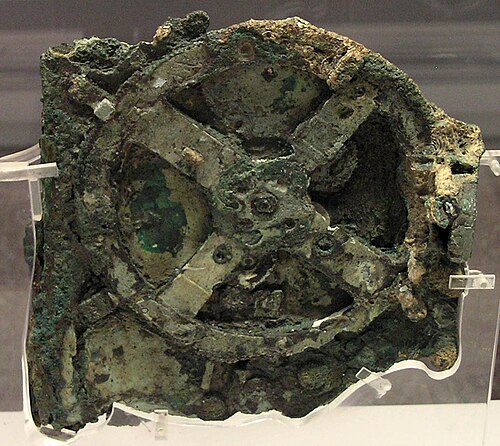
Among the finds was a lump of green, crumbly bronze and wood about the size of a shoebox. For a while nobody paid much attention to it. Then, in 1902, a museum director noticed a small gear wheel, with teeth like a bicycle gear, stuck inside the lump.
Scientists slowly worked out that it was a machine. When you turned a handle on its side, dozens of little bronze gears turned together. Pointers on the front moved around circles to show where the Sun and the Moon were among the stars, and a little ball showed whether the Moon was full, half or new.
Spiral dials on the back worked like a very clever calendar. One helped people match the months of the Moon with the years of the Sun. Another showed when eclipses might happen, when the Moon covers the Sun or the Earth’s shadow covers the Moon. A small dial even showed which big sports festival, like the Olympic Games, was coming up.
Nobody knows exactly who built it. It shows that Greek scientists and craftsmen of that time understood the sky very well and could make tiny, precise gears. Nothing else this complicated is known until about 1,400 years later, when people in Europe began building astronomical clocks.
Today the pieces, now broken into 82 fragments, are kept in the National Archaeological Museum in Athens, next to models that show how the machine may have looked when it was new.
At a glance
- What
- A geared astronomical calculator and display in a wooden case; the oldest known geared computing device
- Made
- Hellenistic Greek world, probably late 2nd or early 1st century BCE (proposals range from c. 205 to c. 87 BCE)
- Found
- In the Antikythera shipwreck (sank c. 70–60 BCE), off Point Glyphadia, Antikythera, Greece; recovered 1901
- Kept at
- National Archaeological Museum, Athens
- Surviving parts
- 82 fragments, about a third of the original, including 30 corroded bronze gears; largest gear about 13 cm across with 223 teeth
- Case size
- Roughly 34 × 18 × 9 cm (uncertain)
- Functions
- Positions of Sun and Moon in the zodiac, Moon phase and variable lunar speed, 19-year Metonic calendar, Saros eclipse prediction, cycle of Panhellenic games; probably planetary positions
- Language
- Greek inscriptions, including a “user manual” on the back cover
Easy
What is the Antikythera mechanism?
The Antikythera mechanism is the remains of an ancient Greek machine made of bronze gears inside a wooden case. By turning a small hand crank, the user could move a set of pointers forwards or backwards in time and read off astronomical information: where the Sun and Moon were in the zodiac, what the phase of the Moon was, which month it was in several calendars, and whether an eclipse was expected.
It is often called the oldest known analogue computer. That does not mean it worked like a modern electronic computer. It was “analogue” because it represented the cycles of the sky by the turning of wheels: the ratio between the numbers of teeth on its gears reproduced the ratios between astronomical periods. Once the gears were set, the calculation happened mechanically.
The object is named after the small Greek island of Antikythera, between Crete and the Peloponnese, off which it was found in a sunken ship. Only about a third of it survives, in 82 fragments, but modern imaging has allowed researchers to reconstruct much of how it worked.
Easy
A treasure ship at the bottom of the sea
Around Easter 1900, sponge divers from the island of Symi, led by Captain Dimitrios Kontos, stopped at Antikythera to wait for good winds. Diving to about 45 metres, one of them found a heap of bronze and marble statues on the seabed. With help from the Greek navy, divers recovered many objects between late 1900 and 1901: statues such as the bronze Youth of Antikythera, a bronze head known as “the Philosopher,” marble figures, pottery, glassware, jewellery and coins.
The mechanism came up in 1901 as a corroded lump of bronze and wood and was taken to the National Archaeological Museum in Athens with the other finds. Museum staff were busy reassembling the statues, and the lump was not treated; as it dried, the corroded bronze cracked and shrank. On 17 May 1902 the archaeologist Valerios Stais, with his cousin the politician Spyridon Stais, noticed a gear wheel embedded in one of the pieces.
The ship itself was a Roman-era cargo vessel that sank in the second quarter of the first century BCE. Coins found by Jacques Cousteau’s team in 1976 were minted between about 76 and 67 BCE, and the pottery points to the same period, so the wreck is usually dated to about 70–60 BCE. Where the ship came from and where it was going, perhaps towards Italy, remain uncertain.
Easy
The front: a window on the sky
The front of the mechanism had a large round dial with two rings. The inner ring was marked with the twelve signs of the zodiac, each taking up an equal 30-degree sector. The outer ring was a calendar with month names from the Egyptian calendar written in Greek letters; three of them, Pachon, Payni and Epiphi, survive.
Pointers moved around this dial to show the position of the Sun (which also marked the date) and of the Moon. The Moon pointer did not move at a steady speed: it sped up and slowed down, just as the real Moon does because of its elliptical orbit. A small ball, half light and half dark, turned to show the Moon’s phase.
Around the dials ran a parapegma, a star calendar listing the risings and settings of bright stars during the year, keyed to letters on the zodiac scale. Inscriptions on the front cover also describe the five planets known in antiquity, Mercury, Venus, Mars, Jupiter and Saturn, which strongly suggests that the front once showed their positions too, though the gears for them are lost.
Easy
The back: calendars, eclipses and games
The back of the mechanism had two large spiral dials and several smaller ones. The upper spiral, of five turns, showed the Metonic cycle: 235 lunar months that fit almost exactly into 19 solar years. This let people keep a calendar based on the Moon in step with the seasons. The month names on it turned out to belong to a Corinthian-type calendar.
The lower spiral, of four turns, showed the Saros cycle of 223 lunar months, about 18 years and 11 days, after which eclipses repeat in a similar pattern. Small symbols (glyphs) in the cells marked months when a solar or lunar eclipse could be expected, with the time of day. A small dial beside it, the exeligmos dial, showed how many hours to add, since each Saros is about eight hours longer than a whole number of days.
Another small dial followed a four-year cycle of Panhellenic athletic festivals: the Olympic, Pythian, Isthmian and Nemean games, as well as the lesser Naa games of Dodona and the Halieia of Rhodes. It is the only pointer that turned anticlockwise. Its presence shows that the mechanism was about human time, festivals and calendars, not only astronomy.
Intermediate
How the gears worked
The crank turned a large four-spoked gear (known to researchers as b1) once per year. From it, trains of smaller gears drove the other pointers at speeds set by the ratios of their teeth. For example, the gear train for the Metonic dial gives a period of about 6,939.5 days for the full spiral, very close to the modern value of 6,939.69 days; the Saros train gives about 1,646.3 days per turn of the pointer against a modern 1,646.33.
The most remarkable feature is the lunar gearing. Two gears are mounted one on top of the other on a turntable; one has a pin that engages a slot in the other. Because the two axes are slightly offset, the output speeds up and slows down once per lunar month. This pin-and-slot device mechanically reproduces the theory of lunar motion associated with the astronomer Hipparchus, and the turntable itself rotates slowly to model the gradual shift of the Moon’s orbit, a cycle of about 8.88 years. It is the earliest known use of epicyclic gearing.
The gear teeth are small equilateral triangles cut by hand, with an average spacing of about 1.6 millimetres, on wheels about 1.4 millimetres thick. Their irregularity shows they were made with hand tools. Such hand-made gearing would have introduced play and friction that limited the precision of the finest corrections, but the design itself is exceptionally sophisticated.
Intermediate
The science inside: Babylonian cycles and Greek geometry
The mechanism combines two astronomical traditions. From Babylonian astronomy came long period relations, whole-number cycles such as the Saros and the relations used for the planets, discovered over centuries of observation recorded on clay tablets. The 2006 study showed that the eclipse predictions were based on Babylonian arithmetic cycles.
From Greek astronomy came geometrical models that explained irregular motions with circles and epicycles, such as the lunar theory of Hipparchus. The mechanism turned these models into moving parts, making a physical model of a Greek cosmos with the Earth at the centre.
In 2016 researchers read numbers on the front cover inscription giving cycles for Venus (462 years) and Saturn (442 years). The 2021 reconstruction by Tony Freeth’s team at University College London argued that these periods could have been derived with a method of combining period relations, which they linked to mathematics associated with Plato’s Academy, and used them to design compact gear trains for all five planets.
Intermediate
Who made it, when and where?
No maker’s name survives. The inscriptions are in Greek, the astronomy is Hellenistic, and the workmanship suggests a practised tradition rather than a single lucky invention: the mechanism is too refined to be the first of its kind, so there must have been predecessors that are now lost.
Several places have been proposed. Rhodes was a centre of astronomy and engineering, home to Hipparchus and, later, to the Stoic philosopher Posidonius, whom Cicero credits with building a similar device; the Games dial includes the Rhodian Halieia, and the star calendar fits latitudes around Rhodes. The Corinthian-type calendar and the mention of the Naa games at Dodona point to a user in northwestern Greece, perhaps in a Corinthian colony in Epirus. The 2008 study also raised the possibility of Syracuse, Archimedes’ city, but later work showed the calendar cannot be Syracuse’s. A compromise view suggests a design tradition from Rhodes, with this particular example made for a client in Epirus.
Dates also vary. Derek de Solla Price proposed about 87 BCE; others argue for 150–100 BCE; a 2014 study placed the start date of the eclipse dial in 205 BCE, and a 2022 proposal put the initial calibration at 178 BCE. A calibration date is not necessarily a construction date. Everyone agrees only that it was made before the ship sank, about 70–60 BCE.
Intermediate
Echoes in ancient literature
Ancient writers mention devices that showed the motions of the heavens. In his dialogue On the Republic (54–51 BCE), Cicero describes two sphere-like models made by Archimedes that the Roman general Marcellus brought back after the siege of Syracuse in 212 BCE, one of which could show the Sun, Moon and planets. Cicero also says that his friend Posidonius had recently built a device whose revolutions reproduced the daily motions of the Sun, Moon and five planets.
Pappus of Alexandria, writing centuries later, says Archimedes wrote a lost book On Sphere-Making. Later Latin and Greek authors, from Lactantius to Proclus, continued to mention Archimedes’ sphere. These texts show that such instruments were known and admired, although the Antikythera mechanism itself cannot be identified with any of them.
Among surviving objects, machines of similar complexity appear again only about 1,500 years later, in the fourteenth-century European astronomical clocks of Richard of Wallingford and Giovanni de’ Dondi. Whether any continuous tradition of geared devices linked antiquity to these clocks is uncertain, since the intervening evidence is sparse.
Intermediate
More than a century of detective work
After Stais’s identification, many scholars doubted that the object could be ancient, because it seemed far too complex. The German philologist Albert Rehm was the first to argue clearly that it was an astronomical calculator. Serious study resumed when the historian of science Derek J. de Solla Price took up the problem in 1951; with the Greek physicist Charalampos Karakalos he made X-ray and gamma-ray images in 1971, and in 1974 he published Gears from the Greeks, proposing a first overall reconstruction.
In 2002 the mechanical engineer Michael Wright built the first working model incorporating the known gears and his own proposed planetary display; he also discovered the Moon-phase mechanism. From 2005 the Antikythera Mechanism Research Project, with a Cardiff University team led by Mike Edmunds working alongside Greek colleagues, used high-resolution surface imaging and microfocus X-ray computed tomography to see inside the fragments. Their results, published in Nature in 2006 and 2008, doubled the number of deciphered inscriptions and clarified the back dials.
Later work has focused on the lost front gearing. In 2021 the UCL Antikythera Research Team published a complete proposed model of the planetary display, arguing that earlier reconstructions did not fit all the evidence. Other researchers continue to test alternatives, for example about the number of divisions on the front calendar ring.
Intermediate
Why it matters, and what it is not
The mechanism changed our picture of ancient technology. Before its decoding, historians assumed that fine geared machinery began with medieval clockwork. It shows that Hellenistic craftsmen could miniaturise complex gear trains and that astronomers wanted to make their theories visible and usable.
It also shows how ancient science worked across cultures: Babylonian numerical astronomy, Greek geometrical models and Egyptian and Greek calendars were brought together in a single object. Its games dial and calendars remind us that astronomy served social life, from fixing festivals and religious dates to, possibly, astrology and teaching.
Popular culture sometimes treats the mechanism as a mystery that needs aliens, time travel or lost super-civilisations to explain it. Scholars see it instead as the product of a known intellectual world whose other examples happen not to have survived; bronze was usually melted down and reused, so a shipwreck preserved what ordinary history destroyed. It has been featured in documentaries and, in fictionalised form, in the film Indiana Jones and the Dial of Destiny (2023).
Advanced
Debates over the lost front: planets, Sun and calendar
The back dials are now well understood, but the front remains contested because most of its gearing is missing. The space between the main gear and the front plate, features on the four-spoked wheel and the inscriptions all imply further gears. Wright’s 2002 model added a “true Sun” pointer and pointers for all five planets. Evans, Carman and Thorndike (2010) instead interpreted irregular spacing of the zodiac scale as evidence for an eccentric solar display and suggested simpler dials for the planets. Freeth and Jones (2012) proposed compact planetary trains using pin-and-slot devices similar to the lunar mechanism; the 2021 UCL model, with a total of dozens of gears and eight coaxial outputs, derives the gear counts from period relations with small prime factors, sharing gears between planets.
Reconstructions must satisfy tight physical constraints: the thickness of the surviving plates, the positions of bearings and posts, and the texts of the back-cover “user manual,” which describes a display in rings with planets as “little spheres” and the Sun as a “little golden sphere.” Critics note that any full model involves assumptions about lost parts, so none can be proved; the models are best seen as hypotheses that fit the evidence more or less well.
The front calendar ring is another case. It was long assumed to have 365 divisions for the Egyptian solar year, but statistical analyses of the surviving holes beneath the ring (Budiselic and colleagues in 2020, followed by independent studies) suggest about 354 intervals, pointing to a lunar calendar. If correct, this changes how the front dial was used, although the Egyptian month names remain puzzling.
Advanced
Dating, provenance and method
Dating the mechanism combines several kinds of evidence. The wreck gives a terminus ante quem: its coins (minted about 76–67 BCE) and pottery place the sinking around 70–60 BCE, while a radiocarbon date from hull timber (220 BCE ± 43 years) is thought to reflect old wood. Astronomical dating tries to find the moment at which the dials were calibrated: Carman and Evans argued in 2014 that the Saros dial’s eclipse pattern best fits a start in 205 BCE; others prefer 204 or 178 BCE. Such dates identify an epoch built into the design, which could have been copied from an older model.
Provenance arguments depend on calendars and festivals. The 2008 Nature paper identified all twelve month names of the Metonic calendar as Corinthian, which pointed to Corinthian colonies in northwestern Greece or Syracuse. Paul Iversen’s 2017 study of the calendar and the games dial argued that the prototype came from Rhodes but that this example was adapted for a client in Epirus, using an Epirote calendar, and was made no earlier than a generation before the wreck, a view supported by Alexander Jones in the same year.
Methodologically, the mechanism is a showcase for collaboration between archaeology, epigraphy, history of astronomy, engineering and imaging science. Much of the text was invisible until X-ray CT allowed researchers to read letters millimetres high inside corroded layers. At the same time, the history of research is a caution: confident reconstructions have repeatedly been revised when new readings appeared, and some fragments may still await identification in museum storage, as Fragment F did until 2005.
Key ideas
- Analogue computation
- Representing numbers and cycles by physical quantities, here the rotation of gears whose tooth ratios encode astronomical periods.
- Period relations
- Whole-number cycles, often Babylonian, after which astronomical phenomena repeat, such as 235 months in 19 years or 223 months in a Saros.
- Epicyclic pin-and-slot gearing
- Two offset gears linked by a pin and slot that produce a varying speed, reproducing the Moon’s changing motion.
- Geocentric cosmos made visible
- The front display arranged the Sun, Moon and planets in rings around a central Earth, turning Greek cosmology into a working model.
- Calendar as social technology
- Lunar and solar calendars and the games cycle show that the device served civic and religious timekeeping.
- Lost tradition
- Its sophistication implies earlier and later devices that have not survived, because bronze was usually recycled.
- Reconstruction as hypothesis
- Models of the missing parts are tested against physical and inscriptional evidence but cannot be definitively proved.
Records
- c. 205 BCE — One proposed start date for the eclipse dial (205 BCE); alternative calibration proposals include 178 BCE.
- c. 150 BCE — Frequently proposed window for construction begins (c. 150–100 BCE); other estimates run as late as c. 87 BCE.
- c. 70 BCE — The cargo ship carrying the mechanism sinks off Antikythera (c. 70–60 BCE).
- 1900 — Sponge divers from Symi discover the Antikythera wreck; salvage with the Greek navy begins.
- 1901 — The mechanism is recovered from the wreck and taken to the National Archaeological Museum, Athens.
- 1902 — Valerios Stais notices a gear wheel in the corroded lump (17 May).
- 1951 — Derek J. de Solla Price begins his study of the mechanism.
- 1974 — Price publishes Gears from the Greeks after X-ray and gamma-ray imaging in 1971.
- 2002 — Michael Wright builds the first working model with a proposed planetary display.
- 2005 — The Antikythera Mechanism Research Project scans the fragments with X-ray CT and surface imaging.
- 2008 — Nature publishes the Corinthian month names and the Games dial.
- 2021 — The UCL team publishes a complete proposed model of the planetary Cosmos display.
Glossary
- Orrery
- A mechanical model showing the relative motions of the Sun, Moon and planets.
- Gear train
- A series of meshing gears that transmits motion and changes its speed according to the ratios of their teeth.
- Metonic cycle
- 235 lunar months ≈ 19 solar years; used to keep lunar calendars in step with the seasons.
- Saros cycle
- 223 lunar months (about 18 years 11 days) after which eclipses recur in a similar pattern.
- Exeligmos
- Three Saros cycles (about 54 years), after which eclipses recur at nearly the same time of day.
- Callippic cycle
- 76 years (four Metonic cycles minus one day), a refinement of the Metonic cycle mentioned in the inscriptions.
- Parapegma
- A Greek star calendar listing the risings and settings of stars and weather signs through the year.
- Zodiac
- The band of twelve constellations, divided here into equal 30-degree signs, along which the Sun, Moon and planets appear to move.
- X-ray computed tomography (CT)
- An imaging method that builds 3-D pictures from many X-ray images, used to see gears and inscriptions inside the fragments.
- Terminus ante quem
- Latin for “limit before which”: the latest possible date for an object, here the sinking of the ship.
Questions and answers
Is it really a computer?
Not like a laptop. It is an analogue calculator: you turn a handle and gears work out the positions and cycles of the Sun and Moon. Because it computes results mechanically, many people call it the oldest known analogue computer.
Did it have a battery or clockwork spring?
No. It was turned by hand with a crank. It did not keep time by itself; the user moved it to the date they wanted.
Who invented it?
We do not know. Hipparchus’s lunar theory is built into it, and ancient writers credit Archimedes and Posidonius with similar devices, but no source names the maker of this one.
How accurate was it?
Its gear ratios reproduce long cycles very closely, but its planetary positions could be off by many degrees because Greek planetary theory of the time was limited, and hand-cut teeth added looseness.
Why was nothing like it found for so long afterwards?
Similar devices probably existed but were made of bronze, which was usually melted down and reused. The shipwreck preserved one by accident. Comparable complexity reappears in surviving objects only in medieval astronomical clocks.
Why do experts disagree about its date?
Different methods give different answers: letter styles, the wreck’s coins and pottery, and astronomical calibration dates built into the dials. A calibration date may also be older than the actual construction.
Can I see it?
Yes. The fragments and several reconstructions are displayed at the National Archaeological Museum in Athens.
Sources and further reading
- Antikythera mechanism. Wikipedia
- Antikythera wreck. Wikipedia
- T. Freeth, Y. Bitsakis, X. Moussas, J. H. Seiradakis, A. Tselikas, H. Mangou, M. Zafeiropoulou, R. Hadland, D. Bate, A. Ramsey et al., Decoding the ancient Greek astronomical calculator known as the Antikythera Mechanism. Nature 444: 587–591, 2006
- Tony Freeth, Alexander Jones, John M. Steele, Yanis Bitsakis, Calendars with Olympiad display and eclipse prediction on the Antikythera Mechanism. Nature 454: 614–617, 2008
- Tony Freeth, David Higgon, Aris Dacanalis, Lindsay MacDonald, Myrto Georgakopoulou, Adam Wojcik, A Model of the Cosmos in the ancient Greek Antikythera Mechanism. Scientific Reports 11: 5821, 2021
- Derek de Solla Price, Gears from the Greeks: The Antikythera Mechanism, a Calendar Computer from ca. 80 B.C.. Transactions of the American Philosophical Society 64 (7), 1974
- Alexander Jones, A Portable Cosmos: Revealing the Antikythera Mechanism, Scientific Wonder of the Ancient World. Oxford University Press, 2017
Related
- Library of AlexandriaAn ancient center for collecting and studying texts in Ptolemaic Alexandria.
- EuclidGreek mathematician of Alexandria, active around 300 BCE, whose Elements built geometry and number theory from a few definitions and postulates and became the most influential mathematics textbook in history.
- AristotlePlato's student and Alexander's tutor. He founded the Lyceum and wrote on logic, ethics, politics and the natural world.
- Zhang HengEastern Han astronomer, inventor and poet who built the earliest recorded seismoscope and a water-powered armillary sphere.
- AryabhataAn Indian mathematician-astronomer whose Āryabhaṭīya gave π ≈ 3.1416, a sine table and the idea that the Earth rotates daily.
- Nicolaus CopernicusRenaissance astronomer and church canon who argued that the Earth spins daily and orbits the Sun, launching the Copernican Revolution.
Written with AI assistance from the published sources listed above, and revised as new research appears.