Start at the top for an easy introduction. Go further down for more detail and scholarship.
- Easy
- Intermediate
- Advanced
For young readers
Imagine a very powerful man who ruled a huge empire, from Britain to Egypt. In the middle of wars and busy days of government, he wrote short messages to himself in a notebook—reminders to be patient, to do his job well and not to get angry with people who annoyed him. That man was the Roman emperor Marcus Aurelius, and his notebook is the book we call the Meditations.
Marcus did not write it for us. He wrote it for himself, a bit like a secret diary of advice. He wrote in Greek, the main language of philosophy lessons for educated Romans. Today the notes are divided into twelve parts called “books,” but no one knows who made those divisions.
When he wrote, times were hard. Armies from beyond the river Danube were attacking the empire, and a terrible sickness was spreading through towns and army camps. Marcus spent years living in soldiers’ camps far from Rome. Some of his notes even say where he wrote them, such as “at Carnuntum,” a Roman fortress town on the Danube.
Marcus followed a way of thinking called Stoicism. Stoics said: some things are up to you, like your choices and how you treat people, and many things are not, like the weather or what others do. So don’t waste your energy being upset about what you cannot change. Put your energy into being honest, fair, brave and kind.
For hundreds of years after Marcus died, hardly any surviving writing mentions the notebook. Only a few handwritten copies are known, and one of the two most important is now lost. Today it is read all over the world: one publisher alone sold more than 100,000 copies of it in a single year.
At a glance
- What
- A private collection of philosophical notes and self-reminders, not written for publication
- Author
- Marcus Aurelius, Roman emperor 161–180 CE
- When
- During the 170s CE (exact dates debated; often placed c. 170–180, some scholars say c. 171–175)
- Where
- At least partly in army camps on the Danube frontier; notes in the text name “among the Quadi at the Granua” and “at Carnuntum”
- Language
- Greek (Koine), with many quotations from earlier Greek authors
- Form
- Twelve books of short entries, from one-line slogans to page-long reflections
- Philosophy
- Roman-era Stoicism, strongly shaped by Epictetus
- Survival
- Two main witnesses: Codex Vaticanus Graecus 1950 (14th century) and a lost Palatine manuscript used for the first printed edition (Zürich, 1558/59)
Easy
What is the Meditations?
The Meditations is a set of notes that Marcus Aurelius, emperor of Rome from 161 to 180 CE, wrote to himself. It is not a treatise with a planned argument, a speech, or a set of laws. It is closer to a working notebook: Marcus repeats the same ideas again and again in new words, argues with himself, and copies out lines from poets and philosophers that helped him. Almost every entry speaks to “you”—and the “you” is Marcus.
He wrote in Greek, not Latin. For an educated Roman of the second century this was natural: although Cicero and Seneca had written philosophy in Latin, Greek remained the main language of philosophical teaching, and Marcus had studied with Greek-speaking teachers since boyhood. The text survives in twelve “books,” though we do not know whether Marcus himself made those divisions; the first writer known to mention twelve books is the Byzantine lexicon called the Suda, in the late tenth century.
There is no evidence that Marcus meant anyone else to read these notes. Most scholars think he wrote them to train his own mind, which is why the book feels unusually personal. Even the name is uncertain. “Meditations” is a modern English title, and the Greek heading Ta eis heauton, “to himself” or “the things to himself,” is first recorded around 900 CE and may not go back to Marcus at all.
Easy
What is inside: twelve books of reminders
Book 1 is different from the rest. It is a list of thanks: Marcus goes through his family, teachers and friends and writes down the good quality he learned from each one—modesty from one, self-control from another. From his teacher Junius Rusticus, he says, he learned that his character needed correcting, and through him he came to read the discourses of the Stoic teacher Epictetus. The book ends with thanks to the gods.
Books 2 to 12 are made of hundreds of entries. Some are short commands (“Wipe out the impression!”), others are small essays. A famous one opens Book 2: at dawn, he tells himself, expect to meet meddling, ungrateful, arrogant and dishonest people today—and remember that they are your kin, and that we are made to work together like hands, feet and eyelids. Another, at the start of Book 5, begins: “At dawn, when you are reluctant to get up, keep this ready: I am rising to do the work of a human being.”
Readers often notice how much the same few thoughts return: death comes soon for everyone; fame is empty; other people’s faults cannot harm your character; do the task in front of you well. Scholars have argued about whether there is a hidden order in the books, but the repetition makes sense if the purpose was practice rather than presentation. Marcus writes in Book 4 that nowhere can a person retreat into greater quiet than into their own soul—and the notebook was one of the ways he made that retreat.
Intermediate
Written at war: the Danube frontier and the Antonine Plague
Marcus came to the throne in 161 jointly with his adoptive brother Lucius Verus. Almost at once Rome fought a war with Parthia in the east (161–166). Ancient writers say that soldiers returning from that campaign brought back an epidemic, now called the Antonine Plague, which spread across the empire from about 165. The physician Galen described fever, diarrhoea and a skin eruption; smallpox has long been the favourite diagnosis, but recent genetic work has made scholars more cautious, and measles is another candidate. Estimates of the dead vary greatly. Marcus himself died in 180, possibly of the same disease.
At the same time pressure built on the Danube frontier. In the wars historians call the Marcomannic Wars (166–180), Germanic peoples such as the Marcomanni and Quadi and the Sarmatian Iazyges crossed into Roman territory; around 170 raiders even besieged Aquileia in northern Italy. Marcus spent most of the 170s with the army. From the early 170s he made his headquarters at Carnuntum, a legionary fortress and town on the Danube east of present-day Vienna, and he later campaigned across the river against the Quadi.
Two short notes in the manuscripts tie the text to these campaigns. After Book 1 stands “Among the Quadi, at the Granua” (probably the river Hron, a tributary of the Danube), and after Book 2 “At Carnuntum.” Editors differ on whether each note closes the preceding book or heads the next one, but either way they show that at least part of the work was written in or near military camps. The notebook never describes battles, yet the shadow of war and sickness is everywhere in its insistence that life is short and that one’s post must be held to the end.
Intermediate
Stoic ideas in Marcus’ own voice
Logos and nature. Stoics held that the universe is ordered by a divine reason, the logos, which runs through everything, and that the goal of life is to live in agreement with nature. Marcus returns to this constantly, but often in a striking form: “either providence or atoms.” Either the world is governed by intelligence, or it is a random swirl of particles, as the Epicureans taught. He clearly prefers the first answer, but he argues that in both cases the right response is the same—act justly and do not complain.
What is up to us. From Epictetus, Marcus took the sharp line between what depends on us—our judgements, choices and actions—and what does not—body, property, reputation and events. Things do not disturb us, he says repeatedly, our opinions about them do; so change the opinion. Pierre Hadot organised Marcus’ thought around three practices that go back to Epictetus: discipline of judgement (assent), of desire (accepting what happens), and of action (acting justly for others).
Impermanence. Marcus trains himself to see everything from a great height and over long spans of time. “Asia and Europe are corners of the cosmos; every sea is a drop in the cosmos,” he writes in Book 6. Emperors and philosophers of the past are all dust now, and so the court flatterers and critics of today will be. This “view from above” is meant not to make life meaningless but to free attention for what matters: virtue, which the Stoics held to be the only true good.
Duty and the cosmic city. For Marcus every rational being is a fellow citizen of one world-city, the cosmopolis, and owes the others justice and help. He states his double identity plainly: “As Antoninus, my city and fatherland is Rome; as a human being, it is the cosmos.” He also warns himself, “Take care not to be turned into a Caesar, not to be dyed in purple”—a reminder that his imperial role was a duty to fulfil, not a self to become.
Intermediate
From a lost notebook to a printed book
How Marcus’ private notes survived his death is unknown. For centuries the record is almost silent. Herodian, in the third century, praised Marcus’ writings in general terms; the orator Themistius around 364 CE spoke of Marcus’ “precepts,” which may or may not mean this book; the Historia Augusta, a collection of imperial biographies probably written in the fourth century, says in its Life of Avidius Cassius that before leaving for the Marcomannic war Marcus spent three days discussing the books of his “Exhortations.” None of these clearly identifies the Meditations.
The first certain mention comes from Arethas, a Byzantine bishop of Caesarea and a great collector of manuscripts. Before 907 he wrote that he owned an old copy of the emperor’s “most profitable book,” so old that it was falling apart, and that he had it copied. In his marginal notes on other authors he refers to the work as ta eis heauton ēthika, “ethical writings to himself.” A little later the Suda quotes about thirty passages and calls the work a “guide of his own life” in twelve books. Arethas’ copy is lost, but it may be the ancestor of all surviving manuscripts.
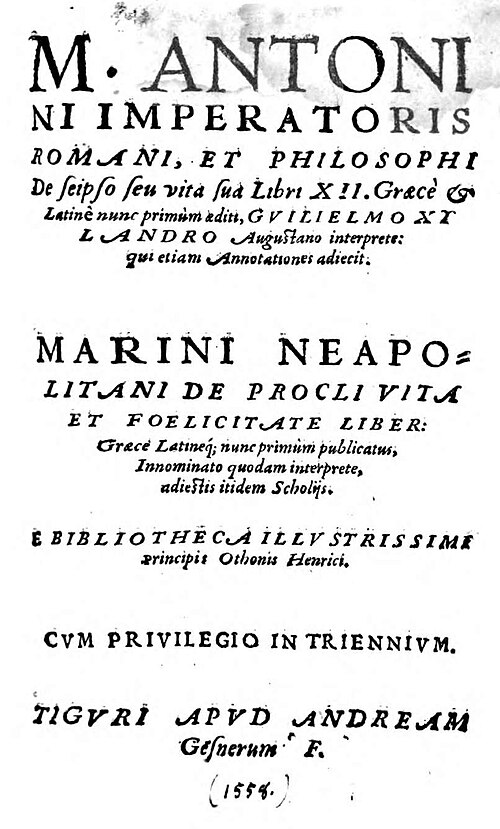
Modern texts depend above all on two witnesses. The first is a fourteenth-century codex in the Vatican Library, Vaticanus Graecus 1950, in which the Meditations sits beside works of Xenophon and Epictetus’ Handbook; its copyist made many errors and skipped some forty-odd lines. The second came from the Palatine library at Heidelberg: the poet Michael Toxites passed it to Conrad Gesner in Zürich, where Wilhelm Xylander edited it with a facing Latin version and Andreas Gesner printed it. The title page bears the date 1558, and the edition is commonly given as 1558 or 1559. When Xylander revised his work in 1568 he could no longer consult that manuscript, and nobody has seen it since.
The title is therefore a puzzle. The Greek Ta eis heauton comes from this manuscript tradition and from Arethas, not from any ancient source close to Marcus. Meric Casaubon’s English translation of 1634 helped fix “Meditations” in English; other versions have used “Thoughts,” “Communings with Himself” or simply “To Himself.”
Intermediate
Meanwhile in the world: Rome, the Indian Ocean and Han China
Marcus’ notebook urges him to think of himself as a citizen of the whole world, and in his time long-distance trade networks linked the Mediterranean, the Indian Ocean and Han China. The official history of the Eastern Han dynasty, the Hou Hanshu, records that in the ninth year of the Yanxi era of Emperor Huan—166 CE—envoys of “Andun, king of Da Qin” arrived from beyond the frontier of Rinan, a commandery on the central Vietnamese coast, bringing ivory, rhinoceros horn and tortoiseshell. Da Qin is the Chinese name for the Roman world, and Andun is generally taken to be “Antoninus,” a name borne by both Antoninus Pius (died 161) and Marcus Aurelius.
The Chinese historians themselves were suspicious: the gifts, they noted, were neither precious nor rare, and they wondered whether the reports had been exaggerated. Many modern historians think the visitors were merchants from the Roman east who presented themselves as envoys, not an embassy sent by Marcus. What the record does show is that news of “Roman” visitors reached the Han court through Rinan, from the maritime south. Trade on the Roman side of the ocean is documented separately. Merchants from Roman Egypt sailed to India on the monsoon winds, and a papyrus of the mid-second century now in Vienna, the “Muziris papyrus,” concerns a cargo shipped from the Indian port of Muziris on the ship Hermapollon: 167 elephant tusks, a huge quantity of a product usually read as pepper (about 139 tonnes), and other goods; the cargo account on the papyrus’s reverse (the front preserves a loan contract), probably a private record of customs calculations, values the goods remaining after the customs deduction at nearly seven million drachmas. Such goods travelled along chains of ports and intermediaries rather than in single journeys between Rome and China.
The year 166 was also a turning point inside China. At the Han court, eunuch factions persuaded Emperor Huan to expel a group of Confucian officials and students who had criticised them, beginning the “partisan prohibitions”; a harsher purge followed in 168–169. Chinese sources record repeated epidemics in the 160s–180s, and in 184 the faith-healer Zhang Jue led the Yellow Turban uprising across northern China. The rebellion was crushed within the year, but the armies raised against it, a renewed court crisis after Emperor Ling’s death in 189 and the warlord fighting that followed together broke the dynasty apart, leading to the Three Kingdoms period.
Did the same disease strike both empires? The historian William McNeill argued in 1976 that epidemics helped weaken both Han China and Rome, and some scholars point out that Chinese epidemics cluster in the same decades as the Antonine Plague. But we do not know what the Chinese disease was, and the link remains a hypothesis. What can safely be said is that two great empires at either end of Eurasia faced epidemic, frontier pressure and political strain at the same moment—while one of their rulers wrote in his notebook that Asia and Europe were mere corners of the cosmos.
Intermediate
Reception: from Renaissance scholars to modern self-help
In Byzantium the book was read and excerpted by scholars, and quotations appear in Greek anthologies of the fourteenth to sixteenth centuries. Its Western career began with Xylander’s Greek–Latin edition, which made it available to European humanists. Translations into the vernacular languages followed; in English, Meric Casaubon’s version of 1634 was followed by many others, including George Long’s influential translation of 1862.
For nineteenth-century Europeans Marcus became a test case for whether a non-Christian could be a moral model. In On Liberty (1859) John Stuart Mill described Marcus as perhaps the best and wisest ruler of his age, whose writings were close to Christian ethics—and who nevertheless, from a sense of duty, persecuted Christianity. Mill called this one of the most tragic facts in history and used it to argue that even the wisest authority should not suppress opinions. Matthew Arnold answered with his own essay on Marcus in 1863, and the debate shaped the Victorian image of the emperor-philosopher.
In the twentieth century the book reached psychology. The founders of cognitive therapy wrote in 1979 that their approach could be traced back to the Stoic philosophers, naming Marcus Aurelius among them, and the Stoic idea that our judgements shape our emotions became central to cognitive behavioural therapy.
In the twenty-first century the Meditations became a bestseller. Penguin reported that sales of its edition grew several times over in the 2010s, passing 100,000 copies in 2019. Writers such as Ryan Holiday built a large “modern Stoicism” audience online, and politicians from Bill Clinton to the former Chinese premier Wen Jiabao have praised the book. Critics—including philosophers who welcome the revival—warn that slogans cut from their context can turn Marcus into a guru of productivity or emotional suppression, which is far from a text that keeps asking its writer to serve others.
Advanced
Different perspectives
Philosophy or spiritual exercise? Readers have long treated the Meditations either as a summary of Stoic doctrine or as a window into Marcus’ personality and moods. Pierre Hadot, in La Citadelle intérieure (1992; English The Inner Citadel, 1998), argued instead that the text is a series of “spiritual exercises”: Marcus was following Epictetus’ advice to write down the core principles of Stoicism every day, so that he could make them vivid and live by them. On this view the repetition, the rhetorical force and the gloomy images are tools, not confessions, and Hadot warned against reading them as clues to the emperor’s psychology. Reviewers have praised Hadot’s reading while questioning parts of it: Rachana Kamtekar, for example, noted that the need for persuasive literary devices sits uneasily with orthodox Stoic psychology, and that his account of the Stoic doctrine of “indifferent” things makes the Stoics look more confused than they were.
Orthodox Stoic or eclectic? Marcus quotes Heraclitus, Plato and Democritus, and even approves of Epicurus on pain. Nine times he sets out the alternative “providence or atoms.” Some scholars, such as John Rist and Julia Annas, have taken this as a sign that his grip on Stoic physics was loose; others, including Hadot, read it as an argument that the Stoic way of life holds whichever physics is true. The Stanford Encyclopedia adds a methodological warning: because Marcus writes to produce attitudes in himself, statements that look contradictory may be deliberate exaggerations, and reading them as doctrine makes him look more eclectic and imprecise than he was.
The ideals and the reign. The book’s praise of justice and patience sits beside a harsh record. Under Marcus, Christians were executed: the apologist Justin was beheaded in Rome around 165 by order of the city prefect Junius Rusticus—the same Stoic teacher Marcus thanks in Book 1—and in 177 Christians of Lyon and Vienne were tortured and killed at Lyon after the governor consulted the emperor, who, according to the survivors’ letter preserved by Eusebius, ordered that those who confessed be executed and those who denied be released. Historians disagree about Marcus’ personal role: persecutions were local and driven by crowds and governors, Christian writers of the time did not blame him directly, and Tertullian even presented him as a protector on the basis of a letter now regarded as a forgery. The Meditations itself mentions Christians only once (11.3), in a disparaging aside about dying “from mere obstinacy”; many editors think the words are a later reader’s marginal note that slipped into the text.
The choice of Commodus. The “good emperors” before Marcus had mostly adopted their heirs; Marcus made his biological son Commodus co-emperor in 177, and Commodus ruled alone from 180 until he was murdered in 192. The senator Cassius Dio, who lived through it, wrote that with Marcus’ death history fell “from a kingdom of gold to one of iron and rust.” Defenders of Marcus, such as the historian Michael Grant, argue that passing over a grown son in favour of someone else would almost certainly have led to civil war; ancient writers already treated the choice as the great misfortune of his life—the Historia Augusta remarks that had Marcus been truly fortunate he would not have left a son. Even the idea of Marcus as Plato’s “philosopher-king” is partly a construction: the Historia Augusta says he often quoted Plato’s saying that states flourish when philosophers rule, and Christian apologists flattered him as a philosopher, yet in his own notebook he tells himself not to hope for Plato’s ideal Republic and to be content if even the smallest thing goes forward.
Advanced
Evidence and method: reading a damaged private text
Every modern edition is a reconstruction. With the Palatine manuscript gone, its readings survive only through Xylander’s print, which editors set against the Vatican codex. Anthologies made by Byzantine readers add a little more: a Darmstadt manuscript (no. 2773) preserves over a hundred extracts from the first nine books, and a Paris manuscript (gr. 319) a few dozen from the first four. Many passages remain corrupt, and editions sometimes divide and number entries differently, so the same sentence can carry slightly different references.
Dating rests on thin evidence. The two place-notes, the internal references to old age and death, and what we know of Marcus’ movements suggest the 170s, but scholars give different ranges—from roughly 170–180 to more narrowly c. 171–175—and it is debated whether the entries were written in the order in which they now stand.
The biggest methodological problem is genre. If the Meditations is a private exercise, then its statements cannot be read straightforwardly as Marcus’ autobiography or as a record of his policies; the gap between the notebook and the reign may be exactly what the notebook was trying to close. Historians therefore combine it with other sources—Cassius Dio’s history (preserved in Byzantine excerpts), the unreliable Historia Augusta, inscriptions, coins, the Column of Marcus Aurelius in Rome, Galen’s medical writings and the letters of his teacher Fronto—while philosophers read it alongside Epictetus. Each discipline sees a different Marcus, and the notebook rarely settles their disagreements.
Key ideas
- Logos
- The divine reason that, for the Stoics, orders the whole cosmos. Human reason is a share of it, so living rationally means living in agreement with nature.
- What is up to us
- The distinction, inherited from Epictetus, between our own judgements and choices, which are in our power, and external things like health, wealth and reputation, which are not.
- Providence or atoms
- Marcus’ recurring either–or: the world is ruled by intelligence, or it is a random collision of atoms. He argues that in either case one should act justly and calmly.
- Impermanence and the view from above
- Imagining all of history and the whole earth at once, to see how brief fame, pain and quarrels are, and to free attention for virtue.
- Cosmopolis
- The Stoic idea that all rational beings are citizens of one world-city with duties of justice toward one another.
- Duty and one’s post
- Marcus treats his role as emperor as a post assigned by nature that must be filled well, without vanity—“not dyed in purple.”
- Writing as exercise
- Pierre Hadot’s view that the notebook was a tool for training the mind by rewriting core principles, rather than a book for readers.
Records
- 121 CE — Marcus Aurelius is born in Rome (26 April).
- 161 CE — Marcus becomes emperor jointly with Lucius Verus; war with Parthia begins.
- c. 165 CE — The Antonine Plague begins to spread in the Roman Empire.
- c. 165 CE — The Christian teacher Justin is executed in Rome under the city prefect Junius Rusticus, Marcus’ Stoic teacher.
- 166 CE — The Hou Hanshu records envoys from “Andun, king of Da Qin” arriving in Han China by sea; the first partisan prohibition begins at the Han court.
- c. 170 CE — Northern peoples invade Italy and besiege Aquileia; Marcus directs the war from Carnuntum in the early 170s. At least part of the Meditations is written during these campaigns, though when he began is unknown.
- 177 CE — Commodus becomes co-emperor; Christians from Lyon and Vienne are martyred at Lyon.
- 180 CE — Marcus dies on campaign (17 March); Commodus rules alone and makes peace on the Danube.
- 184 CE — The Yellow Turban uprising breaks out in Han China.
- c. 907 CE — Before this date Arethas of Caesarea has an old copy of the book recopied—the first certain mention of the work.
- 1558 — Wilhelm Xylander’s first printed edition, with Latin translation, appears in Zürich (dated 1558; often given as 1558/59).
- 1634 — Meric Casaubon publishes the first English translation.
- 1859 — John Stuart Mill’s On Liberty uses Marcus’ persecution of Christians as a warning about authority.
- 1992 — Pierre Hadot’s La Citadelle intérieure reads the Meditations as spiritual exercises.
Glossary
- Stoicism
- A Greek school of philosophy founded by Zeno of Citium around 300 BCE, teaching that virtue is the only good and that one should live in agreement with nature.
- Epictetus
- A Stoic teacher (c. 50–c. 135 CE), born a slave, whose lectures, recorded by his student Arrian, were Marcus’ main philosophical model.
- Koine Greek
- The common Greek used across the eastern Mediterranean in Roman times, including by educated Romans for philosophy.
- Marcomannic Wars
- Wars of 166–180 CE between Rome and peoples north of the Danube, including the Marcomanni, Quadi and Iazyges.
- Antonine Plague
- An epidemic that spread through the Roman Empire from about 165 CE; its exact disease is uncertain.
- Carnuntum
- A Roman legionary fortress and city on the Danube in the province of Pannonia, east of modern Vienna, used by Marcus as a headquarters.
- Codex
- A handwritten book with pages, the usual form of medieval manuscripts.
- Editio princeps
- The first printed edition of an ancient text; for the Meditations, Xylander’s Zürich edition of 1558/59.
- Da Qin
- The name used in Han Chinese sources for the Roman world, known to them mostly through hearsay.
- Spiritual exercises
- Pierre Hadot’s term for ancient practices of thought, writing and imagination meant to transform how a person lives.
Questions and answers
Did Marcus Aurelius want people to read his notebook?
Probably not. Nothing in the text addresses a reader other than himself, and most scholars see it as private self-training. How it survived and became public is unknown.
Why did a Roman emperor write in Greek?
Greek was the main language of philosophical education in the Roman world, although Romans such as Cicero and Seneca also wrote philosophy in Latin. Marcus learned Greek from childhood and studied with Greek-speaking teachers, so it was natural for him to think about philosophy in Greek.
Is “Meditations” the real title?
No title from Marcus survives. The Greek heading Ta eis heauton (“To himself”) is first attested around 900 CE, and “Meditations” is a modern English title.
Where was it written?
At least part of it was written during campaigns on the Danube frontier. Notes in the text say “among the Quadi, at the Granua” and “at Carnuntum,” a Roman fortress town east of present-day Vienna.
Did Marcus Aurelius persecute Christians?
Christians were executed during his reign, notably Justin in Rome (c. 165) and the martyrs of Lyon (177), where the emperor’s ruling is reported to have ordered death for those who confessed. How far he personally directed persecution is debated.
Did Rome send an embassy to China in his reign?
Chinese records describe envoys from “Andun, king of Da Qin” in 166. Many historians think they were merchants claiming to represent Rome, rather than official ambassadors of Marcus.
How reliable is the text we read today?
Fairly reliable overall, but it depends on very few manuscripts, one of which is lost, so many individual passages are uncertain and editors still disagree on readings.
Is the Meditations good philosophy or just self-help?
Both readings exist. Some value it as a record of Stoic ethics, others, following Hadot, as a practical exercise; critics warn that modern self-help often strips away its demand to serve others.
Sources and further reading
- Rachana Kamtekar, Marcus Aurelius. Stanford Encyclopedia of Philosophy
- John Sellars, Marcus Aurelius. Internet Encyclopedia of Philosophy
- Stoicism. Stanford Encyclopedia of Philosophy
- Epictetus. Stanford Encyclopedia of Philosophy
- Meditations. Wikipedia
- C. R. Haines, Introduction, in The Communings with Himself of Marcus Aurelius Antoninus (Loeb Classical Library). William Heinemann / Wikisource, 1916
- George Long (trans.), The Thoughts of the Emperor Marcus Aurelius Antoninus (trans. George Long). Project Gutenberg, 1862
- Vat.gr.1950, pt. 2 (Xenophon, Marcus Aurelius, Epictetus and others). Biblioteca Apostolica Vaticana, DigiVatLib
- Jona Lendering, Marcus Aurelius. Livius.org
- Commodus. Livius.org
- Marcus Aurelius in Carnuntum: an Emperor between War and Philosophy. Römerstadt Carnuntum
- Marcomannic Wars. Wikipedia
- Antonine Plague. Wikipedia
- Marcus Aurelius. Wikipedia
- Quintus Junius Rusticus. Wikipedia
- Eusebius of Caesarea, Church History, Book V, ch. 1 (letter of the churches of Vienne and Lyon). New Advent (Nicene and Post-Nicene Fathers)
- The Martyrdom of the Holy Martyrs Justin, Chariton, Charites, Paeon and Liberianus. New Advent (Ante-Nicene Fathers)
- Athenagoras of Athens, A Plea for the Christians. New Advent (Ante-Nicene Fathers)
- Cassius Dio, Roman History, Book 72 (epitome). LacusCurtius (Loeb translation)
- Historia Augusta: The Life of Marcus Aurelius. LacusCurtius (Loeb translation)
- John Stuart Mill, On Liberty. Project Gutenberg, 1859
- Lee Behlman, The Victorian Marcus Aurelius: Mill, Arnold, and the Appeal of the Quasi-Christian. Journal of Victorian Culture (Montclair State University Digital Commons), 2011
- Rachana Kamtekar, Review of Pierre Hadot, The Inner Citadel. Bryn Mawr Classical Review 1998.11.35, 1998
- Pierre Hadot (trans. Michael Chase), The Inner Citadel: The Meditations of Marcus Aurelius. Harvard University Press, 1998
- John E. Hill (trans.), The Western Regions according to the Hou Hanshu (sections 11–12 on Da Qin). Silk Road Seattle, University of Washington
- Friedrich Hirth (trans.), Chinese Accounts of Rome, Byzantium and the Middle East. Internet History Sourcebooks, Fordham University
- Fan Ye, 後漢書 卷八十八 西域傳 (Hou Hanshu, ch. 88, Chinese text). Wikisource (Chinese)
- Sino-Roman relations. Wikipedia
- Der Muziris-Papyrus. Österreichische Nationalbibliothek (Austrian National Library)
- Rafe de Crespigny, Man from the Margin: Cao Cao and the Three Kingdoms (51st George Ernest Morrison Lecture). Australian National University, 1990
- Miko Flohr, The Pandemic of the Second Century CE. NIAS (Netherlands Institute for Advanced Study)
- A germ of an idea (on William H. McNeill’s Plagues and Peoples). The University of Chicago Magazine
- Andrea E. Cavanna et al., The Western origins of mindfulness therapy in ancient Rome. Neurological Sciences (PubMed Central), 2023
- The 2,300-year-old philosophy of Stoicism finds a foothold in modern times. USC Dornsife College of Letters, Arts and Sciences
- Shayla Love, The Revival of Stoicism. VICE, 2021
Related
- Marcus AureliusRoman emperor and Stoic writer whose Meditations records private reflections on conduct and duty.
- SocratesAthenian philosopher who wrote nothing himself. Known through Plato and Xenophon, he was tried and executed in 399 BCE.
- PlatoStudent of Socrates and founder of the Academy. His dialogues remain a cornerstone of Western philosophy.
- Augustine of HippoA Christian bishop and thinker whose writings shaped Western theology and philosophy.
- Wars of the Three KingdomsA century of rebellion and civil war (184–280) in which the Han empire broke up into the rival states of Wei, Shu and Wu before the Jin dynasty reunited China.
Written with AI assistance from the published sources listed above, and revised as new research appears.