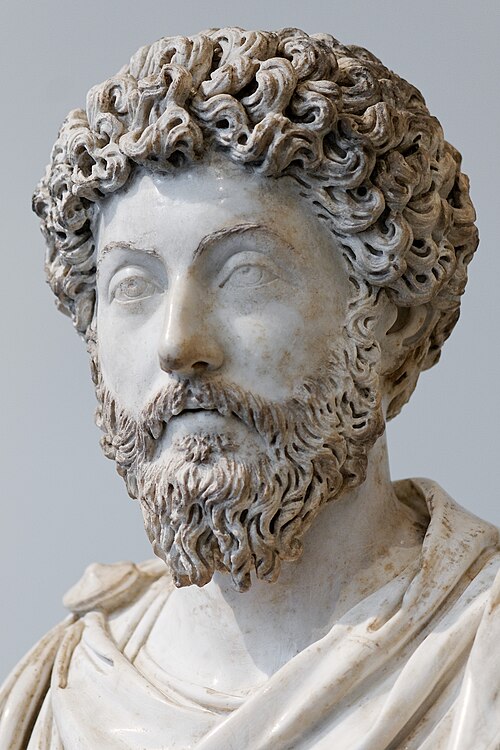
Start at the top for an easy introduction. Go further down for more detail and scholarship.
- Easy
- Intermediate
- Advanced
For young readers
Marcus Aurelius was the ruler of the Roman Empire, one of the biggest countries in the ancient world, about 1,850 years ago. He was the most powerful person in his world. But what made him famous for ever was not a battle or a palace. It was a little notebook he wrote only for himself.
In that notebook, Marcus gave himself advice, the way you might talk to yourself before a hard test. He wrote things like: when people are rude to you, remember that they do not know better; you cannot control what others do, but you can control how you respond; and do each job as if it were the last thing you will ever do, carefully and without complaining.
Marcus followed a way of thinking called Stoicism. Stoics believed that the most important thing in life is to be a good person: to be brave, fair, honest and self-controlled. Money, fame and even health can be taken away, they said, but no one can take away your goodness unless you give it up yourself.
Being emperor was hard. For many years Marcus lived in army camps near the river Danube, far from Rome, because tribes were attacking the empire’s borders. At the same time a terrible disease spread through the empire and killed many people. Marcus wrote his notebook in Greek, often at night, to keep himself steady.
He never meant anyone else to read it. But someone kept it after he died, and today people all over the world read it to learn how to stay calm and kind when life is difficult.
At a glance
- Lived
- 26 April 121 – 17 March 180 CE
- Reign
- 161–180 CE (jointly with Lucius Verus 161–169, and with his son Commodus from 177)
- Born / died
- Born in Rome; died on campaign on the Danube frontier, at Vindobona (Vienna) or Sirmium (Sremska Mitrovica) according to different sources
- Role
- Roman emperor; Stoic philosopher-writer
- Main work
- Meditations (Greek ta eis heauton, “to himself”), 12 books of private notes in Greek, written c. 170–180
- Philosophy
- Roman Stoicism, strongly influenced by Epictetus
- Key events of reign
- Parthian War (161–166), Antonine Plague (from 165), Marcomannic Wars (c. 166–180), revolt of Avidius Cassius (175)
- Legacy
- Last of the “Five Good Emperors”; the Meditations is among the most widely read works of ancient philosophy
Easy
Who was Marcus Aurelius?
Marcus Aurelius was emperor of Rome from 161 to 180 CE, at a time when the Roman Empire stretched from Britain to Egypt and from Spain to Syria. He is remembered in two ways: as a conscientious ruler who spent most of his reign defending the empire’s frontiers, and as the author of the Meditations, a private notebook of philosophical reflections that has become one of the most widely read books from the ancient world.
He was born in Rome on 26 April 121 into a wealthy and well-connected family originally from Spain. His father died when he was about three, and he was brought up by his mother, Domitia Lucilla, and his grandfather. The emperor Hadrian noticed the serious, truthful boy and is said to have nicknamed him “Verissimus”, “most truthful”, a play on his family name Verus.
In 138 Hadrian, who had no son, chose Antoninus Pius as his successor on condition that Antoninus adopt two boys: the 16-year-old Marcus and the younger Lucius, later known as Lucius Verus. From then on Marcus was trained for power. He married Antoninus’ daughter, Faustina the Younger, in 145; they had at least thirteen children, many of whom died young.
When Antoninus died in 161, Marcus became emperor and immediately made Lucius his co-emperor, the first time Rome was ruled by two emperors with equal title. Lucius died in 169, and Marcus ruled alone until he made his son Commodus co-emperor in 177. Marcus died in 180 while on campaign on the Danube.
Easy
A student who fell in love with philosophy
As a future emperor, Marcus received the best education available. His most famous teacher was Marcus Cornelius Fronto, the leading Latin orator of the day, who taught him the art of public speaking. Marcus and Fronto exchanged affectionate letters for decades; many of them survive, giving a rare glimpse of the young prince’s daily life, his studies, his colds and his grape harvests. He also studied Greek rhetoric with the wealthy Athenian Herodes Atticus.
Marcus, however, was drawn more to philosophy than to rhetoric. According to the Historia Augusta, as a boy of about twelve he adopted the rough cloak of a Greek philosopher and slept on the ground until his mother persuaded him to use a bed. In his mid-twenties he turned more decisively to philosophy, to Fronto’s disappointment. His philosophy teachers included the Stoics Junius Rusticus, Apollonius of Chalcedon and Sextus of Chaeronea.
The first book of the Meditations is a thank-you list: Marcus names his relatives, teachers and friends and records what he learned from each. From his grandfather, good character and even temper; from his mother, generosity and simple living; from Rusticus, the realization that his character needed correction, and a copy of the notes of Epictetus’ lectures lent from Rusticus’ own library. Epictetus, a former slave who became one of the greatest Stoic teachers, was the thinker who shaped Marcus most.
This list tells us something important about Marcus: he believed that goodness is learned from other people, and that gratitude is a way of remembering the examples one wants to follow.
Easy
Stoicism in a nutshell
Stoicism was a school of philosophy founded in Athens around 300 BCE by Zeno of Citium. Its name comes from the Stoa Poikilē, the “Painted Porch” where Zeno taught. By Marcus’ time it was the most influential philosophy among educated Romans, taught by figures such as Seneca, Musonius Rufus and Epictetus.
Stoics taught that only virtue is truly good: wisdom, justice, courage and self-control. Things like wealth, health, reputation and even life itself are “indifferent”: some are naturally preferable, but none can make a person truly good or bad. What matters is how we use them.
Stoics also believed that the universe is a single living whole, ordered by a divine reason (logos) that runs through everything. Human beings share in this reason, which makes all people fellow citizens of one world-city. To live well is to live “in agreement with nature”: to understand one’s place in the whole and to act as a rational, social being.
Finally, Stoics taught that our distress comes not from events themselves but from our judgments about them. Epictetus put this in a famous formula: some things are up to us, our judgments, desires and actions, and some are not, our bodies, property and reputation. Marcus returns to this idea again and again.
Intermediate
Ruling an empire in crisis: war and plague
Marcus came to power at the end of a long period of relative peace, but his reign was dominated by crises. In 161 the Parthian Empire invaded Armenia and defeated Roman forces. Lucius Verus was sent east, and Roman generals, especially Avidius Cassius, won a series of victories that ended with the sack of the Parthian capital cities of Seleucia and Ctesiphon in 165–166.
Returning troops are thought to have brought a devastating epidemic, the Antonine Plague, which spread across the empire from about 165. The physician Galen, who served at Marcus’ court, described its symptoms, and many modern scholars think it was smallpox, though this is not certain. Estimates of the death toll vary enormously, from a few percent of the population to much higher figures; the disease returned in waves for years.
In the late 160s Germanic and Sarmatian peoples north of the Danube, including the Marcomanni, Quadi and Iazyges, crossed into Roman territory. Around 170 invaders even reached northern Italy and besieged Aquileia, the first hostile incursion into Italy for centuries. Marcus spent most of the 170s with the army on the Danube, based at places such as Carnuntum and Sirmium. The Historia Augusta says that to pay for the war without raising taxes, he auctioned imperial treasures in the Forum of Trajan.
In 175, after a false rumour of Marcus’ death, Avidius Cassius, now governor in the East, was proclaimed emperor. The revolt collapsed within about three months when Cassius was killed by his own officers. Marcus travelled east to restore order; on the way his wife Faustina died in Cappadocia. On his return journey he visited Athens, where he was initiated into the Eleusinian Mysteries and endowed chairs of philosophy for the four main schools: Platonist, Aristotelian, Stoic and Epicurean.
Intermediate
The Meditations: a notebook written to himself
The Meditations consists of twelve books of notes, written in Greek, the language of philosophy in the Roman world. Most scholars date it to the last decade of Marcus’ life, roughly 170–180. Two notes in the manuscripts place parts of the work “among the Quadi on the Granua” (a river in modern Slovakia) and “at Carnuntum”, showing that at least some of it was written on campaign.
The title under which it survives, ta eis heauton, means “to himself” or “the things to oneself”; it may not be Marcus’ own title. The English name Meditations became standard after Meric Casaubon’s translation of 1634. The text is not a treatise with a plan: it is a collection of short entries, some a single sentence, some a page long, in which Marcus reminds, scolds and encourages himself.
The notes are repetitive on purpose. Scholars such as Pierre Hadot have argued that Marcus was performing a spiritual exercise, rewriting the core principles of Stoicism in his own words so as to keep them vivid. Famous examples include the morning reminder at the start of Book 2, that today he will meet people who are meddling, ungrateful, arrogant and deceitful, but that they cannot harm him and that he was born to work with them, like the hands or the rows of teeth; and the warning to himself (6.30) not to be “turned into a Caesar”, not “dyed purple” by power.
Marcus never intended the work for publication. That is part of its appeal: readers overhear a powerful man struggling with anger, fatigue, grief and the fear of death, and trying, not always successfully, to live up to his principles.
Intermediate
Key ideas of the Meditations
Judgment and inner freedom. “The universe is change; life is opinion” (4.3). Marcus repeatedly tells himself that things do not touch the soul; disturbance comes from our judgments about them, and we can withdraw into ourselves, into what Hadot called the “inner citadel”, and correct those judgments.
Impermanence and the view from above. Marcus often imagines looking down on human life from a great height, or recalls the vanished court of Augustus and the forgotten names of past emperors. “Soon you will have forgotten everything, and soon everything will have forgotten you” (7.21). The purpose is not despair but perspective: fame and possessions are fleeting, so one should concentrate on acting well now.
Duty and social nature. Human beings are made for one another. Marcus urges himself to get up in the morning to do “the work of a human being”, to treat wrongdoers as people who act from ignorance, and to see himself as a citizen of the cosmos as well as of Rome. “What is not good for the swarm is not good for the bee” (6.54).
Providence or atoms. Marcus frequently considers two possibilities: either the world is ordered by providence, as the Stoics taught, or it is a chaotic mixture of atoms, as the Epicureans held. In either case, he argues, the right response is the same: to act justly and accept what happens. Scholars debate whether this reflects genuine doubt or a teaching technique showing that Stoic ethics holds even under the worst assumption.
Death as natural. Death, for Marcus, is a natural process of change like birth or growing old, and nothing to fear. The last entry of the work compares leaving life to an actor leaving the stage when the director dismisses him, “and go graciously, for the one who releases you is gracious”.
Intermediate
The ruler behind the philosopher: Christians, Commodus and judgment
Ancient and modern writers have generally praised Marcus as a just, hardworking emperor who respected the Senate and took his legal duties seriously. He spent long hours hearing cases, and many of his legal rulings, recorded in later Roman law, show concern for slaves, minors and other vulnerable people within the framework of Roman law.
His reign was nevertheless not gentle for everyone. Christians were persecuted in several places, notably the martyrdom of Christians at Lyon in 177, described by the church historian Eusebius. In Rome the philosopher Justin Martyr was condemned around 165 by the city prefect Junius Rusticus, Marcus’ own Stoic teacher. Persecution was mostly local and depended on governors and crowds, and historians debate how far Marcus himself was responsible. The single mention of Christians in the Meditations (11.3) is thought by many scholars to be a later addition.
The wars on the Danube were brutal, as the reliefs on the Column of Marcus Aurelius in Rome show: villages burned, prisoners executed, women and children led away. The column also shows the famous “Rain Miracle”, when a Roman army surrounded and dying of thirst was saved by a sudden storm; pagan writers credited Egyptian magic or the gods, while Christian writers credited the prayers of Christian soldiers.
Marcus’ choice of his son Commodus as successor has been criticized since antiquity. For almost a century emperors had adopted capable adults, whereas Commodus, emperor from 180 to 192, became known for erratic and cruel rule. Defenders of Marcus point out that passing over a living son would have risked civil war. Cassius Dio, a senator who lived through Commodus’ reign, wrote that with Marcus’ death history descended “from a kingdom of gold to one of iron and rust”.
Intermediate
Survival of the text and later influence
How the Meditations survived is something of a puzzle. A possible allusion by the fourth-century orator Themistius is uncertain; the first clear reference comes from Arethas, a Byzantine scholar and later bishop of Caesarea, who around 900 wrote that he owned an old, worn copy and had it recopied. The work is quoted in the tenth-century Byzantine encyclopedia known as the Suda.
In the West it was unknown until the Renaissance. The first printed edition was published in Zürich in 1558–1559 by Wilhelm Xylander, based on a manuscript from Heidelberg that has since been lost. Apart from that lost manuscript, the only complete manuscript is Vaticanus Graecus 1950 in the Vatican Library; other manuscripts contain excerpts.
Once printed, the work found admirers across Europe, from Renaissance humanists to Enlightenment thinkers. The English translation by Meric Casaubon (1634) was followed by many others. Frederick the Great of Prussia admired Marcus, and Edward Gibbon famously described the age from Nerva to Marcus as the period when the human race was “most happy and prosperous”. Marcus became the model “philosopher-king”, the rare ruler who seemed to fulfil Plato’s ideal.
Marcus’ image also survives in art. The gilded bronze equestrian statue of him, which escaped being melted down in the Middle Ages because it was believed to show the Christian emperor Constantine, became the centrepiece of Michelangelo’s Capitoline square in Rome; the original is now indoors in the Capitoline Museums, with a copy outside. In recent decades the Meditations has become a bestseller again, read by political leaders, soldiers, athletes, psychologists and anyone seeking practical guidance, part of a broader modern revival of Stoic ideas.
Advanced
Scholarly debates: what kind of text, what kind of Stoic?
Genre and purpose. Is the Meditations a diary, a philosophical notebook, a set of spiritual exercises or an unfinished draft for publication? Pierre Hadot’s The Inner Citadel (French 1992, English 1998) argued that the notes are exercises in which Marcus rewrote Epictetus’ teachings, organized around three disciplines: of assent (judgment), of desire and of action, corresponding to the Stoic divisions of logic, physics and ethics. Hadot’s reading has been hugely influential, though some scholars think it imposes more system on the text than it contains.
The man behind the text. Older scholarship often read the Meditations as the confession of a lonely, melancholy man, even a depressed one. R. B. Rutherford’s study (1989) and later work emphasized that its gloomy passages follow literary and philosophical conventions, such as reflections on death and the brevity of fame, and should not be read directly as biography. Claims made in the twentieth century that Marcus’ outlook was shaped by opium prescribed by Galen are generally regarded as unsupported speculation.
Orthodoxy. How orthodox was Marcus’ Stoicism? His recurrent “providence or atoms” dilemma, his emphasis on the soul’s withdrawal into itself and his interest in the ruling part of the soul (hēgemonikon) have been read as signs of eclecticism or of Platonic influence. Others, including recent Stanford Encyclopedia discussions, argue that these passages fit within the Stoic tradition, especially as mediated by Epictetus, and that the atoms alternative is a rhetorical device rather than a real doubt.
Philosophy and policy. Did Marcus’ Stoicism make any difference to how he governed? Some historians see little distinctive in his policies compared with other conscientious emperors; others point to his legal decisions, his endowment of philosophy chairs and his restraint toward rebels. The question is part of a wider debate about whether ancient philosophy shaped public life or remained largely a private discipline.
Advanced
Sources for Marcus’ life and how reliable they are
Cassius Dio. The Roman History of the senator Cassius Dio (early third century) is the most important narrative source. Dio knew people who had known Marcus, but his books on this period survive only in a Byzantine abridgement made by the monk Xiphilinus in the eleventh century and in excerpts, so much detail is lost.
The Historia Augusta. This collection of imperial biographies claims to be written by six authors in the time of Diocletian and Constantine, but most scholars since Hermann Dessau in 1889 believe it was the work of a single author writing in the late fourth century. It contains fabrications, especially in the lives of minor figures; the life of Marcus is considered one of the more reliable, drawing on a good earlier source, but its anecdotes must be checked against other evidence.
Letters, inscriptions and monuments. The correspondence between Marcus and Fronto was rediscovered in 1815 by Angelo Mai in palimpsests, manuscripts whose original text had been scraped off and written over, and gives an intimate, if fragmentary, picture of his youth. Coins, inscriptions, legal texts and the reliefs of the Column of Marcus Aurelius provide evidence for his policies, titles and wars. Galen’s medical writings offer glimpses of the court and of the plague.
The Meditations itself. It is a precious personal source but a tricky one: it tells us what Marcus wanted to become, not necessarily what he was. Historians must balance its inner world against the external record of a ruler who waged long wars, presided over persecutions and chose his son as heir.
Key ideas
- Virtue as the only good
- Wisdom, justice, courage and self-control are the only true goods; wealth, fame and health are “indifferent”.
- Up to us / not up to us
- Taken from Epictetus: our judgments, desires and actions are in our power; external events are not.
- The inner citadel
- Hadot’s phrase for the mind’s ability to withdraw into itself and correct its judgments, whatever happens outside.
- View from above
- Imagining human affairs from a cosmic height to see their smallness and brevity.
- Cosmopolitanism
- All rational beings are fellow citizens of one world; one’s duty extends beyond one’s city or empire.
- Providence or atoms
- Whether the world is ordered by reason or by chance, the right response is to act justly and accept what happens.
- Philosophy as practice
- Writing and rereading principles as daily spiritual exercises, not only as theory.
Records
- 121 CE — Marcus is born in Rome on 26 April.
- 138 CE — Hadrian adopts Antoninus Pius, who adopts Marcus and Lucius Verus; Hadrian dies that summer.
- 145 CE — Marcus marries Faustina the Younger.
- 161 CE — Antoninus Pius dies; Marcus becomes emperor with Lucius Verus as co-emperor. War with Parthia begins.
- c. 165 CE — The Antonine Plague begins to spread through the empire.
- 169 CE — Lucius Verus dies; Marcus rules alone.
- c. 170 CE — Northern peoples invade Italy and besiege Aquileia; Marcus campaigns on the Danube. Work on the Meditations probably begins in these years.
- 175 CE — Revolt of Avidius Cassius in the East; Faustina dies.
- 176 CE — Marcus visits Athens and endows chairs of philosophy.
- 177 CE — Commodus becomes co-emperor; persecution of Christians at Lyon.
- 180 CE — Marcus dies on campaign on 17 March; Commodus succeeds and makes peace.
- 1558 — Wilhelm Xylander publishes the first printed edition of the Meditations (dated 1558–1559).
Glossary
- Stoicism
- A Greek school of philosophy founded by Zeno of Citium around 300 BCE, teaching that virtue is the only good.
- Logos
- In Stoicism, the divine reason that orders the universe and in which human minds share.
- Indifferents
- Things such as health and wealth that are neither good nor bad in themselves, though some are naturally preferable.
- Hēgemonikon
- The “ruling part” of the soul, the centre of judgment and choice.
- Co-emperor
- One of two or more rulers sharing the imperial title and power.
- Adoption
- The Roman practice of legally making someone one’s son, used by emperors to choose successors.
- Antonine Plague
- An epidemic, possibly smallpox, that spread through the Roman Empire from about 165 CE.
- Marcomannic Wars
- Wars on the Danube frontier against the Marcomanni, Quadi, Iazyges and others, c. 166–180 CE.
- Editio princeps
- The first printed edition of an ancient text.
- Palimpsest
- A manuscript whose original writing was scraped off and written over; the older text can sometimes be recovered.
Questions and answers
Was Marcus Aurelius a good emperor?
Most ancient and modern writers think so: he was hardworking, fair and respectful of the law. But his reign also saw brutal wars, persecution of Christians in some places, and the choice of his son Commodus, who ruled badly.
Why did a Roman emperor write in Greek?
Greek was the language of philosophy in the Roman world, and educated Romans learned it from childhood. The Stoic writers Marcus read, such as Epictetus, wrote or taught in Greek.
Did Marcus want people to read the Meditations?
Almost certainly not. The notes were written to himself as reminders and exercises. That is why they are repetitive and sometimes obscure.
Is the Gladiator movie accurate?
Not really. Marcus did die on campaign and Commodus did succeed him, but there is no evidence that Commodus murdered him or that Marcus planned to restore the Republic.
Where exactly did Marcus die?
Ancient sources disagree. Some place his death at Vindobona (modern Vienna), others at Sirmium (in modern Serbia). Both were bases of his Danube campaigns.
How original was Marcus as a philosopher?
He did not invent new doctrines, and he drew heavily on Epictetus. His originality lies in the personal, vivid way he applied Stoic ideas to his own life, which is why scholars value him as a witness to philosophy as a way of life.
How did the Meditations survive?
Probably through a few Byzantine copies. The scholar Arethas mentions owning a worn copy around 900, and the first printed edition (1558–1559) was based on a Heidelberg manuscript that is now lost.
Sources and further reading
- Marcus Aurelius. Wikipedia
- Rachana Kamtekar, Marcus Aurelius. Stanford Encyclopedia of Philosophy
- Stoicism. Stanford Encyclopedia of Philosophy
- Meditations. Wikipedia
- Antonine Plague. Wikipedia
- Marcomannic Wars. Wikipedia
- Historia Augusta. Wikipedia
- Pierre Hadot (trans. Michael Chase), The Inner Citadel: The Meditations of Marcus Aurelius. Harvard University Press, 1998
- R. B. Rutherford, The Meditations of Marcus Aurelius: A Study. Clarendon Press (Oxford), 1989
- Anthony R. Birley, Marcus Aurelius: A Biography. Routledge, 2000 (revised edition)
Related
- SocratesAthenian philosopher who wrote nothing himself. Known through Plato and Xenophon, he was tried and executed in 399 BCE.
- PlatoStudent of Socrates and founder of the Academy. His dialogues remain a cornerstone of Western philosophy.
- AristotlePlato's student and Alexander's tutor. He founded the Lyceum and wrote on logic, ethics, politics and the natural world.
- PantheonA Roman temple rebuilt under Hadrian, celebrated for its vast concrete dome and central opening.
- Augustine of HippoA Christian bishop and thinker whose writings shaped Western theology and philosophy.
Written with AI assistance from the published sources listed above, and revised as new research appears.