Start at the top for an easy introduction. Go further down for more detail and scholarship.
- Easy
- Intermediate
- Advanced
For young readers
About 1,800 years ago China was ruled by the Han emperors. Their empire was huge and old, but the emperors had become weak. Powerful palace officials fought each other, farmers suffered from floods and hunger, and in 184 a great rebellion broke out. The rebels wore yellow cloths on their heads, so they were called the Yellow Turbans.
The army put down the rebellion, but the generals who had fought it did not go home. Each one kept his own soldiers and ruled his own land, like the leader of a gang who takes over a neighbourhood. For many years these warlords fought one another.
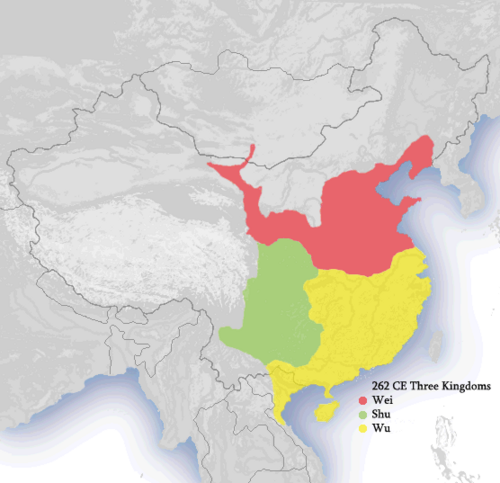
Three leaders came out on top. Cao Cao controlled the emperor and the rich north. Liu Bei, who said he was a distant relative of the emperors, built a state in the mountains of the west. Sun Quan ruled the rivers and lakes of the south-east. After the last Han emperor gave up his throne in 220, each of their families had its own emperor. We call these three states Wei, Shu and Wu — the Three Kingdoms.
The most famous battle was at the Red Cliffs on the Yangtze River in 208. Sun Quan’s and Liu Bei’s fleets set fire to Cao Cao’s ships and stopped him from conquering the south. Later the clever minister Zhuge Liang led the army of Shu again and again against Wei, but he could never win a final victory.
In the end none of the three won. A family of Wei generals called the Sima took over Wei, conquered Shu, started a new dynasty called Jin, and conquered Wu in 280. China was one country again. Centuries later a long novel, the Romance of the Three Kingdoms, turned these wars into adventure stories that people in China, Korea, Japan and Vietnam still read, watch and play today — but the novel adds many things that did not really happen.
At a glance
- Period
- 184 (Yellow Turban Rebellion) to 280 (Jin conquest of Wu); the Three Kingdoms proper from 220 to 280
- Place
- The territory of the Han empire: northern and central China, Sichuan, the Yangtze valley and the south, with campaigns into Liaodong, Yunnan and the steppe frontier
- Main powers
- Cao Cao and his heirs (Cao Wei, 220–266), Liu Bei and his heirs (Shu Han, 221–263), Sun Quan and his heirs (Eastern Wu, 229–280), and finally the Sima family’s Jin dynasty
- Key battles
- Guandu (200), Red Cliffs (208), Tong Pass (211), Hanzhong (217–219), Fancheng (219), Xiaoting/Yiling (221–222), Zhuge Liang’s northern expeditions (228–234), conquest of Shu (263), conquest of Wu (279–280)
- Human cost
- Registered population fell from about 56.5 million (Han census of the 150s) to about 16.2 million (Jin census of 280); historians debate how much of this was death and how much was people dropping off the tax rolls
- Main sources
- Chen Shou’s Records of the Three Kingdoms (late 3rd century) with Pei Songzhi’s commentary (429); the Book of the Later Han; Sima Guang’s Zizhi Tongjian (1084)
- Famous retelling
- Romance of the Three Kingdoms, a 14th-century novel attributed to Luo Guanzhong, “seven parts fact and three parts fiction”
The war day by day
Press play to follow the campaign on the map. Markers are battles and events; arrows are recorded marches.
Phases
A religious mass rising across eastern China was put down within the year by imperial armies, but it left the provinces armed and the court weakened.
Yellow Turban Rebellion (English Wikipedia)黃巾之亂 (Chinese Wikipedia)sxtwl — Chinese calendar library (Shouxing tianwenli) used for lunar-date conversion
Latest events
Playback shows what the sources confirm up to each date — it does not mean something happened every day. Dates known only to the month or year are shown as periods; dashed arrows only link two confirmed points.
Easy
What were the wars of the Three Kingdoms?
The wars of the Three Kingdoms is a name for almost a hundred years of fighting in China, from the Yellow Turban Rebellion of 184 to the reunification of the country in 280. During this time the Han dynasty, which had ruled China for about four hundred years, lost control, and the country split into pieces ruled by generals and local strongmen.
Out of these many warlords, three states survived. Wei held the north, with the old capital Luoyang. Shu (also called Shu Han) held Sichuan in the west, with its capital at Chengdu. Wu held the lands along the lower and middle Yangtze River, with its capital at Jianye, today’s Nanjing. For about sixty years there were three emperors at once, each claiming to be the rightful ruler of all China.
Historians count the ‘Three Kingdoms period’ proper from 220, when the last Han emperor gave up his throne, to 280. But the story everyone knows begins earlier, with the collapse of the Han, the rise of Cao Cao, Liu Bei and Sun Quan, and the great battles of Guandu and Red Cliffs. This page follows that whole arc.
Easy
A broken empire: why the Han fell apart
By the 180s the Han court was weak. Emperors came to the throne as children, and real power passed back and forth between the families of empresses and the palace eunuchs, the servants who lived inside the palace. Officials who protested were purged. Meanwhile floods, epidemics and heavy taxes pushed many farmers into poverty or into the service of rich landowners.
In 184 a religious movement called the Way of Great Peace, led by Zhang Jue, rose in revolt across eastern China. The rebels promised that a new ‘yellow heaven’ would replace the old one. The court raised armies and defeated the main rebel forces within the year, but to do so it let provincial governors and generals build up their own troops.
When Emperor Ling died in 189, the regent He Jin tried to destroy the eunuchs and was murdered by them. In the chaos the frontier general Dong Zhuo marched into Luoyang, deposed the young emperor and put the boy Liu Xie (Emperor Xian) on the throne. The governors of the east formed a coalition against Dong Zhuo, who burned Luoyang and moved the court to Chang’an. From then on the emperor was a prize to be captured, and the empire belonged to whoever had the strongest army.
Easy
The main people
Cao Cao (155–220) was a tough, practical general and a talented poet. In 196 he took the emperor under his protection at Xu, which let him give orders in the emperor’s name. He defeated his great rival Yuan Shao, united northern China, and became King of Wei, but he never took the title of emperor himself. He also wrote the oldest surviving commentary on Sunzi’s Art of War.
Liu Bei (161–223) spent most of his life losing: he served one warlord after another and was driven out of every base he held. But he was famous for loyalty and for attracting brave followers such as Guan Yu, Zhang Fei and Zhao Yun, and the brilliant adviser Zhuge Liang. In the 210s he finally won Sichuan and Hanzhong and in 221 declared himself emperor, claiming to continue the Han.
Sun Quan (182–252) inherited the lands south of the Yangtze from his father Sun Jian and his brother Sun Ce. A careful and flexible ruler, he allied with Liu Bei against Cao Cao, then with Cao Cao against Liu Bei, whichever kept his state safe. He declared himself emperor of Wu in 229.
Zhuge Liang (181–234) became chancellor of Shu after Liu Bei’s death and ran the state for his son Liu Shan. He was an able administrator and a cautious commander. In later legend he became a near-magical genius, but the historical Zhuge Liang is admired above all for honesty and hard work.
Intermediate
From the Yellow Turbans to Guandu (184–207)
The 190s were the age of the warlords. Yuan Shao, head of one of the most distinguished families of the empire, won control of the north-east after defeating Gongsun Zan at Jieqiao and finally at Yijing (199). Yuan Shu held the Huai region and even proclaimed himself emperor in 197, a move that isolated him. Sun Jian was killed in 191 fighting Liu Biao, the governor of Jing Province, and his son Sun Ce conquered the lower Yangtze. Dong Zhuo was assassinated in Chang’an in 192, and his officers fought over the capital until the emperor escaped east.
Cao Cao built his power in Yan Province. His invasions of Xu Province in 193–194, in revenge for his father’s murder, included massacres of civilians that the sources record plainly. While he was away, his officers invited Lü Bu into Yan, and Cao Cao nearly lost everything. He recovered, took Emperor Xian to Xu in 196, set up military farming colonies (tuntian) to feed his armies, and destroyed Lü Bu at Xiapi in 198–199.
The decisive clash came in 200 at Guandu, on the Yellow River plain. Yuan Shao’s army was much larger, and for months Cao Cao held a fortified line while running short of food. When the Yuan adviser Xu You defected, Cao Cao led a night raid that burned Yuan Shao’s supply depot at Wuchao, and the Yuan army collapsed. Yuan Shao died in 202; Cao Cao exploited the quarrels of his sons, took their capital Ye in 204, and in 207 crossed the mountains to defeat their Wuhuan allies at White Wolf Mountain. By 208 all of northern China was his.
Intermediate
Red Cliffs: history and the novel
In the autumn of 208 Cao Cao marched south to Jing Province. Liu Biao died, his son surrendered without a fight, and Cao Cao’s cavalry caught Liu Bei’s fleeing column at Changban. Liu Bei escaped to Xiakou and sent Zhuge Liang to Sun Quan. Cao Cao wrote to Sun Quan claiming an army of 800,000; Sun Quan’s commander Zhou Yu estimated its real size at about 230,000, many of them unreliable troops from Jing, and argued for resistance. Sun Quan agreed, and about 50,000 allied troops met Cao Cao on the Yangtze that winter.
According to the historical accounts, after a first skirmish Cao Cao pulled back to Wulin on the north bank, where his ships were fastened together. Zhou Yu’s officer Huang Gai sent a false letter of surrender, then sailed a squadron of boats loaded with dry reeds and oil towards Cao Cao’s fleet and set them alight. The fire spread to the camps on shore. Cao Cao retreated through marshland along the Huarong road, losing many men to mud, hunger and disease — the sources suggest an epidemic had already weakened his army.
The Romance of the Three Kingdoms turns this into a contest of genius. In the novel Zhuge Liang ‘borrows’ 100,000 arrows by sending straw-covered boats into the fog, calls up the south-east wind with a ritual at an altar, and Guan Yu lets Cao Cao escape at Huarong out of gratitude. None of these episodes appears in the Records of the Three Kingdoms; the novel also gives Zhuge Liang credit that the histories give to Zhou Yu, Huang Gai and Lu Su. The historical battle was a victory of the Sun army, with Liu Bei’s forces as partners.
Even the place is uncertain. Several sites along the Yangtze claim to be ‘the’ Red Cliffs. Most scholars favour a stretch of river south-west of modern Wuhan, and the town of Puqi there was renamed Chibi (‘Red Cliffs’) City in 1998. The ‘Red Cliffs’ at Huangzhou, made famous by the Song poet Su Shi, are generally thought to be the wrong place.
Intermediate
Three states take shape (208–223)
After Red Cliffs the allies divided Jing Province, the rich middle Yangtze region. Liu Bei then accepted an invitation from Liu Zhang, the governor of Yi Province (Sichuan), to help against Zhang Lu in Hanzhong, and instead turned on his host. After a year-long siege of Luo, in which his adviser Pang Tong was killed, Liu Bei took Chengdu in 214. Cao Cao meanwhile crushed Ma Chao and the north-western warlords at Tong Pass (211) and took Hanzhong from Zhang Lu (215). Between 217 and 219 Liu Bei fought him for Hanzhong; his general Huang Zhong killed Cao Cao’s commander Xiahou Yuan at Mount Dingjun, and Cao Cao withdrew.
In 219 Guan Yu, who held Jing for Liu Bei, attacked Cao Ren at Fancheng. Autumn floods on the Han River drowned the relief army and Yu Jin surrendered; for a moment Cao Cao considered moving the capital. But Sun Quan, alarmed by Guan Yu’s power and angry over Jing, secretly allied with Cao Cao. His general Lü Meng hid soldiers in boats disguised as merchant ships, took the river posts and received the surrender of Jiangling. Guan Yu was trapped, captured and executed at the end of 219. Jing Province now belonged to Wu.
Cao Cao died in early 220. His son Cao Pi forced Emperor Xian to abdicate later that year, ending the Han and founding Wei. Liu Bei proclaimed himself emperor in 221 and marched down the Yangtze to take revenge on Wu. In 222 the young Wu commander Lu Xun waited out the summer, then burned Liu Bei’s long line of camps at Xiaoting (Yiling). Liu Bei died at Baidi in 223, and Zhuge Liang, ruling for Liu Shan, restored the alliance with Wu. Sun Quan took the title of emperor in 229. The map of three states was now fixed for a generation.
Intermediate
Zhuge Liang’s expeditions and the long stalemate (225–262)
Shu was the smallest of the three states. Zhuge Liang first secured its southern frontier in 225, campaigning among the peoples of Nanzhong (today’s Yunnan and Guizhou). Then, from 228 to 234, he led five expeditions north through the Qinling mountains. The first came closest to success: three Wei commanderies went over to him, but his general Ma Su was defeated at Jieting and the army had to retreat. Later campaigns besieged Chencang, defeated Wei forces near Mount Qi, and used new transport devices, the ‘wooden oxen’ and ‘flowing horses’, to carry grain over mountain roads.
Wei’s answer was patience. Sima Yi, who commanded against Zhuge Liang from 231, refused battle and let supply problems do the work. On the last expedition in 234 the two armies faced each other for months on the Wuzhang Plains beside the Wei River, until Zhuge Liang fell ill and died in camp. His successor in the field, Jiang Wei, launched many further campaigns with little gain, and Wu’s offensives against Hefei in the east failed just as often.
The real change happened inside Wei. Sima Yi destroyed Gongsun Yuan in Liaodong in 238 and in 249 seized power in a coup while the regent Cao Shuang was visiting the imperial tombs at Gaoping. Rebellions against the Sima at Shouchun in the 250s were put down, and a Wei emperor who tried to fight back, Cao Mao, was killed in 260. By the 260s Wei was a Sima state in all but name.
Intermediate
The end: conquest of Shu and Wu (263–280)
In 263 Sima Zhao sent three armies against Shu. Zhong Hui’s main force took Hanzhong but was stopped by Jiang Wei at the mountain pass of Jiange. Deng Ai then led a small force along a mountain path from Yinping, through country with no roads, and came out behind the Shu defences. Zhuge Liang’s son and grandson died at Mianzhu, and the emperor Liu Shan surrendered Chengdu. An attempted revolt by Zhong Hui with Jiang Wei in early 264 ended with both men killed.
In 266 Sima Zhao’s son Sima Yan made the last Wei emperor abdicate and founded the Jin dynasty. Wu, under its harsh last ruler Sun Hao, held out for another fourteen years behind the Yangtze. In the winter of 279 Jin launched six armies along the whole frontier, while a great fleet built in Sichuan under Wang Jun sailed down the Yangtze, burning through the iron chains that Wu had strung across the gorges. In the spring of 280 Wang Jun reached Jianye and Sun Hao surrendered.
The cost was enormous. The last Han census, in the 150s, registered about 56.5 million people; the Jin census of 280 counted about 16.2 million. Historians agree the real fall was smaller than these numbers suggest, because many people had escaped registration by working for great landowners or by moving south, but war, famine and epidemic clearly killed very many. The sources describe cities destroyed, whole districts emptied, and massacres such as Cao Cao’s in Xu Province in 193–194.
Intermediate
How the wars were fought
Geography shaped every campaign. The north had cavalry country, big cities and most of the people. Wu’s strength was the Yangtze: its navy made the great river a moat, and the fortresses at Ruxu, Dongxing and Jiangling guarded the crossings. Shu sat behind mountains; the few roads through the Qinling range and the gorges of the Yangtze were easy to defend but hard to attack out of. This is why Wei took sixty years to conquer the south, and why both Zhuge Liang’s and Wei’s invasions of each other so often ended in retreat.
Supply was usually the deciding factor. Armies of tens of thousands had to be fed over long distances. Cao Cao’s military farming colonies, in which soldiers and settlers grew grain on state land, became a model copied by all three states. Many battles — Guandu, Chencang, Mount Qi, Wuzhang — turned on grain depots, supply lines or the simple fact that food ran out.
Soldiers were increasingly hereditary. Families registered as military households provided troops generation after generation, and generals often led private followings loyal to themselves. All three states also recruited non-Chinese peoples: Wuhuan and Xianbei cavalry in the north, the Shanyue hill peoples in Wu, and the peoples of Nanzhong in Shu. Numbers in the sources, such as Cao Cao’s claim of 800,000 men in 208, should be read as propaganda or rough guesses rather than counts.
Intermediate
Memory across East Asia
Stories about the Three Kingdoms were told by storytellers and on stage for centuries. A printed popular version, the Sanguozhi Pinghua, appeared in the 1320s. The great novel Romance of the Three Kingdoms, attributed to Luo Guanzhong, was first printed in 1522, and in the 1660s Mao Lun and Mao Zonggang produced the 120-chapter version most people read today. The novel favours Liu Bei and Zhuge Liang as heroes and paints Cao Cao as a cunning villain.
Guan Yu became a god. Worshipped as a symbol of loyalty and righteousness, he was honoured by merchants, soldiers and secret societies across China. In Korea, the Guan Yu shrine Dongmyo in Seoul was built in 1599–1601 at the request of Ming China, whose troops had brought the cult during the war against Japan’s invasions; Korean officials at first found it an unwelcome burden, and it became part of state ritual only in the 18th century.
In Korea the novel, known as Samgukji, and in Japan, where it was retold by Yoshikawa Eiji and others, the story has been adapted again and again into novels, comics, television dramas and video games. For Korean and Japanese history the period matters for another reason too: the Records of the Three Kingdoms contains the earliest detailed Chinese descriptions of Goguryeo, Buyeo, the Samhan and the Wa, including Queen Himiko, who sent envoys to Wei in 238 or 239.
Advanced
The sources and their problems
The core source is the Records of the Three Kingdoms (Sanguozhi) by Chen Shou (233–297), a former Shu official who wrote under Jin. It is short and mostly made of biographies, arranged in separate books for Wei, Shu and Wu; only the Wei rulers receive imperial annals. Chen Shou drew on earlier histories of Wei and Wu, while for Shu, which kept no comparable official history, he collected material himself. In 429 Pei Songzhi added a commentary quoting dozens of other works, many now lost, which makes the combined text about three times as long. Much of the colourful detail people remember — and many contradictions — comes from Pei’s quotations rather than from Chen Shou.
Later historians rearranged this material. The Book of the Later Han (5th century) covers the Han side of the story, and Sima Guang’s Zizhi Tongjian (completed 1084) wove all the sources into a single year-by-year narrative, choosing between conflicting versions and explaining some choices in a separate critical study. Modern accounts in Chinese, Korean, Japanese and Western languages usually follow the Zizhi Tongjian’s chronology; in English Rafe de Crespigny’s annotated translations and his biography of Cao Cao are standard.
Dating is a real problem. The sources give dates by reign era, lunar month and sometimes a sexagenary day name. Converting them to Western dates needs tables of the historical Chinese calendar, and the three states did not always use the same calendar: Wu adopted its own from 223, and Wei briefly renumbered its months in 237–239. The sources also disagree with each other. Red Cliffs, for example, is placed in the 10th month by the Zizhi Tongjian but in the 12th month in Cao Cao’s annals, which is why the battle is usually dated only to ‘winter 208’.
Advanced
Debates: legitimacy, numbers and the novel
The oldest debate is about legitimacy. Chen Shou, writing for Jin, which had inherited its throne from Wei, treated Wei as the legitimate successor of Han. Xi Zuochi in the 4th century argued instead for Shu, because Liu Bei was a member of the Han imperial clan. Sima Guang used Wei’s era names for convenience while saying none of the three had truly held the Mandate of Heaven; the Neo-Confucian Zhu Xi rejected this and made Shu the legitimate line. Zhu Xi’s view, attractive to a Southern Song dynasty that had itself lost the north, shaped popular storytelling and the novel.
A second debate concerns scale. The census figures and army sizes in the sources cannot be taken at face value. Registered population measured who paid tax, not who was alive, and armies reported round and often inflated figures. Historians therefore argue both about how catastrophic the demographic collapse was and about how large the armies at Guandu or Red Cliffs really were; most modern estimates are far lower than the figures in the novel.
Finally there is the relationship between history and fiction. The Qing historian Zhang Xuecheng famously called the novel ‘seven parts fact and three parts fiction’. Modern scholarship studies the novel as a literary work shaped by Ming values, and its image of Cao Cao as a villain has been challenged since the 20th century by writers and historians who stress his achievements as a unifier, administrator and poet. At the same time, the popularity of the novel means that for most readers in East Asia the ‘Three Kingdoms’ is as much a story as a period of history, and historians often have to explain what the sources actually say.
Key ideas
- Collapse from the centre
- The Han did not fall to foreign invaders; it broke apart when court feuds, rebellion and armed governors destroyed central authority.
- Holding the emperor
- Controlling Emperor Xian let Cao Cao issue orders in the name of the dynasty — legitimacy as a weapon.
- Geography and logistics
- The Yangtze, the Qinling mountains and the problem of feeding armies explain why the three states lasted so long.
- Shifting alliances
- Wu and Shu allied against Wei, fought each other over Jing Province, and allied again; no friendship outlasted interest.
- The Sima takeover
- The war was not won by any of the three founders’ families but by a family of Wei generals who took over from inside.
- Human cost
- Massacres, famine and epidemic, together with the breakdown of registration, produced one of the largest recorded population falls in Chinese history.
- History versus Romance
- The novel transformed the period into a moral drama; reading the Records of the Three Kingdoms shows a more complex and less heroic picture.
Records
- 184 CE — Yellow Turban Rebellion breaks out across eastern China.
- 189 CE — Dong Zhuo seizes Luoyang and installs Emperor Xian.
- 190 CE — Eastern coalition forms against Dong Zhuo; Luoyang is burned and the court moved to Chang’an.
- 196 CE — Cao Cao takes Emperor Xian to Xu.
- 200 CE — Cao Cao defeats Yuan Shao at Guandu.
- 208 CE — Battle of Red Cliffs: Sun Quan and Liu Bei defeat Cao Cao on the Yangtze.
- 214 CE — Liu Bei takes Chengdu and Yi Province.
- 219 CE — Liu Bei wins Hanzhong; Wu seizes Jing Province and executes Guan Yu.
- 220 CE — Cao Pi ends the Han dynasty and founds Wei.
- 222 CE — Lu Xun defeats Liu Bei at Xiaoting (Yiling).
- 234 CE — Zhuge Liang dies at the Wuzhang Plains during his last northern expedition.
- 249 CE — Sima Yi’s coup at the Gaoping Tombs gives his family control of Wei.
- 263 CE — Wei conquers Shu; Liu Shan surrenders.
- 280 CE — Jin conquers Wu; China is reunited.
Glossary
- Han dynasty
- The ruling house of China from 202 BCE to 220 CE (with a short break); its later part, from 25 CE, is called Eastern or Later Han.
- Warlord
- A general or governor who controls territory and troops on his own account, obeying the central government only in name.
- Yellow Turbans
- Followers of Zhang Jue’s Way of Great Peace who rebelled in 184, wearing yellow headcloths.
- Cao Wei
- The state founded by Cao Pi in 220 in northern China, with its capital at Luoyang; replaced by Jin in 266.
- Shu Han
- The state founded by Liu Bei in 221 in Sichuan, with its capital at Chengdu; conquered by Wei in 263.
- Eastern Wu
- The state of the Sun family in the Yangtze valley and south, with capitals at Wuchang and Jianye; its ruler became emperor in 229; conquered by Jin in 280.
- Jin dynasty
- The dynasty founded by Sima Yan in 266, which reunited China in 280.
- Tuntian
- Military farming colonies in which soldiers or settlers farmed state land to supply the army.
- Records of the Three Kingdoms
- Sanguozhi, the official history of the period by Chen Shou, with Pei Songzhi’s 5th-century commentary.
- Romance of the Three Kingdoms
- Sanguo yanyi, the 14th-century historical novel attributed to Luo Guanzhong, based on the histories and on popular legend.
- Mandate of Heaven
- The traditional Chinese idea that Heaven grants the right to rule to a worthy dynasty and withdraws it from an unworthy one.
Questions and answers
Were the Three Kingdoms really kingdoms?
Not exactly. Each state was ruled by someone who claimed to be emperor of all China. ‘Three Kingdoms’ is a traditional name, from the title of Chen Shou’s history.
Who won?
None of the three founding families. The Sima family took over Wei from inside, conquered Shu in 263, founded the Jin dynasty in 266 and conquered Wu in 280.
Did Zhuge Liang really borrow arrows and call up the east wind at Red Cliffs?
No. Those episodes come from the novel and earlier legends. In the histories, the fire attack was planned by Zhou Yu’s officer Huang Gai, and Zhuge Liang’s role was mainly as Liu Bei’s envoy to Sun Quan.
Why did Shu keep attacking Wei if it was so much smaller?
Liu Bei’s state claimed to be the continuation of the Han, so it could not accept Wei as a legitimate equal. Strategically, Zhuge Liang may also have believed that waiting would only let Wei’s larger resources grow.
How many people died?
No one knows. Registered population fell from about 56.5 million to about 16.2 million, but part of the decline reflects people leaving the tax registers rather than dying. Historians agree the loss of life was nevertheless very great.
Why is the Records of the Three Kingdoms important for Korean and Japanese history?
Its chapter on the peoples of the north-east gives the earliest detailed accounts of Goguryeo, Buyeo, the Samhan and the Wa, including Queen Himiko of Yamatai.
How reliable are the dates?
Years are usually secure and months often recorded, but the sources sometimes disagree, and converting Chinese lunar dates to Western ones requires historical calendar tables; exact days are known only for some events.
Sources and further reading
- Three Kingdoms. Wikipedia
- End of the Han dynasty. Wikipedia
- Battle of Red Cliffs. Wikipedia
- Records of the Three Kingdoms. Wikipedia
- Romance of the Three Kingdoms. Wikipedia
- Zizhi Tongjian. Wikipedia
- Dongmyo. Wikipedia
- 삼국 시대 (중국). 위키백과
- 삼국지연의. 위키백과
- Rafe de Crespigny, Imperial Warlord: A Biography of Cao Cao 155–220 AD. Brill, 2010
Related
- The Art of WarAn early Chinese treatise on warfare traditionally attributed to Sunzi; its authorship and date are debated.
- Sima QianA Han dynasty historian who compiled the Records of the Grand Historian, a broad history of the ancient Chinese world.
- Zhang HengEastern Han astronomer, inventor and poet who built the earliest recorded seismoscope and a water-powered armillary sphere.
- Cai LunAn Eastern Han court official traditionally credited with presenting an improved method of making paper in 105 CE.
Written with AI assistance from the published sources listed above, and revised as new research appears.