Start at the top for an easy introduction. Go further down for more detail and scholarship.
- Easy
- Intermediate
- Advanced
For young readers
About 1,400 years ago, Japan was ruled by a woman, Empress Suiko. She had a helper from her own family: her nephew, Prince Umayado. Later people gave him a grand title, Shōtoku Taishi, which means something like “Crown Prince of Holy Virtue”.
The prince loved Buddhism, a religion that had come to Japan from Korea not long before. His teacher was a monk from Goguryeo, a kingdom in what is now northern Korea and north-east China. Temples he is said to have founded, like Hōryū-ji, still stand today, and some of their wooden buildings are among the oldest in the world.
The prince is famous for seventeen rules for the people who worked in the government. The very first rule says that harmony — getting along and talking things through — is the most precious thing. Other rules tell officials to be fair, not to take bribes and to work hard from early morning.
He is also remembered for sending messengers across the sea to China, which was then a huge empire ruled by the Sui family. One letter began, “The Son of Heaven where the sun rises writes to the Son of Heaven where the sun sets.” The Chinese emperor was not pleased: he thought only he could be called the Son of Heaven!
There are so many wonderful stories about the prince — that he could listen to ten people speaking at once, for example — that some historians wonder which parts really happened. That is part of what makes him interesting: we learn not only about him, but about how people build heroes.
At a glance
- Lived
- 574 – 622 (death date from the Hōryū-ji Shaka Triad inscription; the Nihon Shoki gives 621)
- Personal name
- Umayado (厩戸), often called Umayado no Ōji or Umayado-ō; “Shōtoku” is a later honorific
- Family
- Son of Emperor Yōmei and Princess Anahobe no Hashihito; nephew of Empress Suiko; linked by marriage and descent to the Soga clan
- Role
- Traditionally regent and crown prince under Empress Suiko from 593, sharing power with the chief minister Soga no Umako
- Measures attributed to him
- Twelve cap ranks (603), Seventeen-Article Constitution (604), embassies to Sui China (600?, 607, 608), temple building, a court history (620)
- Temples linked with him
- Shitennō-ji (Osaka), Hōryū-ji (Ikaruga), Chūgū-ji and others
- Main sources
- Nihon Shoki (720); Book of Sui (636); Hōryū-ji inscriptions; Tenjukoku embroidery; Jōgū Shōtoku Hōō Teisetsu
- Debate
- His real achievements are disputed: some scholars see an idealised figure shaped in the 8th century
Easy
Who was Prince Shōtoku?
Prince Shōtoku is one of the best-known figures in early Japanese history. He was a member of the royal family of Yamato, the kingdom in central Japan whose rulers later took the title tennō (emperor). His personal name was Umayado, “stable door” — a later legend says he was born beside a stable. The name Shōtoku, “holy virtue”, was given to him after his death, and by the eighth century it had become the usual way to refer to him.
According to the Nihon Shoki (Chronicles of Japan), a court history completed in 720, his aunt Suiko became ruler in 593 and made the prince her crown prince and gave him charge of government. He shared that power with Soga no Umako, the most powerful minister of the time and a relative of both Suiko and the prince. The Chronicles credit the prince with a series of reforms: new court ranks, a set of moral rules for officials, diplomatic missions to China and the building of Buddhist temples.
Because he stands at the start of so many things — Japanese Buddhism, written law, relations with a unified China — Shōtoku became a national symbol. His image appeared on Japanese banknotes for much of the twentieth century, and many schools and temples are named after him. At the same time, modern historians have looked closely at the evidence and asked how much of his reputation was built by later writers.
Easy
Japan around the year 600
Around 600, Japan was not yet a single state with fixed borders and a bureaucracy. The Yamato king was the leader of an alliance of powerful clans (uji), each with its own lands, dependants and hereditary titles (kabane). Great mound tombs (kofun) built over the previous three centuries show how much wealth and labour these leaders could command.
The royal court was in the Asuka basin, south of modern Nara. Many skilled people there — scribes, builders, metalworkers, potters and monks — were immigrants or descendants of immigrants from the Korean peninsula and China. Writing itself, in Chinese characters, came through these contacts.
The biggest recent change was Buddhism. Around the middle of the sixth century the king of Baekje, a kingdom in south-western Korea, had sent Buddhist images and scriptures to Yamato. The court argued over whether to accept this foreign faith: the Soga clan supported it, while the Mononobe and Nakatomi clans opposed it. In 587 the Soga and their allies — the young Umayado among them, according to the Chronicles — defeated the Mononobe in battle. From then on, Buddhism enjoyed royal support, and the first great temple, Asuka-dera, was built by Soga no Umako.
Easy
A Buddhist prince and his Korean teachers
The Nihon Shoki says that the prince studied Buddhism with Hyeja (Eji in Japanese), a monk from the Korean kingdom of Goguryeo, and studied the Chinese classics with a scholar named Kakka (Kakuka). Hyeja arrived in 595 and lived for about twenty years in Japan, staying at Asuka-dera together with Hyechong (Eso), a monk from Baekje, before returning home in 615. The Korean government’s historical database presents these entries as a clear example of cultural diplomacy between Goguryeo and Yamato.
The prince is said to have lectured on Buddhist sutras to the empress, and three commentaries on sutras — the Sangyō Gisho, on the Lotus, Vimalakīrti and Śrīmālā sutras — are traditionally attributed to him. Whether he wrote them himself, compiled them with his teachers, or whether they were imported from China is one of the questions scholars still discuss.
Temples linked with him include Shitennō-ji, the “Temple of the Four Heavenly Kings” in Osaka, said to have been vowed during the battle of 587, and Hōryū-ji at Ikaruga, founded in 607 next to his own palace. Hōryū-ji burned in 670, according to the Chronicles, and was rebuilt a little later; its main hall and pagoda are among the oldest surviving wooden buildings on earth. Tree-ring dating shows that the timber of the pagoda’s central pillar was cut in 594.
Intermediate
Twelve cap ranks and the Seventeen-Article Constitution
In 603, according to the Chronicles, the court created a system of twelve cap ranks. Officials wore silk caps whose colours showed their rank; the ranks were named after six virtues — virtue, benevolence, propriety, sincerity, justice and knowledge — each divided into greater and lesser. Unlike the old hereditary kabane titles, a rank was given to an individual and could be raised. Ono no Imoko, the envoy to China, is the famous example: he rose to the highest rank after his missions. The ranks did not, however, apply to the very top: the Soga leaders stood outside the system. The model was continental — historians compare it with rank systems in Goguryeo, Baekje and China — and it was replaced by a new system in 647.
In 604, the Chronicles say, the prince himself wrote seventeen articles. They are called a “constitution” (kenpō), but they are not a legal code with penalties. They are moral instructions for officials. Article 1 makes harmony (wa) the highest value and asks people to discuss matters calmly. Article 2 tells everyone to revere the Three Treasures — the Buddha, the Dharma (teaching) and the Sangha (community of monks). Article 3 says that when an imperial command is received it must be obeyed, comparing the ruler to heaven and the subjects to earth.
Later articles ask judges to decide lawsuits without taking bribes, officials to come to court early and leave late, and provincial authorities not to levy their own taxes on the people, because the country has only one sovereign. Article 16 says that people should be called up for labour only in seasons when farming is not disturbed, and Article 17 advises that important matters should not be decided by one person alone but discussed with many.
The text is a mixture of ideas. It uses Confucian language about ruler and subject, Buddhist ideas about human weakness and compassion, and phrases that echo Chinese classics and statecraft writings. It sketches a picture of a centralised state in which officials serve one sovereign rather than their own clans — a picture that would only become reality decades later.
Intermediate
“Where the sun rises”: embassies to Sui China
In 589 the Sui dynasty reunited China after nearly three centuries of division. For every state in East Asia this was a shock: a single, powerful empire now stood on the continent. Goguryeo, Baekje and Silla all sent envoys, and so did Yamato.
The first Japanese embassy, in 600, is recorded only in the Chinese Book of Sui, not in the Nihon Shoki. The Book of Sui says that the Wa king, called Ame no Tarishihoko, sent envoys, and that Emperor Wen thought their description of how the king ruled made little sense. In 607 a second embassy, led by Ono no Imoko, brought a letter that began: “The Son of Heaven in the land where the sun rises sends a letter to the Son of Heaven in the land where the sun sets.” Emperor Yang was displeased, because in the Chinese world order there could be only one Son of Heaven. Even so, he sent an envoy, Pei Shiqing, back to Japan with Imoko in 608.
When Imoko returned to China later in 608, he took students and monks with him, including Takamuko no Kuromaro (Genri), Minabuchi no Shōan and the monk Min (Sōmin). Some stayed in China for decades, lived through the fall of Sui and the rise of Tang, and came home with first-hand knowledge of Chinese government. Several of them became advisers in the Taika Reform after 645 — one of the clearest links between Shōtoku’s age and the later Japanese state.
The letter of 607 is also famous because it describes Japan as the land “where the sun rises”, an idea later expressed in the name Nihon (“origin of the sun”). Scholars debate whether the letter was meant as a claim to equality with China, as clumsy diplomacy, or as a Buddhist turn of phrase, but it shows the Yamato court trying to define its own place in a new international order.
Intermediate
Meanwhile in the world
Shōtoku’s life fits inside one of the great turning points of Eurasian history. On the Korean peninsula, Goguryeo fought off huge Sui invasions in 598, 612 and later; the disastrous campaign of 612, when a Sui army was destroyed at the Salsu river, helped to bring down the Sui dynasty itself. Goguryeo’s choice to send Hyeja to Yamato in 595 makes more sense in this light: a kingdom facing a giant empire had good reasons to make friends across the sea. Baekje and Silla, meanwhile, were fighting each other for the Han river valley, and each looked for allies in Japan and China.
In China, the Sui built the Grand Canal and reorganised government, including the first examinations for officials, before collapsing in 618. The Tang dynasty that followed would become the model that Japan copied most closely after Shōtoku’s death. In northern India, King Harsha ruled a large kingdom from 606, and the monastic university of Nalanda was at its height; Chinese pilgrims would soon travel there to collect scriptures.
Further west, the year 622 — when Shōtoku died — is also the year of the Hijra, when the Prophet Muhammad and his followers moved from Mecca to Medina, the event from which the Islamic calendar is counted. The Byzantine emperor Heraclius and the Sasanian king Khosrow II were locked in the last great war between Rome and Persia, which would leave both empires exhausted just before the Arab conquests. In England, the rich ship burial at Sutton Hoo was laid in the ground in roughly the same decades, and in Europe Pope Gregory the Great (590–604) sent missionaries to the Anglo-Saxons in 597.
Seen together, these events show a common pattern: rulers across Eurasia were using universal religions — Buddhism, Christianity and soon Islam — and written law to hold together larger states. Shōtoku’s combination of Buddhist piety and rules for officials is one East Asian version of that story.
Intermediate
Later years, death and the Soga
In 601 the prince began building a palace at Ikaruga, some 20 km north-west of Asuka, and he seems to have moved there by 605. This put him close to the Yamato river route to Naniwa (Osaka) and the sea, and Hōryū-ji grew up beside the palace. In 620, the Chronicles say, he and Soga no Umako compiled histories of the rulers and the country (Tennōki and Kokki), which have not survived.
The prince died in early 622, according to the inscription on the back of the bronze Shaka Triad at Hōryū-ji, made the following year by the sculptor Tori. The Nihon Shoki places his death in 621. A large embroidered curtain, the Tenjukoku Shūchō, fragments of which survive at Chūgū-ji, was made by his widow to show the prince in the “Land of Heavenly Long Life” after death. Hyeja, back in Goguryeo, is said to have vowed to die on the same day the following year.
The prince never became ruler. After Suiko died in 628, the Soga dominated the succession. In 643 Soga no Iruka attacked the prince’s son, Prince Yamashiro no Ōe, at Ikaruga, and Yamashiro and his family took their own lives. Two years later Iruka himself was killed in the coup of 645 that opened the Taika Reform. The fate of the prince’s line helped later writers to portray Shōtoku as a virtuous figure destroyed by an arrogant clan.
Advanced
What do the sources really tell us?
Almost everything about Shōtoku comes from the Nihon Shoki, compiled nearly a century after his death by a court that had its own reasons to celebrate a wise Buddhist prince and a strong ruling house. The Chronicles mix record with legend — the prince speaking at birth, hearing ten petitioners at once, meeting a starving beggar who turned out to be a sage. Other early sources exist: inscriptions on Buddhist images at Hōryū-ji, the Tenjukoku embroidery, the Jōgū Shōtoku Hōō Teisetsu (a biography whose earliest parts may be old but whose surviving text is later), and the Chinese Book of Sui. Each has problems of date and authenticity.
Doubts are old. In the early twentieth century the historian Tsuda Sōkichi argued that the Seventeen-Article Constitution and the sutra commentaries were probably not the prince’s own work. Readers of the constitution have pointed to words and ideas — for example references to provincial officials (kuni no mikotomochi) and a strongly centralised state — that seem better suited to the late seventh century than to 604.
In 1999 Ōyama Seiichi went further, arguing that “Shōtoku Taishi” as a saintly founder was largely created during the compilation of the Nihon Shoki, even though a real Prince Umayado existed. This “fabrication theory” provoked a wide debate. Critics defended the early date of some inscriptions and the plausibility of the reforms. According to the scholar Ishii Kōsei, writing in 2021, articles actively supporting Ōyama’s thesis had largely stopped appearing in academic journals for over a decade. Most specialists now accept that Umayado was a real and important royal politician, while treating the specific achievements credited to him with caution.
A further issue is the Book of Sui itself. It calls the Wa ruler of 600 a king with a male-sounding name and mentions a wife, although the Japanese sovereign at the time was the female Suiko. Some historians think the Chinese account mistook the prince, or Soga no Umako, for the king; others think it reflects how Yamato presented its monarchy abroad. The mismatch reminds us that Chinese and Japanese sources were each written for their own audiences.
Advanced
Different perspectives
In modern Japan, Shōtoku has been read in very different ways. Before 1945 he could be presented as a model imperial servant and the founder of a Japanese spirit of harmony; after the war, Article 1 on harmony was often cited as an early expression of consensus and peaceful government. Popular Buddhism made him a saint: from the Heian and Kamakura periods, a “cult of the Prince” (Taishi shinkō) treated him as an incarnation of the bodhisattva Kannon, and founders such as Shinran revered him.
Japanese historians have argued, as seen above, about whether the reforms were his, Soga no Umako’s, or later projections. This debate reached schools in 2017, when the Ministry of Education’s draft curriculum proposed writing “Umayado-ō (Prince Shōtoku)” to reflect scholarship. After public comments objecting that the familiar name should be kept, the ministry went back to “Prince Shōtoku” within a month. The episode showed how a question of evidence can also be a question of national identity.
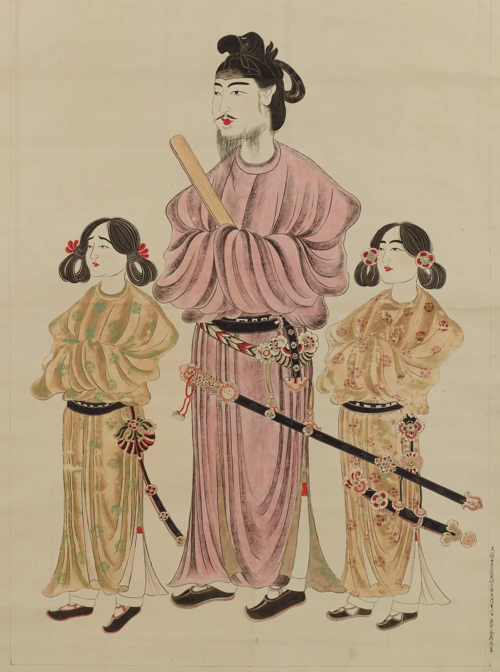
Korean scholarship and popular history tend to emphasise the peninsular side of the story: his Buddhist teacher Hyeja came from Goguryeo; Baekje monks, craftsmen and scholars built the temples of Asuka; and a famous portrait of the prince once kept at Hōryū-ji has traditionally been attributed to Prince Aja of Baekje, although that attribution is not proven. From this angle Shōtoku’s Japan appears as part of a shared Korean–Japanese Buddhist world rather than as an isolated beginning.
Chinese sources frame the embassies within the tributary order: the Book of Sui records Wa as a distant country that sent envoys and offered gifts, and records Emperor Yang’s irritation at the “Son of Heaven” letter. Modern Chinese historians generally treat the missions as part of the spread of Sui–Tang civilisation across East Asia. None of these perspectives is simply wrong; each highlights a different part of the evidence, and reading them together gives the fullest picture.
Advanced
Legacy: from Asuka to the ritsuryō state
Whatever his personal role, the reign of Suiko marks the moment when Yamato began deliberately to borrow Chinese-style institutions — ranks, written instructions for officials, a court calendar, histories and state-sponsored Buddhism — often through Korean intermediaries. The next steps were the Taika Reform after 645, which announced public ownership of land and people, and the Taihō Code of 701, which created a full ritsuryō state on the Tang model.
Hōryū-ji is his most tangible legacy. Rebuilt after the fire of 670, it preserves the architecture and sculpture of the Asuka and early Nara periods: the Shaka Triad of 623 in a style related to Northern Wei and Korean Buddhist sculpture, the Tamamushi Shrine, and the Yumedono (Hall of Dreams), an octagonal hall built in 739 on the site of the prince’s Ikaruga palace. In 1993 the Buddhist monuments of the Hōryū-ji area became Japan’s first UNESCO World Heritage site.
Shōtoku’s story is therefore two stories at once. One is about a real prince at the court of Asuka, living in a world transformed by Sui China, Korean Buddhism and clan rivalry. The other is about how later generations — eighth-century historians, medieval devotees, modern nationalists, post-war educators and today’s researchers — kept reshaping his memory to answer their own questions.
Key ideas
- Harmony (wa)
- The value placed first in the Seventeen-Article Constitution: officials should avoid factional quarrels and settle matters by calm discussion.
- Three Treasures
- The Buddha, his teaching (Dharma) and the monastic community (Sangha); Article 2 asks all people to revere them.
- One sovereign
- The constitution insists that the country has only one ruler, a principle that challenged the independent power of clans and local chiefs.
- Rank by merit
- The twelve cap ranks were given to individuals and could be raised, unlike hereditary clan titles.
- Equal diplomacy?
- The 607 letter addressed the Sui emperor as a fellow “Son of Heaven”, a phrasing that has been read as a claim to equal status.
- Korean mediation
- Buddhism, temple building and learning reached Yamato largely through Baekje and Goguryeo monks, craftsmen and scholars.
- Hero-making
- Later chronicles and cults turned a royal politician into a saintly founder, which is why historians distinguish Umayado from “Shōtoku Taishi”.
Records
- 574 CE — Birth of Prince Umayado, son of the future Emperor Yōmei.
- 587 CE — The Soga and their allies defeat the Mononobe; Buddhism gains royal backing.
- 589 CE — The Sui dynasty reunites China.
- 593 CE — Suiko becomes ruler; the Nihon Shoki says Umayado is made crown prince and given charge of government.
- 595 CE — The Goguryeo monk Hyeja arrives and becomes the prince’s Buddhist teacher.
- 600 CE — First embassy from Wa to Sui, recorded only in the Book of Sui.
- 601 CE — Construction of the Ikaruga palace begins.
- 603 CE — Twelve cap ranks are established.
- 604 CE — The Seventeen-Article Constitution, according to the Nihon Shoki.
- 607 CE — Ono no Imoko carries the “where the sun rises” letter to Sui; Hōryū-ji is founded.
- 608 CE — Pei Shiqing visits Japan; students and monks leave for China.
- 622 CE — Death of the prince (621 in the Nihon Shoki); the Hijra takes place in Arabia the same year.
Glossary
- Yamato
- The kingdom centred in the Nara basin whose rulers became the emperors of Japan.
- Wa
- The name Chinese and Korean sources used for Japan and its people before “Nihon” came into use.
- Uji and kabane
- Clans and the hereditary titles that ranked them at the Yamato court.
- Regent
- Someone who governs on behalf of a ruler; here, the traditional description of the prince’s role under Suiko.
- Nihon Shoki
- The Chronicles of Japan, an official history in Chinese completed in 720, the main source for this period.
- Book of Sui
- The official Chinese history of the Sui dynasty, completed in 636, which includes an account of Wa.
- Sangyō Gisho
- Commentaries on three Buddhist sutras traditionally attributed to the prince.
- Ritsuryō
- A system of penal (ritsu) and administrative (ryō) codes on the Chinese model, adopted in Japan in the late 7th and early 8th centuries.
- Taishi shinkō
- The religious cult of Prince Shōtoku that developed in later centuries.
Questions and answers
Was Prince Shōtoku ever emperor?
No. He was crown prince and, according to the Chronicles, ran the government for his aunt, Empress Suiko, but he died before her.
Could he really listen to ten people at once?
That is a legend meant to show his wisdom. Stories like this are one reason historians read the sources about him carefully.
Did he really write the Seventeen-Article Constitution?
The Nihon Shoki says so, but since the early 20th century some scholars have argued that the text was written or revised later. The question is still open.
Why is he connected with Korea?
His Buddhist teacher Hyeja came from Goguryeo, and monks and craftsmen from Baekje built the temples of his time. Buddhism itself reached Japan through Baekje.
Why did the Sui emperor dislike the 607 letter?
It called the Japanese ruler “Son of Heaven”, a title the Chinese emperor claimed for himself alone.
Is the ‘fabrication theory’ accepted?
Not in its strong form. Most scholars accept that Prince Umayado existed and mattered politically, while doubting that every reform credited to him was his personal work.
What survives from his time?
Parts of Hōryū-ji’s buildings (rebuilt soon after 670), the Shaka Triad of 623, fragments of the Tenjukoku embroidery and several other Buddhist images and inscriptions.
Sources and further reading
- Prince Shōtoku. Wikipedia
- 聖徳太子. Wikipedia (Japanese)
- 쇼토쿠 태자. Wikipedia (Korean)
- 쇼토쿠 태자의 스승 혜자 (Hyeja, teacher of Prince Shōtoku). National Institute of Korean History, 사료로 본 한국사
- Seventeen-article constitution. Wikipedia
- The Constitution of Prince Shōtoku (adapted from W. G. Aston’s translation). Asia for Educators, Columbia University
- Japanese missions to Sui China. Wikipedia
- 遣隋使. Wikipedia (Japanese)
- Twelve Level Cap and Rank System. Wikipedia
- Hōryū-ji. Wikipedia
- Buddhism in Japan. Wikipedia
- About Asuka-Fujiwara: component properties. Ancient Capitals of Asuka and Fujiwara Council
- W. G. Aston (trans.), Nihongi: Chronicles of Japan from the Earliest Times to A.D. 697. Kegan Paul, Trench, Trübner (Japan Society of London), 1896
- Wm. Theodore de Bary, Donald Keene, George Tanabe and Paul Varley (eds.), Sources of Japanese Tradition, Volume 1 (2nd ed.). Columbia University Press, 2001
Related
- Hōryū-jiA Buddhist temple complex in Japan traditionally founded in 607 CE and home to some of the world's oldest surviving wooden buildings.
- Asuka-deraJapan’s first full-scale Buddhist temple, built in 588–596 by Soga no Umako with craftsmen sent from Baekje; its bronze Great Buddha still sits on the original spot.
- Taika ReformA programme of political reforms launched after the palace coup of 645, which aimed to turn Japan’s alliance of powerful clans into a centralised state on the model of Tang China.
- Imperial examinationChina's system of written civil service examinations, begun under the Sui around 605 and abolished in 1905, which chose officials by tested learning rather than birth.
- Goguryeo–Sui WarsFour failed invasions of the Korean kingdom of Goguryeo by the Chinese Sui dynasty in 598 and 612–614; their cost helped bring down the Sui in 618.
- MuhammadThe Prophet of Islam, whom Muslims believe to be the last messenger of God. Born in Mecca, he founded the Muslim community in Medina after the Hijra of 622.
Written with AI assistance from the published sources listed above, and revised as new research appears.