Start at the top for an easy introduction. Go further down for more detail and scholarship.
- Easy
- Intermediate
- Advanced
For young readers
About 1,600 years ago, the north of the Korean peninsula and part of what is now northeast China belonged to a kingdom called Goguryeo. When a boy named Damdeok became its king at just eighteen years old, Goguryeo had recently lost a war and its king before him had been killed in battle. Damdeok wanted to make his kingdom strong again.
He spent almost his whole reign on the move with his armies. He fought the kingdom of Baekje to the south, horse-riding peoples to the west and north, and even sent a huge army to help the kingdom of Silla when it was attacked. Because his lands grew so much, people later called him Gwanggaeto, which means “the one who widely opened up the land”.
He died when he was only thirty-nine. Two years later his son put up an enormous stone pillar near his tomb. It is more than six metres tall, taller than three grown-ups standing on each other’s shoulders, and covered on all four sides with about 1,775 Chinese characters.
The stone tells an old story about how Goguryeo began, lists the king’s battles year by year, and ends with rules about the families who had to look after his tomb for ever. It is like a giant stone report card that the king’s family wrote about him, so historians read it carefully and remember that it only tells one side.
Today the stone stands inside a glass pavilion in the city of Ji’an in China, close to the border with North Korea. People from Korea, China and Japan all study it, and sometimes they argue about what a few damaged words really say.
At a glance
- Reign
- 391–412 according to his stele (the 12th-century Samguk sagi gives 392–413)
- Personal name
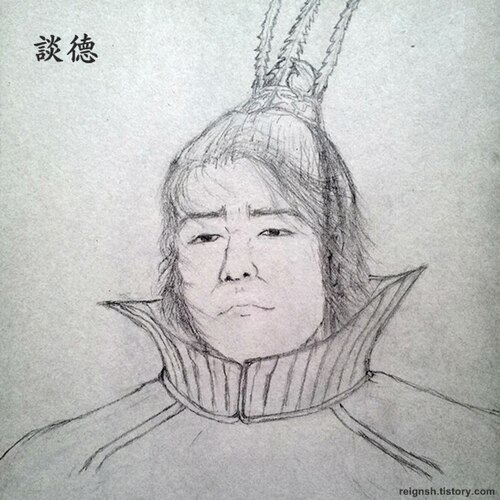
- Damdeok (談德)
- Full title on stele
- Gukgangsang Gwanggaetogyeong Pyeongan Hotaewang (國岡上廣開土境平安好太王), usually shortened to Hotaewang, “Good Great King”
- Reign era
- Yeongnak (永樂, “Eternal Joy”), one of the earliest known era names used by a Korean state
- Capital
- Gungnae (國內城), in the Tonggou basin by the Yalu River, modern Ji’an, Jilin, China
- Main campaigns
- Against the Khitan (395), Baekje (396), the Sushen (398), a rescue of Silla from Wa and allied attackers (400), Wa raiders (404), Later Yan in Liaodong, and Eastern Buyeo (410)
- Memorial
- The Gwanggaeto Stele (414), about 6.39 m tall with about 1,775 characters, erected by his son King Jangsu
- World Heritage
- The stele and royal tombs of Ji’an are part of UNESCO’s “Capitals and Tombs of the Ancient Koguryo Kingdom” (2004)
Easy
Who was Gwanggaeto?
Gwanggaeto was the nineteenth ruler of Goguryeo, one of the three kingdoms that shared the Korean peninsula and southern Manchuria in the first centuries CE, together with Baekje in the south-west and Silla in the south-east. His personal name was Damdeok. He was born in 374 and, according to the stone monument set up after his death, he came to the throne in 391 at the age of eighteen.
The name Gwanggaeto is not really a name but a description. It is a shortened form of a long title written on his monument, which can be translated roughly as “the king buried at Gukgangsang, who widely opened up the territory and brought peace and security, the good great king”. Koreans today usually call him Gwanggaeto Daewang, “Gwanggaeto the Great”.
His reign lasted only about twenty-one years, but it changed the map of north-east Asia. Goguryeo pushed into the Liaodong region west of the Yalu River, defeated Baekje, placed Silla under its protection and conquered peoples to the north and north-east. His son and successor Jangsu built on these gains and ruled for almost eighty years.
Almost everything we know about Gwanggaeto’s deeds comes from two kinds of writing: a stone inscription made by his own family two years after his death, and history books written in China and Korea centuries later. Reading these sources side by side, and noticing where they disagree, is part of what makes him interesting to historians.
Easy
What did he do?
Gwanggaeto is remembered as a warrior king. When he became king, Goguryeo was still recovering from a disaster: in 371 the Baekje army had killed his grandfather, King Gogugwon, in battle at Pyongyang. The young king set out to reverse that humiliation.
His monument lists campaigns in almost every direction. In the west he fought the Khitan, a people living along the Liao River. In the south he attacked Baekje and, in 396, forced its king to surrender and swear loyalty. In 400 he sent a large army of infantry and cavalry, fifty thousand soldiers according to the stele, to help Silla, whose lands had been overrun by warriors from Wa (the islands of Japan) and their allies. In the north-east he marched against the Sushen and the kingdom of Eastern Buyeo.
Not every change was about war. Chinese-style writing, Buddhism and a state school had recently arrived in Goguryeo under his uncle, King Sosurim, and Korean records say Gwanggaeto founded nine Buddhist temples at Pyongyang in 393. His family also took care to record rules for the households that looked after royal tombs, which shows a growing, organised government.
By the end of his reign the stele claims he had captured 64 walled towns and about 1,400 villages. We should read such numbers as the proud boasts of a royal monument, but they show what Goguryeo’s rulers wanted people to believe about their king.
Easy
The giant stone that tells his story
In 414 King Jangsu erected a huge stone pillar near his father’s tomb in the Tonggou basin by the Yalu River. It is a natural, roughly shaped block of volcanic stone (Korean and Japanese reference works describe it as tuff or tuff breccia), about 6.39 metres high and between about 1.35 and 2 metres wide on each side. Characters were carved into all four faces in 44 vertical lines, about 1,775 in total, in a style close to Chinese clerical script.
The text has three parts. The first tells the origin legend of Goguryeo: its founder Chumo was the son of the Heavenly Emperor and the daughter of a river god, and he crossed a river on a bridge of turtles and fish to found the kingdom. The second part lists Gwanggaeto’s campaigns year by year. The third part names 330 households, drawn from both old Goguryeo people and newly conquered peoples, whose duty was to guard and maintain the royal tombs, and forbids anyone to buy or sell them.
After Goguryeo fell in 668, the region became a borderland and the stele was forgotten for more than a thousand years. It was rediscovered in the late nineteenth century when the Qing government reopened the area to settlement. Today it stands in a protective glass pavilion in Ji’an, Jilin Province, China, and is part of a UNESCO World Heritage Site.
Intermediate
Goguryeo before Gwanggaeto: defeat and reform
Goguryeo had grown since the first century BCE from a confederation of mountain peoples along the middle Yalu into a powerful kingdom, but the fourth century brought crises. In 342 the Former Yan, a state founded by the Murong branch of the Xianbei, sacked the Goguryeo capital. In 371 King Geunchogo of Baekje, at the height of Baekje’s power, invaded the north and King Gogugwon was killed defending Pyongyang.
The response under Gogugwon’s son, King Sosurim (r. 371–384), was a programme of reform. In 372 Buddhism was officially received from the Former Qin, the northern Chinese state then dominating the region, and a national academy, the Taehak, was founded to teach the Confucian classics to aristocratic youths. In 373 Goguryeo issued written laws. These measures strengthened the throne and gave the aristocracy a shared education and religion. Gwanggaeto’s father, King Gogugyang, reigned briefly after Sosurim.
Gwanggaeto therefore inherited a state that had rebuilt its institutions but not yet its prestige. China had been divided since the early fourth century between short-lived northern states ruled by steppe and Tibetan-speaking dynasties and the Eastern Jin in the south. When the Former Qin collapsed after its defeat at the Fei River in 383, Liaodong and the northern frontier became a contested zone between Goguryeo and the revived Murong state of Later Yan. This fluid situation gave an ambitious king room to expand.
Intermediate
The campaigns, year by year
The stele dates events by the reign era Yeongnak, counting from 391. In Yeongnak 5 (395) the king personally led an attack on the Baili, a Khitan group on the Liao River, and returned with livestock and captives. In Yeongnak 6 (396) he led a naval and land campaign against Baekje, which the stele calls by the insulting name Baekjan, “Baekje remnants”. The inscription claims the capture of 58 walled towns and 700 villages; the Baekje king surrendered, handed over a thousand men and women and ten of his brothers and ministers as hostages, and swore to be Goguryeo’s “slave” for ever.
In Yeongnak 8 (398) a force was sent against the Sushen in the north-east. In Yeongnak 9 (399), the stele says, Baekje broke its oath and made an alliance with Wa, and Silla sent word that Wa troops filled its lands. In Yeongnak 10 (400) Gwanggaeto sent 50,000 infantry and cavalry south; they drove the Wa forces out of Silla and pursued them to a fortress in the Gaya region at the southern tip of the peninsula. In Yeongnak 14 (404) Wa forces who had entered the old Daebang region (around modern Hwanghae Province) were routed at sea and on land.
In Yeongnak 17 (407) the stele records a great victory in which some ten thousand suits of armour were captured, though the enemy is lost in a damaged passage. In Yeongnak 20 (410) the king marched against Eastern Buyeo, which had stopped paying tribute, and received its submission. Summing up, the stele claims 64 walled towns and 1,400 villages taken during the reign.
The stele says little about the west, but Chinese histories record fighting between Goguryeo and Later Yan around 400–407, including a Yan attack on Goguryeo’s western fortresses and Goguryeo counter-attacks. By the end of this period Goguryeo controlled Liaodong, a rich agricultural plain that it would hold until the seventh century and defend against the Sui and Tang empires.
Intermediate
The rescue of Silla and the southern peninsula
The expedition of 400 had consequences far beyond one campaign. Silla, still a small kingdom centred on the Gyeongju basin, came under strong Goguryeo influence for much of the fifth century. Korean records say Silla sent princes as hostages to Goguryeo, and Goguryeo objects appear in Silla tombs of this period.
One striking object is a bronze bowl found in 1946 in the Houchong tomb in Gyeongju. Its base carries sixteen characters that read, in effect, “Year eulmyo, the vessel of King Gukgangsang Gwanggaeto Hotaewang, number ten”. The year corresponds to 415, one year after the stele was erected, and the bowl was probably made for a memorial rite for the dead king. It ended up in a Silla tomb built in the early sixth century, a century later: a physical trace of how closely Silla’s elite was tied to Goguryeo.
For the Gaya polities on the southern coast, the campaign of 400 is often seen as a turning point. Many historians connect the decline of Geumgwan Gaya (at modern Gimhae), the leading Gaya state until then, with the Goguryeo pursuit to “Imna-Gara” mentioned on the stele, after which leadership among the Gaya states shifted inland to Dae Gaya at Goryeong. The exact scale of the damage is debated.
The stele’s picture of the Wa as frequent invaders also raises questions about Japan in this period. The islands were in the Kofun period of great keyhole-shaped tombs, and their elites depended on iron and technology from the peninsula. Whether the “Wa” of the stele were armies sent by a central ruler in the Kinai region, warriors from western Japan, or mixed forces including peninsular allies is one of the problems discussed in the advanced sections below.
Intermediate
A Great King under Heaven: titles, era names and tomb keepers
The stele shows how Goguryeo’s rulers saw themselves. The king is called taewang, “great king”, and the founder is presented as the son of Heaven’s ruler. The use of a reign era, Yeongnak, rather than the era names of a Chinese emperor, signals that Goguryeo claimed its own place at the centre of a world order: neighbouring peoples are described as its subjects who came to pay tribute. Historians describe this as Goguryeo’s own “world view” or tianxia, modelled on, but independent of, Chinese imperial ideas.
At the same time, Goguryeo kings accepted titles from Chinese courts when it suited them diplomatically. This double stance, using Chinese forms of kingship at home while bargaining with Chinese states abroad, was common among East Asian kingdoms and is important for the later historiographical debates.
The final third of the inscription, about the tomb-keeping households, reads almost like a legal document. It explains that earlier kings had drawn the guardians only from old Goguryeo people, that Gwanggaeto had ordered conquered peoples to be used as well, and that the households were divided into 30 “state households” and 300 “watch households”. It also bans the buying and selling of these people. For social historians this is one of the most valuable parts of the stele, showing how Goguryeo organised labour and absorbed conquered communities.
Where exactly Gwanggaeto was buried is less certain than the stele’s location suggests. Two great stepped stone tombs nearby have been proposed: the Taewangneung (“Tomb of the Great King”), where a brick reading “May the tomb of the Great King be as secure as a mountain” was found in 1913, and the better-preserved Janggunchong (“General’s Tomb”). A bronze bell inscribed with the year sinmyo and the title Hotaewang was later found at the Taewangneung, and most scholars now favour it as Gwanggaeto’s tomb, though not all agree.
Intermediate
Meanwhile in the world
Gwanggaeto’s reign, 391–412, coincided with some of the most famous turning points in world history. In the Roman world, Emperor Theodosius I banned public pagan sacrifice in 391–392, and after his death in 395 the empire was divided for good between his sons in the East and the West. In 410, two years before Gwanggaeto died, the Visigoths under Alaric sacked the city of Rome. Augustine of Hippo, who had written his Confessions around 397–400, responded to that shock with The City of God.
In India the Gupta Empire was at its height under Chandragupta II (r. c. 375–415). Between 399 and 412, almost exactly the years of Gwanggaeto’s reign, the Chinese monk Faxian travelled overland from Chang’an to India, studied and collected Buddhist texts, and returned by sea via Sri Lanka. His travel record is a key source for Gupta India. Later Indian tradition places the poet Kalidasa at the court of a king Vikramaditya, often identified with Chandragupta II.
In China the same years saw the rise of the Northern Wei, founded in 386 by the Tuoba Xianbei, which would reunify northern China and later become Goguryeo’s main neighbour. The great translator Kumārajīva arrived in Chang’an in 401 and produced the Chinese versions of Buddhist scriptures that Korean and Japanese monks would read for centuries. Buddhism, which had reached Goguryeo in 372, was thus spreading along the same routes that armies and envoys used.
Far away in the Americas, the Maya city of Tikal had in 378 experienced the arrival of a powerful stranger linked to Teotihuacan, and a new dynasty with central Mexican connections ruled it through Gwanggaeto’s lifetime. Across Eurasia and beyond, the late fourth and early fifth centuries were an age when empires broke apart, new kingdoms formed on their edges and universal religions travelled with merchants and monks. Goguryeo’s expansion is one East Asian version of that pattern.
Intermediate
After Gwanggaeto: Jangsu, Pyongyang and modern memory
His son Jangsu (r. 413–491) inherited a large and confident kingdom. In 427 he moved the capital south to Pyongyang, closer to the peninsula’s farmland and to the rival kingdoms. In 475 Goguryeo captured Hanseong, the Baekje capital near modern Seoul, and killed the Baekje king, forcing Baekje to move south to Ungjin (Gongju). Silla and Baekje drew together in an alliance against Goguryeo. The balance of power that Gwanggaeto created thus shaped the next two centuries of peninsular politics.
In Korean memory Gwanggaeto became a symbol of a time when a Korean kingdom ruled wide lands in Manchuria. In the twentieth century, under Japanese colonial rule and after liberation, his story was used to encourage national pride. His name has been given to streets, statues and a class of South Korean navy destroyers, and he appears in novels and television dramas. These modern uses tell us more about twentieth- and twenty-first-century concerns than about the fifth century.
For scholars, his lasting legacy is above all the stele: the longest surviving text from any of the three kingdoms, and one of very few contemporary written sources for the history of Goguryeo, Baekje, Silla, Gaya and Wa around the year 400.
Advanced
Rediscovery, rubbings and the lime-coating question
The stele re-entered history in the late nineteenth century, after the Qing lifted its ban on settlement in the region. Local farmers and officials found the monument covered in moss and vines; burning the vegetation in the early 1880s damaged the surface. Local rubbing-makers, notably the Chu family (father and son Chu Tianfu and Chu Junde), produced rubbings for sale. In 1883 the Japanese army officer Sakō Kageaki obtained a copy made by tracing and inking (not a true rubbing) and took it to Japan, where the army general staff studied it and published a reading in 1889.
From around the turn of the twentieth century the rubbing-makers applied lime plaster to the uneven surface so that clearer, more saleable rubbings could be made. This coating altered the visible shapes of some characters. In 1972 the Korean-Japanese historian Lee Jin-hui (Ri Shinki) argued that the Japanese general staff had deliberately coated and altered the stone to strengthen passages about the Wa. His thesis caused a sensation and made the stele a symbol of colonial manipulation of history.
Later research did not support deliberate falsification. The Chinese scholar Wang Jianqun, who studied the stone on site from the late 1970s and published a monograph in 1984, concluded that the lime had been applied by the local rubbing-makers for commercial reasons, not to distort history. In 2006 Xu Jianxin reported comparisons of the earliest surviving rubbings, made before the lime was applied, with Sakō’s copy, and found that the passages about Wa matched. Most specialists in Korea, Japan and China now reject the conspiracy theory, while agreeing that later rubbings must be used with great caution.
Philologically, the key problem is that about 140 or more characters are damaged or illegible. Reconstructions depend on comparing early rubbings of different dates, photographs and the stone itself, and on arguments about grammar and the stele’s internal structure. Several passages, not only the famous “sinmyo year” sentence, therefore allow more than one reading.
Advanced
Different perspectives
The sinmyo passage. One sentence introducing the campaign of 396 reads, in its most common transcription, 百殘新羅舊是屬民由來朝貢而倭以辛卯年來渡海破百殘□□新羅以爲臣民. The traditional reading, established by Japanese scholars from the late nineteenth century, takes the Wa as the subject throughout: “Baekje and Silla were formerly [Goguryeo’s] subject peoples and paid tribute; but in the sinmyo year (391) the Wa came, crossed the sea and defeated Baekje, [..] and Silla, and made them their subjects.” In pre-war Japan this reading was used as evidence for an ancient Japanese dominion over the southern peninsula, the idea later associated with “Mimana Nihonfu”, and it served colonial ideology.
Korean scholars have proposed alternative readings. The historian Jeong In-bo (Chŏng In-bo), whose reading was published in 1955, argued that the subject changes in mid-sentence: the Wa came in 391, and Goguryeo then crossed the sea and defeated them (or Baekje). Others have questioned the reading of individual damaged characters, such as 海 (“sea”), or argued that the passage describes Baekje rather than Wa as the power that subjugated Silla. Most of these alternatives are grammatically possible but depend on characters that cannot be read with certainty.
A third line of interpretation, now common in both Korean and Japanese scholarship, accepts that the text does mention the Wa crossing and defeating Baekje and Silla, but reads the sentence as a preamble written from Goguryeo’s point of view. On this reading the stele exaggerates the Wa threat in order to justify Gwanggaeto’s campaigns and to magnify his victories; it is royal propaganda, not a neutral report. Japanese historians such as Hamada Kōsaku and Nishijima Sadao are among those who emphasised this rhetorical character. This approach does not settle how far Wa forces really operated in the peninsula, a question that archaeologists now approach through the distribution of weapons, armour and keyhole-shaped tombs on both sides of the strait.
Whose history is Goguryeo? A second debate concerns the kingdom as a whole. In Korean historiography Goguryeo is one of the Three Kingdoms of Korean history; the later kingdom of Goryeo took its name from it, and Korea’s English name comes from Goryeo. From 2002 to 2007 the Chinese Academy of Social Sciences ran the government-supported “Northeast Project”, which presented Goguryeo as a regional regime of an ethnic minority within the history of China, on the grounds that most of its territory and early capitals lie in present-day China and that its kings received Chinese titles. Korean scholars and governments objected strongly, arguing that tributary titles did not mean political subordination and that Goguryeo’s language, culture and self-image, visible on the stele itself, place it within Korean history. South Korea founded research bodies, later merged into the Northeast Asian History Foundation (2006), partly in response.
In 2004 UNESCO inscribed both China’s “Capitals and Tombs of the Ancient Koguryo Kingdom”, which includes the stele, and North Korea’s “Complex of Koguryo Tombs”. Many historians outside the two countries argue that projecting modern nation-states back onto a fifth-century kingdom is itself anachronistic: Goguryeo was a multi-ethnic state whose population included Yemaek, Buyeo, Chinese, Xianbei and Mohe peoples, and it belongs to the shared history of north-east Asia. Readers should notice that textbooks in Korea, China and Japan still frame Gwanggaeto and his stele quite differently.
Advanced
Sources and their problems
The stele is a contemporary source, carved within two years of the king’s death, but it is a commemorative text commissioned by his heir. It selects victories, names enemies with contempt and says nothing about defeats. It also uses its own dating: counting from the stele, Gwanggaeto acceded in 391 at 18 and died in 412 at 39.
The Samguk sagi, compiled in 1145 under the Goryeo dynasty, preserves annals of Goguryeo that date his accession to 392 and his death to 413, one year later than the stele, and records events not on the stele, such as the capture of Baekje’s Gwanmi fortress in 392 and fighting with Later Yan. Its compilers drew on Chinese histories and lost Korean records; where it conflicts with the stele, most scholars prefer the stele for dates but use the Samguk sagi for events the stele omits.
Chinese dynastic histories, such as the histories of the Jin and Later Yan period compiled later, give the view from the other side of the Liao frontier and mention Goguryeo mainly in the context of war and diplomacy. Japanese chronicles like the Nihon shoki (720) contain traditions about the peninsula in this period, but their chronology for the fourth and fifth centuries is widely regarded as unreliable and has to be corrected, often by 120 years, before it can be compared with Korean and Chinese evidence.
Archaeology adds an independent check. Objects such as the 415 bronze bowl from Gyeongju, Goguryeo-style goods in Silla tombs, the stepped stone tombs of Ji’an and the fortresses of Liaodong allow historians to test and sometimes correct the written sources. Much of the relevant ground is now divided among China, North Korea and South Korea, which makes shared fieldwork and open access to finds a continuing challenge.
Key ideas
- Taewang (Great King)
- Goguryeo’s royal title on the stele, expressing a claim to rule over surrounding peoples within Goguryeo’s own world order.
- Yeongnak era
- The reign era used to date events on the stele; its use shows Goguryeo’s claim to independent sovereignty.
- Stele as propaganda
- The inscription was written by the king’s heir to glorify him; historians read its victories and enemies critically.
- Sinmyo passage
- A damaged sentence about the Wa in 391 whose reading has been debated between Japanese and Korean scholars for over a century.
- Tomb-keeping households
- The 330 households assigned to guard royal tombs, including conquered peoples, which reveal Goguryeo’s social organisation.
- Contested heritage
- Goguryeo is claimed in different ways by Korean and Chinese national histories, and its monuments lie across modern borders.
Records
- 371 CE — King Gogugwon of Goguryeo is killed at Pyongyang by the Baekje army of King Geunchogo.
- 372 CE — Buddhism is officially received from Former Qin and the Taehak academy is founded under King Sosurim.
- 374 CE — Birth of Damdeok, the future Gwanggaeto.
- 391 CE — Accession of Gwanggaeto at 18, according to the stele (392 in the Samguk sagi); start of the Yeongnak era.
- 396 CE — Campaign against Baekje; the Baekje king surrenders and gives hostages.
- 400 CE — Goguryeo sends 50,000 troops to rescue Silla and pursues Wa forces towards Gaya.
- 404 CE — Wa forces in the old Daebang region are defeated.
- 410 CE — Campaign against Eastern Buyeo.
- 412 CE — Death of Gwanggaeto at 39, according to the stele (413 in the Samguk sagi).
- 414 CE — King Jangsu erects the Gwanggaeto Stele.
- 427 CE — Jangsu moves the capital to Pyongyang.
- 1883 — Sakō Kageaki takes an ink-traced copy of the inscription to Japan.
- 2004 — The stele and Ji’an tombs are inscribed as part of a UNESCO World Heritage Site.
Glossary
- Goguryeo
- A kingdom in southern Manchuria and northern Korea (traditionally 37 BCE–668 CE), one of the Three Kingdoms of Korea.
- Baekje
- A kingdom in south-western Korea, Goguryeo’s main southern rival in Gwanggaeto’s time.
- Silla
- A kingdom in south-eastern Korea centred on Gyeongju, which later unified most of the peninsula.
- Gaya
- A group of small states on the southern coast of Korea, between Baekje and Silla.
- Wa
- The name used in Chinese and Korean sources of this period for the people and polities of the Japanese islands.
- Later Yan
- A state in north-east China (384–407) ruled by the Murong Xianbei, Goguryeo’s western rival.
- Stele
- An upright stone slab or pillar carrying an inscription.
- Rubbing
- A copy of an inscription made by pressing paper onto the stone and dabbing it with ink.
- Era name
- A name for a run of years chosen by a ruler, used for dating events.
Questions and answers
Why is he called “the Great”?
Because his reign greatly expanded Goguryeo’s territory. Koreans later added “Great” (daewang) to honour him; his own title on the stele already praises him as a king who “widely opened up the land”.
How tall is his stone monument?
About 6.39 metres, taller than a two-storey house, with writing on all four sides.
Where is the stele now?
Where it was put up in 414: in Ji’an, Jilin Province, China, near the Yalu River border with North Korea, inside a protective pavilion.
Did Japanese soldiers change the words on the stele?
This was argued in 1972, but later studies of rubbings made before the stone was plastered found that the key passages already read the same way. Most scholars now think local rubbing-makers applied lime to sell clearer copies, not to falsify history.
Why do the stele and the Samguk sagi give different dates?
The Samguk sagi was compiled more than 700 years later and places his reign one year later. Most historians trust the contemporary stele for dates.
Is Goguryeo part of Korean or Chinese history?
Korean historiography treats it as one of Korea’s Three Kingdoms; a Chinese state-supported project (2002–2007) presented it as a regional regime within Chinese history. Many historians see it as part of the shared history of north-east Asia.
Which tomb is Gwanggaeto’s?
Most scholars favour the Taewangneung near the stele, where a bronze bell with the title Hotaewang was found, but the nearby Janggunchong has also been proposed.
Sources and further reading
- 안정준 (Ahn Jeong-jun), 광개토왕릉비 (Gwanggaeto Stele). Encyclopedia of Korean Culture, Academy of Korean Studies
- 태왕릉 (Taewangneung). Encyclopedia of Korean Culture, Academy of Korean Studies
- 정호섭 (Jeong Ho-seop), 광개토왕호우명문 (Inscription on the Gwanggaeto bronze bowl). Encyclopedia of Korean Culture, Academy of Korean Studies
- Gwanggaeto the Great. Wikipedia
- 광개토대왕. Korean Wikipedia
- Gwanggaeto Stele. Wikipedia
- 広開土王碑 (Kōkaido-ō hi). Japanese Wikipedia
- Goguryeo. Wikipedia
- Northeast Project. Wikipedia
- Faxian. Wikipedia
Related
- Goguryeo–Sui WarsFour failed invasions of the Korean kingdom of Goguryeo by the Chinese Sui dynasty in 598 and 612–614; their cost helped bring down the Sui in 618.
- Yeon GaesomunA Goguryeo aristocrat and general who seized power in a coup in 642 and led the kingdom's resistance to the Tang until his death in the mid-660s.
- Gyeongju Historic AreasFive zones of palace grounds, royal tombs, temple sites, carved Buddhas and fortresses preserving the capital of the Silla kingdom, inscribed as a World Heritage property in 2000.
- KālidāsaA Sanskrit poet and playwright whose works are landmarks of classical Indian literature.
- TikalOne of the greatest Classic Maya cities, whose kings raised temple-pyramids up to 70 m high and fought a centuries-long rivalry with Calakmul.
Written with AI assistance from the published sources listed above, and revised as new research appears.